

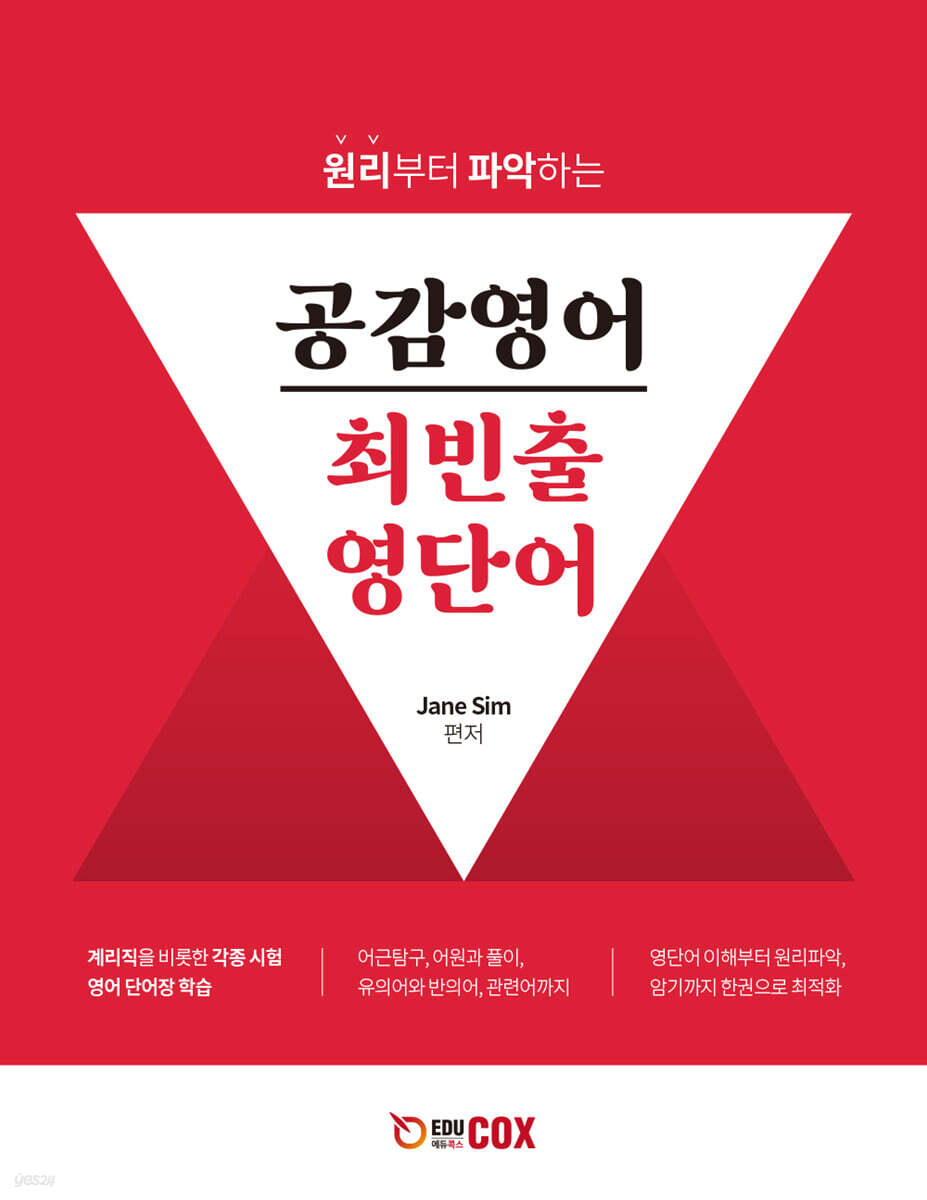
Empathy English Most Frequently Used English Words
 |
Description
Book Introduction
- Complete English vocabulary for accounting exam preparation
- Root research, etymology and interpretation, and related words
- From understanding English words to understanding the principles and memorizing them, all in one book.
- Root research, etymology and interpretation, and related words
- From understanding English words to understanding the principles and memorizing them, all in one book.
- You can preview some of the book's contents.
Preview
index
Ⅰ Direction & Position (Direction, Position, Directional Prefixes) 16
ab/ad | ward | de | di,dis | sub/sup/suc/suf | under | infra | super | sur/su | up | summa | highest | over | tele | hyper | trans,tra | per | dia | circum
Ⅱ Motion & Process (Movement, Progress, Transmission) 58
mov/mot/mo/mei | mit/miss | ject | veni/ven | cede/ceed/cess/scend | gress/grad | cur/curs/cours | port | fer | vec/veh | cast | gest | duc/duce/duct | agogos | trac/tra/tri | volv | volum | pass | cid | pend,pens | vers,vert
Ⅲ Action & Creation 96
ars/art | cap/cept/ceive/cip | take | fac/fic/fect/fy | act/ag | oper | labor | erg | util | use | plic/plec/plo | text | press | strain/strict | sect | tail | cise
Ⅳ Perception & Expression 124
spec/spect/spic | vid/vis/view | ops | dict/dic | fess | log/locu/loqu | cite | claim | clar | graph/gram | scrib/script | mem/monu/mnest | note | sign | trembl | terr | tim | phob | sent,sens,senc | pathos | passio | tort | winc,wr
V Reason & Knowledge 156
gno | disc | sci(o) | solv | mono | log | lect/leg/lig | uni | sol | singul | bi- | multi | vari | du/duo | tri | deca | cent | myriad | milli/mille | kilo | numer | count,conter | putare | ratio | part | ampl | augm | cumul | latus | longus | gros/gross | largus | maximus | megalo | magnus | mini | micro | parcula | littl(e) | metr,mens,meas | par | equ | pani/peer | greg/grex | sym/syn | medi | centr | mod/modul | co/con/com/cor | with | inter | littera
Ⅵ Body & Life 209
bio | body | corp | viv/vit/vi | nutrire | gyn/gene- | nat-/nai | born | manu/man/main | cap/capit | front/frons/for | ped(i)/pod | cor/card/cord | audi | anim | spirit | spir | tact/teg/tang | vox/voc/vok
Ⅶ Nature & Elements 238
terr | aer | aqua | therm | luc | candid | grave | tempor | cycl | circul | phys | chem | techn | machin
Ⅷ Human & Society 249
anthrop | hum | civi | demo | popul | urb | pub/public | pater,patr- | soci | commun | iden | ilc/ilk | habit | here | hosp/host | site,side | abid,abod | custom | cult/culti | phil | ego | self | auto | alter/altr | cura/caus | care | leg | reg/rect | ju/jud/just | crit | deem | norm/nom | odrin/ord | loc | pose/posit | pri/proto | arch | cra | camp
Ⅸ Morality & Value 289
moral | eth/ethic | cred | fid | sanct | testi | bene | amor | eu | favor | grati | mis | fault | mal | vol/volu | fort | potent | firm | vir | soph | preci,pric | val(e) | vail | worth | estim | dignus | undare | vog,woge | flu,fluct | indu | penuria | pauc | pecu | privare | deore | pars,parc | evils
Ⅹ Negation & Contrast 317
anti | contra/counter | ob/oc | in/im | un/in/im/il | non | pre/pro | post | re | ex | extra/extr/e | out | para | para,pare,pere | ambi | be | en/em
? Myth, Symbol & Abstract Concepts (Myths and Symbols) 363
astr | mira | chrono | geo/ge | psych | mort/mor | figure & character | animal | onym | fame | temple & oracle | pha- | plaus/pleas | prob/prov | puni | puls | clin
? Change, Form & Process 388
cre | ori- | rise | caus | effect | result | sequ | secut | pel | form | morph | type | able/ible | mut | st/stan/stat | tain/ten/tin | tend/tens/tent | termi | ceas/cess | fine | claud/clos | nove,nova | vaca/van | pele | flex/flec | frag |
ab/ad | ward | de | di,dis | sub/sup/suc/suf | under | infra | super | sur/su | up | summa | highest | over | tele | hyper | trans,tra | per | dia | circum
Ⅱ Motion & Process (Movement, Progress, Transmission) 58
mov/mot/mo/mei | mit/miss | ject | veni/ven | cede/ceed/cess/scend | gress/grad | cur/curs/cours | port | fer | vec/veh | cast | gest | duc/duce/duct | agogos | trac/tra/tri | volv | volum | pass | cid | pend,pens | vers,vert
Ⅲ Action & Creation 96
ars/art | cap/cept/ceive/cip | take | fac/fic/fect/fy | act/ag | oper | labor | erg | util | use | plic/plec/plo | text | press | strain/strict | sect | tail | cise
Ⅳ Perception & Expression 124
spec/spect/spic | vid/vis/view | ops | dict/dic | fess | log/locu/loqu | cite | claim | clar | graph/gram | scrib/script | mem/monu/mnest | note | sign | trembl | terr | tim | phob | sent,sens,senc | pathos | passio | tort | winc,wr
V Reason & Knowledge 156
gno | disc | sci(o) | solv | mono | log | lect/leg/lig | uni | sol | singul | bi- | multi | vari | du/duo | tri | deca | cent | myriad | milli/mille | kilo | numer | count,conter | putare | ratio | part | ampl | augm | cumul | latus | longus | gros/gross | largus | maximus | megalo | magnus | mini | micro | parcula | littl(e) | metr,mens,meas | par | equ | pani/peer | greg/grex | sym/syn | medi | centr | mod/modul | co/con/com/cor | with | inter | littera
Ⅵ Body & Life 209
bio | body | corp | viv/vit/vi | nutrire | gyn/gene- | nat-/nai | born | manu/man/main | cap/capit | front/frons/for | ped(i)/pod | cor/card/cord | audi | anim | spirit | spir | tact/teg/tang | vox/voc/vok
Ⅶ Nature & Elements 238
terr | aer | aqua | therm | luc | candid | grave | tempor | cycl | circul | phys | chem | techn | machin
Ⅷ Human & Society 249
anthrop | hum | civi | demo | popul | urb | pub/public | pater,patr- | soci | commun | iden | ilc/ilk | habit | here | hosp/host | site,side | abid,abod | custom | cult/culti | phil | ego | self | auto | alter/altr | cura/caus | care | leg | reg/rect | ju/jud/just | crit | deem | norm/nom | odrin/ord | loc | pose/posit | pri/proto | arch | cra | camp
Ⅸ Morality & Value 289
moral | eth/ethic | cred | fid | sanct | testi | bene | amor | eu | favor | grati | mis | fault | mal | vol/volu | fort | potent | firm | vir | soph | preci,pric | val(e) | vail | worth | estim | dignus | undare | vog,woge | flu,fluct | indu | penuria | pauc | pecu | privare | deore | pars,parc | evils
Ⅹ Negation & Contrast 317
anti | contra/counter | ob/oc | in/im | un/in/im/il | non | pre/pro | post | re | ex | extra/extr/e | out | para | para,pare,pere | ambi | be | en/em
? Myth, Symbol & Abstract Concepts (Myths and Symbols) 363
astr | mira | chrono | geo/ge | psych | mort/mor | figure & character | animal | onym | fame | temple & oracle | pha- | plaus/pleas | prob/prov | puni | puls | clin
? Change, Form & Process 388
cre | ori- | rise | caus | effect | result | sequ | secut | pel | form | morph | type | able/ible | mut | st/stan/stat | tain/ten/tin | tend/tens/tent | termi | ceas/cess | fine | claud/clos | nove,nova | vaca/van | pele | flex/flec | frag |
Publisher's Review
[preface]
How can I memorize words better, more easily, and remember them longer?
How do you memorize vocabulary? How effective is your method? For English learners, vocabulary is the most basic and important resource.
We all know that maintaining this resource is the cornerstone for moving on to the next level of learning.
However, no matter how much time and effort you put into memorizing English words, if you can't retrieve them and use them when you need them, it will feel like building a sandcastle in front of a wave.
For the past several hundred years, linguists have been studying the principles of foreign language acquisition and effective learning methods.
As a result, they all came to a common conclusion.
The point is that vocabulary can only be 'acquired' through 'understanding'.
The key to memorizing vocabulary, which was presented as a more efficient and more powerful language tool than the process of 'repetition' that we generally use when memorizing vocabulary, was 'understanding the principle'.
However, many people still believe that they must force themselves to memorize the principles of language by reading and writing blindly, rather than understanding them.
Acquisition through repetition has the fatal flaw of being very short-lived and difficult to apply in real life.
For example, let's think about memorizing the word candent, which was tested on the national exam.
Some people will memorize by writing it down on paper, some will memorize it by reading it out loud, and sometimes they will memorize it by making a vocabulary list or taking tests on themselves.
So, when you think you've memorized the word "candent" a few days or months later, will you be able to immediately recall its meaning? (Actually, memory studies show that after just a month, the probability of recalling the correct answer drops to less than 4%.) If a similar word, "candid," were given, would you be able to infer its meaning?
So, let's compare what it would be like to 'learn through understanding the principles' instead of just memorizing.
The root word cand of candent means 'to shine'.
Therefore, all English words that contain cand- have meanings related to 'light, something bright, something that illuminates.'
Candle is a noun suffix added to the root cand- meaning 'light'.
-ent is an adjectival suffix, so candent means 'shining, incandescent'.
Candidate is a noun that combines the adjective candid with the noun suffix -ate, which indicates a person or state. It originally meant 'a person who shines brightly' and came to mean a person who can be considered qualified to hold an important position or responsibility.
So what does "candid" mean? It means "bright," as seen in "candle" and "candidate." To speak candidly means to "speak openly or honestly," and a candid person is someone who "discloses without concealment or makes fair judgments."
Learning by doing is a powerful learning tool that allows you to memorize vocabulary with the utmost certainty and even to infer unlearned words.
And this book was created for those who want to learn English words more efficiently through principles.
This book includes the most frequently appearing basic English words and antonyms that appear on the exam, to enhance learning efficiency. Among them, words that appear on all sections are marked with a '***' to distinguish them.
Additionally, it helps you memorize words effectively by grouping similar roots by topic.
If you want to utilize this book most effectively, please read the basic vocabulary and root explanations by topic from the beginning 'slowly', 'chew over and understand the content' of the roots, then firmly engrave the content through example sentences and studying synonyms/antonyms, and finally, try studying the related materials provided on the website to understand and draw a memorization map in your head at the same time.
Students enrolled in the paid course will also have the opportunity to 'utilize and check their knowledge' through vocabulary problems provided on the website and at the Gonggam English Cafe.
Even if it's slow and difficult at times, if you persevere and study as I intended, by the end of this book and course, your English foundation will be much more solid, you'll be empowered to improve your vocabulary and reading comprehension, and this will bring positive changes to your life.
Author Jane Sim
How can I memorize words better, more easily, and remember them longer?
How do you memorize vocabulary? How effective is your method? For English learners, vocabulary is the most basic and important resource.
We all know that maintaining this resource is the cornerstone for moving on to the next level of learning.
However, no matter how much time and effort you put into memorizing English words, if you can't retrieve them and use them when you need them, it will feel like building a sandcastle in front of a wave.
For the past several hundred years, linguists have been studying the principles of foreign language acquisition and effective learning methods.
As a result, they all came to a common conclusion.
The point is that vocabulary can only be 'acquired' through 'understanding'.
The key to memorizing vocabulary, which was presented as a more efficient and more powerful language tool than the process of 'repetition' that we generally use when memorizing vocabulary, was 'understanding the principle'.
However, many people still believe that they must force themselves to memorize the principles of language by reading and writing blindly, rather than understanding them.
Acquisition through repetition has the fatal flaw of being very short-lived and difficult to apply in real life.
For example, let's think about memorizing the word candent, which was tested on the national exam.
Some people will memorize by writing it down on paper, some will memorize it by reading it out loud, and sometimes they will memorize it by making a vocabulary list or taking tests on themselves.
So, when you think you've memorized the word "candent" a few days or months later, will you be able to immediately recall its meaning? (Actually, memory studies show that after just a month, the probability of recalling the correct answer drops to less than 4%.) If a similar word, "candid," were given, would you be able to infer its meaning?
So, let's compare what it would be like to 'learn through understanding the principles' instead of just memorizing.
The root word cand of candent means 'to shine'.
Therefore, all English words that contain cand- have meanings related to 'light, something bright, something that illuminates.'
Candle is a noun suffix added to the root cand- meaning 'light'.
-ent is an adjectival suffix, so candent means 'shining, incandescent'.
Candidate is a noun that combines the adjective candid with the noun suffix -ate, which indicates a person or state. It originally meant 'a person who shines brightly' and came to mean a person who can be considered qualified to hold an important position or responsibility.
So what does "candid" mean? It means "bright," as seen in "candle" and "candidate." To speak candidly means to "speak openly or honestly," and a candid person is someone who "discloses without concealment or makes fair judgments."
Learning by doing is a powerful learning tool that allows you to memorize vocabulary with the utmost certainty and even to infer unlearned words.
And this book was created for those who want to learn English words more efficiently through principles.
This book includes the most frequently appearing basic English words and antonyms that appear on the exam, to enhance learning efficiency. Among them, words that appear on all sections are marked with a '***' to distinguish them.
Additionally, it helps you memorize words effectively by grouping similar roots by topic.
If you want to utilize this book most effectively, please read the basic vocabulary and root explanations by topic from the beginning 'slowly', 'chew over and understand the content' of the roots, then firmly engrave the content through example sentences and studying synonyms/antonyms, and finally, try studying the related materials provided on the website to understand and draw a memorization map in your head at the same time.
Students enrolled in the paid course will also have the opportunity to 'utilize and check their knowledge' through vocabulary problems provided on the website and at the Gonggam English Cafe.
Even if it's slow and difficult at times, if you persevere and study as I intended, by the end of this book and course, your English foundation will be much more solid, you'll be empowered to improve your vocabulary and reading comprehension, and this will bring positive changes to your life.
Author Jane Sim
GOODS SPECIFICS
- Date of issue: November 7, 2025
- Page count, weight, size: 424 pages | 170*220*30mm
- ISBN13: 9791193666388
- ISBN10: 1193666384
You may also like
카테고리
korean


korean

![ELLE 엘르 스페셜 에디션 A형 : 12월 [2025]](http://librairie.coreenne.fr/cdn/shop/files/b8e27a3de6c9538896439686c6b0e8fb.jpg?v=1766436872&width=3840)


