

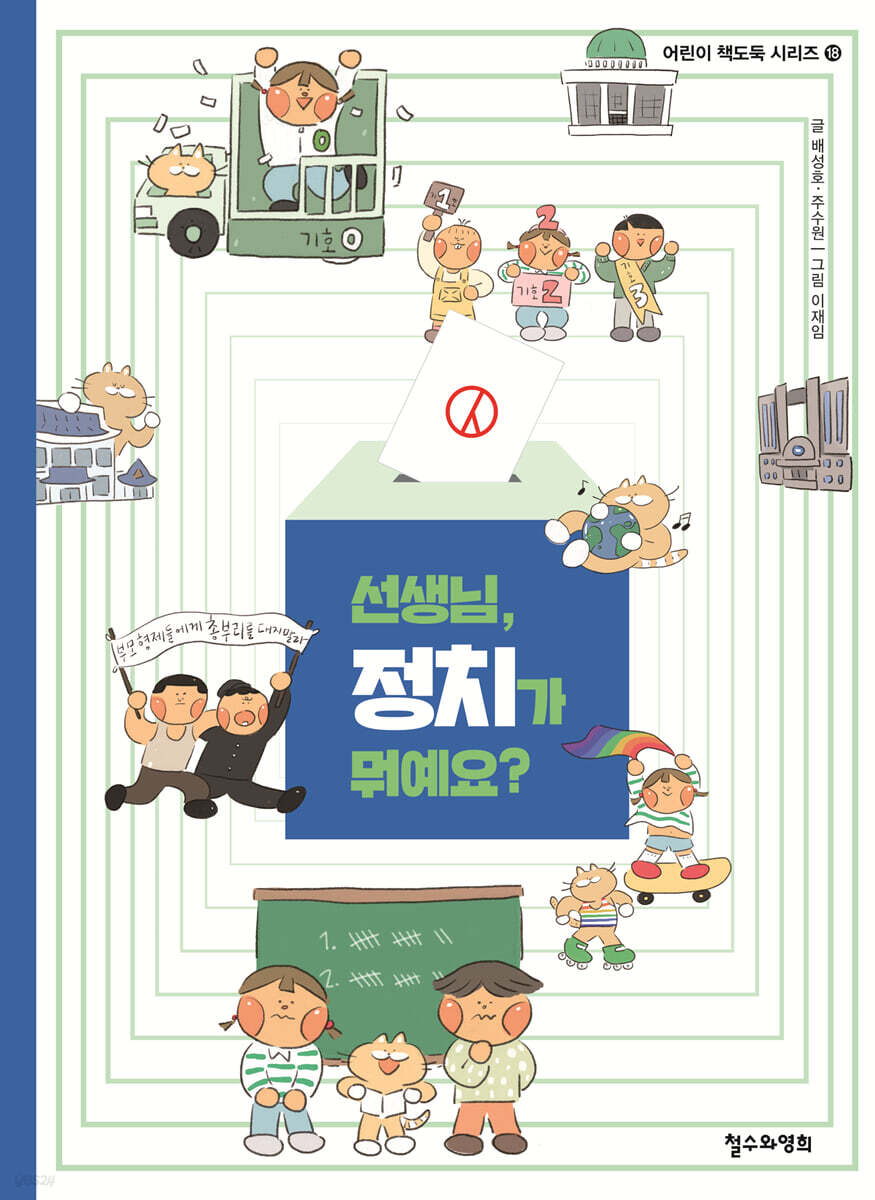
Teacher, what is politics?
 |
Description
Book Introduction
Shall we begin a political journey that will change our lives?
Can children and teenagers also participate in politics?
What is the difference between democracy and dictatorship?
What do political parties, ruling party, and opposition party mean?
The terms left and right come from seating arrangements?
Why did the June Democracy Movement occur?
Can only rich people run for election?
Why do we have rallies and strikes in a democratic society?
This book explains what politics is, why we need to know about it, and what kind of politics is desirable, from a child's perspective, through various topics and cases related to politics, such as democracy, majority rule, elections and voting rights, freedom of the press, and fake news.
Can children and teenagers also participate in politics?
What is the difference between democracy and dictatorship?
What do political parties, ruling party, and opposition party mean?
The terms left and right come from seating arrangements?
Why did the June Democracy Movement occur?
Can only rich people run for election?
Why do we have rallies and strikes in a democratic society?
This book explains what politics is, why we need to know about it, and what kind of politics is desirable, from a child's perspective, through various topics and cases related to politics, such as democracy, majority rule, elections and voting rights, freedom of the press, and fake news.
- You can preview some of the book's contents.
Preview
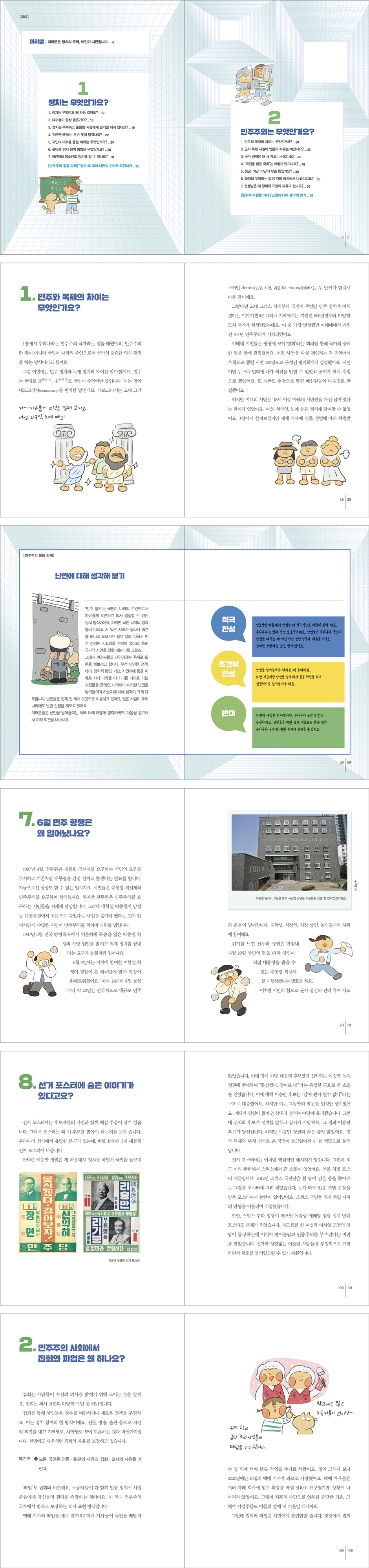
index
Preface : You are the protagonists of politics, young citizens.
Chapter 1.
What is politics?
1.
What is politics and why do we do it?
2.
Is majority rule always right?
3.
Shouldn't politics be left to smart and good people?
4.
What does 'Republic of Korea' mean?
5.
Why do we elect representatives of the people?
6.
What is the right way to participate in politics?
7.
Can children and teenagers also participate in politics?
[Democracy Activity Assignment] Expressing 'Politics' in Your Own Words
Chapter 2.
What is democracy?
1.
What is the difference between democracy and dictatorship?
2.
What was freedom of the press like during the military dictatorship?
3.
Why was state power divided into three?
4.
How do we create a National Assembly that resembles the people?
5.
What do political parties, ruling party, and opposition party mean?
6.
The terms left and right come from seating arrangements?
7.
Teacher, why don't we have freedom of political expression?
[Democracy Activism Assignment] Thinking About Refugees
Chapter 3.
How did you win the right to vote?
1.
The right to vote didn't just appear, did it?
2.
Women didn't have the right to vote?
3.
What does the saying "no taxes, no representation" mean?
4.
Why is there a Black Museum in Washington?
5.
An elementary school student participated in the April 19 Revolution?
6.
During the dictatorship, they elected the president at the gymnasium?
7.
Why did the June Democracy Movement occur?
[Democracy Activity Assignment] Create a Voter Participation Poster
Chapter 4.
Why are elections important?
1.
Can only rich people run for election?
2.
Why are electoral districts determined by law?
3.
What are the electoral district systems?
4.
Why do we vote early?
5.
Is there a history that was changed by one vote?
6.
Which candidate should I vote for?
7.
Why should you be wary of fake news?
8.
Are there hidden stories in election posters?
[Democracy Activity Assignment] Creating a Pledge Scorecard
Chapter 5.
Can children and young people change the world?
1.
Should we protect the environment or develop the region?
2.
Why do we have rallies and strikes in a democratic society?
3.
How can we coexist with diverse cultures?
4.
Why is our country divided into South and North?
5.
Why did the Myanmar incident happen?
6.
Why do we need anti-discrimination laws?
7.
Can children and young people change the world?
[Democracy Activism Assignment] Thinking About Nuclear Power Plants
Chapter 1.
What is politics?
1.
What is politics and why do we do it?
2.
Is majority rule always right?
3.
Shouldn't politics be left to smart and good people?
4.
What does 'Republic of Korea' mean?
5.
Why do we elect representatives of the people?
6.
What is the right way to participate in politics?
7.
Can children and teenagers also participate in politics?
[Democracy Activity Assignment] Expressing 'Politics' in Your Own Words
Chapter 2.
What is democracy?
1.
What is the difference between democracy and dictatorship?
2.
What was freedom of the press like during the military dictatorship?
3.
Why was state power divided into three?
4.
How do we create a National Assembly that resembles the people?
5.
What do political parties, ruling party, and opposition party mean?
6.
The terms left and right come from seating arrangements?
7.
Teacher, why don't we have freedom of political expression?
[Democracy Activism Assignment] Thinking About Refugees
Chapter 3.
How did you win the right to vote?
1.
The right to vote didn't just appear, did it?
2.
Women didn't have the right to vote?
3.
What does the saying "no taxes, no representation" mean?
4.
Why is there a Black Museum in Washington?
5.
An elementary school student participated in the April 19 Revolution?
6.
During the dictatorship, they elected the president at the gymnasium?
7.
Why did the June Democracy Movement occur?
[Democracy Activity Assignment] Create a Voter Participation Poster
Chapter 4.
Why are elections important?
1.
Can only rich people run for election?
2.
Why are electoral districts determined by law?
3.
What are the electoral district systems?
4.
Why do we vote early?
5.
Is there a history that was changed by one vote?
6.
Which candidate should I vote for?
7.
Why should you be wary of fake news?
8.
Are there hidden stories in election posters?
[Democracy Activity Assignment] Creating a Pledge Scorecard
Chapter 5.
Can children and young people change the world?
1.
Should we protect the environment or develop the region?
2.
Why do we have rallies and strikes in a democratic society?
3.
How can we coexist with diverse cultures?
4.
Why is our country divided into South and North?
5.
Why did the Myanmar incident happen?
6.
Why do we need anti-discrimination laws?
7.
Can children and young people change the world?
[Democracy Activism Assignment] Thinking About Nuclear Power Plants
Detailed image
Into the book
Politics in a broad sense can be said to be 'joint decision-making'.
When people live together, there are bound to be many instances where they have to make decisions together.
The way these decisions are made, the process of making these decisions, etc., is politics.
That is why Aristotle said, “Man is a political animal.”
-
When making decisions together and having others follow them, we must always check whether we are not harming the interests of society as a whole by only considering the interests of the group, or whether the majority is using their power to discriminate against the minority.
-
You may think that politics is indifferent and has nothing to do with you, but that's not true.
Even if you just look at bus fares, they are decided by the government, but they have a huge impact on your daily life.
In this way, political decisions are embedded everywhere around us.
Moreover, if the people are not interested in politics, certain forces can dominate politics and pursue only their own interests.
That is why the ancient political philosopher Plato said, “If you are indifferent to politics, you will be ruled by the lowest of men.”
-
Democracy means that power should be more divided and returned to the people, allowing them to participate in politics in various areas, including daily life. What do you think, my friends?
-
The political party that produces the president is called the 'ruling party', and the other political parties are called the 'opposition party'.
As the president changes through elections, it is natural for the ruling party to become the opposition party and the opposition party to become the ruling party.
The ruling party works with the president to implement the policies promised to the people during the election.
On the other hand, the opposition party monitors and criticizes the government and ruling party's policies, presents better alternatives, and works to elect a president in the next election.
-
The right to vote, which most people in the world take for granted today, was not previously available to everyone.
Unless you were of a special status, such as a nobleman, you could not vote.
There was a long period of time when people were barred from voting simply because they were black or women.
-
Thanks to the public election system, candidates can receive reimbursement for their campaign expenses based on the outcome of the election.
If you are elected or receive more than 15% of the total valid votes, you will receive a refund of all election costs. If you receive more than 10% but less than 15% of the votes, you will receive a refund of half of the election costs.
However, candidates who receive less than 10% of the votes do not receive a single penny back.
-
There is also a proportional representation system that determines winners based on the number of votes or seats received by a political party, even if they do not run in a local constituency.
In parliamentary elections, you vote not only for the candidates running in your district, but also for the political parties.
It is a system designed to provide opportunities for voters who support small parties rather than large parties to participate in politics.
-
A citizen's vote is very precious in a democracy.
There have actually been instances where history was changed by a single vote.
In 1875, France went to a vote on whether to have a monarchy or a republic.
And by just one vote, it was decided that the country would be a republic where the people were the masters, not a country ruled by a king.
The same is true of Germany in 1923.
Hitler becomes leader of the Nazi Party by just one vote.
-
We usually think of politics as something only adults do.
But children and young people can also change the world through political participation.
Just like how children and teenagers created new history by participating in the March 1st Movement demonstrations.
-
Children and youth are not just objects of learning; they are proud citizens living in our time.
Any citizen can participate in everyday life issues and politics and express their opinions.
You can suggest anything for a better world.
So, I hope you all think about what you would like to change in your life.
When people live together, there are bound to be many instances where they have to make decisions together.
The way these decisions are made, the process of making these decisions, etc., is politics.
That is why Aristotle said, “Man is a political animal.”
-
When making decisions together and having others follow them, we must always check whether we are not harming the interests of society as a whole by only considering the interests of the group, or whether the majority is using their power to discriminate against the minority.
-
You may think that politics is indifferent and has nothing to do with you, but that's not true.
Even if you just look at bus fares, they are decided by the government, but they have a huge impact on your daily life.
In this way, political decisions are embedded everywhere around us.
Moreover, if the people are not interested in politics, certain forces can dominate politics and pursue only their own interests.
That is why the ancient political philosopher Plato said, “If you are indifferent to politics, you will be ruled by the lowest of men.”
-
Democracy means that power should be more divided and returned to the people, allowing them to participate in politics in various areas, including daily life. What do you think, my friends?
-
The political party that produces the president is called the 'ruling party', and the other political parties are called the 'opposition party'.
As the president changes through elections, it is natural for the ruling party to become the opposition party and the opposition party to become the ruling party.
The ruling party works with the president to implement the policies promised to the people during the election.
On the other hand, the opposition party monitors and criticizes the government and ruling party's policies, presents better alternatives, and works to elect a president in the next election.
-
The right to vote, which most people in the world take for granted today, was not previously available to everyone.
Unless you were of a special status, such as a nobleman, you could not vote.
There was a long period of time when people were barred from voting simply because they were black or women.
-
Thanks to the public election system, candidates can receive reimbursement for their campaign expenses based on the outcome of the election.
If you are elected or receive more than 15% of the total valid votes, you will receive a refund of all election costs. If you receive more than 10% but less than 15% of the votes, you will receive a refund of half of the election costs.
However, candidates who receive less than 10% of the votes do not receive a single penny back.
-
There is also a proportional representation system that determines winners based on the number of votes or seats received by a political party, even if they do not run in a local constituency.
In parliamentary elections, you vote not only for the candidates running in your district, but also for the political parties.
It is a system designed to provide opportunities for voters who support small parties rather than large parties to participate in politics.
-
A citizen's vote is very precious in a democracy.
There have actually been instances where history was changed by a single vote.
In 1875, France went to a vote on whether to have a monarchy or a republic.
And by just one vote, it was decided that the country would be a republic where the people were the masters, not a country ruled by a king.
The same is true of Germany in 1923.
Hitler becomes leader of the Nazi Party by just one vote.
-
We usually think of politics as something only adults do.
But children and young people can also change the world through political participation.
Just like how children and teenagers created new history by participating in the March 1st Movement demonstrations.
-
Children and youth are not just objects of learning; they are proud citizens living in our time.
Any citizen can participate in everyday life issues and politics and express their opinions.
You can suggest anything for a better world.
So, I hope you all think about what you would like to change in your life.
--- From the text
Publisher's Review
This book explains what politics is, why we need to know about it, and what kind of politics is desirable, from a child's perspective, through various topics and cases related to politics, such as democracy, majority rule, elections and voting rights, freedom of the press, and fake news.
This book explores 36 questions and answers about politics that children are curious about or need to know, such as the difference between democracy and dictatorship, the meaning of political parties, ruling parties, and opposition parties, how the terms left and right came to be, why the June Democracy Movement occurred, and why there are rallies and strikes in a democratic society.
By examining the history of democracy in our country, including the movements for voting rights by black people and women in various countries around the world, the April Revolution, and the June Struggle, we come to understand how precious the right to vote is, for which countless people lost their lives or were injured.
Through this book, children can naturally learn about the politics that change our lives and how politics is connected to their lives.
Just as deciding how to choose partners or groups at the beginning of the semester is a matter of politics, we learn that the process of gathering and resolving opinions among many people is itself politics.
We learn that politics is not just for politicians or adults, but is present in every aspect of children's daily lives.
Furthermore, we can exercise our social imagination about politics and dream of a politics that creates a happy society together.
You can directly engage in democratic activities through appendices to each chapter, such as ‘Thinking about Refugees,’ ‘Making a Voter Participation Poster,’ and ‘Making a Pledge Scorecard.’
This book explores 36 questions and answers about politics that children are curious about or need to know, such as the difference between democracy and dictatorship, the meaning of political parties, ruling parties, and opposition parties, how the terms left and right came to be, why the June Democracy Movement occurred, and why there are rallies and strikes in a democratic society.
By examining the history of democracy in our country, including the movements for voting rights by black people and women in various countries around the world, the April Revolution, and the June Struggle, we come to understand how precious the right to vote is, for which countless people lost their lives or were injured.
Through this book, children can naturally learn about the politics that change our lives and how politics is connected to their lives.
Just as deciding how to choose partners or groups at the beginning of the semester is a matter of politics, we learn that the process of gathering and resolving opinions among many people is itself politics.
We learn that politics is not just for politicians or adults, but is present in every aspect of children's daily lives.
Furthermore, we can exercise our social imagination about politics and dream of a politics that creates a happy society together.
You can directly engage in democratic activities through appendices to each chapter, such as ‘Thinking about Refugees,’ ‘Making a Voter Participation Poster,’ and ‘Making a Pledge Scorecard.’
GOODS SPECIFICS
- Publication date: November 3, 2021
- Page count, weight, size: 128 pages | 236g | 150*207*9mm
- ISBN13: 9791188215652
- ISBN10: 1188215655
You may also like
카테고리
korean


korean

![ELLE 엘르 스페셜 에디션 A형 : 12월 [2025]](http://librairie.coreenne.fr/cdn/shop/files/b8e27a3de6c9538896439686c6b0e8fb.jpg?v=1766436872&width=3840)


