

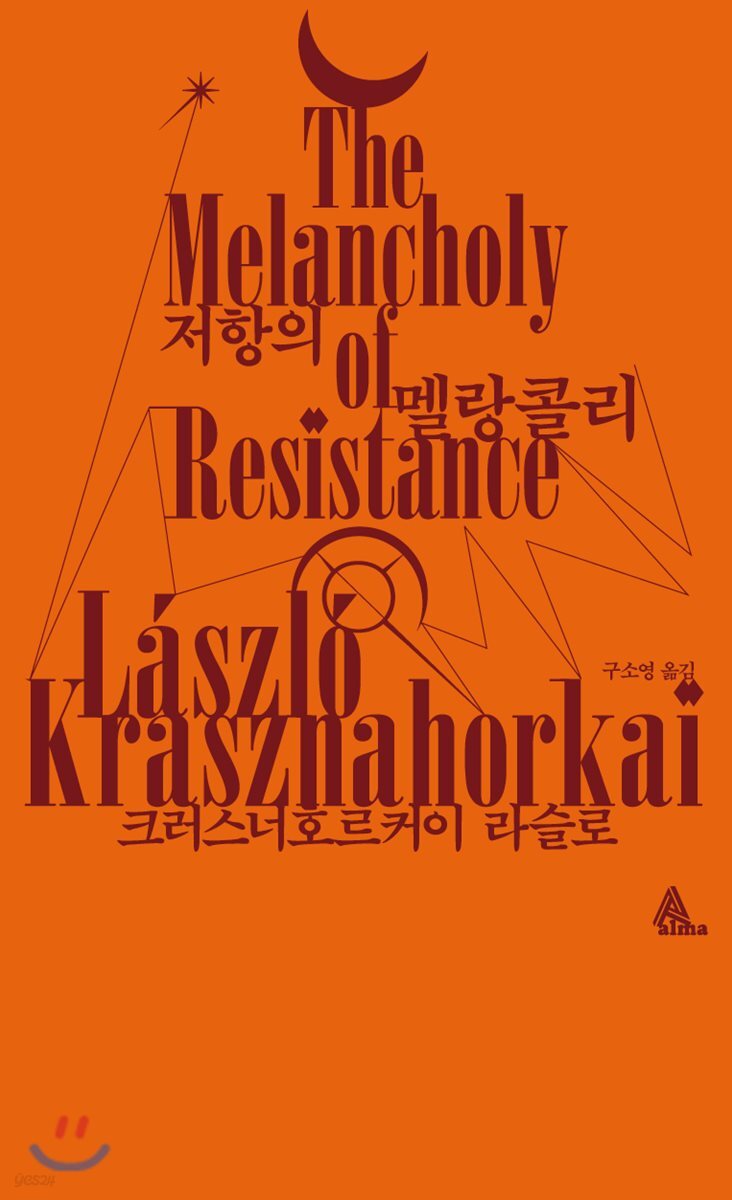
Melancholy of Resistance
 |
Description
Book Introduction
“An insight into the dark history of Western civilization!” _ Man Booker judges
“It goes far beyond the petty concerns of modern writing!” _ W.
G. Sebald
"An artist who reawakened the power of art even amidst the fear of destruction."
Continuing our connection with Korean readers with the new work "Hersheyt 07769."
László Krásznáhorkaj, a master of modern Hungarian literature, has won the 2025 Nobel Prize in Literature.
The Nobel Committee stated that the award was given for “a powerful and visionary work that reawakens the power of art even in the face of the horrors of destruction,” and that he had shown again the possibility of a “prophetic language” that modern literature had lost.
A literary prophet walking the boundaries of language, between destruction and salvation.
Since his literary debut in 1985 with "Satantango," László Krzysztof Krzysztof Krzysztof has been a writer who has depicted the anxieties of human existence and the collapse of the world in his compelling prose. His prose, with its endlessly long sentences and intense narrative tension, immerses readers in a unique style that can be called a "reading exercise."
Alma Publishing has introduced the author's six representative works, "Satan Tango," "Melancholy of Resistance," "The Last Wolf," "The World Goes On," "The Descent of the Queen Mother of the West," and "The Return of Baron Wenkheim," to Korea, and plans to publish a new work, "Herscht 07769," in January 2026.
"Hersht 07769" depicts the journey of "Hersht," a man called by a number instead of a name, as he seeks to rediscover his identity and the meaning of language in a world after the collapse of civilization. In a society where communication is based solely on numbers and symbols, he encounters a world of humans whose names can no longer be called. This work is considered to be the author's later work that most densely embodies the "anxiety of existence" and "human possibilities after the end of language," which the author has consistently explored.
His literary works, which have expanded globally, have long cultivated a deep readership, even amidst a quiet resonance. This Nobel Prize in Literature marks the moment when his endless exploration of the origins of humanity and art is once again resurrected in the languages of the world, and will undoubtedly resonate deeply with readers.
Promotion of screenings of "Reading László Krzysztof ...
To commemorate this award, Alma Publishing will present a booklet titled "Reading László Krasnahorkai" (tentative title), which aims to bring readers closer to the world of literature, which is by no means easy but essential to read. The contributors include Professor Han Kyung-min, poet Jo Won-gyu, film critic Jeong Seong-il, literary critic Jang Eun-soo, critic Geum Jeong-yeon, and poet Kim Yu-tae, who will each interpret the author's world from their own perspectives.
Additionally, in order to expand and illuminate the author's literary world through film, we are promoting the screening of "Werckmeister Harmonies," based on the films "Satantango" and "Resistance Melancholy" by another world-renowned director, Tar Bella.
“It goes far beyond the petty concerns of modern writing!” _ W.
G. Sebald
"An artist who reawakened the power of art even amidst the fear of destruction."
Continuing our connection with Korean readers with the new work "Hersheyt 07769."
László Krásznáhorkaj, a master of modern Hungarian literature, has won the 2025 Nobel Prize in Literature.
The Nobel Committee stated that the award was given for “a powerful and visionary work that reawakens the power of art even in the face of the horrors of destruction,” and that he had shown again the possibility of a “prophetic language” that modern literature had lost.
A literary prophet walking the boundaries of language, between destruction and salvation.
Since his literary debut in 1985 with "Satantango," László Krzysztof Krzysztof Krzysztof has been a writer who has depicted the anxieties of human existence and the collapse of the world in his compelling prose. His prose, with its endlessly long sentences and intense narrative tension, immerses readers in a unique style that can be called a "reading exercise."
Alma Publishing has introduced the author's six representative works, "Satan Tango," "Melancholy of Resistance," "The Last Wolf," "The World Goes On," "The Descent of the Queen Mother of the West," and "The Return of Baron Wenkheim," to Korea, and plans to publish a new work, "Herscht 07769," in January 2026.
"Hersht 07769" depicts the journey of "Hersht," a man called by a number instead of a name, as he seeks to rediscover his identity and the meaning of language in a world after the collapse of civilization. In a society where communication is based solely on numbers and symbols, he encounters a world of humans whose names can no longer be called. This work is considered to be the author's later work that most densely embodies the "anxiety of existence" and "human possibilities after the end of language," which the author has consistently explored.
His literary works, which have expanded globally, have long cultivated a deep readership, even amidst a quiet resonance. This Nobel Prize in Literature marks the moment when his endless exploration of the origins of humanity and art is once again resurrected in the languages of the world, and will undoubtedly resonate deeply with readers.
Promotion of screenings of "Reading László Krzysztof ...
To commemorate this award, Alma Publishing will present a booklet titled "Reading László Krasnahorkai" (tentative title), which aims to bring readers closer to the world of literature, which is by no means easy but essential to read. The contributors include Professor Han Kyung-min, poet Jo Won-gyu, film critic Jeong Seong-il, literary critic Jang Eun-soo, critic Geum Jeong-yeon, and poet Kim Yu-tae, who will each interpret the author's world from their own perspectives.
Additionally, in order to expand and illuminate the author's literary world through film, we are promoting the screening of "Werckmeister Harmonies," based on the films "Satantango" and "Resistance Melancholy" by another world-renowned director, Tar Bella.
- You can preview some of the book's contents.
Preview
index
Introduction: Unusual Situations
Negotiation: Bergmeister Harmony
Conclusion: Eulogy
Translator's Note
Negotiation: Bergmeister Harmony
Conclusion: Eulogy
Translator's Note
Into the book
It's been impossible to keep my wits about me amidst the increasingly frightening events of the past few months.
News, gossip, rumors, and personal experiences were jumbled and jumbled together, often with little coherence (it was difficult to find any rational connection between, say, the untimely frost in early November, the mysterious family disasters, the unusually frequent train accidents, and the terrifying rumors that hordes of juvenile delinquents were vandalizing public monuments in distant capitals), and none of these news items had any meaning in themselves, but simply seemed to all seem, as a growing number of people were saying, to portend a 'coming catastrophe.'
--- p.14
'Is this a silent acknowledgement? Or am I dreaming again?' Mrs. Plauf stared straight ahead, quickly dismissing the possibility that it was a figment of her imagination.
Given everything she had seen and heard, she couldn't help but think that the man had hit the old woman.
The man must have been fed up with the old woman's constant chatter.
And simply, without a word, he hit her in the face, no, he hit her chest, yes, it couldn't have been any other way, the thought made her freeze in shock, and beads of sweat broke out on her forehead in a chilling fear.
The old woman is lying unconscious there, and the man in the fur hat is motionless.
Sweat began to beat down on his forehead again.
How on earth did I end up in this shameful and trashy situation?
--- p.37
Seeing a whale, on the other hand, did not mean grasping the whole picture as a whole.
Trying to discern the enormous tail fin, the dry, cracked iron-gray shell, the strangely swollen body halfway down, and the dorsal fin, each of which was easily several meters long, seemed a hopeless task.
It was just too big and too long.
The whole thing didn't come into my eyes at once, and I didn't have a chance to look at the dead eyes properly.
Balusiker managed to squeeze himself into the waddling rope, and finally reached the jaw, which was ingeniously propped open, and he looked into the dark throat, or farther away to find two small eyes sunk in deep cavities on either side of the outer body, or to discern two pores in the forehead, low above the eyes, or to examine these parts separately, so that together it was impossible to see the enormous head as a single whole.
--- pp.150-151
He wanted to forget everything he had suffered during his decades as the so-called dean of the music arts academy.
The endless, foolish attacks, the blank, blank stares, the young people who were completely devoid of any bright intelligence, the dull smell of a rotten soul, the pressure of trivial matters, the easy satisfaction, the strong pride and the heavy weight of low expectations—these were all things that were almost destroying him, no matter how light they were.
He wanted to forget the old troublemakers he had taken care of, whose eyes sparkled with the desire to smash the piano with an axe.
I wanted to forget the 'Grand Symphony Orchestra', where, as a manager, I had to gather together a variety of drunken private tutors and tear-jerking music lovers.
Every month, he wanted to forget the thunderous applause of the audience, who, without a doubt, were so enthusiastic about the shallow talents of this abominable, unimaginably incompetent band, not even fit to grace a village wedding, and the endless efforts to inculcate in them the habit of music, and the vain pleas that they should know how to play at least one sacred piece.
--- p.184
He looked at the whale, which lay alone, now lit only by the light of two flickering bulbs.
The whale was about to give a comical scolding ('Look how much trouble you've caused, you can't hurt anyone anymore...') when an unexpected, unclear, and broken voice rang out from somewhere deep within the wagon.
Who was making this sound? I immediately recognized the voice.
And as I soon found out, I hadn't misheard.
At the door at the back, which, as I had previously deduced, led to the area set up as a living quarters, I pressed my ear against the tin wall and picked up a few words ('... I asked you to show yourself, not to make up silly stories here.
I won't let him out.
Turn it around…!') It was the circus leader's voice, unmistakable.
--- p.260
'I want to be a fool.
And I want to tell the king something nice, something proper, that your country is trash.' 'Stop talking nonsense.' The older child scowled wickedly behind his younger brother, and Balusiker asked a question, also trying to get the older child's agreement.
"Why? Then what do you want to be?" "Me? I want to be a good police officer," the boy answered proudly, but he seemed hesitant to reveal the full extent of his plans to a stranger.
'And put everyone in jail,' he said, crossing his arms and leaning his shoulder against the doorframe.
'All the drunkards and all the fools.' 'The drunkards too, yes,' agreed the little boy, and then, 'Death to the drunkards!' he yelled, jumping up and down and running excitedly around the room.
--- p.293
But now he saw him differently.
He enters the house at noon, wearing a brimmed hat and a postman's coat that reaches down to his ankles. He knocks lightly at the door, says "Please come," and when he's finished, he slings his lunchbox over his shoulder and tiptoes down the hallway so that his flimsy boots don't disturb the quiet of the living room, moving even more quietly until he reaches the entrance.
In this way, he lightened the atmosphere of the house, which had been heavy with the landlord's obsession, at least until his next visit, and healed him with his mysterious benevolence, his affectionate attention, and his rather complex 'simplicity'.
He attended to every need of the landlord with such profound constancy, with such touching care, that he could not even perceive that it was not a matter of course, but of such profound diligence, with such intelligence, that he cared for it in the truest sense of the word.
--- p.330
For, however much we searched, we could not find an object that matched our disgust and despair, and so with the same infinite fury we attacked everything that stood in our way.
We broke into the store, threw movable objects out the windows, and trampled them on the asphalt.
If you can't move the thing, smash it with a metal bar or a broken shutter.
Then we passed through the unrecognizable wreckage of destruction we had run over: hairdryers, soap, loaves of bread, shirts, orthopedic shoes, canned food, books, bags, children's toys, overturned cars parked on the side of the road, ripped down desolate signs and billboards, and took over and destroyed a telephone exchange after someone had left a light inside.
By the time we got out of the crowd that had gathered at the entrance of the building, and after a long wait, the two telephone operators who had also been trampled underfoot were lying unconscious, limp, their hands hanging limply on their knees, sliding down the wall like old rags.
--- p.385
'The Balusiq! Doctor, have you ever seen the Balusiq?' The whispering of the crowd suddenly stopped at the mention of the name, and the woman nervously looked at the soldiers, who looked at each other as if this was the conversation they had been trying to have.
Meanwhile, the doctor shook his head without looking at Ester (then whispered, as a warning, 'But from what I've heard, now is not a good time to bring up such matters...'). One of the soldiers took out a piece of paper, traced it with his finger, poked at a certain spot, and showed it to his colleague, who then fixed his eyes on Ester and shouted at her.
'Bullusiker Yanos?' 'Yes.' Esther turned to them.
'That's the man I was talking about,' he said, and they demanded he reveal everything he knew about 'the man in question.'
--- pp.423-424
'The man in question,' said Madame Esther, once the laughter had died down.
'He's mentally unstable.' 'What do you mean?' 'I mean he's mentally unstable.' 'In that case,' the colonel shrugged, 'we'll put him in a mental hospital.
'At least I have someone I can lock up,' he added, a suppressed smile twitching beneath his mustache, and then paused, as if to warn me to brace myself for another joke that I couldn't help but laugh at.
‘Even if we can’t lock up this whole crazy town…’
--- p.465
I just stared at the flames, wondering, "Is this me? Or is this me?" And I really didn't know what to do.
I couldn't move until I was sure, because I didn't know if it was me who had done this, which I know now, but not then, so I told myself, since I'm already in this situation, it's better to just leave this place... So I cross the Germanic district, these incredibly confusing little alleys, without knowing what to do, so that I won't run into the people I just left, and I stop to catch my breath by the cemetery gate, and I'm leaning against the iron bars like this (he showed them), when suddenly someone speaks to me right behind me.
Damn, I'm sorry for my bad language, they're coming for me too, I don't usually run away like a scared rabbit, you can tell by looking at me, Secretary, but I was scared shitless when someone spoke to me like that.
Of course, I was one of those fighters who thought it was time to fight.
He said, let's swap coats...
News, gossip, rumors, and personal experiences were jumbled and jumbled together, often with little coherence (it was difficult to find any rational connection between, say, the untimely frost in early November, the mysterious family disasters, the unusually frequent train accidents, and the terrifying rumors that hordes of juvenile delinquents were vandalizing public monuments in distant capitals), and none of these news items had any meaning in themselves, but simply seemed to all seem, as a growing number of people were saying, to portend a 'coming catastrophe.'
--- p.14
'Is this a silent acknowledgement? Or am I dreaming again?' Mrs. Plauf stared straight ahead, quickly dismissing the possibility that it was a figment of her imagination.
Given everything she had seen and heard, she couldn't help but think that the man had hit the old woman.
The man must have been fed up with the old woman's constant chatter.
And simply, without a word, he hit her in the face, no, he hit her chest, yes, it couldn't have been any other way, the thought made her freeze in shock, and beads of sweat broke out on her forehead in a chilling fear.
The old woman is lying unconscious there, and the man in the fur hat is motionless.
Sweat began to beat down on his forehead again.
How on earth did I end up in this shameful and trashy situation?
--- p.37
Seeing a whale, on the other hand, did not mean grasping the whole picture as a whole.
Trying to discern the enormous tail fin, the dry, cracked iron-gray shell, the strangely swollen body halfway down, and the dorsal fin, each of which was easily several meters long, seemed a hopeless task.
It was just too big and too long.
The whole thing didn't come into my eyes at once, and I didn't have a chance to look at the dead eyes properly.
Balusiker managed to squeeze himself into the waddling rope, and finally reached the jaw, which was ingeniously propped open, and he looked into the dark throat, or farther away to find two small eyes sunk in deep cavities on either side of the outer body, or to discern two pores in the forehead, low above the eyes, or to examine these parts separately, so that together it was impossible to see the enormous head as a single whole.
--- pp.150-151
He wanted to forget everything he had suffered during his decades as the so-called dean of the music arts academy.
The endless, foolish attacks, the blank, blank stares, the young people who were completely devoid of any bright intelligence, the dull smell of a rotten soul, the pressure of trivial matters, the easy satisfaction, the strong pride and the heavy weight of low expectations—these were all things that were almost destroying him, no matter how light they were.
He wanted to forget the old troublemakers he had taken care of, whose eyes sparkled with the desire to smash the piano with an axe.
I wanted to forget the 'Grand Symphony Orchestra', where, as a manager, I had to gather together a variety of drunken private tutors and tear-jerking music lovers.
Every month, he wanted to forget the thunderous applause of the audience, who, without a doubt, were so enthusiastic about the shallow talents of this abominable, unimaginably incompetent band, not even fit to grace a village wedding, and the endless efforts to inculcate in them the habit of music, and the vain pleas that they should know how to play at least one sacred piece.
--- p.184
He looked at the whale, which lay alone, now lit only by the light of two flickering bulbs.
The whale was about to give a comical scolding ('Look how much trouble you've caused, you can't hurt anyone anymore...') when an unexpected, unclear, and broken voice rang out from somewhere deep within the wagon.
Who was making this sound? I immediately recognized the voice.
And as I soon found out, I hadn't misheard.
At the door at the back, which, as I had previously deduced, led to the area set up as a living quarters, I pressed my ear against the tin wall and picked up a few words ('... I asked you to show yourself, not to make up silly stories here.
I won't let him out.
Turn it around…!') It was the circus leader's voice, unmistakable.
--- p.260
'I want to be a fool.
And I want to tell the king something nice, something proper, that your country is trash.' 'Stop talking nonsense.' The older child scowled wickedly behind his younger brother, and Balusiker asked a question, also trying to get the older child's agreement.
"Why? Then what do you want to be?" "Me? I want to be a good police officer," the boy answered proudly, but he seemed hesitant to reveal the full extent of his plans to a stranger.
'And put everyone in jail,' he said, crossing his arms and leaning his shoulder against the doorframe.
'All the drunkards and all the fools.' 'The drunkards too, yes,' agreed the little boy, and then, 'Death to the drunkards!' he yelled, jumping up and down and running excitedly around the room.
--- p.293
But now he saw him differently.
He enters the house at noon, wearing a brimmed hat and a postman's coat that reaches down to his ankles. He knocks lightly at the door, says "Please come," and when he's finished, he slings his lunchbox over his shoulder and tiptoes down the hallway so that his flimsy boots don't disturb the quiet of the living room, moving even more quietly until he reaches the entrance.
In this way, he lightened the atmosphere of the house, which had been heavy with the landlord's obsession, at least until his next visit, and healed him with his mysterious benevolence, his affectionate attention, and his rather complex 'simplicity'.
He attended to every need of the landlord with such profound constancy, with such touching care, that he could not even perceive that it was not a matter of course, but of such profound diligence, with such intelligence, that he cared for it in the truest sense of the word.
--- p.330
For, however much we searched, we could not find an object that matched our disgust and despair, and so with the same infinite fury we attacked everything that stood in our way.
We broke into the store, threw movable objects out the windows, and trampled them on the asphalt.
If you can't move the thing, smash it with a metal bar or a broken shutter.
Then we passed through the unrecognizable wreckage of destruction we had run over: hairdryers, soap, loaves of bread, shirts, orthopedic shoes, canned food, books, bags, children's toys, overturned cars parked on the side of the road, ripped down desolate signs and billboards, and took over and destroyed a telephone exchange after someone had left a light inside.
By the time we got out of the crowd that had gathered at the entrance of the building, and after a long wait, the two telephone operators who had also been trampled underfoot were lying unconscious, limp, their hands hanging limply on their knees, sliding down the wall like old rags.
--- p.385
'The Balusiq! Doctor, have you ever seen the Balusiq?' The whispering of the crowd suddenly stopped at the mention of the name, and the woman nervously looked at the soldiers, who looked at each other as if this was the conversation they had been trying to have.
Meanwhile, the doctor shook his head without looking at Ester (then whispered, as a warning, 'But from what I've heard, now is not a good time to bring up such matters...'). One of the soldiers took out a piece of paper, traced it with his finger, poked at a certain spot, and showed it to his colleague, who then fixed his eyes on Ester and shouted at her.
'Bullusiker Yanos?' 'Yes.' Esther turned to them.
'That's the man I was talking about,' he said, and they demanded he reveal everything he knew about 'the man in question.'
--- pp.423-424
'The man in question,' said Madame Esther, once the laughter had died down.
'He's mentally unstable.' 'What do you mean?' 'I mean he's mentally unstable.' 'In that case,' the colonel shrugged, 'we'll put him in a mental hospital.
'At least I have someone I can lock up,' he added, a suppressed smile twitching beneath his mustache, and then paused, as if to warn me to brace myself for another joke that I couldn't help but laugh at.
‘Even if we can’t lock up this whole crazy town…’
--- p.465
I just stared at the flames, wondering, "Is this me? Or is this me?" And I really didn't know what to do.
I couldn't move until I was sure, because I didn't know if it was me who had done this, which I know now, but not then, so I told myself, since I'm already in this situation, it's better to just leave this place... So I cross the Germanic district, these incredibly confusing little alleys, without knowing what to do, so that I won't run into the people I just left, and I stop to catch my breath by the cemetery gate, and I'm leaning against the iron bars like this (he showed them), when suddenly someone speaks to me right behind me.
Damn, I'm sorry for my bad language, they're coming for me too, I don't usually run away like a scared rabbit, you can tell by looking at me, Secretary, but I was scared shitless when someone spoke to me like that.
Of course, I was one of those fighters who thought it was time to fight.
He said, let's swap coats...
--- p.501
Publisher's Review
Laszlo Krusnahorkai, author of "Satantango"
This time, summon 'Leviathan'!
In a small Hungarian town, a bitter cold persists, streetlights fail to turn on for no reason, a giant tree is uprooted overnight and lies flat, and a church clock that has been stopped for decades begins to move.
Just then, a traveling circus enters the city, promising to show off "the world's largest whale," and all sorts of rumors and paranoia run rampant.
In his debut work, Satantango, László Krzysztof Nahorkai used the steps of the tango—six steps forward, six steps back—to depict the process of people trampled by the system being trapped in a hamster wheel of suffering. In Melancholy of Resistance, László Krzysztof Nahorkai chose the whale to depict the “end of the world and beyond” once again.
This 'enormous beast that cannot be seen at first glance' overlaps with the sea monster 'Leviathan' that appears in the Book of Job in the Old Testament.
At the same time, the ominous truck transporting the whale evokes the vast artistic imagination implied by the Trojan Horse, in that it causes virtually no direct harm to the town, but simply sits quietly in the middle of the square, driving the entire town into madness.
W.
As G. Sebald puts it, the universality of the insights this novel offers 'far surpasses the petty concerns of all modern writing.'
The message contained in the vast black river of letters without a single paragraph is difficult to compress into one word.
It is a history of the upheavals in Eastern Europe that the author passed through, a cold reflection on the formation of social consciousness in each class, the fate of humans stuck in the mire of melancholy, also called the "demon of noonday," an attempt to derive Greek tragedy from kitsch and black comedy, or all of these.
The Hungarian Hermit, the Artist of Artists
An enchanting literary experience from the Man Booker International Prize-winning author.
Last year, Alma published the novel Satantango, introducing László Krasnahorkaj to Korean readers for the first time.
The film of the same name, based on this novel, was first introduced in Korea and garnered attention for its legendary cinematography by director Bela Tarr and a running time of over seven hours.
Audiences, captivated by the overwhelming scale of the film that Susan Sontag praised with the words, “I will definitely see it once a year for the rest of my life,” have been waiting to see the original work, and the publication of the novel “Satantango” has brought a welcome rain to that long-awaited thirst.
Known only as the 'Hungarian Hermit' and the 'Artist of Artists,' Krusnahorkai has landed on the territory of readers who have been wandering in search of 'another ecstasy,' offering an experience beyond the horizons reached by previously introduced world literature.
Alma's second work, "Melancholy of Resistance," elevates the author's signature apocalypticism to a grander level.
The Man Booker International Prize jury praised the work as “an insight into the dark history that passes for Western civilization.”
This novel was also made into a film, Werckmeister Harmonies, directed by Bela Tarr.
Although it has not yet been introduced in Korea, it was selected as one of the 100 best films since 2000 by the BBC.
Alma also sequentially introduces other representative works of László Krzysztof ...
Readers who do not doubt the limits of the world that literature can push forward will be able to fill in their own evaluation of a master whose works remain unknown no matter how they are described through this collection.
Sentences pouring out like lava,
A character who falls and resists again,
Melancholy that dominates the novel from outside the novel
Many postmodern writers deal with reality through the lens of madness, but Krusnahorkai is considered to be the 'most peculiar writer' among them.
His tireless narrative often turns a page with a single sentence.
George Szirtes, the poet and translator of the English version of “Melancholy of Resistance,” likened it to “a narrative like slow-flowing lava.”
Set in a Hungarian village, this narrative features a series of vivid characters intricately intertwined.
While the people are running around in confusion, frightened by the 'whale' brought by the circus, Madame Esther, who will do anything for her own ambitions, devises a plan to take over the town.
Her husband, Esther György, was once the director of a music school, respected by many in the neighborhood, but years ago he decided to isolate himself from the world and now spends all day in bed, an old, sickly man of vague reputation.
The only time he still has a tenuous connection to the world is when Balusiker, a thirty-five-year-old young man, visits his 'gloomy bedroom' to bring him a meal.
Balusiker, who wanders the village day and night, captivated by his own 'cosmos', talking about the stars, the moon, and the sun, although in the eyes of the world he is an idiot of the village, drunk and daydreaming, and incapable of being human despite his age, to Esther he is the only one who saves her soul from the chaos outside.
The strange friendship between these two who 'resist' the world clashes with the fascism manifested through Madame Esther, and swirls amidst the fear and anxiety that has gripped the village.
The word 'melancholy' in the title is never mentioned in the book.
As translator Gu So-young says, the two fundamental concepts of this symptom, which operates ‘outside the cover’ and never leaves the reader’s mind, are ‘fear’ and ‘sadness’.
Moreover, to borrow the words of [The New Yorker], the fact that none of the characters in this book can accurately describe their own private Edens makes their inner worlds “both less beautiful and more beautiful.”
This kind of irony once again confirms the ability of Krusnahorker, who described himself as “a writer for readers who seek beauty in hell.”
Series Introduction
Alma Incognita series
Embark on a special adventure into an unknown world through literature.
Toshiki Okada
The End of the Special Time Granted to Us (by Toshiki Okada, translated by Sanghong Lee, August 2016)
A Relatively Optimistic Case (by Toshiki Okada, translated by Hongi Lee, July 2017)
Hervé Guibert
Ghost Images (by Hervé Guibert, translated by An Bo-ok, March 2017)
The Man in the Red Hat (by Hervé Guibert, translated by An Bo-ok, June 2018)
To the Friend Who Couldn't Save My Life (Hervé Gibet, November 2018)
The Record of Compassion (by Hervé Guibert, translated by Shin Yu-jin, March 2022)
Mathieu Langdon
Erberino (by Mathieu Lindon, translated by Shin Yu-jin, December 2022)
Uming
Elephant on the Sunlit Road (Written by Wuming, translated by Heo Yu-yeong, March 2018)
Laszlo Krusnahorkay
Satan Tango (by László Krzysztof ...
The Melancholy of Resistance (by László Krzysztof ...
The Last Wolf (by László Krzysztof ...
The Descent of the Queen Mother of the West (by László Krzysztof ...
The World Goes On (by László Krzysztof ...
The Return of Baron Wenckheim (by László Krzysztof ...
David Foster Wallace
Oblivion (by David Foster Wallace, translated by Shin Ji-young, October 2019)
String Theory (by David Foster Wallace, translated by Noh Seung-young, November 2019)
A Univus Pluram: Television and the American Novel (by David Foster Wallace, translated by Noh Seung-young, February 2022)
Olivia Rosenthal
Survival Mechanisms in Hostile Situations (by Olivia Rosenthal, translated by Hankookhwa, January 2020)
Kim Sa-gwa
Outside is a Burning Swamp/Trapped in a Mental Hospital (by Kim Sa-gwa, November 2020)
Laurie Frankel
Claude and Poppy (by Laurie Frankl, translated by Kim Hee-jung, May 2023)
John Jeremiah Sullivan
Pulphead (by John Jeremiah Sullivan, translated by Go Young-beom, August 2023)
Norman Erickson Passaribu
Mostly Happy Stories (by Norman Erickson Passaribu, translated by Go Young-beom, November 2023)
Guillaume Laurent
My Body Disappeared (by Guillaume Laurent, translated by Kim Do-yeon, March 2024)
Ludovic Escand
Dreamers of the Night (by Ludovic Escand, translated by Kim Nam-joo, January 2025)
* Will continue to be published.
This time, summon 'Leviathan'!
In a small Hungarian town, a bitter cold persists, streetlights fail to turn on for no reason, a giant tree is uprooted overnight and lies flat, and a church clock that has been stopped for decades begins to move.
Just then, a traveling circus enters the city, promising to show off "the world's largest whale," and all sorts of rumors and paranoia run rampant.
In his debut work, Satantango, László Krzysztof Nahorkai used the steps of the tango—six steps forward, six steps back—to depict the process of people trampled by the system being trapped in a hamster wheel of suffering. In Melancholy of Resistance, László Krzysztof Nahorkai chose the whale to depict the “end of the world and beyond” once again.
This 'enormous beast that cannot be seen at first glance' overlaps with the sea monster 'Leviathan' that appears in the Book of Job in the Old Testament.
At the same time, the ominous truck transporting the whale evokes the vast artistic imagination implied by the Trojan Horse, in that it causes virtually no direct harm to the town, but simply sits quietly in the middle of the square, driving the entire town into madness.
W.
As G. Sebald puts it, the universality of the insights this novel offers 'far surpasses the petty concerns of all modern writing.'
The message contained in the vast black river of letters without a single paragraph is difficult to compress into one word.
It is a history of the upheavals in Eastern Europe that the author passed through, a cold reflection on the formation of social consciousness in each class, the fate of humans stuck in the mire of melancholy, also called the "demon of noonday," an attempt to derive Greek tragedy from kitsch and black comedy, or all of these.
The Hungarian Hermit, the Artist of Artists
An enchanting literary experience from the Man Booker International Prize-winning author.
Last year, Alma published the novel Satantango, introducing László Krasnahorkaj to Korean readers for the first time.
The film of the same name, based on this novel, was first introduced in Korea and garnered attention for its legendary cinematography by director Bela Tarr and a running time of over seven hours.
Audiences, captivated by the overwhelming scale of the film that Susan Sontag praised with the words, “I will definitely see it once a year for the rest of my life,” have been waiting to see the original work, and the publication of the novel “Satantango” has brought a welcome rain to that long-awaited thirst.
Known only as the 'Hungarian Hermit' and the 'Artist of Artists,' Krusnahorkai has landed on the territory of readers who have been wandering in search of 'another ecstasy,' offering an experience beyond the horizons reached by previously introduced world literature.
Alma's second work, "Melancholy of Resistance," elevates the author's signature apocalypticism to a grander level.
The Man Booker International Prize jury praised the work as “an insight into the dark history that passes for Western civilization.”
This novel was also made into a film, Werckmeister Harmonies, directed by Bela Tarr.
Although it has not yet been introduced in Korea, it was selected as one of the 100 best films since 2000 by the BBC.
Alma also sequentially introduces other representative works of László Krzysztof ...
Readers who do not doubt the limits of the world that literature can push forward will be able to fill in their own evaluation of a master whose works remain unknown no matter how they are described through this collection.
Sentences pouring out like lava,
A character who falls and resists again,
Melancholy that dominates the novel from outside the novel
Many postmodern writers deal with reality through the lens of madness, but Krusnahorkai is considered to be the 'most peculiar writer' among them.
His tireless narrative often turns a page with a single sentence.
George Szirtes, the poet and translator of the English version of “Melancholy of Resistance,” likened it to “a narrative like slow-flowing lava.”
Set in a Hungarian village, this narrative features a series of vivid characters intricately intertwined.
While the people are running around in confusion, frightened by the 'whale' brought by the circus, Madame Esther, who will do anything for her own ambitions, devises a plan to take over the town.
Her husband, Esther György, was once the director of a music school, respected by many in the neighborhood, but years ago he decided to isolate himself from the world and now spends all day in bed, an old, sickly man of vague reputation.
The only time he still has a tenuous connection to the world is when Balusiker, a thirty-five-year-old young man, visits his 'gloomy bedroom' to bring him a meal.
Balusiker, who wanders the village day and night, captivated by his own 'cosmos', talking about the stars, the moon, and the sun, although in the eyes of the world he is an idiot of the village, drunk and daydreaming, and incapable of being human despite his age, to Esther he is the only one who saves her soul from the chaos outside.
The strange friendship between these two who 'resist' the world clashes with the fascism manifested through Madame Esther, and swirls amidst the fear and anxiety that has gripped the village.
The word 'melancholy' in the title is never mentioned in the book.
As translator Gu So-young says, the two fundamental concepts of this symptom, which operates ‘outside the cover’ and never leaves the reader’s mind, are ‘fear’ and ‘sadness’.
Moreover, to borrow the words of [The New Yorker], the fact that none of the characters in this book can accurately describe their own private Edens makes their inner worlds “both less beautiful and more beautiful.”
This kind of irony once again confirms the ability of Krusnahorker, who described himself as “a writer for readers who seek beauty in hell.”
Series Introduction
Alma Incognita series
Embark on a special adventure into an unknown world through literature.
Toshiki Okada
The End of the Special Time Granted to Us (by Toshiki Okada, translated by Sanghong Lee, August 2016)
A Relatively Optimistic Case (by Toshiki Okada, translated by Hongi Lee, July 2017)
Hervé Guibert
Ghost Images (by Hervé Guibert, translated by An Bo-ok, March 2017)
The Man in the Red Hat (by Hervé Guibert, translated by An Bo-ok, June 2018)
To the Friend Who Couldn't Save My Life (Hervé Gibet, November 2018)
The Record of Compassion (by Hervé Guibert, translated by Shin Yu-jin, March 2022)
Mathieu Langdon
Erberino (by Mathieu Lindon, translated by Shin Yu-jin, December 2022)
Uming
Elephant on the Sunlit Road (Written by Wuming, translated by Heo Yu-yeong, March 2018)
Laszlo Krusnahorkay
Satan Tango (by László Krzysztof ...
The Melancholy of Resistance (by László Krzysztof ...
The Last Wolf (by László Krzysztof ...
The Descent of the Queen Mother of the West (by László Krzysztof ...
The World Goes On (by László Krzysztof ...
The Return of Baron Wenckheim (by László Krzysztof ...
David Foster Wallace
Oblivion (by David Foster Wallace, translated by Shin Ji-young, October 2019)
String Theory (by David Foster Wallace, translated by Noh Seung-young, November 2019)
A Univus Pluram: Television and the American Novel (by David Foster Wallace, translated by Noh Seung-young, February 2022)
Olivia Rosenthal
Survival Mechanisms in Hostile Situations (by Olivia Rosenthal, translated by Hankookhwa, January 2020)
Kim Sa-gwa
Outside is a Burning Swamp/Trapped in a Mental Hospital (by Kim Sa-gwa, November 2020)
Laurie Frankel
Claude and Poppy (by Laurie Frankl, translated by Kim Hee-jung, May 2023)
John Jeremiah Sullivan
Pulphead (by John Jeremiah Sullivan, translated by Go Young-beom, August 2023)
Norman Erickson Passaribu
Mostly Happy Stories (by Norman Erickson Passaribu, translated by Go Young-beom, November 2023)
Guillaume Laurent
My Body Disappeared (by Guillaume Laurent, translated by Kim Do-yeon, March 2024)
Ludovic Escand
Dreamers of the Night (by Ludovic Escand, translated by Kim Nam-joo, January 2025)
* Will continue to be published.
GOODS SPECIFICS
- Date of issue: May 13, 2019
- Page count, weight, size: 536 pages | 628g | 130*213*35mm
- ISBN13: 9791159922527
- ISBN10: 1159922527
You may also like
카테고리
korean


korean

![GQ KOREA Mark (Monthly): December [2025]](http://librairie.coreenne.fr/cdn/shop/files/8ef265dbbfbf186523ed75ba7319009d.jpg?v=1765340328&width=3840)


