

The Lie of Recycling
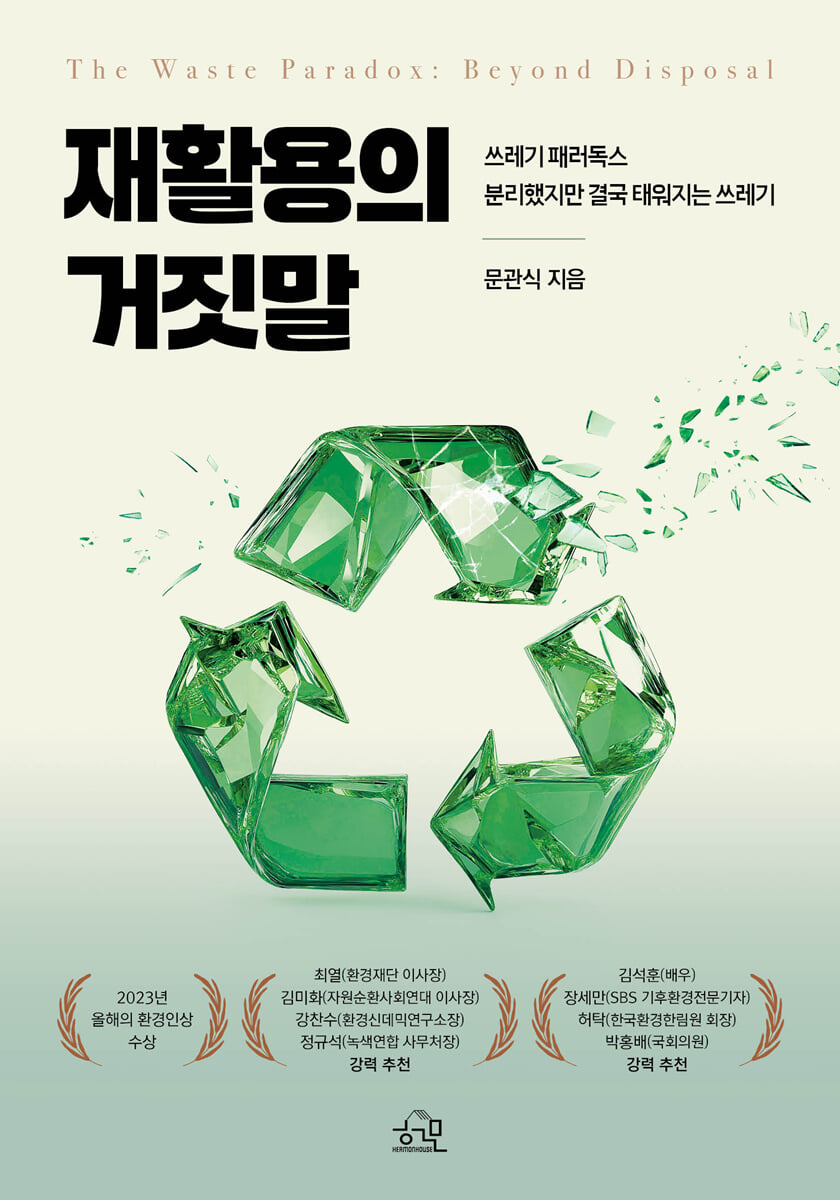 |
Description
Book Introduction
★★★
2023 Environmental Person of the Year Award
Actor Kim Seok-hoon strongly recommends Choi Yeol, chairman of the Environmental Foundation.
Beyond the Recycling Myth: The First Book to Offer Structural Solutions
‘Separate waste disposal’ has now become a daily routine that we all must follow.
We carefully peel off the labels, spread out the plastic to dry, and tie up the paper.
The government touts its achievements as an “86% recycling rate” and a “recycling powerhouse.”
However, in reality, only about 20% of it is reused as a resource.
This is because in Korea, even the amount burned is included in the recycling performance.
"The Lie of Recycling" starts from this very gap.
It exposes the structural contradictions hidden behind flashy statistics and shows the reality that even with careful separation and disposal, waste ultimately ends up being incinerated.
This book examines the logic of citizens who only pay costs, companies that shirk their responsibilities, administrations that focus solely on performance management, and markets that immediately burn down assets when prices drop, using specific examples and voices from the field.
This book suggests new directions for systems, policies, and social consensus, as well as what needs to be fixed, to ensure that our efforts in waste separation are not in vain.
"The Lie of Recycling" dismantles recycling myths and presents the first step toward a sustainable circular economy.
2023 Environmental Person of the Year Award
Actor Kim Seok-hoon strongly recommends Choi Yeol, chairman of the Environmental Foundation.
Beyond the Recycling Myth: The First Book to Offer Structural Solutions
‘Separate waste disposal’ has now become a daily routine that we all must follow.
We carefully peel off the labels, spread out the plastic to dry, and tie up the paper.
The government touts its achievements as an “86% recycling rate” and a “recycling powerhouse.”
However, in reality, only about 20% of it is reused as a resource.
This is because in Korea, even the amount burned is included in the recycling performance.
"The Lie of Recycling" starts from this very gap.
It exposes the structural contradictions hidden behind flashy statistics and shows the reality that even with careful separation and disposal, waste ultimately ends up being incinerated.
This book examines the logic of citizens who only pay costs, companies that shirk their responsibilities, administrations that focus solely on performance management, and markets that immediately burn down assets when prices drop, using specific examples and voices from the field.
This book suggests new directions for systems, policies, and social consensus, as well as what needs to be fixed, to ensure that our efforts in waste separation are not in vain.
"The Lie of Recycling" dismantles recycling myths and presents the first step toward a sustainable circular economy.
- You can preview some of the book's contents.
Preview
index
Recommendation 4
Prologue 18
I separated the first chapter, so why are you burning it all?
Recycling and Waste Sorting: How Have They Changed Our Daily Lives?
Recycling, the trap of the name
Recycling Policies Are Getting More Refined: Are They Really Being Reused?
The OTHER category is the first barrier to circulation.
Why is 'reduction' not recorded?
Numbers Are Not Neutral: Statistics for Designing Purposes
The Illusion of Language and Numbers: The Illusion of a Recycling Superpower
Chapter 2: Why Can't Law and System Keep Up with Reality?
Two laws: no one system
The Fate of Plastic: Its Structure Rejects Recycling
The plans are piled up, but the site remains the same
The illusion of ethical consumption, an unchanging reality
Eco-friendly certification and voluntary agreements
The Paradox of Biodegradability Certification: Poor Standards and Structure
The gap left by certification and performance
Social Consensus and Structural Transformation: The Conditions for a Circular Economy We Create Together
A society that re-quests standards, for a new consensus
Chapter 3: Who will take full responsibility for the trash I separate?
The disappearance of responsibility, the cost falls on the citizens
The Cost Paradox: The More You Practice, the More the Burden
Practice of waste separation from the beginning
A market-driven cycle, an uncontrolled flow
Publicness and Transparency: Surveillance Beyond the Market
A structure that takes responsibility until the end, the final link that creates a true cycle.
The Structure Experiment: Holding People Accountable
Multilayer Governance: A New Experiment in Bridging Accountability
Chapter 4: Small Experiments and Questions Make a Difference
Practice at your fingertips, trust in the structure
Beyond reuse, towards a sustainable society
Beyond the era of performance and surveillance, to the era of true circulation.
At the end of practice, think of another way
Epilogue
Author's Note
References
Prologue 18
I separated the first chapter, so why are you burning it all?
Recycling and Waste Sorting: How Have They Changed Our Daily Lives?
Recycling, the trap of the name
Recycling Policies Are Getting More Refined: Are They Really Being Reused?
The OTHER category is the first barrier to circulation.
Why is 'reduction' not recorded?
Numbers Are Not Neutral: Statistics for Designing Purposes
The Illusion of Language and Numbers: The Illusion of a Recycling Superpower
Chapter 2: Why Can't Law and System Keep Up with Reality?
Two laws: no one system
The Fate of Plastic: Its Structure Rejects Recycling
The plans are piled up, but the site remains the same
The illusion of ethical consumption, an unchanging reality
Eco-friendly certification and voluntary agreements
The Paradox of Biodegradability Certification: Poor Standards and Structure
The gap left by certification and performance
Social Consensus and Structural Transformation: The Conditions for a Circular Economy We Create Together
A society that re-quests standards, for a new consensus
Chapter 3: Who will take full responsibility for the trash I separate?
The disappearance of responsibility, the cost falls on the citizens
The Cost Paradox: The More You Practice, the More the Burden
Practice of waste separation from the beginning
A market-driven cycle, an uncontrolled flow
Publicness and Transparency: Surveillance Beyond the Market
A structure that takes responsibility until the end, the final link that creates a true cycle.
The Structure Experiment: Holding People Accountable
Multilayer Governance: A New Experiment in Bridging Accountability
Chapter 4: Small Experiments and Questions Make a Difference
Practice at your fingertips, trust in the structure
Beyond reuse, towards a sustainable society
Beyond the era of performance and surveillance, to the era of true circulation.
At the end of practice, think of another way
Epilogue
Author's Note
References
Detailed image

Into the book
Now we need to change the question.
Rather than blaming ourselves for not reducing waste, we need to ask a structural question: “Why was a flawed system created that didn’t require reduction?”
Now that the real purpose of the reduction has disappeared, we must once again focus on the paradox created by the flaws in the system design.
--- From "I separated the first sheet, so why are you burning it all?"
Now, beyond the limits of practice, everyone is beginning to recognize that only by changing the structure itself can a true cycle begin.
The conditions for circularity no longer lie in consumer practices. Unless we stop the neglect of OTHER classification and the distribution of composite materials, even carefully separated plastics will still end up in incinerators and landfills.
Real change begins when all stakeholders come together and actively participate in evaluation, monitoring, and policy design.
Citizens who practice separate waste disposal, the government that designs policies, the market and businesses, the media, civil society, and local communities must all participate in evaluation, monitoring, and policy design within a single structure.
Real change begins only when we share experiences and data within a single structure and jointly examine our achievements and limitations.
Only with this structure can policy effectiveness, social trust, market responsibility, and the lived experience form a single flow.
--- From Chapter 2, “Why Can’t Law and System Keep Up with Reality?”
Publicness and transparency are not just policy tasks; they are the key to restoring public trust.
For citizens who are doing their best to separate their waste to experience the actual circulation, a responsible public role and an effective monitoring system are essential.
Only then can resource circulation become a reality of life, not just a slogan.
--- From "Chapter 3: Who Will Take Responsibility for the Trash I Separated?"
Now, at the end of the practice, what is needed is small questions and small experiments.
When you keep asking questions without stopping the experiment, at some point a new connection will emerge.
It can develop into a structure where responsibility flows, information is disclosed, and stakeholders build trust with each other.
Rather than blaming ourselves for not reducing waste, we need to ask a structural question: “Why was a flawed system created that didn’t require reduction?”
Now that the real purpose of the reduction has disappeared, we must once again focus on the paradox created by the flaws in the system design.
--- From "I separated the first sheet, so why are you burning it all?"
Now, beyond the limits of practice, everyone is beginning to recognize that only by changing the structure itself can a true cycle begin.
The conditions for circularity no longer lie in consumer practices. Unless we stop the neglect of OTHER classification and the distribution of composite materials, even carefully separated plastics will still end up in incinerators and landfills.
Real change begins when all stakeholders come together and actively participate in evaluation, monitoring, and policy design.
Citizens who practice separate waste disposal, the government that designs policies, the market and businesses, the media, civil society, and local communities must all participate in evaluation, monitoring, and policy design within a single structure.
Real change begins only when we share experiences and data within a single structure and jointly examine our achievements and limitations.
Only with this structure can policy effectiveness, social trust, market responsibility, and the lived experience form a single flow.
--- From Chapter 2, “Why Can’t Law and System Keep Up with Reality?”
Publicness and transparency are not just policy tasks; they are the key to restoring public trust.
For citizens who are doing their best to separate their waste to experience the actual circulation, a responsible public role and an effective monitoring system are essential.
Only then can resource circulation become a reality of life, not just a slogan.
--- From "Chapter 3: Who Will Take Responsibility for the Trash I Separated?"
Now, at the end of the practice, what is needed is small questions and small experiments.
When you keep asking questions without stopping the experiment, at some point a new connection will emerge.
It can develop into a structure where responsibility flows, information is disclosed, and stakeholders build trust with each other.
--- From "Chapter 4: Small Experiments and Questions Bring About Change"
Publisher's Review
‘Separate disposal’ and ‘ethical consumption’ have become part of our daily lives.
“Is it really helping to protect the environment?”
Separating plastic, cans, paper, vinyl, etc. and putting them in a corner of the kitchen and putting them in the recycling bin on a set day according to the rules has become our daily routine.
The apartment management office discloses the monthly waste separation performance to residents and emphasizes the need to consistently practice waste separation through notices and broadcasts.
Children learn at school that separating waste is essential for protecting the environment, and they receive a "separate waste disposal tag" and put it on their refrigerator.
Companies also run in-house campaigns to encourage employees to separate their waste thoroughly.
In this way, waste separation has now become a social rule that everyone must follow.
Consumption habits have also changed.
We choose products by looking at the 'eco-friendly certification' and 'biodegradable certification' marks, and feel a sense of pride in our 'ethical consumption.'
I am confident that I am helping to protect the environment by choosing products that have been officially certified by the government as being good for the environment.
But, looking at the garbage trucks that end up carrying the garbage mixed together, we all have probably wondered this question.
"I've diligently separated my waste, but is it really being recycled? I chose it solely based on the certification mark, but is it really being properly sorted?"
The optical illusion of fancy 'recycling rate' figures and
The illusion of being a 'recycling leader'
Every year, the government promotes its environmental policy achievements with flashy phrases like “86% recycling rate” and “recycling powerhouse.”
The media transcribes this verbatim, and citizens gain a sense of relief that they are contributing to national achievement.
However, the author raises painful questions about these ‘achievements’.
As of 2022, the overall waste recycling rate in Korea was announced to be 86.2%.
But that figure varies greatly depending on what you define as recycling.
In major countries such as Europe and Japan, heat recovery, fuel conversion, and incineration are not included in the recycling category.
True recycling is only considered when waste is converted back into material that can actually be reused.
That is, only ‘material recycling’ is included in the recycling rate.
However, in our country, recycling includes incineration to obtain energy or use as fuel.
The author points out that if we recalculate according to the standards applied by advanced countries, our country's actual recycling rate is only about 20%.
The government's publicity of its achievements based on faulty standards creates an illusion and creates the illusion of a "recycling-advanced nation."
The author criticizes various reasons, citing these illusions as blinding citizens and preventing fundamental changes in policy.
A system left to the private sector,
Back to a public controlled structure
The author points out that, above all, the environmental policy structure left to the private sector causes fundamental problems.
The government has been entrusting the recycling system to private companies in the name of efficiency.
Initially, it was a choice to reduce costs and secure expertise, but as reliance on the private sector increased, the government found itself in a situation where it could not intervene.
Moreover, with large capital entering the recycling market, even policy directions are now being influenced by market logic.
As a result, the reality is that the waste separated by citizens is not properly recycled.
The author points out these structural limitations using a wealth of field examples and data.
When recycling remains only a corporate profit model, it reveals that true 'resource circulation' is impossible.
The author argues that the public must be able to intervene to ensure a smooth circulation of resources.
A 'multi-layered governance model' is proposed as a key device for achieving such goals.
This model significantly enhances the implementation of environmental policies by encouraging organic cooperation and coordination among various stakeholders, including citizens, private companies, and the government.
He adds further support to his argument by saying that major advanced countries are also adopting this model to strengthen their 'decentralized cooperation system'.
He also emphasizes that to maximize the efficiency of introducing such models, a transparent information disclosure system and an effective monitoring system must be established.
For a ‘sustainable society’
Fundamental challenges and solutions
"The Lie of Recycling" confronts the inconvenient reality hidden behind the flashy numbers and proposes structural changes to move toward a resource-recycling society.
And it poses the question, “What needs to change to build a sustainable society?”
Now, we must change fundamentally to move beyond a performance-oriented society and into an era of practical resource circulation.
We cannot achieve structural change by only emphasizing the practice of separate disposal and being comforted by the illusion of recycling rates.
We must now realize that recycling is viewed not only as a means of 'reusing' but also as the starting point for building a 'sustainable society'.
In "The Lie of Recycling," the author revisits the key meaning and value of "recycling" and clearly presents the direction in which our country's environmental policy should proceed.
The role of citizens is also not left out.
He emphasizes that we should not simply practice recycling, but constantly ask why it is not being recycled properly and monitor whether the flow of resource circulation is actually continuing.
“Is it really helping to protect the environment?”
Separating plastic, cans, paper, vinyl, etc. and putting them in a corner of the kitchen and putting them in the recycling bin on a set day according to the rules has become our daily routine.
The apartment management office discloses the monthly waste separation performance to residents and emphasizes the need to consistently practice waste separation through notices and broadcasts.
Children learn at school that separating waste is essential for protecting the environment, and they receive a "separate waste disposal tag" and put it on their refrigerator.
Companies also run in-house campaigns to encourage employees to separate their waste thoroughly.
In this way, waste separation has now become a social rule that everyone must follow.
Consumption habits have also changed.
We choose products by looking at the 'eco-friendly certification' and 'biodegradable certification' marks, and feel a sense of pride in our 'ethical consumption.'
I am confident that I am helping to protect the environment by choosing products that have been officially certified by the government as being good for the environment.
But, looking at the garbage trucks that end up carrying the garbage mixed together, we all have probably wondered this question.
"I've diligently separated my waste, but is it really being recycled? I chose it solely based on the certification mark, but is it really being properly sorted?"
The optical illusion of fancy 'recycling rate' figures and
The illusion of being a 'recycling leader'
Every year, the government promotes its environmental policy achievements with flashy phrases like “86% recycling rate” and “recycling powerhouse.”
The media transcribes this verbatim, and citizens gain a sense of relief that they are contributing to national achievement.
However, the author raises painful questions about these ‘achievements’.
As of 2022, the overall waste recycling rate in Korea was announced to be 86.2%.
But that figure varies greatly depending on what you define as recycling.
In major countries such as Europe and Japan, heat recovery, fuel conversion, and incineration are not included in the recycling category.
True recycling is only considered when waste is converted back into material that can actually be reused.
That is, only ‘material recycling’ is included in the recycling rate.
However, in our country, recycling includes incineration to obtain energy or use as fuel.
The author points out that if we recalculate according to the standards applied by advanced countries, our country's actual recycling rate is only about 20%.
The government's publicity of its achievements based on faulty standards creates an illusion and creates the illusion of a "recycling-advanced nation."
The author criticizes various reasons, citing these illusions as blinding citizens and preventing fundamental changes in policy.
A system left to the private sector,
Back to a public controlled structure
The author points out that, above all, the environmental policy structure left to the private sector causes fundamental problems.
The government has been entrusting the recycling system to private companies in the name of efficiency.
Initially, it was a choice to reduce costs and secure expertise, but as reliance on the private sector increased, the government found itself in a situation where it could not intervene.
Moreover, with large capital entering the recycling market, even policy directions are now being influenced by market logic.
As a result, the reality is that the waste separated by citizens is not properly recycled.
The author points out these structural limitations using a wealth of field examples and data.
When recycling remains only a corporate profit model, it reveals that true 'resource circulation' is impossible.
The author argues that the public must be able to intervene to ensure a smooth circulation of resources.
A 'multi-layered governance model' is proposed as a key device for achieving such goals.
This model significantly enhances the implementation of environmental policies by encouraging organic cooperation and coordination among various stakeholders, including citizens, private companies, and the government.
He adds further support to his argument by saying that major advanced countries are also adopting this model to strengthen their 'decentralized cooperation system'.
He also emphasizes that to maximize the efficiency of introducing such models, a transparent information disclosure system and an effective monitoring system must be established.
For a ‘sustainable society’
Fundamental challenges and solutions
"The Lie of Recycling" confronts the inconvenient reality hidden behind the flashy numbers and proposes structural changes to move toward a resource-recycling society.
And it poses the question, “What needs to change to build a sustainable society?”
Now, we must change fundamentally to move beyond a performance-oriented society and into an era of practical resource circulation.
We cannot achieve structural change by only emphasizing the practice of separate disposal and being comforted by the illusion of recycling rates.
We must now realize that recycling is viewed not only as a means of 'reusing' but also as the starting point for building a 'sustainable society'.
In "The Lie of Recycling," the author revisits the key meaning and value of "recycling" and clearly presents the direction in which our country's environmental policy should proceed.
The role of citizens is also not left out.
He emphasizes that we should not simply practice recycling, but constantly ask why it is not being recycled properly and monitor whether the flow of resource circulation is actually continuing.
GOODS SPECIFICS
- Date of issue: October 2, 2025
- Page count, weight, size: 208 pages | 140*200*20mm
- ISBN13: 9791194085751
- ISBN10: 119408575X
You may also like
카테고리
korean


korean

![GQ KOREA Mark (Monthly): December [2025]](http://librairie.coreenne.fr/cdn/shop/files/8ef265dbbfbf186523ed75ba7319009d.jpg?v=1765340328&width=3840)


