

Things money can't buy
 |
Description
Book Introduction
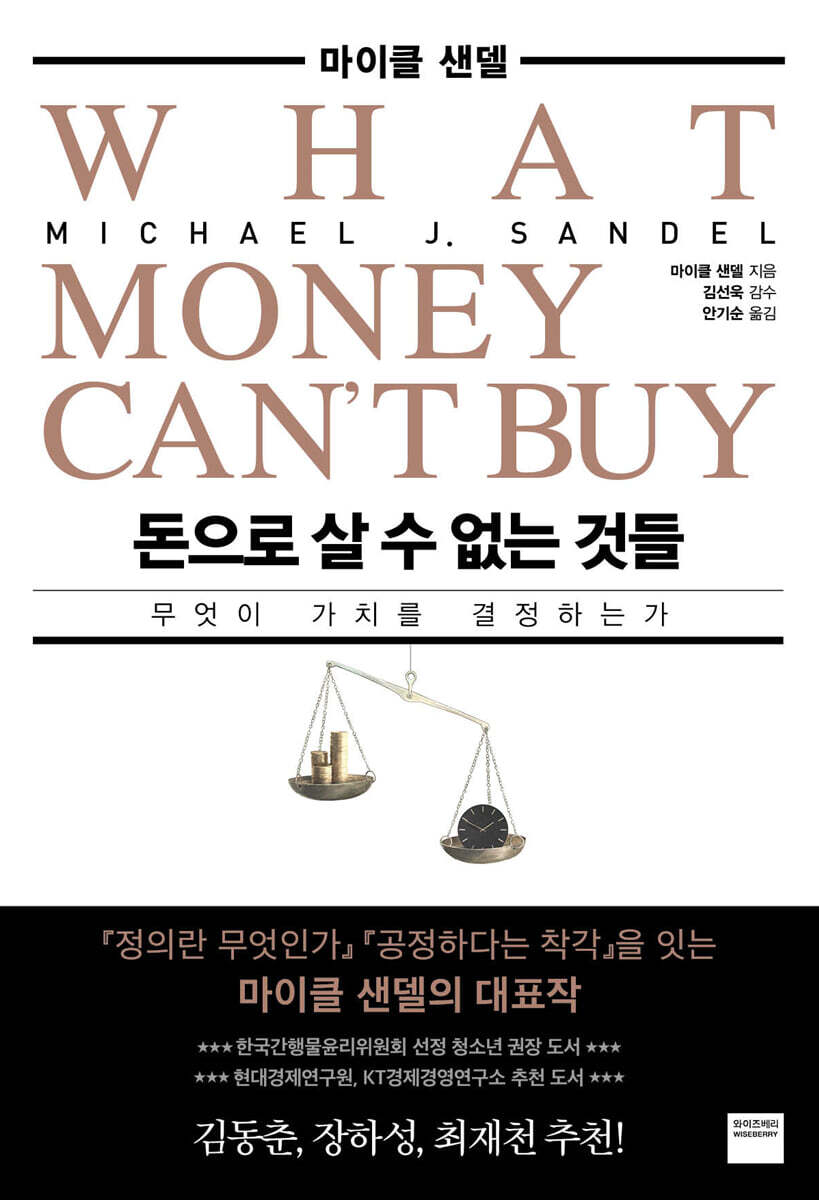
In an age where even moral values are bought and sold, what is the role of the market? Harvard University's most popular lecture, "Markets and Morals," is now available as a book, following "Justice" and "The Illusion of Fairness." Michael Sandel's masterpiece, "What Money Can't Buy," is another masterpiece by Sandel, who brought about the "justice" craze in Korea. It discusses the moral limits of markets and the blind spots of market supremacy. This is a masterpiece that Sandel completed after 15 years of thorough preparation and reflection on the moral limits of the market, and is based on his most popular lecture at Harvard University, "Markets & Morals," which followed "Justice." Through this book, Sandel provides an opportunity to reflect on the limitations of market economy. By presenting specific cases where market logic dominates all areas of society, it provides an answer to the question, "Is the market always right?" The author's signature question-and-answer style, provocative questions, and meticulous logic lead to a compelling philosophical debate surrounding the market. There are many things in the world that money cannot buy. Issues such as sex, education, and the environment have traditionally been areas not subject to market dominance. But now, if you have money, you can change your last name, get into a donation-based school, and even buy carbon credits. Amusement parks and other places sometimes sell priority admission tickets. Moral realms that are considered invaluable are increasingly being dominated by money and the market, and their values are being distorted. Sandel draws attention to this very point, warning against market supremacy and helping us rethink the role of the market. Rather than leaving us to the market to decide when to use the market and what not to trade, it cultivates the power of philosophical thinking that allows us to make our own judgments. In this age of declining moral values, this is a book worth reading. |
- You can preview some of the book's contents.
Preview
index
Introduction: Markets and Morality
The era of market supremacy
The era of omnipotent transactions
Rethinking the role of the market
1.
cut-off
Priority boarding pass
By Lexus car
Proxy queue business
Black market for medical appointment vouchers
Dedicated doctor system
The market logic of the newbie
Market queue
Markets and Corruption
What's wrong with ticket scalping?
The morality of queuing
2.
incentives
Cash incentives to encourage sterilization
An economic approach to life
A prize given to a student with good grades
Bribes for maintaining health
distorted incentives
Fines vs. Fees
Purchase a black rhino hunting license
Walrus hunting rights
Incentives and Moral Confusion
3.
How Markets Push Morality
What money can and can't buy
Proxy apology service and wedding congratulatory speech sales
Economic logic against gift exchange
Cashing in on a gift? Fame bought with money
Two objections surrounding the market
Pushing out non-market norms
nuclear waste disposal site
Donation Day and Parents Picking Up Their Kids Late
commercialization effect
Blood sales
Two positions surrounding market beliefs
Economization of Love
4.
Market of Life and Death
Janitor Insurance
Life-threatening gamble, terminal repayment
Deathpool
A Brief History of Life Insurance from a Moral Perspective
terrorism futures market
Other people's lives
Death bond
5.
naming rights
Trade of Signs
Game name
Skybox
Moneyball
Advertising space
What is the problem with commercialism?
City Marketing
Skyboxing
The era of market supremacy
The era of omnipotent transactions
Rethinking the role of the market
1.
cut-off
Priority boarding pass
By Lexus car
Proxy queue business
Black market for medical appointment vouchers
Dedicated doctor system
The market logic of the newbie
Market queue
Markets and Corruption
What's wrong with ticket scalping?
The morality of queuing
2.
incentives
Cash incentives to encourage sterilization
An economic approach to life
A prize given to a student with good grades
Bribes for maintaining health
distorted incentives
Fines vs. Fees
Purchase a black rhino hunting license
Walrus hunting rights
Incentives and Moral Confusion
3.
How Markets Push Morality
What money can and can't buy
Proxy apology service and wedding congratulatory speech sales
Economic logic against gift exchange
Cashing in on a gift? Fame bought with money
Two objections surrounding the market
Pushing out non-market norms
nuclear waste disposal site
Donation Day and Parents Picking Up Their Kids Late
commercialization effect
Blood sales
Two positions surrounding market beliefs
Economization of Love
4.
Market of Life and Death
Janitor Insurance
Life-threatening gamble, terminal repayment
Deathpool
A Brief History of Life Insurance from a Moral Perspective
terrorism futures market
Other people's lives
Death bond
5.
naming rights
Trade of Signs
Game name
Skybox
Moneyball
Advertising space
What is the problem with commercialism?
City Marketing
Skyboxing
Detailed image
Publisher's Review
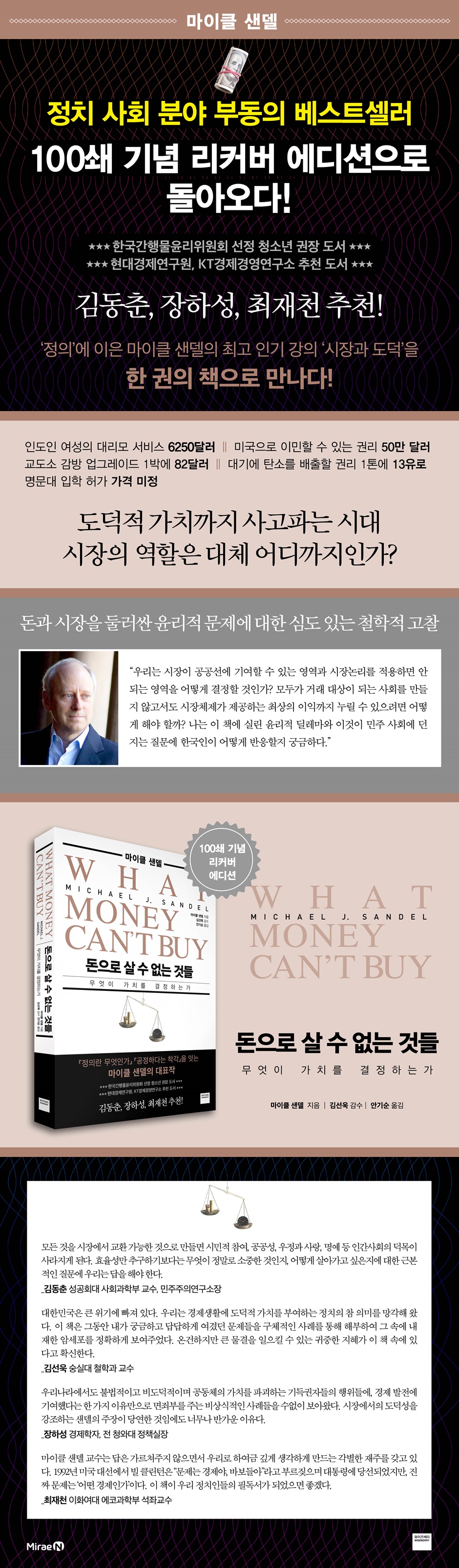
A perennial bestseller in the field of politics and society
Back with the 100th printing commemorative recover edition!
In an era of market dominance, a warning and in-depth reflection from the world's greatest political philosopher!
Michael Sandel, a world-renowned political philosopher who sparked a "justice" craze in Korea, has released his masterpiece, "What Money Can't Buy," in a 100th edition commemorative edition.
A perennial bestseller in the political and social fields for 13 years, "What Money Can't Buy" reexamines the role of markets in an era of market omnipotence, posing crucial questions for our time.
As market values expand into areas of life previously untouched by them—education, the environment, family, health, politics—Sandel poses the most crucial ethical question of our time.
Is the market always right?
The 2008 financial crisis brought the global economy to a standstill, raising skepticism about capitalism and the market economy.
It seemed that market supremacy was about to meet a violent end.
However, in the absence of an alternative that the majority can agree on, the focus of discussion is on how to reform the current capitalist and economic structure, and faith in the market has not wavered.
If the market is the most efficient tool for distributing goods and creating wealth, and if transactions are conducted fairly through the free choice of individuals, the belief that "the market is always right" goes beyond certainty and occupies a religious status.
In fact, it was the government that lost credibility due to the financial crisis.
Public discourse has focused on how to correct the greed of corporations and the financial sector, how to correct the government's failure to properly oversee the autonomous functioning of the market, and how to come up with reasonable regulatory solutions.
Michael Sandel argues that before these institutional improvements can be made, our thinking about markets must fundamentally change.
Even if market self-regulation and government oversight are properly implemented, if market transactions undermine and distort lifestyles, ways of thinking, and moral and community values, this should not be tolerated in the name of efficiency.
Mike Sandel's popular lecture following "Justice"
Meet 'Market and Morality' in one book!
This book is based on a philosophy course at Harvard University titled "Markets & Morals," which began in the spring semester of 2012.
Reflecting Sandel's reputation, the lecture was so popular that students who had not been able to register for the class on the first day flocked to the lecture, forcing the lecture to be moved to a larger lecture room.
This lecture began with the discussion of 'Markets and Morality' in the 'Tanner Lectures on Human Values' at Oxford University in 1998, and was further developed with support from the Carnegie Endowment for Research in 2000-2002.
In 2009, he impressed many audiences with his lectures on the desirable role of markets at the Reith Lectures hosted by BBC Radio 4, and through his lectures at the World Knowledge Forum in 2011, the SERI CEO lecture in 2012, and the special discussion on “Coexistence and Justice” on Channel A, he provided an opportunity for domestic intellectuals and opinion leaders to point out the limitations of market supremacy.
As such, this book is a masterpiece that Sandel completed after 15 years of thorough preparation and deliberation.
This book presents a self-portrait of market fundamentalism through specific cases in which market logic dominates all areas of society.
Sandel argues that rather than being helplessly swayed by the market's infinite expansion, we must deeply consider this issue and seek solutions through public discussion.
Sandel's signature question-and-answer style, provocative question-and-answer presentation, and rigorous logic guide us through the fascinating philosophical debate surrounding the market, delving into vivid examples relevant to everyday life.
A market that pushes out morality,
Dissecting a society where everything is bought and sold
Sandel diagnoses that in recent decades, without us even realizing it, our society has shifted from a market economy to a market society.
In a market economy, the market is an effective 'tool' for producing goods and creating wealth, while a market society is a kind of 'lifestyle' in which market values have permeated all areas of human activity.
Sandel focuses on the transformation of value that occurs when money and markets intervene in areas that were not previously traded in the market.
For example, in Israel, daycare centers introduced a fine system when the number of parents picking up their children late increased.
However, the number of parents picking up their children late has not decreased, but rather increased.
This is a very puzzling result considering the logic of general economics, which believes that people respond to incentives.
The guilt felt when picking up a child late has been transformed into a 'service' that can be enjoyed by paying a fee with the introduction of a fine system.
In other words, financial incentives changed the norm.
To improve children's grades, how about giving them a small amount of money every time they read a book? While this might increase their reading volume in the short term, it's highly likely they'll view reading as a means to earn money.
Giving money to children can be seen as a kind of morally compromised bribe that replaces the higher norm of reading for the pleasure of reading with the lower norm of reading for money.
Wouldn't selling indulgences to help the needy be a good thing? Wouldn't selling college admissions to provide scholarships to students in need benefit everyone? When you don't know what the recipient will like, wouldn't gifting a gift certificate be more rational? Economists argue that the efficient allocation of resources through the market will benefit everyone, as long as transactions aren't unequal or coerced.
However, Sandel counters that moral values are pushed out when areas traditionally governed by non-market norms, such as sex, school qualifications, the environment, and education, are bought and sold for money.
That is, the value of some goods is damaged or altered when they are traded as commodities in the market.
"What Money Can't Buy" is a meticulously argued book based on numerous examples, concluding that goods whose original value and purpose are damaged when bought and sold with money should not be left to the market.
To determine when to use the market and what should not be traded there, we must first decide how to evaluate the value of goods and social practices such as health, the environment, education, national security, childbirth, and human rights.
Now it's time for us to ask the market
What is the true role of the market?
Sandel diagnoses that the reason market supremacy, in which the market determines value on our behalf, has dominated society for the past several decades is because we have been afraid to reveal our moral beliefs in the public sphere and have not questioned what belongs in the market and what does not.
Now that the disastrous consequences of market supremacy have been revealed, it is time for a sober moral judgment on the market and its role, not a stopgap measure of institutional reform and a showy cry for "coexistence and symbiosis."
Sandel believes that hope for moral and civic renewal depends on bringing these concerns into public discourse.
"What Money Can't Buy" sparks precisely this debate and provides a philosophical framework for determining the moral limits of markets and how to appropriately assess the value of goods.
Ultimately, this book is about, as Sandel puts it, 'how we will live together.'
Back with the 100th printing commemorative recover edition!
In an era of market dominance, a warning and in-depth reflection from the world's greatest political philosopher!
Michael Sandel, a world-renowned political philosopher who sparked a "justice" craze in Korea, has released his masterpiece, "What Money Can't Buy," in a 100th edition commemorative edition.
A perennial bestseller in the political and social fields for 13 years, "What Money Can't Buy" reexamines the role of markets in an era of market omnipotence, posing crucial questions for our time.
As market values expand into areas of life previously untouched by them—education, the environment, family, health, politics—Sandel poses the most crucial ethical question of our time.
Is the market always right?
The 2008 financial crisis brought the global economy to a standstill, raising skepticism about capitalism and the market economy.
It seemed that market supremacy was about to meet a violent end.
However, in the absence of an alternative that the majority can agree on, the focus of discussion is on how to reform the current capitalist and economic structure, and faith in the market has not wavered.
If the market is the most efficient tool for distributing goods and creating wealth, and if transactions are conducted fairly through the free choice of individuals, the belief that "the market is always right" goes beyond certainty and occupies a religious status.
In fact, it was the government that lost credibility due to the financial crisis.
Public discourse has focused on how to correct the greed of corporations and the financial sector, how to correct the government's failure to properly oversee the autonomous functioning of the market, and how to come up with reasonable regulatory solutions.
Michael Sandel argues that before these institutional improvements can be made, our thinking about markets must fundamentally change.
Even if market self-regulation and government oversight are properly implemented, if market transactions undermine and distort lifestyles, ways of thinking, and moral and community values, this should not be tolerated in the name of efficiency.
Mike Sandel's popular lecture following "Justice"
Meet 'Market and Morality' in one book!
This book is based on a philosophy course at Harvard University titled "Markets & Morals," which began in the spring semester of 2012.
Reflecting Sandel's reputation, the lecture was so popular that students who had not been able to register for the class on the first day flocked to the lecture, forcing the lecture to be moved to a larger lecture room.
This lecture began with the discussion of 'Markets and Morality' in the 'Tanner Lectures on Human Values' at Oxford University in 1998, and was further developed with support from the Carnegie Endowment for Research in 2000-2002.
In 2009, he impressed many audiences with his lectures on the desirable role of markets at the Reith Lectures hosted by BBC Radio 4, and through his lectures at the World Knowledge Forum in 2011, the SERI CEO lecture in 2012, and the special discussion on “Coexistence and Justice” on Channel A, he provided an opportunity for domestic intellectuals and opinion leaders to point out the limitations of market supremacy.
As such, this book is a masterpiece that Sandel completed after 15 years of thorough preparation and deliberation.
This book presents a self-portrait of market fundamentalism through specific cases in which market logic dominates all areas of society.
Sandel argues that rather than being helplessly swayed by the market's infinite expansion, we must deeply consider this issue and seek solutions through public discussion.
Sandel's signature question-and-answer style, provocative question-and-answer presentation, and rigorous logic guide us through the fascinating philosophical debate surrounding the market, delving into vivid examples relevant to everyday life.
A market that pushes out morality,
Dissecting a society where everything is bought and sold
Sandel diagnoses that in recent decades, without us even realizing it, our society has shifted from a market economy to a market society.
In a market economy, the market is an effective 'tool' for producing goods and creating wealth, while a market society is a kind of 'lifestyle' in which market values have permeated all areas of human activity.
Sandel focuses on the transformation of value that occurs when money and markets intervene in areas that were not previously traded in the market.
For example, in Israel, daycare centers introduced a fine system when the number of parents picking up their children late increased.
However, the number of parents picking up their children late has not decreased, but rather increased.
This is a very puzzling result considering the logic of general economics, which believes that people respond to incentives.
The guilt felt when picking up a child late has been transformed into a 'service' that can be enjoyed by paying a fee with the introduction of a fine system.
In other words, financial incentives changed the norm.
To improve children's grades, how about giving them a small amount of money every time they read a book? While this might increase their reading volume in the short term, it's highly likely they'll view reading as a means to earn money.
Giving money to children can be seen as a kind of morally compromised bribe that replaces the higher norm of reading for the pleasure of reading with the lower norm of reading for money.
Wouldn't selling indulgences to help the needy be a good thing? Wouldn't selling college admissions to provide scholarships to students in need benefit everyone? When you don't know what the recipient will like, wouldn't gifting a gift certificate be more rational? Economists argue that the efficient allocation of resources through the market will benefit everyone, as long as transactions aren't unequal or coerced.
However, Sandel counters that moral values are pushed out when areas traditionally governed by non-market norms, such as sex, school qualifications, the environment, and education, are bought and sold for money.
That is, the value of some goods is damaged or altered when they are traded as commodities in the market.
"What Money Can't Buy" is a meticulously argued book based on numerous examples, concluding that goods whose original value and purpose are damaged when bought and sold with money should not be left to the market.
To determine when to use the market and what should not be traded there, we must first decide how to evaluate the value of goods and social practices such as health, the environment, education, national security, childbirth, and human rights.
Now it's time for us to ask the market
What is the true role of the market?
Sandel diagnoses that the reason market supremacy, in which the market determines value on our behalf, has dominated society for the past several decades is because we have been afraid to reveal our moral beliefs in the public sphere and have not questioned what belongs in the market and what does not.
Now that the disastrous consequences of market supremacy have been revealed, it is time for a sober moral judgment on the market and its role, not a stopgap measure of institutional reform and a showy cry for "coexistence and symbiosis."
Sandel believes that hope for moral and civic renewal depends on bringing these concerns into public discourse.
"What Money Can't Buy" sparks precisely this debate and provides a philosophical framework for determining the moral limits of markets and how to appropriately assess the value of goods.
Ultimately, this book is about, as Sandel puts it, 'how we will live together.'
GOODS SPECIFICS
- Date of issue: April 24, 2012
- Page count, weight, size: 336 pages | 597g | 153*224*30mm
- ISBN13: 9788937833663
- ISBN10: 8937833662
You may also like
카테고리
korean


korean

![GQ KOREA Mark (Monthly): December [2025]](http://librairie.coreenne.fr/cdn/shop/files/8ef265dbbfbf186523ed75ba7319009d.jpg?v=1765340328&width=3840)


