

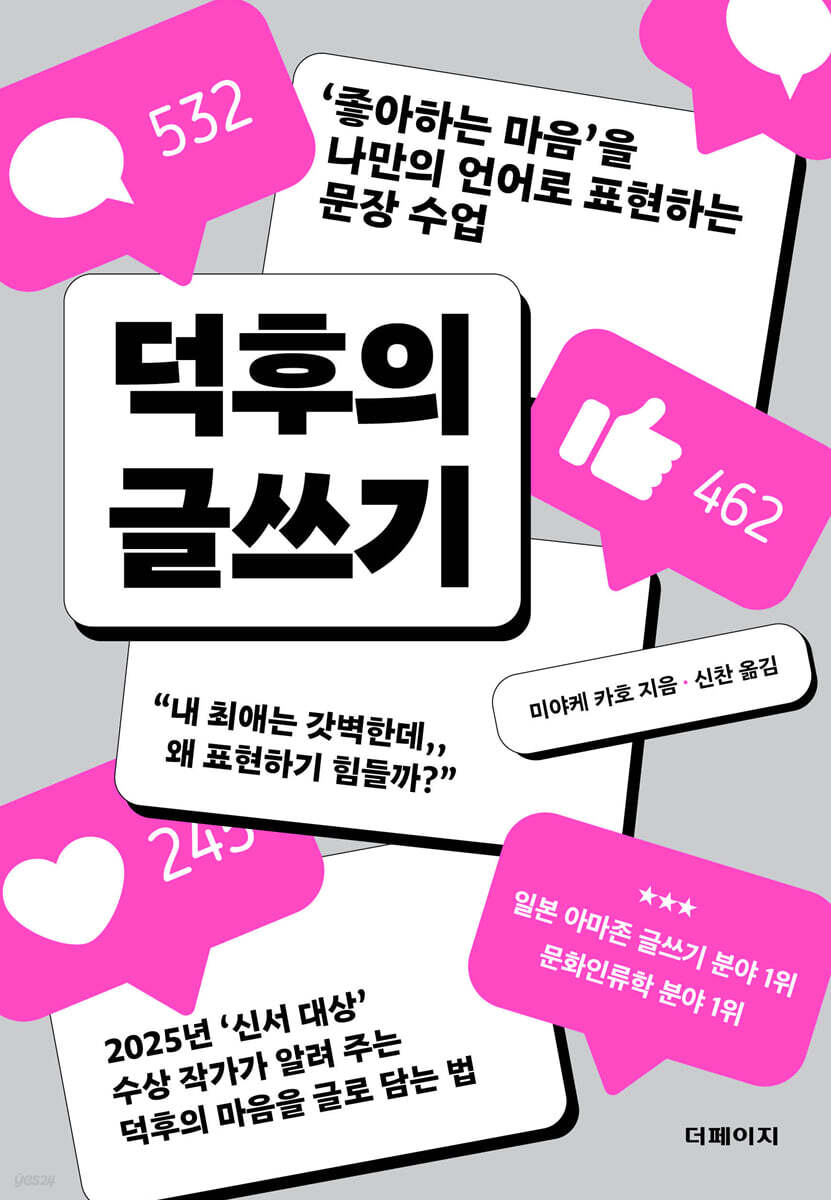
Nerd's writing
 |
Description
Book Introduction
“No more clichés!
“I convey my favorite emotions 100% in my own language.”
The art of accurately conveying your feelings through words and writing
“This book teaches me the most powerful language habit, not just about writing, but about thinking through my emotions in detail and protecting myself from the gaze of others.
“After reading it, both what I like and my existence become clearer.”
When you try to describe that moment when your heart almost bursts, aren't the only words that come to mind are "Awesome!" or "Awesome!"? Passion explodes, but expressions are always trapped in clichés.
This frustration goes beyond the simple feeling of not being able to properly convey what you like, and eventually even makes that emotion fade.
In these desperate moments, we often blame our vocabulary or writing skills and end up choosing silence.
But I can assure you that the problem is not that you are empty-headed or lack writing skills.
So what's the problem? In this book, the author presents both the problem and a clear solution.
It doesn't require advanced knowledge or genius; all you need is a few small tricks to capture and finely dissect emotions.
Without having to memorize complex rhetoric, I can clearly distinguish whether the emotion I feel as "good" is "empathy" or "surprise," and ask the question, "Why did I feel good?" to break down the cause of the emotion.
These detailed emotions develop into my own unique language that can be truly conveyed to others.
The author is Miyake Kaho, a renowned Japanese literary critic and book reviewer.
By combining his deep experience of 'fandom' towards idols and works with sharp logic and writing skills, he has elevated simple fandom into the skill of original writing.
As a result, he was recognized as an expert who had already raised intellectual issues in Japanese society by winning the 'New Book Award', Japan's most prestigious award.
This book is a unique guide that goes beyond simple appreciation methods and contains proven language construction techniques and know-how in logical thinking.
Now that you have mastered the techniques presented in this book, you no longer have to remain in vague feelings.
You'll gain powerful persuasive skills that will make your favorite character's appeal ten times more engaging and instantly transform your listeners into fanboys. You'll also dramatically improve your ability to write original, cliché-free reviews on social media and blogs. Beyond simply improving your expressive skills, you'll also experience a process of solidifying your own tastes and values.
The anxious days of being swayed by the words of others and doubting even my own feelings are over.
You now have the ability to build your most powerful weapon to protect yourself: your own language.
This book is more than just a simple writing guide; it's a practical manual that will take your fan life to the limit, and it will serve as a sensory tool for life that will allow you to fully express and enjoy what you love.
Let's begin today on a journey to truly convey your emotions.
“I convey my favorite emotions 100% in my own language.”
The art of accurately conveying your feelings through words and writing
“This book teaches me the most powerful language habit, not just about writing, but about thinking through my emotions in detail and protecting myself from the gaze of others.
“After reading it, both what I like and my existence become clearer.”
When you try to describe that moment when your heart almost bursts, aren't the only words that come to mind are "Awesome!" or "Awesome!"? Passion explodes, but expressions are always trapped in clichés.
This frustration goes beyond the simple feeling of not being able to properly convey what you like, and eventually even makes that emotion fade.
In these desperate moments, we often blame our vocabulary or writing skills and end up choosing silence.
But I can assure you that the problem is not that you are empty-headed or lack writing skills.
So what's the problem? In this book, the author presents both the problem and a clear solution.
It doesn't require advanced knowledge or genius; all you need is a few small tricks to capture and finely dissect emotions.
Without having to memorize complex rhetoric, I can clearly distinguish whether the emotion I feel as "good" is "empathy" or "surprise," and ask the question, "Why did I feel good?" to break down the cause of the emotion.
These detailed emotions develop into my own unique language that can be truly conveyed to others.
The author is Miyake Kaho, a renowned Japanese literary critic and book reviewer.
By combining his deep experience of 'fandom' towards idols and works with sharp logic and writing skills, he has elevated simple fandom into the skill of original writing.
As a result, he was recognized as an expert who had already raised intellectual issues in Japanese society by winning the 'New Book Award', Japan's most prestigious award.
This book is a unique guide that goes beyond simple appreciation methods and contains proven language construction techniques and know-how in logical thinking.
Now that you have mastered the techniques presented in this book, you no longer have to remain in vague feelings.
You'll gain powerful persuasive skills that will make your favorite character's appeal ten times more engaging and instantly transform your listeners into fanboys. You'll also dramatically improve your ability to write original, cliché-free reviews on social media and blogs. Beyond simply improving your expressive skills, you'll also experience a process of solidifying your own tastes and values.
The anxious days of being swayed by the words of others and doubting even my own feelings are over.
You now have the ability to build your most powerful weapon to protect yourself: your own language.
This book is more than just a simple writing guide; it's a practical manual that will take your fan life to the limit, and it will serve as a sensory tool for life that will allow you to fully express and enjoy what you love.
Let's begin today on a journey to truly convey your emotions.
- You can preview some of the book's contents.
Preview
index
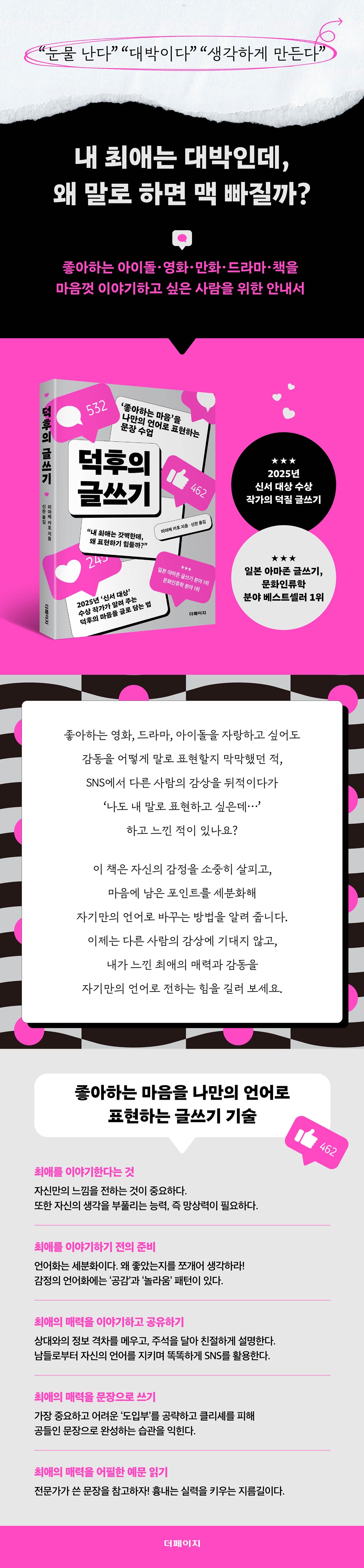
To begin with, a fan's writing begins with his own language.
Chapter 1: A Story About Your Favorite Love Is a Life Confession
How should I talk about my favorite person?
Your own feelings are the most important
Willingness to put effort into sentences
We need imagination, not reading comprehension.
Chapter 2: Preparation before talking about your favorite
Why verbalize your favorite?
How to Tell Your Favorite Story in the Smartphone Age
Verbalization is segmentation
There is a pattern to verbalizing emotions.
Putting gossip into words is surprisingly difficult.
Notes are most enjoyable when written freely and alone.
Chapter 3: Talking about your favorite charm
Narrowing the information gap with your opponent
Speaking with annotations
Tips for talking about your favorite person
Chapter 4: Share Your Favorite Charms on Social Media
Protecting your language from others
It should not be contagious to the language of others.
Mention yourself while talking about your favorite person
Chapter 5: Let's Write a Sentence About Your Favorite Charm
A good sentence is one that conveys a story you want to share.
The most important and most difficult introduction
Let's write it all out, even if it's roughly written!
What to do when things don't work out well
Get into the habit of revising your writing.
Chapter 6: Let's read an example sentence that appeals to the charm of a favorite.
Let's refer to the sentences written by experts!
Imitation is a shortcut to improving your skills.
Q&A about the charm of your favorite book, perfect for when you're stuck
In conclusion, for a healthy otaku life that is maintained in one's own language.
Chapter 1: A Story About Your Favorite Love Is a Life Confession
How should I talk about my favorite person?
Your own feelings are the most important
Willingness to put effort into sentences
We need imagination, not reading comprehension.
Chapter 2: Preparation before talking about your favorite
Why verbalize your favorite?
How to Tell Your Favorite Story in the Smartphone Age
Verbalization is segmentation
There is a pattern to verbalizing emotions.
Putting gossip into words is surprisingly difficult.
Notes are most enjoyable when written freely and alone.
Chapter 3: Talking about your favorite charm
Narrowing the information gap with your opponent
Speaking with annotations
Tips for talking about your favorite person
Chapter 4: Share Your Favorite Charms on Social Media
Protecting your language from others
It should not be contagious to the language of others.
Mention yourself while talking about your favorite person
Chapter 5: Let's Write a Sentence About Your Favorite Charm
A good sentence is one that conveys a story you want to share.
The most important and most difficult introduction
Let's write it all out, even if it's roughly written!
What to do when things don't work out well
Get into the habit of revising your writing.
Chapter 6: Let's read an example sentence that appeals to the charm of a favorite.
Let's refer to the sentences written by experts!
Imitation is a shortcut to improving your skills.
Q&A about the charm of your favorite book, perfect for when you're stuck
In conclusion, for a healthy otaku life that is maintained in one's own language.
Detailed image
Into the book
In this book, I present to you the skills I've accumulated over the years as a book reviewer, sharing my favorites in my own words.
There are no restrictions on the 'favorite' type.
Actors, voice actors, YouTubers, idols, music bands, singers, athletes, anime characters, books, comics, movies, fishing, hiking, running, traveling, baduk, plants… whatever you like. We've divided it into categories based on sharing format, such as short posts on social media, long-form content like blogs, and when talking to friends or to an unspecified audience.
--- p.14
As you share your favorites in your own language, you'll definitely discover where your own affections come from.
Talking about your favorite person is also talking about your own life.
--- p.15
Writing also requires skill.
To write a great review, you need to be able to use your skills well.
In other words, it means, 'If you just understand writing skills, you can write a good review or good sentences.'
Moreover, depending on how you think about it, a book review can also be a way to express your favorite.
Because it is a review written from the perspective of appealing to a book you like.
In that sense, even when talking about your favorite, you need proper skills.
--- p.24
There may not be many people who care about their writing skills even though they are not novelists.
However, anyone who cares about their writing skills should keep in mind that writing ability is determined not by writing skills but by the amount of effort put into it.
If you look at the world's writings with that mindset, you can see another side of them.
That way, you can learn things from other people's writing, like, "Aha, this word makes the sentence easier to understand," or "That line break here messed up the story."
--- p.36
Even if the feeling of love is shaken and lost, if you leave it in words, you can keep that feeling within you.
For example, if your favorite person is an idol.
I was having a great time chasing live performances and releasing new songs, but then a scandal broke out.
Many people criticize the idol and are shocked themselves.
--- p.55
The attitude of using your own language rather than borrowing the language of others will instill confidence in your own feelings.
Again, I emphasize that you need to be able to explain what you like in your own words.
The language of others is meaningless.
The reason I keep saying that you should use your own language and not someone else's is because it is so important.
--- p.65
Originally, ‘sharing’ begins with understanding the distance between oneself and the other person.
This isn't limited to just talking about your favorites.
Interviews, presentations, YouTube, lectures, etc. are all the same.
Any activity that involves conveying information to someone, or "sharing," must begin with first determining the distance between you and the other person.
--- p.104
That's a given.
If the information of yourself and the other person is the same, there is no need to share it.
What makes your sharing valuable is that there is "unknown information" between you and someone else.
When I say information, it might sound a bit inorganic, but anything that expresses simple feelings like 'I'm hungry' or 'I'm sleepy' is fine.
There is an information gap between you and your partner, as they may not know that you are hungry.
And how much the other person wants to know about your hunger is their position on that information.
--- p.107
There is no relationship between ‘your favorite’ and ‘yourself’ and ‘the feelings of others’.
The emotions of others we're talking about here are the words of fans who share your tastes or the general worldview. So, isn't there any reason to bring others' emotions into your relationship with your favorite? In fact, I feel it's a shame that the self-talk you've built over time could be shaken by the influence of others.
--- p.135
The 'commitment to writing' is a means of bridging the gap between oneself and others.
You might wonder, 'Do I really need to put in that much effort?'
You might be dumbfounded and think, 'Why don't you just write whatever you want?'
But if you really want to convey something, you have to put in the time and effort.
--- p.160
In that sense, I will introduce a coping method for when things don't work out well.
First, let's look at the patterns that cause writing blockages.
The first thing to be suspicious of is 'when the beginning of the text is strange in the first place'.
If you try to force your logic from the beginning or if it's a topic you don't really want to write about, it may be difficult to write until the end.
--- p.181
When sharing your favorite's charm, instead of using commonly used words and concepts, why not try expressing it in your own words? I explained the methodology earlier.
Every time I read poet Saihate's sentences, I feel that 'language correction' has been repeated.
--- p.208
When you imitate someone, there comes a moment when your own individuality comes out.
Rather than trying to find your own individuality from the beginning, try to find your own uniqueness by imitating the way people like you do. That will become your individuality.
--- p.222
I hope this book helps you shine your favorite light.
And above all, I sincerely hope that you can live a healthy life enjoying your favorite things.
Let's have fun sharing our favorites.
And let's build our own language.
First of all, that would be the starting line.
There are no restrictions on the 'favorite' type.
Actors, voice actors, YouTubers, idols, music bands, singers, athletes, anime characters, books, comics, movies, fishing, hiking, running, traveling, baduk, plants… whatever you like. We've divided it into categories based on sharing format, such as short posts on social media, long-form content like blogs, and when talking to friends or to an unspecified audience.
--- p.14
As you share your favorites in your own language, you'll definitely discover where your own affections come from.
Talking about your favorite person is also talking about your own life.
--- p.15
Writing also requires skill.
To write a great review, you need to be able to use your skills well.
In other words, it means, 'If you just understand writing skills, you can write a good review or good sentences.'
Moreover, depending on how you think about it, a book review can also be a way to express your favorite.
Because it is a review written from the perspective of appealing to a book you like.
In that sense, even when talking about your favorite, you need proper skills.
--- p.24
There may not be many people who care about their writing skills even though they are not novelists.
However, anyone who cares about their writing skills should keep in mind that writing ability is determined not by writing skills but by the amount of effort put into it.
If you look at the world's writings with that mindset, you can see another side of them.
That way, you can learn things from other people's writing, like, "Aha, this word makes the sentence easier to understand," or "That line break here messed up the story."
--- p.36
Even if the feeling of love is shaken and lost, if you leave it in words, you can keep that feeling within you.
For example, if your favorite person is an idol.
I was having a great time chasing live performances and releasing new songs, but then a scandal broke out.
Many people criticize the idol and are shocked themselves.
--- p.55
The attitude of using your own language rather than borrowing the language of others will instill confidence in your own feelings.
Again, I emphasize that you need to be able to explain what you like in your own words.
The language of others is meaningless.
The reason I keep saying that you should use your own language and not someone else's is because it is so important.
--- p.65
Originally, ‘sharing’ begins with understanding the distance between oneself and the other person.
This isn't limited to just talking about your favorites.
Interviews, presentations, YouTube, lectures, etc. are all the same.
Any activity that involves conveying information to someone, or "sharing," must begin with first determining the distance between you and the other person.
--- p.104
That's a given.
If the information of yourself and the other person is the same, there is no need to share it.
What makes your sharing valuable is that there is "unknown information" between you and someone else.
When I say information, it might sound a bit inorganic, but anything that expresses simple feelings like 'I'm hungry' or 'I'm sleepy' is fine.
There is an information gap between you and your partner, as they may not know that you are hungry.
And how much the other person wants to know about your hunger is their position on that information.
--- p.107
There is no relationship between ‘your favorite’ and ‘yourself’ and ‘the feelings of others’.
The emotions of others we're talking about here are the words of fans who share your tastes or the general worldview. So, isn't there any reason to bring others' emotions into your relationship with your favorite? In fact, I feel it's a shame that the self-talk you've built over time could be shaken by the influence of others.
--- p.135
The 'commitment to writing' is a means of bridging the gap between oneself and others.
You might wonder, 'Do I really need to put in that much effort?'
You might be dumbfounded and think, 'Why don't you just write whatever you want?'
But if you really want to convey something, you have to put in the time and effort.
--- p.160
In that sense, I will introduce a coping method for when things don't work out well.
First, let's look at the patterns that cause writing blockages.
The first thing to be suspicious of is 'when the beginning of the text is strange in the first place'.
If you try to force your logic from the beginning or if it's a topic you don't really want to write about, it may be difficult to write until the end.
--- p.181
When sharing your favorite's charm, instead of using commonly used words and concepts, why not try expressing it in your own words? I explained the methodology earlier.
Every time I read poet Saihate's sentences, I feel that 'language correction' has been repeated.
--- p.208
When you imitate someone, there comes a moment when your own individuality comes out.
Rather than trying to find your own individuality from the beginning, try to find your own uniqueness by imitating the way people like you do. That will become your individuality.
--- p.222
I hope this book helps you shine your favorite light.
And above all, I sincerely hope that you can live a healthy life enjoying your favorite things.
Let's have fun sharing our favorites.
And let's build our own language.
First of all, that would be the starting line.
--- p.235
Publisher's Review
“Don’t just press ‘Like’ without thinking, like an automatic reaction.
“Let’s be hipsters who know how to explain why something is good!”
Favorite idols, movies, comics, dramas, and books
A guide for those who want to talk freely
ㆍPeople who want to introduce their favorites but always shout “Awesome!” or “The best!”
ㆍPeople who feel anxious because it seems like their own impressions are only organized after reading other people's reviews
ㆍPeople who want to express their sincerity in specific sentences on fan letters, blogs, and SNS
ㆍPeople who want to understand themselves and their loved ones
When I opened my mouth to show off my 'favorite' that made my heart race to the world, that overwhelming emotion was reduced to just a simple "Awesome!"
It is a moment of 'language pause' that everyone has experienced at least once.
My passionate heart seems to be capable of destroying the universe, but the words that come out of my mouth are stuck in a swamp of obvious and clichéd phrases.
In these frustrating moments, we blame ourselves, saying, "My vocabulary is really lacking," and bury our precious emotions in silence.
Now, the twist begins with this book.
The author asserts that your head is not empty, and declares that “the problem is not vocabulary, but a little bit of tact.”
Once you know the trick, your nerd life will be completely upgraded from now on.
It is equipped with the extremely powerful 'Emotion Cause Segmentation Technology Patch'.
The 'language cheat key' presented by a literary critic who has systematically compiled his own 'fandom' experiences is surprisingly fresh and full of pleasant twists.
“How should I express this warm emotion?”
Writing techniques that express emotion and virtue
The author first points out that if there are people who laugh when you shout “Wow!”, they are missing the historical truth from 1,000 years ago.
This kind of exclamation is a powerful raw material that expresses 'unknown wonder', like 'Aharenari' of Japan's Heian period.
But without the process of polishing this raw stone, it would just remain as a passing, ordinary exclamation.
Once we have established the legitimacy of our admiration, we must now concretize that emotion in words.
The author cheerfully advises that when writing a book review, many people should put aside their 'reading comprehension skills' and instead focus on their 'illusion skills'.
Here, delusion refers to the ability to inflate one's own thoughts.
If you continue to fantasize endlessly, asking yourself, "Why was it good?" or "What was good?", you will experience the miracle of your feelings exploding into your own story, not objective truth, and the material for language bursting forth.
Along with this, she says that expressions like 'it makes me cry', 'it's driving me crazy', and 'it makes me think' are the clichés that make your sentences the most boring, and that you should boldly erase such sentences from your mind.
The moment you erase the cliché, your brain starts working desperately to find 'my true emotions' and starts churning out original sentences.
And he shows you the magic of creating powerful copy that captivates readers by simply changing the order of your words, bringing the most impactful sentences to the front.
Now, with this book, let's end the anxious era of being swept up in the language of others and doubting even our own emotions.
The process of fully expressing what I like in my own words ultimately leads to the act of firmly establishing my own tastes and values.
Let's equip ourselves with the skills to build our most powerful weapon, 'our own language', and raise the resolution of our unwavering fan life to the limit right now.
If you want to make your favorites ten times more fun to show off and turn everyone around you into fellow nerds, this book is the perfect guide.
“You don’t need to master the vocabulary; you just need to learn a few tricks.”
The most powerful weapon that protects me,
Build your own language
This book is a guide for those who want to express their love for their favorite things, such as idols, comics, movies, concerts, and books, not just with exclamations, but clearly express it in their own words.
The author explains deep insights using simple yet diverse examples that are easy to understand.
Verbalizing the object of your affection is a process of understanding yourself and building your own language without being swept away by the language of others.
Chapter 1 emphasizes that talking about one's favorite is not simply about appreciation, but about 'telling the story of one's life.'
To avoid obvious clichés and maintain one's own unique emotions, one needs to put effort into sentences and have imagination (the power to expand thoughts).
Chapter 2, which follows, is a full-fledged preparatory course, covering training in segmenting and verbalizing emotions.
It distinguishes between two emotional patterns: empathy and surprise, and suggests that we concretize not only positive emotions but also negative emotions, such as discomfort or boredom, in our own words.
Chapter 3 covers how to reduce the information gap with others.
To reach out to others, you need to explain as if you were commenting, and you need to avoid using technical terms and slang to increase your communication skills.
An important weapon at this time is your regular note-taking habits.
This context is extended to social media in Chapter 4.
To protect your own language in a space where it's easy to unconsciously mimic the expressions of others, you must first record your own feelings and center the story of "myself who loves my favorite."
Chapter 5 gets into the actual writing.
The key to writing is to clearly state the story you want to convey, and the introduction in particular serves as a focal point that captures the reader's attention.
When you get stuck, it's helpful to write all the way through and then bring your best parts to the introduction, or simply rewrite the text.
During the revision process, you should eliminate obvious expressions and carefully polish your sentences.
Chapter 6 emphasizes the practice of learning by imitating good writing through real-life examples.
Imitating the writing of experts is a shortcut to expressing your own individuality.
The final Q&A presents specific solutions to realistic concerns such as "when the response is lukewarm," "when you stop at sharing other people's SNS," and "when you want to break away from the nerd tone."
This book begins with the principle of "verbalizing your favorites," and follows a flow that includes segmenting emotions, sharing information, expanding social media, completing writing, studying model answers, and finally, solving real-world problems. You'll learn writing skills to convey your feelings in your own words in a variety of situations, including social media, blogging, presentations, and conversations with friends.
Readers will learn how to express their favorites while discovering a new 'self' within language.
“Let’s be hipsters who know how to explain why something is good!”
Favorite idols, movies, comics, dramas, and books
A guide for those who want to talk freely
ㆍPeople who want to introduce their favorites but always shout “Awesome!” or “The best!”
ㆍPeople who feel anxious because it seems like their own impressions are only organized after reading other people's reviews
ㆍPeople who want to express their sincerity in specific sentences on fan letters, blogs, and SNS
ㆍPeople who want to understand themselves and their loved ones
When I opened my mouth to show off my 'favorite' that made my heart race to the world, that overwhelming emotion was reduced to just a simple "Awesome!"
It is a moment of 'language pause' that everyone has experienced at least once.
My passionate heart seems to be capable of destroying the universe, but the words that come out of my mouth are stuck in a swamp of obvious and clichéd phrases.
In these frustrating moments, we blame ourselves, saying, "My vocabulary is really lacking," and bury our precious emotions in silence.
Now, the twist begins with this book.
The author asserts that your head is not empty, and declares that “the problem is not vocabulary, but a little bit of tact.”
Once you know the trick, your nerd life will be completely upgraded from now on.
It is equipped with the extremely powerful 'Emotion Cause Segmentation Technology Patch'.
The 'language cheat key' presented by a literary critic who has systematically compiled his own 'fandom' experiences is surprisingly fresh and full of pleasant twists.
“How should I express this warm emotion?”
Writing techniques that express emotion and virtue
The author first points out that if there are people who laugh when you shout “Wow!”, they are missing the historical truth from 1,000 years ago.
This kind of exclamation is a powerful raw material that expresses 'unknown wonder', like 'Aharenari' of Japan's Heian period.
But without the process of polishing this raw stone, it would just remain as a passing, ordinary exclamation.
Once we have established the legitimacy of our admiration, we must now concretize that emotion in words.
The author cheerfully advises that when writing a book review, many people should put aside their 'reading comprehension skills' and instead focus on their 'illusion skills'.
Here, delusion refers to the ability to inflate one's own thoughts.
If you continue to fantasize endlessly, asking yourself, "Why was it good?" or "What was good?", you will experience the miracle of your feelings exploding into your own story, not objective truth, and the material for language bursting forth.
Along with this, she says that expressions like 'it makes me cry', 'it's driving me crazy', and 'it makes me think' are the clichés that make your sentences the most boring, and that you should boldly erase such sentences from your mind.
The moment you erase the cliché, your brain starts working desperately to find 'my true emotions' and starts churning out original sentences.
And he shows you the magic of creating powerful copy that captivates readers by simply changing the order of your words, bringing the most impactful sentences to the front.
Now, with this book, let's end the anxious era of being swept up in the language of others and doubting even our own emotions.
The process of fully expressing what I like in my own words ultimately leads to the act of firmly establishing my own tastes and values.
Let's equip ourselves with the skills to build our most powerful weapon, 'our own language', and raise the resolution of our unwavering fan life to the limit right now.
If you want to make your favorites ten times more fun to show off and turn everyone around you into fellow nerds, this book is the perfect guide.
“You don’t need to master the vocabulary; you just need to learn a few tricks.”
The most powerful weapon that protects me,
Build your own language
This book is a guide for those who want to express their love for their favorite things, such as idols, comics, movies, concerts, and books, not just with exclamations, but clearly express it in their own words.
The author explains deep insights using simple yet diverse examples that are easy to understand.
Verbalizing the object of your affection is a process of understanding yourself and building your own language without being swept away by the language of others.
Chapter 1 emphasizes that talking about one's favorite is not simply about appreciation, but about 'telling the story of one's life.'
To avoid obvious clichés and maintain one's own unique emotions, one needs to put effort into sentences and have imagination (the power to expand thoughts).
Chapter 2, which follows, is a full-fledged preparatory course, covering training in segmenting and verbalizing emotions.
It distinguishes between two emotional patterns: empathy and surprise, and suggests that we concretize not only positive emotions but also negative emotions, such as discomfort or boredom, in our own words.
Chapter 3 covers how to reduce the information gap with others.
To reach out to others, you need to explain as if you were commenting, and you need to avoid using technical terms and slang to increase your communication skills.
An important weapon at this time is your regular note-taking habits.
This context is extended to social media in Chapter 4.
To protect your own language in a space where it's easy to unconsciously mimic the expressions of others, you must first record your own feelings and center the story of "myself who loves my favorite."
Chapter 5 gets into the actual writing.
The key to writing is to clearly state the story you want to convey, and the introduction in particular serves as a focal point that captures the reader's attention.
When you get stuck, it's helpful to write all the way through and then bring your best parts to the introduction, or simply rewrite the text.
During the revision process, you should eliminate obvious expressions and carefully polish your sentences.
Chapter 6 emphasizes the practice of learning by imitating good writing through real-life examples.
Imitating the writing of experts is a shortcut to expressing your own individuality.
The final Q&A presents specific solutions to realistic concerns such as "when the response is lukewarm," "when you stop at sharing other people's SNS," and "when you want to break away from the nerd tone."
This book begins with the principle of "verbalizing your favorites," and follows a flow that includes segmenting emotions, sharing information, expanding social media, completing writing, studying model answers, and finally, solving real-world problems. You'll learn writing skills to convey your feelings in your own words in a variety of situations, including social media, blogging, presentations, and conversations with friends.
Readers will learn how to express their favorites while discovering a new 'self' within language.
GOODS SPECIFICS
- Date of issue: November 10, 2025
- Page count, weight, size: 240 pages | 147*212*20mm
- ISBN13: 9791194156307
- ISBN10: 1194156304
You may also like
카테고리
korean


korean

![GQ KOREA Mark (Monthly): December [2025]](http://librairie.coreenne.fr/cdn/shop/files/8ef265dbbfbf186523ed75ba7319009d.jpg?v=1765340328&width=3840)


