

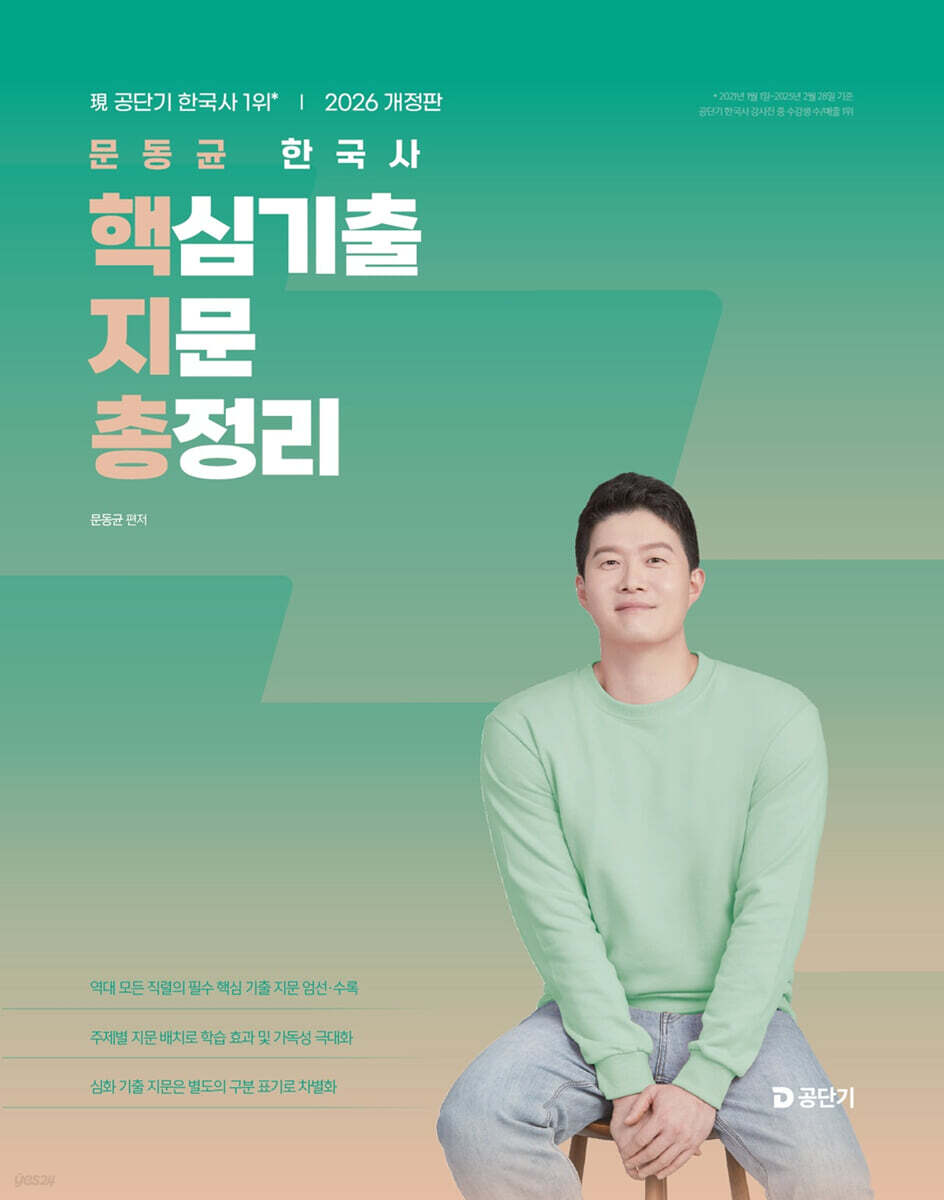
2026 Moon Dong-gyun Korean History Key Past Exam Questions Summary
 |
Description
Book Introduction
The best-selling civil service exam Korean history guide! "2026 Moon Dong-gyun's Korean History Key Past Questions Compilation"
『2026 Moon Dong-gyun's Korean History Key Past Exam Questions Summary (Nuclear Summary)』 is a must-have item for passing the exam in a short period of time, condensing Professor Moon Dong-gyun's passing techniques.
『Nuclear General』 is a final, last-minute textbook that reorganizes past exam questions by type into ○X problems, and it fully reflects the latest exam questions up to 2025, allowing you to immediately grasp the current trends in past exam questions.
This is a must-read textbook for test takers who are weak at memorizing because they cannot grasp and master important passages, test takers whose test scores are stagnant in the 70-80 point range, test takers who fall into the trap of the test passages, test takers who cannot apply what they have learned to actual content, and test takers who need a comprehensive review of Korean history before the test.
『2026 Moon Dong-gyun's Korean History Key Past Exam Questions Summary (Nuclear Summary)』 is a must-have item for passing the exam in a short period of time, condensing Professor Moon Dong-gyun's passing techniques.
『Nuclear General』 is a final, last-minute textbook that reorganizes past exam questions by type into ○X problems, and it fully reflects the latest exam questions up to 2025, allowing you to immediately grasp the current trends in past exam questions.
This is a must-read textbook for test takers who are weak at memorizing because they cannot grasp and master important passages, test takers whose test scores are stagnant in the 70-80 point range, test takers who fall into the trap of the test passages, test takers who cannot apply what they have learned to actual content, and test takers who need a comprehensive review of Korean history before the test.
- You can preview some of the book's contents.
Preview
index
PART 01 Prehistoric Culture and the Formation of the State
01 Development of Prehistoric Times
Theme 001 Paleolithic Age (approximately 700,000 to 10,000 years ago)
Theme 002 Neolithic Age (BC)
Around 8,000 years ago)
02 Formation of the nation
Theme 003 Acceptance and spread of bronze (Bronze Age, BC)
Around 2000~)
Theme 004 Use of Iron (BC)
Around the 5th century~)
Theme 005 Gojoseon
Theme 006: The Establishment and Development of Wiman Joseon (194–108 BC)
Theme 007 Gojoseon Society
03 Growth in various countries
Theme 008 Grant
Theme 009 Goguryeo
Theme 010 Okjeo
Theme 011 Dongye
Theme 012 Samhan
PART 02 Development of Ancient Society
01 Formation of ancient society
Theme 013 Early Goguryeo
Theme 014 Early Baekje
Theme 015 Early Silla and the Evolution of the Royal Title
Theme 016 Gaya
02 Ancient Politics
Theme 017 The Development of Goguryeo
Theme 018 The Golden Age of Baekje
Theme 019 The Golden Age of Goguryeo
Theme 020 The Decline of Baekje
Theme 021 The Revival of Baekje
Theme 022 The Development of Silla
Theme 023 King Jinheung (6th century, 540-576, Silla's golden age)
Theme 024 Inscriptions
Theme 025 The political situation in the late 6th and early 7th centuries - The Yeosu-Su War
Theme 026 7th Century Politics - The Russo-Tang War
Theme 027 The history of the royal dynasties from the late 6th century to the 7th century
Theme 028: Unification of the Three Kingdoms
Theme 029 Yeon Gaesomun (?~666)
Theme 030 Kim Yu-sin (595-673)
Theme 031 Kings of the Middle Silla Dynasty
Theme 032 The situation in the late Silla period
Theme 033 6th Head (Deuknan)
Theme 034: The Founding and Development of Balhae (698–926)
Theme 035 Kings of Balhae
Theme 036 Central government and local administrative organization of the Three Kingdoms
Theme 037 Central Politics of North and South Korea
Theme 038 Local governance in the North and South
Theme 039 Military Organization of Ancient States
03 Ancient Society
Theme 040 The appearance of the society of the Three Kingdoms
Theme 041 Social Appearances of North and South Korea
04 Ancient Economy
Theme 042 Economy of the Three Kingdoms
Theme 043 Economy of Unified Silla
Theme 044 Civil Affairs Documents of Unified Silla (Silla Jangjeok, Silla Village Documents)
Theme 045 Balhae's Economy
05 Ancient Culture
Theme 046 Buddhism in the Three Kingdoms
Theme 047 Buddhism in Unified Silla (Middle Silla) - ① Wonhyo (617-686)
Theme 048 Buddhism in Unified Silla (Middle Silla) - ② Uisang (625-702)
Theme 049 Buddhism in Unified Silla (Middle Silla) - ③ Other Monks
Theme 050 Buddhism and Feng Shui in the Late Silla Period
Theme 051 Taoism and Taoist philosophy
Theme 052: The spread and education of Chinese characters
Theme 053: Compilation of History and the Spread of Confucianism
Theme 054 Development of Science and Technology
Theme 055 Tombs and Tomb Murals
Theme 056 Architecture, pagodas, Buddhist statues, crafts, etc.
Theme 057 The Spread of Ancient Culture to Japan
PART 03 The Development of Medieval Society
01 Transition to medieval society
Theme 058 Origin of the Clan
Theme 059 The Establishment and Unification of the Later Three Kingdoms
02 Politics of the Middle Ages
Theme 060 Taejo and the Ten Commandments of Hunyo
Theme 061 King Hyejong (943-945) and King Jeongjong (945-949)
Theme 062 Gwangjong (949-975)
Theme 063: 28 Articles on the Affairs of King Seongjong (981-997) and Choi Seung-ro
Theme 064 King Hyeonjong (1009-1031)
Theme 065 King Munjong (1046-1083)
Theme 066 Central Governing Organization
Theme 067 Local Government Organization
Theme 068 Military Service System and Military Organization
Theme 069 Foreign Relations in the Early Goryeo Dynasty
Theme 070 Race (1122-1146)
Theme 071 The period of military rule (1170–1270)
Theme 072 War with the Mongols
Theme 073: The Circle Interference
Theme 074 King Gongmin (1351-1374)
Theme 075 King Woo and King Gongyang
Theme 076: Repulsion of the Red Turbans and Japanese Pirates
03 Medieval Society
Theme 077 Goryeo's caste system
Theme 078 Goryeo's Class System - ① Middle Class
Theme 079 Goryeo's Caste System - ② Commoners
Theme 080 Goryeo's Caste System - ③ Cheonmin (Slaves)
Theme 081 Status Changes in the Goryeo Dynasty
Theme 082 Ruling Powers of the Goryeo Dynasty
Theme 083 Guidance (Communal Organization of Farmers)
Theme 084 Social Policy and Social Systems
Theme 085 Law of the Goryeo Dynasty
Theme 086 Goryeo's family system
Theme 087 Palgwanhoe
04 Medieval Economy
Theme 088 Exhibition and System
Theme 089 The Land System Reorganization Process
Theme 090 Receipt System
Theme 091 Farmers' Economic Life and the Development of Agricultural Technology
Theme 092 Handicraft Activities
Theme 093 Commercial Activities and Coinage
Theme 094 Foreign Trade
05 Medieval Culture
Theme 095: The Development of Confucianism and the Compilation of History Books
Theme 096 History of the Early Goryeo Dynasty
Theme 097 History books of the late Goryeo Dynasty
Theme 098 Education Policy and Educational Institutions
Theme 099 Management Recruitment System
Theme 100 Buddhism in the Early Goryeo Dynasty
Theme 101 Buddhism during the Military Period
Theme 102 Buddhism after the Won Intervention
Theme 103 Tripitaka
Theme 104 Taoism, geomancy, folk beliefs, state rites, etc.
Theme 105: Advances in Science and Technology
Theme 106 Buddhist statues, architecture, and pagodas
Theme 107 Porcelain and Other Crafts
Theme 108 Literature, calligraphy, music, painting, etc.
PART 04 Development of Early Modern Society
01 Modern Politics
Theme 109: Taejo and Jeong Do-jeon
Theme 110 King Taejong (1400-1418)
Theme 111 King Sejong (1418–1450)
Theme 112 King Sejo (1455-1468)
Theme 113 King Seongjong (1469-1494)
Theme 114 Central Political Organization
Theme 115 Local Government Organization
Theme 116 Military service system and military organization in the early Joseon Dynasty
Theme 117 Foreign Relations in the Early Joseon Dynasty
Theme 118: Hun-gu and Sa-rim
Theme 119 The Occurrence of a Sahwa
Theme 120 The formation of factions and the division of the same faction
Theme 121: The outbreak of the Imjin War (1592)
Theme 122 King Gwanghaegun (1608–1623)
Theme 123 Injo (1623–1649)
Theme 124 King Hyojong (1649–1659)
Theme 125: The Development of Factional Politics
Theme 126: The Yesong Debate (1659, 1674, during the reign of King Hyeonjong)
02 Modern Society
Theme 127 Joseon's Class System
Theme 128 Social Policy and Legal Systems
Theme 129: Organization and Operation of Rural Society
Theme 130 Family System in the Early Joseon Dynasty
Theme 131 Seowon and Hyangyak
03 Modern Economy
Theme 132 The Law of Over-Effectiveness (1391, King Gongyang)
Theme 133 The Immediate Law (1466, King Sejo)
Theme 134: Irrigation System (1470, King Seongjong)
Theme 135 Abolition of the Direct Act (1556, King Myeongjong)
Theme 136 Receiving System
Theme 137: King Sejong's Tribute Law
Theme 138 Station
Theme 139: The Disruption of the 16th-Century Collection System
Theme 140 Development of Agricultural Technology in the Early Joseon Dynasty
Theme 141: Handicrafts and Commerce in the Early Joseon Dynasty
04 Modern Culture
Theme 142 Education System
Theme 143 Management Appointment System
Theme 144: Compilation of History
Theme 145 Annals of the Joseon Dynasty
Theme 146: The Creation of Hangul
Theme 147: Compilation of the Code (including the late Joseon Dynasty)
Theme 148 Compilation of Maps
Theme 149: Formation and Conflict of Schools and the Development of Neo-Confucianism
Theme 150 Toegye Yi Hwang [1501 (Yeonsangun 7) - 1570 (Seonjo 3)]
Theme 151 Yulgok Yi I [1536 (31st year of King Jungjong's reign) - 1584 (17th year of King Seonjo's reign)]
Theme 152: The Horak Controversy in the Late Joseon Dynasty (18th Century)
Theme 153 Buddhism, Taoism, and Feng Shui
Theme 154: Advances in Science and Technology
Theme 155: Science, Technology, and Culture during the reign of King Sejong
Theme 156 Architecture and Literature
PART 05 The Birth of Modern Society
01 Politics in the Early Modern Era
Theme 157 Changes in Military Institutions and Governing Systems
Theme 158 King Sukjong (1674-1720) and the Hwan-guk (the degeneration of factional politics)
Theme 159 King Yeongjo (1724–1776)
Theme 160 King Jeongjo (1776-1800)
Theme 161: The Age of Sedō Politics (19th Century)
Theme 162 Changes in Foreign Relations
02 Society in the Early Modern Era
Theme 163: Changes in Social Structure and the Unrest of the Class System
Theme 164: Changes in the Family System in the Late Joseon Dynasty
Theme 165: Changes in the Rural Order of the Late Joseon Dynasty
Theme 166: The Deepening of Social Unrest
Theme 167 Catholicism (Western Learning)
Theme 168: The Rise of Donghak (1860, 11th year of King Cheoljong's reign)
Theme 169 Hong Gyeong-rae's Rebellion (1811, 11th year of King Sunjo's reign)
Theme 170 Imsul Peasant Uprising (1862, 13th year of King Cheoljong's reign)
03 Economy in the Early Modern Era
Theme 171: The Yeongjeong Law (Injo, 1635)
Theme 172: Daedong Law (first implemented during the reign of King Gwanghaegun, nationwide during the reign of King Sukjong)
Theme 173: Equalization Law (Yeongjo, 1750)
Theme 174: Changes in the Peasant Economy in the Late Joseon Dynasty
Theme 175: The Development of Private Handicrafts
Theme 176: The Rise of Private Mines
Theme 177 Commerce in the Late Joseon Dynasty
Theme 178: The Development of Long Poetry
Theme 179 Commercial Activities at the Port
Theme 180: The Activity of Thought and the Development of Foreign Trade
Theme 181 Currency Circulation
04 Culture in the Early Modern Era
Theme 182: Changes in Neo-Confucianism
Theme 183 Yangmingism
Theme 184: Physiocratic School (Political Economics School) - ① Yu Hyeong-won (1622–1673)
Theme 185: Physiocratic School (Political Economics School) - ② Lee Ik (1681–1763)
Theme 186: Physiocratic School (Governmental School) - ③ Jeong Yak-yong (1762-1836)
Theme 187: The School of Mercantilism (Northern School, Lee Yong-hu-saeng School) - ① Yu Su-won (1694-1755)
Theme 188: The School of Mercantilism (Northern School, Lee Yong-hu-saeng School) - ② Hong Dae-yong (1731-1783)
Theme 189: The School of Mercantilism (Northern School, Lee Yong-hu-saeng School) - ③ Park Ji-won (1737-1805)
Theme 190: The School of Mercantilism (Northern School, Lee Yong-hu-saeng School) - ④ Park Je-ga (1750-1805)
Theme 191 17th-18th Century History
Theme 192: Expansion of Korean Studies
Theme 193: Advances in Science and Technology
Theme 194: The Development of Common People's Culture
Theme 195 Literary Activities in the Late Joseon Dynasty
PART 06 The Development of Modern Society
01 Invasive approach of foreign powers and opening of ports
Theme 196: Heungseon Daewongun's Reign (1863–1873)
Theme 197: The Treaty of Ganghwa Island and its Annexed Treaties
Theme 198: Establishing diplomatic relations with Western powers
02 The Enlightenment Movement and the Promotion of Modern Reform
Theme 199: The Formation and Division of the Enlightenment
Theme 200: Promoting the Government's Enlightenment Policy
Theme 201: The Movement to Reject the Invasions
Theme 202 Im-o Incident (1882.
6.)
Theme 203 Gapsin Coup (1884.
10.)
Theme 204: The political situation after the Gapsin Coup (1884)
03 Donghak Peasant Revolution and Gabo Reform
Theme 205: Donghak Peasant Revolution (1894)
Theme 206 The First Gabo Reform (1894)
Theme 207 The Second Gabo Reform (1894–1895)
04 Russia vs. Japan Conflict (1895-1904)
Theme 208 Sino-Japanese War (1894.
6.~1895.
4.) Immediate situation
Theme 209 The Intervention of the Three Kingdoms (1895.
4.) The situation after that
Theme 210 Eulmi Reform (1895.
8.~1896.
2.)
Theme 211 Independence Association (1896.
7.~1898.
12.)
Theme 212: The Korean Empire (1897–1910) and the Gwangmu Reform
05 Japanese soloist (1905-1910)
Theme 213: Eulmi Righteous Army (1895)
Theme 214 Hwalbindang (1900-1904)
Theme 215 Eulsa Uprising (1905~)
Theme 216 Jeongmi Righteous Army (1907~)
Theme 217 Doctors' Activities
Theme 218 Patriotic Enlightenment Movement - ① Security Association (1904.
7.)
Theme 219 Patriotic Enlightenment Movement - ② Daehan Jaganghoe (1906-1907)
Theme 220 Patriotic Enlightenment Movement - ③ Shinminhoe (1907-1911)
Theme 221 Gando
Theme 222 Dokdo
06 Economy and Society after the Opening of Ports
Theme 223: Trade during the Port Opening Period
Theme 224 Joseon-Qing Merchants' Land and Sea Trade (1882.
8.)
Theme 225: Economic Invasion by Great Powers and the Economic Salvation Movement
Theme 226: Currency Consolidation Project (1905)
Theme 227: The National Debt Redemption Movement (1907)
Theme 228: Changes in Social Structure and Consciousness
07 Acceptance of modern civilization and formation of modern culture
Theme 229 Acceptance of Modern Civilization
Theme 230 Media Activities
Theme 231: Modern Education and National Studies
Theme 232 New Trends in Literature and Religion
PART 07 The Development of the National Independence Movement
01 Japanese invasion and national suffering
Theme 233: The process of Japan's erosion of national sovereignty
Theme 234: Japanese colonial rule in the 1910s (military rule)
Theme 235: Japanese colonial rule in the 1920s (cultural rule period)
Theme 236 Japan's colonial rule after the 1930s (the era of national genocide)
Theme 237: Japanese economic exploitation in the 1910s
Theme 238: Japanese economic exploitation in the 1920s
Theme 239 Japanese economic exploitation since the 1930s
02 March 1st Movement and the Provisional Government of the Republic of Korea
Theme 240: Secret Society Movements in Korea in the 1910s
Theme 241: Overseas Independence Movements in the 1910s
Theme 242 March 1st Movement (1919)
Theme 243 Shanghai Provisional Government of the Republic of Korea
Theme 244 Chongqing Provisional Government of the Republic of Korea
03 Student anti-Japanese movement and the development of the armed war for independence
Theme 245 June 10th Independence Movement (1926)
Theme 246: Gwangju Student Anti-Japanese Movement (1929)
Theme 247 Righteous Army (1919)
Theme 248 Korean Patriotic Corps (1931)
Theme 249 Armed War of Independence in the 1920s
Theme 250: Joint Korean-Chinese Operations in the 1930s
Theme 251: National Revolutionary Party (Nanjing, 1935)
Theme 252 Korean Volunteer Corps (1938)
Theme 253 Korean Independence Alliance (1942) and the Korean Volunteer Army
04 Social and Economic National Movement
Theme 254: Equity Movement, Children's Movement, Women's Movement
Theme 255: National Cooperative Front Movement
Theme 256: Skill Development Movement - ① The 1920s Domestic Product Promotion Movement
Theme 257: Ability Development Movement - ② Private University Establishment Movement in the 1920s
Theme 258 Literacy Movement - ③ Literacy Eradication Movement
Theme 259 Peasant Movement and Labor Movement
Theme 260 Activities of Overseas Koreans (Including Activities in the Late Joseon Dynasty)
Theme 261 Life during the Japanese colonial period
05 Movement to Protect National Culture
Theme 262: Japanese Educational Ordinances in Korea and the Distortion of Korean History
Theme 263: Nationalist History - ① Park Eun-sik (1859–1925, including activities during the late Joseon Dynasty)
Theme 264 Nationalist History - ② Shin Chae-ho (1880-1936, including activities during the late Joseon Dynasty)
Theme 265: Nationalist History - ③ Jeong In-bo (1893-1950)
Theme 266: Nationalist History - ④ Moon Il-pyeong (1888-1939)
Theme 267 Social and Economic History - Baek Nam-un (1894–1979)
Theme 268 Positivist History
Theme 269: Neo-Nationalist History - Ahn Jae-hong and Son Jin-tae
Theme 270: Korean Language Research and the Promotion of Hangul
Theme 271 Literature, Art, Religion, etc.
PART 08 Development of Modern Society
01 Liberation and the Establishment of the Republic of Korea
Theme 272: International Debate on Korea Before Liberation
Theme 273 Liberation (1945.
8. 15.) The situation immediately after
Theme 274 Joseon National Foundation Preparatory Committee (1945.
8.)
Theme 275 Moscow Tripartite Foreign Ministers' Conference (1945.
12.)
Theme 276 First US-Soviet Joint Commission (1946.
3.)
Theme 277 Left-Right Joint Movement (1946.
7.)
Theme 278 North-South negotiations (1948.
4.)
Theme 279 May 10 General Election (1948.
5.)
Theme 280: Establishment of the Republic of Korea Government and Major Bills Passed by the Constitutional Assembly
Theme 281 The Korean War (1950–1953)
02 The Trials and Development of Democracy
Theme 282: Syngman Rhee's Government (First Republic, 1948–1960)
Theme 283 Third constitutional amendment under the Heo Jeong interim government (1960.
6.)
Theme 284 Scene Cabinet (Second Republic, 1960.
8.~1961.
5.)
Theme 285: The May 16 Military Coup and the Establishment of Military Government (1961–1963)
Theme 286: Park Chung-hee's Government (Third Republic, 1963–1972)
Theme 287: Yushin Regime (Fourth Republic, 1972–1979)
Theme 288: The Rise of the New Military Powers
Theme 289: The Chun Doo-hwan Government (Fifth Republic, 1981–1988)
Theme 290: The Roh Tae-woo Government (Sixth Republic, 1988–1993)
Theme 291: Kim Young-sam's Government (1993–1998)
Theme 292 Kim Dae-jung administration (1998–2003)
03 Unification Policy and the Tasks of Peaceful Unification
Theme 293: Unification Policy and Inter-Korean Exchange - ① The Park Chung-hee Government (1963–1979)
Theme 294 Unification Policy and Inter-Korean Exchange - ② The Chun Doo-hwan Government (1981-1988)
Theme 295: Unification Policy and Inter-Korean Exchange - ③ The Roh Tae-woo Administration (1988-1993)
Theme 296: Unification Policy and Inter-Korean Exchange - ④ The Kim Dae-jung Administration (1998-2003)
04 Economic Growth and Social and Cultural Change
Theme 297: Economy immediately after liberation and during the US military government
Theme 298 The Economy of the 1950s
Theme 299 The Economy of the 1960s
Theme 300: The Economy of the 1970s
Theme 301: The Economy of the 1980s
Theme 302 The Economy of the 1990s
Theme 303 Social Change and Social Issues
Theme 304 Changes in Education Policy
Theme 305 Local History and Others
Theme 306 Joseon Dynasty Royal Protocols
Theme 307 UNESCO World Heritage Sites in Korea
01 Development of Prehistoric Times
Theme 001 Paleolithic Age (approximately 700,000 to 10,000 years ago)
Theme 002 Neolithic Age (BC)
Around 8,000 years ago)
02 Formation of the nation
Theme 003 Acceptance and spread of bronze (Bronze Age, BC)
Around 2000~)
Theme 004 Use of Iron (BC)
Around the 5th century~)
Theme 005 Gojoseon
Theme 006: The Establishment and Development of Wiman Joseon (194–108 BC)
Theme 007 Gojoseon Society
03 Growth in various countries
Theme 008 Grant
Theme 009 Goguryeo
Theme 010 Okjeo
Theme 011 Dongye
Theme 012 Samhan
PART 02 Development of Ancient Society
01 Formation of ancient society
Theme 013 Early Goguryeo
Theme 014 Early Baekje
Theme 015 Early Silla and the Evolution of the Royal Title
Theme 016 Gaya
02 Ancient Politics
Theme 017 The Development of Goguryeo
Theme 018 The Golden Age of Baekje
Theme 019 The Golden Age of Goguryeo
Theme 020 The Decline of Baekje
Theme 021 The Revival of Baekje
Theme 022 The Development of Silla
Theme 023 King Jinheung (6th century, 540-576, Silla's golden age)
Theme 024 Inscriptions
Theme 025 The political situation in the late 6th and early 7th centuries - The Yeosu-Su War
Theme 026 7th Century Politics - The Russo-Tang War
Theme 027 The history of the royal dynasties from the late 6th century to the 7th century
Theme 028: Unification of the Three Kingdoms
Theme 029 Yeon Gaesomun (?~666)
Theme 030 Kim Yu-sin (595-673)
Theme 031 Kings of the Middle Silla Dynasty
Theme 032 The situation in the late Silla period
Theme 033 6th Head (Deuknan)
Theme 034: The Founding and Development of Balhae (698–926)
Theme 035 Kings of Balhae
Theme 036 Central government and local administrative organization of the Three Kingdoms
Theme 037 Central Politics of North and South Korea
Theme 038 Local governance in the North and South
Theme 039 Military Organization of Ancient States
03 Ancient Society
Theme 040 The appearance of the society of the Three Kingdoms
Theme 041 Social Appearances of North and South Korea
04 Ancient Economy
Theme 042 Economy of the Three Kingdoms
Theme 043 Economy of Unified Silla
Theme 044 Civil Affairs Documents of Unified Silla (Silla Jangjeok, Silla Village Documents)
Theme 045 Balhae's Economy
05 Ancient Culture
Theme 046 Buddhism in the Three Kingdoms
Theme 047 Buddhism in Unified Silla (Middle Silla) - ① Wonhyo (617-686)
Theme 048 Buddhism in Unified Silla (Middle Silla) - ② Uisang (625-702)
Theme 049 Buddhism in Unified Silla (Middle Silla) - ③ Other Monks
Theme 050 Buddhism and Feng Shui in the Late Silla Period
Theme 051 Taoism and Taoist philosophy
Theme 052: The spread and education of Chinese characters
Theme 053: Compilation of History and the Spread of Confucianism
Theme 054 Development of Science and Technology
Theme 055 Tombs and Tomb Murals
Theme 056 Architecture, pagodas, Buddhist statues, crafts, etc.
Theme 057 The Spread of Ancient Culture to Japan
PART 03 The Development of Medieval Society
01 Transition to medieval society
Theme 058 Origin of the Clan
Theme 059 The Establishment and Unification of the Later Three Kingdoms
02 Politics of the Middle Ages
Theme 060 Taejo and the Ten Commandments of Hunyo
Theme 061 King Hyejong (943-945) and King Jeongjong (945-949)
Theme 062 Gwangjong (949-975)
Theme 063: 28 Articles on the Affairs of King Seongjong (981-997) and Choi Seung-ro
Theme 064 King Hyeonjong (1009-1031)
Theme 065 King Munjong (1046-1083)
Theme 066 Central Governing Organization
Theme 067 Local Government Organization
Theme 068 Military Service System and Military Organization
Theme 069 Foreign Relations in the Early Goryeo Dynasty
Theme 070 Race (1122-1146)
Theme 071 The period of military rule (1170–1270)
Theme 072 War with the Mongols
Theme 073: The Circle Interference
Theme 074 King Gongmin (1351-1374)
Theme 075 King Woo and King Gongyang
Theme 076: Repulsion of the Red Turbans and Japanese Pirates
03 Medieval Society
Theme 077 Goryeo's caste system
Theme 078 Goryeo's Class System - ① Middle Class
Theme 079 Goryeo's Caste System - ② Commoners
Theme 080 Goryeo's Caste System - ③ Cheonmin (Slaves)
Theme 081 Status Changes in the Goryeo Dynasty
Theme 082 Ruling Powers of the Goryeo Dynasty
Theme 083 Guidance (Communal Organization of Farmers)
Theme 084 Social Policy and Social Systems
Theme 085 Law of the Goryeo Dynasty
Theme 086 Goryeo's family system
Theme 087 Palgwanhoe
04 Medieval Economy
Theme 088 Exhibition and System
Theme 089 The Land System Reorganization Process
Theme 090 Receipt System
Theme 091 Farmers' Economic Life and the Development of Agricultural Technology
Theme 092 Handicraft Activities
Theme 093 Commercial Activities and Coinage
Theme 094 Foreign Trade
05 Medieval Culture
Theme 095: The Development of Confucianism and the Compilation of History Books
Theme 096 History of the Early Goryeo Dynasty
Theme 097 History books of the late Goryeo Dynasty
Theme 098 Education Policy and Educational Institutions
Theme 099 Management Recruitment System
Theme 100 Buddhism in the Early Goryeo Dynasty
Theme 101 Buddhism during the Military Period
Theme 102 Buddhism after the Won Intervention
Theme 103 Tripitaka
Theme 104 Taoism, geomancy, folk beliefs, state rites, etc.
Theme 105: Advances in Science and Technology
Theme 106 Buddhist statues, architecture, and pagodas
Theme 107 Porcelain and Other Crafts
Theme 108 Literature, calligraphy, music, painting, etc.
PART 04 Development of Early Modern Society
01 Modern Politics
Theme 109: Taejo and Jeong Do-jeon
Theme 110 King Taejong (1400-1418)
Theme 111 King Sejong (1418–1450)
Theme 112 King Sejo (1455-1468)
Theme 113 King Seongjong (1469-1494)
Theme 114 Central Political Organization
Theme 115 Local Government Organization
Theme 116 Military service system and military organization in the early Joseon Dynasty
Theme 117 Foreign Relations in the Early Joseon Dynasty
Theme 118: Hun-gu and Sa-rim
Theme 119 The Occurrence of a Sahwa
Theme 120 The formation of factions and the division of the same faction
Theme 121: The outbreak of the Imjin War (1592)
Theme 122 King Gwanghaegun (1608–1623)
Theme 123 Injo (1623–1649)
Theme 124 King Hyojong (1649–1659)
Theme 125: The Development of Factional Politics
Theme 126: The Yesong Debate (1659, 1674, during the reign of King Hyeonjong)
02 Modern Society
Theme 127 Joseon's Class System
Theme 128 Social Policy and Legal Systems
Theme 129: Organization and Operation of Rural Society
Theme 130 Family System in the Early Joseon Dynasty
Theme 131 Seowon and Hyangyak
03 Modern Economy
Theme 132 The Law of Over-Effectiveness (1391, King Gongyang)
Theme 133 The Immediate Law (1466, King Sejo)
Theme 134: Irrigation System (1470, King Seongjong)
Theme 135 Abolition of the Direct Act (1556, King Myeongjong)
Theme 136 Receiving System
Theme 137: King Sejong's Tribute Law
Theme 138 Station
Theme 139: The Disruption of the 16th-Century Collection System
Theme 140 Development of Agricultural Technology in the Early Joseon Dynasty
Theme 141: Handicrafts and Commerce in the Early Joseon Dynasty
04 Modern Culture
Theme 142 Education System
Theme 143 Management Appointment System
Theme 144: Compilation of History
Theme 145 Annals of the Joseon Dynasty
Theme 146: The Creation of Hangul
Theme 147: Compilation of the Code (including the late Joseon Dynasty)
Theme 148 Compilation of Maps
Theme 149: Formation and Conflict of Schools and the Development of Neo-Confucianism
Theme 150 Toegye Yi Hwang [1501 (Yeonsangun 7) - 1570 (Seonjo 3)]
Theme 151 Yulgok Yi I [1536 (31st year of King Jungjong's reign) - 1584 (17th year of King Seonjo's reign)]
Theme 152: The Horak Controversy in the Late Joseon Dynasty (18th Century)
Theme 153 Buddhism, Taoism, and Feng Shui
Theme 154: Advances in Science and Technology
Theme 155: Science, Technology, and Culture during the reign of King Sejong
Theme 156 Architecture and Literature
PART 05 The Birth of Modern Society
01 Politics in the Early Modern Era
Theme 157 Changes in Military Institutions and Governing Systems
Theme 158 King Sukjong (1674-1720) and the Hwan-guk (the degeneration of factional politics)
Theme 159 King Yeongjo (1724–1776)
Theme 160 King Jeongjo (1776-1800)
Theme 161: The Age of Sedō Politics (19th Century)
Theme 162 Changes in Foreign Relations
02 Society in the Early Modern Era
Theme 163: Changes in Social Structure and the Unrest of the Class System
Theme 164: Changes in the Family System in the Late Joseon Dynasty
Theme 165: Changes in the Rural Order of the Late Joseon Dynasty
Theme 166: The Deepening of Social Unrest
Theme 167 Catholicism (Western Learning)
Theme 168: The Rise of Donghak (1860, 11th year of King Cheoljong's reign)
Theme 169 Hong Gyeong-rae's Rebellion (1811, 11th year of King Sunjo's reign)
Theme 170 Imsul Peasant Uprising (1862, 13th year of King Cheoljong's reign)
03 Economy in the Early Modern Era
Theme 171: The Yeongjeong Law (Injo, 1635)
Theme 172: Daedong Law (first implemented during the reign of King Gwanghaegun, nationwide during the reign of King Sukjong)
Theme 173: Equalization Law (Yeongjo, 1750)
Theme 174: Changes in the Peasant Economy in the Late Joseon Dynasty
Theme 175: The Development of Private Handicrafts
Theme 176: The Rise of Private Mines
Theme 177 Commerce in the Late Joseon Dynasty
Theme 178: The Development of Long Poetry
Theme 179 Commercial Activities at the Port
Theme 180: The Activity of Thought and the Development of Foreign Trade
Theme 181 Currency Circulation
04 Culture in the Early Modern Era
Theme 182: Changes in Neo-Confucianism
Theme 183 Yangmingism
Theme 184: Physiocratic School (Political Economics School) - ① Yu Hyeong-won (1622–1673)
Theme 185: Physiocratic School (Political Economics School) - ② Lee Ik (1681–1763)
Theme 186: Physiocratic School (Governmental School) - ③ Jeong Yak-yong (1762-1836)
Theme 187: The School of Mercantilism (Northern School, Lee Yong-hu-saeng School) - ① Yu Su-won (1694-1755)
Theme 188: The School of Mercantilism (Northern School, Lee Yong-hu-saeng School) - ② Hong Dae-yong (1731-1783)
Theme 189: The School of Mercantilism (Northern School, Lee Yong-hu-saeng School) - ③ Park Ji-won (1737-1805)
Theme 190: The School of Mercantilism (Northern School, Lee Yong-hu-saeng School) - ④ Park Je-ga (1750-1805)
Theme 191 17th-18th Century History
Theme 192: Expansion of Korean Studies
Theme 193: Advances in Science and Technology
Theme 194: The Development of Common People's Culture
Theme 195 Literary Activities in the Late Joseon Dynasty
PART 06 The Development of Modern Society
01 Invasive approach of foreign powers and opening of ports
Theme 196: Heungseon Daewongun's Reign (1863–1873)
Theme 197: The Treaty of Ganghwa Island and its Annexed Treaties
Theme 198: Establishing diplomatic relations with Western powers
02 The Enlightenment Movement and the Promotion of Modern Reform
Theme 199: The Formation and Division of the Enlightenment
Theme 200: Promoting the Government's Enlightenment Policy
Theme 201: The Movement to Reject the Invasions
Theme 202 Im-o Incident (1882.
6.)
Theme 203 Gapsin Coup (1884.
10.)
Theme 204: The political situation after the Gapsin Coup (1884)
03 Donghak Peasant Revolution and Gabo Reform
Theme 205: Donghak Peasant Revolution (1894)
Theme 206 The First Gabo Reform (1894)
Theme 207 The Second Gabo Reform (1894–1895)
04 Russia vs. Japan Conflict (1895-1904)
Theme 208 Sino-Japanese War (1894.
6.~1895.
4.) Immediate situation
Theme 209 The Intervention of the Three Kingdoms (1895.
4.) The situation after that
Theme 210 Eulmi Reform (1895.
8.~1896.
2.)
Theme 211 Independence Association (1896.
7.~1898.
12.)
Theme 212: The Korean Empire (1897–1910) and the Gwangmu Reform
05 Japanese soloist (1905-1910)
Theme 213: Eulmi Righteous Army (1895)
Theme 214 Hwalbindang (1900-1904)
Theme 215 Eulsa Uprising (1905~)
Theme 216 Jeongmi Righteous Army (1907~)
Theme 217 Doctors' Activities
Theme 218 Patriotic Enlightenment Movement - ① Security Association (1904.
7.)
Theme 219 Patriotic Enlightenment Movement - ② Daehan Jaganghoe (1906-1907)
Theme 220 Patriotic Enlightenment Movement - ③ Shinminhoe (1907-1911)
Theme 221 Gando
Theme 222 Dokdo
06 Economy and Society after the Opening of Ports
Theme 223: Trade during the Port Opening Period
Theme 224 Joseon-Qing Merchants' Land and Sea Trade (1882.
8.)
Theme 225: Economic Invasion by Great Powers and the Economic Salvation Movement
Theme 226: Currency Consolidation Project (1905)
Theme 227: The National Debt Redemption Movement (1907)
Theme 228: Changes in Social Structure and Consciousness
07 Acceptance of modern civilization and formation of modern culture
Theme 229 Acceptance of Modern Civilization
Theme 230 Media Activities
Theme 231: Modern Education and National Studies
Theme 232 New Trends in Literature and Religion
PART 07 The Development of the National Independence Movement
01 Japanese invasion and national suffering
Theme 233: The process of Japan's erosion of national sovereignty
Theme 234: Japanese colonial rule in the 1910s (military rule)
Theme 235: Japanese colonial rule in the 1920s (cultural rule period)
Theme 236 Japan's colonial rule after the 1930s (the era of national genocide)
Theme 237: Japanese economic exploitation in the 1910s
Theme 238: Japanese economic exploitation in the 1920s
Theme 239 Japanese economic exploitation since the 1930s
02 March 1st Movement and the Provisional Government of the Republic of Korea
Theme 240: Secret Society Movements in Korea in the 1910s
Theme 241: Overseas Independence Movements in the 1910s
Theme 242 March 1st Movement (1919)
Theme 243 Shanghai Provisional Government of the Republic of Korea
Theme 244 Chongqing Provisional Government of the Republic of Korea
03 Student anti-Japanese movement and the development of the armed war for independence
Theme 245 June 10th Independence Movement (1926)
Theme 246: Gwangju Student Anti-Japanese Movement (1929)
Theme 247 Righteous Army (1919)
Theme 248 Korean Patriotic Corps (1931)
Theme 249 Armed War of Independence in the 1920s
Theme 250: Joint Korean-Chinese Operations in the 1930s
Theme 251: National Revolutionary Party (Nanjing, 1935)
Theme 252 Korean Volunteer Corps (1938)
Theme 253 Korean Independence Alliance (1942) and the Korean Volunteer Army
04 Social and Economic National Movement
Theme 254: Equity Movement, Children's Movement, Women's Movement
Theme 255: National Cooperative Front Movement
Theme 256: Skill Development Movement - ① The 1920s Domestic Product Promotion Movement
Theme 257: Ability Development Movement - ② Private University Establishment Movement in the 1920s
Theme 258 Literacy Movement - ③ Literacy Eradication Movement
Theme 259 Peasant Movement and Labor Movement
Theme 260 Activities of Overseas Koreans (Including Activities in the Late Joseon Dynasty)
Theme 261 Life during the Japanese colonial period
05 Movement to Protect National Culture
Theme 262: Japanese Educational Ordinances in Korea and the Distortion of Korean History
Theme 263: Nationalist History - ① Park Eun-sik (1859–1925, including activities during the late Joseon Dynasty)
Theme 264 Nationalist History - ② Shin Chae-ho (1880-1936, including activities during the late Joseon Dynasty)
Theme 265: Nationalist History - ③ Jeong In-bo (1893-1950)
Theme 266: Nationalist History - ④ Moon Il-pyeong (1888-1939)
Theme 267 Social and Economic History - Baek Nam-un (1894–1979)
Theme 268 Positivist History
Theme 269: Neo-Nationalist History - Ahn Jae-hong and Son Jin-tae
Theme 270: Korean Language Research and the Promotion of Hangul
Theme 271 Literature, Art, Religion, etc.
PART 08 Development of Modern Society
01 Liberation and the Establishment of the Republic of Korea
Theme 272: International Debate on Korea Before Liberation
Theme 273 Liberation (1945.
8. 15.) The situation immediately after
Theme 274 Joseon National Foundation Preparatory Committee (1945.
8.)
Theme 275 Moscow Tripartite Foreign Ministers' Conference (1945.
12.)
Theme 276 First US-Soviet Joint Commission (1946.
3.)
Theme 277 Left-Right Joint Movement (1946.
7.)
Theme 278 North-South negotiations (1948.
4.)
Theme 279 May 10 General Election (1948.
5.)
Theme 280: Establishment of the Republic of Korea Government and Major Bills Passed by the Constitutional Assembly
Theme 281 The Korean War (1950–1953)
02 The Trials and Development of Democracy
Theme 282: Syngman Rhee's Government (First Republic, 1948–1960)
Theme 283 Third constitutional amendment under the Heo Jeong interim government (1960.
6.)
Theme 284 Scene Cabinet (Second Republic, 1960.
8.~1961.
5.)
Theme 285: The May 16 Military Coup and the Establishment of Military Government (1961–1963)
Theme 286: Park Chung-hee's Government (Third Republic, 1963–1972)
Theme 287: Yushin Regime (Fourth Republic, 1972–1979)
Theme 288: The Rise of the New Military Powers
Theme 289: The Chun Doo-hwan Government (Fifth Republic, 1981–1988)
Theme 290: The Roh Tae-woo Government (Sixth Republic, 1988–1993)
Theme 291: Kim Young-sam's Government (1993–1998)
Theme 292 Kim Dae-jung administration (1998–2003)
03 Unification Policy and the Tasks of Peaceful Unification
Theme 293: Unification Policy and Inter-Korean Exchange - ① The Park Chung-hee Government (1963–1979)
Theme 294 Unification Policy and Inter-Korean Exchange - ② The Chun Doo-hwan Government (1981-1988)
Theme 295: Unification Policy and Inter-Korean Exchange - ③ The Roh Tae-woo Administration (1988-1993)
Theme 296: Unification Policy and Inter-Korean Exchange - ④ The Kim Dae-jung Administration (1998-2003)
04 Economic Growth and Social and Cultural Change
Theme 297: Economy immediately after liberation and during the US military government
Theme 298 The Economy of the 1950s
Theme 299 The Economy of the 1960s
Theme 300: The Economy of the 1970s
Theme 301: The Economy of the 1980s
Theme 302 The Economy of the 1990s
Theme 303 Social Change and Social Issues
Theme 304 Changes in Education Policy
Theme 305 Local History and Others
Theme 306 Joseon Dynasty Royal Protocols
Theme 307 UNESCO World Heritage Sites in Korea
Detailed image

Publisher's Review
Let's quickly review the entire range of past exam questions!
《2026 Moon Dong-gyun Korean History Key Past Exam Questions Compilation》, now more compact and focused on the essentials.
- Includes the latest exam questions from 2025 and in-depth classification of past exam questions
We've included past Korean history exam questions from 2025, so you can immediately grasp the latest trends.
Additionally, because the fingerprints are categorized into detailed topics, you can identify your weaknesses and improve the efficiency of your study.
In-depth passages and passages that are expected to have a high error rate when re-examined have been marked separately to differentiate them from simple passages.
- Commentary and cover upgrades
We supplemented the insufficient explanations through communication with test takers and successful candidates who studied last year's textbook.
We also included brief yet clear commentary to improve readability and understanding.
We have created a cover that can hide the answers and explanations, in response to feedback from test takers who said that the answers and explanations were visible first while studying, which hindered their learning.
《2026 Moon Dong-gyun Korean History Key Past Exam Questions Compilation》, now more compact and focused on the essentials.
- Includes the latest exam questions from 2025 and in-depth classification of past exam questions
We've included past Korean history exam questions from 2025, so you can immediately grasp the latest trends.
Additionally, because the fingerprints are categorized into detailed topics, you can identify your weaknesses and improve the efficiency of your study.
In-depth passages and passages that are expected to have a high error rate when re-examined have been marked separately to differentiate them from simple passages.
- Commentary and cover upgrades
We supplemented the insufficient explanations through communication with test takers and successful candidates who studied last year's textbook.
We also included brief yet clear commentary to improve readability and understanding.
We have created a cover that can hide the answers and explanations, in response to feedback from test takers who said that the answers and explanations were visible first while studying, which hindered their learning.
GOODS SPECIFICS
- Date of issue: October 13, 2025
- Page count, weight, size: 200 pages | 205*260*20mm
- ISBN13: 9791169664608
- ISBN10: 1169664601
You may also like
카테고리
korean


korean

![GQ KOREA Mark (Monthly): December [2025]](http://librairie.coreenne.fr/cdn/shop/files/8ef265dbbfbf186523ed75ba7319009d.jpg?v=1765340328&width=3840)


