

2022 Revised Curriculum Evaluation: Taking Flight with AI (Concept-Based Curriculum)
 |
Description
Book Introduction
Changing classes begins with changing the assessment paradigm.
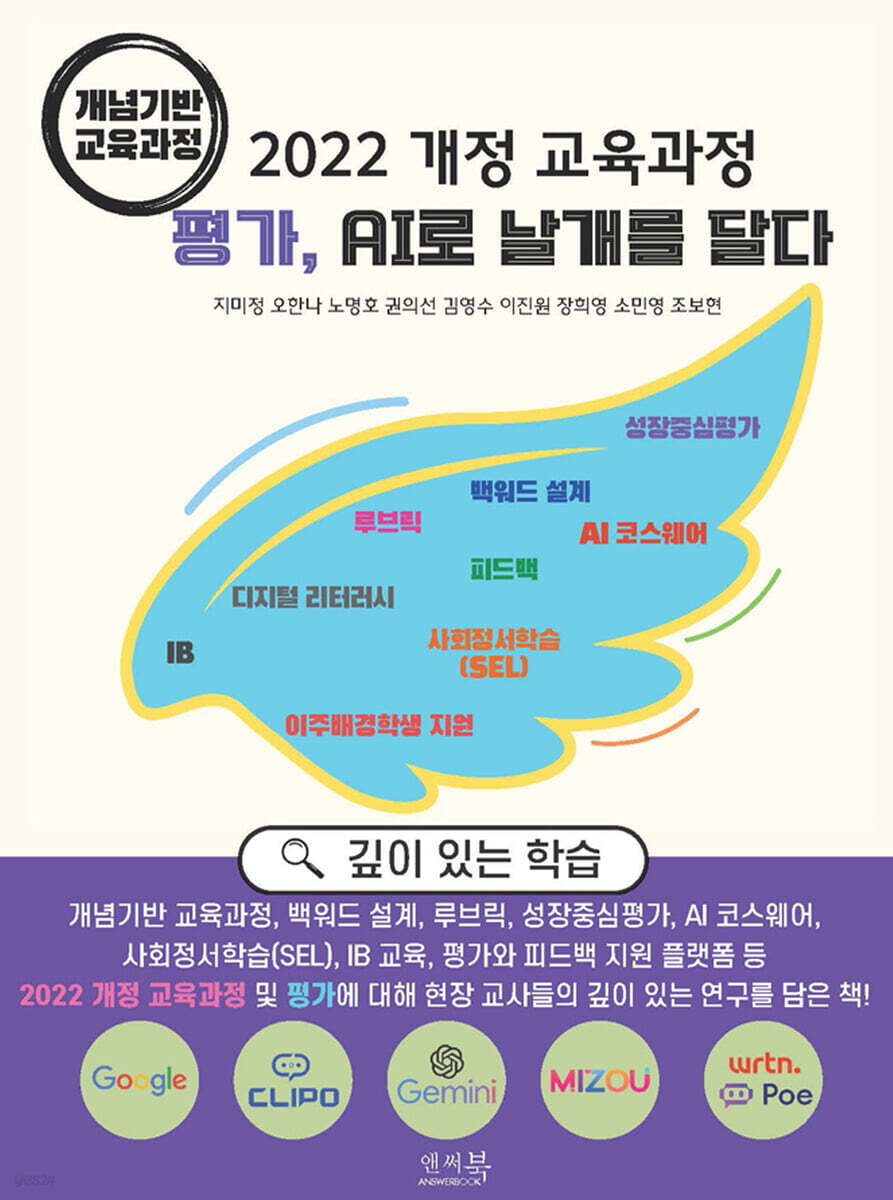
The book, "2022 Revised Curriculum Evaluation, Taking Flight with AI," contains honest and detailed accounts of nine current teachers' practical examples of how they are implementing curriculum and evaluation with AI.
The structure and features of the book are as follows.
Chapter 1 delves into the assessment direction of the 2022 revised curriculum and presents assessment design and implementation plans for in-depth learning.
In particular, we will introduce specific examples of how various edtechs, such as AI courseware and generative AI, can be used to provide personalized education and assessment for students, and we will also explore assessment methods for educationally vulnerable groups, such as students from immigrant backgrounds.
Chapter 2 helps to understand the concept-based curriculum and, based on this, presents a method for designing classes and assessments that elicit true understanding and transfer through backward design.
It also presents specific examples of how AI can be used to effectively implement concept-based curricula.
In Chapter 3, we will learn about rubrics, which are very important in evaluation.
We will examine the challenges, solutions, and application cases of direct application in school settings, and introduce easy ways to receive assistance using AI.
Chapter 4 explores the meaning and practical methods of growth-centered evaluation.
Through various growth-focused assessment examples, including student-participatory assessment, data-driven assessment, and definitional domain assessment, we present the potential of assessment methods that foster student self-reflection and growth. We also introduce edutech-based assessment methods, such as feedback using AI chatbots and assessments using Google Surveys, to strengthen teachers' practical capabilities.
Chapter 5 introduces various platforms that effectively support assessment and feedback, including Google Classroom, "Dahahaha!", and Clippo.
We provide detailed guidance on the features and usage of each platform to help teachers increase the efficiency of their assessments and provide more meaningful feedback to students.
Chapter 6 objectively compares and analyzes the International Baccalaureate (IB) curriculum, which each provincial office of education is actively introducing, and the 2022 revised curriculum, also known as future education, to diagnose the direction of future education in Korea and critically examine various concerns from the perspective of teachers responsible for teacher education curriculum.
The book emphasizes that understanding concept-based inquiry learning and digital and AI literacy are essential prerequisites for implementing the 2022 revised curriculum.
This means that rather than simply relying on digital technology, a comprehensive approach must be taken, including strengthening teachers' expertise, innovating teaching and learning methods, and improving evaluation systems.
This book will serve as a useful guide for all educators seeking to shift the assessment paradigm in line with the 2022 revised curriculum and actively utilize edutech, including AI, to implement assessments that support student growth and development.
This is because this book does not stop at abstract theories discussed by scholars and officials, but boldly applies them to the field and puts them into practice, even revealing cases of failure without reservation.
This book, which is imbued with the concerns of the field, is dedicated to all teachers in Korea who are constantly thinking and working together to nurture students who learn and grow even in a rapidly changing educational environment.
The book, "2022 Revised Curriculum Evaluation, Taking Flight with AI," contains honest and detailed accounts of nine current teachers' practical examples of how they are implementing curriculum and evaluation with AI.
The structure and features of the book are as follows.
Chapter 1 delves into the assessment direction of the 2022 revised curriculum and presents assessment design and implementation plans for in-depth learning.
In particular, we will introduce specific examples of how various edtechs, such as AI courseware and generative AI, can be used to provide personalized education and assessment for students, and we will also explore assessment methods for educationally vulnerable groups, such as students from immigrant backgrounds.
Chapter 2 helps to understand the concept-based curriculum and, based on this, presents a method for designing classes and assessments that elicit true understanding and transfer through backward design.
It also presents specific examples of how AI can be used to effectively implement concept-based curricula.
In Chapter 3, we will learn about rubrics, which are very important in evaluation.
We will examine the challenges, solutions, and application cases of direct application in school settings, and introduce easy ways to receive assistance using AI.
Chapter 4 explores the meaning and practical methods of growth-centered evaluation.
Through various growth-focused assessment examples, including student-participatory assessment, data-driven assessment, and definitional domain assessment, we present the potential of assessment methods that foster student self-reflection and growth. We also introduce edutech-based assessment methods, such as feedback using AI chatbots and assessments using Google Surveys, to strengthen teachers' practical capabilities.
Chapter 5 introduces various platforms that effectively support assessment and feedback, including Google Classroom, "Dahahaha!", and Clippo.
We provide detailed guidance on the features and usage of each platform to help teachers increase the efficiency of their assessments and provide more meaningful feedback to students.
Chapter 6 objectively compares and analyzes the International Baccalaureate (IB) curriculum, which each provincial office of education is actively introducing, and the 2022 revised curriculum, also known as future education, to diagnose the direction of future education in Korea and critically examine various concerns from the perspective of teachers responsible for teacher education curriculum.
The book emphasizes that understanding concept-based inquiry learning and digital and AI literacy are essential prerequisites for implementing the 2022 revised curriculum.
This means that rather than simply relying on digital technology, a comprehensive approach must be taken, including strengthening teachers' expertise, innovating teaching and learning methods, and improving evaluation systems.
This book will serve as a useful guide for all educators seeking to shift the assessment paradigm in line with the 2022 revised curriculum and actively utilize edutech, including AI, to implement assessments that support student growth and development.
This is because this book does not stop at abstract theories discussed by scholars and officials, but boldly applies them to the field and puts them into practice, even revealing cases of failure without reservation.
This book, which is imbued with the concerns of the field, is dedicated to all teachers in Korea who are constantly thinking and working together to nurture students who learn and grow even in a rapidly changing educational environment.
index
===============================
Ⅰ.
A Look at the 2022 Revised Curriculum Evaluation
===============================
1.
2022 Revised Curriculum Evaluation Direction
go.
The Meaning and Direction of the 2022 Revised Curriculum
me.
2022 Revised Curriculum Evaluation Direction
2.
Teaching and Assessment Cases for Implementing Deep Learning
go.
Achieving In-Depth Learning in Secondary Foreign Language Curriculum
me.
Achieving Deep Learning in Elementary Mathematics
3.
Efforts to provide personalized education for students
go.
Mastering Math Classes with Digital Textbooks, AI Courseware, and Generative AI
me.
Learning and assessment that does not exclude students from immigrant backgrounds (multicultural students)
4.
Expanding Digital and AI-Based Classes and Assessments
go.
Challenges and Evaluation of Digital and AI-Based Classes
me.
Digital and AI-based class performance evaluations that are separate from the actual class purpose
all.
Designing Digital and AI-Powered Classes and Assessments
la.
Assessment as learning that expands learning and develops competencies
===============================
Ⅱ.
Explore the concept-based curriculum
===============================
1.
Solving Concept-Based Curriculum Problems with Generating AI
go.
A challenging concept-based curriculum
me.
Dive into AI-powered concept-based curricula
2.
Backward design and evaluation for true understanding (transfer)
go.
Backward Curriculum and Concept-Based Curriculum
me.
What is backward curriculum?
all.
Application of backward curriculum
A. Designing a backward curriculum using AI
mind.
Backward Design and Evaluation, and AI
3.
Concept-based music lessons that transfer to life
go.
Find general sentences related to speed at the student's eye level
B. Deriving generalized sentences related to speed using AI
all.
Expressing the speed discovered in real life through edutech
la.
Transferring the concept of speed to other subjects
mind.
Generalization and transfer discovered in the evaluation
bar.
The importance of a conceptual lens, realized too late
===============================
Ⅲ.
Rubric
===============================
1.
The concept and creation of rubrics
go.
The concept of rubric
me.
Creating a rubric
2.
Using Rubrics
go.
Rubrics for Teaching and Assessment
me.
Rubrics to Help Teachers Grow
===============================
Ⅳ.
Practicing growth-centered evaluation
===============================
1.
Case studies of student-participatory assessment practices
go.
Before Class: Set the Evaluation Direction Reflecting KWL with a Google Form
me.
In class: Prepare for performance assessments by adding self- and peer-assessments.
all.
After class: Conduct assessments and provide follow-up guidance
2.
Data-Driven Evaluation Practices
go.
Monitor student achievement in real time
me.
Supporting student growth through data sharing and feedback
3.
Social-Emotional Learning (SEL) and Affective Domain Assessment Practices
go.
Growth-focused assessment of the definitional domain supported by edutech
me.
Student Peer Relationships Assessment Questionnaire: Helping You Improve Social-Emotional Competence and Classroom Instruction
===============================
V.
A platform that supports evaluation and feedback
===============================
1.
Google Classroom
go.
The Concerns of a Novice EdTech Teacher
me.
Assessment and feedback to support growth in one go with Google Classroom.
all.
Teacher Reflection on Assessment and Feedback that Supports Growth
la.
Concerns and areas for improvement in assessment using digital devices
mind.
Impressions from a novice edtech teacher who completed evaluations and feedback.
2.
Google Classroom Practice Sets
go.
Curriculum Analysis
me.
Google Classroom - Resources - Create a New Practice Set
all.
Utilize intuitive dashboards and customization tools
3.
Are you done? I'm done.
go.
Portfolio Evaluation: Growing Through Feedback
me.
Portfolio Evaluation Using "Are You Done? I'm Done."
4.
Clipo, Wrtn tools, and chatbots
go.
Evaluation of learning outcomes
me.
Growth-centered evaluation
all.
Evaluation and feedback tools (Clippo, Rutton chatbot and tools, Rutton chat)
la.
Sharing growth-centered evaluation
===============================
Ⅵ. IB and the 2022 Revised Curriculum
===============================
Finding clues to the new curriculum
A. Comparison of the Introduction of IB Education and the 2022 Revised Curriculum
B. Understanding IB Education
all.
Comparative Analysis of the 2022 Revised Curriculum and the IB Curriculum
la.
The Practical Difficulties of Implementing the 2022 Revised Curriculum
mind.
Suggestions for Implementing Evaluation of the 2022 Revised Curriculum
Ⅰ.
A Look at the 2022 Revised Curriculum Evaluation
===============================
1.
2022 Revised Curriculum Evaluation Direction
go.
The Meaning and Direction of the 2022 Revised Curriculum
me.
2022 Revised Curriculum Evaluation Direction
2.
Teaching and Assessment Cases for Implementing Deep Learning
go.
Achieving In-Depth Learning in Secondary Foreign Language Curriculum
me.
Achieving Deep Learning in Elementary Mathematics
3.
Efforts to provide personalized education for students
go.
Mastering Math Classes with Digital Textbooks, AI Courseware, and Generative AI
me.
Learning and assessment that does not exclude students from immigrant backgrounds (multicultural students)
4.
Expanding Digital and AI-Based Classes and Assessments
go.
Challenges and Evaluation of Digital and AI-Based Classes
me.
Digital and AI-based class performance evaluations that are separate from the actual class purpose
all.
Designing Digital and AI-Powered Classes and Assessments
la.
Assessment as learning that expands learning and develops competencies
===============================
Ⅱ.
Explore the concept-based curriculum
===============================
1.
Solving Concept-Based Curriculum Problems with Generating AI
go.
A challenging concept-based curriculum
me.
Dive into AI-powered concept-based curricula
2.
Backward design and evaluation for true understanding (transfer)
go.
Backward Curriculum and Concept-Based Curriculum
me.
What is backward curriculum?
all.
Application of backward curriculum
A. Designing a backward curriculum using AI
mind.
Backward Design and Evaluation, and AI
3.
Concept-based music lessons that transfer to life
go.
Find general sentences related to speed at the student's eye level
B. Deriving generalized sentences related to speed using AI
all.
Expressing the speed discovered in real life through edutech
la.
Transferring the concept of speed to other subjects
mind.
Generalization and transfer discovered in the evaluation
bar.
The importance of a conceptual lens, realized too late
===============================
Ⅲ.
Rubric
===============================
1.
The concept and creation of rubrics
go.
The concept of rubric
me.
Creating a rubric
2.
Using Rubrics
go.
Rubrics for Teaching and Assessment
me.
Rubrics to Help Teachers Grow
===============================
Ⅳ.
Practicing growth-centered evaluation
===============================
1.
Case studies of student-participatory assessment practices
go.
Before Class: Set the Evaluation Direction Reflecting KWL with a Google Form
me.
In class: Prepare for performance assessments by adding self- and peer-assessments.
all.
After class: Conduct assessments and provide follow-up guidance
2.
Data-Driven Evaluation Practices
go.
Monitor student achievement in real time
me.
Supporting student growth through data sharing and feedback
3.
Social-Emotional Learning (SEL) and Affective Domain Assessment Practices
go.
Growth-focused assessment of the definitional domain supported by edutech
me.
Student Peer Relationships Assessment Questionnaire: Helping You Improve Social-Emotional Competence and Classroom Instruction
===============================
V.
A platform that supports evaluation and feedback
===============================
1.
Google Classroom
go.
The Concerns of a Novice EdTech Teacher
me.
Assessment and feedback to support growth in one go with Google Classroom.
all.
Teacher Reflection on Assessment and Feedback that Supports Growth
la.
Concerns and areas for improvement in assessment using digital devices
mind.
Impressions from a novice edtech teacher who completed evaluations and feedback.
2.
Google Classroom Practice Sets
go.
Curriculum Analysis
me.
Google Classroom - Resources - Create a New Practice Set
all.
Utilize intuitive dashboards and customization tools
3.
Are you done? I'm done.
go.
Portfolio Evaluation: Growing Through Feedback
me.
Portfolio Evaluation Using "Are You Done? I'm Done."
4.
Clipo, Wrtn tools, and chatbots
go.
Evaluation of learning outcomes
me.
Growth-centered evaluation
all.
Evaluation and feedback tools (Clippo, Rutton chatbot and tools, Rutton chat)
la.
Sharing growth-centered evaluation
===============================
Ⅵ. IB and the 2022 Revised Curriculum
===============================
Finding clues to the new curriculum
A. Comparison of the Introduction of IB Education and the 2022 Revised Curriculum
B. Understanding IB Education
all.
Comparative Analysis of the 2022 Revised Curriculum and the IB Curriculum
la.
The Practical Difficulties of Implementing the 2022 Revised Curriculum
mind.
Suggestions for Implementing Evaluation of the 2022 Revised Curriculum
Publisher's Review
"The future of education starts now."
Nine current teachers took up their pens and drew the forefront of educational innovation.
This book is not simply a theoretical book; it is a guide to innovation, filled with vivid experiences and challenges from the field.
This book, which penetrates the core of the 2022 revised curriculum, declares a revolution in assessment utilizing AI and edutech.
From concept-based curricula, backward design, rubric assessment, and growth-focused assessment—we're putting all the pieces of the puzzle together for the future of education.
What is particularly noteworthy is the courage of the authors to honestly share their field application cases and even their experiences of failure.
This makes this book more than just a guidebook; it's a true forum for conversation with fellow teachers.
In the age of AI, this book is essential for all educators seeking innovation while preserving the essence of education.
"2022 Revised Curriculum Evaluation: Taking Flight with AI" presents a blueprint for future education, offering courage and wisdom to accompany you on that journey.
Change in the classroom begins right here.
A new wave that will change the future of education in Korea begins with this book you are holding in your hands.
Nine current teachers took up their pens and drew the forefront of educational innovation.
This book is not simply a theoretical book; it is a guide to innovation, filled with vivid experiences and challenges from the field.
This book, which penetrates the core of the 2022 revised curriculum, declares a revolution in assessment utilizing AI and edutech.
From concept-based curricula, backward design, rubric assessment, and growth-focused assessment—we're putting all the pieces of the puzzle together for the future of education.
What is particularly noteworthy is the courage of the authors to honestly share their field application cases and even their experiences of failure.
This makes this book more than just a guidebook; it's a true forum for conversation with fellow teachers.
In the age of AI, this book is essential for all educators seeking innovation while preserving the essence of education.
"2022 Revised Curriculum Evaluation: Taking Flight with AI" presents a blueprint for future education, offering courage and wisdom to accompany you on that journey.
Change in the classroom begins right here.
A new wave that will change the future of education in Korea begins with this book you are holding in your hands.
GOODS SPECIFICS
- Date of issue: September 20, 2024
- Page count, weight, size: 353 pages | 170*225*14mm
- ISBN13: 9791193059364
- ISBN10: 1193059364
You may also like
카테고리
korean


korean

![GQ KOREA Mark (Monthly): December [2025]](http://librairie.coreenne.fr/cdn/shop/files/8ef265dbbfbf186523ed75ba7319009d.jpg?v=1765340328&width=3840)


