

Greek time
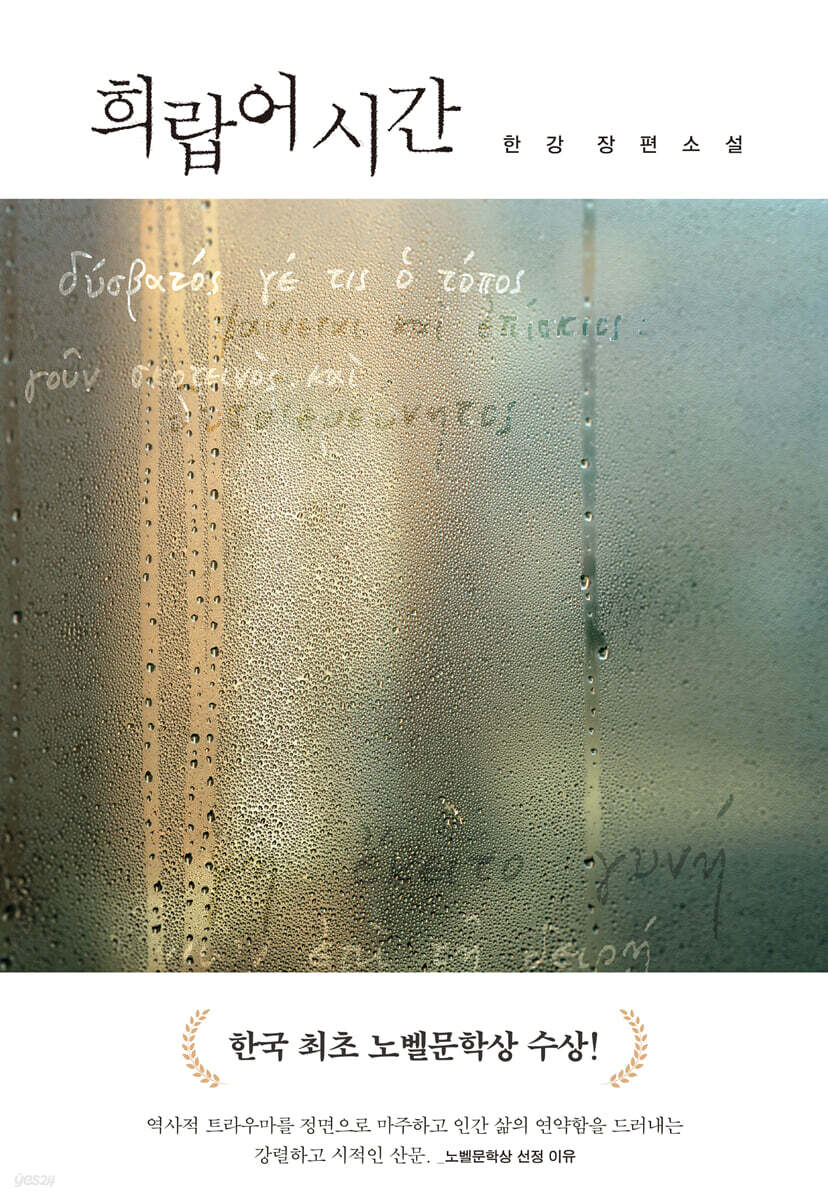 |
Description
Book Introduction
The silence of a woman losing her language
The story of a man losing his sight and the light that meets his eyes.
Without any cause or warning, the woman loses her speech.
It first came in the winter of my seventeenth year.
It was a single French word, an unfamiliar foreign language, that made her lips, which had been speechless, move again.
Time passed again.
After getting divorced, losing custody of her nine-year-old child, and losing her ability to speak again, a woman who had no choice but to let go of everything in her life chose Greek, a language that had already become a dead language.
The Greek teacher and the woman I met there had a stammering conversation in front of each other, silenced.
A man who returned to Korea alone after leaving his family in Germany for over ten years to teach Greek.
The man is gradually losing his light.
I'm approaching forty, which I said I wouldn't be able to see, but I might be able to see for another year or two.
He carefully observes a woman among the students at the academy who neither speaks nor smiles, but is afraid when he encounters her firm silence.
A terrible silence, the likes of which I have never seen in a living person.
And the faint light of a man gradually fading away.
Will this twilight lead to complete night?
To look into 『Greek Hours』 is to discover certain signs and follow traces.
And those faintly emerging hints and traces, like a photograph in a dark room in fixative, gradually creates a clearer image, at some point creating a long and solid story like ancient text.
And it includes time in the past, and time in the present progressive tense that continues to the present.
Through the novel, we will witness things that existed long ago, their signs and traces, moments that seem eternal, and a scene where all of these things meet in one place.
The story of a man losing his sight and the light that meets his eyes.
Without any cause or warning, the woman loses her speech.
It first came in the winter of my seventeenth year.
It was a single French word, an unfamiliar foreign language, that made her lips, which had been speechless, move again.
Time passed again.
After getting divorced, losing custody of her nine-year-old child, and losing her ability to speak again, a woman who had no choice but to let go of everything in her life chose Greek, a language that had already become a dead language.
The Greek teacher and the woman I met there had a stammering conversation in front of each other, silenced.
A man who returned to Korea alone after leaving his family in Germany for over ten years to teach Greek.
The man is gradually losing his light.
I'm approaching forty, which I said I wouldn't be able to see, but I might be able to see for another year or two.
He carefully observes a woman among the students at the academy who neither speaks nor smiles, but is afraid when he encounters her firm silence.
A terrible silence, the likes of which I have never seen in a living person.
And the faint light of a man gradually fading away.
Will this twilight lead to complete night?
To look into 『Greek Hours』 is to discover certain signs and follow traces.
And those faintly emerging hints and traces, like a photograph in a dark room in fixative, gradually creates a clearer image, at some point creating a long and solid story like ancient text.
And it includes time in the past, and time in the present progressive tense that continues to the present.
Through the novel, we will witness things that existed long ago, their signs and traces, moments that seem eternal, and a scene where all of these things meet in one place.
- You can preview some of the book's contents.
Preview
index
Greek time
Author's Note
Author's Note
Detailed image
.jpg)
Publisher's Review
This is a story about a man and a woman.
The silence of a woman losing her language
The story of a man losing his sight and the light that meets his eyes.
Is this finally what I've been waiting for?
True syllables rising from beneath the charred remains of language that I thought had been burned away.
The author takes us into a world of things that existed before language took shape—a world made of traces, images, sensations, and passions.
In the moment when a new language and a dying language meet and rub against each other, we return to a world of distant origins and discover the pain and joy of humanity frozen there.
And then suddenly you realize.
The fact that in order to encounter the true desires that one's body remembers, one must descend to the cold, boiling edge of writing, near zero degrees.
There we witness the worldly miracle of death and birth, where a person is reincarnated into a new body.
Has there ever been a novel that taught us how to fall so beautifully and completely? _Lee So-yeon (literary critic)
It's just a story about a woman and a man meeting.
Here, a woman's story
It's here again.
Without any cause or warning, the woman loses her speech.
It first came in the winter of my seventeenth year.
It was a single French word, an unfamiliar foreign language, that made her lips, which had been speechless, move again.
Time passed again.
After getting divorced, losing custody of her nine-year-old child, and losing her ability to speak again, a woman who had no choice but to let go of everything in her life chose Greek, a language that had already become a dead language.
The Greek teacher and the woman I met there had a stammering conversation in front of each other, silenced.
And here, another man's story
As time goes by… … all I can see will be in my dreams.
A man who returned to Korea alone after leaving his family in Germany for over ten years to teach Greek.
The man is gradually losing his light.
I'm approaching forty, which I said I wouldn't be able to see, but I might be able to see for another year or two.
He carefully observes a woman among the students at the academy who neither speaks nor smiles, but is afraid when he encounters her firm silence.
A terrible silence, the likes of which I have never seen in a living person.
And the faint light of a man gradually fading away.
Will this twilight lead to complete night?
Reading this novel might be like staring at a photograph for a long time.
A Photograph | Philip Perkis talks about 'looking' in the very first chapter of 'Notes on Photography'.
Don't take your eyes off the picture, first feel the reality of the light falling on the surface of the subject.
“It has no meaning.
WC: “Only things exist”
Quoting Williams, he says:
You have to stay with it until the moment the picture is taken.
But everything I've learned throughout my life has been in opposition to this staying.
Seeing things as they are: the relationship between light, space, distance, air, resonance, rhythm, texture, forms of movement, light and shade… the thing itself… Whatever these may mean later, they are not yet social, political, or sexual.
Name it not, brand it not, treasure it not, love it not, hate it not, remember it not, covet it not.
Just look at it.
Philip Perkis, "Notes from a Photography Lecture"
In a similar vein, Willie Ronis once said:
Usually I don't change anything that happens.
Just watch and wait.
So that reality may be revealed in a more vivid truth.
It is a pleasure of the moment, and sometimes a pain.
Because it is hoping for something that has not happened, or something that has not happened yet, but will happen.
Willy Ronis, The Days
If you stare at a single photograph that contains the object itself (or the very existence of the object itself) for a long time, you will slowly discover certain signs.
Likewise, looking into this novel, “Greek Hours,” is like discovering certain signs and tracing traces.
And those faintly emerging hints and traces, like a photograph in a dark room in fixative, gradually creates a clearer image, at some point creating a long and solid story like ancient text.
And it includes time in the past, and time in the present progressive tense that continues to the present.
What is time? If I were to take a picture of you right now, it would be something that happened right now.
When you look at that photo ten years from now, you'll be instantly transported back to this moment.
(……) A photograph is a frozen moment and a memory.
But photographs always capture the present moment.
That's the magic of photography.
Philip Purkiss, Conversations with Philip Purkiss
Any photograph can become such a 'present' if the appropriate context is created for it.
In general, the better the photograph, the more complete the context it can create.
Such a context replaces the photograph in time—not in its own original time, which is impossible—but in the time it is described.
Described time becomes historical time when it takes on the character of social memory and social action.
The time that is narrated must respect the process of memory that it seeks to stimulate.
John Berger, The Meaning of Seeing
The most important thing in the darkroom where photos are developed and printed, and the most important thing to get a good photo, is none other than light and darkness.
If natural light seeps into the darkroom, the photo will turn white, and if the light from the darkroom is too strong, the photo will turn completely black.
And then you have to wait again.
Only after the photo is completely dry can you tell if the print was successful.
Art created by light, darkness, and time.
If it were a photograph, then 『Greek Hours』 is, and so is, a photograph, a black-and-white photograph completed only with light and darkness, only with light and shade.
“The truth is revealed only in the light and shade that exists between black and white.” (G.
I. Guzip)
Like Greek, the oldest and most solid writing system on Earth, and like a black-and-white photograph made entirely of light and darkness, the novel is free from all unnecessary elements and is fine and solid in its texture.
Seo Young-gi, a carpenter and photographer, said in an interview.
“For a carpenter, the body’s response is important.
When you touch the tree, your body reacts and you become mentally focused.
Photography is my reaction to the world.
“Even though the target is different, as the reaction is repeated and concentrated, the boundary between the two disappears at the same point.” (Monthly Photo, November 2011)
In the case of the Han River, and in the case of this novel, “Greek Time,” it would be language.
Emotions that are neither excessive nor lacking, and words that are evenly and carefully restrained.
Seeing, feeling and expressing the world through language and sentences themselves.
Each and every word, each and every sentence, is already like a photograph, like a novel.
With this novel, we will witness things that existed long ago, their traces and signs, moments that seem eternal, and a scene where all of these things meet in one place.
The silence of a woman losing her language
The story of a man losing his sight and the light that meets his eyes.
Is this finally what I've been waiting for?
True syllables rising from beneath the charred remains of language that I thought had been burned away.
The author takes us into a world of things that existed before language took shape—a world made of traces, images, sensations, and passions.
In the moment when a new language and a dying language meet and rub against each other, we return to a world of distant origins and discover the pain and joy of humanity frozen there.
And then suddenly you realize.
The fact that in order to encounter the true desires that one's body remembers, one must descend to the cold, boiling edge of writing, near zero degrees.
There we witness the worldly miracle of death and birth, where a person is reincarnated into a new body.
Has there ever been a novel that taught us how to fall so beautifully and completely? _Lee So-yeon (literary critic)
It's just a story about a woman and a man meeting.
Here, a woman's story
It's here again.
Without any cause or warning, the woman loses her speech.
It first came in the winter of my seventeenth year.
It was a single French word, an unfamiliar foreign language, that made her lips, which had been speechless, move again.
Time passed again.
After getting divorced, losing custody of her nine-year-old child, and losing her ability to speak again, a woman who had no choice but to let go of everything in her life chose Greek, a language that had already become a dead language.
The Greek teacher and the woman I met there had a stammering conversation in front of each other, silenced.
And here, another man's story
As time goes by… … all I can see will be in my dreams.
A man who returned to Korea alone after leaving his family in Germany for over ten years to teach Greek.
The man is gradually losing his light.
I'm approaching forty, which I said I wouldn't be able to see, but I might be able to see for another year or two.
He carefully observes a woman among the students at the academy who neither speaks nor smiles, but is afraid when he encounters her firm silence.
A terrible silence, the likes of which I have never seen in a living person.
And the faint light of a man gradually fading away.
Will this twilight lead to complete night?
Reading this novel might be like staring at a photograph for a long time.
A Photograph | Philip Perkis talks about 'looking' in the very first chapter of 'Notes on Photography'.
Don't take your eyes off the picture, first feel the reality of the light falling on the surface of the subject.
“It has no meaning.
WC: “Only things exist”
Quoting Williams, he says:
You have to stay with it until the moment the picture is taken.
But everything I've learned throughout my life has been in opposition to this staying.
Seeing things as they are: the relationship between light, space, distance, air, resonance, rhythm, texture, forms of movement, light and shade… the thing itself… Whatever these may mean later, they are not yet social, political, or sexual.
Name it not, brand it not, treasure it not, love it not, hate it not, remember it not, covet it not.
Just look at it.
Philip Perkis, "Notes from a Photography Lecture"
In a similar vein, Willie Ronis once said:
Usually I don't change anything that happens.
Just watch and wait.
So that reality may be revealed in a more vivid truth.
It is a pleasure of the moment, and sometimes a pain.
Because it is hoping for something that has not happened, or something that has not happened yet, but will happen.
Willy Ronis, The Days
If you stare at a single photograph that contains the object itself (or the very existence of the object itself) for a long time, you will slowly discover certain signs.
Likewise, looking into this novel, “Greek Hours,” is like discovering certain signs and tracing traces.
And those faintly emerging hints and traces, like a photograph in a dark room in fixative, gradually creates a clearer image, at some point creating a long and solid story like ancient text.
And it includes time in the past, and time in the present progressive tense that continues to the present.
What is time? If I were to take a picture of you right now, it would be something that happened right now.
When you look at that photo ten years from now, you'll be instantly transported back to this moment.
(……) A photograph is a frozen moment and a memory.
But photographs always capture the present moment.
That's the magic of photography.
Philip Purkiss, Conversations with Philip Purkiss
Any photograph can become such a 'present' if the appropriate context is created for it.
In general, the better the photograph, the more complete the context it can create.
Such a context replaces the photograph in time—not in its own original time, which is impossible—but in the time it is described.
Described time becomes historical time when it takes on the character of social memory and social action.
The time that is narrated must respect the process of memory that it seeks to stimulate.
John Berger, The Meaning of Seeing
The most important thing in the darkroom where photos are developed and printed, and the most important thing to get a good photo, is none other than light and darkness.
If natural light seeps into the darkroom, the photo will turn white, and if the light from the darkroom is too strong, the photo will turn completely black.
And then you have to wait again.
Only after the photo is completely dry can you tell if the print was successful.
Art created by light, darkness, and time.
If it were a photograph, then 『Greek Hours』 is, and so is, a photograph, a black-and-white photograph completed only with light and darkness, only with light and shade.
“The truth is revealed only in the light and shade that exists between black and white.” (G.
I. Guzip)
Like Greek, the oldest and most solid writing system on Earth, and like a black-and-white photograph made entirely of light and darkness, the novel is free from all unnecessary elements and is fine and solid in its texture.
Seo Young-gi, a carpenter and photographer, said in an interview.
“For a carpenter, the body’s response is important.
When you touch the tree, your body reacts and you become mentally focused.
Photography is my reaction to the world.
“Even though the target is different, as the reaction is repeated and concentrated, the boundary between the two disappears at the same point.” (Monthly Photo, November 2011)
In the case of the Han River, and in the case of this novel, “Greek Time,” it would be language.
Emotions that are neither excessive nor lacking, and words that are evenly and carefully restrained.
Seeing, feeling and expressing the world through language and sentences themselves.
Each and every word, each and every sentence, is already like a photograph, like a novel.
With this novel, we will witness things that existed long ago, their traces and signs, moments that seem eternal, and a scene where all of these things meet in one place.
GOODS SPECIFICS
- Date of issue: November 10, 2011
- Page count, weight, size: 194 pages | 302g | 145*210*20mm
- ISBN13: 9788954616515
- ISBN10: 8954616518
You may also like
카테고리
korean


korean

![GQ KOREA Mark (Monthly): December [2025]](http://librairie.coreenne.fr/cdn/shop/files/8ef265dbbfbf186523ed75ba7319009d.jpg?v=1765340328&width=3840)


