

suicide
 |
Description
Book Introduction
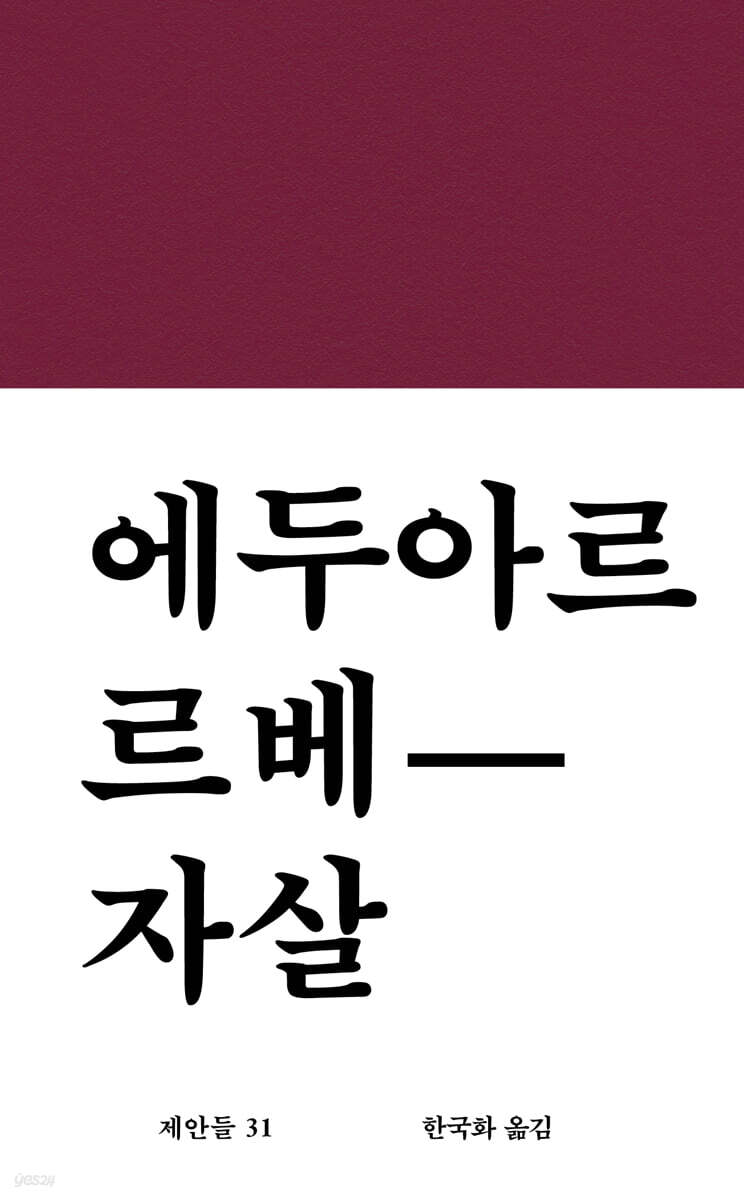
French author Edouard Levé's "Suicide" (translated into Korean) has been published as the 31st volume of the Workroom Literature Series "Proposals."
Edouard Levé, whose main medium was photography and writing, was an artist who devoted himself to conceptual work.
He began his career as a writer in 2002 by publishing "Works," a collection of 533 work ideas, by looking up artists with the same names as those who influenced him in the phone book, taking pictures of American cities with the same names as European cities, and reconstructing poses, paintings, and dream scenes of typical people into real photographs.
This book, "Suicide," was published the year after Edouard Levé committed suicide, and is a piece he wrote a few days before his death.
Edouard Levé, whose main medium was photography and writing, was an artist who devoted himself to conceptual work.
He began his career as a writer in 2002 by publishing "Works," a collection of 533 work ideas, by looking up artists with the same names as those who influenced him in the phone book, taking pictures of American cities with the same names as European cities, and reconstructing poses, paintings, and dream scenes of typical people into real photographs.
This book, "Suicide," was published the year after Edouard Levé committed suicide, and is a piece he wrote a few days before his death.
- You can preview some of the book's contents.
Preview
index
About the author
About this book
suicide
Translator's Note
Edouard Levé Chronology
About this book
suicide
Translator's Note
Edouard Levé Chronology
Into the book
Your life is a hypothesis.
People who die of old age are a collection of the past.
When you think of them, what they have done appears.
But when I think of you, all that you could have been comes to mind.
You were and remain a bundle of possibilities.
--- p.16
You are a book that speaks to me when I want to.
Your death has written your life.
--- p.17
You would rather stand in a bookstore and read than sit in a library and read.
You wanted to discover the literature of today rather than of the past.
The past is in the library, the present is in the bookstore.
Yet you were more interested in the dead than in the people of the present age.
In particular, you read authors you call the 'living dead', authors who are dead but continue to be published.
You trusted publishers who made yesterday's knowledge into today's.
You didn't quite believe in the miraculous discoveries of forgotten writers.
You thought that time would sort them all out, and therefore it was better to read writers from the past who were still being published today than to read writers of today who would be forgotten tomorrow.
--- p.22
Only the living seem to be inconsistent.
Death brings to an end the series of events that constituted their lives.
Then we give up on finding meaning in it.
To refuse to find meaning is to accept the absurdity of one life, of all life.
Your life has not reached the consistency of the finished things.
But your death gave consistency to your life.
--- pp.25~26
In art, to subtract is to become perfect.
By leaving, you have settled into the beauty of the negative.
--- p.27
You believed what was written, regardless of whether it was true or false.
--- pp.43~44
You preferred to see friendships being formed before your eyes rather than join an already established friendship as a stranger.
You saw this latter friendship born and growing.
You couldn't predict what special interests would bind you together, but you knew that by starting at the same time, you were all equal before the future.
--- p.65
You wanted to do only actions that had a lasting effect, gestures that could be made in a few minutes and whose traces could be preserved and seen for a long time.
You are interested in painting because of the time that is suspended in materiality.
The short time it takes to paint a picture is followed by the long life of the picture.
--- p.68
You were afraid of being bored when you were alone and of being bored when you were with others.
But what you feared most of all when the two of you were face to face was boredom.
You have not imposed any virtue on moments of waiting without stimulation.
People who die of old age are a collection of the past.
When you think of them, what they have done appears.
But when I think of you, all that you could have been comes to mind.
You were and remain a bundle of possibilities.
--- p.16
You are a book that speaks to me when I want to.
Your death has written your life.
--- p.17
You would rather stand in a bookstore and read than sit in a library and read.
You wanted to discover the literature of today rather than of the past.
The past is in the library, the present is in the bookstore.
Yet you were more interested in the dead than in the people of the present age.
In particular, you read authors you call the 'living dead', authors who are dead but continue to be published.
You trusted publishers who made yesterday's knowledge into today's.
You didn't quite believe in the miraculous discoveries of forgotten writers.
You thought that time would sort them all out, and therefore it was better to read writers from the past who were still being published today than to read writers of today who would be forgotten tomorrow.
--- p.22
Only the living seem to be inconsistent.
Death brings to an end the series of events that constituted their lives.
Then we give up on finding meaning in it.
To refuse to find meaning is to accept the absurdity of one life, of all life.
Your life has not reached the consistency of the finished things.
But your death gave consistency to your life.
--- pp.25~26
In art, to subtract is to become perfect.
By leaving, you have settled into the beauty of the negative.
--- p.27
You believed what was written, regardless of whether it was true or false.
--- pp.43~44
You preferred to see friendships being formed before your eyes rather than join an already established friendship as a stranger.
You saw this latter friendship born and growing.
You couldn't predict what special interests would bind you together, but you knew that by starting at the same time, you were all equal before the future.
--- p.65
You wanted to do only actions that had a lasting effect, gestures that could be made in a few minutes and whose traces could be preserved and seen for a long time.
You are interested in painting because of the time that is suspended in materiality.
The short time it takes to paint a picture is followed by the long life of the picture.
--- p.68
You were afraid of being bored when you were alone and of being bored when you were with others.
But what you feared most of all when the two of you were face to face was boredom.
You have not imposed any virtue on moments of waiting without stimulation.
--- p.90
Publisher's Review
The method of suicide
This book is the last work the author wrote during his lifetime.
Not every writer can decide what his last work will be, but Edouard Levé succeeded in doing so.
This becomes important because Levé is an artist who has been working in conceptual art.
His choice to align the way he ended his personal life with the way he ended his life as a writer reflects the way he pursued his work as a writer.
'Suicide' is an extension of Levé's many choices, whether names, poses, or scenes, which he reconstructs and reproduces in his work from reality.
Now his life is written and read as that of a writer who committed suicide by writing a novel about suicide.
Even if it is overly abbreviated, this is the truth about the writer Edouard Levé.
The fact that it was written
“(...) Levé refused to write works with typical plots, and wanted only strong or trivial facts.
The narrative style he displayed in ‘Self-Portrait’ and ‘Suicide’ proves this.
“The fragments of memory are simply listed, without any causal relationship or passage of time, and only the truth of the sentences exists.” (Translator’s note, p. 118)
The author, who wrote about himself in “Self-Portrait” published before writing “Suicide,” writes about “you,” a character in “Suicide,” as follows.
“You believed what was written, regardless of whether it was true or false.” (pp. 43-4) One might try to gauge how much overlap there is between the character “you,” the narrator “I,” and the author Levé in this book.
But whether these three people are truly the same or not may not really be a very important question.
What is important is that this text is written by listing sentences, excluding any structure that could form a narrative.
An attitude that accepts the fact that someone's death was made by someone's life, that someone's life was made by someone's death, and that all of this process was written by someone as a fact surrounding the medium called novel would be suitable for this book.
This book is the last work the author wrote during his lifetime.
Not every writer can decide what his last work will be, but Edouard Levé succeeded in doing so.
This becomes important because Levé is an artist who has been working in conceptual art.
His choice to align the way he ended his personal life with the way he ended his life as a writer reflects the way he pursued his work as a writer.
'Suicide' is an extension of Levé's many choices, whether names, poses, or scenes, which he reconstructs and reproduces in his work from reality.
Now his life is written and read as that of a writer who committed suicide by writing a novel about suicide.
Even if it is overly abbreviated, this is the truth about the writer Edouard Levé.
The fact that it was written
“(...) Levé refused to write works with typical plots, and wanted only strong or trivial facts.
The narrative style he displayed in ‘Self-Portrait’ and ‘Suicide’ proves this.
“The fragments of memory are simply listed, without any causal relationship or passage of time, and only the truth of the sentences exists.” (Translator’s note, p. 118)
The author, who wrote about himself in “Self-Portrait” published before writing “Suicide,” writes about “you,” a character in “Suicide,” as follows.
“You believed what was written, regardless of whether it was true or false.” (pp. 43-4) One might try to gauge how much overlap there is between the character “you,” the narrator “I,” and the author Levé in this book.
But whether these three people are truly the same or not may not really be a very important question.
What is important is that this text is written by listing sentences, excluding any structure that could form a narrative.
An attitude that accepts the fact that someone's death was made by someone's life, that someone's life was made by someone's death, and that all of this process was written by someone as a fact surrounding the medium called novel would be suitable for this book.
GOODS SPECIFICS
- Date of issue: March 10, 2023
- Format: Hardcover book binding method guide
- Page count, weight, size: 128 pages | 178g | 110*175*20mm
- ISBN13: 9791189356934
- ISBN10: 1189356937
You may also like
카테고리
korean


korean

![GQ KOREA Mark (Monthly): December [2025]](http://librairie.coreenne.fr/cdn/shop/files/8ef265dbbfbf186523ed75ba7319009d.jpg?v=1765340328&width=3840)


