

Snow country
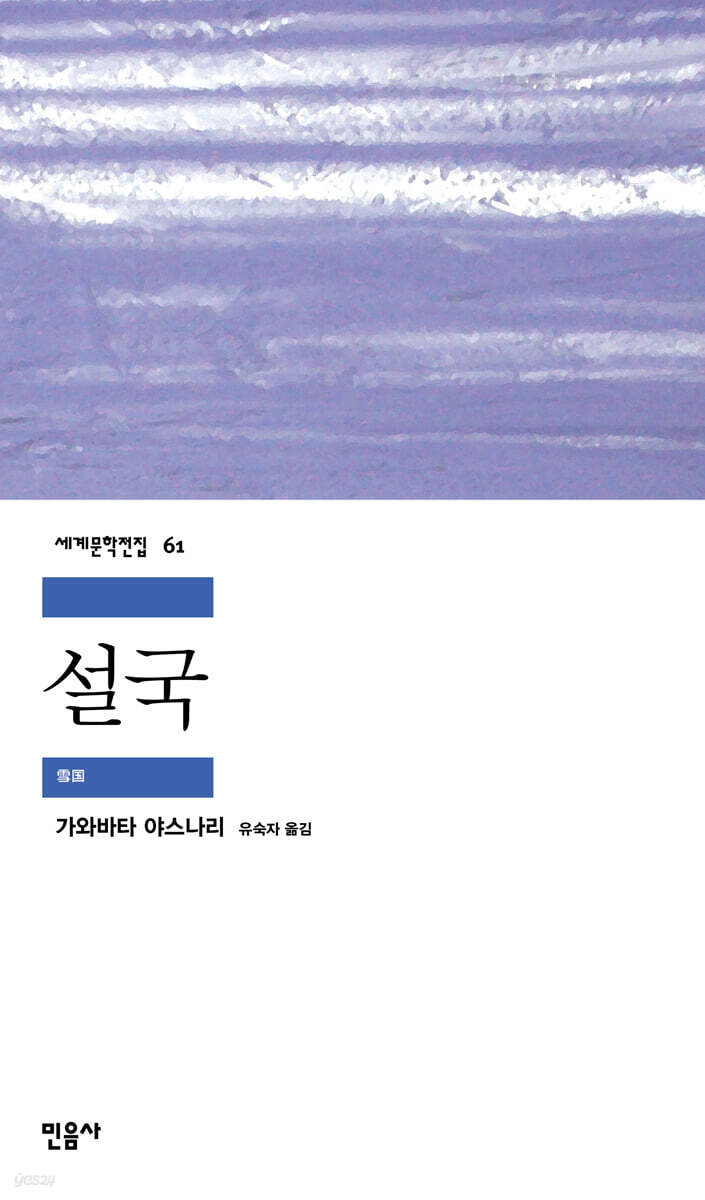 |
Description
Book Introduction
A Nobel Prize-winning work that epitomizes the essence of Oriental beauty.
The beautiful snow-covered landscape of Niigata has captivated people around the world.
The pinnacle of Japanese literature, sensually depicting the world of pure lyricism.
“As we came out of the long tunnel at the border, it was a snowy place.”
The official Korean edition of "Snow Country," the 1968 Nobel Prize winner and a quintessential example of Japanese lyric literature, has been published.
『Snow Country』 has been newly translated and published by Minumsa.
"Snow Country" is a representative Japanese novel that is widely read in Korea, with over ten Korean translations already available and hundreds of thousands of copies sold, but this is the first official contract translation.
"Snow Country," which can be said to be the greatest lyrical novel in the history of Japanese literature, is a very ambiguous work without a clear plot, but it is a masterpiece that can draw anyone into it with its outstanding sensuous writing style and depiction of the human world with excellence.
This translation, in which the translator has made every effort to preserve the lyricism and sensibility of the original text, is worth reading for many readers during this unusually snowy winter.
The beautiful snow-covered landscape of Niigata has captivated people around the world.
The pinnacle of Japanese literature, sensually depicting the world of pure lyricism.
“As we came out of the long tunnel at the border, it was a snowy place.”
The official Korean edition of "Snow Country," the 1968 Nobel Prize winner and a quintessential example of Japanese lyric literature, has been published.
『Snow Country』 has been newly translated and published by Minumsa.
"Snow Country" is a representative Japanese novel that is widely read in Korea, with over ten Korean translations already available and hundreds of thousands of copies sold, but this is the first official contract translation.
"Snow Country," which can be said to be the greatest lyrical novel in the history of Japanese literature, is a very ambiguous work without a clear plot, but it is a masterpiece that can draw anyone into it with its outstanding sensuous writing style and depiction of the human world with excellence.
This translation, in which the translator has made every effort to preserve the lyricism and sensibility of the original text, is worth reading for many readers during this unusually snowy winter.
- You can preview some of the book's contents.
Preview
index
Commentary on the work
Shimamura or Kawabata's eyes
Author's Chronology
Shimamura or Kawabata's eyes
Author's Chronology
Publisher's Review
Sensual depiction of the world of pure lyricism
"Snow Country" is the first work to win the Nobel Prize in Literature for Japan.
In 1968, the Swedish Academy nominated Kawabata for the Nobel Prize in Literature, citing as its primary reason “his skill in narrative, which expresses the essence of the Japanese mind with exceptional sensitivity.”
However, if this work had simply talked about Japanese traditions, it would have been difficult to arouse the interest of many readers in various countries.
『Snow Country』 is characterized primarily by its lyrical and sensual style that depicts the scenery of a snowy region.
Kawabata mainly obtained motifs for his works from landscapes.
The specific setting of this novel is Yuzawa Onsen in Echigo, Niigata Prefecture, Japan, a place famous for its heavy snowfall, and Kawabata wrote this work while staying there.
Originally, 『Snow Country』 was not conceived as a complete work from the beginning.
Kawabata wrote the short story "Mirror of the Evening Scene" in 1935, when he was 36 years old. Afterwards, he published short stories here and there based on the material of this work, and collected them into a complete edition called "Snow Country" in 1948.
In short, he spent a whopping 12 years meticulously refining and carving out a new world called 'Snow Country'.
As a result, the natural scenery, customs, and people's lives of this snowy region are intricately depicted in 『Snow Country』.
Kawabata's writing style, which depicts the seasonal changes in the snow region, is admirably delicate.
However, this work is characterized by the fact that, despite its detailed description of characters and background, there is no prominent plot.
Without a compelling plot, the novel takes place in the snowy countryside and portrays a symbolic world through the psychological development of its characters.
And that world is clearly something different from the real world.
It is a world of wandering travelers, a world of futility that makes us aware of the finite and mortal existence of humans compared to nature, which is constantly changing but ultimately remains the same.
The contrast between beautiful nature and finite human existence, passion and futility
There are three main characters in this novel.
Shimamura, who is living a life of idleness and travel with the fortune his parents left him, Komako, a sensual and alluring woman who lives as a geisha in the snow region and loves Shimamura so passionately that it is pitiful, and Yoko, a beautiful and pure girl who devotes herself to the work she loves.
Shimamura is drawn to Komako and goes to a hot spring in the snow region to meet her.
However, he just watches the passionate affection that Komako shows him, saying that it is “all in vain.”
"Snow Country" delicately depicts beautiful snow-covered natural landscapes in a uniquely sensual style.
On top of that, the finite human existence that contrasts with such nature is depicted through the voice of the protagonist's inner consciousness.
Therefore, the 'Snow Country' that serves as the setting for this work is not simply the name of a region, but a symbolic world in which nature and humans stand in stark contrast.
If you simply read the plot, you will never be able to guess its depth and flavor, so 『Snow Country』 is a classic that requires more careful reading than any other work.
"Snow Country" is the first work to win the Nobel Prize in Literature for Japan.
In 1968, the Swedish Academy nominated Kawabata for the Nobel Prize in Literature, citing as its primary reason “his skill in narrative, which expresses the essence of the Japanese mind with exceptional sensitivity.”
However, if this work had simply talked about Japanese traditions, it would have been difficult to arouse the interest of many readers in various countries.
『Snow Country』 is characterized primarily by its lyrical and sensual style that depicts the scenery of a snowy region.
Kawabata mainly obtained motifs for his works from landscapes.
The specific setting of this novel is Yuzawa Onsen in Echigo, Niigata Prefecture, Japan, a place famous for its heavy snowfall, and Kawabata wrote this work while staying there.
Originally, 『Snow Country』 was not conceived as a complete work from the beginning.
Kawabata wrote the short story "Mirror of the Evening Scene" in 1935, when he was 36 years old. Afterwards, he published short stories here and there based on the material of this work, and collected them into a complete edition called "Snow Country" in 1948.
In short, he spent a whopping 12 years meticulously refining and carving out a new world called 'Snow Country'.
As a result, the natural scenery, customs, and people's lives of this snowy region are intricately depicted in 『Snow Country』.
Kawabata's writing style, which depicts the seasonal changes in the snow region, is admirably delicate.
However, this work is characterized by the fact that, despite its detailed description of characters and background, there is no prominent plot.
Without a compelling plot, the novel takes place in the snowy countryside and portrays a symbolic world through the psychological development of its characters.
And that world is clearly something different from the real world.
It is a world of wandering travelers, a world of futility that makes us aware of the finite and mortal existence of humans compared to nature, which is constantly changing but ultimately remains the same.
The contrast between beautiful nature and finite human existence, passion and futility
There are three main characters in this novel.
Shimamura, who is living a life of idleness and travel with the fortune his parents left him, Komako, a sensual and alluring woman who lives as a geisha in the snow region and loves Shimamura so passionately that it is pitiful, and Yoko, a beautiful and pure girl who devotes herself to the work she loves.
Shimamura is drawn to Komako and goes to a hot spring in the snow region to meet her.
However, he just watches the passionate affection that Komako shows him, saying that it is “all in vain.”
"Snow Country" delicately depicts beautiful snow-covered natural landscapes in a uniquely sensual style.
On top of that, the finite human existence that contrasts with such nature is depicted through the voice of the protagonist's inner consciousness.
Therefore, the 'Snow Country' that serves as the setting for this work is not simply the name of a region, but a symbolic world in which nature and humans stand in stark contrast.
If you simply read the plot, you will never be able to guess its depth and flavor, so 『Snow Country』 is a classic that requires more careful reading than any other work.
GOODS SPECIFICS
- Date of issue: January 31, 2002
- Page count, weight, size: 163 pages | 294g | 132*225*20mm
- ISBN13: 9788937460616
- ISBN10: 8937460610
You may also like
카테고리
korean


korean

![GQ KOREA Mark (Monthly): December [2025]](http://librairie.coreenne.fr/cdn/shop/files/8ef265dbbfbf186523ed75ba7319009d.jpg?v=1765340328&width=3840)


