

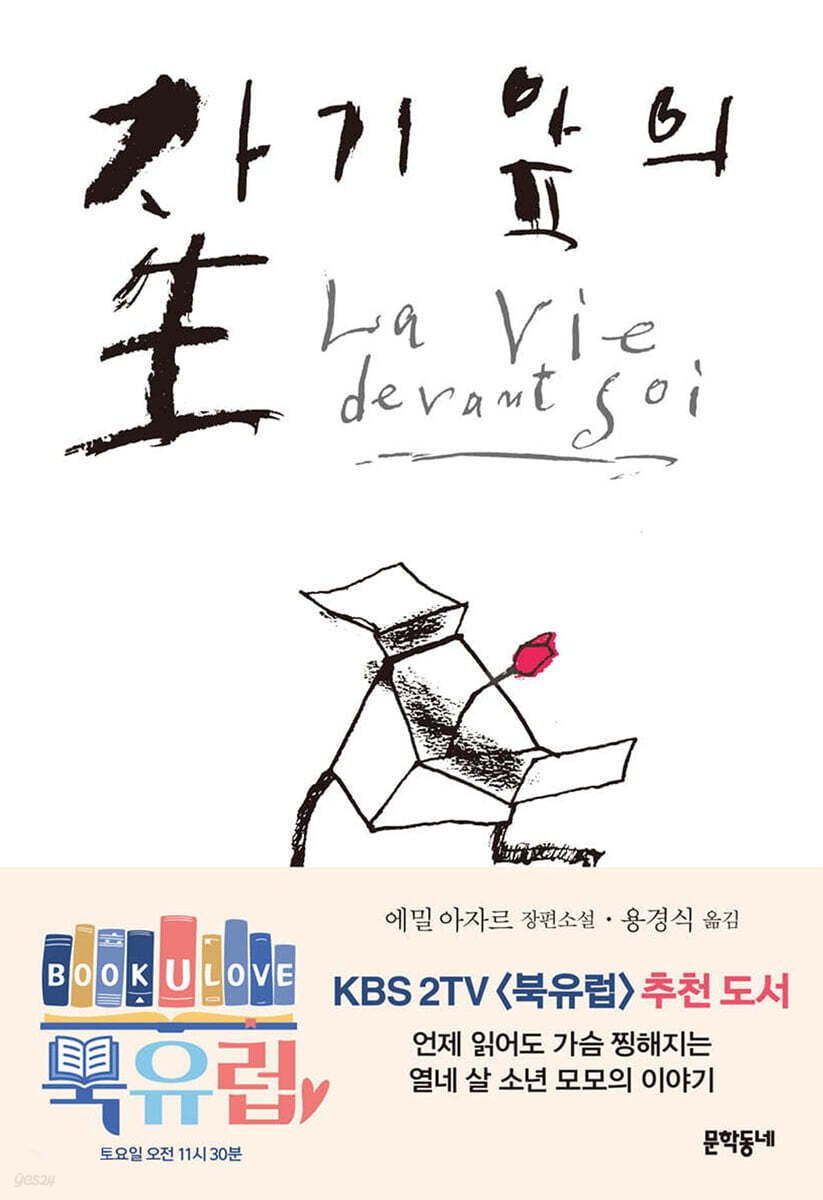
The life before you
 |
Description
Book Introduction
Romain Gary, the only writer to win the Prix Goncourt twice
Grandpa Hamilton, can a person live without love?
Romain Gary, known as the 'writer of humanism', was a Jewish man of Russian immigrant origin.
After World War II, he worked as a diplomat around the world and won the Prix Goncourt in 1956 for his novel The Roots of Heaven.
He also published several novels under pseudonyms, and his second novel, The Life Before Us, published under the name of Azar, won the Prix Goncourt, an award that is never given to a single author twice, making him the first author to win the Prix Goncourt twice.
The author looks at the incomprehensible world through the eyes of fourteen-year-old Momo, who lives older than her actual age.
The world reflected in Momo's eyes is by no means a beautiful, dreamlike world.
The world seems harsher and more cruel when viewed through the eyes of a child.
Arabs, Africans, prostitutes, old people...
All the people Momo loves are people who are marginalized from society and live at the bottom.
But they live more filled with love than anyone else.
These marginalized people, including Aunt Rosa, a Jewish woman who was a prostitute and raised him, are all teachers who awaken the boy.
Through them, the boy learns how to overcome sadness and despair, while also embracing life and caring for the wounds within.
“Life Before Us” is a novel filled with “infinite and deep affection for life.”
Nevertheless, it is also a painful novel.
The weight of life on Momo's back makes it difficult for him to even stand still, let alone climb a mountain.
But what is truly heartbreaking is not the weight of life that weighs down young Momo's life.
But young Momo doesn't show the heaviness, the sadness of life that she learned too early.
Rather, he tries to shake off the weight with cynical cynicism.
The newly translated and published 『Life Before Us』 is a definitive edition, having been newly translated under an official contract with the French company Mercure de France.
This book also includes Romain Gary's will, The Life and Death of Émile Ajar, published by Gallimard after his death.
Grandpa Hamilton, can a person live without love?
Romain Gary, known as the 'writer of humanism', was a Jewish man of Russian immigrant origin.
After World War II, he worked as a diplomat around the world and won the Prix Goncourt in 1956 for his novel The Roots of Heaven.
He also published several novels under pseudonyms, and his second novel, The Life Before Us, published under the name of Azar, won the Prix Goncourt, an award that is never given to a single author twice, making him the first author to win the Prix Goncourt twice.
The author looks at the incomprehensible world through the eyes of fourteen-year-old Momo, who lives older than her actual age.
The world reflected in Momo's eyes is by no means a beautiful, dreamlike world.
The world seems harsher and more cruel when viewed through the eyes of a child.
Arabs, Africans, prostitutes, old people...
All the people Momo loves are people who are marginalized from society and live at the bottom.
But they live more filled with love than anyone else.
These marginalized people, including Aunt Rosa, a Jewish woman who was a prostitute and raised him, are all teachers who awaken the boy.
Through them, the boy learns how to overcome sadness and despair, while also embracing life and caring for the wounds within.
“Life Before Us” is a novel filled with “infinite and deep affection for life.”
Nevertheless, it is also a painful novel.
The weight of life on Momo's back makes it difficult for him to even stand still, let alone climb a mountain.
But what is truly heartbreaking is not the weight of life that weighs down young Momo's life.
But young Momo doesn't show the heaviness, the sadness of life that she learned too early.
Rather, he tries to shake off the weight with cynical cynicism.
The newly translated and published 『Life Before Us』 is a definitive edition, having been newly translated under an official contract with the French company Mercure de France.
This book also includes Romain Gary's will, The Life and Death of Émile Ajar, published by Gallimard after his death.
- You can preview some of the book's contents.
Preview
index
[Life before you]
The Life and Death of Émile Ajar/Romain Gary
People can be happy even with a sad ending/Jo Kyung-ran
The Life and Death of Émile Ajar/Romain Gary
People can be happy even with a sad ending/Jo Kyung-ran
Publisher's Review
Korea's first original contract
"Emile Ajar, winner of the 75th Prix Goncourt, whose original work even the publisher didn't know, even resorted to advertising to find the author! Who is he? Did he really write it? Why did he refuse the award? The shocking story of Ajar's work has sent shockwaves throughout the world!"
In the 1976 edition of Munhaksasangsa's 『Life Before Us』, this phrase appears instead of the author's introduction.
In addition to Munhaksasangsa, numerous editions of 『The Life Before Us』 have been published, but none of them have formally signed a copyright agreement, and many parts of the novel have been published with them missing.
The newly translated and published 『Life Before Us』 is a definitive version, having been translated under an official contract with the French company Mercure de France.
This book also includes Romain Gary's will, The Life and Death of Émile Ajar, published by Gallimard after his death.
Like all good books, this one makes you cry and laugh at the same time.
- Nouvelle Observateur
"Life Before Us" is a story about ordinary people who do extraordinary things.
The extraordinary thing is to realize love and put it into practice.
Momo told me.
That people can be happy even with a sad ending.
-Jo Kyung-ran (novelist)
"Life Before Us" is a sad and beautiful story.
“Life Before Us” is a novel filled with “infinite and deep affection for life.”
Nevertheless, it is also a painful novel.
Who said life was like climbing a mountain with a heavy load on your back?
But the weight of life on Momo's back makes it difficult for him to even stand still, let alone climb a mountain.
But what is truly heartbreaking is not the weight of life that weighs down young Momo's life.
If he had just sat down and cried, saying it was hard, if he had just kicked and cried out to be freed from this life, perhaps we who read his life wouldn't have had such a hard time.
Yes, that's right.
We feel energized throughout the reading of the work.
It takes a lot of effort to close the bookcase several times, and then pick it up again for the same reason.
But young Momo doesn't show the heaviness, the sadness of life that she learned too early.
Rather, he tries to shake off the weight with cynical cynicism.
Knowing that his cynicism is just a pile of countless tears, my heart aches…
Grandpa Hamilton, can a person live without love?
The author looks at the incomprehensible world through the eyes of fourteen-year-old Momo, who lives older than her actual age.
The world reflected in Momo's eyes is by no means a beautiful, dreamlike world.
The world seems harsher and more cruel when viewed through the eyes of a child.
Arabs and Africans who are racially discriminated against, Jews who were taken to Auschwitz and barely returned alive, the children of abandoned prostitutes, prostitutes who have to sell their smiles to survive, women who take care of the children of prostitutes, old people without friends or family, transgender people who have both female and male characteristics in one body, poor people, sick people, murderers… … All the people Momo loves are people who have deviated from the center of the world, alienated from society, and who live at the bottom, alienating themselves.
Abandoned people, people suffering and saddened by their exhausted lives… …but they live more filled with love than anyone else.
These marginalized people, including Aunt Rosa, a Jewish woman who was a prostitute and raised him, are all teachers who awaken the boy.
Through them, the boy learns how to overcome sadness and despair, while also embracing life and caring for the wounds within.
“I used to say that I would be happy if I had just two people on my side, someone who would never put me down, no matter where or under what circumstances…” This is a line from Shin Kyung-sook’s novel.
To Momo, who sat by Rosa's side, touching up her makeup several times, worried that she might hate the sight of her dead Aunt Rosa sitting on an old sofa in her basement, and turning blue and hard, Aunt Rosa was the only person on her side.
To the woman who would not even give her child to her biological father, Momo was the only person on her side.
The love that the two people showed transcended race, age, and gender, and was one in which they desperately missed each other and warmly embraced each other.
What the boy discovers by uncovering the miserable lives of the destitute and the ignored is the 'mysterious and wondrous secret of life.'
It is also the implicit truth that the author wants to convey throughout the work through the voice of a bewildered boy.
Romain Gary (Emile Ajar) says his ventriloquist, Momo.
"You have to love."
"Mittornich Jorgen." In case you don't know Hebrew, it means 'I have nothing to blame the world for.'
Yes, that's right.
There is nothing to blame the world for.
Because we must love, and we love.
The Life and Death of the Lonely Clown Romain Gary--The Life and Death of Émile Ajar
Romain Gary, known as the 'writer of humanism', was a Jewish man of Russian immigrant origin.
After the outbreak of World War I, his mother turned her back on her homeland, Russia, and began a long journey of over ten years with her son, passing through Poland and then to France.
In order to settle down in France as an immigrant, his mother worked any job she could find, and Romain Gary, who grew up under such a tough mother, was a shy boy who loved writing.
During World War II, he was active in the resistance group 'Free France' and was awarded the Legion of Honor for his service as a captain in the Lorraine Flying Squadron.
After the war, he worked as a diplomat around the world and won the Prix Goncourt in 1956 for his novel The Roots of Heaven.
In addition to his glamorous marriages with Leslie Blanch, the editor of Vogue who was seven years his senior, and Jean Seberg, the heroine of Breatheless, he also seemed to enjoy a celebrity-like life with the title of successful writer.
But behind that flashy exterior, there was always a lonely writer who wanted to try something new.
Romain Gary also published several novels under the pseudonyms of Émile Ajar, Posco Sinibaldi, and Chatan Bogat.
His unfulfilled longing for life was rooted in his desire to live as himself, even if it meant changing his name.
In the end, he won the Prix Goncourt, which is never given to the same writer twice, for his second novel, The Life Before Us, published under the name of Azar. The writer who published novels alternately under the names of Romain Gary and Émile Ajar was even accused of trying to plagiarize Azar, which is ironic.
In December 1980, a year after his ex-wife Jean Seberg committed suicide by taking drugs, Romain Gary also ended his lonely life by shooting himself with a pistol.
He was 66 years old.
In 『The Life and Death of Émile Ajar』, published after his suicide, Romain Gary reveals that Ajar is himself, ridicules the so-called 'Parisian style' of literary power and critics who write criticism without even reading the work carefully, and confesses why he had no choice but to continuously devote himself to writing, even using a pseudonym.
Romain Gary, the only writer to win the Prix Goncourt twice
When the 1975 Goncourt Prize winner was announced to be Émile Ajar, author of The Life Before Us, the winning author announced to the Goncourt Academy that he would not accept the award.
However, Hervé Bazin, president of the Academy, responds: “The Academy voted not for a candidate, but for a book.
Like birth and death, the Goncourt Prize can neither be accepted nor declined.
The winner is still Hazard.” Thus, the mysterious writer Émile Ajar remained the winner, and when it was later revealed that Hazard was actually Romain Gary, Romain Gary became the only writer to have won the Prix Goncourt twice.
That you can be happy even with a sad ending
The childhood days, when there were many things it was better not to know, will soon pass.
After reading "The Life Before Us," I became an adult and, like Momo, learned about the great wounds and the power to hide them.
"Life Before Us" is a story about ordinary people who do extraordinary things.
The extraordinary thing is to realize love and put it into practice.
Momo told me.
That people can be happy even with a sad ending.
After closing 『The Life Before Us』, I suddenly felt the urge to call someone's name with all my heart.
The reason I want to call him this is to remind him that there are still people who love him and know his name, and that he has such a name.
And then, all of a sudden, I wish someone would call my name really loudly.
Perhaps we can have a passionate conversation about how living this life isn't as futile as spreading salt on the ground or moving a piece of ice.
And we will say:
About the kind of love that can give each other courage.--Jo Kyung-ran (novelist)
"Emile Ajar, winner of the 75th Prix Goncourt, whose original work even the publisher didn't know, even resorted to advertising to find the author! Who is he? Did he really write it? Why did he refuse the award? The shocking story of Ajar's work has sent shockwaves throughout the world!"
In the 1976 edition of Munhaksasangsa's 『Life Before Us』, this phrase appears instead of the author's introduction.
In addition to Munhaksasangsa, numerous editions of 『The Life Before Us』 have been published, but none of them have formally signed a copyright agreement, and many parts of the novel have been published with them missing.
The newly translated and published 『Life Before Us』 is a definitive version, having been translated under an official contract with the French company Mercure de France.
This book also includes Romain Gary's will, The Life and Death of Émile Ajar, published by Gallimard after his death.
Like all good books, this one makes you cry and laugh at the same time.
- Nouvelle Observateur
"Life Before Us" is a story about ordinary people who do extraordinary things.
The extraordinary thing is to realize love and put it into practice.
Momo told me.
That people can be happy even with a sad ending.
-Jo Kyung-ran (novelist)
"Life Before Us" is a sad and beautiful story.
“Life Before Us” is a novel filled with “infinite and deep affection for life.”
Nevertheless, it is also a painful novel.
Who said life was like climbing a mountain with a heavy load on your back?
But the weight of life on Momo's back makes it difficult for him to even stand still, let alone climb a mountain.
But what is truly heartbreaking is not the weight of life that weighs down young Momo's life.
If he had just sat down and cried, saying it was hard, if he had just kicked and cried out to be freed from this life, perhaps we who read his life wouldn't have had such a hard time.
Yes, that's right.
We feel energized throughout the reading of the work.
It takes a lot of effort to close the bookcase several times, and then pick it up again for the same reason.
But young Momo doesn't show the heaviness, the sadness of life that she learned too early.
Rather, he tries to shake off the weight with cynical cynicism.
Knowing that his cynicism is just a pile of countless tears, my heart aches…
Grandpa Hamilton, can a person live without love?
The author looks at the incomprehensible world through the eyes of fourteen-year-old Momo, who lives older than her actual age.
The world reflected in Momo's eyes is by no means a beautiful, dreamlike world.
The world seems harsher and more cruel when viewed through the eyes of a child.
Arabs and Africans who are racially discriminated against, Jews who were taken to Auschwitz and barely returned alive, the children of abandoned prostitutes, prostitutes who have to sell their smiles to survive, women who take care of the children of prostitutes, old people without friends or family, transgender people who have both female and male characteristics in one body, poor people, sick people, murderers… … All the people Momo loves are people who have deviated from the center of the world, alienated from society, and who live at the bottom, alienating themselves.
Abandoned people, people suffering and saddened by their exhausted lives… …but they live more filled with love than anyone else.
These marginalized people, including Aunt Rosa, a Jewish woman who was a prostitute and raised him, are all teachers who awaken the boy.
Through them, the boy learns how to overcome sadness and despair, while also embracing life and caring for the wounds within.
“I used to say that I would be happy if I had just two people on my side, someone who would never put me down, no matter where or under what circumstances…” This is a line from Shin Kyung-sook’s novel.
To Momo, who sat by Rosa's side, touching up her makeup several times, worried that she might hate the sight of her dead Aunt Rosa sitting on an old sofa in her basement, and turning blue and hard, Aunt Rosa was the only person on her side.
To the woman who would not even give her child to her biological father, Momo was the only person on her side.
The love that the two people showed transcended race, age, and gender, and was one in which they desperately missed each other and warmly embraced each other.
What the boy discovers by uncovering the miserable lives of the destitute and the ignored is the 'mysterious and wondrous secret of life.'
It is also the implicit truth that the author wants to convey throughout the work through the voice of a bewildered boy.
Romain Gary (Emile Ajar) says his ventriloquist, Momo.
"You have to love."
"Mittornich Jorgen." In case you don't know Hebrew, it means 'I have nothing to blame the world for.'
Yes, that's right.
There is nothing to blame the world for.
Because we must love, and we love.
The Life and Death of the Lonely Clown Romain Gary--The Life and Death of Émile Ajar
Romain Gary, known as the 'writer of humanism', was a Jewish man of Russian immigrant origin.
After the outbreak of World War I, his mother turned her back on her homeland, Russia, and began a long journey of over ten years with her son, passing through Poland and then to France.
In order to settle down in France as an immigrant, his mother worked any job she could find, and Romain Gary, who grew up under such a tough mother, was a shy boy who loved writing.
During World War II, he was active in the resistance group 'Free France' and was awarded the Legion of Honor for his service as a captain in the Lorraine Flying Squadron.
After the war, he worked as a diplomat around the world and won the Prix Goncourt in 1956 for his novel The Roots of Heaven.
In addition to his glamorous marriages with Leslie Blanch, the editor of Vogue who was seven years his senior, and Jean Seberg, the heroine of Breatheless, he also seemed to enjoy a celebrity-like life with the title of successful writer.
But behind that flashy exterior, there was always a lonely writer who wanted to try something new.
Romain Gary also published several novels under the pseudonyms of Émile Ajar, Posco Sinibaldi, and Chatan Bogat.
His unfulfilled longing for life was rooted in his desire to live as himself, even if it meant changing his name.
In the end, he won the Prix Goncourt, which is never given to the same writer twice, for his second novel, The Life Before Us, published under the name of Azar. The writer who published novels alternately under the names of Romain Gary and Émile Ajar was even accused of trying to plagiarize Azar, which is ironic.
In December 1980, a year after his ex-wife Jean Seberg committed suicide by taking drugs, Romain Gary also ended his lonely life by shooting himself with a pistol.
He was 66 years old.
In 『The Life and Death of Émile Ajar』, published after his suicide, Romain Gary reveals that Ajar is himself, ridicules the so-called 'Parisian style' of literary power and critics who write criticism without even reading the work carefully, and confesses why he had no choice but to continuously devote himself to writing, even using a pseudonym.
Romain Gary, the only writer to win the Prix Goncourt twice
When the 1975 Goncourt Prize winner was announced to be Émile Ajar, author of The Life Before Us, the winning author announced to the Goncourt Academy that he would not accept the award.
However, Hervé Bazin, president of the Academy, responds: “The Academy voted not for a candidate, but for a book.
Like birth and death, the Goncourt Prize can neither be accepted nor declined.
The winner is still Hazard.” Thus, the mysterious writer Émile Ajar remained the winner, and when it was later revealed that Hazard was actually Romain Gary, Romain Gary became the only writer to have won the Prix Goncourt twice.
That you can be happy even with a sad ending
The childhood days, when there were many things it was better not to know, will soon pass.
After reading "The Life Before Us," I became an adult and, like Momo, learned about the great wounds and the power to hide them.
"Life Before Us" is a story about ordinary people who do extraordinary things.
The extraordinary thing is to realize love and put it into practice.
Momo told me.
That people can be happy even with a sad ending.
After closing 『The Life Before Us』, I suddenly felt the urge to call someone's name with all my heart.
The reason I want to call him this is to remind him that there are still people who love him and know his name, and that he has such a name.
And then, all of a sudden, I wish someone would call my name really loudly.
Perhaps we can have a passionate conversation about how living this life isn't as futile as spreading salt on the ground or moving a piece of ice.
And we will say:
About the kind of love that can give each other courage.--Jo Kyung-ran (novelist)
GOODS SPECIFICS
- Date of issue: May 6, 2003
- Format: Hardcover book binding method guide
- Page count, weight, size: 363 pages | 450g | 128*188*30mm
- ISBN13: 9788982816635
- ISBN10: 8982816631
You may also like
카테고리
korean


korean

![ELLE 엘르 스페셜 에디션 A형 : 12월 [2025]](http://librairie.coreenne.fr/cdn/shop/files/b8e27a3de6c9538896439686c6b0e8fb.jpg?v=1766436872&width=3840)


