

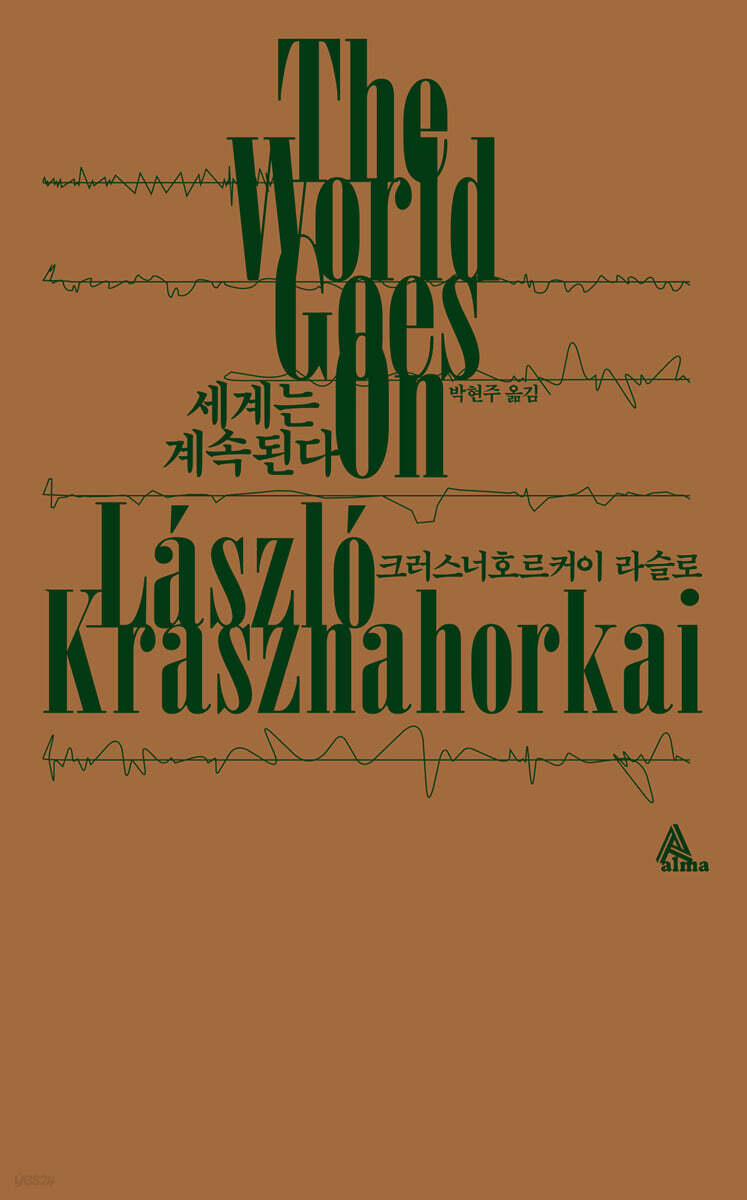
The world goes on
 |
Description
Book Introduction
The master of the apocalypse, Laszlo Krusnahorkai
Another story without a period
Even in despair and apocalypse, the world goes on.
"An artist who reawakened the power of art even amidst the fear of destruction."
Continuing our connection with Korean readers with the new work "Hersheyt 07769."
László Krásznáhorkaj, a master of modern Hungarian literature, has won the 2025 Nobel Prize in Literature.
The Nobel Committee stated that the award was given for “a powerful and visionary work that reawakens the power of art even in the face of the horrors of destruction,” and that he had shown again the possibility of a “prophetic language” that modern literature had lost.
A literary prophet walking the boundaries of language, between destruction and salvation.
Since his literary debut in 1985 with "Satantango," László Krzysztof Krzysztof Krzysztof has been a writer who has depicted the anxieties of human existence and the collapse of the world in his compelling prose. His prose, with its endlessly long sentences and intense narrative tension, immerses readers in a unique style that can be called a "reading exercise."
Alma Publishing has introduced the author's six representative works, "Satan Tango," "Melancholy of Resistance," "The Last Wolf," "The World Goes On," "The Descent of the Queen Mother of the West," and "The Return of Baron Wenkheim," to Korea, and plans to publish a new work, "Herscht 07769," in January 2026.
"Hersht 07769" depicts the journey of "Hersht," a man called by a number instead of a name, as he seeks to rediscover his identity and the meaning of language in a world after the collapse of civilization. In a society where communication is based solely on numbers and symbols, he encounters a world of humans whose names can no longer be called. This work is considered to be the author's later work that most densely embodies the "anxiety of existence" and "human possibilities after the end of language," which the author has consistently explored.
His literary works, which have expanded globally, have long cultivated a deep readership, even amidst a quiet resonance. This Nobel Prize in Literature marks the moment when his endless exploration of the origins of humanity and art is once again resurrected in the languages of the world, and will undoubtedly resonate deeply with readers.
Promotion of screenings of "Reading László Krzysztof ...
To commemorate this award, Alma Publishing will present a booklet titled "Reading László Krasnahorkai" (tentative title), which aims to bring readers closer to the world of literature, which is by no means easy but essential to read. The contributors include Professor Han Kyung-min, poet Jo Won-gyu, film critic Jeong Seong-il, literary critic Jang Eun-soo, critic Geum Jeong-yeon, and poet Kim Yu-tae, who will each interpret the author's world from their own perspectives.
Additionally, in order to expand and illuminate the author's literary world through film, we are promoting the screening of "Werckmeister Harmonies," based on the films "Satantango" and "Resistance Melancholy" by another world-renowned director, Tar Bella.
Another story without a period
Even in despair and apocalypse, the world goes on.
"An artist who reawakened the power of art even amidst the fear of destruction."
Continuing our connection with Korean readers with the new work "Hersheyt 07769."
László Krásznáhorkaj, a master of modern Hungarian literature, has won the 2025 Nobel Prize in Literature.
The Nobel Committee stated that the award was given for “a powerful and visionary work that reawakens the power of art even in the face of the horrors of destruction,” and that he had shown again the possibility of a “prophetic language” that modern literature had lost.
A literary prophet walking the boundaries of language, between destruction and salvation.
Since his literary debut in 1985 with "Satantango," László Krzysztof Krzysztof Krzysztof has been a writer who has depicted the anxieties of human existence and the collapse of the world in his compelling prose. His prose, with its endlessly long sentences and intense narrative tension, immerses readers in a unique style that can be called a "reading exercise."
Alma Publishing has introduced the author's six representative works, "Satan Tango," "Melancholy of Resistance," "The Last Wolf," "The World Goes On," "The Descent of the Queen Mother of the West," and "The Return of Baron Wenkheim," to Korea, and plans to publish a new work, "Herscht 07769," in January 2026.
"Hersht 07769" depicts the journey of "Hersht," a man called by a number instead of a name, as he seeks to rediscover his identity and the meaning of language in a world after the collapse of civilization. In a society where communication is based solely on numbers and symbols, he encounters a world of humans whose names can no longer be called. This work is considered to be the author's later work that most densely embodies the "anxiety of existence" and "human possibilities after the end of language," which the author has consistently explored.
His literary works, which have expanded globally, have long cultivated a deep readership, even amidst a quiet resonance. This Nobel Prize in Literature marks the moment when his endless exploration of the origins of humanity and art is once again resurrected in the languages of the world, and will undoubtedly resonate deeply with readers.
Promotion of screenings of "Reading László Krzysztof ...
To commemorate this award, Alma Publishing will present a booklet titled "Reading László Krasnahorkai" (tentative title), which aims to bring readers closer to the world of literature, which is by no means easy but essential to read. The contributors include Professor Han Kyung-min, poet Jo Won-gyu, film critic Jeong Seong-il, literary critic Jang Eun-soo, critic Geum Jeong-yeon, and poet Kim Yu-tae, who will each interpret the author's world from their own perspectives.
Additionally, in order to expand and illuminate the author's literary world through film, we are promoting the screening of "Werckmeister Harmonies," based on the films "Satantango" and "Resistance Melancholy" by another world-renowned director, Tar Bella.
- You can preview some of the book's contents.
Preview
index
Part 1: Speaking
Standing wandering
About speed
I want to forget
How beautiful
No matter how late, in Turin
The world goes on
Universal Theseus
All together, 100 people
Not on the path of Heraclitus
Part 2 Talk
Guryongju Intersection
One day on Highway 381
Henryk Molnar of the György Ruins
bankers
a drop of water
Downhill path in the forest
bill
That Gagarin
Obstacle theory
Walking through a place without blessings
The Swans of Istanbul
Part 3: Saying Goodbye
I don't need anything here
Translator's Note
Standing wandering
About speed
I want to forget
How beautiful
No matter how late, in Turin
The world goes on
Universal Theseus
All together, 100 people
Not on the path of Heraclitus
Part 2 Talk
Guryongju Intersection
One day on Highway 381
Henryk Molnar of the György Ruins
bankers
a drop of water
Downhill path in the forest
bill
That Gagarin
Obstacle theory
Walking through a place without blessings
The Swans of Istanbul
Part 3: Saying Goodbye
I don't need anything here
Translator's Note
Into the book
No, history is not over, nothing is over.
We can no longer fool ourselves into thinking that what is over is over.
I just keep going and holding on somehow.
Something goes on, something survives.
We still produce art, but we no longer talk about how to do it, and it's not as if it's a work of art that gives us hope.
Up to this point, we had been faithfully submitting to strict discipline, without any understanding of the meaning, taking as presuppositions all that had been meant by the essence of the 'human condition', but in reality we are sinking into the abyss of despair, once again sinking into the muddy waters of the imaginable totality of human existence.
We no longer make the same mistake as the wild youth, declaring that our judgment is the final judgment or that this is a dead end.
Since nothing is rational anymore, we can no longer claim that our works of art contain narrative or time, nor can we claim that others can find a way to make something rational.
We declare that ignoring our disillusionment has proven futile, and we move on to higher goals, to a higher power, but our attempts continue to fail, shamefully.
In vain we talk about nature, but nature does not want this.
There is no use talking about divinity, and God does not want it.
No matter how much we want to, we can't talk about anything but ourselves.
Because we are capable of speaking only about history, only about the human condition, only about those essentially appropriate and immutable qualities that are pleasantly stimulating.
Otherwise, from the perspective of what would otherwise be divine, our essence might actually be eternally, irrelevant to anything at all.
--- pp.30-31
Now we slip between the buoys that mark the harbor, and sail blindly anyway, for the lighthouse keepers are asleep and cannot guide our course, and so we drop anchor in the muddy waters that immediately swallow up the question of whether this greater whole reflects the higher meaning of the law.
And here we wait, unaware, while our fellow human beings slowly approach us from a thousand directions, we simply watch.
Without sending any message, he just watches and maintains a silence filled with empathy.
We believe that this empathy within us is appropriate in itself and will also be appropriate for those who come to us.
Even if it isn't like that today, it will be like that tomorrow... ...or even in 10 years... ...or even in 30 years.
At the latest, in Turin.
--- pp.40-41
Just then, all of a sudden, a terrible fear began to creep slowly into me, and I couldn't tell where it came from, but I could feel it growing, and for a while this fear didn't reveal itself, but just existed and grew, and I sat there, completely helpless, watching the fear grow inside me, waiting, perhaps, after a while, I would understand the nature of this fear, but that didn't happen, it didn't happen at all, this fear continued to grow, but it didn't reveal anything about its inner self, it refused to reveal anything, and so, naturally, I became anxious about what to do next, wondering if I could sit here forever with this fear that concealed itself inside me. And yet, I just sat there, numb, by the window, and outside, the Twin Towers collapsed, collapsed, collapsed again, and then suddenly my ears recognized a creaking noise, like the dull clanking of chains in the distance, and my ears also recognized a slight scratching sound, firmly. As if a rope that had bound me were slowly being untied, all I could hear was this creaking and this terrible scraping, and once again I remembered my old language and the utter silence into which I had fallen, and I sat there staring out, and when utter darkness filled the room, only one thing became utterly certain: it had been untied, it was approaching, it was already here.
--- pp.48-49
Then the woman got up again and approached the window for the third time.
“I’m sorry to disturb you again...” The woman began to speak anxiously.
“I wrote everything... but... I wanted to add something.
“I wonder if it’s okay to write it like this… ….” The woman handed the telegram paper through the window slot.
“I wanted to add just one more word… but I don’t know… should I rewrite everything?” (omitted)
The officer, arms outstretched helplessly, glanced at the next person in line, a young soldier, with a look of complicity in his eyes, then frowned and said, “How can I help you?” He took the telegram and bent over it.
“Please tell me what word it is.
I'll write it down for you.
“Let’s finish this.”
The woman answered in a faint voice.
“Here, I would like to add the word ‘useless.’” (omitted)
“I can’t stand these crazy people.
People like this are so annoying.
“If I see just one more person… … Just look at this!” The woman turned to the young soldier and slammed the telegram down with her palm in disgust.
“What on earth am I supposed to do with this?”
“What is it? What’s wrong?” asked the young man.
With an indignant gesture, the employee held out the telegram to him and crumpled it into a fist.
“There is no recipient.”
--- pp.119-121
After those hundred, no one will even realize that mentioning another person will actually never reach that person, so only words will remain, and for another 2,500 years human language will be as useless as it ever was, not only because people cannot decipher what has been inscribed in the trillions and billions of facts that have been sacred and unmediated from past to present, but also because these words divert us from where they should lead us, and because they were not and will not be the right words to console us, even if we mourn the loss of the original words, and because they cannot give us this warning, we must listen very carefully to what is said, for it will be said once, and only once.
--- p.147
He simply couldn't hide this happiness, he just radiated it as he passed through security, boarded the plane with a bright smile, sat down in his seat with shining eyes and fastened his seatbelt, like a child who had finally received the gift he had been dreaming of, because he was truly happy, he just couldn't talk about it, because what he had realized in Shanghai was indescribable, really, there was nothing else to do but gaze out the plane window at the dazzling blue sky and remain in profound silence. It no longer mattered which waterfall it was, or whether he would see one of them, because they were all the same, just hearing the sound was enough, and he flew quickly north-northwest at 900 kilometers per hour, high in the clouds, at an altitude of about 10,000 meters, towards the dazzling blue sky, towards the hope that one day he would die.
--- pp.196-197
He thought, Run away? Run away from Varanasi?! But damn it, damn it! Varanasi was the world.
With the utmost caution, he first glanced around, then slipped out the door, tiptoed down the stairs, stole past the empty hotel reception, stepped onto the street, turned the first corner he saw, then the next, making sure not to turn four times, always to the left or right, this, this thought rang like an alarm in his head, not four times, not in the same direction, there would be no escape, he would be back where he had left off.
--- p.334
I already know that leaving the Earth won't happen from "my usual window", that is, if I open the window, step outside, and push myself out, that won't happen, I'll go up, that won't work, so instead, after I'm done with everything (and give my notebook to Nurse Istvan), I'll open this window on the sixth floor, stand on the window sill, and push myself out, because whatever doesn't go up will definitely go down.
Because that time has come.
From the 6th floor to paradise.
--- p.418
I leave everything here: the valley, the hill, the path, and the jays of the garden. I leave here the barrel and the priest, the sky and the earth, spring and autumn. I leave here the exit path, the evening in the kitchen, the last glance of a lover, all the city trips that made me shiver. I leave here the deep twilight that falls on the earth, gravity, hope, enchantment, tranquility. I leave here my loved ones and those close to me, everything that moved me, everything that shocked me, everything that fascinated and elevated me. I leave here the noble, the kind, the cheerful, the devilishly beautiful. I leave here the new shoots, all birth and existence. I leave here the spell, the wonder, the intoxication of distance, infinite patience, eternity: here I leave this land and this star, for I can take nothing with me from here. I need nothing here, having already seen what is to come.
We can no longer fool ourselves into thinking that what is over is over.
I just keep going and holding on somehow.
Something goes on, something survives.
We still produce art, but we no longer talk about how to do it, and it's not as if it's a work of art that gives us hope.
Up to this point, we had been faithfully submitting to strict discipline, without any understanding of the meaning, taking as presuppositions all that had been meant by the essence of the 'human condition', but in reality we are sinking into the abyss of despair, once again sinking into the muddy waters of the imaginable totality of human existence.
We no longer make the same mistake as the wild youth, declaring that our judgment is the final judgment or that this is a dead end.
Since nothing is rational anymore, we can no longer claim that our works of art contain narrative or time, nor can we claim that others can find a way to make something rational.
We declare that ignoring our disillusionment has proven futile, and we move on to higher goals, to a higher power, but our attempts continue to fail, shamefully.
In vain we talk about nature, but nature does not want this.
There is no use talking about divinity, and God does not want it.
No matter how much we want to, we can't talk about anything but ourselves.
Because we are capable of speaking only about history, only about the human condition, only about those essentially appropriate and immutable qualities that are pleasantly stimulating.
Otherwise, from the perspective of what would otherwise be divine, our essence might actually be eternally, irrelevant to anything at all.
--- pp.30-31
Now we slip between the buoys that mark the harbor, and sail blindly anyway, for the lighthouse keepers are asleep and cannot guide our course, and so we drop anchor in the muddy waters that immediately swallow up the question of whether this greater whole reflects the higher meaning of the law.
And here we wait, unaware, while our fellow human beings slowly approach us from a thousand directions, we simply watch.
Without sending any message, he just watches and maintains a silence filled with empathy.
We believe that this empathy within us is appropriate in itself and will also be appropriate for those who come to us.
Even if it isn't like that today, it will be like that tomorrow... ...or even in 10 years... ...or even in 30 years.
At the latest, in Turin.
--- pp.40-41
Just then, all of a sudden, a terrible fear began to creep slowly into me, and I couldn't tell where it came from, but I could feel it growing, and for a while this fear didn't reveal itself, but just existed and grew, and I sat there, completely helpless, watching the fear grow inside me, waiting, perhaps, after a while, I would understand the nature of this fear, but that didn't happen, it didn't happen at all, this fear continued to grow, but it didn't reveal anything about its inner self, it refused to reveal anything, and so, naturally, I became anxious about what to do next, wondering if I could sit here forever with this fear that concealed itself inside me. And yet, I just sat there, numb, by the window, and outside, the Twin Towers collapsed, collapsed, collapsed again, and then suddenly my ears recognized a creaking noise, like the dull clanking of chains in the distance, and my ears also recognized a slight scratching sound, firmly. As if a rope that had bound me were slowly being untied, all I could hear was this creaking and this terrible scraping, and once again I remembered my old language and the utter silence into which I had fallen, and I sat there staring out, and when utter darkness filled the room, only one thing became utterly certain: it had been untied, it was approaching, it was already here.
--- pp.48-49
Then the woman got up again and approached the window for the third time.
“I’m sorry to disturb you again...” The woman began to speak anxiously.
“I wrote everything... but... I wanted to add something.
“I wonder if it’s okay to write it like this… ….” The woman handed the telegram paper through the window slot.
“I wanted to add just one more word… but I don’t know… should I rewrite everything?” (omitted)
The officer, arms outstretched helplessly, glanced at the next person in line, a young soldier, with a look of complicity in his eyes, then frowned and said, “How can I help you?” He took the telegram and bent over it.
“Please tell me what word it is.
I'll write it down for you.
“Let’s finish this.”
The woman answered in a faint voice.
“Here, I would like to add the word ‘useless.’” (omitted)
“I can’t stand these crazy people.
People like this are so annoying.
“If I see just one more person… … Just look at this!” The woman turned to the young soldier and slammed the telegram down with her palm in disgust.
“What on earth am I supposed to do with this?”
“What is it? What’s wrong?” asked the young man.
With an indignant gesture, the employee held out the telegram to him and crumpled it into a fist.
“There is no recipient.”
--- pp.119-121
After those hundred, no one will even realize that mentioning another person will actually never reach that person, so only words will remain, and for another 2,500 years human language will be as useless as it ever was, not only because people cannot decipher what has been inscribed in the trillions and billions of facts that have been sacred and unmediated from past to present, but also because these words divert us from where they should lead us, and because they were not and will not be the right words to console us, even if we mourn the loss of the original words, and because they cannot give us this warning, we must listen very carefully to what is said, for it will be said once, and only once.
--- p.147
He simply couldn't hide this happiness, he just radiated it as he passed through security, boarded the plane with a bright smile, sat down in his seat with shining eyes and fastened his seatbelt, like a child who had finally received the gift he had been dreaming of, because he was truly happy, he just couldn't talk about it, because what he had realized in Shanghai was indescribable, really, there was nothing else to do but gaze out the plane window at the dazzling blue sky and remain in profound silence. It no longer mattered which waterfall it was, or whether he would see one of them, because they were all the same, just hearing the sound was enough, and he flew quickly north-northwest at 900 kilometers per hour, high in the clouds, at an altitude of about 10,000 meters, towards the dazzling blue sky, towards the hope that one day he would die.
--- pp.196-197
He thought, Run away? Run away from Varanasi?! But damn it, damn it! Varanasi was the world.
With the utmost caution, he first glanced around, then slipped out the door, tiptoed down the stairs, stole past the empty hotel reception, stepped onto the street, turned the first corner he saw, then the next, making sure not to turn four times, always to the left or right, this, this thought rang like an alarm in his head, not four times, not in the same direction, there would be no escape, he would be back where he had left off.
--- p.334
I already know that leaving the Earth won't happen from "my usual window", that is, if I open the window, step outside, and push myself out, that won't happen, I'll go up, that won't work, so instead, after I'm done with everything (and give my notebook to Nurse Istvan), I'll open this window on the sixth floor, stand on the window sill, and push myself out, because whatever doesn't go up will definitely go down.
Because that time has come.
From the 6th floor to paradise.
--- p.418
I leave everything here: the valley, the hill, the path, and the jays of the garden. I leave here the barrel and the priest, the sky and the earth, spring and autumn. I leave here the exit path, the evening in the kitchen, the last glance of a lover, all the city trips that made me shiver. I leave here the deep twilight that falls on the earth, gravity, hope, enchantment, tranquility. I leave here my loved ones and those close to me, everything that moved me, everything that shocked me, everything that fascinated and elevated me. I leave here the noble, the kind, the cheerful, the devilishly beautiful. I leave here the new shoots, all birth and existence. I leave here the spell, the wonder, the intoxication of distance, infinite patience, eternity: here I leave this land and this star, for I can take nothing with me from here. I need nothing here, having already seen what is to come.
--- pp.467-468
Publisher's Review
A complex and expansive story racing towards the end
Laszlo Krzysztof ...
The clearest assessment of his work is probably Susan Sontag's comment that he is "a modern Hungarian master of the apocalypse."
When reading his works, which are as difficult as their names, there are no words that come across as intuitively as these.
This book, "The World Goes On," which has a title that contrasts with the evaluation of "The Master of the Apocalypse," is a truly Laszlo-like work.
His sentences are long, connected by commas instead of periods, and he uses narrative and technique that are reminiscent of Lee Sang's "Wings" to clearly reveal complex yet ambiguous states of consciousness.
The world is heading towards its end, but it still rolls forward and continues on.
Humans inevitably resist the inevitable approach of catastrophe, but the results are insignificant.
But is there anything else humans can do? What must humans do to survive in this seemingly endless world? László's long story is an apocalyptic literary exploration of this question.
The reader must discover the answer for himself.
Even in his final farewell, where he leaves everything and everyone behind, the author seems to hint at a final possibility, mentioning infinite perseverance and eternity.
The author, who says in his final farewell, “I have already seen what is to come, so I do not need anything here,” suddenly makes a gentle wave of his hand and disappears like a prophet.
“László Krzysztof ...
“Stories that are unforgettably powerful, delightfully strange, and ultimately larger than the world they inhabit.” — Jacob Silverman, The New York Times
A sense of apocalypse, but a world that continues
An infinite labyrinth like a Möbius strip
Laszlo, the author of the apocalypse, consistently talks about the end, destruction, and the end.
The short story, "The World Goes On," which shares the same title as the book, uses the image of the Twin Towers that collapsed in the 9/11 terrorist attacks to tell a story about the apocalypse and destruction that befell the world.
"Universal Theseus" deals with a lecture in which a person is confined somewhere and tells his story, and it suggests that a situation close to the end is already occurring in the world beyond the lecture hall.
"The Kowloon Island Intersection" is about a man who has always wanted to see a giant waterfall in person but has never been there. He wanders drunkenly through Shanghai's Kowloon Island Intersection, returns to his hotel, and hears the sound of a waterfall amidst the endless stream of words on TV, leading him to the realization that life ends in death.
In "Downhill in the Forest," a series of moments of carelessness inevitably lead to catastrophe, and in "The Bankers," people head to the site of the Chernobyl nuclear power plant accident.
"Walking through a place without blessings" depicts the destruction of a temple built by humans who have lost their divine teachings.
In this way, in Laszlo's work, the world has an inevitability that it cannot help but head towards disaster, war, death, and destruction.
In this world, the characters are placed on an infinite Möbius strip, trying to escape but getting trapped in that world.
In his novels, characters lose their bearings or go in circles.
〈Standing Wandering〉 refers to a person who tries to leave where he is, but ends up wandering around the world while standing still.
In "Someday on Highway 381," a boy leaves the quarry where he must work hard and discovers an oasis-like palace in the forest, but ends up returning to the place he came from.
"That Gagarin" is the story of a man who tries to leave Earth but ends up falling from a window, following Gagarin, the first human to successfully fly into space.
In “A Drop of Water,” he tries to escape from Varanasi, but the moment of escape keeps repeating itself.
In this world where the end and the end are approaching, or are approaching, we all dream of escape.
But the escape fails every time.
It seems that the fate of humans is to return to where they were or to remain still.
Because you can't step into the same river twice
A story of humanity moving forward even as the world ends.
Heraclitus's worldview of heredity, one of the recurring motifs in this book, permeates not only individual lives but the whole world.
"On Speed" explains that as humans try to exceed the Earth's rotational speed, they end up matching the Earth's speed.
Humans cannot exist beyond the world, and can only perceive the reality, this moment, and the details given to them.
In other words, we are beings trapped in the labyrinth called reality.
Individuals, like drops of water, come together to form a river of life and death, which flows down into a waterfall, but the individuals who are part of it cannot see or predict either the river or the waterfall.
In "All 100 People," it is shown that history is a history of reinterpretation and reconstruction, just as the words of an old saint lose their original aura when passed through the mouths of 100 people.
The only moment when humans can see the whole is death.
However, Laszlo says that despite this unpredictability, humans are constantly striving to understand the whole and to look at society and history.
That is why there is a sublime paradox in the apocalyptic pessimistic view.
Therefore, this novel is also a tribute to literature that, while insightful of human limitations, never ceases its futile efforts to overcome them.
That is why the story of humans moving forward even as the world ends is bound to be difficult.
“Longer sentences feel more dramatic to me.
I can't help but agree with Laszlo when he says, "I feel a great sense of freedom when I write a single sentence that stretches across several pages."
A writing style in which the person is not separated and the point of view is not clear is therefore natural.
Just as the characters in the work wander through a labyrinth, the sentences also run without an exit, ending only with a period at the very end.
Even when the story ends, it doesn't end.
Series Introduction
Alma Incognita series
Embark on a special adventure into an unknown world through literature.
Toshiki Okada
The End of the Special Time Granted to Us (by Toshiki Okada, translated by Sanghong Lee, August 2016)
A Relatively Optimistic Case (by Toshiki Okada, translated by Hongi Lee, July 2017)
Hervé Guibert
Ghost Images (by Hervé Guibert, translated by An Bo-ok, March 2017)
The Man in the Red Hat (by Hervé Guibert, translated by An Bo-ok, June 2018)
To the Friend Who Couldn't Save My Life (Hervé Gibet, November 2018)
The Record of Compassion (by Hervé Guibert, translated by Shin Yu-jin, March 2022)
Mathieu Langdon
Erberino (by Mathieu Lindon, translated by Shin Yu-jin, December 2022)
Uming
Elephant on the Sunlit Road (Written by Wuming, translated by Heo Yu-yeong, March 2018)
Laszlo Krusnahorkay
Satan Tango (by László Krzysztof ...
The Melancholy of Resistance (by László Krzysztof ...
The Last Wolf (by László Krzysztof ...
The Descent of the Queen Mother of the West (by László Krzysztof ...
The World Goes On (by László Krzysztof ...
The Return of Baron Wenckheim (by László Krzysztof ...
David Foster Wallace
Oblivion (by David Foster Wallace, translated by Shin Ji-young, October 2019)
String Theory (by David Foster Wallace, translated by Noh Seung-young, November 2019)
A Univus Pluram: Television and the American Novel (by David Foster Wallace, translated by Noh Seung-young, February 2022)
Olivia Rosenthal
Survival Mechanisms in Hostile Situations (by Olivia Rosenthal, translated by Hankookhwa, January 2020)
Kim Sa-gwa
Outside is a Burning Swamp/Trapped in a Mental Hospital (by Kim Sa-gwa, November 2020)
Laurie Frankel
Claude and Poppy (by Laurie Frankl, translated by Kim Hee-jung, May 2023)
John Jeremiah Sullivan
Pulphead (by John Jeremiah Sullivan, translated by Go Young-beom, August 2023)
Norman Erickson Passaribu
Mostly Happy Stories (by Norman Erickson Passaribu, translated by Go Young-beom, November 2023)
Guillaume Laurent
My Body Disappeared (by Guillaume Laurent, translated by Kim Do-yeon, March 2024)
Ludovic Escand
Dreamers of the Night (by Ludovic Escand, translated by Kim Nam-joo, January 2025)
* Will continue to be published.
Laszlo Krzysztof ...
The clearest assessment of his work is probably Susan Sontag's comment that he is "a modern Hungarian master of the apocalypse."
When reading his works, which are as difficult as their names, there are no words that come across as intuitively as these.
This book, "The World Goes On," which has a title that contrasts with the evaluation of "The Master of the Apocalypse," is a truly Laszlo-like work.
His sentences are long, connected by commas instead of periods, and he uses narrative and technique that are reminiscent of Lee Sang's "Wings" to clearly reveal complex yet ambiguous states of consciousness.
The world is heading towards its end, but it still rolls forward and continues on.
Humans inevitably resist the inevitable approach of catastrophe, but the results are insignificant.
But is there anything else humans can do? What must humans do to survive in this seemingly endless world? László's long story is an apocalyptic literary exploration of this question.
The reader must discover the answer for himself.
Even in his final farewell, where he leaves everything and everyone behind, the author seems to hint at a final possibility, mentioning infinite perseverance and eternity.
The author, who says in his final farewell, “I have already seen what is to come, so I do not need anything here,” suddenly makes a gentle wave of his hand and disappears like a prophet.
“László Krzysztof ...
“Stories that are unforgettably powerful, delightfully strange, and ultimately larger than the world they inhabit.” — Jacob Silverman, The New York Times
A sense of apocalypse, but a world that continues
An infinite labyrinth like a Möbius strip
Laszlo, the author of the apocalypse, consistently talks about the end, destruction, and the end.
The short story, "The World Goes On," which shares the same title as the book, uses the image of the Twin Towers that collapsed in the 9/11 terrorist attacks to tell a story about the apocalypse and destruction that befell the world.
"Universal Theseus" deals with a lecture in which a person is confined somewhere and tells his story, and it suggests that a situation close to the end is already occurring in the world beyond the lecture hall.
"The Kowloon Island Intersection" is about a man who has always wanted to see a giant waterfall in person but has never been there. He wanders drunkenly through Shanghai's Kowloon Island Intersection, returns to his hotel, and hears the sound of a waterfall amidst the endless stream of words on TV, leading him to the realization that life ends in death.
In "Downhill in the Forest," a series of moments of carelessness inevitably lead to catastrophe, and in "The Bankers," people head to the site of the Chernobyl nuclear power plant accident.
"Walking through a place without blessings" depicts the destruction of a temple built by humans who have lost their divine teachings.
In this way, in Laszlo's work, the world has an inevitability that it cannot help but head towards disaster, war, death, and destruction.
In this world, the characters are placed on an infinite Möbius strip, trying to escape but getting trapped in that world.
In his novels, characters lose their bearings or go in circles.
〈Standing Wandering〉 refers to a person who tries to leave where he is, but ends up wandering around the world while standing still.
In "Someday on Highway 381," a boy leaves the quarry where he must work hard and discovers an oasis-like palace in the forest, but ends up returning to the place he came from.
"That Gagarin" is the story of a man who tries to leave Earth but ends up falling from a window, following Gagarin, the first human to successfully fly into space.
In “A Drop of Water,” he tries to escape from Varanasi, but the moment of escape keeps repeating itself.
In this world where the end and the end are approaching, or are approaching, we all dream of escape.
But the escape fails every time.
It seems that the fate of humans is to return to where they were or to remain still.
Because you can't step into the same river twice
A story of humanity moving forward even as the world ends.
Heraclitus's worldview of heredity, one of the recurring motifs in this book, permeates not only individual lives but the whole world.
"On Speed" explains that as humans try to exceed the Earth's rotational speed, they end up matching the Earth's speed.
Humans cannot exist beyond the world, and can only perceive the reality, this moment, and the details given to them.
In other words, we are beings trapped in the labyrinth called reality.
Individuals, like drops of water, come together to form a river of life and death, which flows down into a waterfall, but the individuals who are part of it cannot see or predict either the river or the waterfall.
In "All 100 People," it is shown that history is a history of reinterpretation and reconstruction, just as the words of an old saint lose their original aura when passed through the mouths of 100 people.
The only moment when humans can see the whole is death.
However, Laszlo says that despite this unpredictability, humans are constantly striving to understand the whole and to look at society and history.
That is why there is a sublime paradox in the apocalyptic pessimistic view.
Therefore, this novel is also a tribute to literature that, while insightful of human limitations, never ceases its futile efforts to overcome them.
That is why the story of humans moving forward even as the world ends is bound to be difficult.
“Longer sentences feel more dramatic to me.
I can't help but agree with Laszlo when he says, "I feel a great sense of freedom when I write a single sentence that stretches across several pages."
A writing style in which the person is not separated and the point of view is not clear is therefore natural.
Just as the characters in the work wander through a labyrinth, the sentences also run without an exit, ending only with a period at the very end.
Even when the story ends, it doesn't end.
Series Introduction
Alma Incognita series
Embark on a special adventure into an unknown world through literature.
Toshiki Okada
The End of the Special Time Granted to Us (by Toshiki Okada, translated by Sanghong Lee, August 2016)
A Relatively Optimistic Case (by Toshiki Okada, translated by Hongi Lee, July 2017)
Hervé Guibert
Ghost Images (by Hervé Guibert, translated by An Bo-ok, March 2017)
The Man in the Red Hat (by Hervé Guibert, translated by An Bo-ok, June 2018)
To the Friend Who Couldn't Save My Life (Hervé Gibet, November 2018)
The Record of Compassion (by Hervé Guibert, translated by Shin Yu-jin, March 2022)
Mathieu Langdon
Erberino (by Mathieu Lindon, translated by Shin Yu-jin, December 2022)
Uming
Elephant on the Sunlit Road (Written by Wuming, translated by Heo Yu-yeong, March 2018)
Laszlo Krusnahorkay
Satan Tango (by László Krzysztof ...
The Melancholy of Resistance (by László Krzysztof ...
The Last Wolf (by László Krzysztof ...
The Descent of the Queen Mother of the West (by László Krzysztof ...
The World Goes On (by László Krzysztof ...
The Return of Baron Wenckheim (by László Krzysztof ...
David Foster Wallace
Oblivion (by David Foster Wallace, translated by Shin Ji-young, October 2019)
String Theory (by David Foster Wallace, translated by Noh Seung-young, November 2019)
A Univus Pluram: Television and the American Novel (by David Foster Wallace, translated by Noh Seung-young, February 2022)
Olivia Rosenthal
Survival Mechanisms in Hostile Situations (by Olivia Rosenthal, translated by Hankookhwa, January 2020)
Kim Sa-gwa
Outside is a Burning Swamp/Trapped in a Mental Hospital (by Kim Sa-gwa, November 2020)
Laurie Frankel
Claude and Poppy (by Laurie Frankl, translated by Kim Hee-jung, May 2023)
John Jeremiah Sullivan
Pulphead (by John Jeremiah Sullivan, translated by Go Young-beom, August 2023)
Norman Erickson Passaribu
Mostly Happy Stories (by Norman Erickson Passaribu, translated by Go Young-beom, November 2023)
Guillaume Laurent
My Body Disappeared (by Guillaume Laurent, translated by Kim Do-yeon, March 2024)
Ludovic Escand
Dreamers of the Night (by Ludovic Escand, translated by Kim Nam-joo, January 2025)
* Will continue to be published.
GOODS SPECIFICS
- Date of issue: January 31, 2023
- Page count, weight, size: 480 pages | 566g | 130*213*30mm
- ISBN13: 9791159923746
- ISBN10: 1159923744
You may also like
카테고리
korean


korean

![GQ KOREA Mark (Monthly): December [2025]](http://librairie.coreenne.fr/cdn/shop/files/8ef265dbbfbf186523ed75ba7319009d.jpg?v=1765340328&width=3840)


