

white
 |
Description
Book Introduction
“Solitude, silence, and courage.
“It was these things that breathed life into me through this book.”
Korea's first Nobel Prize in Literature winner
Han Kang's autobiographical novel
In October 2024, Han Kang was named the first Korean Nobel Prize winner in Literature, with the reason given being “her powerful and poetic prose that confronts historical trauma head-on and reveals the fragility of human life.”
This is also significant as she is the first Asian woman to win the Nobel Prize in Literature and the eighteenth female writer to do so.
In an interview with the Nobel Committee at the time of her award, author Han Kang said, “I recommend ‘White’ as it is a very personal book with many autobiographical elements.”
The author had memories of his young mother, who had given birth to and lost her first daughter alone and an older sister whose face he had never known, who died two hours after her birth.
“Unlike ‘white,’ which is as clean as cotton candy, ‘white’ is filled with the chilling feeling of life and death.
What I wanted to write was a 'white' book.
“I thought one day while walking that the beginning of the book should be the memory of the first baby my mother gave birth to” (page 174, ‘Author’s Note’), and the author started from that memory and included a total of 65 stories in ‘White’.
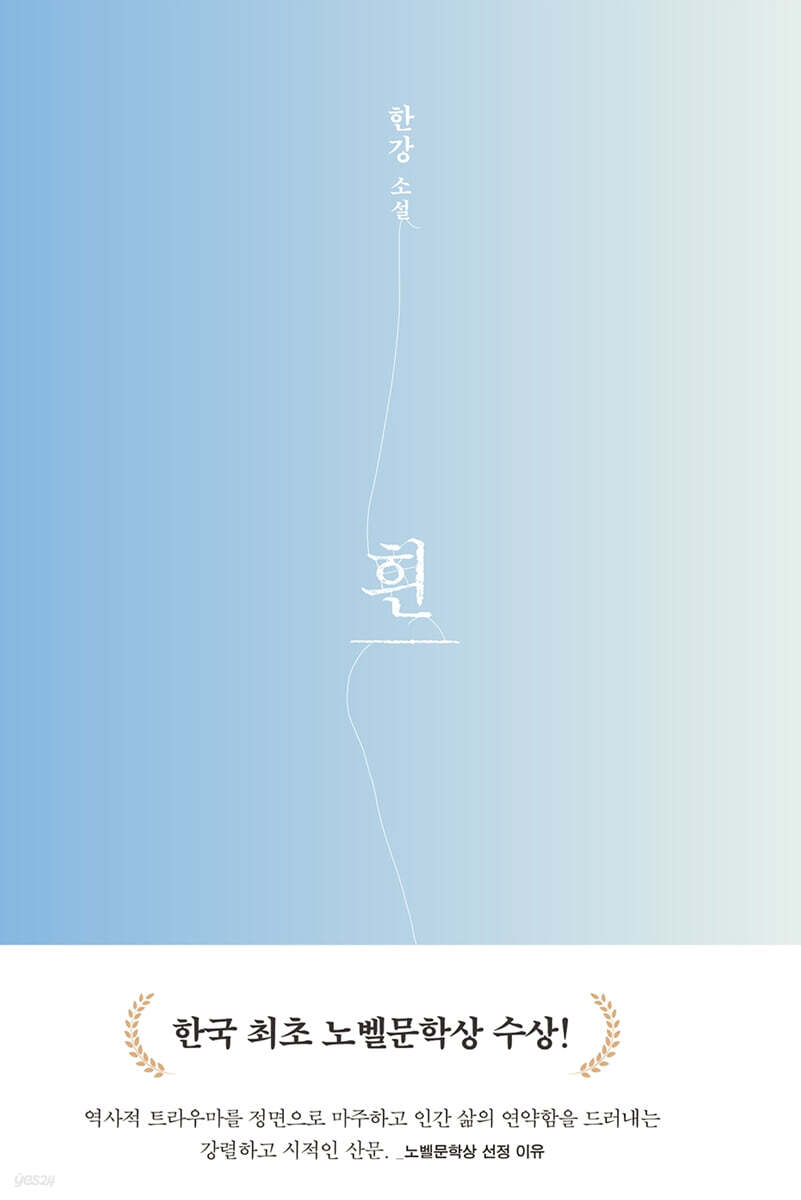
We are publishing 『White』 with a new cover.
To allow for greater focus on the work itself, the photographic images have been removed and the new cover has been designed to feature the title of the work embroidered on a piece of cloth.
This design is inspired by the properties of threads that connect, become entangled, break, and unravel, resembling a world made up of sentences written by the writer and a collection of those sentences.
Spinning thread and composing sentences may seem like linear tasks at first glance, but I wanted to capture how they can encompass everything from intimate explorations of life and death, human existence, to questions about the meaning of countless events in this world.
“It was these things that breathed life into me through this book.”
Korea's first Nobel Prize in Literature winner
Han Kang's autobiographical novel
In October 2024, Han Kang was named the first Korean Nobel Prize winner in Literature, with the reason given being “her powerful and poetic prose that confronts historical trauma head-on and reveals the fragility of human life.”
This is also significant as she is the first Asian woman to win the Nobel Prize in Literature and the eighteenth female writer to do so.
In an interview with the Nobel Committee at the time of her award, author Han Kang said, “I recommend ‘White’ as it is a very personal book with many autobiographical elements.”
The author had memories of his young mother, who had given birth to and lost her first daughter alone and an older sister whose face he had never known, who died two hours after her birth.
“Unlike ‘white,’ which is as clean as cotton candy, ‘white’ is filled with the chilling feeling of life and death.
What I wanted to write was a 'white' book.
“I thought one day while walking that the beginning of the book should be the memory of the first baby my mother gave birth to” (page 174, ‘Author’s Note’), and the author started from that memory and included a total of 65 stories in ‘White’.
We are publishing 『White』 with a new cover.
To allow for greater focus on the work itself, the photographic images have been removed and the new cover has been designed to feature the title of the work embroidered on a piece of cloth.
This design is inspired by the properties of threads that connect, become entangled, break, and unravel, resembling a world made up of sentences written by the writer and a collection of those sentences.
Spinning thread and composing sentences may seem like linear tasks at first glance, but I wanted to capture how they can encompass everything from intimate explorations of life and death, human existence, to questions about the meaning of countless events in this world.
- You can preview some of the book's contents.
Preview
index
Chapter 1 - Me
Chapter 2 - Her
Chapter 3 - All White
Commentary by Kwon Hee-cheol (literary critic) | How is it possible to fight the fact that we are human?
Author's Note
Chapter 2 - Her
Chapter 3 - All White
Commentary by Kwon Hee-cheol (literary critic) | How is it possible to fight the fact that we are human?
Author's Note
Into the book
The sharp edge of time? We move forward on the edge of a transparent cliff that is constantly being updated.
After living for as long as I have, I take one precarious step, and without any time for my will to intervene, I step without hesitation into the air with the remaining foot.
Not because we are particularly brave, but because there is no other way.
--- p.11
Now I'll give you something white.
Even if it gets dirty, white,
I'll only hand over white things.
I won't ask myself anymore.
Is it okay to hand this life over to you?
--- p.39
She continued walking, going against the snowflakes that were whirling fiercely against her face and body.
I couldn't figure it out.
What is this cold, hostile thing? At once fragile, fleeting, and overwhelmingly beautiful?
--- p.60
Some memories are not damaged by time.
The same goes for pain.
It's not true that it colors and ruins everything.
--- p.77
If you were still alive, I wouldn't be living this life right now.
If I were alive now, you wouldn't exist.
Only between darkness and light, only in that pale gap, do we barely see each other face to face.
--- p.109
After a long day, we need some time for silence.
It's time to reach out and open your hardened hands toward the faint warmth of silence, as you do in front of a fireplace without even realizing it.
--- p.122
When talking about white in your native language, there are two adjectives: 'white' and 'white.'
Unlike ‘white’, which is as clean as cotton candy, ‘white’ is filled with the chilling feeling of life and death.
--- p.174 From the author's note
Maybe I'm still connected to this book.
In moments when I feel shaken, cracked, or about to break, I think of you and the white things I wanted to give you.
I have never believed in God, so moments like these become my fervent prayers.
After living for as long as I have, I take one precarious step, and without any time for my will to intervene, I step without hesitation into the air with the remaining foot.
Not because we are particularly brave, but because there is no other way.
--- p.11
Now I'll give you something white.
Even if it gets dirty, white,
I'll only hand over white things.
I won't ask myself anymore.
Is it okay to hand this life over to you?
--- p.39
She continued walking, going against the snowflakes that were whirling fiercely against her face and body.
I couldn't figure it out.
What is this cold, hostile thing? At once fragile, fleeting, and overwhelmingly beautiful?
--- p.60
Some memories are not damaged by time.
The same goes for pain.
It's not true that it colors and ruins everything.
--- p.77
If you were still alive, I wouldn't be living this life right now.
If I were alive now, you wouldn't exist.
Only between darkness and light, only in that pale gap, do we barely see each other face to face.
--- p.109
After a long day, we need some time for silence.
It's time to reach out and open your hardened hands toward the faint warmth of silence, as you do in front of a fireplace without even realizing it.
--- p.122
When talking about white in your native language, there are two adjectives: 'white' and 'white.'
Unlike ‘white’, which is as clean as cotton candy, ‘white’ is filled with the chilling feeling of life and death.
--- p.174 From the author's note
Maybe I'm still connected to this book.
In moments when I feel shaken, cracked, or about to break, I think of you and the white things I wanted to give you.
I have never believed in God, so moments like these become my fervent prayers.
--- From the author's note on pp.176-177
Publisher's Review
Author Han Kang's novel "White" is a book written with sweat and tears, like embroidery, and is a book stained with those drops of sweat.
If not for this moment, would I have been able to cling to the single word ‘white’ and examine the inside and outside of all the ‘white things’ in the world that he had derived?
As I stare intently at the single character 'white', a sticky sadness, like boiling soup, surges up from the shape and pronunciation of the single character 'white'.
‘White’, where does this feeling, which feels familiar and comfortable but then becomes unfamiliar and strange, come from?
In this strange and subtle world of 'whiteness', where one can neither say one knows nor say one does not know, the narrative that Han Kang has created is surprisingly broad and deep.
The thoughts that are sharply picked up with a unique sense that is both sensitive and delicate are as cold as ice and as hot as freshly ground bone powder.
Don't we all come from 'white' and return to 'white'?
The novel 『White』 written by Han Kang with all his might on a blank sheet of paper.
The novel "White" that talks about everything else that is white.
"White" is a story about something white that never gets dirty, something that can never be dirty.
“The first thing I did in the spring when I decided to write about white was to make a list.”
The list of white things called out by the author is smeared under three chapters: 'Me', 'Her', and 'All White'.
Although it is a novel, it can also be read as a poetry collection containing 65 poems, as each story under each subheading boasts a dense and complete quality in itself.
This novel, with its relatively thin volume, is not an easy read.
I have them read very slowly, very slowly, then I have them pick up a dull pencil and mark sentences or words, and then I have them go back to the page they were reading before and start reading again from where they were before.
The white things that were called out to support the weight of the novel 『White』, which was becoming heavier and heavier as the lump in my heart seeped into the bookshelf.
For example, a blanket, a baby's underwear, a moon cake, fog, a white city, milk, grass, frost, sugar cubes, white stones, white bones, white hair, clouds, incandescent light bulbs, white nights, the white back of thin paper, white butterflies, rice and cooked meals, shrouds, mourning clothes, smoke, lower teeth, snow, snowflakes, eternal snow, waves, sleet, white dogs, blizzards, ash, salt, the moon, lace curtains, breath, white birds, handkerchiefs, the Milky Way, white magnolias, sugar-coated tablets... ... and so on. I try to softly pronounce the names of all the mercilessly white things.
This novel, in this way, reveals my true inner thoughts through two processes: reading with my eyes and reading with my mouth.
Wouldn't the process of recalling, calling out, calling out, and writing about white ultimately be healing for us who see and read white?
There is 'me' who suffers from "migraines, a familiar and terrible friend."
I have a story about my 'sister' who was born when my deceased mother was 23 and died two hours after birth.
Last spring someone asked me:
“When you were young, did you have any experiences that brought you closer to grief?” At that moment, I think of that death.
“The most helpless of the young beasts.
A baby as white and pretty as a mooncake.
“The story of how I was born and raised in the place where he died.”
Even after moving to an old city on the other side of the world, I am haunted by old memories that keep coming back to me.
Then, by chance, I came across a video of this city taken by a US military aircraft in the spring of 1945.
As I walk through the city, which was completely destroyed and shattered under Hitler's order to "wipe out this city, the only one in Europe that rose up against the Nazis, by all means possible, as an example," and which has been rebuilt seventy years later, I find myself pondering for the first time "the face of that man - someone like this city."
You would only hear voices.
Don't die.
Please don't die.
Those words, which he could not understand, were probably the only voices he heard.
So, it can neither be confirmed nor denied.
Did he come to me sometimes?
It must have lingered on my forehead and around my eyes for a while.
Among the sensations and vague feelings I felt as a child, were there some that came from him without me knowing?
Because everyone has moments when they feel cold while lying in a dark room.
Don't die.
Please don't die.
(Pages 32-33)
The story that started from me ends up shifting its gaze to her.
“Don’t die.
Please don't die.
“Because those words are engraved on her body like a talisman,” I come to think, “she came here in my place.”
And through her, we meet the white things of the world again.
Oh, the frozen white sea, Oh, the frosty time when the sunlight begins to grow a little paler, Oh, the wings of a dead butterfly becoming transparent, Oh, the pale fists that grow colder the more you clench them, Oh, the snow that lives for a second or two before settling on the sleeves of a black coat and melting away, Oh, the sleet that falls when you walk knowing that everything you have held on with all your might will eventually disappear, Oh, the white breath that escapes from our lips for the first time on a cold morning as proof that we are alive, proof that our bodies are warm, Oh, the white bird that never disappears from sight no matter how far it flies, Oh, the handkerchief that falls like a bird with half-folded wings, like a soul hesitantly looking for a place to land, Death like the white back of a thin piece of paper.
She knows that the people of this city are not just lighting candles and offering flowers in front of the wall for the souls.
I believe that being slaughtered is not a shame.
The idea is to prolong the mourning as long as possible.
She thought about what had happened in the country she had left behind, and about the mourning the dead had not fully received.
I thought about the possibility that those souls would be honored in the middle of the street like this, and realized that my homeland had never done that properly.
And more importantly, she learned what process she had been involved in to rebuild herself.
Of course, her body is not dead yet.
Her soul still resides in her body.
(…)
So, there are a few things left for her to do.
Stop lying.
(Open your eyes) I will lift the curtain.
I will light a candle for all the dead and souls I remember - including my own.
(Pages 104-105)
I think as I burn the white cotton skirt and jacket that my younger brother's bride, who is about to get married, had prepared as a share of her deceased mother's belongings.
“If you can come, come now.
“May you wear that dress made of smoke like a winged garment.” And I say:
“In all the white things you will take your last breath.”
The pain that I came to know and suffered under the name of 'All White', the pain that I endured and endured with my whole body, so this farewell greeting could be considered the best.
This could be called a true greeting.
“The movement of the great water that silently sways between this world and the next” is said to be mixed like that.
Don't die.
Please don't die.
I open my lips and mutter what you, who didn't know how to speak, heard with your dark eyes open.
Press hard on a blank piece of paper.
I believe that is the best way to say goodbye.
Don't die.
Live on.
(Page 125)
"White" is a novel that renders powerless the boundary between life and death.
It breaks down the walls of life and death with sand, softens the hardness of life and death, makes the obviousness of life and death strange, disperses the plane of life and death into three dimensions, and expands the finiteness of life and death into the infinity of the universe.
Crossing is a way to build flexibility in your body.
The embrace that flexible thinking creates is enough to build solidarity.
The solidarity of the living and the dead, after all, won't all the living become dead?
Just as “the baby’s diaper became a shroud and the swaddling clothes became a coffin.”
If not for this moment, would I have been able to cling to the single word ‘white’ and examine the inside and outside of all the ‘white things’ in the world that he had derived?
As I stare intently at the single character 'white', a sticky sadness, like boiling soup, surges up from the shape and pronunciation of the single character 'white'.
‘White’, where does this feeling, which feels familiar and comfortable but then becomes unfamiliar and strange, come from?
In this strange and subtle world of 'whiteness', where one can neither say one knows nor say one does not know, the narrative that Han Kang has created is surprisingly broad and deep.
The thoughts that are sharply picked up with a unique sense that is both sensitive and delicate are as cold as ice and as hot as freshly ground bone powder.
Don't we all come from 'white' and return to 'white'?
The novel 『White』 written by Han Kang with all his might on a blank sheet of paper.
The novel "White" that talks about everything else that is white.
"White" is a story about something white that never gets dirty, something that can never be dirty.
“The first thing I did in the spring when I decided to write about white was to make a list.”
The list of white things called out by the author is smeared under three chapters: 'Me', 'Her', and 'All White'.
Although it is a novel, it can also be read as a poetry collection containing 65 poems, as each story under each subheading boasts a dense and complete quality in itself.
This novel, with its relatively thin volume, is not an easy read.
I have them read very slowly, very slowly, then I have them pick up a dull pencil and mark sentences or words, and then I have them go back to the page they were reading before and start reading again from where they were before.
The white things that were called out to support the weight of the novel 『White』, which was becoming heavier and heavier as the lump in my heart seeped into the bookshelf.
For example, a blanket, a baby's underwear, a moon cake, fog, a white city, milk, grass, frost, sugar cubes, white stones, white bones, white hair, clouds, incandescent light bulbs, white nights, the white back of thin paper, white butterflies, rice and cooked meals, shrouds, mourning clothes, smoke, lower teeth, snow, snowflakes, eternal snow, waves, sleet, white dogs, blizzards, ash, salt, the moon, lace curtains, breath, white birds, handkerchiefs, the Milky Way, white magnolias, sugar-coated tablets... ... and so on. I try to softly pronounce the names of all the mercilessly white things.
This novel, in this way, reveals my true inner thoughts through two processes: reading with my eyes and reading with my mouth.
Wouldn't the process of recalling, calling out, calling out, and writing about white ultimately be healing for us who see and read white?
There is 'me' who suffers from "migraines, a familiar and terrible friend."
I have a story about my 'sister' who was born when my deceased mother was 23 and died two hours after birth.
Last spring someone asked me:
“When you were young, did you have any experiences that brought you closer to grief?” At that moment, I think of that death.
“The most helpless of the young beasts.
A baby as white and pretty as a mooncake.
“The story of how I was born and raised in the place where he died.”
Even after moving to an old city on the other side of the world, I am haunted by old memories that keep coming back to me.
Then, by chance, I came across a video of this city taken by a US military aircraft in the spring of 1945.
As I walk through the city, which was completely destroyed and shattered under Hitler's order to "wipe out this city, the only one in Europe that rose up against the Nazis, by all means possible, as an example," and which has been rebuilt seventy years later, I find myself pondering for the first time "the face of that man - someone like this city."
You would only hear voices.
Don't die.
Please don't die.
Those words, which he could not understand, were probably the only voices he heard.
So, it can neither be confirmed nor denied.
Did he come to me sometimes?
It must have lingered on my forehead and around my eyes for a while.
Among the sensations and vague feelings I felt as a child, were there some that came from him without me knowing?
Because everyone has moments when they feel cold while lying in a dark room.
Don't die.
Please don't die.
(Pages 32-33)
The story that started from me ends up shifting its gaze to her.
“Don’t die.
Please don't die.
“Because those words are engraved on her body like a talisman,” I come to think, “she came here in my place.”
And through her, we meet the white things of the world again.
Oh, the frozen white sea, Oh, the frosty time when the sunlight begins to grow a little paler, Oh, the wings of a dead butterfly becoming transparent, Oh, the pale fists that grow colder the more you clench them, Oh, the snow that lives for a second or two before settling on the sleeves of a black coat and melting away, Oh, the sleet that falls when you walk knowing that everything you have held on with all your might will eventually disappear, Oh, the white breath that escapes from our lips for the first time on a cold morning as proof that we are alive, proof that our bodies are warm, Oh, the white bird that never disappears from sight no matter how far it flies, Oh, the handkerchief that falls like a bird with half-folded wings, like a soul hesitantly looking for a place to land, Death like the white back of a thin piece of paper.
She knows that the people of this city are not just lighting candles and offering flowers in front of the wall for the souls.
I believe that being slaughtered is not a shame.
The idea is to prolong the mourning as long as possible.
She thought about what had happened in the country she had left behind, and about the mourning the dead had not fully received.
I thought about the possibility that those souls would be honored in the middle of the street like this, and realized that my homeland had never done that properly.
And more importantly, she learned what process she had been involved in to rebuild herself.
Of course, her body is not dead yet.
Her soul still resides in her body.
(…)
So, there are a few things left for her to do.
Stop lying.
(Open your eyes) I will lift the curtain.
I will light a candle for all the dead and souls I remember - including my own.
(Pages 104-105)
I think as I burn the white cotton skirt and jacket that my younger brother's bride, who is about to get married, had prepared as a share of her deceased mother's belongings.
“If you can come, come now.
“May you wear that dress made of smoke like a winged garment.” And I say:
“In all the white things you will take your last breath.”
The pain that I came to know and suffered under the name of 'All White', the pain that I endured and endured with my whole body, so this farewell greeting could be considered the best.
This could be called a true greeting.
“The movement of the great water that silently sways between this world and the next” is said to be mixed like that.
Don't die.
Please don't die.
I open my lips and mutter what you, who didn't know how to speak, heard with your dark eyes open.
Press hard on a blank piece of paper.
I believe that is the best way to say goodbye.
Don't die.
Live on.
(Page 125)
"White" is a novel that renders powerless the boundary between life and death.
It breaks down the walls of life and death with sand, softens the hardness of life and death, makes the obviousness of life and death strange, disperses the plane of life and death into three dimensions, and expands the finiteness of life and death into the infinity of the universe.
Crossing is a way to build flexibility in your body.
The embrace that flexible thinking creates is enough to build solidarity.
The solidarity of the living and the dead, after all, won't all the living become dead?
Just as “the baby’s diaper became a shroud and the swaddling clothes became a coffin.”
GOODS SPECIFICS
- Date of issue: March 31, 2025
- Format: Hardcover book binding method guide
- Page count, weight, size: 180 pages | 340g | 120*188*20mm
- ISBN13: 9791141601713
- ISBN10: 1141601710
You may also like
카테고리
korean


korean

![GQ KOREA Mark (Monthly): December [2025]](http://librairie.coreenne.fr/cdn/shop/files/8ef265dbbfbf186523ed75ba7319009d.jpg?v=1765340328&width=3840)


