

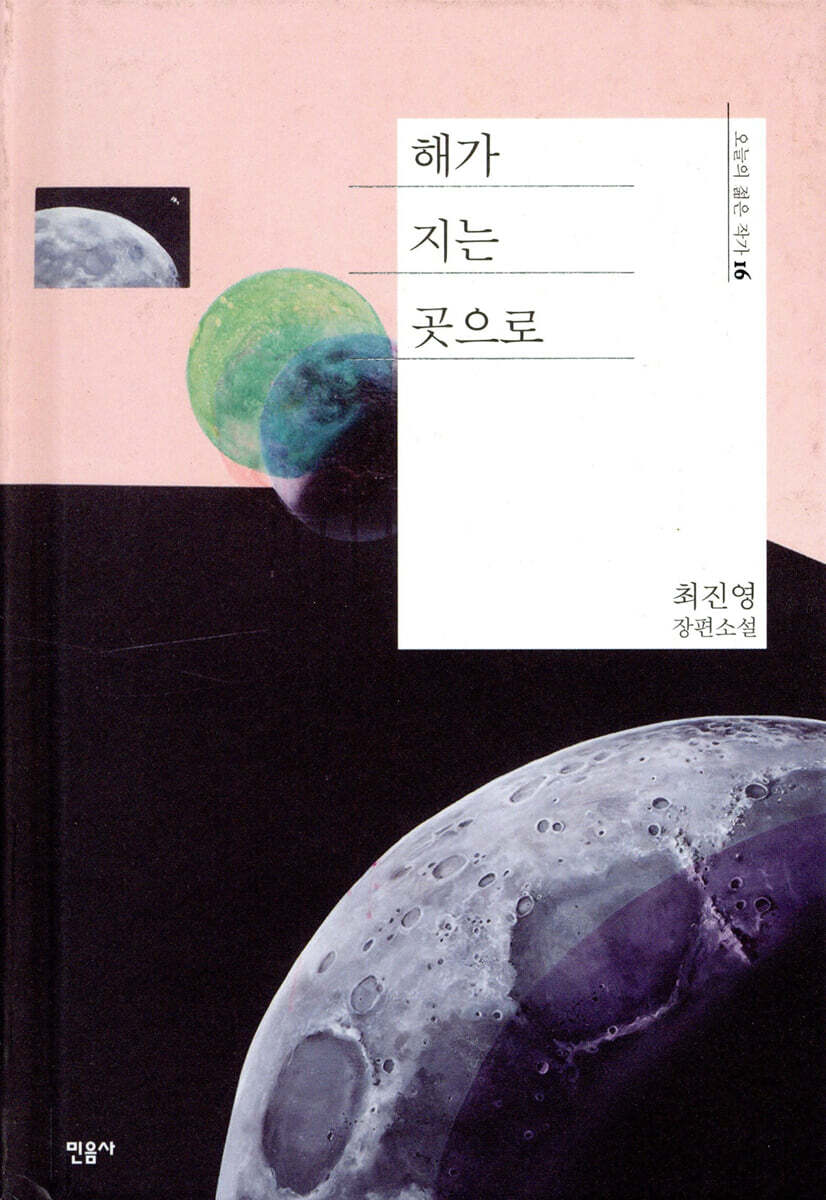
Where the sun sets
 |
Description
Book Introduction
“I will rush to the ends of the earth with love in my heart.”
The one heart that disaster has not struck
A love that survives quietly in a world on the brink of destruction
The fifth full-length novel by Choi Jin-young, winner of the Hankyoreh Literary Award and the Shin Dong-yup Literary Award, has been published in Minumsa's Today's Young Writers series.
Since his debut, Jinyoung Choi has consistently portrayed humans as 'loving beings' with his signature powerful narrative and lingering lyricism.
The new work, “Where the Sun Sets,” is Jinyoung Choi’s first apocalyptic novel.
A time of chaos as an unknown virus spread across the world.
Those infected die in an instant, and those who survive embark on an endless journey in search of safety.
Dori, who walked across Russia bare-handed to protect her younger sister Miso who could neither hear nor speak, meets Gina, who was traveling the world in a van with her relatives, at a village where she was staying for the night...
A gentle omen of love echoing in a world where distrust of others has reached its peak and all emotions are thought to have died out.
Even in the midst of disaster, a romance between two women begins that never goes out.
The one heart that disaster has not struck
A love that survives quietly in a world on the brink of destruction
The fifth full-length novel by Choi Jin-young, winner of the Hankyoreh Literary Award and the Shin Dong-yup Literary Award, has been published in Minumsa's Today's Young Writers series.
Since his debut, Jinyoung Choi has consistently portrayed humans as 'loving beings' with his signature powerful narrative and lingering lyricism.
The new work, “Where the Sun Sets,” is Jinyoung Choi’s first apocalyptic novel.
A time of chaos as an unknown virus spread across the world.
Those infected die in an instant, and those who survive embark on an endless journey in search of safety.
Dori, who walked across Russia bare-handed to protect her younger sister Miso who could neither hear nor speak, meets Gina, who was traveling the world in a van with her relatives, at a village where she was staying for the night...
A gentle omen of love echoing in a world where distrust of others has reached its peak and all emotions are thought to have died out.
Even in the midst of disaster, a romance between two women begins that never goes out.
- You can preview some of the book's contents.
Preview
index
Prologue 7
15 Where the sun sets
Epilogue 173
Author's Note 191
Commentary on the Work | Jeon So-young (Literary Critic) 193
When all the songs of those who love are finally awakened
15 Where the sun sets
Epilogue 173
Author's Note 191
Commentary on the Work | Jeon So-young (Literary Critic) 193
When all the songs of those who love are finally awakened
Detailed image
Into the book
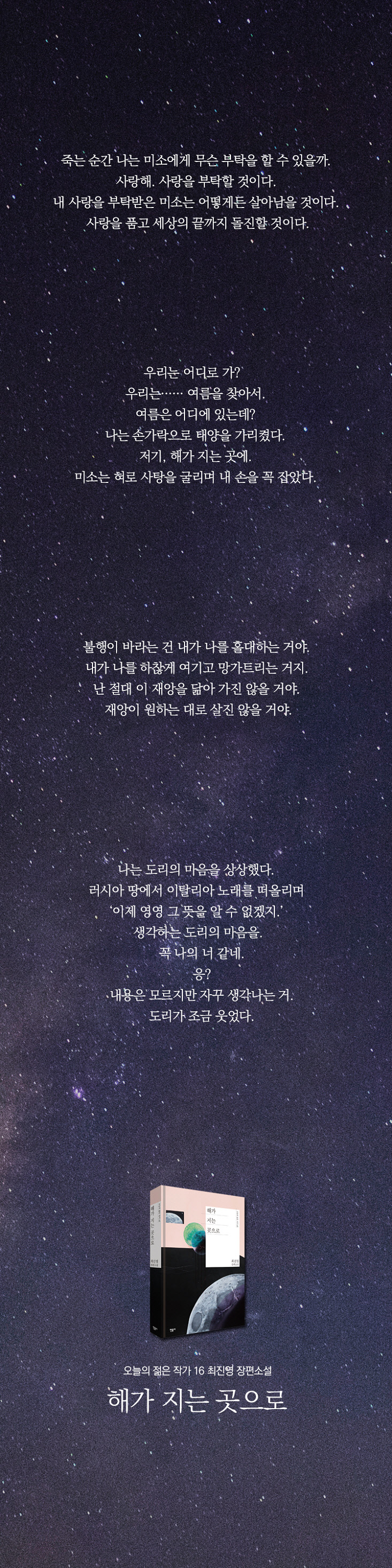
What can I ask of Smile at the moment of my death?
love you.
I will ask for your love.
The smile that I have been asked to love will somehow survive.
I will run to the ends of the earth with love in my heart.
--- p.17~18
Where are we going?
We are… …in search of summer.
Where is summer?
I pointed my finger at the sun.
Over there, where the sun sets.
Smile rolled the candy on her tongue and held my hand tightly.
--- p.24
What misfortune wants is for me to treat myself badly.
I am the one who belittles and ruins myself.
I will never resemble this disaster.
I won't live the way disaster wants me to.
love you.
I will ask for your love.
The smile that I have been asked to love will somehow survive.
I will run to the ends of the earth with love in my heart.
--- p.17~18
Where are we going?
We are… …in search of summer.
Where is summer?
I pointed my finger at the sun.
Over there, where the sun sets.
Smile rolled the candy on her tongue and held my hand tightly.
--- p.24
What misfortune wants is for me to treat myself badly.
I am the one who belittles and ruins myself.
I will never resemble this disaster.
I won't live the way disaster wants me to.
--- p.55
Publisher's Review
Love wins, Dori and Gina
“I was thinking about smiling like Gina, and before I knew it, I kissed her.
It was cold and warm.
It was rough and smooth.
“Cold, hunger, misfortune, and disaster all vanished in surprise at our kiss.”
A meeting like the only gift brought by disaster.
Dori and Jinna define their love very carefully.
The love that blossomed in the ruins where daily life was completely erased may be an opportunity to “build a new story of our own.”
The hope they believe in is not a perfectly safe bunker to avoid the virus, but the present where they can live without being overcome by misfortune.
The goal of this love is not to be held back by past hurts or consumed by future anxieties.
This pledge of love is a firm promise to look straight into each other's faces right now.
Ryu and Dan, who postponed love due to their poor daily lives
“That wasn’t possible in Korea.
I put off seeing someone precious.
Because there is tomorrow.
You can do it next time.
Because I believed there was a long future ahead.
That can't happen anymore.
(……) The life of procrastination is over.
“I have to say I love you.”
Before the disaster, Ryu and Dan's daily life revolved solely around inertia.
We forget conversation, hugs, compliments and gratitude as we work to earn the money we need to live.
After the disaster, they were forced to leave Korea, deprived of the opportunity to mourn the loss of their beloved daughter, Hae-rim.
As his daily life falls apart and the cycle of boredom breaks, Ryu finally looks back on the love he had been putting off.
One day, when the car, which had been running without direction or purpose, stops, Ryu tells Dan a story he had never told her in their entire married life.
In Korea before the disaster, there were no dreams,
“If I had to choose only one thing in life, I would always choose Kwon Ji-na.
Thinking that I was on my way to Gina gave me strength in any case.
“I have a dream, and that dream is not yet complete.”
For Gunji, daily life in Korea was also survival.
At home, there was a father who beat his mother and Geonji, and at school, there were classmates who beat Geonji.
It was Gina who put Ganji, who had decided to die rather than leave the village where the virus was rampant, on the top car.
Geonji, who was led by Gina's hand and set out on a journey of refuge, dreams of a warm sea all year round.
There, you can catch fish, pick fruit from trees, and live with your loved ones.
After the disaster, will Gunji, who has held a precious dream in his heart for the first time, be able to reach the warm sea?
Recommendation
Looking back, the stories Choi Jin-young has kept for so long contain the will to discover your face caught in the fading light, the desperation to not lose sight of your sorrow, and the sensitive attempt to portray our hesitant encounters with the patterns of similar hearts.
In order to fully capture that will, desperation, and sensitive attempt, his novels must have frequently raised the question, "What is human?" and aimed at an era in which the rhetoric of "humanity" had become meaningless.
With carefully crafted sentences and expressions, the possibility of emotional communication within and outside the novel was tapped into.
It could be said that this is a unique way of love in Choi Jin-young's novels, born from his belief in people and novels.
Commentary by Jeon So-young (literary critic)
Author's Note
Even on that day when humanity perishes and everything we have created turns to ashes, people, you, we will still love.
The words of love left by so many people will wander like ghosts and the wind across the quiet earth.
Love remains.
Like a universe that will remain here even if it disappears and disappears.
“I was thinking about smiling like Gina, and before I knew it, I kissed her.
It was cold and warm.
It was rough and smooth.
“Cold, hunger, misfortune, and disaster all vanished in surprise at our kiss.”
A meeting like the only gift brought by disaster.
Dori and Jinna define their love very carefully.
The love that blossomed in the ruins where daily life was completely erased may be an opportunity to “build a new story of our own.”
The hope they believe in is not a perfectly safe bunker to avoid the virus, but the present where they can live without being overcome by misfortune.
The goal of this love is not to be held back by past hurts or consumed by future anxieties.
This pledge of love is a firm promise to look straight into each other's faces right now.
Ryu and Dan, who postponed love due to their poor daily lives
“That wasn’t possible in Korea.
I put off seeing someone precious.
Because there is tomorrow.
You can do it next time.
Because I believed there was a long future ahead.
That can't happen anymore.
(……) The life of procrastination is over.
“I have to say I love you.”
Before the disaster, Ryu and Dan's daily life revolved solely around inertia.
We forget conversation, hugs, compliments and gratitude as we work to earn the money we need to live.
After the disaster, they were forced to leave Korea, deprived of the opportunity to mourn the loss of their beloved daughter, Hae-rim.
As his daily life falls apart and the cycle of boredom breaks, Ryu finally looks back on the love he had been putting off.
One day, when the car, which had been running without direction or purpose, stops, Ryu tells Dan a story he had never told her in their entire married life.
In Korea before the disaster, there were no dreams,
“If I had to choose only one thing in life, I would always choose Kwon Ji-na.
Thinking that I was on my way to Gina gave me strength in any case.
“I have a dream, and that dream is not yet complete.”
For Gunji, daily life in Korea was also survival.
At home, there was a father who beat his mother and Geonji, and at school, there were classmates who beat Geonji.
It was Gina who put Ganji, who had decided to die rather than leave the village where the virus was rampant, on the top car.
Geonji, who was led by Gina's hand and set out on a journey of refuge, dreams of a warm sea all year round.
There, you can catch fish, pick fruit from trees, and live with your loved ones.
After the disaster, will Gunji, who has held a precious dream in his heart for the first time, be able to reach the warm sea?
Recommendation
Looking back, the stories Choi Jin-young has kept for so long contain the will to discover your face caught in the fading light, the desperation to not lose sight of your sorrow, and the sensitive attempt to portray our hesitant encounters with the patterns of similar hearts.
In order to fully capture that will, desperation, and sensitive attempt, his novels must have frequently raised the question, "What is human?" and aimed at an era in which the rhetoric of "humanity" had become meaningless.
With carefully crafted sentences and expressions, the possibility of emotional communication within and outside the novel was tapped into.
It could be said that this is a unique way of love in Choi Jin-young's novels, born from his belief in people and novels.
Commentary by Jeon So-young (literary critic)
Author's Note
Even on that day when humanity perishes and everything we have created turns to ashes, people, you, we will still love.
The words of love left by so many people will wander like ghosts and the wind across the quiet earth.
Love remains.
Like a universe that will remain here even if it disappears and disappears.
GOODS SPECIFICS
- Date of issue: June 30, 2017
- Format: Hardcover book binding method guide
- Page count, weight, size: 208 pages | 308g | 128*188*20mm
- ISBN13: 9788937473166
- ISBN10: 893747316X
You may also like
카테고리
korean


korean

![GQ KOREA Mark (Monthly): December [2025]](http://librairie.coreenne.fr/cdn/shop/files/8ef265dbbfbf186523ed75ba7319009d.jpg?v=1765340328&width=3840)


