

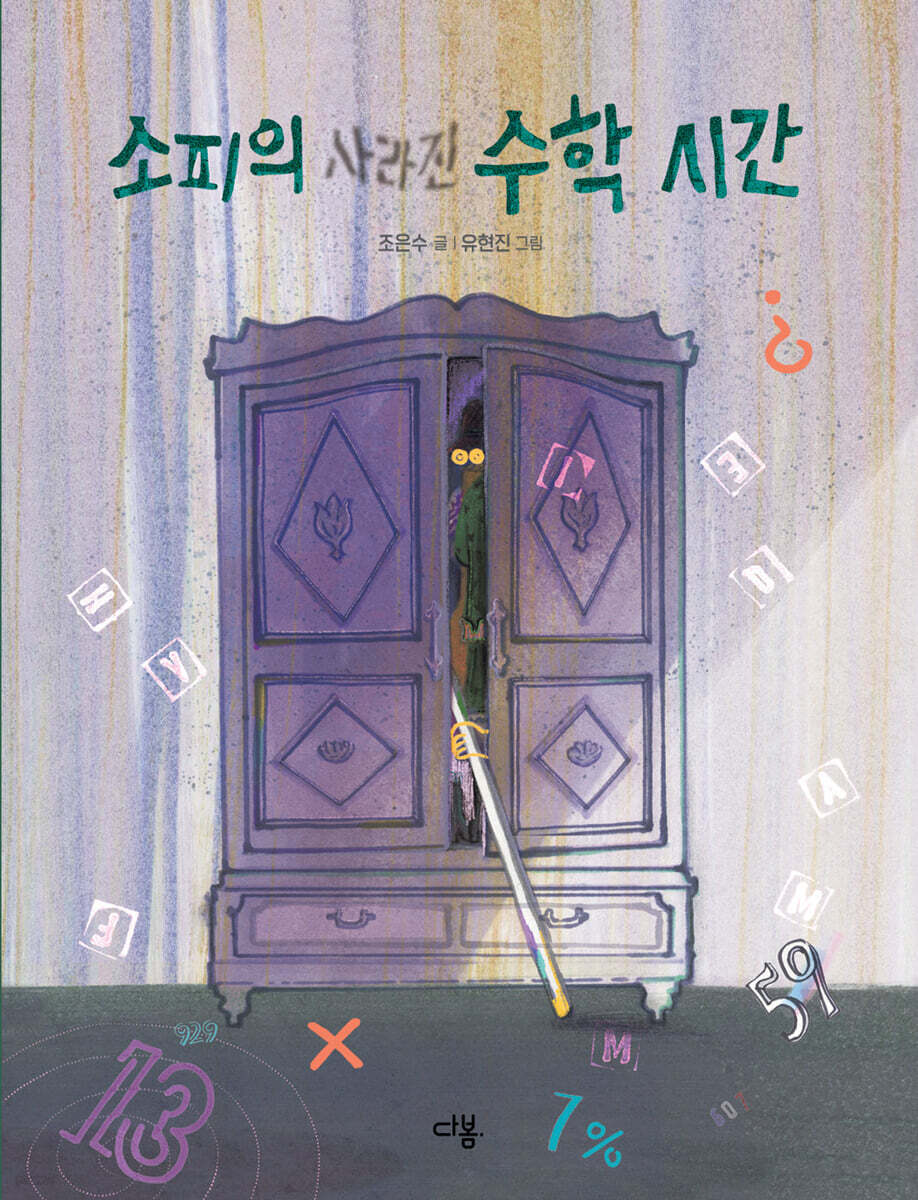
Sophie's Lost Math Lesson
 |
Description
Book Introduction
A secret midnight conversation between genius mathematicians who transcend time and space.
"Math, never study it! Instead, try to really enjoy it!"
This is a story about three genius mathematicians who meet across time and space, created by author Eun-soo Jo, who enjoys creating delicious stories by softly unraveling knowledge across various fields such as science, mathematics, and history, or by expanding thoughts and adding imagination through the connection of knowledge.
The 18th century was a time of chaos in the world due to the French Revolution.
The girl Sophie reads "History of Mathematics" from her father's library and becomes curious about "mathematics," which was something that the ancient Greek mathematician Archimedes was obsessed with until the moment he lost his life to a Roman soldier.
However, since it was a time when girls were forbidden from studying mathematics, Sophie had no choice but to study secretly by candlelight at night while everyone was asleep, avoiding even her parents' eyes.
Then one night, Archimedes, the great mathematician who had led Sophie into the world of mathematics, came to visit her! But Archimedes wasn't the only one who had come across time and space to find Sophie.
Even Perelman, a modern mathematician who won the Fields Medal—the equivalent of the Nobel Prize of mathematics—for solving a mathematical puzzle that had eluded him for over 300 years, but is now more famous for turning down a multi-million dollar prize, comes to visit Sophie! Why on earth have so many brilliant mathematicians from across human history come to visit Sophie?
"Math, never study it! Instead, try to really enjoy it!"
This is a story about three genius mathematicians who meet across time and space, created by author Eun-soo Jo, who enjoys creating delicious stories by softly unraveling knowledge across various fields such as science, mathematics, and history, or by expanding thoughts and adding imagination through the connection of knowledge.
The 18th century was a time of chaos in the world due to the French Revolution.
The girl Sophie reads "History of Mathematics" from her father's library and becomes curious about "mathematics," which was something that the ancient Greek mathematician Archimedes was obsessed with until the moment he lost his life to a Roman soldier.
However, since it was a time when girls were forbidden from studying mathematics, Sophie had no choice but to study secretly by candlelight at night while everyone was asleep, avoiding even her parents' eyes.
Then one night, Archimedes, the great mathematician who had led Sophie into the world of mathematics, came to visit her! But Archimedes wasn't the only one who had come across time and space to find Sophie.
Even Perelman, a modern mathematician who won the Fields Medal—the equivalent of the Nobel Prize of mathematics—for solving a mathematical puzzle that had eluded him for over 300 years, but is now more famous for turning down a multi-million dollar prize, comes to visit Sophie! Why on earth have so many brilliant mathematicians from across human history come to visit Sophie?
- You can preview some of the book's contents.
Preview
index
Math Ban _Page 6
Mysterious Triangle Meeting_Page 14
The Story of Archimedes, the Pulley Prince _Page 22
Marriage or Math _ Page 34
Archimedes' Parchment_Page 44
The Lost Sophie_Page 56
The Black Bread Man's Secret _ Page 70
All the Shapes of the World _Page 78
The Mushroom Hunter, Perelman's Story _Page 86
The Law of Universal Solitude _Page 94
The Ghost Student, Sophie Germain's Story_Page 108
Infinite Greetings_Page 120
Introducing Three Mathematicians _Page 130
Mysterious Triangle Meeting_Page 14
The Story of Archimedes, the Pulley Prince _Page 22
Marriage or Math _ Page 34
Archimedes' Parchment_Page 44
The Lost Sophie_Page 56
The Black Bread Man's Secret _ Page 70
All the Shapes of the World _Page 78
The Mushroom Hunter, Perelman's Story _Page 86
The Law of Universal Solitude _Page 94
The Ghost Student, Sophie Germain's Story_Page 108
Infinite Greetings_Page 120
Introducing Three Mathematicians _Page 130
Detailed image
.jpg)
Into the book
Sophie took out the candle hidden under the blanket, lit it quietly, and wrapped herself in the blanket.
Then he took out Sophie's two friends, a slate and a slate pen.
Soon after, the numbers appeared again with a clicking sound.
Sophie loved mathematics, the world of numbers that was infinite and free, yet rigorous and clear.
--- p.8
“The area of a circle is a sandwich,” said Archimedes, winking.
Then the man who came out of the closet said curtly.
“I don’t eat sandwiches.
“I only eat black bread.” “Black bread and plates are the same.
“A donut and a coffee cup are the same,” Archimedes said again.
“Huh? Grandpa, what on earth do you mean? Please tell me.” Sophie looked at Archimedes desperately, her eyes dying to know.
--- p.20
Is it really true that there are no friends on this planet I can talk to? And yet, after centuries of death, let's just wait...
I died in 212 BC… … .
“It was probably around that time that gnome, that over-energetic Roman soldier, came knocking my head off to show his deeds,” Archimedes said, guessing at the year, and Sophie shuddered.
Then Archimedes smiled again and said,
--- p.41
We have been living in a dream called mathematics, and we have to pay the price.
That's our destiny.
You have little to do with the realities of this world.
All you need is black bread and yogurt.
I don't mind spending my whole life in that bear-like coat and hat.
"Sophie, you're not interested in pretty clothes or a handsome groom like other girls, are you? As long as you have a slate and a pencil, you could live happily in the world of mathematics."
--- p.100
“It is no coincidence that a few years ago you picked up a book called “The History of Mathematics” from your father’s study, and while engrossed in mathematics, you felt a pang of sorrow for me, who was killed by a Roman soldier, and thus entered the mystery of mathematics.
We are connected to each other in infinity.
Even though time and space are not continuous, we are connected.
So whatever happens to you in the future, don't feel lonely and think that you will face it alone.”
Then he took out Sophie's two friends, a slate and a slate pen.
Soon after, the numbers appeared again with a clicking sound.
Sophie loved mathematics, the world of numbers that was infinite and free, yet rigorous and clear.
--- p.8
“The area of a circle is a sandwich,” said Archimedes, winking.
Then the man who came out of the closet said curtly.
“I don’t eat sandwiches.
“I only eat black bread.” “Black bread and plates are the same.
“A donut and a coffee cup are the same,” Archimedes said again.
“Huh? Grandpa, what on earth do you mean? Please tell me.” Sophie looked at Archimedes desperately, her eyes dying to know.
--- p.20
Is it really true that there are no friends on this planet I can talk to? And yet, after centuries of death, let's just wait...
I died in 212 BC… … .
“It was probably around that time that gnome, that over-energetic Roman soldier, came knocking my head off to show his deeds,” Archimedes said, guessing at the year, and Sophie shuddered.
Then Archimedes smiled again and said,
--- p.41
We have been living in a dream called mathematics, and we have to pay the price.
That's our destiny.
You have little to do with the realities of this world.
All you need is black bread and yogurt.
I don't mind spending my whole life in that bear-like coat and hat.
"Sophie, you're not interested in pretty clothes or a handsome groom like other girls, are you? As long as you have a slate and a pencil, you could live happily in the world of mathematics."
--- p.100
“It is no coincidence that a few years ago you picked up a book called “The History of Mathematics” from your father’s study, and while engrossed in mathematics, you felt a pang of sorrow for me, who was killed by a Roman soldier, and thus entered the mystery of mathematics.
We are connected to each other in infinity.
Even though time and space are not continuous, we are connected.
So whatever happens to you in the future, don't feel lonely and think that you will face it alone.”
--- p.105
Publisher's Review
Why do you like math so much?
The answers lie in the lives of Archimedes, Perelman, and Sophie Germain!
Many people think that mathematics is difficult and only a few people like it.
The term 'math dropout' is commonly used to refer to someone who has given up on math, and in reality, there are only a handful of students in a class who like math.
But the main character of this book, Sophie, loves math so much.
Every night, her mom and dad block Sophie's math studies by turning off the candles and the stove, and even locking the closet door to prevent her from going inside to study to avoid the cold. But Sophie wraps her frozen body in a blanket and studies math.
How can I do this in an age where women are not required to study math, nor are they forced to, and are told not to study math?
If you try to ignore it by thinking that it's only natural because he's the main character in a fairy tale, you're in big trouble.
This is because Sophie, Archimedes, and Perelman, who appear in "Sophie's Lost Math Lesson," are real people, and the book is based on their real lives.
Archimedes lost his life while solving mathematical problems even at the point of a Roman soldier's sword during a war, and modern mathematician Perelman succeeded in solving a difficult problem that had remained unsolved for over 300 years, but he continues his original research activities as a mathematician without being obsessed with wealth and fame.
And the protagonist, Sophie Germain, is one of the few female mathematicians who made a significant mark in the history of mathematics.
What is it about mathematics that keeps them captivated, even in the face of life, fame, wealth, and national obstacles? "Sophie's Lost Math Lessons" hides the answer in the nightly conversations of three mathematicians who meet across time and space.
Life isn't a puzzle to be solved, it's a bundle of gifts.
Messages of encouragement and comfort from mathematicians who met through the "Law of Universal Solitude."
It's okay to be lonely! Because I have something I like!
"Sophie's Lost Math Lesson" is not a book that aims to explain difficult mathematical formulas in an easy-to-understand manner.
It's not a book that recommends that you like math because it's really fun.
This book is a fairy tale for everyone who loves something so much that they can get lost in it regardless of what others say, even if it's not about 'math'.
What if even my family didn't understand something I loved so much, and even prevented me from doing it? What if, like Sophie, I found myself in an environment where I absolutely couldn't pursue what I loved? Even if I had the skills, I couldn't get into the school I wanted because I was a woman. Even if I published a paper on mathematics or solved a difficult problem, I couldn't receive recognition for my contributions because I was a woman.
"Sophie's Lost Math Lesson" was born from the author's heart drawn to the 'loneliness' and 'solitude' that people in this situation would feel.
The three mathematicians featured in this book have achieved great achievements that will remain in the history of mathematics, but they also share the commonality of having spent lonely and solitary times in the world of mathematics.
The author uses the 'law of universal solitude', which states that lonely people are attracted to each other, to bring these three together across time and space, and to soothe and comfort their loneliness by having them engage in a pleasant conversation about mathematics.
And on the other hand, I pay tribute to those who have dedicated their lives to what they love, who have faced endless obstacles and sometimes even seemingly hopeless situations, and who have not given up.
Archimedes, who appears as the author's alter ego, says this at the end of the story.
“Life is not a homework assignment to be solved, but a bundle of gifts.”
Readers who join this secret gathering of genius mathematicians who transcend time and space will find what they love, follow their passion, live without loneliness, and experience the happiness of unwrapping a bundle of gifts every day.
The answers lie in the lives of Archimedes, Perelman, and Sophie Germain!
Many people think that mathematics is difficult and only a few people like it.
The term 'math dropout' is commonly used to refer to someone who has given up on math, and in reality, there are only a handful of students in a class who like math.
But the main character of this book, Sophie, loves math so much.
Every night, her mom and dad block Sophie's math studies by turning off the candles and the stove, and even locking the closet door to prevent her from going inside to study to avoid the cold. But Sophie wraps her frozen body in a blanket and studies math.
How can I do this in an age where women are not required to study math, nor are they forced to, and are told not to study math?
If you try to ignore it by thinking that it's only natural because he's the main character in a fairy tale, you're in big trouble.
This is because Sophie, Archimedes, and Perelman, who appear in "Sophie's Lost Math Lesson," are real people, and the book is based on their real lives.
Archimedes lost his life while solving mathematical problems even at the point of a Roman soldier's sword during a war, and modern mathematician Perelman succeeded in solving a difficult problem that had remained unsolved for over 300 years, but he continues his original research activities as a mathematician without being obsessed with wealth and fame.
And the protagonist, Sophie Germain, is one of the few female mathematicians who made a significant mark in the history of mathematics.
What is it about mathematics that keeps them captivated, even in the face of life, fame, wealth, and national obstacles? "Sophie's Lost Math Lessons" hides the answer in the nightly conversations of three mathematicians who meet across time and space.
Life isn't a puzzle to be solved, it's a bundle of gifts.
Messages of encouragement and comfort from mathematicians who met through the "Law of Universal Solitude."
It's okay to be lonely! Because I have something I like!
"Sophie's Lost Math Lesson" is not a book that aims to explain difficult mathematical formulas in an easy-to-understand manner.
It's not a book that recommends that you like math because it's really fun.
This book is a fairy tale for everyone who loves something so much that they can get lost in it regardless of what others say, even if it's not about 'math'.
What if even my family didn't understand something I loved so much, and even prevented me from doing it? What if, like Sophie, I found myself in an environment where I absolutely couldn't pursue what I loved? Even if I had the skills, I couldn't get into the school I wanted because I was a woman. Even if I published a paper on mathematics or solved a difficult problem, I couldn't receive recognition for my contributions because I was a woman.
"Sophie's Lost Math Lesson" was born from the author's heart drawn to the 'loneliness' and 'solitude' that people in this situation would feel.
The three mathematicians featured in this book have achieved great achievements that will remain in the history of mathematics, but they also share the commonality of having spent lonely and solitary times in the world of mathematics.
The author uses the 'law of universal solitude', which states that lonely people are attracted to each other, to bring these three together across time and space, and to soothe and comfort their loneliness by having them engage in a pleasant conversation about mathematics.
And on the other hand, I pay tribute to those who have dedicated their lives to what they love, who have faced endless obstacles and sometimes even seemingly hopeless situations, and who have not given up.
Archimedes, who appears as the author's alter ego, says this at the end of the story.
“Life is not a homework assignment to be solved, but a bundle of gifts.”
Readers who join this secret gathering of genius mathematicians who transcend time and space will find what they love, follow their passion, live without loneliness, and experience the happiness of unwrapping a bundle of gifts every day.
GOODS SPECIFICS
- Date of issue: February 15, 2024
- Format: Hardcover book binding method guide
- Page count, weight, size: 132 pages | 456g | 176*231*14mm
- ISBN13: 9791192148960
- ISBN10: 1192148967
- KC Certification: Certification Type: Conformity Confirmation
You may also like
카테고리
korean


korean

![ELLE 엘르 스페셜 에디션 A형 : 12월 [2025]](http://librairie.coreenne.fr/cdn/shop/files/b8e27a3de6c9538896439686c6b0e8fb.jpg?v=1766436872&width=3840)


