

The Catcher in the Rye
 |
Description
Book Introduction
|
The best-selling novel of the 20th century that captivated young people around the world. J., the heretic of 20th-century American literature. D. Salinger's The Catcher in the Rye is a work that contains the events of the few days before Holden Caulfield, a troubled student at a private school, returns home after being expelled. This novel, which contained wit and pathos that only youth could relate to, amidst profanity and vulgarity that seemed to have been copied straight from the language of teenagers, created the 'Caufield Syndrome' among young readers, and the name Holden Caulfield became synonymous with rebel. While traditional coming-of-age narratives focus on self-discovery and reflection, The Catcher in the Rye offers a keen reflection on the emptiness, alienation, and hypocrisy of the older generation that characterize human existence. The work has sold a cumulative 70 million copies worldwide. |
- You can preview some of the book's contents.
Preview
Detailed image
Publisher's Review
A record of wandering that begins with leaving the stuffy school.
Holden Caulfield, a private school student, is notified of his expulsion one day before Christmas.
The reason for his expulsion was a failing grade on an exam, but behind it lies the confusion of growing up that enveloped the seventeen-year-old boy.
Although he grew up in a wealthy environment with a father who was a lawyer and an older brother who was a Hollywood playwright, Holden is a character who is disgusted by the snobbery and hypocrisy of the older generation.
For him, the private school Pencey was an object of envy from the outside, but inside, it was an unbearable place where young classmates dominated the atmosphere and students were discriminated against based on their parents' status.
Instead of appealing to the school for leniency, Holden decides to wander the streets of New York until a letter notifying him of his expulsion arrives at his home.
Add to this a night at his beloved teacher's house and the loving intervention of his younger sister, Phoebe, and his journey takes an unexpected turn.
A work filled with voices representing youth
When The Catcher in the Rye was published in 1951, the older generation did not understand the main character, Holden.
This novel unfolds as a monologue by Holden Caulfield, a troubled student expelled from a prestigious boarding school, because it clearly reveals his twisted attitude towards the world.
However, Holden, who is more sensitive than his peers, criticizes teachers who discriminate against students based on their parents' social status, and is cynical toward classmates who are only interested in romantic relationships, drew enthusiastic support from young readers.
On the other hand, he is a character who shows antipathy towards the older generation, but retains an innocence that reveals an infinitely tender heart when dealing with children.
Even when he does a writing assignment for his roommate who is going on a date, he chooses a baseball glove as a subject matter, as it holds memories of his late brother, Ali.
He is also a loving older brother who shows unconditional affection to his youngest sister, Phoebe.
When asked, "What do you want to be when you grow up?", Holden answers that he wants to be the "Catcher in the Rye" and protect children. This reveals a sensitivity that is a privilege of youth, a willingness to feel affection and compassion for the powerless.
The bestseller of the century that inspired artists
The Catcher in the Rye was banned at the time of its publication because of its subject matter of a troubled child who was expelled from school and its profane language, but it later became one of the best-selling books of the 20th century and remains one of the most widely read books among teenagers today.
Its influence was particularly evident in the cultural and artistic fields, including music and film, and it is said that numerous musicians, including Simon & Garfunkel, Green Day, The Offspring, and Billy Joel, were inspired by this work.
There is also a famous anecdote about how director Elia Kazan, who directed "On the Waterfront" and "East of Eden," wanted to make a film based on the novel, but Salinger refused, saying, "I'm afraid the protagonist Holden might not like it."
So, rather than directly adapting The Catcher in the Rye, there are many films that indirectly refer to it. The protagonist of Finding Forrester, the genius writer Forrester, is said to be modeled after Salinger, who left behind only one masterpiece and went into seclusion.
Holden's voice in "The Catcher in the Rye," which has been a constant source of inspiration for many with its charming rebellious theme, still retains its vividness and reaches readers around the world today.
The Secret Hidden in Minumsa World Literature Collection's "The Catcher in the Rye"
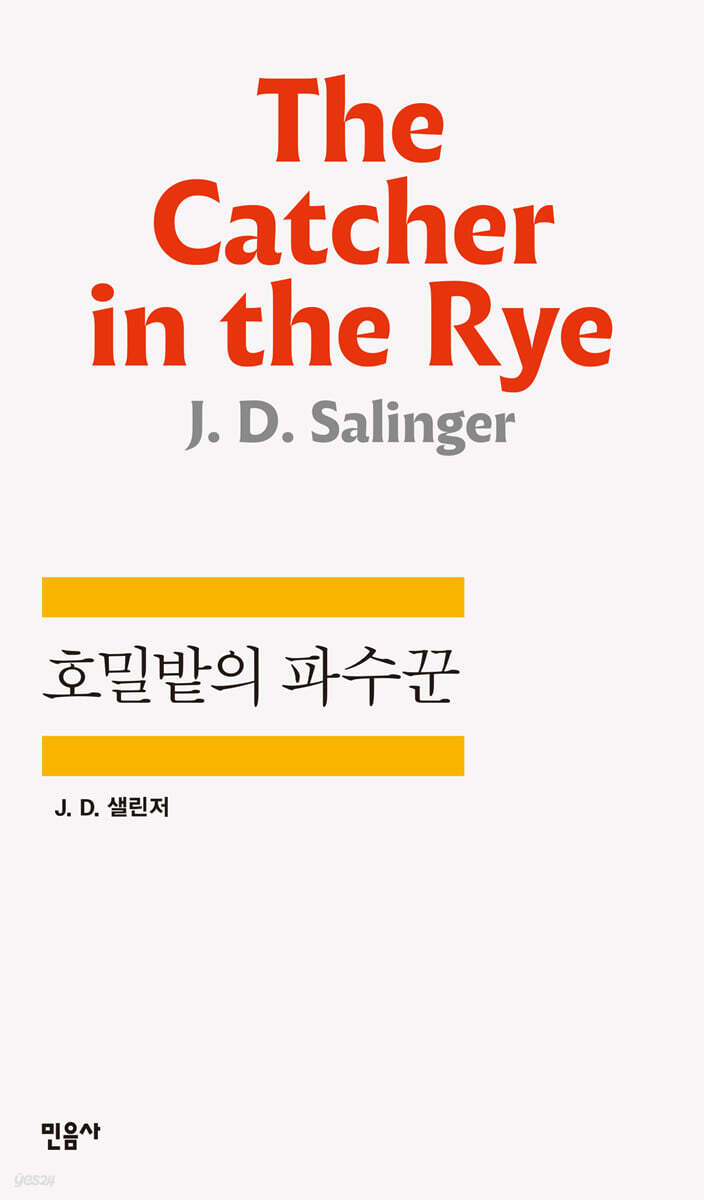
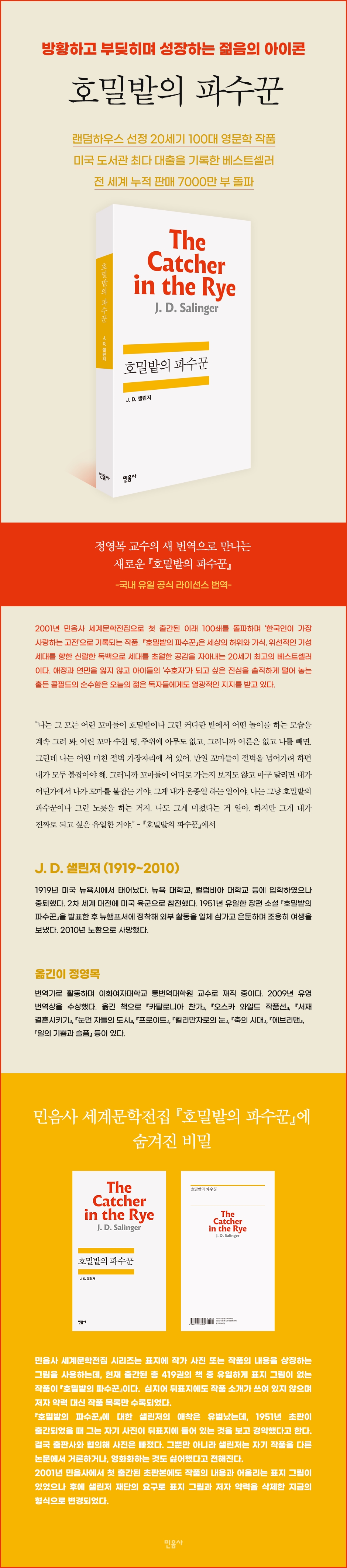
The cover of the Minumsa World Literature Collection edition of “The Catcher in the Rye” does not contain a photo of the author or a famous painting that matches the content of the work.
Moreover, it is clearly distinguished from other works in the World Literature Collection by not including a single line of explanation on the back cover.
This feature, which appears on the cover, can be traced back to the first edition of The Catcher in the Rye published by Little Brown in 1951.
At the time, Salinger was shocked to see his photo printed on the back cover, and eventually negotiated with the publisher to republish the edition without the photo.
Likewise, the first officially licensed edition in Korea, Minumsa World Literature Collection's 『The Catcher in the Rye』, had a cover illustration in its first edition in 2001, but was later changed to the current cover, omitting the cover illustration and author's biography, at the request of the Salinger Foundation.
In this passage, we can glimpse Salinger's unique individuality as a writer: a strong self-consciousness that does not allow even a single line of interpretation or modifier to be applied to his work, and a writerly pride that refuses to be evaluated based on anything outside of his work.
In other words, Salinger wanted to communicate with readers through the work itself, and the cover, which had ‘nothing added to it,’ became another symbol representing Salinger.
Holden Caulfield, a private school student, is notified of his expulsion one day before Christmas.
The reason for his expulsion was a failing grade on an exam, but behind it lies the confusion of growing up that enveloped the seventeen-year-old boy.
Although he grew up in a wealthy environment with a father who was a lawyer and an older brother who was a Hollywood playwright, Holden is a character who is disgusted by the snobbery and hypocrisy of the older generation.
For him, the private school Pencey was an object of envy from the outside, but inside, it was an unbearable place where young classmates dominated the atmosphere and students were discriminated against based on their parents' status.
Instead of appealing to the school for leniency, Holden decides to wander the streets of New York until a letter notifying him of his expulsion arrives at his home.
Add to this a night at his beloved teacher's house and the loving intervention of his younger sister, Phoebe, and his journey takes an unexpected turn.
A work filled with voices representing youth
When The Catcher in the Rye was published in 1951, the older generation did not understand the main character, Holden.
This novel unfolds as a monologue by Holden Caulfield, a troubled student expelled from a prestigious boarding school, because it clearly reveals his twisted attitude towards the world.
However, Holden, who is more sensitive than his peers, criticizes teachers who discriminate against students based on their parents' social status, and is cynical toward classmates who are only interested in romantic relationships, drew enthusiastic support from young readers.
On the other hand, he is a character who shows antipathy towards the older generation, but retains an innocence that reveals an infinitely tender heart when dealing with children.
Even when he does a writing assignment for his roommate who is going on a date, he chooses a baseball glove as a subject matter, as it holds memories of his late brother, Ali.
He is also a loving older brother who shows unconditional affection to his youngest sister, Phoebe.
When asked, "What do you want to be when you grow up?", Holden answers that he wants to be the "Catcher in the Rye" and protect children. This reveals a sensitivity that is a privilege of youth, a willingness to feel affection and compassion for the powerless.
The bestseller of the century that inspired artists
The Catcher in the Rye was banned at the time of its publication because of its subject matter of a troubled child who was expelled from school and its profane language, but it later became one of the best-selling books of the 20th century and remains one of the most widely read books among teenagers today.
Its influence was particularly evident in the cultural and artistic fields, including music and film, and it is said that numerous musicians, including Simon & Garfunkel, Green Day, The Offspring, and Billy Joel, were inspired by this work.
There is also a famous anecdote about how director Elia Kazan, who directed "On the Waterfront" and "East of Eden," wanted to make a film based on the novel, but Salinger refused, saying, "I'm afraid the protagonist Holden might not like it."
So, rather than directly adapting The Catcher in the Rye, there are many films that indirectly refer to it. The protagonist of Finding Forrester, the genius writer Forrester, is said to be modeled after Salinger, who left behind only one masterpiece and went into seclusion.
Holden's voice in "The Catcher in the Rye," which has been a constant source of inspiration for many with its charming rebellious theme, still retains its vividness and reaches readers around the world today.
The Secret Hidden in Minumsa World Literature Collection's "The Catcher in the Rye"
The cover of the Minumsa World Literature Collection edition of “The Catcher in the Rye” does not contain a photo of the author or a famous painting that matches the content of the work.
Moreover, it is clearly distinguished from other works in the World Literature Collection by not including a single line of explanation on the back cover.
This feature, which appears on the cover, can be traced back to the first edition of The Catcher in the Rye published by Little Brown in 1951.
At the time, Salinger was shocked to see his photo printed on the back cover, and eventually negotiated with the publisher to republish the edition without the photo.
Likewise, the first officially licensed edition in Korea, Minumsa World Literature Collection's 『The Catcher in the Rye』, had a cover illustration in its first edition in 2001, but was later changed to the current cover, omitting the cover illustration and author's biography, at the request of the Salinger Foundation.
In this passage, we can glimpse Salinger's unique individuality as a writer: a strong self-consciousness that does not allow even a single line of interpretation or modifier to be applied to his work, and a writerly pride that refuses to be evaluated based on anything outside of his work.
In other words, Salinger wanted to communicate with readers through the work itself, and the cover, which had ‘nothing added to it,’ became another symbol representing Salinger.
GOODS SPECIFICS
- Date of issue: January 17, 2023
- Page count, weight, size: 320 pages | 411g | 133*225*30mm
- ISBN13: 9788937460470
- ISBN10: 8937460475
You may also like
카테고리
korean


korean

![GQ KOREA Mark (Monthly): December [2025]](http://librairie.coreenne.fr/cdn/shop/files/8ef265dbbfbf186523ed75ba7319009d.jpg?v=1765340328&width=3840)


