

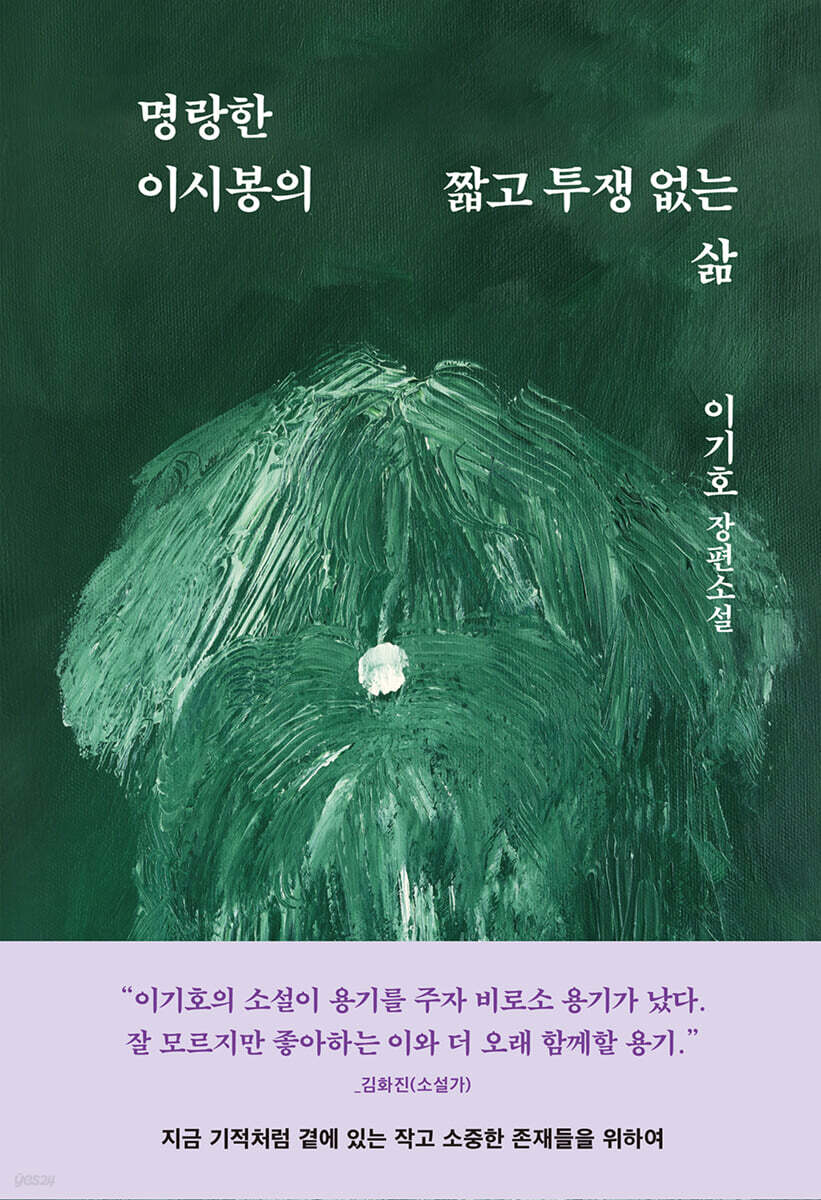
The short, struggle-free life of the cheerful Lee Si-bong
 |
Description
Book Introduction
“I finally found courage after reading Lee Ki-ho’s novel.
“The courage to stay with someone you like, even if you don’t know them well.” _Kim Hwa-jin (novelist)
The author who has called out countless names that contain the lives of individual humans,
Lee Ki-ho's first full-length novel in 11 years
The names of puppies called out in affectionate voices and their sad footsteps
Choi Soon-deok, Kwon Soon-chan, Choi Mi-jin, Han Jeong-hee, Kang Min-ho… … Author Lee Ki-ho approaches the universal essence of human fragility and imperfection through novels that call out familiar and savory names.
He has returned with a full-length novel after 11 years since 『I'm Good at Apologizing』(2009) and 『The World History of Second Sons』(2014).
Considering the author's track record since his debut in 1999, the name that appears in this new full-length novel feels even more precious and welcome: 'Lee Si-bong', a special name that Lee Ki-ho has been calling with affection since he published his early works over 20 years ago.
The name has been given mainly to those among Lee Ki-ho's characters who are somewhat naive and alienated from the world, and thus attract more attention and affection.
This work is noteworthy because the character given this new name is a dog, not a human.
An interesting fact is that the name of the dog that the author actually lives with is also Lee Si-bong.
It is not difficult to guess why the author gave the dog the name he had given to the characters in his novels, as well as his own surname.
The desire to treat companion animals as equal members of the family and allow them to live happily, but isn't that still an attitude influenced by anthropocentrism?
Can the happiness of dogs, and indeed animals, who have become part of human life, be judged by human perspectives?
How far can two beings born as separate species understand each other?
"The Short and Struggle-Free Life of the Cheerful Lee Si-bong" is a work written under the author's own doubts and concerns.
The novel depicts the twists and turns of the Bichon Frise's journey as he enters the lives of a family.
The reason the dog was named Ishibong is because of the human consciousness of atonement for betraying his comrades due to the absurdity of the world. The story of the dog's family being sold to a dog farm is because of the miserable tears of the humans who suffered hardships in exchange for pursuing their dreams. The story of the dog's ancestors being raised in European royal families and then scattered is because of the repeated historical mistakes of humans who only know how to express love in the form of struggle.
By following the lives of dogs over several generations and intersecting them with human lives, Lee Ki-ho reflects on the relationship between 'non-human' animals, who are sometimes loved endlessly, but are also used and eventually cruelly sacrificed, and the 'non-animal' humans who coexist with them.
“The courage to stay with someone you like, even if you don’t know them well.” _Kim Hwa-jin (novelist)
The author who has called out countless names that contain the lives of individual humans,
Lee Ki-ho's first full-length novel in 11 years
The names of puppies called out in affectionate voices and their sad footsteps
Choi Soon-deok, Kwon Soon-chan, Choi Mi-jin, Han Jeong-hee, Kang Min-ho… … Author Lee Ki-ho approaches the universal essence of human fragility and imperfection through novels that call out familiar and savory names.
He has returned with a full-length novel after 11 years since 『I'm Good at Apologizing』(2009) and 『The World History of Second Sons』(2014).
Considering the author's track record since his debut in 1999, the name that appears in this new full-length novel feels even more precious and welcome: 'Lee Si-bong', a special name that Lee Ki-ho has been calling with affection since he published his early works over 20 years ago.
The name has been given mainly to those among Lee Ki-ho's characters who are somewhat naive and alienated from the world, and thus attract more attention and affection.
This work is noteworthy because the character given this new name is a dog, not a human.
An interesting fact is that the name of the dog that the author actually lives with is also Lee Si-bong.
It is not difficult to guess why the author gave the dog the name he had given to the characters in his novels, as well as his own surname.
The desire to treat companion animals as equal members of the family and allow them to live happily, but isn't that still an attitude influenced by anthropocentrism?
Can the happiness of dogs, and indeed animals, who have become part of human life, be judged by human perspectives?
How far can two beings born as separate species understand each other?
"The Short and Struggle-Free Life of the Cheerful Lee Si-bong" is a work written under the author's own doubts and concerns.
The novel depicts the twists and turns of the Bichon Frise's journey as he enters the lives of a family.
The reason the dog was named Ishibong is because of the human consciousness of atonement for betraying his comrades due to the absurdity of the world. The story of the dog's family being sold to a dog farm is because of the miserable tears of the humans who suffered hardships in exchange for pursuing their dreams. The story of the dog's ancestors being raised in European royal families and then scattered is because of the repeated historical mistakes of humans who only know how to express love in the form of struggle.
By following the lives of dogs over several generations and intersecting them with human lives, Lee Ki-ho reflects on the relationship between 'non-human' animals, who are sometimes loved endlessly, but are also used and eventually cruelly sacrificed, and the 'non-animal' humans who coexist with them.
- You can preview some of the book's contents.
Preview
index
The Short, Struggle-Free Life of the Cheerful Lee Si-bong _007
Author's Note _525
Author's Note _525
Into the book
Lee Si-bong is a four-year-old male Bichon Frise who lives with me.
A dog that doesn't even pretend to know you when you call it "Sibong", and only turns around or wags its tail when you call its last name, "Isibong".
Lida often called Lee Si-bong a 'street dog'.
Of course, this was done without Lee Si-bong present.
I guess Lee Si-bong calls me that because he hasn't been to the hair salon in over a year, so I guess I should call him 'homeless' too (who knows, maybe they'll call me that when I'm not around).
I also haven't cut my hair in over a year and a half.
We both have very curly hair, so it's not a huge inconvenience.
However, both of their faces look a bit large compared to their shoulders, so when I hold Isibong in my arms and stare blankly into the mirror (which I do every time I ride the elevator), it looks like two Chupa Chups are floating in the air.
Sometimes it looks like Jesus holding a lamb.
--- pp.10-11
It wasn't Lee Si-bong's fault.
Doesn't Lee Si-bong know nothing about roads, sidewalks, rules, or traffic laws? Isn't that why he's so cheerful? To blame Lee Si-bong is to blame nature.
--- p.52
“Love is experiencing the unpredictable.”
Dad said indifferently.
“Loving a dog is even more so.”
--- p.123
The puppies, having finished drinking the water, pretended not to care and crawled up onto the legs of CEO Jeong Chae-min, who was sitting under the sofa.
Then he tilted his head to one side and met his eyes.
It kept wagging its small, finger-sized tail, and it kept crouching down and trying to jump.
Then, he started licking his front paws again, and then he fell asleep.
CEO Jeong Chae-min couldn't move from the moment the puppies climbed onto her legs.
He was smiling, not even aware that he was unable to move, and not even aware of his own expression as he stared intently at one spot.
--- pp.159-160
Dogs don't get excited by invisible hopes.
We carefully observe the hope right in front of us and approach it cautiously.
So even when that hope is dashed, you can continue your relationship with each other.
But humans are different.
Most human hopes are created by chemical reactions within oneself, without regard for others or concern for others (most hopes come from boredom).
So, when that hope is dashed, it can lead to the complete destruction of the opponent.
Yet, he consoles himself by saying that he is the one who is hurt.
--- p.204
People feel shame when their situation is similar to that of animals.
--- p.261
Every time the soft, round fur of the Ishibong brushed against my forearm and neck, every time its moist nose turned to my eyes, I realized that this creature was asking for more from me.
That was the inevitable relationship between the two of us.
A relationship that I can't abandon on my own.
--- p.283
He knew.
What fate awaits the puppies when the revolution takes place and the devastation of war follows (during the French Revolution, most of the puppies raised by the royal family and noble families were beheaded before their owners).
Puppies are the first to fall to the ground and the first to be trampled.
That is the essence of the relationship humans have with dogs.
The essence is always revealed in unexpected events and accidents.
Dogs have always been sacrificed in this way.
--- p.299
As the queen spoke, she suddenly looked at Godoi's expression.
Godoy stood right next to his desk in his office, holding a puppy wrapped in a red cloth, his face covered with a faint smile, like a young father looking at a child who has just woken up.
That smile, along with the sunset streaming in through the window, inevitably brought to mind death, the end of everything.
--- p.403
Humans interfere with the lives of animals in such a way that they misunderstand and misinterpret them.
That is the only advantage of being human, and the qualification for being a butler.
The position of butler is usually a way for such people, people who are full of self-love but don't really know it, to live in the world.
A dog that doesn't even pretend to know you when you call it "Sibong", and only turns around or wags its tail when you call its last name, "Isibong".
Lida often called Lee Si-bong a 'street dog'.
Of course, this was done without Lee Si-bong present.
I guess Lee Si-bong calls me that because he hasn't been to the hair salon in over a year, so I guess I should call him 'homeless' too (who knows, maybe they'll call me that when I'm not around).
I also haven't cut my hair in over a year and a half.
We both have very curly hair, so it's not a huge inconvenience.
However, both of their faces look a bit large compared to their shoulders, so when I hold Isibong in my arms and stare blankly into the mirror (which I do every time I ride the elevator), it looks like two Chupa Chups are floating in the air.
Sometimes it looks like Jesus holding a lamb.
--- pp.10-11
It wasn't Lee Si-bong's fault.
Doesn't Lee Si-bong know nothing about roads, sidewalks, rules, or traffic laws? Isn't that why he's so cheerful? To blame Lee Si-bong is to blame nature.
--- p.52
“Love is experiencing the unpredictable.”
Dad said indifferently.
“Loving a dog is even more so.”
--- p.123
The puppies, having finished drinking the water, pretended not to care and crawled up onto the legs of CEO Jeong Chae-min, who was sitting under the sofa.
Then he tilted his head to one side and met his eyes.
It kept wagging its small, finger-sized tail, and it kept crouching down and trying to jump.
Then, he started licking his front paws again, and then he fell asleep.
CEO Jeong Chae-min couldn't move from the moment the puppies climbed onto her legs.
He was smiling, not even aware that he was unable to move, and not even aware of his own expression as he stared intently at one spot.
--- pp.159-160
Dogs don't get excited by invisible hopes.
We carefully observe the hope right in front of us and approach it cautiously.
So even when that hope is dashed, you can continue your relationship with each other.
But humans are different.
Most human hopes are created by chemical reactions within oneself, without regard for others or concern for others (most hopes come from boredom).
So, when that hope is dashed, it can lead to the complete destruction of the opponent.
Yet, he consoles himself by saying that he is the one who is hurt.
--- p.204
People feel shame when their situation is similar to that of animals.
--- p.261
Every time the soft, round fur of the Ishibong brushed against my forearm and neck, every time its moist nose turned to my eyes, I realized that this creature was asking for more from me.
That was the inevitable relationship between the two of us.
A relationship that I can't abandon on my own.
--- p.283
He knew.
What fate awaits the puppies when the revolution takes place and the devastation of war follows (during the French Revolution, most of the puppies raised by the royal family and noble families were beheaded before their owners).
Puppies are the first to fall to the ground and the first to be trampled.
That is the essence of the relationship humans have with dogs.
The essence is always revealed in unexpected events and accidents.
Dogs have always been sacrificed in this way.
--- p.299
As the queen spoke, she suddenly looked at Godoi's expression.
Godoy stood right next to his desk in his office, holding a puppy wrapped in a red cloth, his face covered with a faint smile, like a young father looking at a child who has just woken up.
That smile, along with the sunset streaming in through the window, inevitably brought to mind death, the end of everything.
--- p.403
Humans interfere with the lives of animals in such a way that they misunderstand and misinterpret them.
That is the only advantage of being human, and the qualification for being a butler.
The position of butler is usually a way for such people, people who are full of self-love but don't really know it, to live in the world.
--- p.469
Publisher's Review
My dog, small and sad like a speck of dust in the corner of the room
A noble bloodline among the nobles raised in European royal families… …
What adventure brought you to me?
Is it really for your good to live with me like this?
Lee Si-seup, Lee Si-bong's guardian, is a young man in his 20s who has not yet established his own path in life and is wandering.
After losing their father in an unexpected accident, the family of the deceased is left with deep emotional wounds that are not apparent on the outside.
This is because Lee Si-bong is implicated in the death of his father, who brought him home and doted on him, calling him “our youngest child.”
Even though she understands in her head that Lee Si-bong is not at fault, she cannot forgive him in her heart. Living with her mother, Si-seup is always concerned about what her family thinks even when she wants to love Lee Si-bong to her heart's content.
Shi-seup, who became dependent on alcohol to escape reality, always took care of Lee Si-bong by carrying him around with him.
Even though Lee Si-bong's appearance resembles that of a stray dog, he becomes shabby and miserable.
While Si-seup was receiving the worry and pity of his younger sister 'Si-hyeon' and his friends, he relied on Lee Si-bong and continued his rehabilitation within a small living space. One day, a breeding company called 'Ancien House', which specializes in Bichon Frises, appeared in front of him.
The chief breeder there, Michelle Kim, tells Shiseup something surprising.
The investigation revealed that Ishibong was of noble bloodline, once raised by European royalty, and is now the 'King of Bichons', one of only a few left in the world.
Michelle Kim offers a considerable amount of money in exchange for taking over Lee Si-bong, and persuades Si-seup by telling him that Ancien House guarantees luxurious facilities and systematic, comfortable care for Lee Si-bong.
Although he thought it was a ridiculous suggestion, Si-seup's feelings became complicated as he visited the Angsiang House with Lee Si-bong and watched the passionate affection shown by the company's representative, Jeong Chae-min.
Si-seup, who is not confident in his own life, feels like he is holding on to Lee Si-bong instead of supporting him to have a better life.
Her love for Lee Si-bong is a true, unashamed love, yet why does it always seem to be judged by its superiority? To verify the truth of the Ancien House's claims about Lee Si-bong's lineage, Si-seup traces his father's whereabouts around the time he adopted him as a child, only to encounter yet another shocking revelation.
Among my father's acquaintances, there was a 'human Lee Si-bong'.
The secret behind the name of Lee Si-bong, which was thought to be formed by the character 'si' along with the characters 'si' and 'sihyeon', begins to be revealed, and the novel truly moves forward toward an eventful epic.
A wounded and wandering human, a pure and cheerful dog
In the turbulent epic connecting Spain, France, and Korea,
The story of two beings who become each other's inseparable companions.
The narrative is then divided into three main branches.
The narrative closest to the present is the story of Lee Si-seup tracing the story behind Lee Si-bong's name and finally coming face to face with the truth.
It is revealed that the father of the trial was once a member of a factory labor union, but despite the persuasion of those around him, he took voluntary retirement and was asked by his colleague, Lee Si-bong, who took his place as a union leader and went through all kinds of hardships, to lend him money using a puppy left at a dog farm as collateral.
This narrative confirms the heart of a father who protected his dog to the end, calling it by its name as a companion and feeling a sense of atonement. It vividly depicts the individual expressions of people who live with the tragedy that occurs in an absurd society and the pain that comes with it.
The story of how Bichon Frise Lee Si-bong ended up being abandoned at a dog farm is related to Jeong Chae-min's past story.
Jeong Chae-min, the CEO of Angsiang House, invites Lee Si-seup and tells him a long story to express how much she cares for him.
Jeong Chae-min, who grew up in an affluent environment, went to study abroad in France during her youth, where she met a poor Korean artist couple, Kim Sang-woo and Park Yu-jeong.
One day, two dogs with European royal blood appear before them.
Jeong Chae-min, Kim Sang-woo, and Park Yu-jeong join forces to bring the dogs they have cared for with love back to Korea, but their hearts eventually break apart after a conflict of love, jealousy, and money.
The story of poor people who aspired to art and their conflict with their dreams and compromise with reality, and the process of hidden love being distorted over time, are revealed in a poignant and passionate narrative.
So why did the Bichon Frises that lived in the royal family end up with such a shabby lineage?
The reason, says Jeong Chae-min, is related to the popular uprising that broke out in Spain in 1808.
The clock turns back to the monarchy, and the narrative, extending further into the past, tells the story of Manuel Godoy, the Prime Minister and Queen of Spain, who served as the queen's mistress and the voice of the people.
In an age of survival of the fittest, Lee Si-bong's ancestral puppies were political assets bestowed to solidify hierarchical relationships, a pretext to meet a loved one in a respectable manner while hiding one's feelings of affection, and a sacrificial offering to be trampled before the human who represented an era was overthrown.
This magnificent narrative, which follows the downfall of Manuel Godoy and the tragic end of his beloved dogs, exposes the enduring cruelty of humans who exploit and even sacrifice animal lives as a means to fulfill worldly desires.
You are by my side like a miracle right now
The small and precious things that give us
Helpless emotion
And at the point where these three narratives converge, the narratives of Lee Si-seup and Lee Si-bong, who had been wounded and confined in a small world, begin to move.
At the desperate moment when Lee Si-bong is about to fall into the clutches of Michelle Kim and Jeong Chae-min, the novel provides an epiphany not only to Lee Si-seup but to all who have read the story.
I need to cherish more the person who came to me after such a long time and countless stories.
We try to judge our pets' happiness by human standards, but no other being can measure someone else's happiness.
Now, Si-seup, who is ready to love Lee Si-bong to the fullest, runs to get him back.
Of course, Bichon Frise Lee Si-bong will remain an unknown being to Lee Si-seup, whom he will never fully understand.
The dog will instinctively demand something regardless of the human's situation or feelings, and if someone appears who satisfies that instinct more, the dog will immediately turn its gaze and wag its tail.
But wouldn't it be enough for someone who feels transparent joy just from the fact that "these children, who are cheerful and know nothing, who are honest and honest itself", and dogs, cats, birds, fish, reptiles, and amphibians, who fill their short lives with love and die without a struggle, unlike humans who have "an uncanny knack of turning love into a struggle," are now miraculously by their side?
Can't we be happy together even if we don't understand each other?
This form of life, in which one loves others without expecting anything in return, is perhaps the understanding of 'different species' that Lee Ki-ho reached after writing about himself, others, and the world in novels.
Author's Note
Actually, the name of the dog that has been living with us for eight years is Ishibong.
Every time I looked into Lee Si-bong's dark eyes, I felt like telling him a story, but it ended up getting this long.
Novels may not be the right genre to talk about dogs.
But it's still a valid genre for asking humans to take responsibility for their dogs.
_Lee Ki-ho
A noble bloodline among the nobles raised in European royal families… …
What adventure brought you to me?
Is it really for your good to live with me like this?
Lee Si-seup, Lee Si-bong's guardian, is a young man in his 20s who has not yet established his own path in life and is wandering.
After losing their father in an unexpected accident, the family of the deceased is left with deep emotional wounds that are not apparent on the outside.
This is because Lee Si-bong is implicated in the death of his father, who brought him home and doted on him, calling him “our youngest child.”
Even though she understands in her head that Lee Si-bong is not at fault, she cannot forgive him in her heart. Living with her mother, Si-seup is always concerned about what her family thinks even when she wants to love Lee Si-bong to her heart's content.
Shi-seup, who became dependent on alcohol to escape reality, always took care of Lee Si-bong by carrying him around with him.
Even though Lee Si-bong's appearance resembles that of a stray dog, he becomes shabby and miserable.
While Si-seup was receiving the worry and pity of his younger sister 'Si-hyeon' and his friends, he relied on Lee Si-bong and continued his rehabilitation within a small living space. One day, a breeding company called 'Ancien House', which specializes in Bichon Frises, appeared in front of him.
The chief breeder there, Michelle Kim, tells Shiseup something surprising.
The investigation revealed that Ishibong was of noble bloodline, once raised by European royalty, and is now the 'King of Bichons', one of only a few left in the world.
Michelle Kim offers a considerable amount of money in exchange for taking over Lee Si-bong, and persuades Si-seup by telling him that Ancien House guarantees luxurious facilities and systematic, comfortable care for Lee Si-bong.
Although he thought it was a ridiculous suggestion, Si-seup's feelings became complicated as he visited the Angsiang House with Lee Si-bong and watched the passionate affection shown by the company's representative, Jeong Chae-min.
Si-seup, who is not confident in his own life, feels like he is holding on to Lee Si-bong instead of supporting him to have a better life.
Her love for Lee Si-bong is a true, unashamed love, yet why does it always seem to be judged by its superiority? To verify the truth of the Ancien House's claims about Lee Si-bong's lineage, Si-seup traces his father's whereabouts around the time he adopted him as a child, only to encounter yet another shocking revelation.
Among my father's acquaintances, there was a 'human Lee Si-bong'.
The secret behind the name of Lee Si-bong, which was thought to be formed by the character 'si' along with the characters 'si' and 'sihyeon', begins to be revealed, and the novel truly moves forward toward an eventful epic.
A wounded and wandering human, a pure and cheerful dog
In the turbulent epic connecting Spain, France, and Korea,
The story of two beings who become each other's inseparable companions.
The narrative is then divided into three main branches.
The narrative closest to the present is the story of Lee Si-seup tracing the story behind Lee Si-bong's name and finally coming face to face with the truth.
It is revealed that the father of the trial was once a member of a factory labor union, but despite the persuasion of those around him, he took voluntary retirement and was asked by his colleague, Lee Si-bong, who took his place as a union leader and went through all kinds of hardships, to lend him money using a puppy left at a dog farm as collateral.
This narrative confirms the heart of a father who protected his dog to the end, calling it by its name as a companion and feeling a sense of atonement. It vividly depicts the individual expressions of people who live with the tragedy that occurs in an absurd society and the pain that comes with it.
The story of how Bichon Frise Lee Si-bong ended up being abandoned at a dog farm is related to Jeong Chae-min's past story.
Jeong Chae-min, the CEO of Angsiang House, invites Lee Si-seup and tells him a long story to express how much she cares for him.
Jeong Chae-min, who grew up in an affluent environment, went to study abroad in France during her youth, where she met a poor Korean artist couple, Kim Sang-woo and Park Yu-jeong.
One day, two dogs with European royal blood appear before them.
Jeong Chae-min, Kim Sang-woo, and Park Yu-jeong join forces to bring the dogs they have cared for with love back to Korea, but their hearts eventually break apart after a conflict of love, jealousy, and money.
The story of poor people who aspired to art and their conflict with their dreams and compromise with reality, and the process of hidden love being distorted over time, are revealed in a poignant and passionate narrative.
So why did the Bichon Frises that lived in the royal family end up with such a shabby lineage?
The reason, says Jeong Chae-min, is related to the popular uprising that broke out in Spain in 1808.
The clock turns back to the monarchy, and the narrative, extending further into the past, tells the story of Manuel Godoy, the Prime Minister and Queen of Spain, who served as the queen's mistress and the voice of the people.
In an age of survival of the fittest, Lee Si-bong's ancestral puppies were political assets bestowed to solidify hierarchical relationships, a pretext to meet a loved one in a respectable manner while hiding one's feelings of affection, and a sacrificial offering to be trampled before the human who represented an era was overthrown.
This magnificent narrative, which follows the downfall of Manuel Godoy and the tragic end of his beloved dogs, exposes the enduring cruelty of humans who exploit and even sacrifice animal lives as a means to fulfill worldly desires.
You are by my side like a miracle right now
The small and precious things that give us
Helpless emotion
And at the point where these three narratives converge, the narratives of Lee Si-seup and Lee Si-bong, who had been wounded and confined in a small world, begin to move.
At the desperate moment when Lee Si-bong is about to fall into the clutches of Michelle Kim and Jeong Chae-min, the novel provides an epiphany not only to Lee Si-seup but to all who have read the story.
I need to cherish more the person who came to me after such a long time and countless stories.
We try to judge our pets' happiness by human standards, but no other being can measure someone else's happiness.
Now, Si-seup, who is ready to love Lee Si-bong to the fullest, runs to get him back.
Of course, Bichon Frise Lee Si-bong will remain an unknown being to Lee Si-seup, whom he will never fully understand.
The dog will instinctively demand something regardless of the human's situation or feelings, and if someone appears who satisfies that instinct more, the dog will immediately turn its gaze and wag its tail.
But wouldn't it be enough for someone who feels transparent joy just from the fact that "these children, who are cheerful and know nothing, who are honest and honest itself", and dogs, cats, birds, fish, reptiles, and amphibians, who fill their short lives with love and die without a struggle, unlike humans who have "an uncanny knack of turning love into a struggle," are now miraculously by their side?
Can't we be happy together even if we don't understand each other?
This form of life, in which one loves others without expecting anything in return, is perhaps the understanding of 'different species' that Lee Ki-ho reached after writing about himself, others, and the world in novels.
Author's Note
Actually, the name of the dog that has been living with us for eight years is Ishibong.
Every time I looked into Lee Si-bong's dark eyes, I felt like telling him a story, but it ended up getting this long.
Novels may not be the right genre to talk about dogs.
But it's still a valid genre for asking humans to take responsibility for their dogs.
_Lee Ki-ho
GOODS SPECIFICS
- Date of issue: July 17, 2025
- Page count, weight, size: 528 pages | 656g | 130*193*35mm
- ISBN13: 9791141610869
- ISBN10: 1141610868
You may also like
카테고리
korean


korean

![ELLE 엘르 스페셜 에디션 A형 : 12월 [2025]](http://librairie.coreenne.fr/cdn/shop/files/b8e27a3de6c9538896439686c6b0e8fb.jpg?v=1766436872&width=3840)


