

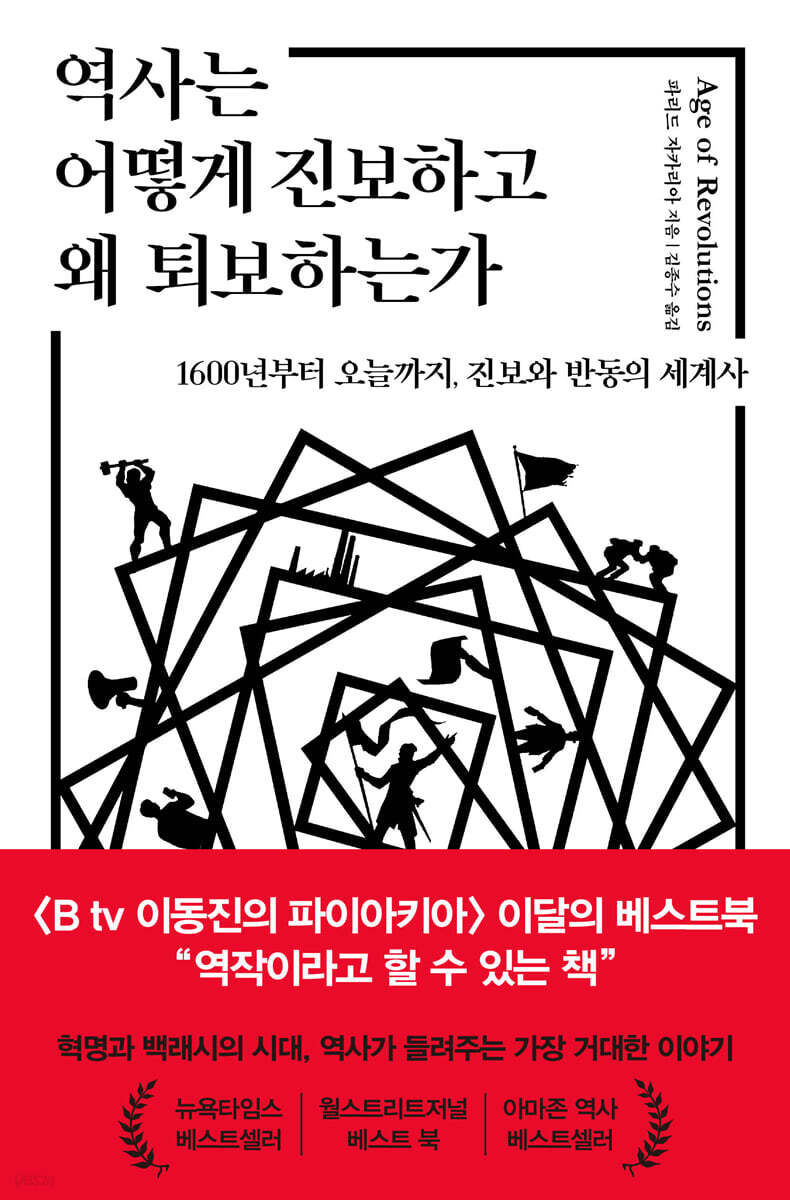
How History Advances and Why It Regresses
 |
Description
Book Introduction
- A word from MD
-
A World History of Revolution and Reaction"revolution: 1) revolution 2) rotation, return" Every change that moves forward is accompanied by a return to the original.
History is the same.
Some histories move along the trajectory of progress while at the same time retreating into the past.
From the liberal revolution to the information revolution, it offers a glimpse into the vast trajectory of the past 400 years, a time of intense revolution and reaction.
September 23, 2025. History PD Ahn Hyun-jae
A chilling insight into the world's history of revolution and reaction over the past 400 years.
It is truly a revolutionary era.
The world is becoming increasingly conflicted and divided as technology, information, globalization, and identity all shake and change rapidly.
Is history truly progressive, or is it regressing into chaos? Fareed Zakaria, host of "Fareed Zakaria GPS," CNN's flagship international affairs program that explains today's world and America's leading expert on international politics, offers an answer through historical insights spanning 400 years of modern history.
The author wrote this book over the course of ten years.
Part 1 examines the path the world has taken by detailing the history of Western political and economic revolutions that have permeated modern times, from the Dutch Revolution of the 16th century, which created the prototype for liberalism and social system innovation, to the Glorious Revolution in England, the French Revolution, the Industrial Revolution, and the American Revolution.
If Part 1 is a longitudinal analysis of history, Part 2 is a cross-sectional analysis of the reality we face today.
The author's sharp analysis shines as he delves into how the globalization revolution, information revolution, identity revolution, and geopolitical revolution, all of which are occurring simultaneously across the globe, interact and face backlash to shape today's world.
Immediately after its publication in the United States, it became a bestseller on Amazon in the history and politics category, receiving rave reviews such as "powerful historical insight" and "a thought-provoking account of why some countries succeed and others fail."
It is truly a revolutionary era.
The world is becoming increasingly conflicted and divided as technology, information, globalization, and identity all shake and change rapidly.
Is history truly progressive, or is it regressing into chaos? Fareed Zakaria, host of "Fareed Zakaria GPS," CNN's flagship international affairs program that explains today's world and America's leading expert on international politics, offers an answer through historical insights spanning 400 years of modern history.
The author wrote this book over the course of ten years.
Part 1 examines the path the world has taken by detailing the history of Western political and economic revolutions that have permeated modern times, from the Dutch Revolution of the 16th century, which created the prototype for liberalism and social system innovation, to the Glorious Revolution in England, the French Revolution, the Industrial Revolution, and the American Revolution.
If Part 1 is a longitudinal analysis of history, Part 2 is a cross-sectional analysis of the reality we face today.
The author's sharp analysis shines as he delves into how the globalization revolution, information revolution, identity revolution, and geopolitical revolution, all of which are occurring simultaneously across the globe, interact and face backlash to shape today's world.
Immediately after its publication in the United States, it became a bestseller on Amazon in the history and politics category, receiving rave reviews such as "powerful historical insight" and "a thought-provoking account of why some countries succeed and others fail."
- You can preview some of the book's contents.
Preview
index
Introduction · Various forms of revolution
The Origins of the Word "Revolution" | The Fundamental Restructuring of International Politics | Change and the Resulting Discontent | The Origins of Left and Right
| Part 1 | What Makes an Era Revolutionary?
1 The first liberal revolution, the Netherlands
Venice, a shabby merchant republic | Spain and Portugal, the first globalizers | The Netherlands was created by the Dutch | The role of the Reformation | The world's first liberal revolution | Pax Hollandica, achieved through naval power | The financial system, the greatest treasure | The benefits of disruptive innovation | The first decentralized modern republic | Backlash and backlash against liberal ideas | The revival of liberalism in Britain
2 The Glorious Revolution, a moderate but truly revolutionary revolution in England
Britain's egalitarian political structure | The economic structure that led to modernization | From reform to revolution | The return of absolutism | Identity politics and bipartisan cooperation | The Netherlands in the trap of decline | The global spread of capitalism | The Whig perspective of optimists
3. The Revolution in France, which left division and chaos
A Revolution Wrongly Worn | The Rise of Radicalism | The Doomed Liberal Lafayette | The Extreme Populist Robespierre | The Dictator and Emperor Napoleon | New Wine in Old Bottles | The Solitude Called Liberty | The Dangers of Militarized Nationalism | The Failed Statism | The Violent Legacy of the French Revolution | The Volcanic Succession of Revolutions | The Industrial Revolution in England That Swallowed the French Revolution
The Industrial Revolution, the mother of the 4th revolution and the one that modernized the world
Technological innovation transforms everyday life | The invention of leisure | Women's liberation sparked by industrialization | Satan's dark factory | Luddites and liberals | Reforms to prevent revolution | No revolution when the stomach is full | Laissez-faire left, anti-market right | The division of political parties due to the Corn Laws | Crystal Palace or Panopticon | New politics, old wounds | The triumph of the British Empire
5 Changes brought about by American industrialization and the American Revolution
How America Industrialized | America's Dramatic Transformation | There Was No Place for Socialism | New Identity, New Politics | Don't Crucify Humanity on a Golden Cross | The Political Realignment of 1896 | The Last Progressive Republican | The Birth of Modern America
| Part 2 | Modern Revolutions: Revolutionary Forces and Backlash
6. The deepening of inequality and relative deprivation, the globalization revolution
The Full-Fledged Embarkation of Globalization | Overcoming the Limits of Distance | The Birth of Internationalism | Trade Wars and Armed Wars | The End of Globalization and Tariffs | The Rebirth of Globalization and the New Economic Order | The Transportation Revolution: The Jet Age | Neoliberal Reforms in Recession | Globalization Accelerated at a High Speed | The Origins of Discontent with Globalization | China Shock or Globalization Shock? | Understanding Shock | The Collapse of the 1990s Economic Boom | The Rapid Shift in Globalization Atmosphere
7 A world where everyone becomes a lonely king: the information revolution
The Jetsons Was Wrong | A World That Made Everyone a King | Bowling Alone | Is It a 'Somewhere' or a 'Nowhere'? | How Half the World Lives | New Printing Presses, Social Media | Old Tribalism, New Networks | Why Robots Aren't Taking Your Job (Yet) | The Biotechnology Revolution | Beyond Dystopia
8 An Identity Revolution Driven by Fear and Anxiety
The Stages of Social Needs | The Splits of the Left | The Countercultural Movement in the United States | The Rising Wave of Secularization in Europe | Social Change and the Silent Majority | The Nameless Problem: Feminism | The New Great Awakening | The Rising Third Way | The Unstable Center Line | The Tipping Point in Europe | Cultural Divisions | Political Tribalism in the United States | Immigration: A Symbol of Social Unrest | God is Dead, and We Killed Him | Conservatives Fear Radical Change | The Strange Alliances of the Culture Wars
9 Between Geopolitical Tensions and Interdependence: A Geopolitical Dual Revolution
The Origins of Pax Americana | The Rise of the Periphery | The Rise and Ambition of China | Russia as a Disruptor | Too Strong or Too Weak | Autocratic Regimes in Danger | Fears of Western Ideological Hegemony | Neither Free, Nor International, Nor Orderly | Illiberal Democracy at Home and Abroad
Conclusion: The Price of Abundance and Freedom, an Age of Loneliness and Loss
What to Do in a Time of Turbulence | Belief in Freedom
The Origins of the Word "Revolution" | The Fundamental Restructuring of International Politics | Change and the Resulting Discontent | The Origins of Left and Right
| Part 1 | What Makes an Era Revolutionary?
1 The first liberal revolution, the Netherlands
Venice, a shabby merchant republic | Spain and Portugal, the first globalizers | The Netherlands was created by the Dutch | The role of the Reformation | The world's first liberal revolution | Pax Hollandica, achieved through naval power | The financial system, the greatest treasure | The benefits of disruptive innovation | The first decentralized modern republic | Backlash and backlash against liberal ideas | The revival of liberalism in Britain
2 The Glorious Revolution, a moderate but truly revolutionary revolution in England
Britain's egalitarian political structure | The economic structure that led to modernization | From reform to revolution | The return of absolutism | Identity politics and bipartisan cooperation | The Netherlands in the trap of decline | The global spread of capitalism | The Whig perspective of optimists
3. The Revolution in France, which left division and chaos
A Revolution Wrongly Worn | The Rise of Radicalism | The Doomed Liberal Lafayette | The Extreme Populist Robespierre | The Dictator and Emperor Napoleon | New Wine in Old Bottles | The Solitude Called Liberty | The Dangers of Militarized Nationalism | The Failed Statism | The Violent Legacy of the French Revolution | The Volcanic Succession of Revolutions | The Industrial Revolution in England That Swallowed the French Revolution
The Industrial Revolution, the mother of the 4th revolution and the one that modernized the world
Technological innovation transforms everyday life | The invention of leisure | Women's liberation sparked by industrialization | Satan's dark factory | Luddites and liberals | Reforms to prevent revolution | No revolution when the stomach is full | Laissez-faire left, anti-market right | The division of political parties due to the Corn Laws | Crystal Palace or Panopticon | New politics, old wounds | The triumph of the British Empire
5 Changes brought about by American industrialization and the American Revolution
How America Industrialized | America's Dramatic Transformation | There Was No Place for Socialism | New Identity, New Politics | Don't Crucify Humanity on a Golden Cross | The Political Realignment of 1896 | The Last Progressive Republican | The Birth of Modern America
| Part 2 | Modern Revolutions: Revolutionary Forces and Backlash
6. The deepening of inequality and relative deprivation, the globalization revolution
The Full-Fledged Embarkation of Globalization | Overcoming the Limits of Distance | The Birth of Internationalism | Trade Wars and Armed Wars | The End of Globalization and Tariffs | The Rebirth of Globalization and the New Economic Order | The Transportation Revolution: The Jet Age | Neoliberal Reforms in Recession | Globalization Accelerated at a High Speed | The Origins of Discontent with Globalization | China Shock or Globalization Shock? | Understanding Shock | The Collapse of the 1990s Economic Boom | The Rapid Shift in Globalization Atmosphere
7 A world where everyone becomes a lonely king: the information revolution
The Jetsons Was Wrong | A World That Made Everyone a King | Bowling Alone | Is It a 'Somewhere' or a 'Nowhere'? | How Half the World Lives | New Printing Presses, Social Media | Old Tribalism, New Networks | Why Robots Aren't Taking Your Job (Yet) | The Biotechnology Revolution | Beyond Dystopia
8 An Identity Revolution Driven by Fear and Anxiety
The Stages of Social Needs | The Splits of the Left | The Countercultural Movement in the United States | The Rising Wave of Secularization in Europe | Social Change and the Silent Majority | The Nameless Problem: Feminism | The New Great Awakening | The Rising Third Way | The Unstable Center Line | The Tipping Point in Europe | Cultural Divisions | Political Tribalism in the United States | Immigration: A Symbol of Social Unrest | God is Dead, and We Killed Him | Conservatives Fear Radical Change | The Strange Alliances of the Culture Wars
9 Between Geopolitical Tensions and Interdependence: A Geopolitical Dual Revolution
The Origins of Pax Americana | The Rise of the Periphery | The Rise and Ambition of China | Russia as a Disruptor | Too Strong or Too Weak | Autocratic Regimes in Danger | Fears of Western Ideological Hegemony | Neither Free, Nor International, Nor Orderly | Illiberal Democracy at Home and Abroad
Conclusion: The Price of Abundance and Freedom, an Age of Loneliness and Loss
What to Do in a Time of Turbulence | Belief in Freedom
Detailed image

Into the book
Politics is one of the few human activities that has remained largely unchanged for thousands of years.
The outward appearance of politics has changed, but its core concerns—the struggle for power and the exercise of power—have not.
--- p.16
Our era is a revolutionary era in the general sense of the word.
Wherever you look, you see dramatic and radical changes.
The international system, once stable and familiar, is now rapidly changing, challenged by a rising China and a Russia seeking real recovery.
--- p.24
Modern history has experienced several broad and fundamental breaks with the past.
Some of them were intellectual, like the Enlightenment, others were technological and economic.
In fact, the world has gone through numerous industrial revolutions: the first, second, third, and now the fourth.
--- p.25
What makes an era revolutionary? Are there other, predictable endings to a revolutionary era? And how will it all end? These are some of the questions I seek to answer in this book.
I will attempt to answer these questions by looking back at past revolutionary eras, understanding their origins and their aftermath, and then examining the present era.
--- p.32
These three revolutionary forces—technology, economy, and identity—almost always provoke backlash and backlash, creating new politics.
Humans cannot accept so many changes so quickly.
Old politics that have continued from previous eras sometimes cannot keep up with the pace of change.
Politicians are scrambling to adapt to change, revising their views and finding new coalitions.
The results are either 'reform and modernization' or 'oppression and rebellion'.
And these two results can sometimes come together in an explosive combination.
--- p.37
With the establishment of the Dutch Republic (or Commonwealth as it was known) in 1588, the Netherlands created a successful social, economic, and political order that lasted for nearly 200 years, placing it among the world's leading nations.
--- p.49
Economic historian Angus Madison has argued that, when measured by the criteria of global leadership in technology and labor productivity, “only three countries have led the world over the past four centuries.”
From about 1890, the leading country was the United States, and for most of the 19th century, it was the United Kingdom.
And before that, “the Netherlands was the best protagonist,” Madison argued.
--- p.50
This first globalization revolution, like the globalization revolutions that followed, was closely linked to the technological revolution.
The Spanish and Portuguese conquerors boasted naval and military technology far superior to that of the natives.
For example, they invented small, easily maneuverable sailing ships, along with large armed merchant ships with three or four masts and a load capacity of over 500 tons.
Spain and Portugal combined these shipbuilding techniques with accurate astronomical navigation to enable long-distance navigation.
Although China had developed advanced naval technology centuries earlier, by the early 1500s it had destroyed all of its ocean-going fleets and reverted to being a land-locked nation.
Europeans gained an unrivalled advantage in the oceans.
--- p.57
The Spanish model was based on top-down rule and strong repression, and focused more on territorial expansion and wealth extraction than on trade.
The victory of the Dutch Revolution heralded an era in which the old logic of power gave way to economic and technological sophistication.
This latter characteristic flourished even more in societies where power was decentralized beyond the courts of absolute monarchs to the common people.
--- p.69
In fact, the very concept of cities as centers of innovation and entrepreneurship likely originated in the Netherlands.
The Netherlands was the most densely populated country in Europe.
The Netherlands had a very high level of urbanization for its time, with up to 56 percent of the population living in towns and cities in 1622.
(By contrast, a century later in France the figure was only 8 percent.) Amsterdam, built on its commercial wealth from trade and investment, became the first modern city, with a stock exchange, public transportation using canal boats, relatively clean running water, and the world's first public street lighting system to curb crime.
--- p.76
Economic historians talk about two types of 'divergence' that appeared in the course of human economic development.
The economic miracle achieved by England and the Netherlands in the 1600s is called the "Little Divergence," referring to the two North Sea nations' escape from the recession that other European countries were experiencing.
Then, in the 19th century, there was the 'Great Divergence', in which Europe's economic, technological, and geopolitical power increased exponentially.
The Great Divergence gave most Western nations an edge over other regions and enabled them to subdue the world's major powers.
The Great Divergence was led by Britain, which was in the process of industrialization.
--- p.109
What went wrong? Above all, the French Revolution clearly demonstrates the dangers of revolutions imposed by a few political leaders, rather than those arising naturally from widespread social, economic, and technological change.
French leaders attempted to impose modernization and the Enlightenment through top-down decrees on a country that was largely unprepared.
--- p.123
Throughout history, we have seen conservative elites repeatedly underestimate populist dictators.
They think they can use him as a mere puppet without handing over power.
But this thinking almost always turns out to be wrong.
Indeed, having seized control of the government with Sieyès's help, Napoleon soon turned against his former political allies and began a 15-year dictatorial rule, later embarking on an imperialist rule that would conquer most of Europe.
Napoleon was probably the most energetic, arrogant, and ambitious man of the entire 19th century.
--- p.141
It was not France but Britain that inspired the modernizing forces of the 19th century around the world with its reformist and liberal political and economic models.
Once again, Hobsbawm said it best:
“The Industrial Revolution (in England) swallowed up the political revolution (in France).
--- p.173
Britain's population grew rapidly due to natural increase and immigrants who came to Britain in search of opportunity.
The first census in England in 1801 showed a population of just over 10 million.
A century later, the population had more than tripled, exceeding 30 million.
--- p.182
Rampant consumerism almost certainly contributed to suppressing the revolutionary tendencies of British workers.
Just as middle-class Americans in the 1950s were too busy buying cars and watching TV to worry about communism, most Britons a century ago were too busy enjoying coal stoves and reading cheap, third-rate novels to engage in revolution.
--- p.206
In many ways, Roosevelt resembled European aristocrats who were disillusioned with the bombast and unethical behavior of the newly wealthy businessmen who suddenly took over society.
Among the old elite of New York, to which the Roosevelts belonged, there was a collective understanding that privileged status brought with it moral responsibilities to the public.
Many in this class recognized the destructive nature of capitalism and the need for government to help the masses.
--- p.254
In the early 20th century, a new kind of technological acceleration began in the United States.
During this period, known as the Second Industrial Revolution, oil replaced coal as the primary fuel for society, and automobiles replaced railroads.
If the United States was overshadowed by Britain during the First Industrial Revolution, the United States became the epicenter of new industrialization during the Second Industrial Revolution.
From the massive black fountains of Texas' intermittent oil wells to the hum and precision machinery of Detroit's factories producing the popular Model-T automobile, America was forging a new future.
--- p.256
Which model is more appropriate for society: democratic capitalism or authoritarian communism? This debate was settled by the end of the 20th century.
Communism was defeated, but it is not correct to say that laissez-faire capitalism was victorious.
As political scientist Sheri Berman argues, it would be more accurate to say that the fight was resolved not by one or the other, but by a hybrid of free-market capitalism and centralized, state-planned economics.
Today, all advanced industrial countries combine capitalism with most of the welfare state institutions advocated by social democratic parties in Europe and the United States in the early 1900s.
--- p.262
For thousands of years, humans have sought new lands, people, and markets for various purposes: farming, pilgrimage, conquest, commerce, and tourism.
But it wasn't until industrialization began in the 19th century that the world began to become truly interconnected.
Adventurers have long traversed the seas in search of glory and fortune, but it wasn't until the 1800s that global supply chains began to substantially replace local trade.
--- p.271
It was not until the late 1800s that terrorism began to be widely used as a political expression.
Beginning in 1878, a series of assassinations and attempted assassinations of prominent figures occurred throughout the Western world.
Between 1892 and 1901, five monarchs or heads of state were assassinated, including the Austrian Empress, the King of Italy, the Spanish Prime Minister, and the Presidents of France and the United States.
Historians later called this period “the decade of assassinations.”
--- p.278
It took nearly four years for Facebook to reach 100 million users worldwide, just over two years for Instagram to reach the same number, and just two months for the artificial intelligence program ChatGPT to reach 100 million users.
--- p.325
The traditional left-right divide, which focused on the debate over “big government versus small government,” has now shifted to arguments about dignity, status, and respect.
We are now thinking differently about what defines our essence and how that definition of humanity should be interpreted in the broader social and political sphere.
--- p.369
The 1960s and 1970s witnessed one of the most rapid and radical identity revolutions of the 20th century.
In 1968, the Western world reached a turning point thanks to the post-war economic boom brought about by globalization and technological advancements.
Young people who had grown up without experiencing the horrors of war and famine became dissatisfied with a society dominated by an established elite.
They aspired for a more comprehensive vision of individual rights and citizenship, one that extended to historically marginalized people.
--- p.376
In the decades following World War II, Europe's centrist powers appeared united.
The center-right and center-left parties differed on economic policy, but they were united in their support for European integration and increased immigration.
But as integration and immigration accelerated, this consensus broke down.
The historical left-right divide has been replaced by a new divide between open and closed politics on issues like trade and immigration.
Just as protectionism emerged in the age of globalization and neo-Luddism emerged in a period of rapid technological change, populist nationalism has drawn momentum from identity revolutions, capitalizing on new anxieties.
As this populism seeped into the political mainstream, traditional class distinctions collapsed.
--- p.408
Because party affiliation is so deeply rooted and closely tied to one's personal identity, switching parties is now tantamount to abandoning one's own tribe.
--- p.417
The first was the rise of European states starting in the 15th century.
This revolution created the world we know today: commerce and capitalism, world trade and great power diplomacy, revolutions in science and industry.
This also led to the long-term dominance of Western world powers and the colonization and subjugation of most non-Western countries around the world.
The second great power shift that began in the late 19th century was the rise of the United States.
--- p.431
We live in a post-American era.
This does not mean that America's national power has declined rapidly.
The U.S. economy remains the world's largest, accounting for about a quarter of global output.
This is larger than the next largest countries, China and Japan, combined.
Since the 1980s, the US market share has remained remarkably stable, even after 2008.
This is because the United States recovered from the global financial crisis faster and more strongly than other countries.
The United States' military power is unparalleled, and it spends more on defense than the next ten largest countries combined.
--- p.446
China, which had rapidly risen to become the world's second-largest economy, could never have readily accepted its previously insignificant international status.
Unlike Japan, China did not rely on the United States for security, nor was it constrained by its own historical mistakes.
Xi Jinping's "Made in China 2025" plan, which outlined China's goal of dominating key sectors of the economy and becoming largely self-sufficient in those sectors, came in 2015, long before Trump's tariffs and Biden's technology transfer ban.
--- p.463
The theme of this book is constant action and reaction, progress and its counteraction.
Even the most successful revolutions that brought lasting prosperity, such as those in the Netherlands, Britain, and the United States presented here, provoked serious resistance.
The failure of the French Revolution led to a fear of radical change that casts a shadow that still lingers today, becoming the origin of modern conservatism.
--- p.486
The greatest challenge remaining is to fill the void in the heart by imbuing the journey with moral meaning, giving it a sense of pride and purpose, much as religion once did.
One reason why communist or fascist revolutions did not occur in places like Britain and the United States despite rapid change is that long-standing elements of society, such as religion, tradition, and community, served as ballast to keep the ship from capsizing in the storm of change.
The outward appearance of politics has changed, but its core concerns—the struggle for power and the exercise of power—have not.
--- p.16
Our era is a revolutionary era in the general sense of the word.
Wherever you look, you see dramatic and radical changes.
The international system, once stable and familiar, is now rapidly changing, challenged by a rising China and a Russia seeking real recovery.
--- p.24
Modern history has experienced several broad and fundamental breaks with the past.
Some of them were intellectual, like the Enlightenment, others were technological and economic.
In fact, the world has gone through numerous industrial revolutions: the first, second, third, and now the fourth.
--- p.25
What makes an era revolutionary? Are there other, predictable endings to a revolutionary era? And how will it all end? These are some of the questions I seek to answer in this book.
I will attempt to answer these questions by looking back at past revolutionary eras, understanding their origins and their aftermath, and then examining the present era.
--- p.32
These three revolutionary forces—technology, economy, and identity—almost always provoke backlash and backlash, creating new politics.
Humans cannot accept so many changes so quickly.
Old politics that have continued from previous eras sometimes cannot keep up with the pace of change.
Politicians are scrambling to adapt to change, revising their views and finding new coalitions.
The results are either 'reform and modernization' or 'oppression and rebellion'.
And these two results can sometimes come together in an explosive combination.
--- p.37
With the establishment of the Dutch Republic (or Commonwealth as it was known) in 1588, the Netherlands created a successful social, economic, and political order that lasted for nearly 200 years, placing it among the world's leading nations.
--- p.49
Economic historian Angus Madison has argued that, when measured by the criteria of global leadership in technology and labor productivity, “only three countries have led the world over the past four centuries.”
From about 1890, the leading country was the United States, and for most of the 19th century, it was the United Kingdom.
And before that, “the Netherlands was the best protagonist,” Madison argued.
--- p.50
This first globalization revolution, like the globalization revolutions that followed, was closely linked to the technological revolution.
The Spanish and Portuguese conquerors boasted naval and military technology far superior to that of the natives.
For example, they invented small, easily maneuverable sailing ships, along with large armed merchant ships with three or four masts and a load capacity of over 500 tons.
Spain and Portugal combined these shipbuilding techniques with accurate astronomical navigation to enable long-distance navigation.
Although China had developed advanced naval technology centuries earlier, by the early 1500s it had destroyed all of its ocean-going fleets and reverted to being a land-locked nation.
Europeans gained an unrivalled advantage in the oceans.
--- p.57
The Spanish model was based on top-down rule and strong repression, and focused more on territorial expansion and wealth extraction than on trade.
The victory of the Dutch Revolution heralded an era in which the old logic of power gave way to economic and technological sophistication.
This latter characteristic flourished even more in societies where power was decentralized beyond the courts of absolute monarchs to the common people.
--- p.69
In fact, the very concept of cities as centers of innovation and entrepreneurship likely originated in the Netherlands.
The Netherlands was the most densely populated country in Europe.
The Netherlands had a very high level of urbanization for its time, with up to 56 percent of the population living in towns and cities in 1622.
(By contrast, a century later in France the figure was only 8 percent.) Amsterdam, built on its commercial wealth from trade and investment, became the first modern city, with a stock exchange, public transportation using canal boats, relatively clean running water, and the world's first public street lighting system to curb crime.
--- p.76
Economic historians talk about two types of 'divergence' that appeared in the course of human economic development.
The economic miracle achieved by England and the Netherlands in the 1600s is called the "Little Divergence," referring to the two North Sea nations' escape from the recession that other European countries were experiencing.
Then, in the 19th century, there was the 'Great Divergence', in which Europe's economic, technological, and geopolitical power increased exponentially.
The Great Divergence gave most Western nations an edge over other regions and enabled them to subdue the world's major powers.
The Great Divergence was led by Britain, which was in the process of industrialization.
--- p.109
What went wrong? Above all, the French Revolution clearly demonstrates the dangers of revolutions imposed by a few political leaders, rather than those arising naturally from widespread social, economic, and technological change.
French leaders attempted to impose modernization and the Enlightenment through top-down decrees on a country that was largely unprepared.
--- p.123
Throughout history, we have seen conservative elites repeatedly underestimate populist dictators.
They think they can use him as a mere puppet without handing over power.
But this thinking almost always turns out to be wrong.
Indeed, having seized control of the government with Sieyès's help, Napoleon soon turned against his former political allies and began a 15-year dictatorial rule, later embarking on an imperialist rule that would conquer most of Europe.
Napoleon was probably the most energetic, arrogant, and ambitious man of the entire 19th century.
--- p.141
It was not France but Britain that inspired the modernizing forces of the 19th century around the world with its reformist and liberal political and economic models.
Once again, Hobsbawm said it best:
“The Industrial Revolution (in England) swallowed up the political revolution (in France).
--- p.173
Britain's population grew rapidly due to natural increase and immigrants who came to Britain in search of opportunity.
The first census in England in 1801 showed a population of just over 10 million.
A century later, the population had more than tripled, exceeding 30 million.
--- p.182
Rampant consumerism almost certainly contributed to suppressing the revolutionary tendencies of British workers.
Just as middle-class Americans in the 1950s were too busy buying cars and watching TV to worry about communism, most Britons a century ago were too busy enjoying coal stoves and reading cheap, third-rate novels to engage in revolution.
--- p.206
In many ways, Roosevelt resembled European aristocrats who were disillusioned with the bombast and unethical behavior of the newly wealthy businessmen who suddenly took over society.
Among the old elite of New York, to which the Roosevelts belonged, there was a collective understanding that privileged status brought with it moral responsibilities to the public.
Many in this class recognized the destructive nature of capitalism and the need for government to help the masses.
--- p.254
In the early 20th century, a new kind of technological acceleration began in the United States.
During this period, known as the Second Industrial Revolution, oil replaced coal as the primary fuel for society, and automobiles replaced railroads.
If the United States was overshadowed by Britain during the First Industrial Revolution, the United States became the epicenter of new industrialization during the Second Industrial Revolution.
From the massive black fountains of Texas' intermittent oil wells to the hum and precision machinery of Detroit's factories producing the popular Model-T automobile, America was forging a new future.
--- p.256
Which model is more appropriate for society: democratic capitalism or authoritarian communism? This debate was settled by the end of the 20th century.
Communism was defeated, but it is not correct to say that laissez-faire capitalism was victorious.
As political scientist Sheri Berman argues, it would be more accurate to say that the fight was resolved not by one or the other, but by a hybrid of free-market capitalism and centralized, state-planned economics.
Today, all advanced industrial countries combine capitalism with most of the welfare state institutions advocated by social democratic parties in Europe and the United States in the early 1900s.
--- p.262
For thousands of years, humans have sought new lands, people, and markets for various purposes: farming, pilgrimage, conquest, commerce, and tourism.
But it wasn't until industrialization began in the 19th century that the world began to become truly interconnected.
Adventurers have long traversed the seas in search of glory and fortune, but it wasn't until the 1800s that global supply chains began to substantially replace local trade.
--- p.271
It was not until the late 1800s that terrorism began to be widely used as a political expression.
Beginning in 1878, a series of assassinations and attempted assassinations of prominent figures occurred throughout the Western world.
Between 1892 and 1901, five monarchs or heads of state were assassinated, including the Austrian Empress, the King of Italy, the Spanish Prime Minister, and the Presidents of France and the United States.
Historians later called this period “the decade of assassinations.”
--- p.278
It took nearly four years for Facebook to reach 100 million users worldwide, just over two years for Instagram to reach the same number, and just two months for the artificial intelligence program ChatGPT to reach 100 million users.
--- p.325
The traditional left-right divide, which focused on the debate over “big government versus small government,” has now shifted to arguments about dignity, status, and respect.
We are now thinking differently about what defines our essence and how that definition of humanity should be interpreted in the broader social and political sphere.
--- p.369
The 1960s and 1970s witnessed one of the most rapid and radical identity revolutions of the 20th century.
In 1968, the Western world reached a turning point thanks to the post-war economic boom brought about by globalization and technological advancements.
Young people who had grown up without experiencing the horrors of war and famine became dissatisfied with a society dominated by an established elite.
They aspired for a more comprehensive vision of individual rights and citizenship, one that extended to historically marginalized people.
--- p.376
In the decades following World War II, Europe's centrist powers appeared united.
The center-right and center-left parties differed on economic policy, but they were united in their support for European integration and increased immigration.
But as integration and immigration accelerated, this consensus broke down.
The historical left-right divide has been replaced by a new divide between open and closed politics on issues like trade and immigration.
Just as protectionism emerged in the age of globalization and neo-Luddism emerged in a period of rapid technological change, populist nationalism has drawn momentum from identity revolutions, capitalizing on new anxieties.
As this populism seeped into the political mainstream, traditional class distinctions collapsed.
--- p.408
Because party affiliation is so deeply rooted and closely tied to one's personal identity, switching parties is now tantamount to abandoning one's own tribe.
--- p.417
The first was the rise of European states starting in the 15th century.
This revolution created the world we know today: commerce and capitalism, world trade and great power diplomacy, revolutions in science and industry.
This also led to the long-term dominance of Western world powers and the colonization and subjugation of most non-Western countries around the world.
The second great power shift that began in the late 19th century was the rise of the United States.
--- p.431
We live in a post-American era.
This does not mean that America's national power has declined rapidly.
The U.S. economy remains the world's largest, accounting for about a quarter of global output.
This is larger than the next largest countries, China and Japan, combined.
Since the 1980s, the US market share has remained remarkably stable, even after 2008.
This is because the United States recovered from the global financial crisis faster and more strongly than other countries.
The United States' military power is unparalleled, and it spends more on defense than the next ten largest countries combined.
--- p.446
China, which had rapidly risen to become the world's second-largest economy, could never have readily accepted its previously insignificant international status.
Unlike Japan, China did not rely on the United States for security, nor was it constrained by its own historical mistakes.
Xi Jinping's "Made in China 2025" plan, which outlined China's goal of dominating key sectors of the economy and becoming largely self-sufficient in those sectors, came in 2015, long before Trump's tariffs and Biden's technology transfer ban.
--- p.463
The theme of this book is constant action and reaction, progress and its counteraction.
Even the most successful revolutions that brought lasting prosperity, such as those in the Netherlands, Britain, and the United States presented here, provoked serious resistance.
The failure of the French Revolution led to a fear of radical change that casts a shadow that still lingers today, becoming the origin of modern conservatism.
--- p.486
The greatest challenge remaining is to fill the void in the heart by imbuing the journey with moral meaning, giving it a sense of pride and purpose, much as religion once did.
One reason why communist or fascist revolutions did not occur in places like Britain and the United States despite rapid change is that long-standing elements of society, such as religion, tradition, and community, served as ballast to keep the ship from capsizing in the storm of change.
--- p.510
Publisher's Review
Solving the problems of modern society
A huge historical story
"How History Advances and Why It Regresses" is, in a word, a powerful book.
This one volume provides us with a comprehensive understanding of today's divided world, the crisis of democracy, the constant revolutions of everyday life, and the fierce backlash.
Today we are going through a time of extreme chaos.
Democracy is being challenged around the world, and societies appear deeply divided by extreme polarization.
The existing identity that we were accustomed to is shaken by the rapid pace of technological, information, and globalization revolution.
Even in all this, can we truly say that history is progressing? Fareed Zakaria, a leading international political expert and thinker, offers an answer to this macroscopic question, drawing on his historical insights from 400 years of modern history.
Fareed Zakaria is one of the most influential public intellectuals in the United States, having served as editor-in-chief of Foreign Affairs, the international editions of Time and Newsweek, and as host of CNN's international current affairs program, Fareed Zakaria GPS.
He has established a solid position with his insightful commentary on international affairs and is often called a "master of context" in the American intellectual community.
This is because he possesses a broader network than most foreign ministers, and possesses an exceptional insight that allows him to grasp current issues in the international community and interpret the origins and development of these issues within the larger framework of historical, economic, political, and cultural trends.
"How History Advances and Why It Regresses" is an ambitious work written over a period of ten years, fully embodying the author's strengths.
Why do we live this way today? What are the forces that have shaped the modern world? How can we understand and navigate this chaotic era, where the forces of turbulent change and the backlash against a return to the familiar old order clash dramatically?
This book boldly challenges the biggest questions facing our time.
Over 400 years
The Dialectic of Revolution and Backlash
Part 1 covers revolutions prior to the 20th century, including the Dutch Revolution, the Glorious Revolution in England, the French Revolution, the American Revolution, and the Industrial Revolution.
It is a reflection on the process of change that has occurred.
The Dutch Revolution, combining religious reform with finance and maritime trade, was the first modern experiment in liberalism, but it also brought about the backlash of religious conflict and foreign war.
The Glorious Revolution established constitutionalism without bloodshed, but it had the limitation of narrowing political participation.
The French Revolution raised the banner of liberty and equality, but it led to the Reign of Terror and the Napoleonic Empire, and the Industrial Revolution revolutionized life through mechanization and urbanization, but it also had the negative side effects of labor exploitation and intensified class conflict.
The American Revolution established a model for a modern democratic republic, but it also brought with it the contradictions of slavery, racial discrimination, and civil war.
The author emphasizes that all revolutions are dialectical processes in which both progress and backlash occur simultaneously.
Part 1 of this book also offers the intellectual pleasure of examining the history of numerous revolutions, each of which was treated as an individual revolutionary history in existing history books, in a diachronic manner, as if threading them together.
For example, the Dutch Revolution, the first modern liberal revolution, although frustrated by backlash, transferred its progressive achievements to England, such as a democratic political system based on local autonomy, technological and institutional innovation, freedom of religion and thought, the joint-stock company system, and great voyages, thereby succeeding in the Glorious Revolution and laying the social foundation for the Industrial Revolution.
After decades of conflict, the Glorious Revolution of 1688 brought an end to religious and political conflict in England.
Political stability has allowed Britain to solidify its national identity as a pragmatic nation focused on its national interests.
Paradoxically, the secret was the adoption of Dutch ideas and institutions, which helped to create a new and more powerful amalgam of British society.
-Page 105
On the other hand, the French Revolution was a very progressive historical movement that advocated human rights, freedom, and equality, but it was frustrated by a strong backlash from the public as it pursued a revolution from above rather than autonomy and innovation.
The failure of the French Revolution brought about the restoration of the monarchy, but the American colonies used this backlash to win their war of independence from Britain.
The independent United States actively embraced the self-government and republicanism, technological and institutional innovation, openness, and inclusiveness that followed from the Netherlands and Britain, and successfully achieved the Industrial Revolution, growing into the most powerful nation of the 20th century.
Part 2 examines four revolutions that define the modern world.
First, the globalization revolution allowed capital, goods, and ideas to freely cross borders, putting countries like Korea on the map of advanced economies. However, it also brought with it the backlash of foreign exchange crises, polarization, and protectionism.
Second, the information revolution has democratized knowledge and participation through the internet, smartphones, and social media, but it has also spread hatred, conspiracy theories, and fragmentation within democracy.
Third, the identity revolution has taken hold on a large scale.
Identity revolution refers to the phenomenon in which consciousness of belonging, such as race, gender, religion, and region, has come to the forefront of politics.
This led to progress in expanding democratic rights, but also brought about a backlash in the form of gender conflict and a fierce cultural war.
Fourth, the geopolitical revolution is the phenomenon of the collapse of the unipolar system after the Cold War, the resurgence of China and Russia, and the return of the multipolar system and territorial disputes.
This boosted the confidence of emerging economies, but also brought about instability through the Ukraine war and the US-China hegemony rivalry.
By juxtaposing the historical revolutions of Part 1 with the modern revolutions of Part 2, this book provides readers with a comprehensive perspective that allows them to compare the revolutions of the past with the world of today, where rapid change has become the norm.
Why do some countries develop?
Which countries are retreating?
The author's core concern that runs through this book is, "How can we continue to advance history despite opposition and backlash?"
The hope of the majority of the public living in this age of extreme chaos is also a 'tomorrow better than today', that is, a progress of history that does not regress.
The author develops his argument by reminding us that the word 'revolution' originally carries two meanings: 'to move forward rapidly' and 'a reaction to return to the original state.'
Why does one word have two almost diametrically opposed definitions? The English word comes from the Latin word "revolvere," meaning "to turn back."
This word not only gave rise to 'revolve', but also to 'revolt', which developed from the concept of 'reverting' loyalty to a king or regime.
-Page 23
Just as there is a law of action and reaction in physics (Newton's third law of mechanics), every radical change in revolution is accompanied by a backlash, a counter-effect that tries to return to its original state.
As technology and the economy advance, public identity changes, and this changed identity demands innovation in politics and society.
It is the force that creates the progress of history.
But throughout history, there have always been those who have fallen behind or suffered losses in the short term from these changes.
Others feel a strong sense of rejection, feeling that their identity has been violated and insulted.
They express their opposition by longing for the golden age of the past, which was relatively simple and orderly.
Even as the age of gunpowder and cannons dawned, the aristocracy longed for chivalry, and the Luddites destroyed machinery to prevent the future of industrialization.
While many people benefit from the advancement of universal human rights, today's reality is no exception, with the emergence of those who feel threatened by their gender identity and the rise of new nationalisms and racism.
While some nations move forward vigorously along the trajectory of progress, others, after a brief period of glory, drift away, swept away by headwinds, and retreat into an outdated past.
Ultimately, this book shows that while the forces of social progress are naturally created by technological and economic changes, the course of history is determined by how the inevitable backlash and backlash are managed and integrated.
From the Dutch Revolution in the 16th century
Until the 21st century identity revolution
Fareed Zakaria, who has examined the macroscopic history of 400 years and deeply analyzed the problems of modern society, emphasizes that “freedom, dignity, and autonomy are irrevocable values for humanity.”
His view is that revolutions always produce backlash, but that backlash cannot reverse the progress made by history.
Ultimately, the author's recommendation regarding the chaos and conflict facing today's world is that we should not retreat from the path of progress that history has trodden, but rather appropriately manage and accept the headwinds that intensify in proportion to the accelerating pace of change.
Rapid change isn't always right.
It requires both pace control and inclusion, institutional restoration, and balanced geopolitical management.
Laissez-faire globalization and technological reliance are dangerous, but isolation and regression are not the answer either.
We need a social safety net and a supplementary distribution system, respect for democratic institutions, and prudent diplomacy amid great power competition.
It's not just the ideological grand narrative that matters.
Today, thanks to technological advancements and global connectivity, modern people enjoy a wealth of content and cultural and artistic works more abundantly than any monarch of the dynasty. However, in a pluralistic society where people are increasingly alienated from the community and disperse individually, they are becoming "lonely kings."
Another important task is how to integrate the backlash from here into society.
Social media has fostered more online connections, but Americans have become increasingly lonely.
The percentage of American men who reported having 10 or more close friends decreased from 40 percent in 1990 to 15 percent in 2021.
Surprisingly, the percentage of people who said they had no close friends increased from 3 percent to 15 percent.
-Page 333
Among the various problems of modern society, the one on which the author has put the most effort is the identity revolution.
The same old camp logic no longer persuades either the left or the right.
We have entered an era where individuals' strong aspirations for culture, taste, and identity overwhelm ideology.
The identity revolution is one of many revolutions, but it is also a decisive force that demands social change by changing the public's thoughts and aspirations.
In Part 1, the author considers the experience of the North Sea region (the Netherlands and Britain), where religious reform, urbanization, and commercialization combined, as an early form of 'identity revolution'.
Breaking away from feudal status and lord loyalty, a new political self-definition as citizen/national emerged.
Despite much backlash, history proves that the development of this massive identity has never been reversed.
The identity revolution in the modern world, examined in Part 2, is increasingly complex and diverse.
As the civil rights, women's, and sexual minority movements, secularization, mass higher education, expanded immigration, and today's information revolution and globalization all overlap, the coordinates of politics shift to the front lines of lifestyle, morality, and culture, and this change becomes the foundation of the 'culture war.'
Culture wars and identity revolutions are also key keywords for understanding the rise of populist regimes around the world, including Trump's second term, and the generational and gender conflicts recently experienced in Korean society.
Revolution and backlash
The most compact and intersecting Korean society
"How History Advances and Why It Regresses" was published just before Trump's second term in office, sparking a backlash against progressivism and causing a stir in American society. However, its implications for Korean society are no less significant.
Korea is the country that has benefited the most from globalization and the information revolution, but has also experienced the greatest impact.
Although it has become an advanced country through compressed growth, it is facing strong headwinds such as foreign exchange crisis, inequality, youth unemployment, and regional extinction.
The information revolution made K-content and candlelight vigils possible, but it also exacerbated online hate and generational and gender conflict.
The geopolitical revolution has turned South Korea into the world's most acute geopolitical testing ground, with the US-China hegemony competition and the North Korean nuclear crisis directly projected onto the Korean Peninsula.
The identity revolution also sharply manifested in Korean politics as generational, gender, and regional conflicts.
Borrowing the author's analytical framework, we can say that "Korea is a society where revolution and backlash intersect most concisely."
In less than a century, we have all experienced the same dialectical relationship of historical progress and backlash that Europe and the United States have experienced over the past 400 years.
Korea is a society that is moving forward with a heavy burden of complex and difficult tasks.
Perhaps now, when things seem most complicated, is the most appropriate time to look back on the past.
"How History Advances and Why It Regresses" will provide a long, 600-page respite for Korean readers who have been running breathlessly, allowing them to catch their breath, listen to the grand narrative of history, and seek wisdom to navigate the future.
A huge historical story
"How History Advances and Why It Regresses" is, in a word, a powerful book.
This one volume provides us with a comprehensive understanding of today's divided world, the crisis of democracy, the constant revolutions of everyday life, and the fierce backlash.
Today we are going through a time of extreme chaos.
Democracy is being challenged around the world, and societies appear deeply divided by extreme polarization.
The existing identity that we were accustomed to is shaken by the rapid pace of technological, information, and globalization revolution.
Even in all this, can we truly say that history is progressing? Fareed Zakaria, a leading international political expert and thinker, offers an answer to this macroscopic question, drawing on his historical insights from 400 years of modern history.
Fareed Zakaria is one of the most influential public intellectuals in the United States, having served as editor-in-chief of Foreign Affairs, the international editions of Time and Newsweek, and as host of CNN's international current affairs program, Fareed Zakaria GPS.
He has established a solid position with his insightful commentary on international affairs and is often called a "master of context" in the American intellectual community.
This is because he possesses a broader network than most foreign ministers, and possesses an exceptional insight that allows him to grasp current issues in the international community and interpret the origins and development of these issues within the larger framework of historical, economic, political, and cultural trends.
"How History Advances and Why It Regresses" is an ambitious work written over a period of ten years, fully embodying the author's strengths.
Why do we live this way today? What are the forces that have shaped the modern world? How can we understand and navigate this chaotic era, where the forces of turbulent change and the backlash against a return to the familiar old order clash dramatically?
This book boldly challenges the biggest questions facing our time.
Over 400 years
The Dialectic of Revolution and Backlash
Part 1 covers revolutions prior to the 20th century, including the Dutch Revolution, the Glorious Revolution in England, the French Revolution, the American Revolution, and the Industrial Revolution.
It is a reflection on the process of change that has occurred.
The Dutch Revolution, combining religious reform with finance and maritime trade, was the first modern experiment in liberalism, but it also brought about the backlash of religious conflict and foreign war.
The Glorious Revolution established constitutionalism without bloodshed, but it had the limitation of narrowing political participation.
The French Revolution raised the banner of liberty and equality, but it led to the Reign of Terror and the Napoleonic Empire, and the Industrial Revolution revolutionized life through mechanization and urbanization, but it also had the negative side effects of labor exploitation and intensified class conflict.
The American Revolution established a model for a modern democratic republic, but it also brought with it the contradictions of slavery, racial discrimination, and civil war.
The author emphasizes that all revolutions are dialectical processes in which both progress and backlash occur simultaneously.
Part 1 of this book also offers the intellectual pleasure of examining the history of numerous revolutions, each of which was treated as an individual revolutionary history in existing history books, in a diachronic manner, as if threading them together.
For example, the Dutch Revolution, the first modern liberal revolution, although frustrated by backlash, transferred its progressive achievements to England, such as a democratic political system based on local autonomy, technological and institutional innovation, freedom of religion and thought, the joint-stock company system, and great voyages, thereby succeeding in the Glorious Revolution and laying the social foundation for the Industrial Revolution.
After decades of conflict, the Glorious Revolution of 1688 brought an end to religious and political conflict in England.
Political stability has allowed Britain to solidify its national identity as a pragmatic nation focused on its national interests.
Paradoxically, the secret was the adoption of Dutch ideas and institutions, which helped to create a new and more powerful amalgam of British society.
-Page 105
On the other hand, the French Revolution was a very progressive historical movement that advocated human rights, freedom, and equality, but it was frustrated by a strong backlash from the public as it pursued a revolution from above rather than autonomy and innovation.
The failure of the French Revolution brought about the restoration of the monarchy, but the American colonies used this backlash to win their war of independence from Britain.
The independent United States actively embraced the self-government and republicanism, technological and institutional innovation, openness, and inclusiveness that followed from the Netherlands and Britain, and successfully achieved the Industrial Revolution, growing into the most powerful nation of the 20th century.
Part 2 examines four revolutions that define the modern world.
First, the globalization revolution allowed capital, goods, and ideas to freely cross borders, putting countries like Korea on the map of advanced economies. However, it also brought with it the backlash of foreign exchange crises, polarization, and protectionism.
Second, the information revolution has democratized knowledge and participation through the internet, smartphones, and social media, but it has also spread hatred, conspiracy theories, and fragmentation within democracy.
Third, the identity revolution has taken hold on a large scale.
Identity revolution refers to the phenomenon in which consciousness of belonging, such as race, gender, religion, and region, has come to the forefront of politics.
This led to progress in expanding democratic rights, but also brought about a backlash in the form of gender conflict and a fierce cultural war.
Fourth, the geopolitical revolution is the phenomenon of the collapse of the unipolar system after the Cold War, the resurgence of China and Russia, and the return of the multipolar system and territorial disputes.
This boosted the confidence of emerging economies, but also brought about instability through the Ukraine war and the US-China hegemony rivalry.
By juxtaposing the historical revolutions of Part 1 with the modern revolutions of Part 2, this book provides readers with a comprehensive perspective that allows them to compare the revolutions of the past with the world of today, where rapid change has become the norm.
Why do some countries develop?
Which countries are retreating?
The author's core concern that runs through this book is, "How can we continue to advance history despite opposition and backlash?"
The hope of the majority of the public living in this age of extreme chaos is also a 'tomorrow better than today', that is, a progress of history that does not regress.
The author develops his argument by reminding us that the word 'revolution' originally carries two meanings: 'to move forward rapidly' and 'a reaction to return to the original state.'
Why does one word have two almost diametrically opposed definitions? The English word comes from the Latin word "revolvere," meaning "to turn back."
This word not only gave rise to 'revolve', but also to 'revolt', which developed from the concept of 'reverting' loyalty to a king or regime.
-Page 23
Just as there is a law of action and reaction in physics (Newton's third law of mechanics), every radical change in revolution is accompanied by a backlash, a counter-effect that tries to return to its original state.
As technology and the economy advance, public identity changes, and this changed identity demands innovation in politics and society.
It is the force that creates the progress of history.
But throughout history, there have always been those who have fallen behind or suffered losses in the short term from these changes.
Others feel a strong sense of rejection, feeling that their identity has been violated and insulted.
They express their opposition by longing for the golden age of the past, which was relatively simple and orderly.
Even as the age of gunpowder and cannons dawned, the aristocracy longed for chivalry, and the Luddites destroyed machinery to prevent the future of industrialization.
While many people benefit from the advancement of universal human rights, today's reality is no exception, with the emergence of those who feel threatened by their gender identity and the rise of new nationalisms and racism.
While some nations move forward vigorously along the trajectory of progress, others, after a brief period of glory, drift away, swept away by headwinds, and retreat into an outdated past.
Ultimately, this book shows that while the forces of social progress are naturally created by technological and economic changes, the course of history is determined by how the inevitable backlash and backlash are managed and integrated.
From the Dutch Revolution in the 16th century
Until the 21st century identity revolution
Fareed Zakaria, who has examined the macroscopic history of 400 years and deeply analyzed the problems of modern society, emphasizes that “freedom, dignity, and autonomy are irrevocable values for humanity.”
His view is that revolutions always produce backlash, but that backlash cannot reverse the progress made by history.
Ultimately, the author's recommendation regarding the chaos and conflict facing today's world is that we should not retreat from the path of progress that history has trodden, but rather appropriately manage and accept the headwinds that intensify in proportion to the accelerating pace of change.
Rapid change isn't always right.
It requires both pace control and inclusion, institutional restoration, and balanced geopolitical management.
Laissez-faire globalization and technological reliance are dangerous, but isolation and regression are not the answer either.
We need a social safety net and a supplementary distribution system, respect for democratic institutions, and prudent diplomacy amid great power competition.
It's not just the ideological grand narrative that matters.
Today, thanks to technological advancements and global connectivity, modern people enjoy a wealth of content and cultural and artistic works more abundantly than any monarch of the dynasty. However, in a pluralistic society where people are increasingly alienated from the community and disperse individually, they are becoming "lonely kings."
Another important task is how to integrate the backlash from here into society.
Social media has fostered more online connections, but Americans have become increasingly lonely.
The percentage of American men who reported having 10 or more close friends decreased from 40 percent in 1990 to 15 percent in 2021.
Surprisingly, the percentage of people who said they had no close friends increased from 3 percent to 15 percent.
-Page 333
Among the various problems of modern society, the one on which the author has put the most effort is the identity revolution.
The same old camp logic no longer persuades either the left or the right.
We have entered an era where individuals' strong aspirations for culture, taste, and identity overwhelm ideology.
The identity revolution is one of many revolutions, but it is also a decisive force that demands social change by changing the public's thoughts and aspirations.
In Part 1, the author considers the experience of the North Sea region (the Netherlands and Britain), where religious reform, urbanization, and commercialization combined, as an early form of 'identity revolution'.
Breaking away from feudal status and lord loyalty, a new political self-definition as citizen/national emerged.
Despite much backlash, history proves that the development of this massive identity has never been reversed.
The identity revolution in the modern world, examined in Part 2, is increasingly complex and diverse.
As the civil rights, women's, and sexual minority movements, secularization, mass higher education, expanded immigration, and today's information revolution and globalization all overlap, the coordinates of politics shift to the front lines of lifestyle, morality, and culture, and this change becomes the foundation of the 'culture war.'
Culture wars and identity revolutions are also key keywords for understanding the rise of populist regimes around the world, including Trump's second term, and the generational and gender conflicts recently experienced in Korean society.
Revolution and backlash
The most compact and intersecting Korean society
"How History Advances and Why It Regresses" was published just before Trump's second term in office, sparking a backlash against progressivism and causing a stir in American society. However, its implications for Korean society are no less significant.
Korea is the country that has benefited the most from globalization and the information revolution, but has also experienced the greatest impact.
Although it has become an advanced country through compressed growth, it is facing strong headwinds such as foreign exchange crisis, inequality, youth unemployment, and regional extinction.
The information revolution made K-content and candlelight vigils possible, but it also exacerbated online hate and generational and gender conflict.
The geopolitical revolution has turned South Korea into the world's most acute geopolitical testing ground, with the US-China hegemony competition and the North Korean nuclear crisis directly projected onto the Korean Peninsula.
The identity revolution also sharply manifested in Korean politics as generational, gender, and regional conflicts.
Borrowing the author's analytical framework, we can say that "Korea is a society where revolution and backlash intersect most concisely."
In less than a century, we have all experienced the same dialectical relationship of historical progress and backlash that Europe and the United States have experienced over the past 400 years.
Korea is a society that is moving forward with a heavy burden of complex and difficult tasks.
Perhaps now, when things seem most complicated, is the most appropriate time to look back on the past.
"How History Advances and Why It Regresses" will provide a long, 600-page respite for Korean readers who have been running breathlessly, allowing them to catch their breath, listen to the grand narrative of history, and seek wisdom to navigate the future.
GOODS SPECIFICS
- Date of issue: September 29, 2025
- Page count, weight, size: 600 pages | 782g | 143*217*30mm
- ISBN13: 9791193528860
You may also like
카테고리
korean


korean

![GQ KOREA Mark (Monthly): December [2025]](http://librairie.coreenne.fr/cdn/shop/files/8ef265dbbfbf186523ed75ba7319009d.jpg?v=1765340328&width=3840)


