

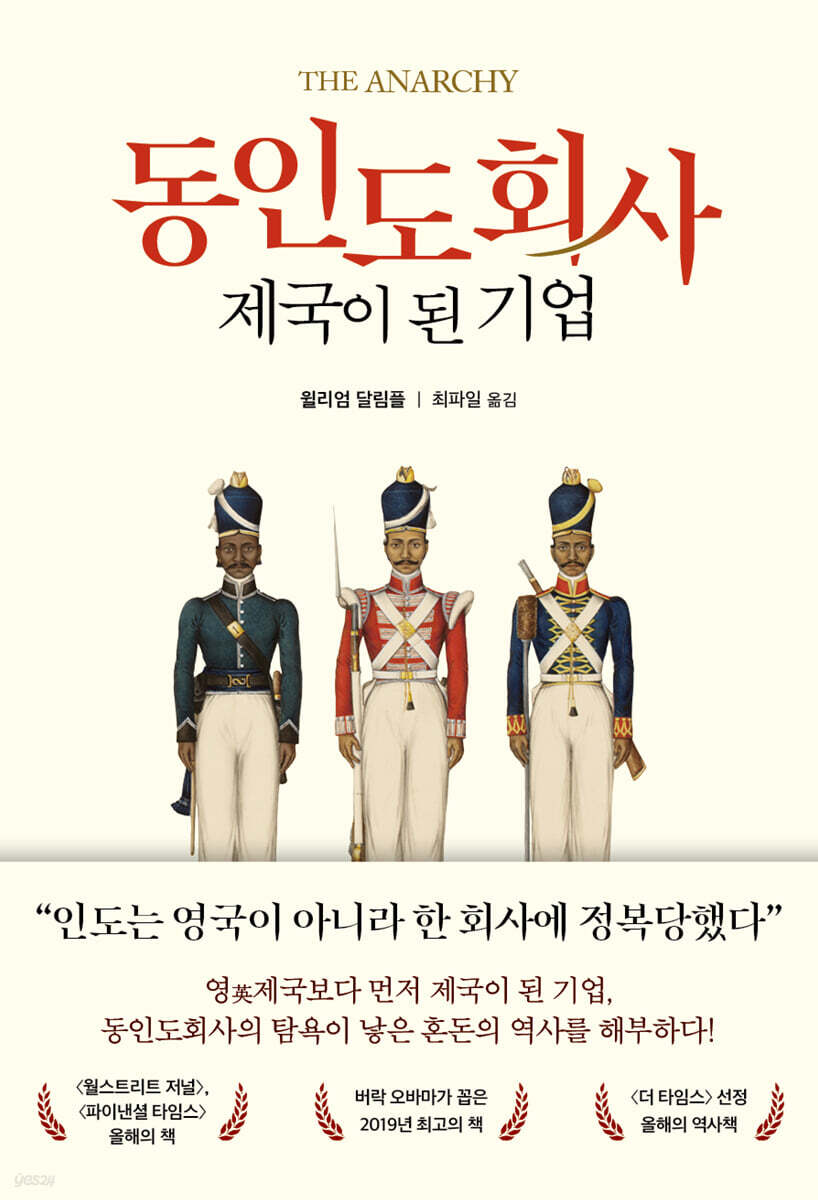
The East India Company, the company that became an empire
 |
Description
Book Introduction
Book of the Year from the Wall Street Journal and Financial Times
Barack Obama's Best Books of 2019
The East India Company, the most powerful corporation in history
A chilling lesson for the era of runaway big tech and AI.
In August 1765, the British East India Company overthrew the young Mughal emperor and installed a government of their own in his place.
And he mobilized private soldiers to collect taxes.
The establishment of this new government marked the moment when the East India Company ceased to be an ordinary corporation.
The East India Company had now become an unprecedented entity: an international corporation transformed into an aggressive colonial power.
For about a century, until the Sepoy Mutiny of 1857, he ruled most of the Indian subcontinent from a boardroom in London.
The East India Company: The Company That Became an Empire tells one of the most remarkable stories in history.
How the Mughal Empire, which dominated global trade and manufacturing, rivaled only by the Ming Dynasty, and had a population more than four times that of the contemporary Ottoman Empire, collapsed, and was replaced by a company headquartered thousands of kilometers away.
The company was accountable only to its shareholders, most of whom had never seen India, and whose interests were the primary criterion of governance.
William Dalrymple, in a vivid narrative based on extensive historical sources, depicts the rise and fall of the first multinational corporation, an empire that predated the British Empire.
Beyond the tragic encounter between India and Britain, "The East India Company: The Company That Became an Empire" is a thought-provoking work that prompts reflection on how we should view the increasingly powerful power of Big Tech.
Barack Obama's Best Books of 2019
The East India Company, the most powerful corporation in history
A chilling lesson for the era of runaway big tech and AI.
In August 1765, the British East India Company overthrew the young Mughal emperor and installed a government of their own in his place.
And he mobilized private soldiers to collect taxes.
The establishment of this new government marked the moment when the East India Company ceased to be an ordinary corporation.
The East India Company had now become an unprecedented entity: an international corporation transformed into an aggressive colonial power.
For about a century, until the Sepoy Mutiny of 1857, he ruled most of the Indian subcontinent from a boardroom in London.
The East India Company: The Company That Became an Empire tells one of the most remarkable stories in history.
How the Mughal Empire, which dominated global trade and manufacturing, rivaled only by the Ming Dynasty, and had a population more than four times that of the contemporary Ottoman Empire, collapsed, and was replaced by a company headquartered thousands of kilometers away.
The company was accountable only to its shareholders, most of whom had never seen India, and whose interests were the primary criterion of governance.
William Dalrymple, in a vivid narrative based on extensive historical sources, depicts the rise and fall of the first multinational corporation, an empire that predated the British Empire.
Beyond the tragic encounter between India and Britain, "The East India Company: The Company That Became an Empire" is a thought-provoking work that prompts reflection on how we should view the increasingly powerful power of Big Tech.
- You can preview some of the book's contents.
Preview
Detailed image

Publisher's Review
“India was conquered by a company, not by Britain.”
The company that became an empire before the British Empire,
Dissecting the chaotic history born from the greed of the East India Company!
It was not the British government that ruled India in the 18th century.
A small company, the East India Company, founded for trade purposes, seized power amid the fall of the Mughal Empire.
In 1765, the young Emperor Shah Alam bowed to the company and handed over the power to collect taxes and govern.
From this moment on, the East India Company was no longer an ordinary corporation, but an unprecedented entity, an international corporation transformed into an "aggressive colonial power."
"The East India Company: The Company That Became an Empire" vividly depicts the great turning point in history: the fall of the Mughal Empire and the rise of the East India Company.
The author of this book, William Dalrymple, is a historian who has long studied British and Indian history.
He has constructed a precise narrative that combines academic rigor with literary appeal, drawing on the vast archives of the British Library in London and the National Archives of India in New Delhi, containing thousands and tens of thousands of pages of little-known company records, as well as Persian histories produced by Mughal historians, nobles, and scribes throughout the 18th century.
Upon publication, The East India Company: The Company That Became an Empire received rave reviews from major media outlets including The Times, The Wall Street Journal, and The Guardian, and was selected as a Book of the Year. It was also a finalist for the 2019 Baillie Gifford Prize for Nonfiction and the 2020 Condill History Prize, and won the Arthur Ross Bronze Medal from the Council on Foreign Relations (CFR).
Created by the protection of the royal family, parliament and the greed of shareholders
The East India Company, an omnipotent 'empire'
On September 24, 1599, Thomas Smythe called together the wealthy merchants of the City of London to raise funds and establish a company to trade in the East.
This was because they thought they could make a lot of profit by directly trading Eastern goods (tea, spices, silk, etc.) without going through the mediation of Islamic powers.
On December 31, 1600, the "London Merchants and Presidents of the East India Trade", consisting of 218 members, received a Royal Charter from Queen Elizabeth.
This document granted them an absolute monopoly on trade between the Cape of Good Hope and the Strait of Magellan, i.e., the entire Indian and Pacific Oceans, exemption from customs duties, and even semi-sovereign privileges to govern their territory and raise armies.
In addition, the most crucial factor in the East India Company's remarkable success was the support it enjoyed from the British Parliament.
Dalrymple describes the relationship between the company and the council as “symbiotic,” which “ultimately morphed into what we might today call a public-private partnership.”
The upstarts who amassed wealth and power in the East Indies used their amassed wealth to buy parliamentary seats—infamous "corrupt constituencies," while the parliament (many of whom were shareholders in the company) used state power to support the company. (p. 30)
The East India Company began as a joint stock company open to all investors from the beginning, with the aim of expanding trade by opening up new sea routes and attracting maximum new capital (although the capital it raised was only a fraction of the amount raised by the Dutch East India Company at the same time).
The East India Company, a joint stock company, was accountable only to its shareholders, and even when the company supplanted the Mughal Empire as the power behind the throne, the primary criterion for governing India remained the interests of its shareholders.
Taxes continued to rise, and the local economy was devastated.
The great famine that killed a third of Bengal's population in 1770 was not a natural disaster, but a representative example of a man-made disaster brought about by the company's exploitative policies.
Bengal, once the wealthiest region in the empire, was hit by a severe drought that began in 1768, which resulted in a loss of about 70 percent of the usual rice harvest by February 1770 and widespread starvation.
Parents sold their children, people lived on grass and leaves from the fields, and in June, the chief minister of Durbar declared that people were eating the flesh of the dead.
Even as a severe famine killed countless people, the East India Company not only maintained taxes at the same level, but in some cases increased them by as much as 10 percent.
Even starving families had to pay taxes, and while a fifth of Bengal's population was starving, instead of offering relief, the East India Company "authorized the expenditure of 44 per cent of its annual budget of 22 million pounds on armies and fortifications, and accordingly the size of the sepoy regiments was greatly increased to a total of 26,000.
The rice they stockpiled was only to feed the sepoys of the company's army.
“Even when a fifth of Bengal’s population was starving, there could be no cuts to the military budget” (pp. 335-336).
Unlike the rule of other colonial powers, the exploitation of the East India Company, which did not even have the minimum standards for governance, still has profound consequences to this day.
The East India Company was based in Bengal and nearby Bihar, and ruled these areas longer than any other region in the subcontinent.
As a result, Bengal, once considered "the richest and most populous state in the world" during the Mughal era, has an income level below the average of other Indian states, and Bihar is at the bottom.
The East India Company, the most powerful corporation in history
A chilling lesson from the era of runaway big tech and AI.
The Mughal Empire was a vast empire that dominated world trade and manufacturing and had a population more than four times that of its contemporary Ottoman Empire.
Dalrymple vividly portrays not only the invasion of the East India Company, but also the internal power struggles, religious divisions, and the constant civil wars between the emperor and local lords that led to the Mughal Empire's downfall.
This chaos provided the perfect opportunity for a small outside spark, the East India Company, to set the vast empire ablaze.
"The East India Company: The Company That Became an Empire" vividly and chillingly portrays a nation weakened by external forces through the tragic mirror of the Mughal Empire.
Today we are witnessing the emergence of another form of corporate empire.
Big tech and AI companies exert global influence based on their vast capital, data, and technological prowess.
Big tech companies consume massive amounts of data, computing power, and natural resources, boasting market capitalizations that exceed the GDP of most countries.
These giant corporations are underregulated and have limited accountability.
“Corporate influence is particularly strong and dangerous in weak countries, where power, money, and irresponsibility are fatally intertwined, where regulation of business is inadequate or ineffective, and where the purchasing power of large corporations can surpass or even overwhelm governments with limited finances.” (p. 572)
Dalrymple warns that “the East India Company remains history’s most chilling warning about the potential abuses of corporate power today, and the insidious means by which shareholder interests can be made to appear as national interests,” and that the “corporate empires” of our world today are evolving into a form of global power that achieves its objectives through more insidious means—campaign contributions, commercial lobbying, multinational financial systems and global markets, corporate influence, and the predictive data-gathering of a new surveillance capitalism—than through the overt military conquest, occupation, or direct economic domination of the past.
“Four hundred and twenty years after its founding, the story of the East India Company is more current than ever.” (p. 574)
The company that became an empire before the British Empire,
Dissecting the chaotic history born from the greed of the East India Company!
It was not the British government that ruled India in the 18th century.
A small company, the East India Company, founded for trade purposes, seized power amid the fall of the Mughal Empire.
In 1765, the young Emperor Shah Alam bowed to the company and handed over the power to collect taxes and govern.
From this moment on, the East India Company was no longer an ordinary corporation, but an unprecedented entity, an international corporation transformed into an "aggressive colonial power."
"The East India Company: The Company That Became an Empire" vividly depicts the great turning point in history: the fall of the Mughal Empire and the rise of the East India Company.
The author of this book, William Dalrymple, is a historian who has long studied British and Indian history.
He has constructed a precise narrative that combines academic rigor with literary appeal, drawing on the vast archives of the British Library in London and the National Archives of India in New Delhi, containing thousands and tens of thousands of pages of little-known company records, as well as Persian histories produced by Mughal historians, nobles, and scribes throughout the 18th century.
Upon publication, The East India Company: The Company That Became an Empire received rave reviews from major media outlets including The Times, The Wall Street Journal, and The Guardian, and was selected as a Book of the Year. It was also a finalist for the 2019 Baillie Gifford Prize for Nonfiction and the 2020 Condill History Prize, and won the Arthur Ross Bronze Medal from the Council on Foreign Relations (CFR).
Created by the protection of the royal family, parliament and the greed of shareholders
The East India Company, an omnipotent 'empire'
On September 24, 1599, Thomas Smythe called together the wealthy merchants of the City of London to raise funds and establish a company to trade in the East.
This was because they thought they could make a lot of profit by directly trading Eastern goods (tea, spices, silk, etc.) without going through the mediation of Islamic powers.
On December 31, 1600, the "London Merchants and Presidents of the East India Trade", consisting of 218 members, received a Royal Charter from Queen Elizabeth.
This document granted them an absolute monopoly on trade between the Cape of Good Hope and the Strait of Magellan, i.e., the entire Indian and Pacific Oceans, exemption from customs duties, and even semi-sovereign privileges to govern their territory and raise armies.
In addition, the most crucial factor in the East India Company's remarkable success was the support it enjoyed from the British Parliament.
Dalrymple describes the relationship between the company and the council as “symbiotic,” which “ultimately morphed into what we might today call a public-private partnership.”
The upstarts who amassed wealth and power in the East Indies used their amassed wealth to buy parliamentary seats—infamous "corrupt constituencies," while the parliament (many of whom were shareholders in the company) used state power to support the company. (p. 30)
The East India Company began as a joint stock company open to all investors from the beginning, with the aim of expanding trade by opening up new sea routes and attracting maximum new capital (although the capital it raised was only a fraction of the amount raised by the Dutch East India Company at the same time).
The East India Company, a joint stock company, was accountable only to its shareholders, and even when the company supplanted the Mughal Empire as the power behind the throne, the primary criterion for governing India remained the interests of its shareholders.
Taxes continued to rise, and the local economy was devastated.
The great famine that killed a third of Bengal's population in 1770 was not a natural disaster, but a representative example of a man-made disaster brought about by the company's exploitative policies.
Bengal, once the wealthiest region in the empire, was hit by a severe drought that began in 1768, which resulted in a loss of about 70 percent of the usual rice harvest by February 1770 and widespread starvation.
Parents sold their children, people lived on grass and leaves from the fields, and in June, the chief minister of Durbar declared that people were eating the flesh of the dead.
Even as a severe famine killed countless people, the East India Company not only maintained taxes at the same level, but in some cases increased them by as much as 10 percent.
Even starving families had to pay taxes, and while a fifth of Bengal's population was starving, instead of offering relief, the East India Company "authorized the expenditure of 44 per cent of its annual budget of 22 million pounds on armies and fortifications, and accordingly the size of the sepoy regiments was greatly increased to a total of 26,000.
The rice they stockpiled was only to feed the sepoys of the company's army.
“Even when a fifth of Bengal’s population was starving, there could be no cuts to the military budget” (pp. 335-336).
Unlike the rule of other colonial powers, the exploitation of the East India Company, which did not even have the minimum standards for governance, still has profound consequences to this day.
The East India Company was based in Bengal and nearby Bihar, and ruled these areas longer than any other region in the subcontinent.
As a result, Bengal, once considered "the richest and most populous state in the world" during the Mughal era, has an income level below the average of other Indian states, and Bihar is at the bottom.
The East India Company, the most powerful corporation in history
A chilling lesson from the era of runaway big tech and AI.
The Mughal Empire was a vast empire that dominated world trade and manufacturing and had a population more than four times that of its contemporary Ottoman Empire.
Dalrymple vividly portrays not only the invasion of the East India Company, but also the internal power struggles, religious divisions, and the constant civil wars between the emperor and local lords that led to the Mughal Empire's downfall.
This chaos provided the perfect opportunity for a small outside spark, the East India Company, to set the vast empire ablaze.
"The East India Company: The Company That Became an Empire" vividly and chillingly portrays a nation weakened by external forces through the tragic mirror of the Mughal Empire.
Today we are witnessing the emergence of another form of corporate empire.
Big tech and AI companies exert global influence based on their vast capital, data, and technological prowess.
Big tech companies consume massive amounts of data, computing power, and natural resources, boasting market capitalizations that exceed the GDP of most countries.
These giant corporations are underregulated and have limited accountability.
“Corporate influence is particularly strong and dangerous in weak countries, where power, money, and irresponsibility are fatally intertwined, where regulation of business is inadequate or ineffective, and where the purchasing power of large corporations can surpass or even overwhelm governments with limited finances.” (p. 572)
Dalrymple warns that “the East India Company remains history’s most chilling warning about the potential abuses of corporate power today, and the insidious means by which shareholder interests can be made to appear as national interests,” and that the “corporate empires” of our world today are evolving into a form of global power that achieves its objectives through more insidious means—campaign contributions, commercial lobbying, multinational financial systems and global markets, corporate influence, and the predictive data-gathering of a new surveillance capitalism—than through the overt military conquest, occupation, or direct economic domination of the past.
“Four hundred and twenty years after its founding, the story of the East India Company is more current than ever.” (p. 574)
GOODS SPECIFICS
- Date of issue: October 10, 2025
- Page count, weight, size: 656 pages | 936g | 152*223*35mm
- ISBN13: 9791194880219
- ISBN10: 1194880215
You may also like
카테고리
korean


korean

![GQ KOREA Mark (Monthly): December [2025]](http://librairie.coreenne.fr/cdn/shop/files/8ef265dbbfbf186523ed75ba7319009d.jpg?v=1765340328&width=3840)


