

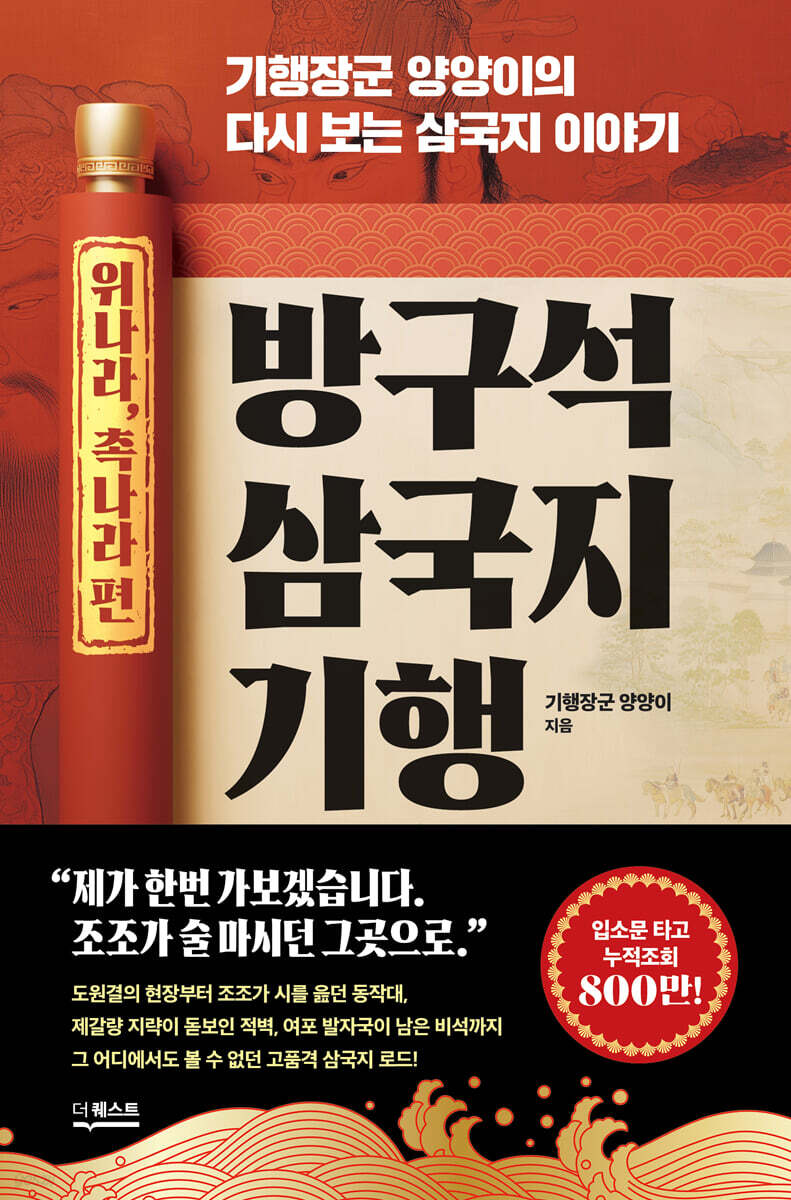
A Journey Through the Three Kingdoms (Wei and Shu)
 |
Description
Book Introduction
Liu Bei, Cao Cao, Zhuge Liang, Guan Yu…
Meet the greatest heroes and their battlefields from the comfort of your own home!
★'General Yangyangi' has accumulated 8 million views through word of mouth!
★A must-read for anyone who has ever encountered 『Romance of the Three Kingdoms』!
★“The quality of a public broadcast documentary” - rave reviews from 55,000 subscribers!
The historical travelogue, “A Corner of the Three Kingdoms: A Travelogue of the Three Kingdoms (Wei and Shu Edition),” which will immediately capture the attention of fans of “Romance of the Three Kingdoms,” has been published.
The author, who runs the YouTube channel 'Traveling General Yang Yang-i' with 55,000 subscribers, has been traveling all over China for several years, visiting and recording around 80 historical sites from the Romance of the Three Kingdoms.
『A Travelogue of the Three Kingdoms in a Corner (Wei and Shu)』 is the culmination of that journey, and goes beyond a simple travelogue or introduction to historical sites to three-dimensionally connect the narrative of 『Romance of the Three Kingdoms』 with historical sites.
In 『A Journey Through the Three Kingdoms (Wei and Shu)』, a colorful story unfolds where history, space, legend, and verification intersect, from the capital city, heroes' tombs, and battlefields to the locals' evaluations of Cao Cao, the cliff where Emperor Xian fled to avoid Li Jue, and even the legendary rock where Lu Bu's footprints remain.
This book will be a friendly guide for beginners, and an opportunity for fans of the Three Kingdoms to look at the Three Kingdoms from a new perspective.
This book, which allows readers to realistically travel through the Three Kingdoms stage from the comfort of their own home, will further enhance their historical knowledge and humanistic understanding.
Meet the greatest heroes and their battlefields from the comfort of your own home!
★'General Yangyangi' has accumulated 8 million views through word of mouth!
★A must-read for anyone who has ever encountered 『Romance of the Three Kingdoms』!
★“The quality of a public broadcast documentary” - rave reviews from 55,000 subscribers!
The historical travelogue, “A Corner of the Three Kingdoms: A Travelogue of the Three Kingdoms (Wei and Shu Edition),” which will immediately capture the attention of fans of “Romance of the Three Kingdoms,” has been published.
The author, who runs the YouTube channel 'Traveling General Yang Yang-i' with 55,000 subscribers, has been traveling all over China for several years, visiting and recording around 80 historical sites from the Romance of the Three Kingdoms.
『A Travelogue of the Three Kingdoms in a Corner (Wei and Shu)』 is the culmination of that journey, and goes beyond a simple travelogue or introduction to historical sites to three-dimensionally connect the narrative of 『Romance of the Three Kingdoms』 with historical sites.
In 『A Journey Through the Three Kingdoms (Wei and Shu)』, a colorful story unfolds where history, space, legend, and verification intersect, from the capital city, heroes' tombs, and battlefields to the locals' evaluations of Cao Cao, the cliff where Emperor Xian fled to avoid Li Jue, and even the legendary rock where Lu Bu's footprints remain.
This book will be a friendly guide for beginners, and an opportunity for fans of the Three Kingdoms to look at the Three Kingdoms from a new perspective.
This book, which allows readers to realistically travel through the Three Kingdoms stage from the comfort of their own home, will further enhance their historical knowledge and humanistic understanding.
- You can preview some of the book's contents.
Preview
index
Entering “Walking on the Stage of the Three Kingdoms”
Part 1.
The Story of Wei
Chapter 1.
Feel Cao Cao's charisma in the vast Central Plains
01.
A hero born in the homeland of his ancestors
02.
The loser's fate that began with the performance
03.
Where Cao Cao's sword was pointed, Xuzhou
Chapter 2.
Walking the land chosen by Cao Cao
01.
Emperor Xian's escape from Chang'an, a film-like story
02.
Heo-hyeon, the land that embraces the emperor
03.
A splendid past and a desolate present
04.
Lu Bu's last breath was in the sleeping Xia Fei
Chapter 3.
The Battle of Guandu, the Prelude to the Three Kingdoms Period
01.
Portrait of a Fallen Leader, Element
02.
The Battle of Baekma, which marked the beginning of the Battle of Guandu
03.
Cao Cao's strategy of choosing Guandu as the decisive battlefield
Chapter 4.
Standing in Cao Cao's Empire from Xuchang to Yecheng
01.
Upseong, the stage of legend and power
02.
Cao Cao's strategy of turning Upseong into a six-tiered fortress
03.
A splendid city reduced to ashes
04.
Dongjakdae, a symbol of Cao Cao's absolute power
Part 2.
The story of Shu
Chapter 5.
Liu Bei, dreaming of the world under a mulberry tree
01.
The Legitimacy of Shu Han as Seen in the Records of the Three Kingdoms and the Book of Shu
02.
The stage of the Peach Garden Oath, Tak Hyun
03.
Liu Bei, who gradually made a name for himself on the plains
04.
Seoju, a path of determination toward new opportunities
05.
Sopei, where Liu Bei made his base
Chapter 6.
In search of the heroes of Liu Bei and Red Cliffs
01.
Hidden in Shinya are unofficial histories intertwined with the Romance of the Three Kingdoms.
02.
The land of Zhuge Liang, the 'three-time thief'
03.
Zhao Yun's Hill, Jangbanpo
04.
The road to finding the real Red Cliff
05.
The stage of the Battle of Red Cliffs, imbued with a magnificent atmosphere
Chapter 7.
Obtaining Ikju through grace
01.
Liu Bei enters Yizhou
02.
A wary meeting between Liu Bei and Liu Zhang
03.
Liu Bei's strategy to capture Yizhou
04.
The Battle of Myeonjuk Pass and the Death of Bangtong
05.
Seongdo, the heart of the Romance of the Three Kingdoms
Chapter 8.
The Sino-Korean War: The Shu Signal Fires
01.
Cao Cao's strategy of turning Han and Zhong into "tie-ups"
02.
The city of Tango Battlefield and its equipment
03.
The Battle of Yangpyeong Pass, where the fate of Wei and Shu hangs in the balance
04.
The Battle of Dingjunshan between Huang Zhong and Xiahou Yuan
05.
The place where Liu Bei opened the gates of the Three Kingdoms
As we leave, "not to the stage of our imagination, but to the fierce scene of 100 years."
Americas
References
Part 1.
The Story of Wei
Chapter 1.
Feel Cao Cao's charisma in the vast Central Plains
01.
A hero born in the homeland of his ancestors
02.
The loser's fate that began with the performance
03.
Where Cao Cao's sword was pointed, Xuzhou
Chapter 2.
Walking the land chosen by Cao Cao
01.
Emperor Xian's escape from Chang'an, a film-like story
02.
Heo-hyeon, the land that embraces the emperor
03.
A splendid past and a desolate present
04.
Lu Bu's last breath was in the sleeping Xia Fei
Chapter 3.
The Battle of Guandu, the Prelude to the Three Kingdoms Period
01.
Portrait of a Fallen Leader, Element
02.
The Battle of Baekma, which marked the beginning of the Battle of Guandu
03.
Cao Cao's strategy of choosing Guandu as the decisive battlefield
Chapter 4.
Standing in Cao Cao's Empire from Xuchang to Yecheng
01.
Upseong, the stage of legend and power
02.
Cao Cao's strategy of turning Upseong into a six-tiered fortress
03.
A splendid city reduced to ashes
04.
Dongjakdae, a symbol of Cao Cao's absolute power
Part 2.
The story of Shu
Chapter 5.
Liu Bei, dreaming of the world under a mulberry tree
01.
The Legitimacy of Shu Han as Seen in the Records of the Three Kingdoms and the Book of Shu
02.
The stage of the Peach Garden Oath, Tak Hyun
03.
Liu Bei, who gradually made a name for himself on the plains
04.
Seoju, a path of determination toward new opportunities
05.
Sopei, where Liu Bei made his base
Chapter 6.
In search of the heroes of Liu Bei and Red Cliffs
01.
Hidden in Shinya are unofficial histories intertwined with the Romance of the Three Kingdoms.
02.
The land of Zhuge Liang, the 'three-time thief'
03.
Zhao Yun's Hill, Jangbanpo
04.
The road to finding the real Red Cliff
05.
The stage of the Battle of Red Cliffs, imbued with a magnificent atmosphere
Chapter 7.
Obtaining Ikju through grace
01.
Liu Bei enters Yizhou
02.
A wary meeting between Liu Bei and Liu Zhang
03.
Liu Bei's strategy to capture Yizhou
04.
The Battle of Myeonjuk Pass and the Death of Bangtong
05.
Seongdo, the heart of the Romance of the Three Kingdoms
Chapter 8.
The Sino-Korean War: The Shu Signal Fires
01.
Cao Cao's strategy of turning Han and Zhong into "tie-ups"
02.
The city of Tango Battlefield and its equipment
03.
The Battle of Yangpyeong Pass, where the fate of Wei and Shu hangs in the balance
04.
The Battle of Dingjunshan between Huang Zhong and Xiahou Yuan
05.
The place where Liu Bei opened the gates of the Three Kingdoms
As we leave, "not to the stage of our imagination, but to the fierce scene of 100 years."
Americas
References
Detailed image

Into the book
Cao Cao's hometown, Chu County, is now a city called Bozhou (? Province) in Anhui Province, and still remains in the same place.
Emperor Wei of Wei designated Chu County as one of the five capitals and placed great importance on it, calling it the "ancestral homeland."
Although it was once an important city, today's Parkju is a small, medium-sized city, so small that you can tour the entire city in a day.
Nevertheless, along with the Weiwu Avenue (魏武大道) that runs north to south through the city, the roads that can be seen everywhere, such as the Wendi Road (文帝路, named after Cao Pi's posthumous name) and Jian'an Road (建安路, named after the reign title of the Later Han Dynasty), and the rather imposing statue of Cao Cao erected in front of the Bozhou Train Station, you can naturally feel that this is Cao Cao's hometown as you walk along the street.
As I was slowly walking along Jian'an Road, I came across a sign that said 'Cao Cao Octagonal Platform Ruins Park'.
I couldn't just pass by after seeing Cao Cao's name, so I headed straight to the Palgakdae Ruins Park.
Although there is no clear record, the Octagonal Pavilion is said to have been built by Cao Cao to overlook Chuan.
Local residents commemorate this as a relic of Cao Cao.
However, contrary to expectations, there were no special remains other than a stone monument with the park's name inscribed on it and a three-story pavilion.
If there had been a statue of Cao Cao like at the train station, the atmosphere would have been different, but it was a bit disappointing.
--- From Chapter 1, "Feeling Cao Cao's Charisma in the Vast Central Plains"
If you were to choose the most famous city in Seoju, it would definitely be Xiamen.
In the late Han Dynasty, the Central Plains was the main stage of the Romance of the Three Kingdoms, and Xiapi was the center that gave birth to numerous historical scenes.
In particular, the story of Cao Cao and Liu Bei joining forces to defeat Lu Bu, who boasted unrivaled military power, leaves a strong impression on readers.
With the Qishui River flowing to the north and the Sasui River flowing to the south, Habi was not only a fertile land and convenient waterway, but also an area advantageous for defense using the river.
In other words, Harvey had excellent geographical and economic conditions, and served as the center of the Western Zhou both militarily and administratively.
Then, in 2014, movements to regain the lost Harvey Castle began to be detected.
The local government of Suining County in Jiangsu Province invited the archaeological team from the Nanjing Museum to begin a wide-ranging investigation to find the site of Xia Fei's castle.
At the beginning of the investigation, the specific location of the castle site was estimated to be north of Habijin and an attempt was made to focus the exploration there, but the area had already been turned into a fish farm and the site was severely damaged, making it difficult to conduct archaeological research.
The research team began a re-examination centered around this area, but finding the site in this vast area proved like finding a needle in a haystack.
--- From Chapter 2, "Walking the Land Chosen by Cao Cao"
At that time, another old woman passing by said, “There’s still a mulberry tree on the way in from the village entrance. Didn’t you see it on your way here? If you go there, there’s a monument commemorating Liu Bei.”
The moment I heard those words, my heart started pounding.
The mulberry tree I encountered in Nusan Village felt like a symbol that had preserved hundreds of years of history, rather than just a single tree.
I thanked my grandmother and hurried on.
After walking for a while, I came across a field filled with fresh, large cabbages.
I chuckled as I thought, ‘Maybe he’s growing up well thanks to the Emperor’s energy?’
As we walked a little further, a white octagonal pavilion came into view through the fields in the distance.
And next to it stood a large tombstone.
When I approached the stele and examined it closely, I saw that it was clearly engraved with the words “Han Zhao Lie Emperor Liu Bei Gu Li (漢昭烈皇帝劉備故里),” indicating that it was his hometown along with the posthumous title given to Liu Bei.
Beneath it were three bottles of baijiu lined up with the name 'Liu Beijia' written on them.
What was particularly interesting was that this liquor was made by ‘Jangbi Brewing Company.’
The name of the liquor placed in front of Liu Bei's birthplace is Liu Bei, and the place where it was made is Zhang Fei Brewing Company. Could it be more exquisite than this?
Unfortunately, Liu Bei is no longer produced, so the opportunity to sip that drink in memory of Liu Bei is gone forever.
--- From Chapter 5, “Liu Bei Dreams of the World Under the Mulberry Tree”
There was a statue of Zhou Yu standing there, as if he was commanding the Battle of Red Cliffs. Although it was just a statue, it gave off a sense of strength and spirit, and I felt that many soldiers under his command had shaken off their fears and gone out to fight in the old battlefield.
In particular, the two characters ‘Red Cliff’ engraved on the rock carvings on the banks of the Yangtze River were very overwhelming.
The huge letters, measuring 150 centimeters wide and 104 centimeters high, immediately captured the viewer's attention with their powerful and bold strokes.
According to legend, this character is said to have been written by Zhou Yu, but judging by the style of the calligraphy, it is highly likely that it was written during the Tang Dynasty.
On the other side of the cliff with the two characters 'Red Cliffs' engraved on it, you can see the Yangtze River where the Battle of Red Cliffs took place at a glance.
On a foggy day, the river flowing quietly and serenely creates a sense of tension in the viewer.
The atmosphere before the full-scale battle began, when the two armies stood facing each other with battling breath, would have been similar.
The one who broke the silence was Hwang Gae.
Zhou Yu, accepting Huang Gai's advice, filled dozens of warships with grass and straw, including Meng Zhong, poured oil into them, and covered them with curtains.
After falsely informing Cao Cao of his intention to surrender, Huang Gai sailed up the Yangtze River to Wulin, where Cao Cao's army was encamped.
--- From Chapter 6, "In Search of Liu Bei's Heroes and Red Cliffs"
I tried the dried beef at a restaurant, and was amazed by the unique flavor of dried beef combined with the tender texture.
Here, I added Zhang Fei Jingyang, a craft beer that can only be tasted in Langzhong City, and it felt like Zhang Fei's spirit was truly spreading throughout my mouth.
The view outside the restaurant was so charming that I could immediately understand why it was called 'the place where gods live.'
As I walked through the castle, I felt as if the reign of the equipment still flowed throughout the city.
But the city also holds a sad legend of having witnessed the final moments of the equipment's life.
It is said that Zhang Fei was assassinated by his subordinates, Zhang Da and Fan Gang, and that the two men fled with Zhang Fei's head and left it in Yunyang.
In the end, Zhang Fei's head was buried in Yunyang, and his body was buried separately in Langzhong. Even now, Zhang Fei's body is enshrined in the Hanhuanhou Temple in Langzhong City, and his head is enshrined in the Zhanghuanhou Temple in Yunyang County, Chongqing City.
There is a strange legend about this tomb.
According to the story, pine and cypress trees grew magnificently over the tomb, but there was one tree that had no trunk.
The local people believed that “since the tomb of the equipment has no head, the tree above the tomb has no trunk.”
It seems as if even the tree on his grave remembers his tragic fate.
Emperor Wei of Wei designated Chu County as one of the five capitals and placed great importance on it, calling it the "ancestral homeland."
Although it was once an important city, today's Parkju is a small, medium-sized city, so small that you can tour the entire city in a day.
Nevertheless, along with the Weiwu Avenue (魏武大道) that runs north to south through the city, the roads that can be seen everywhere, such as the Wendi Road (文帝路, named after Cao Pi's posthumous name) and Jian'an Road (建安路, named after the reign title of the Later Han Dynasty), and the rather imposing statue of Cao Cao erected in front of the Bozhou Train Station, you can naturally feel that this is Cao Cao's hometown as you walk along the street.
As I was slowly walking along Jian'an Road, I came across a sign that said 'Cao Cao Octagonal Platform Ruins Park'.
I couldn't just pass by after seeing Cao Cao's name, so I headed straight to the Palgakdae Ruins Park.
Although there is no clear record, the Octagonal Pavilion is said to have been built by Cao Cao to overlook Chuan.
Local residents commemorate this as a relic of Cao Cao.
However, contrary to expectations, there were no special remains other than a stone monument with the park's name inscribed on it and a three-story pavilion.
If there had been a statue of Cao Cao like at the train station, the atmosphere would have been different, but it was a bit disappointing.
--- From Chapter 1, "Feeling Cao Cao's Charisma in the Vast Central Plains"
If you were to choose the most famous city in Seoju, it would definitely be Xiamen.
In the late Han Dynasty, the Central Plains was the main stage of the Romance of the Three Kingdoms, and Xiapi was the center that gave birth to numerous historical scenes.
In particular, the story of Cao Cao and Liu Bei joining forces to defeat Lu Bu, who boasted unrivaled military power, leaves a strong impression on readers.
With the Qishui River flowing to the north and the Sasui River flowing to the south, Habi was not only a fertile land and convenient waterway, but also an area advantageous for defense using the river.
In other words, Harvey had excellent geographical and economic conditions, and served as the center of the Western Zhou both militarily and administratively.
Then, in 2014, movements to regain the lost Harvey Castle began to be detected.
The local government of Suining County in Jiangsu Province invited the archaeological team from the Nanjing Museum to begin a wide-ranging investigation to find the site of Xia Fei's castle.
At the beginning of the investigation, the specific location of the castle site was estimated to be north of Habijin and an attempt was made to focus the exploration there, but the area had already been turned into a fish farm and the site was severely damaged, making it difficult to conduct archaeological research.
The research team began a re-examination centered around this area, but finding the site in this vast area proved like finding a needle in a haystack.
--- From Chapter 2, "Walking the Land Chosen by Cao Cao"
At that time, another old woman passing by said, “There’s still a mulberry tree on the way in from the village entrance. Didn’t you see it on your way here? If you go there, there’s a monument commemorating Liu Bei.”
The moment I heard those words, my heart started pounding.
The mulberry tree I encountered in Nusan Village felt like a symbol that had preserved hundreds of years of history, rather than just a single tree.
I thanked my grandmother and hurried on.
After walking for a while, I came across a field filled with fresh, large cabbages.
I chuckled as I thought, ‘Maybe he’s growing up well thanks to the Emperor’s energy?’
As we walked a little further, a white octagonal pavilion came into view through the fields in the distance.
And next to it stood a large tombstone.
When I approached the stele and examined it closely, I saw that it was clearly engraved with the words “Han Zhao Lie Emperor Liu Bei Gu Li (漢昭烈皇帝劉備故里),” indicating that it was his hometown along with the posthumous title given to Liu Bei.
Beneath it were three bottles of baijiu lined up with the name 'Liu Beijia' written on them.
What was particularly interesting was that this liquor was made by ‘Jangbi Brewing Company.’
The name of the liquor placed in front of Liu Bei's birthplace is Liu Bei, and the place where it was made is Zhang Fei Brewing Company. Could it be more exquisite than this?
Unfortunately, Liu Bei is no longer produced, so the opportunity to sip that drink in memory of Liu Bei is gone forever.
--- From Chapter 5, “Liu Bei Dreams of the World Under the Mulberry Tree”
There was a statue of Zhou Yu standing there, as if he was commanding the Battle of Red Cliffs. Although it was just a statue, it gave off a sense of strength and spirit, and I felt that many soldiers under his command had shaken off their fears and gone out to fight in the old battlefield.
In particular, the two characters ‘Red Cliff’ engraved on the rock carvings on the banks of the Yangtze River were very overwhelming.
The huge letters, measuring 150 centimeters wide and 104 centimeters high, immediately captured the viewer's attention with their powerful and bold strokes.
According to legend, this character is said to have been written by Zhou Yu, but judging by the style of the calligraphy, it is highly likely that it was written during the Tang Dynasty.
On the other side of the cliff with the two characters 'Red Cliffs' engraved on it, you can see the Yangtze River where the Battle of Red Cliffs took place at a glance.
On a foggy day, the river flowing quietly and serenely creates a sense of tension in the viewer.
The atmosphere before the full-scale battle began, when the two armies stood facing each other with battling breath, would have been similar.
The one who broke the silence was Hwang Gae.
Zhou Yu, accepting Huang Gai's advice, filled dozens of warships with grass and straw, including Meng Zhong, poured oil into them, and covered them with curtains.
After falsely informing Cao Cao of his intention to surrender, Huang Gai sailed up the Yangtze River to Wulin, where Cao Cao's army was encamped.
--- From Chapter 6, "In Search of Liu Bei's Heroes and Red Cliffs"
I tried the dried beef at a restaurant, and was amazed by the unique flavor of dried beef combined with the tender texture.
Here, I added Zhang Fei Jingyang, a craft beer that can only be tasted in Langzhong City, and it felt like Zhang Fei's spirit was truly spreading throughout my mouth.
The view outside the restaurant was so charming that I could immediately understand why it was called 'the place where gods live.'
As I walked through the castle, I felt as if the reign of the equipment still flowed throughout the city.
But the city also holds a sad legend of having witnessed the final moments of the equipment's life.
It is said that Zhang Fei was assassinated by his subordinates, Zhang Da and Fan Gang, and that the two men fled with Zhang Fei's head and left it in Yunyang.
In the end, Zhang Fei's head was buried in Yunyang, and his body was buried separately in Langzhong. Even now, Zhang Fei's body is enshrined in the Hanhuanhou Temple in Langzhong City, and his head is enshrined in the Zhanghuanhou Temple in Yunyang County, Chongqing City.
There is a strange legend about this tomb.
According to the story, pine and cypress trees grew magnificently over the tomb, but there was one tree that had no trunk.
The local people believed that “since the tomb of the equipment has no head, the tree above the tomb has no trunk.”
It seems as if even the tree on his grave remembers his tragic fate.
--- From Chapter 8, "The Battle of Sino-Korean War, the Signal Flare of the Shu Kingdom Sounds"
Publisher's Review
A fan's affection × a specialist's knowledge × a local Chinese stage
I personally walked on the very site where 100 years of history unfolded and recorded it.
『Romance of the Three Kingdoms』 is no longer a story of imagination.
From the place where Cao Cao recited poetry, to the site of the Peach Garden Oath between Liu Bei, Guan Yu, and Zhang Fei, to the place where Zhuge Liang stayed after 'three times seeking refuge,' 『Travelogue of the Three Kingdoms in a Corner (Wei, Shu)』 is a storytelling travelogue that records the actual locations where the decisive scenes of the Three Kingdoms unfolded.
The author, known through the YouTube channel 'Traveling General Yang Yang-i', majored in history in Korea, received a master's degree in education in China, and has visited approximately 80 historical sites of the Romance of the Three Kingdoms since 2019.
As a fan of the Romance of the Three Kingdoms, he repeatedly verified the literature before his travels and compared historical data with geographical information.
With his fluent Chinese skills, he explores every nook and cranny of the countryside and uses drones to vividly convey ancient historical sites to modern readers.
『A Journey Through the Three Kingdoms: Wei and Shu』 is the definitive edition of that journey, richly illustrated with high-quality photographs, original texts carved into historical sites, and interviews with local residents.
Rather than simply transcribing YouTube videos, it adds information and the latest materials that were not previously covered, providing a value that differentiates it from YouTube content.
The moment you unfold it, the ancient battlefield comes to life before your eyes!
The story of the Three Kingdoms reborn with the commentary and insights of General Yang Yang-i.
『A Journey Through the Three Kingdoms: Wei and Shu』 provides a three-dimensional historical experience by reconstructing historical events within a spatial context rather than listing them linearly according to the flow of time.
For example, questions such as “Why did Cao Cao make Xu Xian his capital?” and “Why did Tao Qian hand over Xu Province to Liu Bei?” are answered with literary explanations and vivid descriptions of the actual locations’ topography, structure, and atmosphere.
It is also notable that the game focuses on places not seen in other content, such as the capital city, the hometowns and tombs of heroes, and battlefields.
In 『A Travelogue of the Three Kingdoms in a Corner of the Room (Wei, Shu)』, the stories of Wei and Shu are divided into two parts.
In Part 1, we will visit Cao Cao's hometown, Chu County, the site of the Western Zhou Massacre, Emperor Xian's escape route from Chang'an, and Cao Cao's cities from Xuchang to Yecheng, and reinterpret their backgrounds and meanings.
For example, in 'Standing in Cao Cao's Empire from Xuchang to Yecheng', the site of the Battle of Baekma, Dongjakdae, and the opening of the waterway are linked to explain the specific lands on which Cao Cao's political ambitions were realized.
In Part 2, the Shu Kingdom section, we visit the mulberry tree in Liu Bei's hometown, the Peach Garden Oath Temple, the areas Liu Bei ruled, and the site of the Battle of Hanzhong.
For example, in 'The Road to the Real Red Cliffs', we closely examine the actual battlefield where the Battle of Red Cliffs took place, the mouth of the Yangtze River where fierce fighting took place, and the reasons why Cao Cao's forces were inevitably defeated.
Each chapter includes background information to help even beginners understand, and QR codes linked to YouTube videos are included to make the content even more vivid.
Also included is a map showing the author's 'travel areas'.
There are also many exciting things to see, such as the legendary rock with Lu Bu's footprints, the pillar with traces of Zhao Yun's leaning, and Zhang Fei's tomb.
We also placed wild history stories told by local residents throughout the area to create a device that allows you to immerse yourself in the characters and locations of the Romance of the Three Kingdoms.
For history buffs who want to read 『Romance of the Three Kingdoms』 along with the actual locations, and for enthusiasts who want to understand 『Romance of the Three Kingdoms』 characters and battlefields more deeply, 『Travelogue of the Three Kingdoms in a Corner of the Room (Wei and Shu Edition)』 will provide a special experience like never before.
Beyond simple narratives, this book offers a wealth of information and new historical perspectives, enabling readers to further enhance their knowledge.
I personally walked on the very site where 100 years of history unfolded and recorded it.
『Romance of the Three Kingdoms』 is no longer a story of imagination.
From the place where Cao Cao recited poetry, to the site of the Peach Garden Oath between Liu Bei, Guan Yu, and Zhang Fei, to the place where Zhuge Liang stayed after 'three times seeking refuge,' 『Travelogue of the Three Kingdoms in a Corner (Wei, Shu)』 is a storytelling travelogue that records the actual locations where the decisive scenes of the Three Kingdoms unfolded.
The author, known through the YouTube channel 'Traveling General Yang Yang-i', majored in history in Korea, received a master's degree in education in China, and has visited approximately 80 historical sites of the Romance of the Three Kingdoms since 2019.
As a fan of the Romance of the Three Kingdoms, he repeatedly verified the literature before his travels and compared historical data with geographical information.
With his fluent Chinese skills, he explores every nook and cranny of the countryside and uses drones to vividly convey ancient historical sites to modern readers.
『A Journey Through the Three Kingdoms: Wei and Shu』 is the definitive edition of that journey, richly illustrated with high-quality photographs, original texts carved into historical sites, and interviews with local residents.
Rather than simply transcribing YouTube videos, it adds information and the latest materials that were not previously covered, providing a value that differentiates it from YouTube content.
The moment you unfold it, the ancient battlefield comes to life before your eyes!
The story of the Three Kingdoms reborn with the commentary and insights of General Yang Yang-i.
『A Journey Through the Three Kingdoms: Wei and Shu』 provides a three-dimensional historical experience by reconstructing historical events within a spatial context rather than listing them linearly according to the flow of time.
For example, questions such as “Why did Cao Cao make Xu Xian his capital?” and “Why did Tao Qian hand over Xu Province to Liu Bei?” are answered with literary explanations and vivid descriptions of the actual locations’ topography, structure, and atmosphere.
It is also notable that the game focuses on places not seen in other content, such as the capital city, the hometowns and tombs of heroes, and battlefields.
In 『A Travelogue of the Three Kingdoms in a Corner of the Room (Wei, Shu)』, the stories of Wei and Shu are divided into two parts.
In Part 1, we will visit Cao Cao's hometown, Chu County, the site of the Western Zhou Massacre, Emperor Xian's escape route from Chang'an, and Cao Cao's cities from Xuchang to Yecheng, and reinterpret their backgrounds and meanings.
For example, in 'Standing in Cao Cao's Empire from Xuchang to Yecheng', the site of the Battle of Baekma, Dongjakdae, and the opening of the waterway are linked to explain the specific lands on which Cao Cao's political ambitions were realized.
In Part 2, the Shu Kingdom section, we visit the mulberry tree in Liu Bei's hometown, the Peach Garden Oath Temple, the areas Liu Bei ruled, and the site of the Battle of Hanzhong.
For example, in 'The Road to the Real Red Cliffs', we closely examine the actual battlefield where the Battle of Red Cliffs took place, the mouth of the Yangtze River where fierce fighting took place, and the reasons why Cao Cao's forces were inevitably defeated.
Each chapter includes background information to help even beginners understand, and QR codes linked to YouTube videos are included to make the content even more vivid.
Also included is a map showing the author's 'travel areas'.
There are also many exciting things to see, such as the legendary rock with Lu Bu's footprints, the pillar with traces of Zhao Yun's leaning, and Zhang Fei's tomb.
We also placed wild history stories told by local residents throughout the area to create a device that allows you to immerse yourself in the characters and locations of the Romance of the Three Kingdoms.
For history buffs who want to read 『Romance of the Three Kingdoms』 along with the actual locations, and for enthusiasts who want to understand 『Romance of the Three Kingdoms』 characters and battlefields more deeply, 『Travelogue of the Three Kingdoms in a Corner of the Room (Wei and Shu Edition)』 will provide a special experience like never before.
Beyond simple narratives, this book offers a wealth of information and new historical perspectives, enabling readers to further enhance their knowledge.
GOODS SPECIFICS
- Date of issue: September 12, 2025
- Page count, weight, size: 400 pages | 692g | 147*220*24mm
- ISBN13: 9791140715596
- ISBN10: 1140715593
You may also like
카테고리
korean


korean

![GQ KOREA Mark (Monthly): December [2025]](http://librairie.coreenne.fr/cdn/shop/files/8ef265dbbfbf186523ed75ba7319009d.jpg?v=1765340328&width=3840)


