

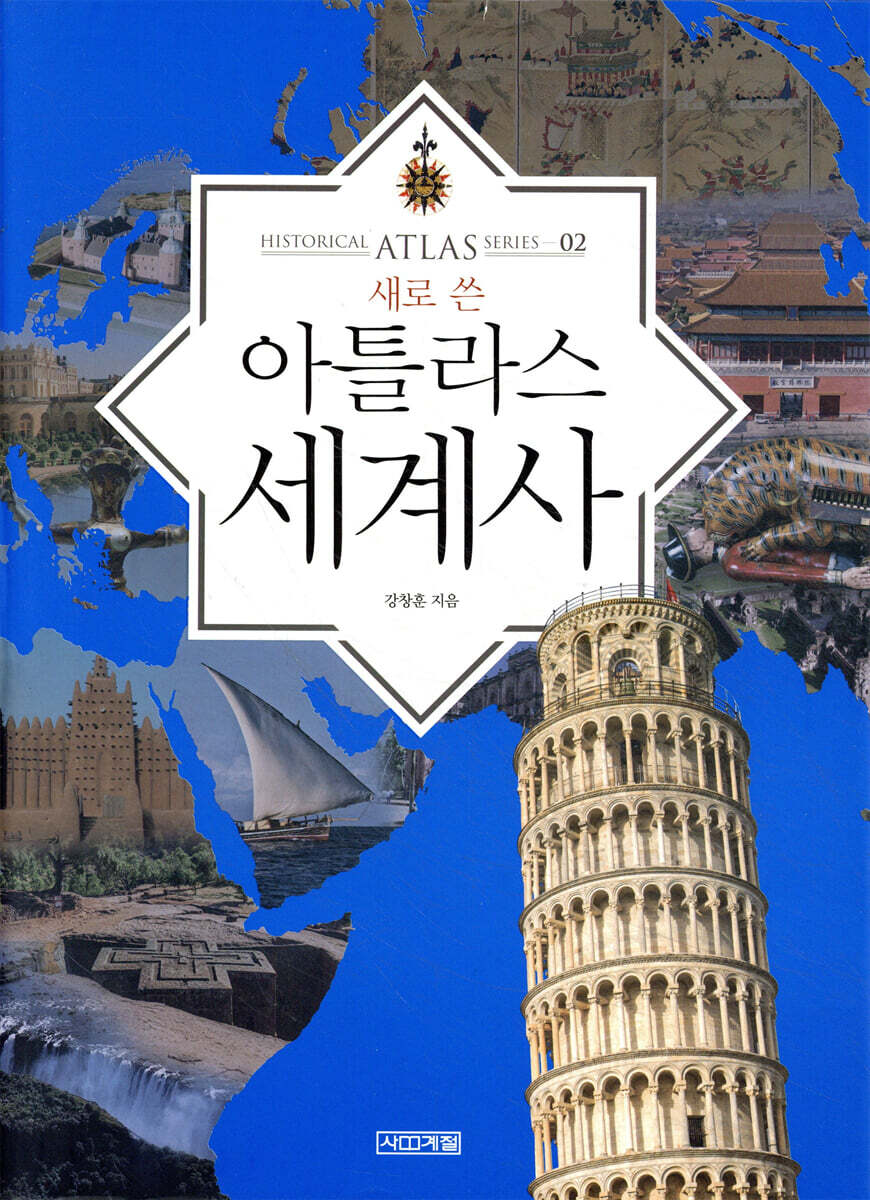
The New Atlas of World History
 |
Description
Book Introduction
“Reading history through maps makes the world look different.”
The latest definitive edition of the best-selling [Atlas History Series], with cumulative sales of 300,000 copies, has been released.
The latest edition of the [Atlas of History Series], 『A Newly Written Atlas of World History』, which brings together the latest research findings of the nation's leading historical scholars over the past 25 years and combines maps, chronology, photographs, and explanations, has been completed.
The original edition of 『Atlas of World History』, which was first published in 2004 and is the starting point of this series, is a translation of the 2001 revised 7th edition of The Times Complete History of the World, an abridged version of 『The Times History of the World』, which Times Books began publishing in 1978.
Afterwards, Sageseoul Publishing Company used this as a foundation, gathered domestic scholars, developed a production team including editors, historical map makers, and atlas history book designers, and published 『Atlas of Korean History』 (first edition 2004, fully revised edition 2022), 『Atlas of Chinese History』 (first edition 2007, revised and expanded edition 2015), 『Atlas of Japanese History』 (2011), and 『Atlas of Central Eurasia History』 (2016) in that order.
And after 20 years, we are publishing the original Korean version of 『A New Atlas World History』, which is a collection of all the Atlas history book writing, editing, and production skills we have accumulated over the years.
Let's witness the scenes of past time and space coming back to life on a map through this book that shows and tells history more neatly, meticulously, and three-dimensionally than any other book or YouTube cultural channel.
The latest definitive edition of the best-selling [Atlas History Series], with cumulative sales of 300,000 copies, has been released.
The latest edition of the [Atlas of History Series], 『A Newly Written Atlas of World History』, which brings together the latest research findings of the nation's leading historical scholars over the past 25 years and combines maps, chronology, photographs, and explanations, has been completed.
The original edition of 『Atlas of World History』, which was first published in 2004 and is the starting point of this series, is a translation of the 2001 revised 7th edition of The Times Complete History of the World, an abridged version of 『The Times History of the World』, which Times Books began publishing in 1978.
Afterwards, Sageseoul Publishing Company used this as a foundation, gathered domestic scholars, developed a production team including editors, historical map makers, and atlas history book designers, and published 『Atlas of Korean History』 (first edition 2004, fully revised edition 2022), 『Atlas of Chinese History』 (first edition 2007, revised and expanded edition 2015), 『Atlas of Japanese History』 (2011), and 『Atlas of Central Eurasia History』 (2016) in that order.
And after 20 years, we are publishing the original Korean version of 『A New Atlas World History』, which is a collection of all the Atlas history book writing, editing, and production skills we have accumulated over the years.
Let's witness the scenes of past time and space coming back to life on a map through this book that shows and tells history more neatly, meticulously, and three-dimensionally than any other book or YouTube cultural channel.
- You can preview some of the book's contents.
Preview
index
004 Entering
Part 1.
Ancient times - the formation and development of civilization
010 The spread of modern humans / 012 Ancient West Asia / 014 Ancient Egypt / 016 [Special] The birth of writing / 018 The unification of the Orient and the Persian Empire / 020 Ancient Greece and Phoenicia / 022 The Greco-Persian Wars / 024 The Empire of Alexander / 026 [Special] The origin and development of Gandhara art / 028 Early Rome, from monarchy to republic / 030 The expansion of the Roman Empire / 032 The division of the Roman Empire / 034 The spread of Christianity / 036 [Special] The spread of Christianity to Africa / 038 The unification of early China and the Qin Dynasty / 040 The development of the Qin and Han Dynasty / 042 The Scythians and the Huns / 044 The birth of the Silk Road / 046 Parthia and Sassanid Persia / 048 Empires of ancient India / 050 The spread of Buddhism / 052 Early Africa and Austronesia / 054 [Special Feature] The Ancient Greek Olympiad
Part 2.
Middle Ages - Expansion of exchange and increased diversity
058 Wei, Jin, Northern and Southern Dynasties / 060 Migration of the Germanic Peoples / 062 Frankish Kingdom / 064 Early Britain / 066 Byzantine Empire / 068 [Special Feature] Development and Discovery of Civilization in the Americas / 070 Sui and Tang Empires and Nomadic States / 072 Spread of Islamic Power / 074 [Special Feature] Spread of Islam to Africa / 076 Viking Activities / 078 Medieval Italy / 080 German Kingdom and Holy Roman Empire / 082 Medieval Iberia / 084 Migration of Slavs and Eastern European Countries / 086 Early Russia / 088 Abbasid Dynasty and Seljuk Turks / 090 Crusades / 092 [Special Feature] Jerusalem, the Holy Land of the Three Religions / 094 Song and the Khitan, Jurchen, and Tangut / 096 Hundred Years' War between England and France / 098 Development of the Ottoman Empire / 100 Medieval Africa / 102 Medieval India / 104 Mongol Empire / 106 [Special Feature] East-West Connections Seen Through Medieval Travel Books / 108 Medieval Southeast Asia
Part 3.
15th-18th centuries - Advances in science and technology and empires in the East and West
112 [Special Feature] The Development of Gunpowder Weapons and the Dissolution of Feudal Knights / 114 Portugal's Commercial Empire / 116 Spain's American Colonies / 118 The Netherlands in the 16th and 17th Centuries / 120 [Special Feature] Missionary Activities in Southeast Asia and the Discovery of American Peppers / 122 The Habsburg Empire / 124 The Reformation and the Thirty Years' War / 126 The Rise of Prussia / 128 [Special Feature] The History of Universities / 130 The Expansion of Russia / 132 The Three Scandinavian Countries / 134 France in the 17th and 18th Centuries / 136 Britain's Expansion in the 16th and 18th Centuries / 138 The Independence and Founding of the United States / 140 The French Revolutionary Wars and the Napoleonic Wars / 142 The Ottoman Empire in the 16th and 18th Centuries / 144 The Timurid Empire and the Mughal Empire / 146 The Safavid and Qajar Dynasties / 148 Ming Dynasty / 150 Qing Dynasty / 152 Japan, up to the 18th Century / 154 [Special Feature] The Birth of Swahili Civilization / 156 Africa, 15th to 18th Centuries
Part 4.
19th Century - The West's Reversal and the Shift of the Axis
160 Europe after the Vienna System / 162 [Special Feature] The Haitian Revolution / 164 Independence in Latin America / 166 Liberalism and Nationalism, the Age of Revolution / 168 [Special Feature] The Journey of Darwin and the Theory of Evolution / 170 Italian Unification / 172 German Unification / 174 Russian Expansion / 176 Decline of the Ottoman Empire / 178 The 19th Century in the Balkans / 180 American Expansion / 182 [Special Feature] The History of Railways / 184 The Partition of Africa / 186 Political Changes in South and Southeast Asia / 188 Modernity Approaching East Asia / 190 Canada and Australia / 192 [Special Feature] Exploring Antarctica, the Last Continent
Part 5.
Modernity - The Emergence of the International Society and the Transnational Community
196 The Outbreak and Development of World War I / 198 The Russian Revolution and the Changes in the Postwar World / 200 The Changing Situation in the Middle East / 202 The Situation of Interwar Europe and Colonies / 204 World War II: Europe and the Mediterranean / 206 World War II: The Asia-Pacific Region / 208 [Special Feature] The Tokyo and Nuremberg War Criminal Trials / 210 The Cold War / 212 [Special Feature] The Clash of Cutting-Edge Sciences, Lunar Exploration / 214 The Path to European Integration / 216 The Changing Situation in the Soviet Union and Eastern Europe / 218 Changes in the Balkans and the Independence of Kosovo / 220 The Middle East after 1945 / 222 The Reconstruction of Modern Africa / 224 [Special Feature] Refugees and UN Relief Activities / 226 Independence and Growth in South and Southeast Asia / 228 Modern East Asia / 230 [Special Feature] Ethnic Minorities in China / 232 The American Century and Changes in America / 234 [Special Feature] The Anthropocene and the Climate Crisis
supplement
236 References
248 Search
Part 1.
Ancient times - the formation and development of civilization
010 The spread of modern humans / 012 Ancient West Asia / 014 Ancient Egypt / 016 [Special] The birth of writing / 018 The unification of the Orient and the Persian Empire / 020 Ancient Greece and Phoenicia / 022 The Greco-Persian Wars / 024 The Empire of Alexander / 026 [Special] The origin and development of Gandhara art / 028 Early Rome, from monarchy to republic / 030 The expansion of the Roman Empire / 032 The division of the Roman Empire / 034 The spread of Christianity / 036 [Special] The spread of Christianity to Africa / 038 The unification of early China and the Qin Dynasty / 040 The development of the Qin and Han Dynasty / 042 The Scythians and the Huns / 044 The birth of the Silk Road / 046 Parthia and Sassanid Persia / 048 Empires of ancient India / 050 The spread of Buddhism / 052 Early Africa and Austronesia / 054 [Special Feature] The Ancient Greek Olympiad
Part 2.
Middle Ages - Expansion of exchange and increased diversity
058 Wei, Jin, Northern and Southern Dynasties / 060 Migration of the Germanic Peoples / 062 Frankish Kingdom / 064 Early Britain / 066 Byzantine Empire / 068 [Special Feature] Development and Discovery of Civilization in the Americas / 070 Sui and Tang Empires and Nomadic States / 072 Spread of Islamic Power / 074 [Special Feature] Spread of Islam to Africa / 076 Viking Activities / 078 Medieval Italy / 080 German Kingdom and Holy Roman Empire / 082 Medieval Iberia / 084 Migration of Slavs and Eastern European Countries / 086 Early Russia / 088 Abbasid Dynasty and Seljuk Turks / 090 Crusades / 092 [Special Feature] Jerusalem, the Holy Land of the Three Religions / 094 Song and the Khitan, Jurchen, and Tangut / 096 Hundred Years' War between England and France / 098 Development of the Ottoman Empire / 100 Medieval Africa / 102 Medieval India / 104 Mongol Empire / 106 [Special Feature] East-West Connections Seen Through Medieval Travel Books / 108 Medieval Southeast Asia
Part 3.
15th-18th centuries - Advances in science and technology and empires in the East and West
112 [Special Feature] The Development of Gunpowder Weapons and the Dissolution of Feudal Knights / 114 Portugal's Commercial Empire / 116 Spain's American Colonies / 118 The Netherlands in the 16th and 17th Centuries / 120 [Special Feature] Missionary Activities in Southeast Asia and the Discovery of American Peppers / 122 The Habsburg Empire / 124 The Reformation and the Thirty Years' War / 126 The Rise of Prussia / 128 [Special Feature] The History of Universities / 130 The Expansion of Russia / 132 The Three Scandinavian Countries / 134 France in the 17th and 18th Centuries / 136 Britain's Expansion in the 16th and 18th Centuries / 138 The Independence and Founding of the United States / 140 The French Revolutionary Wars and the Napoleonic Wars / 142 The Ottoman Empire in the 16th and 18th Centuries / 144 The Timurid Empire and the Mughal Empire / 146 The Safavid and Qajar Dynasties / 148 Ming Dynasty / 150 Qing Dynasty / 152 Japan, up to the 18th Century / 154 [Special Feature] The Birth of Swahili Civilization / 156 Africa, 15th to 18th Centuries
Part 4.
19th Century - The West's Reversal and the Shift of the Axis
160 Europe after the Vienna System / 162 [Special Feature] The Haitian Revolution / 164 Independence in Latin America / 166 Liberalism and Nationalism, the Age of Revolution / 168 [Special Feature] The Journey of Darwin and the Theory of Evolution / 170 Italian Unification / 172 German Unification / 174 Russian Expansion / 176 Decline of the Ottoman Empire / 178 The 19th Century in the Balkans / 180 American Expansion / 182 [Special Feature] The History of Railways / 184 The Partition of Africa / 186 Political Changes in South and Southeast Asia / 188 Modernity Approaching East Asia / 190 Canada and Australia / 192 [Special Feature] Exploring Antarctica, the Last Continent
Part 5.
Modernity - The Emergence of the International Society and the Transnational Community
196 The Outbreak and Development of World War I / 198 The Russian Revolution and the Changes in the Postwar World / 200 The Changing Situation in the Middle East / 202 The Situation of Interwar Europe and Colonies / 204 World War II: Europe and the Mediterranean / 206 World War II: The Asia-Pacific Region / 208 [Special Feature] The Tokyo and Nuremberg War Criminal Trials / 210 The Cold War / 212 [Special Feature] The Clash of Cutting-Edge Sciences, Lunar Exploration / 214 The Path to European Integration / 216 The Changing Situation in the Soviet Union and Eastern Europe / 218 Changes in the Balkans and the Independence of Kosovo / 220 The Middle East after 1945 / 222 The Reconstruction of Modern Africa / 224 [Special Feature] Refugees and UN Relief Activities / 226 Independence and Growth in South and Southeast Asia / 228 Modern East Asia / 230 [Special Feature] Ethnic Minorities in China / 232 The American Century and Changes in America / 234 [Special Feature] The Anthropocene and the Climate Crisis
supplement
236 References
248 Search
Detailed image

Publisher's Review
“Everyone needs to study history sometimes.”
The one book for every moment when history is needed - "Atlas of World History"
There are times in life when you need historical knowledge.
The most representative example is the exam period during school days, and there are also many things to memorize and look up when preparing for civil service exams, media exams, or promotion reviews.
Sometimes, while watching a drama or movie, we become curious about history. When a war suddenly breaks out somewhere in the world, or when martial law is suddenly declared in South Korea, we want to know the background of each incident.
"Atlas of World History," rewritten, is the first step toward studying history and an essential resource for all those moments.
“Spread the time and space of history on a map.”
A comprehensive history of world history, regional history, and national history written by Korea's top historians.
The 'Atlas History Series' is a project representing Korean history publishing that has been carried out by Sageseul Publishing for the past 25 years.
It was the first 'history book to read with maps' published at a time when there were almost no history books that featured maps as the main characters, other than the middle and high school textbook 『History Map』.
Even today, there are only a handful of researchers specializing in historical maps in academia, and research that contains intense reflections on historical geography is rare.
However, Sageseoul Publishing Company continued to publish series and develop its capabilities with the conviction that the importance of geography in history cannot be overemphasized.
Over the years, we have attempted to interpret history in a chronological order, reflecting the latest academic research findings, and have consistently developed maps that enhance information and readability.
Through this, we achieved the unique achievement of “reading history through maps” among history books that are text-based.
The five-volume series has sold a cumulative 300,000 copies, won the 57th Korean Publishing Culture Award in the editing category, and has been a long-term bestseller lent out by leading university libraries across the country, including Seoul National University, and public libraries in each region.
Towards a Masterpiece of History Read Through Maps
Become an editor and author
The author of the new book, Kang Chang-hoon, is the editor-in-chief of the Atlas History series and has distinguished himself in the field of historical maps.
Not only did he win the Korean Publication Culture Award for this series, but he also recently participated as a writer for the middle and high school textbook 『History Book』.
In addition, he has worked as an expert in almost all roles in creating history books for a long time, including writing and translating numerous history books himself.
He was the most suitable person for the important task of ‘writing a comprehensive history of the world’, and he was especially prepared for reading world history through maps.
Accordingly, Sageseoul Publishing boldly selected Kang Chang-hoon as the author of 『A Newly Written Atlas World History』, which will be the definitive and complete edition of the Atlas History Series.
Over the past two years, Kang Chang-hoon has created a masterpiece by leading every process, from selecting a new topic to diligently reviewing materials and meticulously organizing guidance.
“The existing editing method could serve as a simple historical guide for professional historians or those familiar with the flow of world history, but it was frustrating for readers who wanted to meticulously understand the explanations and follow the background and development of historical events step by step.
As the author explains, “This new book is the result of an attempt to overcome such limitations,” and through this book, which incorporates new editing techniques and thematic awareness, readers will be able to see at a glance the history of countless countries and peoples in almost every region of the world.
Features of the New Atlas of World History
① Organizing the core topics of world history in chronological order: increased from 80 in the old edition to 109
② Western history focuses on reducing Western Europe and increasing the importance of Russia, the Balkans, and Scandinavia.
③ Oriental history is presented in a compressed form from 『Atlas of Korean History』, 『Atlas of Chinese History』, 『Atlas of Japanese History』, and 『Atlas of Central Eurasian History』.
④ Explain the development of Southwest Asia, Africa, North and South America, and Oceania in connection with the major changes of each era.
⑤ Production of the largest historical map ever: increased from 150 sheets to 288 sheets
⑥ 21 [Special Features] supplement major topics and events not covered in the main text.
⑦ Summary and organization all in one: Summary chronology included for each chapter
Key Contents of the Newly Written Atlas of World History
Part 1.
Ancient times - the formation and development of civilization
Humans, who diverged from primates 7 million years ago, began migrating from Africa to other continents around 1.8 million years ago.
And about 300,000 years ago, Homo sapiens, the direct ancestors of modern humans, appeared.
The cradle of civilization, such as Mesopotamia, Egypt, India, and China, developed based on the agricultural productivity of the floodplains that formed around them.
As the Bronze Age transitioned into the Iron Age, not only did technology and culture improve, but the area of influence expanded as well.
The world became connected through the process of competition and exchange between settled and nomadic civilizations in various places.
Around the 2nd century AD, Rome in the west and Chang'an in the east were connected by land routes (the Silk Road) and sea routes (the Indian Ocean trade network), and religions such as Christianity and Buddhism, various ideologies, and goods such as silk and glass were exchanged along these routes.
Part 2.
Middle Ages - Expansion of exchange and increased diversity
Not only have regional and ethnic identities strengthened globally, but the emergence of new identities, namely religion, has further accelerated the fragmentation of the civilized world.
Each nation developed based on one or more identities and competed with neighboring nations with different identities.
In particular, two global wars that occurred during the Middle Ages triggered great changes in both the East and the West.
One of them is the Crusades, and the other is the conquests of the Mongol Empire.
In the Christian world of Europe, the religious power of the Pope and the ruling power of the Emperor or King sometimes clashed and sometimes combined, triggering social change.
Meanwhile, in India and Southeast Asia, the new religion Islam competed with the local religions Hinduism and Buddhism, and several empires and kingdoms rose and fell.
In 1453, the Ottoman Empire conquered Constantinople, creating a vast empire spanning Europe, Asia, and Africa.
Part 3.
15th-18th centuries - Advances in science and technology and empires in the East and West
By the 15th century, European powers had begun to penetrate the Indian Ocean network, which had been a hub for exchange between Arab, Oriental, and African nations.
Led by Portugal and Spain, England, the Netherlands, France, and others jumped into the search for new sources of wealth and new sea routes to trade directly with Asia.
European conquerors soon took control of most of the American continent and shipped black Africans to their plantations there.
Europe was waging a fierce religious war within itself, giving birth to a new order.
The Enlightenment of the 17th century not only led to discoveries in natural science, but also transformed religion and philosophy.
During this process, about 150 universities across Europe developed theories of religion, scholarship, and governance.
Meanwhile, the existing gold and silver standard system was threatened as large quantities of silver produced in America, Africa, and Japan flowed into Europe.
To solve this problem, a new form of financial economy emerged: banking and money.
Part 4.
19th Century - The West's Reversal and the Shift of the Axis
The fervor of liberalism and republicanism swept across Europe, and revolutions followed in each country.
The March Revolution in Germany in 1848 and the Paris Commune in France in 1871 left behind a legacy of constitutional order within a solid imperialist system.
Nationalism, which emerged from the French Revolution, gave birth to new states in the Balkans and Latin America.
In 1848, another spark of revolution began to stir when Marx and Engels published the Communist Manifesto.
Since then, communism has developed into a system that opposes imperialism and capitalism.
Meanwhile, from this period onwards, the power order between the East and the West was reversed.
European nations conquered almost all of Africa, then India and China, and Russia completed its conquest of Siberia, becoming a great power encompassing all of Eurasia.
In the American continent, the United States, founded in the late 18th century, rapidly expanded its influence and established a ruling order different from that of Europe.
In East Asia, Japan learned the governance and colonial rule methods of imperialist countries through the Meiji Restoration and was reborn as an Eastern power.
Part 5.
Modernity - The Emergence of the International Society and the Transnational Community
Countries that had experienced two world wars formed a supranational community to maintain world peace and security.
After the end of World War I, the League of Nations was formed in 1919 by the Treaty of Versailles, and was expanded into the United Nations immediately after the end of World War II.
In addition, efforts continued to promote political and economic cooperation between countries and strengthen regional solidarity.
As a result, various international organizations were created, such as the European Union, the North American Free Trade Agreement, the Association of Southeast Asian Nations, and BRICS, a group of emerging economies.
As economic interdependence expands across virtually every sector, including product markets, investment, science and technology, communications, and services, each organization is responding to globalization by lowering trade barriers between member countries and imposing high tariffs on trade with non-member countries.
At the same time, the international community is strengthening cooperation to address emerging challenges such as the Cold War, refugees, neoliberalism, and the climate crisis.
The one book for every moment when history is needed - "Atlas of World History"
There are times in life when you need historical knowledge.
The most representative example is the exam period during school days, and there are also many things to memorize and look up when preparing for civil service exams, media exams, or promotion reviews.
Sometimes, while watching a drama or movie, we become curious about history. When a war suddenly breaks out somewhere in the world, or when martial law is suddenly declared in South Korea, we want to know the background of each incident.
"Atlas of World History," rewritten, is the first step toward studying history and an essential resource for all those moments.
“Spread the time and space of history on a map.”
A comprehensive history of world history, regional history, and national history written by Korea's top historians.
The 'Atlas History Series' is a project representing Korean history publishing that has been carried out by Sageseul Publishing for the past 25 years.
It was the first 'history book to read with maps' published at a time when there were almost no history books that featured maps as the main characters, other than the middle and high school textbook 『History Map』.
Even today, there are only a handful of researchers specializing in historical maps in academia, and research that contains intense reflections on historical geography is rare.
However, Sageseoul Publishing Company continued to publish series and develop its capabilities with the conviction that the importance of geography in history cannot be overemphasized.
Over the years, we have attempted to interpret history in a chronological order, reflecting the latest academic research findings, and have consistently developed maps that enhance information and readability.
Through this, we achieved the unique achievement of “reading history through maps” among history books that are text-based.
The five-volume series has sold a cumulative 300,000 copies, won the 57th Korean Publishing Culture Award in the editing category, and has been a long-term bestseller lent out by leading university libraries across the country, including Seoul National University, and public libraries in each region.
Towards a Masterpiece of History Read Through Maps
Become an editor and author
The author of the new book, Kang Chang-hoon, is the editor-in-chief of the Atlas History series and has distinguished himself in the field of historical maps.
Not only did he win the Korean Publication Culture Award for this series, but he also recently participated as a writer for the middle and high school textbook 『History Book』.
In addition, he has worked as an expert in almost all roles in creating history books for a long time, including writing and translating numerous history books himself.
He was the most suitable person for the important task of ‘writing a comprehensive history of the world’, and he was especially prepared for reading world history through maps.
Accordingly, Sageseoul Publishing boldly selected Kang Chang-hoon as the author of 『A Newly Written Atlas World History』, which will be the definitive and complete edition of the Atlas History Series.
Over the past two years, Kang Chang-hoon has created a masterpiece by leading every process, from selecting a new topic to diligently reviewing materials and meticulously organizing guidance.
“The existing editing method could serve as a simple historical guide for professional historians or those familiar with the flow of world history, but it was frustrating for readers who wanted to meticulously understand the explanations and follow the background and development of historical events step by step.
As the author explains, “This new book is the result of an attempt to overcome such limitations,” and through this book, which incorporates new editing techniques and thematic awareness, readers will be able to see at a glance the history of countless countries and peoples in almost every region of the world.
Features of the New Atlas of World History
① Organizing the core topics of world history in chronological order: increased from 80 in the old edition to 109
② Western history focuses on reducing Western Europe and increasing the importance of Russia, the Balkans, and Scandinavia.
③ Oriental history is presented in a compressed form from 『Atlas of Korean History』, 『Atlas of Chinese History』, 『Atlas of Japanese History』, and 『Atlas of Central Eurasian History』.
④ Explain the development of Southwest Asia, Africa, North and South America, and Oceania in connection with the major changes of each era.
⑤ Production of the largest historical map ever: increased from 150 sheets to 288 sheets
⑥ 21 [Special Features] supplement major topics and events not covered in the main text.
⑦ Summary and organization all in one: Summary chronology included for each chapter
Key Contents of the Newly Written Atlas of World History
Part 1.
Ancient times - the formation and development of civilization
Humans, who diverged from primates 7 million years ago, began migrating from Africa to other continents around 1.8 million years ago.
And about 300,000 years ago, Homo sapiens, the direct ancestors of modern humans, appeared.
The cradle of civilization, such as Mesopotamia, Egypt, India, and China, developed based on the agricultural productivity of the floodplains that formed around them.
As the Bronze Age transitioned into the Iron Age, not only did technology and culture improve, but the area of influence expanded as well.
The world became connected through the process of competition and exchange between settled and nomadic civilizations in various places.
Around the 2nd century AD, Rome in the west and Chang'an in the east were connected by land routes (the Silk Road) and sea routes (the Indian Ocean trade network), and religions such as Christianity and Buddhism, various ideologies, and goods such as silk and glass were exchanged along these routes.
Part 2.
Middle Ages - Expansion of exchange and increased diversity
Not only have regional and ethnic identities strengthened globally, but the emergence of new identities, namely religion, has further accelerated the fragmentation of the civilized world.
Each nation developed based on one or more identities and competed with neighboring nations with different identities.
In particular, two global wars that occurred during the Middle Ages triggered great changes in both the East and the West.
One of them is the Crusades, and the other is the conquests of the Mongol Empire.
In the Christian world of Europe, the religious power of the Pope and the ruling power of the Emperor or King sometimes clashed and sometimes combined, triggering social change.
Meanwhile, in India and Southeast Asia, the new religion Islam competed with the local religions Hinduism and Buddhism, and several empires and kingdoms rose and fell.
In 1453, the Ottoman Empire conquered Constantinople, creating a vast empire spanning Europe, Asia, and Africa.
Part 3.
15th-18th centuries - Advances in science and technology and empires in the East and West
By the 15th century, European powers had begun to penetrate the Indian Ocean network, which had been a hub for exchange between Arab, Oriental, and African nations.
Led by Portugal and Spain, England, the Netherlands, France, and others jumped into the search for new sources of wealth and new sea routes to trade directly with Asia.
European conquerors soon took control of most of the American continent and shipped black Africans to their plantations there.
Europe was waging a fierce religious war within itself, giving birth to a new order.
The Enlightenment of the 17th century not only led to discoveries in natural science, but also transformed religion and philosophy.
During this process, about 150 universities across Europe developed theories of religion, scholarship, and governance.
Meanwhile, the existing gold and silver standard system was threatened as large quantities of silver produced in America, Africa, and Japan flowed into Europe.
To solve this problem, a new form of financial economy emerged: banking and money.
Part 4.
19th Century - The West's Reversal and the Shift of the Axis
The fervor of liberalism and republicanism swept across Europe, and revolutions followed in each country.
The March Revolution in Germany in 1848 and the Paris Commune in France in 1871 left behind a legacy of constitutional order within a solid imperialist system.
Nationalism, which emerged from the French Revolution, gave birth to new states in the Balkans and Latin America.
In 1848, another spark of revolution began to stir when Marx and Engels published the Communist Manifesto.
Since then, communism has developed into a system that opposes imperialism and capitalism.
Meanwhile, from this period onwards, the power order between the East and the West was reversed.
European nations conquered almost all of Africa, then India and China, and Russia completed its conquest of Siberia, becoming a great power encompassing all of Eurasia.
In the American continent, the United States, founded in the late 18th century, rapidly expanded its influence and established a ruling order different from that of Europe.
In East Asia, Japan learned the governance and colonial rule methods of imperialist countries through the Meiji Restoration and was reborn as an Eastern power.
Part 5.
Modernity - The Emergence of the International Society and the Transnational Community
Countries that had experienced two world wars formed a supranational community to maintain world peace and security.
After the end of World War I, the League of Nations was formed in 1919 by the Treaty of Versailles, and was expanded into the United Nations immediately after the end of World War II.
In addition, efforts continued to promote political and economic cooperation between countries and strengthen regional solidarity.
As a result, various international organizations were created, such as the European Union, the North American Free Trade Agreement, the Association of Southeast Asian Nations, and BRICS, a group of emerging economies.
As economic interdependence expands across virtually every sector, including product markets, investment, science and technology, communications, and services, each organization is responding to globalization by lowering trade barriers between member countries and imposing high tariffs on trade with non-member countries.
At the same time, the international community is strengthening cooperation to address emerging challenges such as the Cold War, refugees, neoliberalism, and the climate crisis.
GOODS SPECIFICS
- Date of issue: March 7, 2025
- Format: Hardcover book binding method guide
- Page count, weight, size: 272 pages | 1,036g | 195*267*27mm
- ISBN13: 9791169813594
- ISBN10: 1169813593
You may also like
카테고리
korean


korean

![GQ KOREA Mark (Monthly): December [2025]](http://librairie.coreenne.fr/cdn/shop/files/8ef265dbbfbf186523ed75ba7319009d.jpg?v=1765340328&width=3840)


