

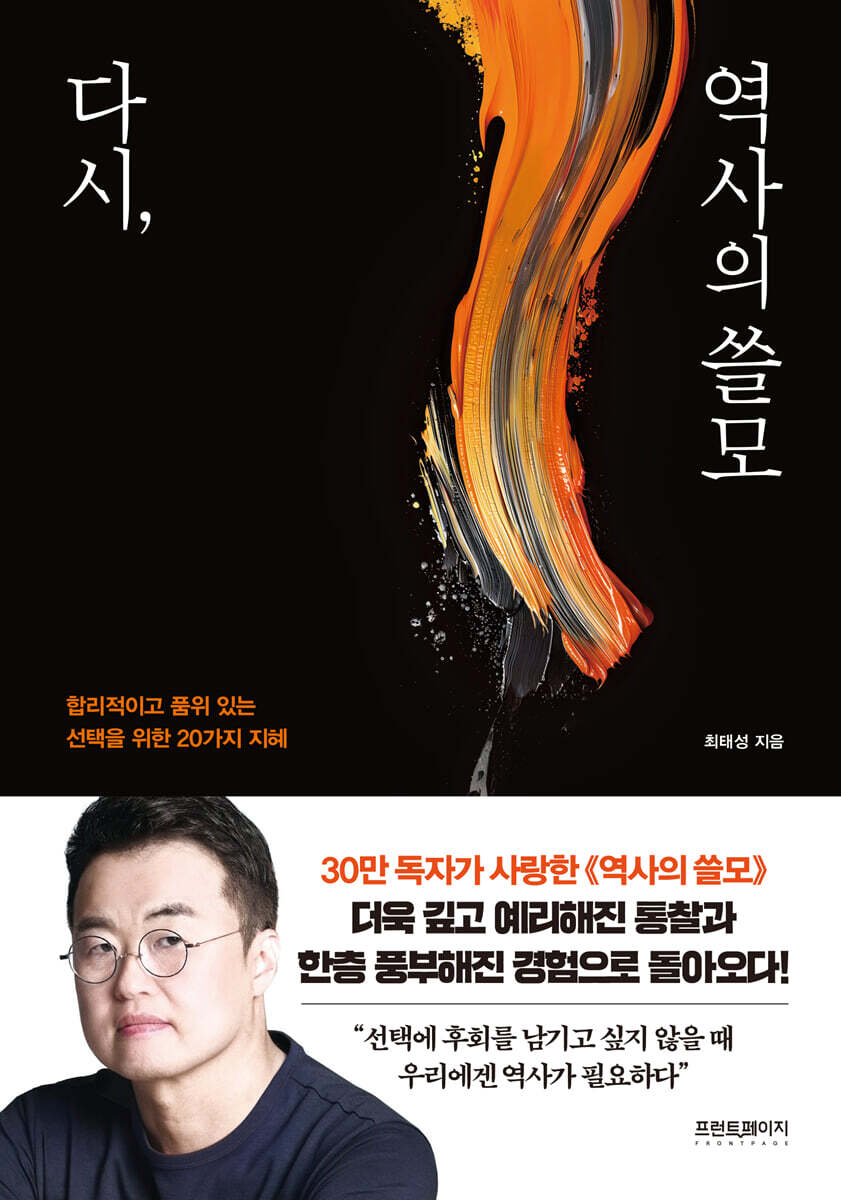
Again, the usefulness of history
 |
Description
Book Introduction
- A word from MD
-
Bringing the wisdom of history into life"We need history when we don't want to regret our choices." A new book by author Taeseong Choi, who returns with deeper insight and enriched experience.
Beyond why we should study history, it covers how to bring the wisdom of history into our lives.
The solid values that remain unchanged over time, found in history, still prove the usefulness of history.
July 26, 2024. History PD Ahn Hyun-jae
The Usefulness of History, Loved by 300,000 Readers
Return with deeper insights and a richer experience!
“When you don’t want to regret your choice
“We need history”
The Usefulness of History, which has been a bestseller in history for five consecutive years, has been selected as a ‘Youth Recommended Book’ by the National Library for Children and Young Adults, ‘Book of the Year’ by Yes24, and ‘Book of the Year’ by local governments across the country including Gyeongnam, Cheongju, and Yangju, has brought about a craze for usefulness in Korea and has returned with a new story.
The new book, "The Usefulness of History Again," is a book that contains the new usefulness of history that Choi Tae-seong, Korea's leading history communicator, has discovered over the past five years. It goes a step further than his previous work, which answered the question, "Why should we learn history?", to discuss "How to bring the wisdom of history into our lives."
As befitting the protagonist of a famous lecture that has touched the hearts of 7 million people, Choi Tae-seong displays exceptional storytelling skills, breathing life into events from hundreds of years ago and finding meaning that is still relevant today, while kindly explaining them.
Here, with a deeper, sharper perspective and a richer experience, "The Usefulness of History Again" introduces a dignified way of using history as a tool for exploring life and the world beyond knowledge, inviting readers once again into the world of the usefulness of history.
In an age where social change is faster than ever, what we desperately need is something that will set the standard of living straight.
Instead of being bombarded with information that becomes outdated after just a month or two, why not lean into the insights of history, proven over hundreds of years? For those who aspire to live without being swayed by the world and making choices without regret, "The Usefulness of History Again" captures the timeless, solid values found in history.
Anyone who still ponders the meaning of a human life will find the answer to the question, "How should we live our one life?" in this book.
Return with deeper insights and a richer experience!
“When you don’t want to regret your choice
“We need history”
The Usefulness of History, which has been a bestseller in history for five consecutive years, has been selected as a ‘Youth Recommended Book’ by the National Library for Children and Young Adults, ‘Book of the Year’ by Yes24, and ‘Book of the Year’ by local governments across the country including Gyeongnam, Cheongju, and Yangju, has brought about a craze for usefulness in Korea and has returned with a new story.
The new book, "The Usefulness of History Again," is a book that contains the new usefulness of history that Choi Tae-seong, Korea's leading history communicator, has discovered over the past five years. It goes a step further than his previous work, which answered the question, "Why should we learn history?", to discuss "How to bring the wisdom of history into our lives."
As befitting the protagonist of a famous lecture that has touched the hearts of 7 million people, Choi Tae-seong displays exceptional storytelling skills, breathing life into events from hundreds of years ago and finding meaning that is still relevant today, while kindly explaining them.
Here, with a deeper, sharper perspective and a richer experience, "The Usefulness of History Again" introduces a dignified way of using history as a tool for exploring life and the world beyond knowledge, inviting readers once again into the world of the usefulness of history.
In an age where social change is faster than ever, what we desperately need is something that will set the standard of living straight.
Instead of being bombarded with information that becomes outdated after just a month or two, why not lean into the insights of history, proven over hundreds of years? For those who aspire to live without being swayed by the world and making choices without regret, "The Usefulness of History Again" captures the timeless, solid values found in history.
Anyone who still ponders the meaning of a human life will find the answer to the question, "How should we live our one life?" in this book.
- You can preview some of the book's contents.
Preview
index
|Introduction| Finding values that remain unchanged over time
Chapter 1 | Again, Why Look for History?
The moment when an ordinary person like me becomes the protagonist of history
The power to turn coincidence into inevitability
The Meaning of Love in an Age of Each-For-All
The intellectual joy of learning the real story
Chapter 2 | Insights from History That Preserve the Dignity of Life
Kim Deuk-shin: Hard work and effort ultimately pay off.
Hyegyeonggung: Why Lady Hong Should View the World with a Kind Heart
The King of Chairs: The Winner's Dignity That Determines the Aftermath of Victory
Hwang Hyun and Choi Jae-hyung: How to Protect Your Dignity in a Chaotic World
Queen Woo: The simple truth is that I am the master of my own life.
Han Myeong-hoe and Im Sa-hong: Why Did Apgujeong's Master Han Myeong-hoe Fall?
Chapter 3 | Ancient Wisdom for Adding Sincerity to Everyday Life
A New Idea: A Change of Mind That Cracked an Impregnable Fortress
Macro Perspective: What Europe's New Sea Routes Reveal
Imagination: How far can you draw?
The Limits of Discrimination: The Injustice That Brings an Era to a Close
The flip side of success: A beautiful outcome doesn't guarantee a beautiful process.
The Goal of Education: The Education That Created Yi Wan-yong, the Education That Created Yun Dong-ju
Chapter 4 | Things I Only Realized at the End of My Journey
That there is a history worth boasting about
Why new roads are being created
A person who practiced service rather than success
The definition of happiness realized by Chusa Kim Jeong-hui in his later years
Chapter 1 | Again, Why Look for History?
The moment when an ordinary person like me becomes the protagonist of history
The power to turn coincidence into inevitability
The Meaning of Love in an Age of Each-For-All
The intellectual joy of learning the real story
Chapter 2 | Insights from History That Preserve the Dignity of Life
Kim Deuk-shin: Hard work and effort ultimately pay off.
Hyegyeonggung: Why Lady Hong Should View the World with a Kind Heart
The King of Chairs: The Winner's Dignity That Determines the Aftermath of Victory
Hwang Hyun and Choi Jae-hyung: How to Protect Your Dignity in a Chaotic World
Queen Woo: The simple truth is that I am the master of my own life.
Han Myeong-hoe and Im Sa-hong: Why Did Apgujeong's Master Han Myeong-hoe Fall?
Chapter 3 | Ancient Wisdom for Adding Sincerity to Everyday Life
A New Idea: A Change of Mind That Cracked an Impregnable Fortress
Macro Perspective: What Europe's New Sea Routes Reveal
Imagination: How far can you draw?
The Limits of Discrimination: The Injustice That Brings an Era to a Close
The flip side of success: A beautiful outcome doesn't guarantee a beautiful process.
The Goal of Education: The Education That Created Yi Wan-yong, the Education That Created Yun Dong-ju
Chapter 4 | Things I Only Realized at the End of My Journey
That there is a history worth boasting about
Why new roads are being created
A person who practiced service rather than success
The definition of happiness realized by Chusa Kim Jeong-hui in his later years
Detailed image
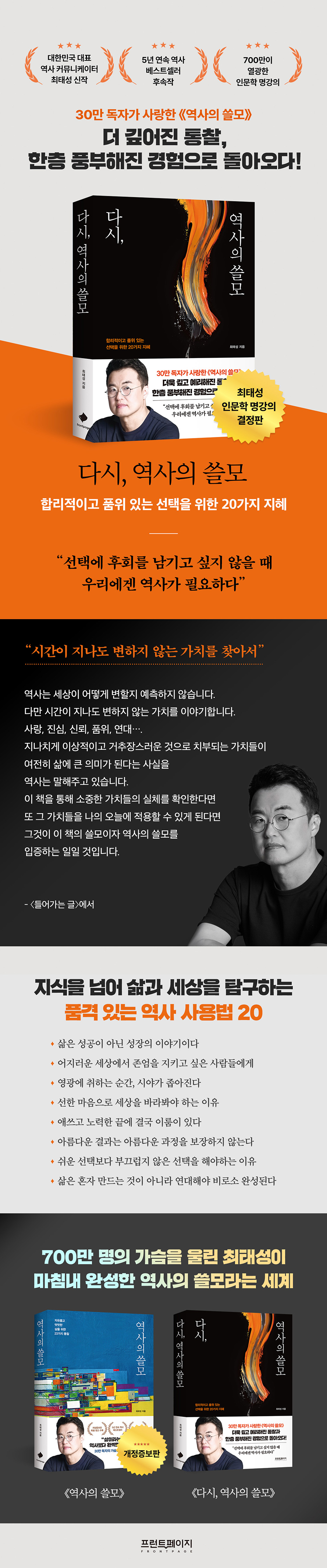
Into the book
History does not predict how the world will change.
It just talks about values that don't change over time.
Love, sincerity, trust, dignity, duty, solidarity… .
History tells us that values that are often dismissed as overly idealistic or cumbersome in modern times still hold significant meaning in our lives.
(…) If this book helps me confirm the reality of the various values I vaguely felt, and if I can apply those values to my present, then that will prove the usefulness of this book and the usefulness of history.
---From "Finding Values That Don't Change Over Time"
The world is not only influenced by great men.
Just as individual drops of water come together to form a huge wave, the healthy spirit of the times of each and every person living an ordinary life ultimately changes history.
My history comes together to become our history, and that becomes the history of humanity.
In that sense, there is no one who writes history.
It is I and our actions that will soon become history.
So, even if my existence seems small, I hope you don't forget that I too am a member and subject of history.
History is not a story that has nothing to do with me; it is my story right now.
---From "The Moment When an Ordinary Person Became the Protagonist of History"
If you only look at the phenomenon of any event, it is easy to make mistakes.
In that sense, studying history is also a task of finding necessity.
In any event, we go beyond the surface phenomena and read the background, situation, flow, and causal relationships.
So, studying history gives you a deeper perspective and insight.
You will be able to understand why what is happening now is happening and what wingbeats have come together to bring us here.
Instead of relying on chance to interpret, you gain the power to see beyond what you see.
That's why we learn history.
---From "The Power to Turn Coincidence into Inevitability"
If many people had chosen to live swept up in this turbulent world, our people would not have been able to embrace the light of hope in the darkness of the Japanese colonial period.
(…) It is easy to weigh the pros and cons.
It's not difficult to make decisions that won't harm you, decisions that are in your best interest.
Hwang Hyeon-na and Choi Jae-hyung could have made that choice too.
There's no need to sacrifice your life for a country that hasn't done anything for you.
There are people who defend pro-Japanese collaborators and traitors with this kind of thinking.
The point is, the country is in a mess, so isn't that kind of choice even possible?
To those people, I want to say this.
There were people who thought that just because the country was in a mess, they shouldn't be in a mess too.
Using the country as an excuse to live a life of shame is not a smart thing to do, it is self-destructive.
---From "Hwang Hyeon and Choi Jae-hyung: How to Protect My Dignity in a Dizzying World"
Despite leading an army of 100,000 men, Mehmet II almost missed victory.
But instead of giving up in the face of adversity, he pondered.
And I found change.
I figured out a way to do it that people don't do.
What were the results? The change worked.
No matter how you look at history, the road to a goal is not smooth.
But when I look at people who have achieved their goals, I see that even in seemingly dead-end situations where there seems to be no other way out, they did their best to seek change and find solutions through that change.
So, how about we give it another try? If we think about it long enough, we might come up with a clever way to send the ship into the mountains.
---From "New Ideas: The Change in Thinking That Cracked Down an Impregnable Fortress"
The history of the military coup sends us a kind of signal.
It tells us that discrimination and injustice have the explosive power to bring down an era.
The contempt for the gods was not an individual aberration.
The discrimination and unfair system that were taken for granted eventually became the trigger for the military coup, which resulted in the tragedy of terrible purges and massacres.
(…) Of course, a society that is fair to everyone may be an ideal.
However, I hope you don't live with the idea that an unfair society is the default in the world.
Because a tilted world will eventually collapse under its weight.
---From "The Limits of Discrimination: The Injustice That Brings an Era to a Close"
The cases of Yukyoung Park and Myeongdong School provide food for thought about the current state of education in our country.
Are we nurturing Yi Wan-yong or Yun Dong-ju? Yi Wan-yong, who studied for his own success, grew into an elite willing to side with any country, even betraying his own country, if it meant achieving success.
I would do anything to become rich.
I didn't have a philosophy about how to become rich, my goal was just to become rich.
---From "The Goal of Education: The Education That Created Yi Wan-yong, the Education That Created Yun Dong-ju"
As I am still living life, I still ask myself how to live properly and what a happy life is.
(…) So what I found again was history.
All the figures in history are our seniors in life.
Looking at the trajectory of that life, I refer to it and think, 'I should live like this' or 'I shouldn't live like this.'
Of course, doing so doesn't mean we can live the same life as them.
But there's a huge difference between knowing what kind of life I want and not knowing.
I find comfort in looking at the lives of those who have gone before.
The answers found by those who have seriously pondered life-threatening issues are contained in their lives.
Every time that happens, it feels like a tree appears that I can lean on.
So, studying history makes you a little less shaken and a little more solid.
It just talks about values that don't change over time.
Love, sincerity, trust, dignity, duty, solidarity… .
History tells us that values that are often dismissed as overly idealistic or cumbersome in modern times still hold significant meaning in our lives.
(…) If this book helps me confirm the reality of the various values I vaguely felt, and if I can apply those values to my present, then that will prove the usefulness of this book and the usefulness of history.
---From "Finding Values That Don't Change Over Time"
The world is not only influenced by great men.
Just as individual drops of water come together to form a huge wave, the healthy spirit of the times of each and every person living an ordinary life ultimately changes history.
My history comes together to become our history, and that becomes the history of humanity.
In that sense, there is no one who writes history.
It is I and our actions that will soon become history.
So, even if my existence seems small, I hope you don't forget that I too am a member and subject of history.
History is not a story that has nothing to do with me; it is my story right now.
---From "The Moment When an Ordinary Person Became the Protagonist of History"
If you only look at the phenomenon of any event, it is easy to make mistakes.
In that sense, studying history is also a task of finding necessity.
In any event, we go beyond the surface phenomena and read the background, situation, flow, and causal relationships.
So, studying history gives you a deeper perspective and insight.
You will be able to understand why what is happening now is happening and what wingbeats have come together to bring us here.
Instead of relying on chance to interpret, you gain the power to see beyond what you see.
That's why we learn history.
---From "The Power to Turn Coincidence into Inevitability"
If many people had chosen to live swept up in this turbulent world, our people would not have been able to embrace the light of hope in the darkness of the Japanese colonial period.
(…) It is easy to weigh the pros and cons.
It's not difficult to make decisions that won't harm you, decisions that are in your best interest.
Hwang Hyeon-na and Choi Jae-hyung could have made that choice too.
There's no need to sacrifice your life for a country that hasn't done anything for you.
There are people who defend pro-Japanese collaborators and traitors with this kind of thinking.
The point is, the country is in a mess, so isn't that kind of choice even possible?
To those people, I want to say this.
There were people who thought that just because the country was in a mess, they shouldn't be in a mess too.
Using the country as an excuse to live a life of shame is not a smart thing to do, it is self-destructive.
---From "Hwang Hyeon and Choi Jae-hyung: How to Protect My Dignity in a Dizzying World"
Despite leading an army of 100,000 men, Mehmet II almost missed victory.
But instead of giving up in the face of adversity, he pondered.
And I found change.
I figured out a way to do it that people don't do.
What were the results? The change worked.
No matter how you look at history, the road to a goal is not smooth.
But when I look at people who have achieved their goals, I see that even in seemingly dead-end situations where there seems to be no other way out, they did their best to seek change and find solutions through that change.
So, how about we give it another try? If we think about it long enough, we might come up with a clever way to send the ship into the mountains.
---From "New Ideas: The Change in Thinking That Cracked Down an Impregnable Fortress"
The history of the military coup sends us a kind of signal.
It tells us that discrimination and injustice have the explosive power to bring down an era.
The contempt for the gods was not an individual aberration.
The discrimination and unfair system that were taken for granted eventually became the trigger for the military coup, which resulted in the tragedy of terrible purges and massacres.
(…) Of course, a society that is fair to everyone may be an ideal.
However, I hope you don't live with the idea that an unfair society is the default in the world.
Because a tilted world will eventually collapse under its weight.
---From "The Limits of Discrimination: The Injustice That Brings an Era to a Close"
The cases of Yukyoung Park and Myeongdong School provide food for thought about the current state of education in our country.
Are we nurturing Yi Wan-yong or Yun Dong-ju? Yi Wan-yong, who studied for his own success, grew into an elite willing to side with any country, even betraying his own country, if it meant achieving success.
I would do anything to become rich.
I didn't have a philosophy about how to become rich, my goal was just to become rich.
---From "The Goal of Education: The Education That Created Yi Wan-yong, the Education That Created Yun Dong-ju"
As I am still living life, I still ask myself how to live properly and what a happy life is.
(…) So what I found again was history.
All the figures in history are our seniors in life.
Looking at the trajectory of that life, I refer to it and think, 'I should live like this' or 'I shouldn't live like this.'
Of course, doing so doesn't mean we can live the same life as them.
But there's a huge difference between knowing what kind of life I want and not knowing.
I find comfort in looking at the lives of those who have gone before.
The answers found by those who have seriously pondered life-threatening issues are contained in their lives.
Every time that happens, it feels like a tree appears that I can lean on.
So, studying history makes you a little less shaken and a little more solid.
---From "The Definition of Happiness Realized by Chusa Kim Jeong-hui in His Later Years"
Publisher's Review
Choi Tae-seong, who touched the hearts of 7 million people
The world of useful history has finally been completed!
The second story, "The Usefulness of History Again," has been published!
Difficult and complex historical events become more interesting than dramas when explained with his explanations, and stories of people who lived long ago become moving and wise when told through his mouth.
A person who makes you shed tears while listening to a history lecture, and more than anything, a person who says that whenever he gets lost and wanders, he finds the answer in history.
Choi Tae-seong, Korea's leading history communicator, has returned with the 'Usefulness of History' series.
Published in 2019, “The Usefulness of History” has sold nearly 300,000 copies to date and has been loved by many readers.
This book, which transformed history, which had been called a synonym for useless study, into "the most complete commentary on the question of life," changed the perspective on history by making it practical to look at history, and captivated readers with vivid stories that made them feel like they were listening to a lecture in person, and was mentioned as a life book by tens of thousands of people.
Readers who were not satisfied with one volume have been asking for more useful information about history, and in response, author Choi Tae-seong has once again collected historical stories that can help solve life's worries over the past five years.
As a result, the sequel that everyone had been eagerly awaiting, “The Usefulness of History Again,” was born.
From deep and sharp insights and enriched experiences
Exploring life and the world beyond knowledge
How to Use History with Dignity
《Again, the Usefulness of History》, like its predecessor 《The Usefulness of History》, is a book that answers why history is necessary in our lives.
However, while the previous work focused on finding out how practical history is as an academic discipline, "The Usefulness of History Again" focuses on examining a healthy perspective on the present through history.
The fun and emotion that made many readers laugh and cry remains, but the insights have become deeper and sharper, and the experiences have become richer.
Now is the time to experience the usefulness of a new, upgraded history.
For author Choi Tae-seong, history is not a subject to be memorized, but rather a ‘humanities that allows one to meet people.’
So, in this book, “The Usefulness of History Again,” I also introduced a person who can stimulate and inspire readers.
The difference from the previous work is that these characters present a standard for looking beyond individual lives to society and the world in a correct way.
But that doesn't mean you have to be afraid.
As befitting Korea's leading historical communicator, Choi Tae-seong freely weaves the stories of historical figures into the concerns of modern people and the problems of modern society, creating a compelling narrative.
Through the story of Maecheon Hwang Hyeon, who made the choice to uphold his conscience as a Joseon scholar after his country was taken over by Japan, it makes us think about how to live while maintaining our dignity in a chaotic world. By comparing the educational goals of the schools attended by Yi Wan-yong and Yun Dong-ju, it makes us think together about the direction that our country's education should take. By examining the process of the fall of the Berlin Wall, which is said to have fallen due to a slip of the tongue by a politician, it makes us realize the power of the spirit of the times that ordinary people have in common.
Even if it's little-known Korean history or unfamiliar world history, exploring here and there under his friendly guidance will provide an amazing experience of understanding our daily lives and society today through stories from hundreds of years ago.
Discover a dignified way to use history to explore life and the world beyond knowledge through 20 stories packed with historical knowledge, humanistic insights, and practical life advice.
20 Tips for Making Rational and Dignified Choices
“One life, how to live it”
My answer is this book"
Independence activist Ahn Chang-ho has an unusual history.
It was about running a job placement agency in California, USA, a state famous for orange cultivation.
When Korean immigrant workers had difficulty finding jobs, Ahn Chang-ho negotiated directly with farm owners to find them jobs.
And he worked hard with them and said this.
“Even if we pick just one orange, let’s pick it carefully.” He believed that if we pick oranges carefully, fewer will fall, and if fewer fall, trust in Koreans will build, making it easier to find jobs, and when Korea appeals for independence someday, Americans will support it.
For Ahn Chang-ho, even picking oranges was an act of service to the country if done with sincerity.
Introducing this anecdote, the author says:
The more I study history, the more I realize that life isn't created through one's own efforts alone.
Because history tells us that there are people who have sacrificed their lives and fortunes to create this era.
So, paradoxically, he says, he makes an effort to spend his days to the fullest.
Because the attempts to spend each day with sincerity will come together to change the world and change history.
To add meaning to everyday life, "The Usefulness of History Again" reminds us of precious values whose usefulness has been proven throughout history.
And love, sincerity, trust, dignity, duty, solidarity… these values, which have faded in modern times, prove that they still hold great significance in our lives.
Despite experiencing the tragedy of his father's death, King Jeongjo was able to become a good king instead of a tyrant like King Yeonsangun because of his mother's teachings to look at the world with a good heart.
Joseon scholar Kim Deuk-sin was so dull that he couldn't remember the first line of a book even after reading it 100,000 times. However, through hard work and effort, he eventually left his name in history.
History tells us that even if it seems like we're losing out a little, we can ultimately encounter great results when we follow the path of basics and moderation.
In a world where countless values clash and each offers different answers, the weight of choice only grows heavier.
What should be our criteria for making choices in times like these? For those of you who want to avoid regretting your choices, for those of you who dream of a better tomorrow than today, we've compiled hundreds of years of wisdom and wisdom into "The Usefulness of History Again."
Through this book, readers will find realistic and correct criteria for making rational and dignified choices.
The world of useful history has finally been completed!
The second story, "The Usefulness of History Again," has been published!
Difficult and complex historical events become more interesting than dramas when explained with his explanations, and stories of people who lived long ago become moving and wise when told through his mouth.
A person who makes you shed tears while listening to a history lecture, and more than anything, a person who says that whenever he gets lost and wanders, he finds the answer in history.
Choi Tae-seong, Korea's leading history communicator, has returned with the 'Usefulness of History' series.
Published in 2019, “The Usefulness of History” has sold nearly 300,000 copies to date and has been loved by many readers.
This book, which transformed history, which had been called a synonym for useless study, into "the most complete commentary on the question of life," changed the perspective on history by making it practical to look at history, and captivated readers with vivid stories that made them feel like they were listening to a lecture in person, and was mentioned as a life book by tens of thousands of people.
Readers who were not satisfied with one volume have been asking for more useful information about history, and in response, author Choi Tae-seong has once again collected historical stories that can help solve life's worries over the past five years.
As a result, the sequel that everyone had been eagerly awaiting, “The Usefulness of History Again,” was born.
From deep and sharp insights and enriched experiences
Exploring life and the world beyond knowledge
How to Use History with Dignity
《Again, the Usefulness of History》, like its predecessor 《The Usefulness of History》, is a book that answers why history is necessary in our lives.
However, while the previous work focused on finding out how practical history is as an academic discipline, "The Usefulness of History Again" focuses on examining a healthy perspective on the present through history.
The fun and emotion that made many readers laugh and cry remains, but the insights have become deeper and sharper, and the experiences have become richer.
Now is the time to experience the usefulness of a new, upgraded history.
For author Choi Tae-seong, history is not a subject to be memorized, but rather a ‘humanities that allows one to meet people.’
So, in this book, “The Usefulness of History Again,” I also introduced a person who can stimulate and inspire readers.
The difference from the previous work is that these characters present a standard for looking beyond individual lives to society and the world in a correct way.
But that doesn't mean you have to be afraid.
As befitting Korea's leading historical communicator, Choi Tae-seong freely weaves the stories of historical figures into the concerns of modern people and the problems of modern society, creating a compelling narrative.
Through the story of Maecheon Hwang Hyeon, who made the choice to uphold his conscience as a Joseon scholar after his country was taken over by Japan, it makes us think about how to live while maintaining our dignity in a chaotic world. By comparing the educational goals of the schools attended by Yi Wan-yong and Yun Dong-ju, it makes us think together about the direction that our country's education should take. By examining the process of the fall of the Berlin Wall, which is said to have fallen due to a slip of the tongue by a politician, it makes us realize the power of the spirit of the times that ordinary people have in common.
Even if it's little-known Korean history or unfamiliar world history, exploring here and there under his friendly guidance will provide an amazing experience of understanding our daily lives and society today through stories from hundreds of years ago.
Discover a dignified way to use history to explore life and the world beyond knowledge through 20 stories packed with historical knowledge, humanistic insights, and practical life advice.
20 Tips for Making Rational and Dignified Choices
“One life, how to live it”
My answer is this book"
Independence activist Ahn Chang-ho has an unusual history.
It was about running a job placement agency in California, USA, a state famous for orange cultivation.
When Korean immigrant workers had difficulty finding jobs, Ahn Chang-ho negotiated directly with farm owners to find them jobs.
And he worked hard with them and said this.
“Even if we pick just one orange, let’s pick it carefully.” He believed that if we pick oranges carefully, fewer will fall, and if fewer fall, trust in Koreans will build, making it easier to find jobs, and when Korea appeals for independence someday, Americans will support it.
For Ahn Chang-ho, even picking oranges was an act of service to the country if done with sincerity.
Introducing this anecdote, the author says:
The more I study history, the more I realize that life isn't created through one's own efforts alone.
Because history tells us that there are people who have sacrificed their lives and fortunes to create this era.
So, paradoxically, he says, he makes an effort to spend his days to the fullest.
Because the attempts to spend each day with sincerity will come together to change the world and change history.
To add meaning to everyday life, "The Usefulness of History Again" reminds us of precious values whose usefulness has been proven throughout history.
And love, sincerity, trust, dignity, duty, solidarity… these values, which have faded in modern times, prove that they still hold great significance in our lives.
Despite experiencing the tragedy of his father's death, King Jeongjo was able to become a good king instead of a tyrant like King Yeonsangun because of his mother's teachings to look at the world with a good heart.
Joseon scholar Kim Deuk-sin was so dull that he couldn't remember the first line of a book even after reading it 100,000 times. However, through hard work and effort, he eventually left his name in history.
History tells us that even if it seems like we're losing out a little, we can ultimately encounter great results when we follow the path of basics and moderation.
In a world where countless values clash and each offers different answers, the weight of choice only grows heavier.
What should be our criteria for making choices in times like these? For those of you who want to avoid regretting your choices, for those of you who dream of a better tomorrow than today, we've compiled hundreds of years of wisdom and wisdom into "The Usefulness of History Again."
Through this book, readers will find realistic and correct criteria for making rational and dignified choices.
GOODS SPECIFICS
- Date of issue: July 29, 2024
- Page count, weight, size: 280 pages | 516g | 145*210*21mm
- ISBN13: 9791193401217
- ISBN10: 1193401216
You may also like
카테고리
korean


korean

![GQ KOREA Mark (Monthly): December [2025]](http://librairie.coreenne.fr/cdn/shop/files/8ef265dbbfbf186523ed75ba7319009d.jpg?v=1765340328&width=3840)


