

Seasonal Happiness (Four Seasons Limited Edition)
 |
Description
Book Introduction
- A word from MD
-
Best wishes at the most opportune timeAn essay by writer Kim Shin-ji, who writes to remember.
We tell the story of 'seasonal happiness', the small joys that can be felt at this moment.
Let's face the happiness right before our eyes by aligning the year with the 24 solar terms.
And let's increase the moments of happiness one by one.
Happiness will remain with us just by not missing the seasonal sights.
April 30, 2024. Essay PD Lee Ju-eun
Kim Shin-ji's bestselling essay, "Seasonal Happiness"
'Four Seasons Limited Edition' published
Limited edition recover commemorating the publication of the daily calendar "Today's Seasonal Happiness"
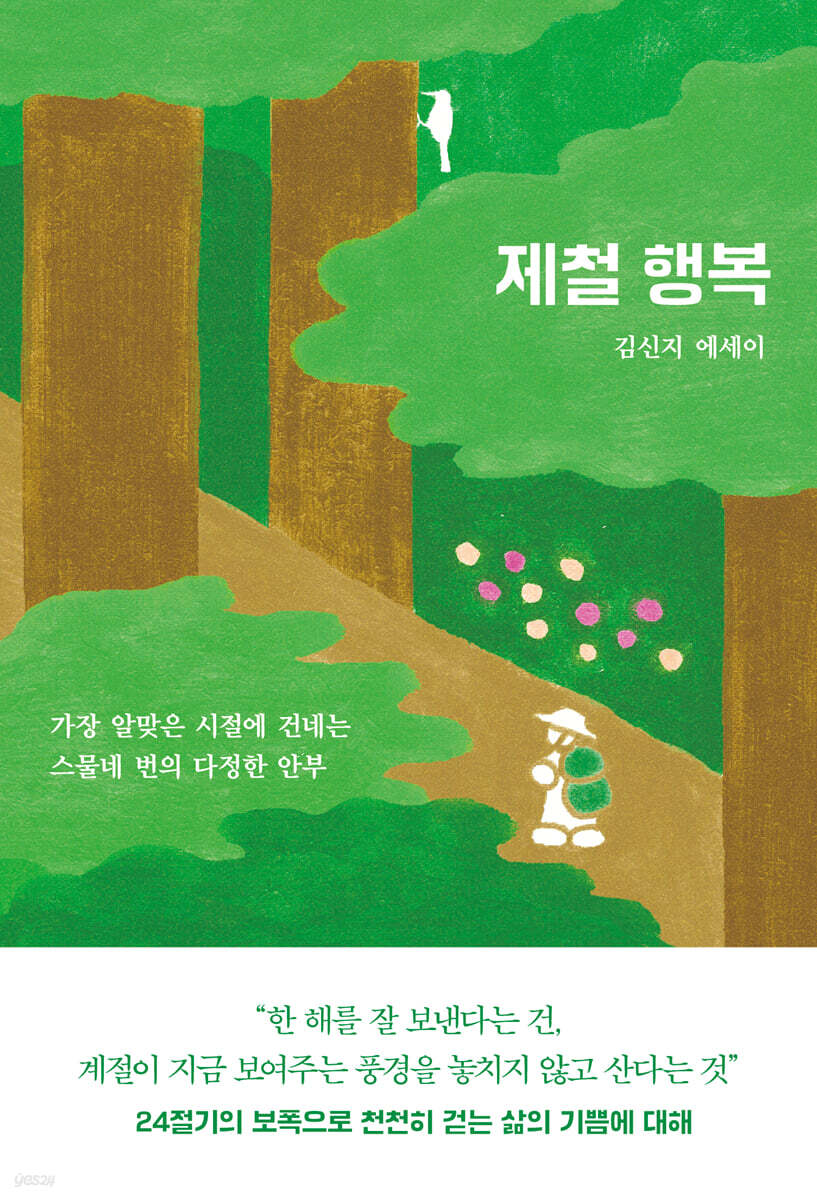
Kim Shin-ji's essay "Seasonal Happiness," which tells us about a life of walking in step with the seasons and finding happiness, has been reissued as a special limited edition.
The 'Four Seasons Limited Edition' is a frame of spring, summer, fall, and winter scenery drawn by illustrator and cook, like a sweet postcard.
《Seasonal Happiness》, which has consistently maintained its position on the bestseller list since its publication in the spring of 2024, is a book that has become a reliable companion for readers who walk through the year at the pace of the 24 solar terms.
A year spent practicing the "seasonal homework" introduced by author Kim Shin-ji, such as a walk in the flower rain around Cheongmyeong, a festival around Mangjong filled with the romance of summer nights, a satisfying dish made with summer potatoes, and a "kimchi stew talk" shared on the longest night, gave us special joy and memories.
After that, we go around the seasons and present a limited edition of the re-cover along with the publication of the daily calendar “Today’s Seasonal Happiness.”
It will be a sweet gift to those preparing for a new year, following the promise of the year that will give them the opportunity to be happy with each returning season.
'Four Seasons Limited Edition' published
Limited edition recover commemorating the publication of the daily calendar "Today's Seasonal Happiness"
Kim Shin-ji's essay "Seasonal Happiness," which tells us about a life of walking in step with the seasons and finding happiness, has been reissued as a special limited edition.
The 'Four Seasons Limited Edition' is a frame of spring, summer, fall, and winter scenery drawn by illustrator and cook, like a sweet postcard.
《Seasonal Happiness》, which has consistently maintained its position on the bestseller list since its publication in the spring of 2024, is a book that has become a reliable companion for readers who walk through the year at the pace of the 24 solar terms.
A year spent practicing the "seasonal homework" introduced by author Kim Shin-ji, such as a walk in the flower rain around Cheongmyeong, a festival around Mangjong filled with the romance of summer nights, a satisfying dish made with summer potatoes, and a "kimchi stew talk" shared on the longest night, gave us special joy and memories.
After that, we go around the seasons and present a limited edition of the re-cover along with the publication of the daily calendar “Today’s Seasonal Happiness.”
It will be a sweet gift to those preparing for a new year, following the promise of the year that will give them the opportunity to be happy with each returning season.
- You can preview some of the book's contents.
Preview
index
As you enter, you may have your own annual event.
Part 1: Spring, the season of waking up to spring rain
As spring comes without fail, there is hope
- On the first day of spring, pure hope is in season.
Excellent, it was always spring, when we met
- Early spring vegetables are in season in Usu.
Has Keongchip arrived? It's time to answer nature's question.
- The season for stretching to welcome spring is Gyeongchip.
A note of spring hidden at the tip of a branch in the vernal bush
- The spring equinox is the season for 'Finding Spring' walks.
If you miss Qingming now, you'll have to wait a year.
- Flowers are in season on Qingming
When I look at the spring mountains in Gokwoo, there is someone I think of.
- In the Gokwoo period, spring mountains and wild chives are in season.
Part 2 Summer, the season of growing in the sun
This white snow falling in May
- In the beginning of summer, ‘Ipha White Flower’ is in season.
It's always good if you give the cow first
- In Soman, fresh greetings are in season
Things to do before the Mangjong rainy season arrives
- In Mangjong, whatever you do, the outside is the best season
The sun never sets and we never tire
- In Hajien, beer is in season with sweet potatoes.
Is there a place you want to run to when it rains?
- In Soseoen, 'Bimyeong' is in season
Eight Ways to Cool Off in the Summer Heat
- In the Great West, the posture of rest is the best
Part 3: Autumn, the season of ripening dew
What happened when I helped a baby swallow one day in the fall?
- The best time to enjoy cloud viewing and swallow observation is during the beginning of autumn.
After drying my damp heart in the sun,
- In the beginning of summer, the best time to eat dried pollack is
Into the forest to find the six white-crowned acorn brothers
- Acorns are in season for studying in Baekro.
On a day like the autumnal equinox, let's go somewhere
- The scent of the cinnamon tree is in season during the autumn equinox.
The closest happiness is the cold season
- An old walk in Hanro is in season
Arriving at the last station of autumn on the high-speed train
- The last autumn foliage season is in full swing in Sanggang.
Part 4 Winter, the season of falling asleep under the snow
Let's prepare to cross the long winter together.
- In the spring, gifts that resemble magpie rice are in season.
What kind of joy can we instill in the novel Winter?
- In novels, everything is good and has its own season.
Heavy snow is a blanket of barley, our long-standing joy.
- Snowman pilgrimage is the best season during heavy snowfall.
Comrade, looking back on the long night, there were many good moments.
- In Dongji, 'Kimchi Soup Talk' is in season.
Scenes revealed as the cold winter opens its doors
- In Sohan, bird watching and winter snow observation are in season.
If there is a life I can live as myself
- In Korea, winter hideouts are in season
Books cited
Part 1: Spring, the season of waking up to spring rain
As spring comes without fail, there is hope
- On the first day of spring, pure hope is in season.
Excellent, it was always spring, when we met
- Early spring vegetables are in season in Usu.
Has Keongchip arrived? It's time to answer nature's question.
- The season for stretching to welcome spring is Gyeongchip.
A note of spring hidden at the tip of a branch in the vernal bush
- The spring equinox is the season for 'Finding Spring' walks.
If you miss Qingming now, you'll have to wait a year.
- Flowers are in season on Qingming
When I look at the spring mountains in Gokwoo, there is someone I think of.
- In the Gokwoo period, spring mountains and wild chives are in season.
Part 2 Summer, the season of growing in the sun
This white snow falling in May
- In the beginning of summer, ‘Ipha White Flower’ is in season.
It's always good if you give the cow first
- In Soman, fresh greetings are in season
Things to do before the Mangjong rainy season arrives
- In Mangjong, whatever you do, the outside is the best season
The sun never sets and we never tire
- In Hajien, beer is in season with sweet potatoes.
Is there a place you want to run to when it rains?
- In Soseoen, 'Bimyeong' is in season
Eight Ways to Cool Off in the Summer Heat
- In the Great West, the posture of rest is the best
Part 3: Autumn, the season of ripening dew
What happened when I helped a baby swallow one day in the fall?
- The best time to enjoy cloud viewing and swallow observation is during the beginning of autumn.
After drying my damp heart in the sun,
- In the beginning of summer, the best time to eat dried pollack is
Into the forest to find the six white-crowned acorn brothers
- Acorns are in season for studying in Baekro.
On a day like the autumnal equinox, let's go somewhere
- The scent of the cinnamon tree is in season during the autumn equinox.
The closest happiness is the cold season
- An old walk in Hanro is in season
Arriving at the last station of autumn on the high-speed train
- The last autumn foliage season is in full swing in Sanggang.
Part 4 Winter, the season of falling asleep under the snow
Let's prepare to cross the long winter together.
- In the spring, gifts that resemble magpie rice are in season.
What kind of joy can we instill in the novel Winter?
- In novels, everything is good and has its own season.
Heavy snow is a blanket of barley, our long-standing joy.
- Snowman pilgrimage is the best season during heavy snowfall.
Comrade, looking back on the long night, there were many good moments.
- In Dongji, 'Kimchi Soup Talk' is in season.
Scenes revealed as the cold winter opens its doors
- In Sohan, bird watching and winter snow observation are in season.
If there is a life I can live as myself
- In Korea, winter hideouts are in season
Books cited
Detailed image

Into the book
Living according to the seasons means experiencing the year as a dense series of 'twenty-four seasons' rather than four.
It is also a promise that you will have twenty-four opportunities to be happy just by not missing the season right before your eyes.
(…) I hope that I can always spend my time thinking about what I want to do in this season and what joys I should embrace without putting them off.
So that you can have your own annual event that you look forward to with excitement every year.
--- pp.8-9 From "Introduction"
It's wonderful to know that the hearts of the old people, who were about to start a new year, were pointing in the same direction.
People who, rather than hoping for luck, put their heart into life, took care of their feelings, and tried to melt their frozen hearts on their own throughout the winter.
Hoping that better things will happen, that we will become better people, that happy things will come to us... ... We may have been living for a long time, not out of superstition, but inheriting that feeling, by putting those wishes into action and once again pinning our hopes on the time that has not yet come.
So, there is only one homework for the beginning of spring.
Like spring, which comes on time without fail,
I will submit unwavering hope as my New Year's homework.
--- p.31 From “The Beginning of Spring: As Spring Comes Without End, There is Hope”
Why is spring, which comes to the willow trees, so bright?
The long stems, which resemble neatly combed hair that never gets tangled or the hem of a chiffon dress, are wonderful, but the light green color that can be seen just at this time of year is the most precious.
It is a light green color that softens the heart.
I like sitting on the riverbank, feeling sorry for the colors that cannot be captured in photos no matter how I take them, and trying to take them in with my eyes.
Today, on my way back from my Nth spring search, I was walking while looking at the sunset spreading softly like the scent of plum blossoms, and suddenly this one word filled my heart.
'Ah, this is why I like this season.'
To live a good year means to live without missing the scenery that the seasons, which are divided into smaller pieces, show us 'now'.
I'm sure you've had this thought twenty-four times, not four.
That's why I like it now, the present moment is constantly being renewed.
Taking the time to walk and enjoy the seasonal scenery and finding happiness in between.
--- pp.69-70 From "Vernal Equinox: A Note of Spring Hidden in the Bushes, at the Tip of a Branch"
When I see cherry blossoms blooming, my heart swells.
It's a feeling that becomes more precious as the years go by, and I look forward to spring again.
I'll be watching to see if my heart swells this year too.
Like watching bread rise beyond the oven.
Is my heart baking well?
Are you still swelling in the spring sun?
As if that were some kind of confirmation that the heart was alive.
--- p.80 From "Cheongmyeong: If you miss the present, you have to wait a year"
When you walk through the forest or along the river at this time of year, you are amazed at how much you can enjoy all of this without spending any money, just time.
The air is fluffy, the sun is warm, and the scenery is glossy.
Nature, which no one can possess, is spread out before our eyes.
Why can't I enjoy the bright lights outside my window this season?
--- pp.107-108 From "Entry: Such White Snow Falling in May"
In Jeju, the period from five days after Daehan to three days before Ipchun was called 'Shingugan' and was considered a period when gods did not exist on earth where humans live.
The time between the new and the old, when the gods who have completed their missions for the year ascend to the heavens, report to the Jade Emperor, and are given new missions before coming down to earth.
It was believed that anything that happened while the gods were absent would be forgiven, so people did things like moving and repairing their homes during this period.
We prepare for the coming time by repairing broken doors and windows and mending old fences and stone walls.
On the other hand, it was thought that doing such things outside of the new period could lead to 'dongti' (incurring the wrath of God by interfering with things for no reason) and causing trouble.
It is heart-warming to see what people did during the week when God was absent.
(…) It is a time when the old and the new take their places, so it can also be read as a way to properly tie up the ‘in-between’ time connecting the previous year and the next year.
They say that the more you use your heart, the more it wears out.
I want to spend the rest of the winter repairing the cracks and broken corners of my heart, like a fence, from the year's use.
It is also a promise that you will have twenty-four opportunities to be happy just by not missing the season right before your eyes.
(…) I hope that I can always spend my time thinking about what I want to do in this season and what joys I should embrace without putting them off.
So that you can have your own annual event that you look forward to with excitement every year.
--- pp.8-9 From "Introduction"
It's wonderful to know that the hearts of the old people, who were about to start a new year, were pointing in the same direction.
People who, rather than hoping for luck, put their heart into life, took care of their feelings, and tried to melt their frozen hearts on their own throughout the winter.
Hoping that better things will happen, that we will become better people, that happy things will come to us... ... We may have been living for a long time, not out of superstition, but inheriting that feeling, by putting those wishes into action and once again pinning our hopes on the time that has not yet come.
So, there is only one homework for the beginning of spring.
Like spring, which comes on time without fail,
I will submit unwavering hope as my New Year's homework.
--- p.31 From “The Beginning of Spring: As Spring Comes Without End, There is Hope”
Why is spring, which comes to the willow trees, so bright?
The long stems, which resemble neatly combed hair that never gets tangled or the hem of a chiffon dress, are wonderful, but the light green color that can be seen just at this time of year is the most precious.
It is a light green color that softens the heart.
I like sitting on the riverbank, feeling sorry for the colors that cannot be captured in photos no matter how I take them, and trying to take them in with my eyes.
Today, on my way back from my Nth spring search, I was walking while looking at the sunset spreading softly like the scent of plum blossoms, and suddenly this one word filled my heart.
'Ah, this is why I like this season.'
To live a good year means to live without missing the scenery that the seasons, which are divided into smaller pieces, show us 'now'.
I'm sure you've had this thought twenty-four times, not four.
That's why I like it now, the present moment is constantly being renewed.
Taking the time to walk and enjoy the seasonal scenery and finding happiness in between.
--- pp.69-70 From "Vernal Equinox: A Note of Spring Hidden in the Bushes, at the Tip of a Branch"
When I see cherry blossoms blooming, my heart swells.
It's a feeling that becomes more precious as the years go by, and I look forward to spring again.
I'll be watching to see if my heart swells this year too.
Like watching bread rise beyond the oven.
Is my heart baking well?
Are you still swelling in the spring sun?
As if that were some kind of confirmation that the heart was alive.
--- p.80 From "Cheongmyeong: If you miss the present, you have to wait a year"
When you walk through the forest or along the river at this time of year, you are amazed at how much you can enjoy all of this without spending any money, just time.
The air is fluffy, the sun is warm, and the scenery is glossy.
Nature, which no one can possess, is spread out before our eyes.
Why can't I enjoy the bright lights outside my window this season?
--- pp.107-108 From "Entry: Such White Snow Falling in May"
In Jeju, the period from five days after Daehan to three days before Ipchun was called 'Shingugan' and was considered a period when gods did not exist on earth where humans live.
The time between the new and the old, when the gods who have completed their missions for the year ascend to the heavens, report to the Jade Emperor, and are given new missions before coming down to earth.
It was believed that anything that happened while the gods were absent would be forgiven, so people did things like moving and repairing their homes during this period.
We prepare for the coming time by repairing broken doors and windows and mending old fences and stone walls.
On the other hand, it was thought that doing such things outside of the new period could lead to 'dongti' (incurring the wrath of God by interfering with things for no reason) and causing trouble.
It is heart-warming to see what people did during the week when God was absent.
(…) It is a time when the old and the new take their places, so it can also be read as a way to properly tie up the ‘in-between’ time connecting the previous year and the next year.
They say that the more you use your heart, the more it wears out.
I want to spend the rest of the winter repairing the cracks and broken corners of my heart, like a fence, from the year's use.
--- pp.329-330 From “Daehan: If I Could Live a Life as I Am”
Publisher's Review
“Having a good year means,
“Living without missing the scenery that the seasons present to us.”
About the joy of life, walking slowly at the pace of the 24 solar terms
"Life became a little more enjoyable when I added 'seasonal' to the things I liked."
Kim Shin-ji's affectionate greetings delivered at the most appropriate time
There is a happiness that if you miss it now, you will have to wait a year.
A walk in the flower rain around Qingming, a festival around Mangjong filled with the romance of a summer night, a satisfying dish made with summer potatoes, a chatter in our own hideout on a long night… … Come to think of it, none of the twenty-four seasons can be wasted.
The new essay, “Seasonal Happiness,” by Kim Shin-ji, the beloved author of bestsellers such as “I Wish I Had Time” and “I Decided to Write It Down,” is a story about a life lived without missing the scenery that each season provides.
It is also a record of twenty-four seasons lived closely with the mindset of “Ah, this is why I like this season.”
The reason why I am so serious about this season is simple.
Because rather than living a life chased by time, I want to live at a pace and pace that matches the seasons.
Because I want to smile more often and be happy.
If possible, not four times, but twenty-four times.
I present this book to readers as if to ask for their well-being at the most appropriate time, which is the dictionary definition of 'season'.
Are you ready to enjoy seasonal happiness?
“When I understand my own heart, we gain the strength to live.”
May there be many annual events that make you happy
Writer Kim Shin-ji, who has often leaned on nature, like an old friend, whenever she felt the pressure of living in Seoul since she was nineteen, is a person who is more sincere about the seasons than anyone else.
As I lived like that, things like specific annual events naturally came into being.
For example, around the time of Gokwoo, the spring rain that grows grains, people go out to see off the cherry blossoms.
After enjoying a few days of spring at a mountain lodge I had reserved in advance last winter, on the way back I stopped by a shop overlooking the Bukhan River and had some seasonal dolminari pancakes and makgeolli.
Even the walks I take every day have different themes and purposes depending on the season.
On the walking path of the beginning of summer, I learn the names of white flowers that are confusing no matter how many times I memorize them, such as poplar, Chinese juniper, and dogwood. On the walking path of the white heron, I am busy trying to distinguish between the six acorn brothers that seem similar but are different.
In the fall, I like to visit the palace, which is a good place to 'myeong' (a type of meditation), and during the autumnal equinox, I like to walk under the 'Keungkeung Zone', a cinnamon tree with a sweet scent.
Gradually, my own seasonal rituals are developing and the number of 'seasonal tasks' is increasing, which means I live my life thinking about what I want to do rather than what I have to do.
This 'seasonal sense' takes us to good places, and tells us where we smile more often and what we remember longer at this time of year.
And “When we know what we want, that list alone gives us the strength to live.” (p. 146) The words to find our own seasonal happiness are ultimately a kind encouragement to live each season while taking care of our hearts, which are easily neglected.
Just by not missing the season before your eyes
The Story of the 24 Solar Terms: The Promise of Twenty-Four Opportunities to Be Happy
The 24 solar terms are familiar yet unfamiliar to us.
The traditional calendar, which divides the sun's annual rotation into twenty-four periods, is "the broad stride of the four seasons divided into twenty-four seasons."
The four 'solstice' that form the basis of the seasons, from the vernal and autumnal equinoxes when day and night are equal, to the summer solstice when day is the longest, and the winter solstice when night is the longest, to the four 'starting solar terms' of Ipchun, Ipsum, Ipchu, and Ipdong when the seasons begin, two more solar terms with names that describe the weather phenomena or natural changes of that time are added between the eight solar terms to form the 24 solar terms.
The author affectionately refers to the season that returns every year and refreshes life as “the promise of the year.”
“It is also a promise that just by not missing the season right before your eyes, you will have twenty-four opportunities to be happy.” (p. 8)
Following the steps of the sun, from Ipchun to Usoo, from Gyeongchip to Chunbun, the author thinks more often about the path to happiness.
I also try to cover my mind with the customs and old sayings of people who passed this season long ago.
When I write a greeting card like 'Ipchundaegil' or drink 'Cheongmyeongju', and my heart points in the same direction across time and space, I can't help but smile.
The sentences and thoughts contained in the book are densely and beautifully composed, resembling the promise of the sun.
As I read the stories and feelings contained in each season, season by season, my damp heart feels like it is being refreshed, like the seasonal homework of the beginning of summer, 'Poswae (曝?).'
After experiencing this special experience of living for a year following the iron and Kim Shin-ji, you will never be able to go back to before reading this book.
From a foolish mind that doesn't know iron, now becomes the most appropriate season.
“Living without missing the scenery that the seasons present to us.”
About the joy of life, walking slowly at the pace of the 24 solar terms
"Life became a little more enjoyable when I added 'seasonal' to the things I liked."
Kim Shin-ji's affectionate greetings delivered at the most appropriate time
There is a happiness that if you miss it now, you will have to wait a year.
A walk in the flower rain around Qingming, a festival around Mangjong filled with the romance of a summer night, a satisfying dish made with summer potatoes, a chatter in our own hideout on a long night… … Come to think of it, none of the twenty-four seasons can be wasted.
The new essay, “Seasonal Happiness,” by Kim Shin-ji, the beloved author of bestsellers such as “I Wish I Had Time” and “I Decided to Write It Down,” is a story about a life lived without missing the scenery that each season provides.
It is also a record of twenty-four seasons lived closely with the mindset of “Ah, this is why I like this season.”
The reason why I am so serious about this season is simple.
Because rather than living a life chased by time, I want to live at a pace and pace that matches the seasons.
Because I want to smile more often and be happy.
If possible, not four times, but twenty-four times.
I present this book to readers as if to ask for their well-being at the most appropriate time, which is the dictionary definition of 'season'.
Are you ready to enjoy seasonal happiness?
“When I understand my own heart, we gain the strength to live.”
May there be many annual events that make you happy
Writer Kim Shin-ji, who has often leaned on nature, like an old friend, whenever she felt the pressure of living in Seoul since she was nineteen, is a person who is more sincere about the seasons than anyone else.
As I lived like that, things like specific annual events naturally came into being.
For example, around the time of Gokwoo, the spring rain that grows grains, people go out to see off the cherry blossoms.
After enjoying a few days of spring at a mountain lodge I had reserved in advance last winter, on the way back I stopped by a shop overlooking the Bukhan River and had some seasonal dolminari pancakes and makgeolli.
Even the walks I take every day have different themes and purposes depending on the season.
On the walking path of the beginning of summer, I learn the names of white flowers that are confusing no matter how many times I memorize them, such as poplar, Chinese juniper, and dogwood. On the walking path of the white heron, I am busy trying to distinguish between the six acorn brothers that seem similar but are different.
In the fall, I like to visit the palace, which is a good place to 'myeong' (a type of meditation), and during the autumnal equinox, I like to walk under the 'Keungkeung Zone', a cinnamon tree with a sweet scent.
Gradually, my own seasonal rituals are developing and the number of 'seasonal tasks' is increasing, which means I live my life thinking about what I want to do rather than what I have to do.
This 'seasonal sense' takes us to good places, and tells us where we smile more often and what we remember longer at this time of year.
And “When we know what we want, that list alone gives us the strength to live.” (p. 146) The words to find our own seasonal happiness are ultimately a kind encouragement to live each season while taking care of our hearts, which are easily neglected.
Just by not missing the season before your eyes
The Story of the 24 Solar Terms: The Promise of Twenty-Four Opportunities to Be Happy
The 24 solar terms are familiar yet unfamiliar to us.
The traditional calendar, which divides the sun's annual rotation into twenty-four periods, is "the broad stride of the four seasons divided into twenty-four seasons."
The four 'solstice' that form the basis of the seasons, from the vernal and autumnal equinoxes when day and night are equal, to the summer solstice when day is the longest, and the winter solstice when night is the longest, to the four 'starting solar terms' of Ipchun, Ipsum, Ipchu, and Ipdong when the seasons begin, two more solar terms with names that describe the weather phenomena or natural changes of that time are added between the eight solar terms to form the 24 solar terms.
The author affectionately refers to the season that returns every year and refreshes life as “the promise of the year.”
“It is also a promise that just by not missing the season right before your eyes, you will have twenty-four opportunities to be happy.” (p. 8)
Following the steps of the sun, from Ipchun to Usoo, from Gyeongchip to Chunbun, the author thinks more often about the path to happiness.
I also try to cover my mind with the customs and old sayings of people who passed this season long ago.
When I write a greeting card like 'Ipchundaegil' or drink 'Cheongmyeongju', and my heart points in the same direction across time and space, I can't help but smile.
The sentences and thoughts contained in the book are densely and beautifully composed, resembling the promise of the sun.
As I read the stories and feelings contained in each season, season by season, my damp heart feels like it is being refreshed, like the seasonal homework of the beginning of summer, 'Poswae (曝?).'
After experiencing this special experience of living for a year following the iron and Kim Shin-ji, you will never be able to go back to before reading this book.
From a foolish mind that doesn't know iron, now becomes the most appropriate season.
GOODS SPECIFICS
- Date of issue: April 25, 2024
- Page count, weight, size: 336 pages | 414g | 128*188*20mm
- ISBN13: 9791168341890
- ISBN10: 1168341892
You may also like
카테고리
korean


korean

![GQ KOREA Mark (Monthly): December [2025]](http://librairie.coreenne.fr/cdn/shop/files/8ef265dbbfbf186523ed75ba7319009d.jpg?v=1765340328&width=3840)


