

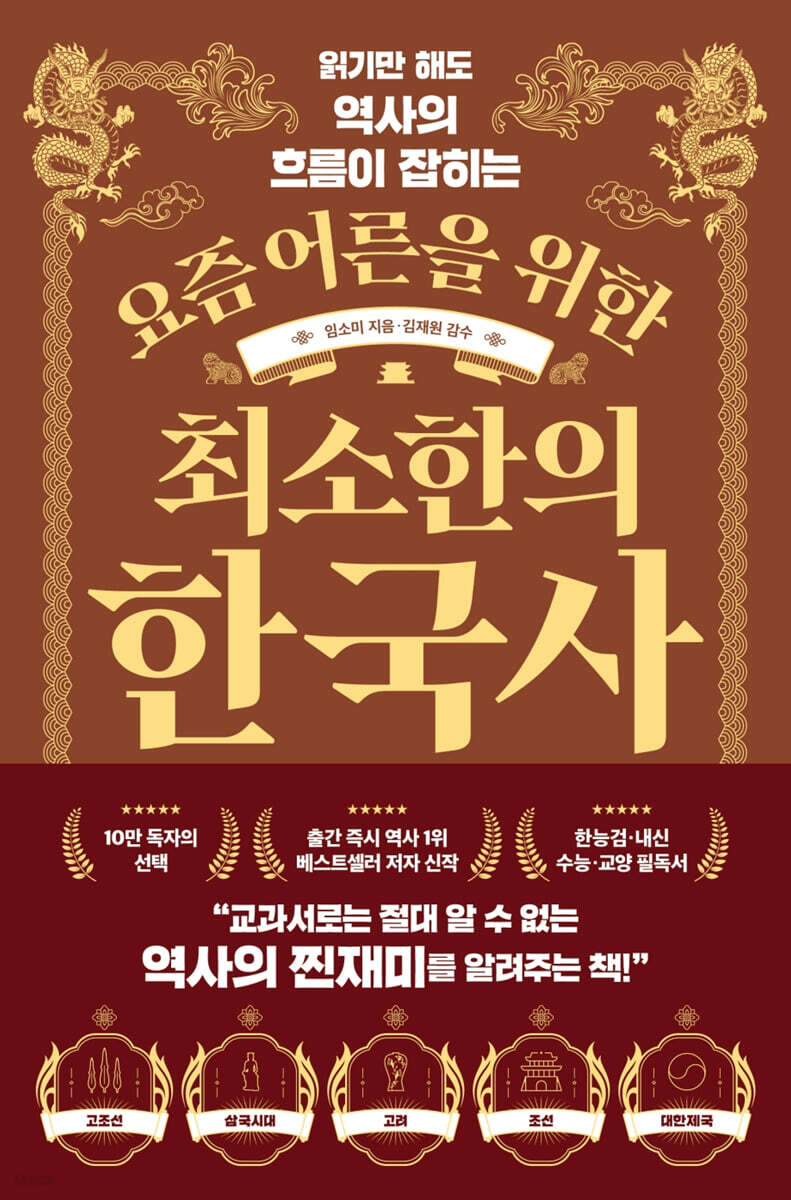
A Minimum Korean History for Adults Today
 |
Description
Book Introduction
“If you only read one book on Korean history, this is definitely it!”
The easiest and fastest way to read Korean history, chosen by 560,000 people.
Author So-mi Lim, who quickly grasped the vast context of world history in “Minimum World History for Today’s Adults” and was chosen by 100,000 readers, has now condensed the essential Korean history into a single volume, “Minimum Korean History for Today’s Adults.”
As in the previous work, the flow of Korean history is described in a way that allows one to immediately picture it in their mind through a delicious eloquence.
This book not only allows readers to truly experience the true joy of history that cannot be found in textbooks, but also serves as a friendly guide for readers who want to learn the basics of history as a general knowledge.
From the beginning of our history, Gojoseon, through the Three Kingdoms period, a period of fierce warfare, to the Goryeo and Joseon dynasties, by following the rise and fall of each era, you will experience the miracle of having all the essential Korean history for living today summarized in one book.
The easiest and fastest way to read Korean history, chosen by 560,000 people.
Author So-mi Lim, who quickly grasped the vast context of world history in “Minimum World History for Today’s Adults” and was chosen by 100,000 readers, has now condensed the essential Korean history into a single volume, “Minimum Korean History for Today’s Adults.”
As in the previous work, the flow of Korean history is described in a way that allows one to immediately picture it in their mind through a delicious eloquence.
This book not only allows readers to truly experience the true joy of history that cannot be found in textbooks, but also serves as a friendly guide for readers who want to learn the basics of history as a general knowledge.
From the beginning of our history, Gojoseon, through the Three Kingdoms period, a period of fierce warfare, to the Goryeo and Joseon dynasties, by following the rise and fall of each era, you will experience the miracle of having all the essential Korean history for living today summarized in one book.
- You can preview some of the book's contents.
Preview
index
Prologue│The Minimum Korean History You Must Know
Complete chronology of Korean history
PART 1.
The beginning of Korean Peninsula history: Gojoseon and the Three Kingdoms period
Gojoseon, which opened the door to Korean history
The establishment of early states with unique customs
Goguryeo, a nation that exuded a brave spirit throughout the world
Baekje, which blossomed with a brilliant culture
PART 2.
Silla, which achieved the great feat of unifying the three kingdoms
The last to reach his prime, but the ultimate winner
Unified Silla, the first kingdom to achieve unification of the Korean Peninsula
Gaya, which showed the essence of the Iron Age culture
Why Balhae, the Kingdom of the East, is part of our history
PART 3.
Goryeo, which opened the Middle Ages of Korean history
Split again during the Later Three Kingdoms period
The beginning of the 500-year Goryeo Dynasty
The continued invasion of the Khitan and the suffering of the people
The Yuan Empire's intervention and the end of Goryeo
PART 4.
The beginning of the 500-year Joseon Dynasty
Taejo, the oldest king to ascend the throne
The emergence of a passionate genius king who succeeded King Taejong, who was skilled in both literature and martial arts.
The true face of King Sejo, who had two faces
King Yejong and King Seongjong, who brought about the revival and development of Joseon
The bloody storm that enveloped Joseon, the era of purges
The Imjin War, a turning point in Joseon history
PART 5.
From Joseon to the Korean Empire through turbulent times
Injo's humiliation after surrendering to the Qing Dynasty
The court was engulfed in a state of national upheaval amid the pressure of the Yesong controversy.
King Yeongjo, who reigned the longest, and the son of a criminal
The beginning of the Andong Kim clan's power politics
The process of the fall of the Korean Empire and the monarchs of the fallen nation
Appendix│Genealogy of the Goryeo Kings and the Joseon Kings
References
Complete chronology of Korean history
PART 1.
The beginning of Korean Peninsula history: Gojoseon and the Three Kingdoms period
Gojoseon, which opened the door to Korean history
The establishment of early states with unique customs
Goguryeo, a nation that exuded a brave spirit throughout the world
Baekje, which blossomed with a brilliant culture
PART 2.
Silla, which achieved the great feat of unifying the three kingdoms
The last to reach his prime, but the ultimate winner
Unified Silla, the first kingdom to achieve unification of the Korean Peninsula
Gaya, which showed the essence of the Iron Age culture
Why Balhae, the Kingdom of the East, is part of our history
PART 3.
Goryeo, which opened the Middle Ages of Korean history
Split again during the Later Three Kingdoms period
The beginning of the 500-year Goryeo Dynasty
The continued invasion of the Khitan and the suffering of the people
The Yuan Empire's intervention and the end of Goryeo
PART 4.
The beginning of the 500-year Joseon Dynasty
Taejo, the oldest king to ascend the throne
The emergence of a passionate genius king who succeeded King Taejong, who was skilled in both literature and martial arts.
The true face of King Sejo, who had two faces
King Yejong and King Seongjong, who brought about the revival and development of Joseon
The bloody storm that enveloped Joseon, the era of purges
The Imjin War, a turning point in Joseon history
PART 5.
From Joseon to the Korean Empire through turbulent times
Injo's humiliation after surrendering to the Qing Dynasty
The court was engulfed in a state of national upheaval amid the pressure of the Yesong controversy.
King Yeongjo, who reigned the longest, and the son of a criminal
The beginning of the Andong Kim clan's power politics
The process of the fall of the Korean Empire and the monarchs of the fallen nation
Appendix│Genealogy of the Goryeo Kings and the Joseon Kings
References
Detailed image

Into the book
As we ponder the problems facing individuals and society, we often turn to past history.
In the recent past, there was a Japanese colonial period, and before that, there was Joseon.
Joseon also naturally accepted the legacy of the previous era by following and reforming various systems of Goryeo.
Korea's roots extend deeper and deeper into the past.
In the process of encountering those roots, we can discover the traces that each era left on our society today.
Herein lies the reason why this book was created.
By examining the world our ancestors on the Korean Peninsula created, the mistakes they repeated, and the frustrations and triumphs they experienced, we gain a deeper understanding of the world we live in today.
---From "Prologue | The Minimum Korean History You Must Know"
Eulpaso was a descendant of Eulso, who served as a minister during the reign of the second king, King Yurimyeong, and was a talented person who was evaluated as having a strong character and wisdom.
Originally, King Gogukcheon offered him the position of minister, but Eulpaso refused with these words.
“God is dull and slow, and cannot bear to obey strict orders. Please choose a virtuous person, give him a high position, and accomplish great things.”
For Eulpaso, who was a farmer, to help the king overcome the national crisis, a position as high as minister was out of the question.
King Gogukcheon, who noticed his true intentions, appointed Eulpaso as the national minister and issued a strict order that if he did not follow the national minister, he would exterminate all of his clan.
As a result, the independent four-part power was weakened and gradually began to unify under the king.
The ruling class of each department loses its independent power and transforms into a central aristocracy and bureaucrats who live crowded together in the capital.
In addition, the succession to the throne changed from inheritance from siblings to inheritance from father to son, and the status of the king became stronger.
Later, the unique title of 'Taewang' was used for the king of Goguryeo.
---From "Goguryeo, a nation that spread its brave spirit throughout the world"
Anyone who fell into Gung Ye's trap was struck by a red-hot iron hammer and died a dog's death.
(Omitted) That trap of suspicion soon fell upon Wang Geon, the second-in-command.
Gung Ye immediately summons Wang Geon and interrogates him, saying that he has seen through the law that Wang Geon plotted a rebellion last night.
Wang Geon had a complicated mind.
If I had said no outright here, it would have been no different from openly denying Gung Ye's supernatural powers.
When Gung Ye raised his head for a moment and closed his eyes, Choi Eung deliberately dropped his brush and pretended to pick it up, whispering to Wang Geon.
It was an urgent piece of advice that if you acknowledge Gung Ye's words and apologize, your life will be saved.
At that moment, Wang Geon realized that Gung Ye was testing him and begged for his life.
In a tense moment when Wang Geon's life was on the line, Gung Ye unexpectedly laughed out loud as if he was satisfied.
“The king is indeed honest.”
---From "Divided Again During the Later Three Kingdoms Period"
The 17th century begins with Gwanghaegun and ends with Sukjong.
Even after the Imjin War, chaos continued.
The Later Jin, which was looked down upon as a barbarian, grew in size and caused the Byeongja Horan, and the Later Jin changed its national name to the Qing and caused the Byeongja Horan.
The incident in which King Injo of Joseon had to perform a humiliating surrender ceremony in front of Emperor Taizong of the Qing Dynasty also occurred in the 17th century.
Internally, factional politics developed, with various political forces coexisting and competing.
However, as the evils of factional politics became severe due to overheated competition, King Yeongjo and King Jeongjo of the 18th century pursued a policy of tangpyeong.
He tried to balance the political factions with a strong royal authority.
But eventually, as even the proper function of factional politics, namely checks and balances, collapsed, the politics of factions developed in the 19th century.
The nation's fortunes declined due to the monopoly of power by a certain royal family, and a dark period of unceasing lamentation by the people lasted for about 60 years.
---From "Taejo, the oldest king to ascend to the throne"
The ministers were displeased with King Gwanghae, who betrayed his rule and tried to make peace with the barbarians.
The Seoin faction began to exploit Gwanghaegun's weaknesses with the intention of dethroning him.
There were many problems, including the palace restoration project and abuse of power, but the weakness of King Gwanghaegun that was particularly noted was the assassination of his queen mother.
The act of killing one's mother means killing one's younger sibling after killing one's mother.
king
In the process of focusing on strengthening power, King Gwanghae and the Northern faction took several risky measures.
Prince Yeongchang, who was a threat simply by his existence, was eventually exiled to Ganghwa Island and then murdered.
Queen Inmok, who gave birth to Prince Yeongchang, was locked in the palace and was not allowed to enter or leave Changdeokgung Palace.
Such behavior was contrary to Confucian ethics, which value righteousness, justification, and filial piety.
In the end, the Seoin faction branded Gwanghaegun an unfilial king and launched the Injo Restoration, and the Namin faction also joined in, leading to Gwanghaegun's expulsion.
In 1623, he was 49 years old.
---From "The Humiliation of King Injo Who Surrendered to the Qing Dynasty"
The characteristic of the 18th century led by King Yeongjo and King Jeongjo was the politics of tangpyeong.
Since King Sukjong's return to the country, the factional strife within the government has become more intense.
Now, whether it's coexistence or anything else, the perception that in order to survive, either the other side must die or our side must die has become stronger.
The principle of factions that check each other and maintain a balance of power is crumbling.
I lost, and now only the interests of my party matter.
The relationship between the factions was so bad that they wouldn't even allow marriages between families from different factions.
As time passed, the descendants of each party inherited the party line, and the party colors became too strong and solidified.
King Yeongjo, who personally experienced this situation, pushed for a policy of peace as soon as he ascended to the throne.
In fact, the story of Tangpyeong policy first came out during the reign of King Sukjong.
As the conflict between the Noron and Soron factions became increasingly intense, the Tangpyeong policy was proposed as a solution.
However, during the reign of King Sukjong, the Tangpyeong policy was not properly promoted.
In the recent past, there was a Japanese colonial period, and before that, there was Joseon.
Joseon also naturally accepted the legacy of the previous era by following and reforming various systems of Goryeo.
Korea's roots extend deeper and deeper into the past.
In the process of encountering those roots, we can discover the traces that each era left on our society today.
Herein lies the reason why this book was created.
By examining the world our ancestors on the Korean Peninsula created, the mistakes they repeated, and the frustrations and triumphs they experienced, we gain a deeper understanding of the world we live in today.
---From "Prologue | The Minimum Korean History You Must Know"
Eulpaso was a descendant of Eulso, who served as a minister during the reign of the second king, King Yurimyeong, and was a talented person who was evaluated as having a strong character and wisdom.
Originally, King Gogukcheon offered him the position of minister, but Eulpaso refused with these words.
“God is dull and slow, and cannot bear to obey strict orders. Please choose a virtuous person, give him a high position, and accomplish great things.”
For Eulpaso, who was a farmer, to help the king overcome the national crisis, a position as high as minister was out of the question.
King Gogukcheon, who noticed his true intentions, appointed Eulpaso as the national minister and issued a strict order that if he did not follow the national minister, he would exterminate all of his clan.
As a result, the independent four-part power was weakened and gradually began to unify under the king.
The ruling class of each department loses its independent power and transforms into a central aristocracy and bureaucrats who live crowded together in the capital.
In addition, the succession to the throne changed from inheritance from siblings to inheritance from father to son, and the status of the king became stronger.
Later, the unique title of 'Taewang' was used for the king of Goguryeo.
---From "Goguryeo, a nation that spread its brave spirit throughout the world"
Anyone who fell into Gung Ye's trap was struck by a red-hot iron hammer and died a dog's death.
(Omitted) That trap of suspicion soon fell upon Wang Geon, the second-in-command.
Gung Ye immediately summons Wang Geon and interrogates him, saying that he has seen through the law that Wang Geon plotted a rebellion last night.
Wang Geon had a complicated mind.
If I had said no outright here, it would have been no different from openly denying Gung Ye's supernatural powers.
When Gung Ye raised his head for a moment and closed his eyes, Choi Eung deliberately dropped his brush and pretended to pick it up, whispering to Wang Geon.
It was an urgent piece of advice that if you acknowledge Gung Ye's words and apologize, your life will be saved.
At that moment, Wang Geon realized that Gung Ye was testing him and begged for his life.
In a tense moment when Wang Geon's life was on the line, Gung Ye unexpectedly laughed out loud as if he was satisfied.
“The king is indeed honest.”
---From "Divided Again During the Later Three Kingdoms Period"
The 17th century begins with Gwanghaegun and ends with Sukjong.
Even after the Imjin War, chaos continued.
The Later Jin, which was looked down upon as a barbarian, grew in size and caused the Byeongja Horan, and the Later Jin changed its national name to the Qing and caused the Byeongja Horan.
The incident in which King Injo of Joseon had to perform a humiliating surrender ceremony in front of Emperor Taizong of the Qing Dynasty also occurred in the 17th century.
Internally, factional politics developed, with various political forces coexisting and competing.
However, as the evils of factional politics became severe due to overheated competition, King Yeongjo and King Jeongjo of the 18th century pursued a policy of tangpyeong.
He tried to balance the political factions with a strong royal authority.
But eventually, as even the proper function of factional politics, namely checks and balances, collapsed, the politics of factions developed in the 19th century.
The nation's fortunes declined due to the monopoly of power by a certain royal family, and a dark period of unceasing lamentation by the people lasted for about 60 years.
---From "Taejo, the oldest king to ascend to the throne"
The ministers were displeased with King Gwanghae, who betrayed his rule and tried to make peace with the barbarians.
The Seoin faction began to exploit Gwanghaegun's weaknesses with the intention of dethroning him.
There were many problems, including the palace restoration project and abuse of power, but the weakness of King Gwanghaegun that was particularly noted was the assassination of his queen mother.
The act of killing one's mother means killing one's younger sibling after killing one's mother.
king
In the process of focusing on strengthening power, King Gwanghae and the Northern faction took several risky measures.
Prince Yeongchang, who was a threat simply by his existence, was eventually exiled to Ganghwa Island and then murdered.
Queen Inmok, who gave birth to Prince Yeongchang, was locked in the palace and was not allowed to enter or leave Changdeokgung Palace.
Such behavior was contrary to Confucian ethics, which value righteousness, justification, and filial piety.
In the end, the Seoin faction branded Gwanghaegun an unfilial king and launched the Injo Restoration, and the Namin faction also joined in, leading to Gwanghaegun's expulsion.
In 1623, he was 49 years old.
---From "The Humiliation of King Injo Who Surrendered to the Qing Dynasty"
The characteristic of the 18th century led by King Yeongjo and King Jeongjo was the politics of tangpyeong.
Since King Sukjong's return to the country, the factional strife within the government has become more intense.
Now, whether it's coexistence or anything else, the perception that in order to survive, either the other side must die or our side must die has become stronger.
The principle of factions that check each other and maintain a balance of power is crumbling.
I lost, and now only the interests of my party matter.
The relationship between the factions was so bad that they wouldn't even allow marriages between families from different factions.
As time passed, the descendants of each party inherited the party line, and the party colors became too strong and solidified.
King Yeongjo, who personally experienced this situation, pushed for a policy of peace as soon as he ascended to the throne.
In fact, the story of Tangpyeong policy first came out during the reign of King Sukjong.
As the conflict between the Noron and Soron factions became increasingly intense, the Tangpyeong policy was proposed as a solution.
However, during the reign of King Sukjong, the Tangpyeong policy was not properly promoted.
---From "Yeongjo, who reigned the longest, and the son of a criminal"
Publisher's Review
* A new work by the author of the #1 bestseller in the history category immediately after publication!
* Must-read books for the Korean Proficiency Test, internal exams, college entrance exam, and liberal arts chosen by 100,000 readers!
- What was the incident in which Silla and Baekje broke the alliance and became enemies?
- Why did King Taejo Wang Geon marry 29 people?
- Nam-in vs.
What was the outcome of the Seoin Yesong controversy?
- What was the background that allowed Heungseon Daewongun to become the ruler of Joseon?
“We’ve carefully selected only the Korean history you absolutely need to know today!”
Complete Korean history from Gojoseon to the Japanese colonial period!
Why do we need to know history? As we navigate our social lives, we often find ourselves feeling embarrassed because we don't even have a proper grasp of historical concepts that even elementary school students know.
Also, Korean history is one of the liberal arts that you must know and not miss in order to prepare for employment or interviews.
Although it would be good to know this, it has always been considered difficult to properly master Korean history due to the vast amount of content, complex events, and difficult Chinese characters.
《Minimum Korean History for Today's Adults》 is a smooth read even without any historical background knowledge, and is fun enough to keep even those who have never read a history book turning the pages.
Reading about the rise and fall of our history from Gojoseon to the Japanese colonial period will not only allow you to quickly and easily acquire a general understanding of Korean history, but will also provide you with valuable insights essential to our lives today.
Publication requests flood in! A hot topic in Korean history that has captured the attention of 560,000 people!
* “This is the only book I, who doesn’t read history books, have read all the way through!”
* “A book that reveals the true joy of history that you can never learn from textbooks!”
* “If you still find history difficult, you must read this book!”
The reason history feels difficult is because many events are intertwined like a thread, making it difficult to grasp the whole picture at once.
In this book, the historical story of author So-mi Lim, who has demonstrated exceptional storytelling skills to the point of earning the title of “Scheherazade of the history world” through her previous works, unfolds like a drama.
The author reviewed a vast amount of data, including hundreds of books and papers, and conducted thorough research to include in one volume the crucial moments in Korean history that must be known in modern times.
The flow of historical events that we have heard of but found difficult to understand, such as the process of unification of the three kingdoms of Goguryeo, Baekje, and Silla, the military regime of Goryeo, factional politics of the Joseon Dynasty, and the Yesong controversy, is immediately grasped.
In addition, we have added abundant illustrations to the text to aid understanding, and have inserted a 'chronology of major events by era' to help organize the historical flow at a glance.
In addition, the appendix, ‘Complete Chronology of Korean History, Genealogy of the Kings of Goryeo and Joseon’, was included to greatly help in summarizing the key points.
Lastly, the accuracy and reliability of historical facts were enhanced through the supervision of Professor Kim Jae-won of the Department of Korean History at Catholic University, who is familiar to the public through his appearances on various broadcasts.
What if you still haven't mastered Korean history?
This one book will teach you all about history!
As the title suggests, “Minimum Korean History for Adults Today” contains only the essential information that must be known.
From Gojoseon, which marked the beginning of Korean history, to the early states, to Silla, which unified the Three Kingdoms period, to Goryeo and Joseon, the historical events that created turning points in each era unfold vividly before your eyes.
It focuses on the people and wars that must be remembered, so you can perfectly acquire the basics of Korean history by reading just this one book.
From scandals that rocked the palace to little-known behind-the-scenes stories, such as how spending money and goods as one pleases came to be called "excessive spending" and how Joseon's first planned city was born, this book stimulates curiosity by revealing the true fun of history that you will never find in textbooks.
You'll find yourself absorbed in this captivating historical narrative, and before you know it, you'll have turned the last page.
This book will be an excellent introductory text for readers who have wanted to understand Korean history but have been unable to do so.
* Must-read books for the Korean Proficiency Test, internal exams, college entrance exam, and liberal arts chosen by 100,000 readers!
- What was the incident in which Silla and Baekje broke the alliance and became enemies?
- Why did King Taejo Wang Geon marry 29 people?
- Nam-in vs.
What was the outcome of the Seoin Yesong controversy?
- What was the background that allowed Heungseon Daewongun to become the ruler of Joseon?
“We’ve carefully selected only the Korean history you absolutely need to know today!”
Complete Korean history from Gojoseon to the Japanese colonial period!
Why do we need to know history? As we navigate our social lives, we often find ourselves feeling embarrassed because we don't even have a proper grasp of historical concepts that even elementary school students know.
Also, Korean history is one of the liberal arts that you must know and not miss in order to prepare for employment or interviews.
Although it would be good to know this, it has always been considered difficult to properly master Korean history due to the vast amount of content, complex events, and difficult Chinese characters.
《Minimum Korean History for Today's Adults》 is a smooth read even without any historical background knowledge, and is fun enough to keep even those who have never read a history book turning the pages.
Reading about the rise and fall of our history from Gojoseon to the Japanese colonial period will not only allow you to quickly and easily acquire a general understanding of Korean history, but will also provide you with valuable insights essential to our lives today.
Publication requests flood in! A hot topic in Korean history that has captured the attention of 560,000 people!
* “This is the only book I, who doesn’t read history books, have read all the way through!”
* “A book that reveals the true joy of history that you can never learn from textbooks!”
* “If you still find history difficult, you must read this book!”
The reason history feels difficult is because many events are intertwined like a thread, making it difficult to grasp the whole picture at once.
In this book, the historical story of author So-mi Lim, who has demonstrated exceptional storytelling skills to the point of earning the title of “Scheherazade of the history world” through her previous works, unfolds like a drama.
The author reviewed a vast amount of data, including hundreds of books and papers, and conducted thorough research to include in one volume the crucial moments in Korean history that must be known in modern times.
The flow of historical events that we have heard of but found difficult to understand, such as the process of unification of the three kingdoms of Goguryeo, Baekje, and Silla, the military regime of Goryeo, factional politics of the Joseon Dynasty, and the Yesong controversy, is immediately grasped.
In addition, we have added abundant illustrations to the text to aid understanding, and have inserted a 'chronology of major events by era' to help organize the historical flow at a glance.
In addition, the appendix, ‘Complete Chronology of Korean History, Genealogy of the Kings of Goryeo and Joseon’, was included to greatly help in summarizing the key points.
Lastly, the accuracy and reliability of historical facts were enhanced through the supervision of Professor Kim Jae-won of the Department of Korean History at Catholic University, who is familiar to the public through his appearances on various broadcasts.
What if you still haven't mastered Korean history?
This one book will teach you all about history!
As the title suggests, “Minimum Korean History for Adults Today” contains only the essential information that must be known.
From Gojoseon, which marked the beginning of Korean history, to the early states, to Silla, which unified the Three Kingdoms period, to Goryeo and Joseon, the historical events that created turning points in each era unfold vividly before your eyes.
It focuses on the people and wars that must be remembered, so you can perfectly acquire the basics of Korean history by reading just this one book.
From scandals that rocked the palace to little-known behind-the-scenes stories, such as how spending money and goods as one pleases came to be called "excessive spending" and how Joseon's first planned city was born, this book stimulates curiosity by revealing the true fun of history that you will never find in textbooks.
You'll find yourself absorbed in this captivating historical narrative, and before you know it, you'll have turned the last page.
This book will be an excellent introductory text for readers who have wanted to understand Korean history but have been unable to do so.
GOODS SPECIFICS
- Date of issue: June 20, 2024
- Page count, weight, size: 320 pages | 552g | 145*220*20mm
- ISBN13: 9791193128992
- ISBN10: 1193128994
You may also like
카테고리
korean


korean

![GQ KOREA Mark (Monthly): December [2025]](http://librairie.coreenne.fr/cdn/shop/files/8ef265dbbfbf186523ed75ba7319009d.jpg?v=1765340328&width=3840)


