

See history
 |
Description
Book Introduction
- A word from MD
-
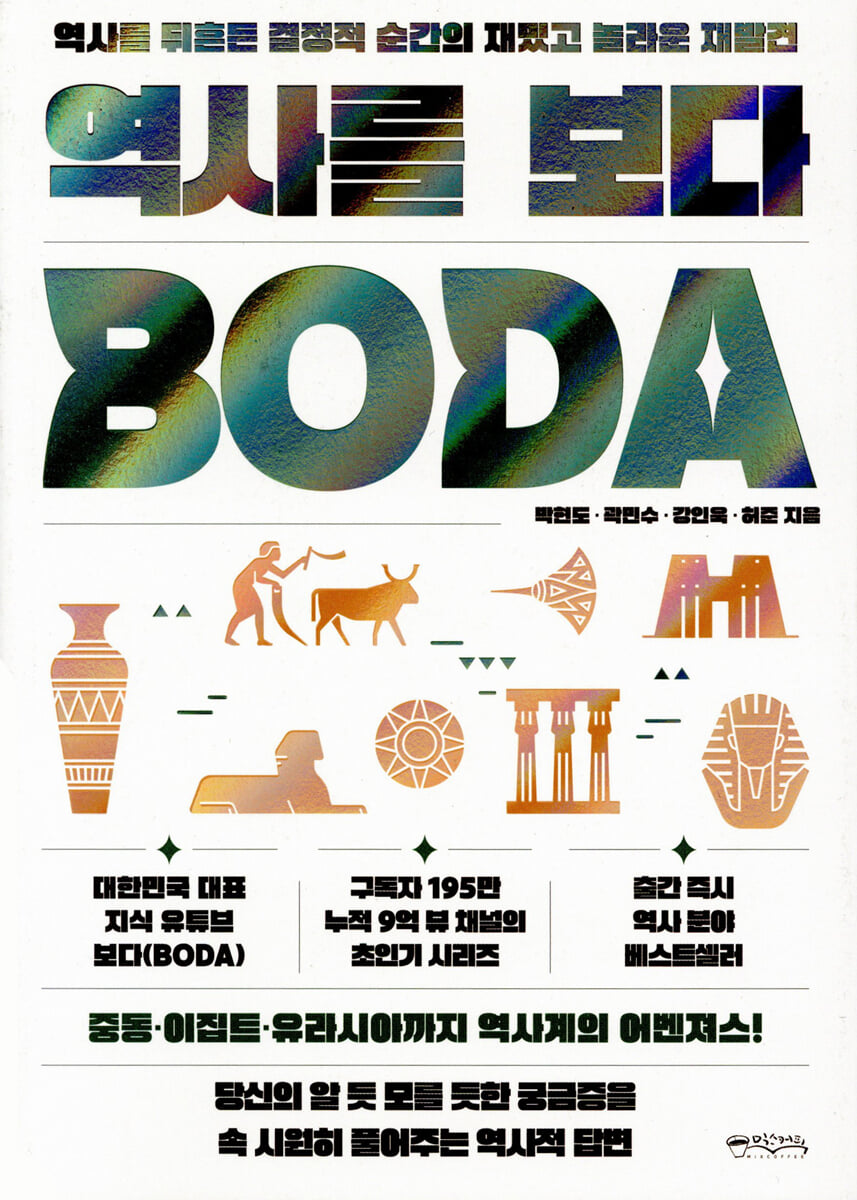
Avengers of History, Assemble!A popular series on BODA, a knowledge YouTube channel born from books.
Park Hyun-do from the Middle East, Kwak Min-soo from Egypt, Kang In-wook from Eurasia, and Heo Jun, who is in charge of hosting, answer many questions with historical insight and interesting storytelling.
Even people who are not interested in history will find themselves drawn into the world of history by reading this book.
July 12, 2024. History PD Ahn Hyun-jae
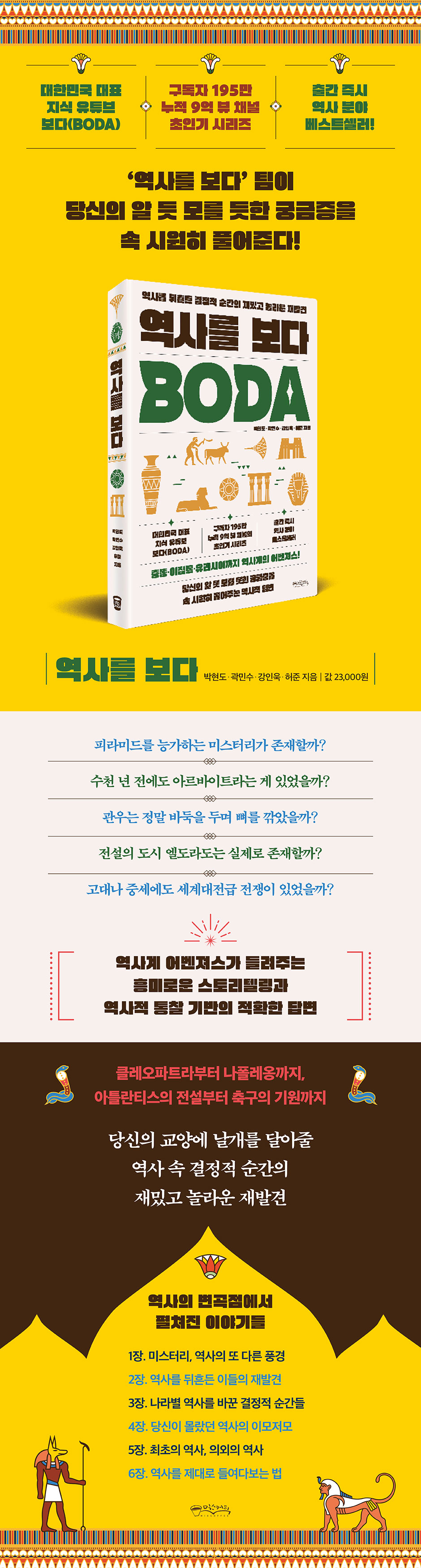
“Amazing stories that unfold at a turning point in history!”
Give wings to your culture
Rediscovering a Decisive Moment in History
* Korea's representative knowledge YouTuber, BODA *
* Super popular series with 1.95 million subscribers and 920 million cumulative views *
* Avengers of History from the Middle East, Egypt, and Eurasia *
* An instant history bestseller! *
BODA, Korea's leading knowledge channel boasting 1.95 million subscribers and 920 million cumulative views, has published the super popular series 'See History' in book form.
From ancient Egypt, where there were even part-time jobs and pregnancy tests, to the Janissaries, the most powerful army in Middle Eastern history, to Napoleon, who wanted to visit Joseon, to the way historians approach unofficial history and conspiracy theories, this book thoroughly answers historical questions that may seem familiar but are not. It goes back and forth between Egypt, the Middle East, and Eurasia.
A vast amount of information is presented in a fun and easy-to-understand storytelling style by knowledgeable authorities.
It is accompanied by a warm gaze that conveys the wisdom of the old people.
"Looking at History" is the best history textbook, filled with history, culture, and knowledge.
We filled in parts that were not covered in the video, corrected inaccurate expressions, placed photos in appropriate places, and even added storytelling to make it more intuitive and easier for readers to understand than the video.
You can look forward to a book armed with a different charm from the video.
Give wings to your culture
Rediscovering a Decisive Moment in History
* Korea's representative knowledge YouTuber, BODA *
* Super popular series with 1.95 million subscribers and 920 million cumulative views *
* Avengers of History from the Middle East, Egypt, and Eurasia *
* An instant history bestseller! *
BODA, Korea's leading knowledge channel boasting 1.95 million subscribers and 920 million cumulative views, has published the super popular series 'See History' in book form.
From ancient Egypt, where there were even part-time jobs and pregnancy tests, to the Janissaries, the most powerful army in Middle Eastern history, to Napoleon, who wanted to visit Joseon, to the way historians approach unofficial history and conspiracy theories, this book thoroughly answers historical questions that may seem familiar but are not. It goes back and forth between Egypt, the Middle East, and Eurasia.
A vast amount of information is presented in a fun and easy-to-understand storytelling style by knowledgeable authorities.
It is accompanied by a warm gaze that conveys the wisdom of the old people.
"Looking at History" is the best history textbook, filled with history, culture, and knowledge.
We filled in parts that were not covered in the video, corrected inaccurate expressions, placed photos in appropriate places, and even added storytelling to make it more intuitive and easier for readers to understand than the video.
You can look forward to a book armed with a different charm from the video.
- You can preview some of the book's contents.
Preview
index
Entering_
Inviting you to the bittersweet charm of history
Chapter 1: Mystery, Another Landscape of History
The Arrogant Side of the Wondrous and Mysterious Relics
About the Seven Wonders of the Ancient World
Is there a mystery that surpasses the pyramids?
Is Atlantis history or legend?
Does the legendary city of El Dorado really exist?
When, where, and how did Napoleon die?
As it turned out, that's how he died
The Mystery of the Giant Mummy's Finger
The epidemic that changed the course of history
About the most powerful army in Middle Eastern history
Ancient technology that surpasses modern people's imagination
A reasonable but inaccurate ancient Egyptian conspiracy theory
Subscribers' first curiosity
Chapter 2: Rediscovering Those Who Shook History
Napoleon wanted to visit Joseon
A list of national heroes representing each country
The century's greatest doctors surpassing the divine Hwa-tuo
Did Guan Yu really grind his bones playing Go?
The great significance of Napoleon's Egyptian expedition
On the claim that Cleopatra was black
Medieval Islam and Modern France, Connected by Saladin
Perceptions of Napoleon outside France
The sorrow of kings that you don't know until you experience it
The superior who treated his subordinates most cruelly
Was Napoleon a hero or a dictator?
Subscribers' second question
Chapter 3: Decisive Moments That Changed History in Each Country
The worst mistake in thousands of years of Egyptian history
The ancient world wars that clashed between Europe and Asia
Were there any major wars on the scale of World War II in the Middle Ages?
A decisive choice that completely changed the course of the war
Coups d'état, if they fail, are treason; if they succeed, they are revolution.
Dark histories of each country that we really want to erase
Are there countries that can never be reconciled?
The forces that dominated the transition point of hegemony
Why Ancient Egypt Didn't Take the Path of an Empire
About gold, which has caused war and tragedy throughout human history
The most absurd and absurd deaths in human history
Subscribers' third question
Chapter 4: History You Didn't Know About
Was there such a thing as part-time work in ancient times?
Did toilets exist in ancient times?
How were maps made in ancient times?
Are the pyramids of ancient Egypt really tombs?
How were armies commanded in ancient times?
Why was the once splendid Persia so forgotten?
Are all Middle Eastern people Muslim?
Why do Middle Eastern women wear hijabs?
Why Muslims Don't Eat Pork
Interesting stories about languages from different countries
The true face of unexpected treasures from each country
Subscribers' fourth question
Chapter 5: The First History, the Unexpected History
Were the ancient Egyptians the first to build pyramids?
Ancient Egypt isn't where it all began.
In the case of animals ridden by humans in ancient times,
About gold, a common treasure throughout human history
Unique ancient hairstyles by culture
An ancient punishment that would have been better than death
Superstitions created in history, based on history
Ancient Egypt, where workers were treated well
Absurd Medical Cases from Ancient Egypt
About incest in the ancient Egyptian royal family
An ancient Egyptian husband who adopted his wife as his daughter.
Laws so absurd and peculiar that they leave you speechless
A special way for ancient people to honor the deceased
Subscribers' Fifth Curiosity
Chapter 6: How to Look at History Properly
How historians read history
When a historian watches a historical film
How historians treat unofficial history
How a Historian Approaches Conspiracy Theories
Moments that thrill historians
The bitter side of historians in history
Why theories about the origins of civilization need to change
About the various caste systems in human history
The basis for the formation of ancient cities and civilizations
Strange Stories Surrounding the Aryans
The earliest evidence of soccer in human history
Important excavations currently underway
Subscribers' Sixth Question
Inviting you to the bittersweet charm of history
Chapter 1: Mystery, Another Landscape of History
The Arrogant Side of the Wondrous and Mysterious Relics
About the Seven Wonders of the Ancient World
Is there a mystery that surpasses the pyramids?
Is Atlantis history or legend?
Does the legendary city of El Dorado really exist?
When, where, and how did Napoleon die?
As it turned out, that's how he died
The Mystery of the Giant Mummy's Finger
The epidemic that changed the course of history
About the most powerful army in Middle Eastern history
Ancient technology that surpasses modern people's imagination
A reasonable but inaccurate ancient Egyptian conspiracy theory
Subscribers' first curiosity
Chapter 2: Rediscovering Those Who Shook History
Napoleon wanted to visit Joseon
A list of national heroes representing each country
The century's greatest doctors surpassing the divine Hwa-tuo
Did Guan Yu really grind his bones playing Go?
The great significance of Napoleon's Egyptian expedition
On the claim that Cleopatra was black
Medieval Islam and Modern France, Connected by Saladin
Perceptions of Napoleon outside France
The sorrow of kings that you don't know until you experience it
The superior who treated his subordinates most cruelly
Was Napoleon a hero or a dictator?
Subscribers' second question
Chapter 3: Decisive Moments That Changed History in Each Country
The worst mistake in thousands of years of Egyptian history
The ancient world wars that clashed between Europe and Asia
Were there any major wars on the scale of World War II in the Middle Ages?
A decisive choice that completely changed the course of the war
Coups d'état, if they fail, are treason; if they succeed, they are revolution.
Dark histories of each country that we really want to erase
Are there countries that can never be reconciled?
The forces that dominated the transition point of hegemony
Why Ancient Egypt Didn't Take the Path of an Empire
About gold, which has caused war and tragedy throughout human history
The most absurd and absurd deaths in human history
Subscribers' third question
Chapter 4: History You Didn't Know About
Was there such a thing as part-time work in ancient times?
Did toilets exist in ancient times?
How were maps made in ancient times?
Are the pyramids of ancient Egypt really tombs?
How were armies commanded in ancient times?
Why was the once splendid Persia so forgotten?
Are all Middle Eastern people Muslim?
Why do Middle Eastern women wear hijabs?
Why Muslims Don't Eat Pork
Interesting stories about languages from different countries
The true face of unexpected treasures from each country
Subscribers' fourth question
Chapter 5: The First History, the Unexpected History
Were the ancient Egyptians the first to build pyramids?
Ancient Egypt isn't where it all began.
In the case of animals ridden by humans in ancient times,
About gold, a common treasure throughout human history
Unique ancient hairstyles by culture
An ancient punishment that would have been better than death
Superstitions created in history, based on history
Ancient Egypt, where workers were treated well
Absurd Medical Cases from Ancient Egypt
About incest in the ancient Egyptian royal family
An ancient Egyptian husband who adopted his wife as his daughter.
Laws so absurd and peculiar that they leave you speechless
A special way for ancient people to honor the deceased
Subscribers' Fifth Curiosity
Chapter 6: How to Look at History Properly
How historians read history
When a historian watches a historical film
How historians treat unofficial history
How a Historian Approaches Conspiracy Theories
Moments that thrill historians
The bitter side of historians in history
Why theories about the origins of civilization need to change
About the various caste systems in human history
The basis for the formation of ancient cities and civilizations
Strange Stories Surrounding the Aryans
The earliest evidence of soccer in human history
Important excavations currently underway
Subscribers' Sixth Question
Detailed image
Into the book
When Henri Mouhot first saw Angkor Wat, he thought it was an indescribable, mystical place, a wonder like no other in the world.
The praise continued.
It is truly a new world, so unique that it is beyond compare.
But Angkor Wat is just a temple built by locals.
It was built over a period of 30 years by Suryavarman II, the 17th king of the Khmer Empire, in the 12th century, and covers a total area of 160 hectares (1.6 million square meters).
It's the world's largest religious building, but aren't temples everywhere?
Westerners were amazed that the very people they had dismissed and despised as uncivilized could build such enormous, beautiful, and wondrous structures.
Let me say this again, I don't think we should emphasize wonder and mystery in that way.
---From "Chapter 1: Mystery, Another Landscape of History"
There are also heroes who saved the country in Middle Eastern history.
To be precise, he is the 'hero of salvation' who protected the entire Islamic world.
This is Salah ad-Din, better known as Saladin.
Salahuddin is also a hero of the Crusades.
He recaptured Jerusalem, which had been lost to the Crusaders in the Battle of Hattin in 1187, effectively destroying the Kingdom of Jerusalem.
After that, he saves all the Christians.
Let me just live there.
And they never killed prisoners.
Anyone can steal, but not everyone can save.
---From "Chapter 2: Rediscovery of Those Who Shook History"
I believe there are one or two defining events or mistakes in human history, one of which is the Battle of Manzikert in 1071, which is said to be the prelude to the fall of the Eastern Roman Empire.
The Eastern Roman Emperor at that time was Romanos IV Diogenes.
He clashed with the newly emerging Selcuk Empire in Central Asia.
At that time, the Seljuks did not have the capacity to fight the Eastern Roman Empire.
Because they had to subdue the Fatimid dynasty of Egypt.
So the Seljuks made a peace treaty with the Eastern Roman Empire and set out to subdue the Fatimids.
However, taking advantage of this gap, Romanos IV attacked Seljuk.
Even if it means breaking the peace treaty.
It was an attack that should not have been done.
Romanos IV was expected to win, but he was defeated and even taken prisoner.
But the Seljuks could not kill Romanos IV.
If you kill them, the Eastern Roman Empire won't stay still.
So, he lets Romanos IV live.
However, he is eventually killed in his own country.
The Eastern Roman Empire began to weaken after suffering a crushing defeat at the Battle of Manzikert.
Most of the Anatolian Peninsula, which is now part of Turkic territory, was taken over by the Seljuks.
It is literally the prelude to the fall of the Eastern Roman Empire.
---From "Chapter 3: Decisive Moments That Changed History in Each Country"
You might be surprised to learn that Saudi Arabia, a country rich in oil, imports three things.
The first one is 'sand'.
There must be a lot of sand in the Saudi Arabian desert, but desert sand cannot be used for construction.
The second is ‘oil’.
When Russia produces refined oil, we buy it quickly at a low price.
Refining oil costs money, but Russia does it cheaply, while Saudi Arabia makes a profit by selling unrefined oil at a high price.
The third is 'camel'.
Sand and oil are surprising, but camels are even more surprising.
However, it is imported for food, not as a means of transportation.
We mainly buy camels raised in Australia.
---From "Chapter 4: Various Facts About History You Didn't Know"
Workers even went on strike because their wages were delayed.
This is a very famous case.
Originally, not just anyone could enter the Egyptian temples.
But then the workers stormed into the temple and started a sit-in protest all night.
They go around to temples here and there and protest.
So the Prime Minister has no choice but to send a representative to calm the workers.
Ultimately, workers receive a portion of their wages.
Administrative documents documenting the strike process have been unearthed, and the content shows that one striking worker was so angry that he did not hesitate to make blasphemous remarks.
For example, it's a statement like, "If I don't get my pay today, I'm going to raid Pharaoh's tomb."
Although it was a statement that could have been fully punished, there was no evidence that any punishment had been given, and there was also no evidence that any punishment had been given to the strike leaders after the strike was called off.
---From "Chapter 5: The First History, Unexpected History"
The greatest joy of archaeology is not knowing what will come next.
There are always new relics waiting.
Like the box of chocolates in the movie [Forrest Gump].
No one knows what's inside.
Always looking forward and full of hope.
Besides, artifacts excavated from the site are always special.
Don't humans live by feeling?
The smell of the soil and the feel of the relics are difficult to experience unless you dig them up yourself.
But when you actually go to the historical site, there are often nothing special there.
But, even if there is nothing, it is not expressed as a blank.
Everything has rotted away and now there is nothing left.
At times like that, it's fun to find things that weren't there before.
The praise continued.
It is truly a new world, so unique that it is beyond compare.
But Angkor Wat is just a temple built by locals.
It was built over a period of 30 years by Suryavarman II, the 17th king of the Khmer Empire, in the 12th century, and covers a total area of 160 hectares (1.6 million square meters).
It's the world's largest religious building, but aren't temples everywhere?
Westerners were amazed that the very people they had dismissed and despised as uncivilized could build such enormous, beautiful, and wondrous structures.
Let me say this again, I don't think we should emphasize wonder and mystery in that way.
---From "Chapter 1: Mystery, Another Landscape of History"
There are also heroes who saved the country in Middle Eastern history.
To be precise, he is the 'hero of salvation' who protected the entire Islamic world.
This is Salah ad-Din, better known as Saladin.
Salahuddin is also a hero of the Crusades.
He recaptured Jerusalem, which had been lost to the Crusaders in the Battle of Hattin in 1187, effectively destroying the Kingdom of Jerusalem.
After that, he saves all the Christians.
Let me just live there.
And they never killed prisoners.
Anyone can steal, but not everyone can save.
---From "Chapter 2: Rediscovery of Those Who Shook History"
I believe there are one or two defining events or mistakes in human history, one of which is the Battle of Manzikert in 1071, which is said to be the prelude to the fall of the Eastern Roman Empire.
The Eastern Roman Emperor at that time was Romanos IV Diogenes.
He clashed with the newly emerging Selcuk Empire in Central Asia.
At that time, the Seljuks did not have the capacity to fight the Eastern Roman Empire.
Because they had to subdue the Fatimid dynasty of Egypt.
So the Seljuks made a peace treaty with the Eastern Roman Empire and set out to subdue the Fatimids.
However, taking advantage of this gap, Romanos IV attacked Seljuk.
Even if it means breaking the peace treaty.
It was an attack that should not have been done.
Romanos IV was expected to win, but he was defeated and even taken prisoner.
But the Seljuks could not kill Romanos IV.
If you kill them, the Eastern Roman Empire won't stay still.
So, he lets Romanos IV live.
However, he is eventually killed in his own country.
The Eastern Roman Empire began to weaken after suffering a crushing defeat at the Battle of Manzikert.
Most of the Anatolian Peninsula, which is now part of Turkic territory, was taken over by the Seljuks.
It is literally the prelude to the fall of the Eastern Roman Empire.
---From "Chapter 3: Decisive Moments That Changed History in Each Country"
You might be surprised to learn that Saudi Arabia, a country rich in oil, imports three things.
The first one is 'sand'.
There must be a lot of sand in the Saudi Arabian desert, but desert sand cannot be used for construction.
The second is ‘oil’.
When Russia produces refined oil, we buy it quickly at a low price.
Refining oil costs money, but Russia does it cheaply, while Saudi Arabia makes a profit by selling unrefined oil at a high price.
The third is 'camel'.
Sand and oil are surprising, but camels are even more surprising.
However, it is imported for food, not as a means of transportation.
We mainly buy camels raised in Australia.
---From "Chapter 4: Various Facts About History You Didn't Know"
Workers even went on strike because their wages were delayed.
This is a very famous case.
Originally, not just anyone could enter the Egyptian temples.
But then the workers stormed into the temple and started a sit-in protest all night.
They go around to temples here and there and protest.
So the Prime Minister has no choice but to send a representative to calm the workers.
Ultimately, workers receive a portion of their wages.
Administrative documents documenting the strike process have been unearthed, and the content shows that one striking worker was so angry that he did not hesitate to make blasphemous remarks.
For example, it's a statement like, "If I don't get my pay today, I'm going to raid Pharaoh's tomb."
Although it was a statement that could have been fully punished, there was no evidence that any punishment had been given, and there was also no evidence that any punishment had been given to the strike leaders after the strike was called off.
---From "Chapter 5: The First History, Unexpected History"
The greatest joy of archaeology is not knowing what will come next.
There are always new relics waiting.
Like the box of chocolates in the movie [Forrest Gump].
No one knows what's inside.
Always looking forward and full of hope.
Besides, artifacts excavated from the site are always special.
Don't humans live by feeling?
The smell of the soil and the feel of the relics are difficult to experience unless you dig them up yourself.
But when you actually go to the historical site, there are often nothing special there.
But, even if there is nothing, it is not expressed as a blank.
Everything has rotted away and now there is nothing left.
At times like that, it's fun to find things that weren't there before.
---From "Chapter 6: How to Look Properly into History"
Publisher's Review
"It's time to fall in love with the bittersweet allure of history."
Satisfying your vague curiosity
A refreshing answer from the Avengers of history!
The so-called 'Avengers of History' were mobilized, including Park Hyun-do from the Middle East, Kwak Min-su from Egypt, and Kang In-wook from Eurasia.
Here, Heo Jun, the MC of a history program representing Korea, joins us.
The super popular series 'Looking at History' on BODA, Korea's representative knowledge channel centered around these four, began in August 2023 and received much love, surpassing 20 million views and 30,000 comments in just 10 months.
With its interesting subject matter, smooth progression, rich content, and vibrant editing, it has established itself as a trusted source of historical content.
Launched in April 2023, it stands tall as one of the two major mountain ranges of BODA, along with 'See Science', which has established itself as Korea's representative science content.
Looking into history, one is left with a series of questions that seem to be both known and unknown, ranging from rather serious and weighty questions like, "Is there a greater mystery to mankind than the pyramids?" and "Were there wars of a world-class level in ancient or medieval times?" to rather innocent and trivial questions like, "Was there such a thing as part-time jobs thousands of years ago?" and "Did Guan Yu really grind his bones playing Go?"
The so-called "Avengers of History" will answer your questions with engaging storytelling and accurate answers based on historical insight.
As Professor Kang In-wook states in the introduction, the regions covered in this book are the so-called ‘periphery.’
It's hard to find books on the Middle East, Egypt, and Eurasia, but the fact that they've been bundled together into a YouTube series and a book is not only a core part that we absolutely must know, but also proof that the ground is finally being created for the "periphery" to have a place in our historical world.
This book consists of a total of six chapters.
Chapter 1 examines another aspect of history: the mysterious events.
It covers stories such as the pyramids, Atlantis, and the death of Napoleon.
In Chapter 2, we rediscover those who shook up history.
It presents stories of national heroes, famous doctors of the century, and the sorrows of kings.
Chapter 3 tells the story of the decisive moments that changed history.
Mistakes, choices, wars, coups, etc. are the main topics.
Chapter 4 takes a look at various aspects of history that no one knew about.
Ancient jobs, toilets, maps, languages, treasures, and more will be fascinating.
Chapter 5 introduces the first or unexpected history.
Stories about animals, gold, punishments, superstitions, and laws will be interesting.
Chapter 6 tells you how to look at history properly.
We delve into the hidden side of historians in history, theories on the origins of civilization, and the story of the Aryans.
Satisfying your vague curiosity
A refreshing answer from the Avengers of history!
The so-called 'Avengers of History' were mobilized, including Park Hyun-do from the Middle East, Kwak Min-su from Egypt, and Kang In-wook from Eurasia.
Here, Heo Jun, the MC of a history program representing Korea, joins us.
The super popular series 'Looking at History' on BODA, Korea's representative knowledge channel centered around these four, began in August 2023 and received much love, surpassing 20 million views and 30,000 comments in just 10 months.
With its interesting subject matter, smooth progression, rich content, and vibrant editing, it has established itself as a trusted source of historical content.
Launched in April 2023, it stands tall as one of the two major mountain ranges of BODA, along with 'See Science', which has established itself as Korea's representative science content.
Looking into history, one is left with a series of questions that seem to be both known and unknown, ranging from rather serious and weighty questions like, "Is there a greater mystery to mankind than the pyramids?" and "Were there wars of a world-class level in ancient or medieval times?" to rather innocent and trivial questions like, "Was there such a thing as part-time jobs thousands of years ago?" and "Did Guan Yu really grind his bones playing Go?"
The so-called "Avengers of History" will answer your questions with engaging storytelling and accurate answers based on historical insight.
As Professor Kang In-wook states in the introduction, the regions covered in this book are the so-called ‘periphery.’
It's hard to find books on the Middle East, Egypt, and Eurasia, but the fact that they've been bundled together into a YouTube series and a book is not only a core part that we absolutely must know, but also proof that the ground is finally being created for the "periphery" to have a place in our historical world.
This book consists of a total of six chapters.
Chapter 1 examines another aspect of history: the mysterious events.
It covers stories such as the pyramids, Atlantis, and the death of Napoleon.
In Chapter 2, we rediscover those who shook up history.
It presents stories of national heroes, famous doctors of the century, and the sorrows of kings.
Chapter 3 tells the story of the decisive moments that changed history.
Mistakes, choices, wars, coups, etc. are the main topics.
Chapter 4 takes a look at various aspects of history that no one knew about.
Ancient jobs, toilets, maps, languages, treasures, and more will be fascinating.
Chapter 5 introduces the first or unexpected history.
Stories about animals, gold, punishments, superstitions, and laws will be interesting.
Chapter 6 tells you how to look at history properly.
We delve into the hidden side of historians in history, theories on the origins of civilization, and the story of the Aryans.
GOODS SPECIFICS
- Date of issue: July 10, 2024
- Page count, weight, size: 372 pages | 586g | 149*210*23mm
- ISBN13: 9791170435488
- ISBN10: 1170435483
You may also like
카테고리
korean


korean

![GQ KOREA Mark (Monthly): December [2025]](http://librairie.coreenne.fr/cdn/shop/files/8ef265dbbfbf186523ed75ba7319009d.jpg?v=1765340328&width=3840)


