

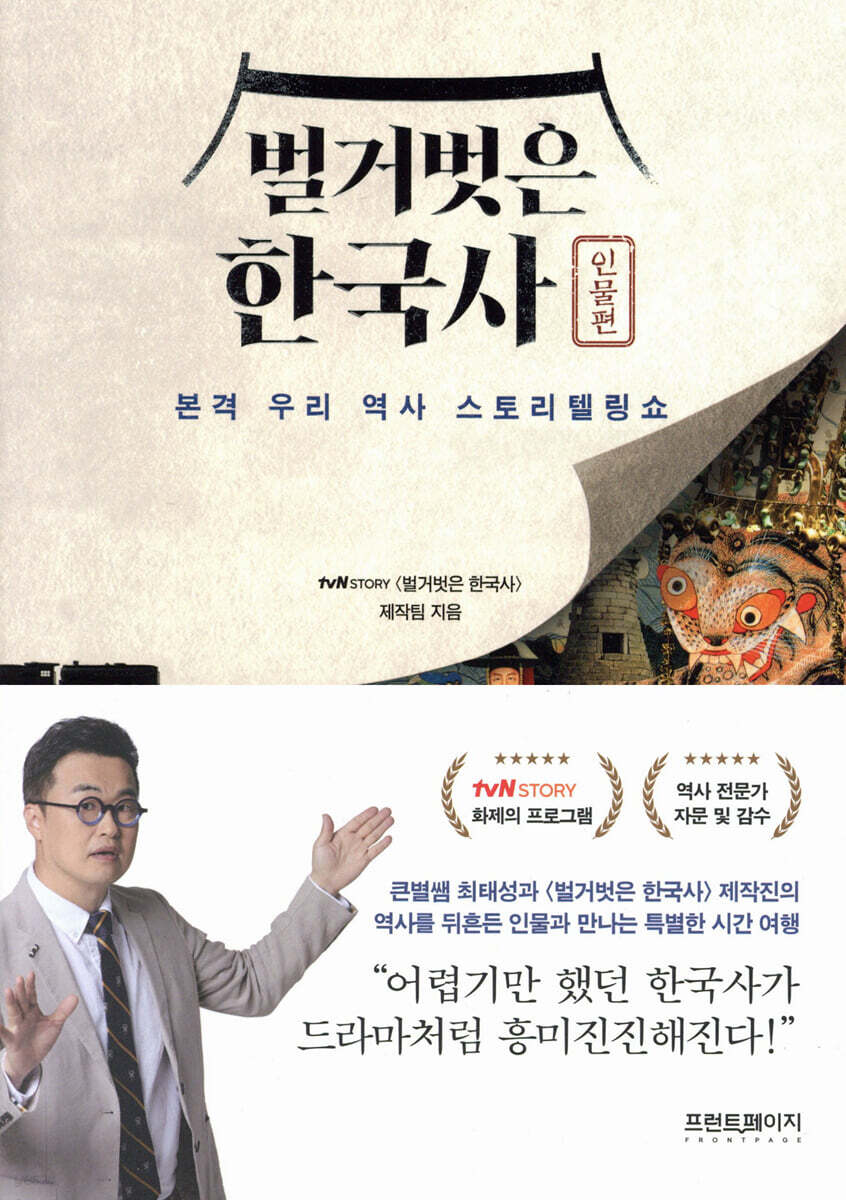
Naked Korean History: People
 |
Description
Book Introduction
- A word from MD
- Decisive moments and figures in Korean historyWhat do King Taejo Yi Seong-gye, King Gung Ye, King Uija, King Taejong Yi Bang-won, King Yeonsangun, Crown Prince Sado, and King Sejong have in common? They lived lives more fascinating than those depicted in movies and dramas.
And that life had a significant impact on the development of Korean history.
We invite you to a journey through Korean history stories that are both fun and meaningful.
August 30, 2022. History PD Son Min-gyu
tvN STORY's hit show "Naked Korean History" now available as a book.
“Korean history was so difficult
It becomes as exciting as a drama!”
tvN's STORY "Naked Korean History," which received attention for its high viewership ratings and buzz, is being published as a book.
〈Naked Korean History〉 is a historical storytelling show that strips bare the hidden stories of Korean history, one by one.
Choi Tae-seong, a leading Korean history lecturer with 6 million cumulative students, served as a guide and delivered a passionate lecture, earning praise as a trustworthy and premium Korean history lecture.
"Naked Korean History: People" is a history textbook that contains the stories of people who shook up our history among the fascinating scenes of Korean history introduced in "Naked Korean History."
From King Uija and Yi Seong-gye, who changed the fate of the nation, to King Yeonsangun and Eou-dong, who astonished the world, we delve into the inner workings of figures not taught in textbooks and the conflicts of interest surrounding them, breathing life into history.
As you read the story, which unfolds as if watching a drama, you will have the surprising experience of naturally understanding the historical facts you had been trying to memorize.
This book, which presents an immersive storytelling based on in-depth knowledge and clear commentary, is a new level of history education that instantly resolves the regret felt from existing stiff and difficult history books.
Whether you are new to Korean history or looking to learn more, you can enjoy history without any burden with 『Naked Korean History: People』.
We invite readers who want to get closer to history through a special time travel experience where they meet people from the past.
“Korean history was so difficult
It becomes as exciting as a drama!”
tvN's STORY "Naked Korean History," which received attention for its high viewership ratings and buzz, is being published as a book.
〈Naked Korean History〉 is a historical storytelling show that strips bare the hidden stories of Korean history, one by one.
Choi Tae-seong, a leading Korean history lecturer with 6 million cumulative students, served as a guide and delivered a passionate lecture, earning praise as a trustworthy and premium Korean history lecture.
"Naked Korean History: People" is a history textbook that contains the stories of people who shook up our history among the fascinating scenes of Korean history introduced in "Naked Korean History."
From King Uija and Yi Seong-gye, who changed the fate of the nation, to King Yeonsangun and Eou-dong, who astonished the world, we delve into the inner workings of figures not taught in textbooks and the conflicts of interest surrounding them, breathing life into history.
As you read the story, which unfolds as if watching a drama, you will have the surprising experience of naturally understanding the historical facts you had been trying to memorize.
This book, which presents an immersive storytelling based on in-depth knowledge and clear commentary, is a new level of history education that instantly resolves the regret felt from existing stiff and difficult history books.
Whether you are new to Korean history or looking to learn more, you can enjoy history without any burden with 『Naked Korean History: People』.
We invite readers who want to get closer to history through a special time travel experience where they meet people from the past.
- You can preview some of the book's contents.
Preview
index
Introduction | Let's go on a special journey together.
Recommended Reading | Stories of People in History Filled with Fun and Meaning _____ Choi Tae-seong
[Part 1] People Who Changed the Fate of the Nation
Chapter 1: The Naked Taejo _____ Kim Gyeong-su
: Why did Lee Seong-gye disobey the royal order and turn back?
Chapter 2 The Naked Tyrant _____ Im Gi-hwan
: Why couldn't Gung Ye read Wang Geon's mind?
Chapter 3 The Naked Last King _____ Lee Do-hak
: How did King Uija become the last king of Baekje?
Chapter 4 The Naked Prince _____ Kim Kyung-soo
: Why did Lee Bang-won dig up his mother's grave?
[Part 2] People Who Shocked the World
Chapter 5: The Naked Deposed King _____ Song Woong-seop, Noh Gyu-sik
: Why did Yeonsangun become mad?
Chapter 6 The Naked Crown Prince _____ Succession Offender
: Why did the Crown Prince have to die locked in a rice chest?
Chapter 7: The Naked King _____ Han Hee-sook
: Why did King Sejong the Great expel his four daughters-in-law?
Chapter 8: Naked Scandal Maker _____ Kim Ji-young
: Did Awoodong really commit a mortal sin?
Recommended Reading | Stories of People in History Filled with Fun and Meaning _____ Choi Tae-seong
[Part 1] People Who Changed the Fate of the Nation
Chapter 1: The Naked Taejo _____ Kim Gyeong-su
: Why did Lee Seong-gye disobey the royal order and turn back?
Chapter 2 The Naked Tyrant _____ Im Gi-hwan
: Why couldn't Gung Ye read Wang Geon's mind?
Chapter 3 The Naked Last King _____ Lee Do-hak
: How did King Uija become the last king of Baekje?
Chapter 4 The Naked Prince _____ Kim Kyung-soo
: Why did Lee Bang-won dig up his mother's grave?
[Part 2] People Who Shocked the World
Chapter 5: The Naked Deposed King _____ Song Woong-seop, Noh Gyu-sik
: Why did Yeonsangun become mad?
Chapter 6 The Naked Crown Prince _____ Succession Offender
: Why did the Crown Prince have to die locked in a rice chest?
Chapter 7: The Naked King _____ Han Hee-sook
: Why did King Sejong the Great expel his four daughters-in-law?
Chapter 8: Naked Scandal Maker _____ Kim Ji-young
: Did Awoodong really commit a mortal sin?
Detailed image

Into the book
When we think of Yi Seong-gye, it's easy to think of him as the first king of Joseon, but in fact, he was Goryeo's greatest general, leading the way in defeating Japanese pirates.
He was a true hero of Goryeo, repelling not only the Japanese pirates but also the Red Turbans, the Jurchen tribe, and the Yuan army, protecting the territory and saving Goryeo.
In 1388, he disobeyed the royal order to conquer Liaodong, turned his horse around at Wihwado Island, and led his troops toward the capital city of Gaeseong.
After occupying the capital, he ascended to the throne and established Joseon.
Why did Yi Seong-gye, who risked his life fighting in every crisis, decide to abandon Goryeo and establish a new nation? We will now uncover the truth behind how Yi Seong-gye became a traitor to Goryeo.
---From "Chapter 1: The Naked King Taejo - Why did Lee Seong-gye disobey the royal order and turn his horse around?"
Gung Ye, who even began to suspect his closest confidant, Wang Geon, strengthened his reign of terror as if trying to shake off his growing anxiety.
People were dying every day.
Mrs. Kang, who could not stand to see Gung Ye's tyranny, cried and pleaded with her husband.
“Stop doing wrong!” Gung Ye became furious and suddenly accused his wife of the crime.
“I know my wife has been having an affair with another man.” He found out about his wife’s affair through the law of interest.
Kang said that such a thing would never happen, but Gung Ye would not listen to him.
Gung Ye, who interrogated his wife at Chugukjang, found her guilty, and in the end, Kang was executed.
And after his wife, he brutally beat his two sons to death.
The atrocity of killing even his own family can be said to be the decisive event that made Gung Ye remembered as a tyrant.
---From "Chapter 2 The Naked Tyrant - Why Couldn't Gung Ye Read Wang Geon's Mind"
Although King Uija lived as a conquering monarch for 15 of his 20-year reign, what many people think of when they hear his name is the image of a debauched monarch with three thousand court ladies.
Because he was the last king of Baekje who failed to protect his country, he is remembered only for enjoying luxury and pleasure, and he was given the harsh stigma of being like the Three Thousand Palace Maidens.
If King Uija had not lost his original intention, the fate of not only Baekje but also the three kingdoms might have been different.
Maintaining a healthy mindset consistently is not a virtue only for kings.
Why not take a moment to reflect on ourselves through the hidden stories of these people? This, too, is one of the many meanings of history.
---From "Chapter 3 The Naked Last King _ How did King Uija become the last king of Baekje?"
After the Gapjasahwa, King Yeonsangun ran wild like a locomotive without brakes.
He neglects state affairs and spends his time indulging in alcohol and women.
Yeonsangun named the gisaengs who gathered in each region 'Unpyeong', and among them, he selected the most beautiful ones who were good at dancing and singing and called them 'Heungcheong'.
Not only did he frequently bestow wealth and slaves on the Heungcheong, he also called their parents to Hanyang and bought them houses and land.
Gyeongbokgung Palace and Changdeokgung Palace, where the king administered state affairs, became playgrounds for Yeonsangun and his followers.
We also enjoyed boating on the pond.
The word 'Heungcheongmangcheong' originated from here.
---From "Chapter 5 The Naked Deposed King - Why Did Yeonsangun Go Mad?"
There are many interpretations of the death of the Crown Prince, but this much is certain.
If we ignore the royal background and view King Yeongjo and Crown Prince Sado only as an ordinary father-son relationship, the death of Crown Prince Sado will inevitably remain a mystery.
Because the royal family is a place that revolves around political interests.
Prince Sado was also a son who initially grew up receiving all of his father's favor.
It's not just a normal father-son relationship, it's a king-crown relationship.
The death of Prince Sado is an event that can only be understood when considering political interests.
If you look at history with this kind of exploratory perspective, you will be able to understand even incomprehensible people and events more deeply.
---From "Chapter 6 The Naked Crown Prince - Why Did Crown Prince Sado Have to Die in a Rice Chest?"
Why did King Sejong, who loved and cared for his people with a spirit of patriotism, show such a cold side to his daughters-in-law? Perhaps because he was the third son of the king, lacking the right to the throne, he desired both his country and his family to conform to his Confucian ideals.
Sejong did not only take care of state affairs with the spirit of long-term prosperity.
Because he considered the family as an area that he had to govern, he intervened in his son and daughter-in-law's problems as if he were watching over their affairs.
It may be difficult to accept from a modern perspective, but Sejong, as both king and head of the household, pursued a royal family that was fully Confucian.
---From "Chapter 7 The Naked King _ How did King Sejong kick out his four daughters-in-law?"
Despite the royal decree to reunite, the husband abandoned his wife, and her parents failed to warmly embrace their daughter.
The maid's promise to introduce a good man who could be her spouse was a shocking proposition, hard to imagine in the Joseon Dynasty, but it was also a tempting offer to Eou-dong, who was just sighing alone.
Awoodong eventually accepted the maid's secret proposal.
Although it was difficult for her to remarry because she was not officially divorced, she chose to live a completely different life than before instead of maintaining the life of a woman from a noble family.
He was a true hero of Goryeo, repelling not only the Japanese pirates but also the Red Turbans, the Jurchen tribe, and the Yuan army, protecting the territory and saving Goryeo.
In 1388, he disobeyed the royal order to conquer Liaodong, turned his horse around at Wihwado Island, and led his troops toward the capital city of Gaeseong.
After occupying the capital, he ascended to the throne and established Joseon.
Why did Yi Seong-gye, who risked his life fighting in every crisis, decide to abandon Goryeo and establish a new nation? We will now uncover the truth behind how Yi Seong-gye became a traitor to Goryeo.
---From "Chapter 1: The Naked King Taejo - Why did Lee Seong-gye disobey the royal order and turn his horse around?"
Gung Ye, who even began to suspect his closest confidant, Wang Geon, strengthened his reign of terror as if trying to shake off his growing anxiety.
People were dying every day.
Mrs. Kang, who could not stand to see Gung Ye's tyranny, cried and pleaded with her husband.
“Stop doing wrong!” Gung Ye became furious and suddenly accused his wife of the crime.
“I know my wife has been having an affair with another man.” He found out about his wife’s affair through the law of interest.
Kang said that such a thing would never happen, but Gung Ye would not listen to him.
Gung Ye, who interrogated his wife at Chugukjang, found her guilty, and in the end, Kang was executed.
And after his wife, he brutally beat his two sons to death.
The atrocity of killing even his own family can be said to be the decisive event that made Gung Ye remembered as a tyrant.
---From "Chapter 2 The Naked Tyrant - Why Couldn't Gung Ye Read Wang Geon's Mind"
Although King Uija lived as a conquering monarch for 15 of his 20-year reign, what many people think of when they hear his name is the image of a debauched monarch with three thousand court ladies.
Because he was the last king of Baekje who failed to protect his country, he is remembered only for enjoying luxury and pleasure, and he was given the harsh stigma of being like the Three Thousand Palace Maidens.
If King Uija had not lost his original intention, the fate of not only Baekje but also the three kingdoms might have been different.
Maintaining a healthy mindset consistently is not a virtue only for kings.
Why not take a moment to reflect on ourselves through the hidden stories of these people? This, too, is one of the many meanings of history.
---From "Chapter 3 The Naked Last King _ How did King Uija become the last king of Baekje?"
After the Gapjasahwa, King Yeonsangun ran wild like a locomotive without brakes.
He neglects state affairs and spends his time indulging in alcohol and women.
Yeonsangun named the gisaengs who gathered in each region 'Unpyeong', and among them, he selected the most beautiful ones who were good at dancing and singing and called them 'Heungcheong'.
Not only did he frequently bestow wealth and slaves on the Heungcheong, he also called their parents to Hanyang and bought them houses and land.
Gyeongbokgung Palace and Changdeokgung Palace, where the king administered state affairs, became playgrounds for Yeonsangun and his followers.
We also enjoyed boating on the pond.
The word 'Heungcheongmangcheong' originated from here.
---From "Chapter 5 The Naked Deposed King - Why Did Yeonsangun Go Mad?"
There are many interpretations of the death of the Crown Prince, but this much is certain.
If we ignore the royal background and view King Yeongjo and Crown Prince Sado only as an ordinary father-son relationship, the death of Crown Prince Sado will inevitably remain a mystery.
Because the royal family is a place that revolves around political interests.
Prince Sado was also a son who initially grew up receiving all of his father's favor.
It's not just a normal father-son relationship, it's a king-crown relationship.
The death of Prince Sado is an event that can only be understood when considering political interests.
If you look at history with this kind of exploratory perspective, you will be able to understand even incomprehensible people and events more deeply.
---From "Chapter 6 The Naked Crown Prince - Why Did Crown Prince Sado Have to Die in a Rice Chest?"
Why did King Sejong, who loved and cared for his people with a spirit of patriotism, show such a cold side to his daughters-in-law? Perhaps because he was the third son of the king, lacking the right to the throne, he desired both his country and his family to conform to his Confucian ideals.
Sejong did not only take care of state affairs with the spirit of long-term prosperity.
Because he considered the family as an area that he had to govern, he intervened in his son and daughter-in-law's problems as if he were watching over their affairs.
It may be difficult to accept from a modern perspective, but Sejong, as both king and head of the household, pursued a royal family that was fully Confucian.
---From "Chapter 7 The Naked King _ How did King Sejong kick out his four daughters-in-law?"
Despite the royal decree to reunite, the husband abandoned his wife, and her parents failed to warmly embrace their daughter.
The maid's promise to introduce a good man who could be her spouse was a shocking proposition, hard to imagine in the Joseon Dynasty, but it was also a tempting offer to Eou-dong, who was just sighing alone.
Awoodong eventually accepted the maid's secret proposal.
Although it was difficult for her to remarry because she was not officially divorced, she chose to live a completely different life than before instead of maintaining the life of a woman from a noble family.
---From "Chapter 8: The Naked Scandal Maker - Did Awoo-dong Really Commit a Mortal Sin"
Publisher's Review
A meeting between Big Star Teacher Choi Tae-seong and the production crew of [Naked Korean History]!
Deep knowledge, clear explanations, and engaging storytelling.
A high-quality history textbook has finally been born.
Every Korean has probably learned about our history at least once, but somehow, when faced with history, our voices become small and only fragmentary knowledge such as dates, events, and people come to mind.
This is because history was approached not as an interesting story, but as complex knowledge with a lot to memorize.
In order to gather scattered information and remember historical facts for a long time, we must pay attention to the essence of history as a 'story.'
tvN's STORY "Naked Korean History," which strips away key scenes from our history and tells interesting stories, also started from that very point.
Among the various stories covered on the show, we have compiled the stories of key figures that we must know in 『Naked Korean History: People』.
This book offers in-depth knowledge from experts in each era and field, and Choi Tae-seong, a leading lecturer in Korean history, uses his many years of teaching expertise to tell the story clearly and interestingly, killing two birds with one stone: depth and fun.
In addition, the completeness was improved by including new content and photo materials that could not be shown on the broadcast due to time constraints.
"Naked Korean History: People," which focuses on the unknown side of Korean history, naturally weaves episodes and concepts into fascinating stories, not only helping readers grasp the larger context of Korean history but also providing a wealth of background knowledge.
Through this book, readers will experience the thrill of seeing the disjointed pieces of the historical puzzle fit together into a single picture.
Now, let's take our first steps into a new world of history filled with fascinating stories.
From King Taejo Lee Seong-gye, who overthrew Goryeo and founded Joseon
Even Joseon's greatest scandal maker, Awoo Dong...
Key figures in our history who shook up Korean history!
Their hidden backstories you never knew about are revealed!
1.
The Last Naked King
There is a word that always appears when talking about King Uija, the last king of Baekje.
It is none other than the ‘Three Thousand Palace Ladies’.
The story of how King Uija's debauchery and extravagance, including having three thousand court ladies, led to the downfall of Baekje is so famous that it is even included in song lyrics in textbooks.
But surprisingly, this story is fake news.
In fact, there were no three thousand palace maids in Baekje.
So why did Baekje end up on the path to destruction? How did King Uija become Baekje's last king?
2.
The Naked Crown Prince
King Yeongjo, the 21st king of Joseon, who had his grown son killed in a rice chest at the age of 28.
Although he has a strong image as a heartless father who killed his own son with his own hands, he was actually a father who loved his youngest son, Crown Prince Sado, whom he had at the late age of 42, more than anyone else.
Why did he, who was like that, throw a knife at his son and tell him to kill himself? When his son refused, why did he lock him in a chest and ultimately kill him?
"Naked Korean History: People" delves into the hidden backstories of the figures who left their mark on our history, from Yi Seong-gye, a hero of the Goryeo Dynasty who became the founder of the Joseon Dynasty, to Eou-dong, the protagonist of a scandal that shocked the world.
By examining in detail why the characters had to make such choices and what kind of world they lived in, the dull and dead history we've encountered in written records is transformed into the story of a single person's life, alive with joy and sorrow.
This presents a new experience of realizing that history was the life of someone who lived before me.
Instructor Choi Tae-seong, who is the history guide for this special time travel to vivid historical sites, says, "History is the humanities that meet people."
The purpose of studying history is to observe the struggles and choices of people in the past and gain lessons that can serve as a starting point for rectifying one's own life and resolving one's worries. I confidently recommend this book as a helpful guide on that path.
Rather than reading history as a boring and dull subject, let's open the bookshelf and listen to interesting old stories that are easy on the ears.
A story journey full of fun and meaning will unfold.
Deep knowledge, clear explanations, and engaging storytelling.
A high-quality history textbook has finally been born.
Every Korean has probably learned about our history at least once, but somehow, when faced with history, our voices become small and only fragmentary knowledge such as dates, events, and people come to mind.
This is because history was approached not as an interesting story, but as complex knowledge with a lot to memorize.
In order to gather scattered information and remember historical facts for a long time, we must pay attention to the essence of history as a 'story.'
tvN's STORY "Naked Korean History," which strips away key scenes from our history and tells interesting stories, also started from that very point.
Among the various stories covered on the show, we have compiled the stories of key figures that we must know in 『Naked Korean History: People』.
This book offers in-depth knowledge from experts in each era and field, and Choi Tae-seong, a leading lecturer in Korean history, uses his many years of teaching expertise to tell the story clearly and interestingly, killing two birds with one stone: depth and fun.
In addition, the completeness was improved by including new content and photo materials that could not be shown on the broadcast due to time constraints.
"Naked Korean History: People," which focuses on the unknown side of Korean history, naturally weaves episodes and concepts into fascinating stories, not only helping readers grasp the larger context of Korean history but also providing a wealth of background knowledge.
Through this book, readers will experience the thrill of seeing the disjointed pieces of the historical puzzle fit together into a single picture.
Now, let's take our first steps into a new world of history filled with fascinating stories.
From King Taejo Lee Seong-gye, who overthrew Goryeo and founded Joseon
Even Joseon's greatest scandal maker, Awoo Dong...
Key figures in our history who shook up Korean history!
Their hidden backstories you never knew about are revealed!
1.
The Last Naked King
There is a word that always appears when talking about King Uija, the last king of Baekje.
It is none other than the ‘Three Thousand Palace Ladies’.
The story of how King Uija's debauchery and extravagance, including having three thousand court ladies, led to the downfall of Baekje is so famous that it is even included in song lyrics in textbooks.
But surprisingly, this story is fake news.
In fact, there were no three thousand palace maids in Baekje.
So why did Baekje end up on the path to destruction? How did King Uija become Baekje's last king?
2.
The Naked Crown Prince
King Yeongjo, the 21st king of Joseon, who had his grown son killed in a rice chest at the age of 28.
Although he has a strong image as a heartless father who killed his own son with his own hands, he was actually a father who loved his youngest son, Crown Prince Sado, whom he had at the late age of 42, more than anyone else.
Why did he, who was like that, throw a knife at his son and tell him to kill himself? When his son refused, why did he lock him in a chest and ultimately kill him?
"Naked Korean History: People" delves into the hidden backstories of the figures who left their mark on our history, from Yi Seong-gye, a hero of the Goryeo Dynasty who became the founder of the Joseon Dynasty, to Eou-dong, the protagonist of a scandal that shocked the world.
By examining in detail why the characters had to make such choices and what kind of world they lived in, the dull and dead history we've encountered in written records is transformed into the story of a single person's life, alive with joy and sorrow.
This presents a new experience of realizing that history was the life of someone who lived before me.
Instructor Choi Tae-seong, who is the history guide for this special time travel to vivid historical sites, says, "History is the humanities that meet people."
The purpose of studying history is to observe the struggles and choices of people in the past and gain lessons that can serve as a starting point for rectifying one's own life and resolving one's worries. I confidently recommend this book as a helpful guide on that path.
Rather than reading history as a boring and dull subject, let's open the bookshelf and listen to interesting old stories that are easy on the ears.
A story journey full of fun and meaning will unfold.
GOODS SPECIFICS
- Publication date: August 22, 2022
- Page count, weight, size: 320 pages | 548g | 152*215*30mm
- ISBN13: 9791197871214
- ISBN10: 1197871217
You may also like
카테고리
korean


korean

![GQ KOREA Mark (Monthly): December [2025]](http://librairie.coreenne.fr/cdn/shop/files/8ef265dbbfbf186523ed75ba7319009d.jpg?v=1765340328&width=3840)


