

Finally, geography class
 |
Description
Book Introduction
Everything that happens on earth is connected to geography.
“A book that properly organizes geography so that anyone can understand it has finally been published.
I guarantee that the moment you finish reading and close it, you will be completely captivated by the magic of geography!
Park Jeong-jae (Professor of Geography, Seoul National University, author of "The Origin of the Korean People")
“Among the many geography books, this one stands out and will remain a long-lasting one!
“A very friendly introductory book and a useful resource for investors and professionals of all walks of life.”
- Kim Si-deok (urban literature scholar, author of "The Future of Korean Cities")
When we talk about geography, many people will first think of the geography subject they learned in high school.
You might only remember it as a subject to memorize to get a good score.
However, geography is a discipline that is closer to our lives and more practical than we think.
Moreover, geography is becoming more important in the 21st century, when everything is becoming more complex and uncertain.
Because everything that happens on this earth, from the homes and cities we live in to wars and climate crises, is connected to geography.
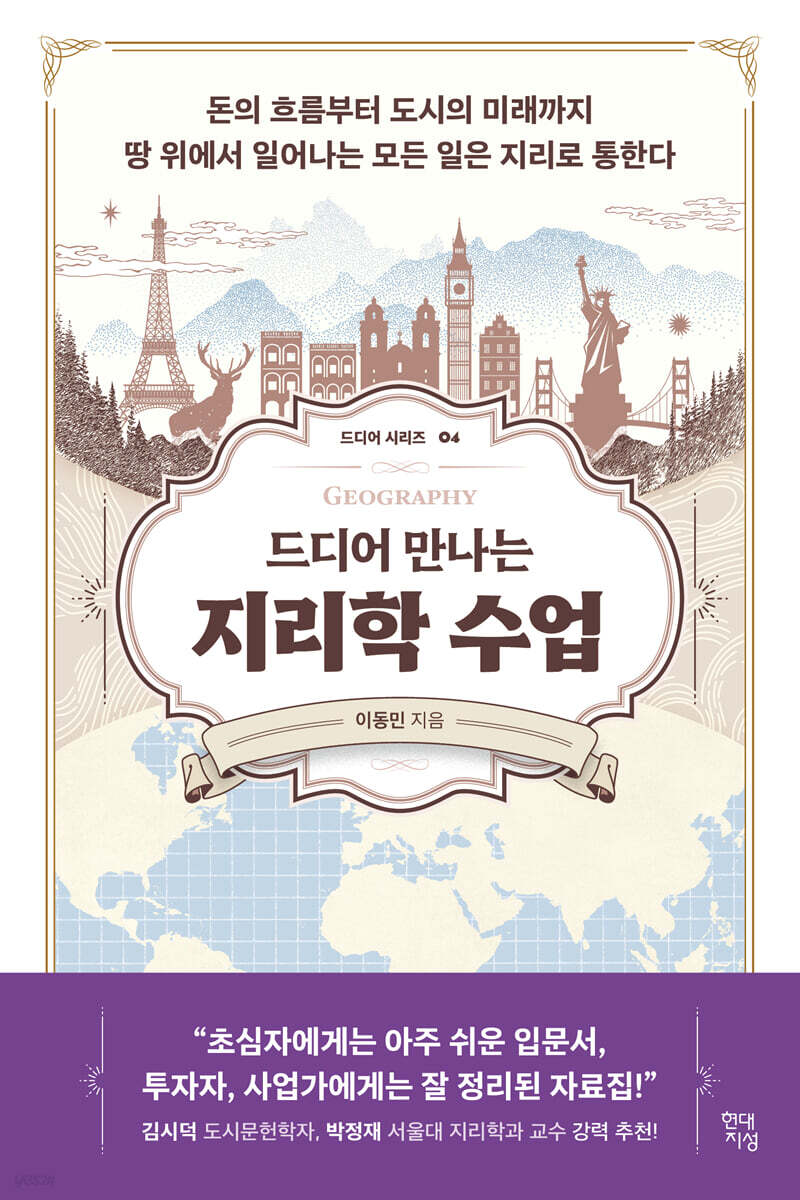
"Finally, We Meet Geography Class" is an introductory book written by Professor Lee Dong-min, a geographer who has practiced and researched geography education for over 15 years, to convey the charm and usefulness of geography.
Everything about geography, from physical geography and human geography to the history of maps, is organized in one volume.
Rather than providing textbook-style knowledge, it contains essential knowledge and insights that help us understand the world, including economics, society, and geopolitics.
Includes 68 colorful maps, diagrams, and color photographs to explain basic geography concepts in a very easy-to-understand manner.
It also contains a wealth of examples closely related to our lives, helping us apply the perspective of geography in real life.
To properly understand what is happening on earth, it is essential to have the ability to interpret and perceive things from a geographical perspective, that is, to have a “geographic eye.”
If you look at the world through the eyes of geography through this book, you will be able to easily and accurately understand the difficult yet unfamiliar world.
“A book that properly organizes geography so that anyone can understand it has finally been published.
I guarantee that the moment you finish reading and close it, you will be completely captivated by the magic of geography!
Park Jeong-jae (Professor of Geography, Seoul National University, author of "The Origin of the Korean People")
“Among the many geography books, this one stands out and will remain a long-lasting one!
“A very friendly introductory book and a useful resource for investors and professionals of all walks of life.”
- Kim Si-deok (urban literature scholar, author of "The Future of Korean Cities")
When we talk about geography, many people will first think of the geography subject they learned in high school.
You might only remember it as a subject to memorize to get a good score.
However, geography is a discipline that is closer to our lives and more practical than we think.
Moreover, geography is becoming more important in the 21st century, when everything is becoming more complex and uncertain.
Because everything that happens on this earth, from the homes and cities we live in to wars and climate crises, is connected to geography.
"Finally, We Meet Geography Class" is an introductory book written by Professor Lee Dong-min, a geographer who has practiced and researched geography education for over 15 years, to convey the charm and usefulness of geography.
Everything about geography, from physical geography and human geography to the history of maps, is organized in one volume.
Rather than providing textbook-style knowledge, it contains essential knowledge and insights that help us understand the world, including economics, society, and geopolitics.
Includes 68 colorful maps, diagrams, and color photographs to explain basic geography concepts in a very easy-to-understand manner.
It also contains a wealth of examples closely related to our lives, helping us apply the perspective of geography in real life.
To properly understand what is happening on earth, it is essential to have the ability to interpret and perceive things from a geographical perspective, that is, to have a “geographic eye.”
If you look at the world through the eyes of geography through this book, you will be able to easily and accurately understand the difficult yet unfamiliar world.
- You can preview some of the book's contents.
Preview
index
Recommendation
Before entering
Entering
Part 1: A Different World Opens Through the Eyes of Geography
Chapter 1: Reading the World Through the Eyes of Geography
What is Geography
When the land changes, people change, and when people change, the world changes.
Changes that occur on land altered by humans
Seeing the world through the eyes of geography
Chapter 2: What You See When You Know Heaven and Earth
Terrain: Nature's drawing on the earth
Climate: The harmony of the sky coloring the land
Part 2: The Power of Geography to Create History and Imagine the Future
Chapter 3: Minimum Geography for Beginners
History and mathematics that formed the basis of geography
The era of exploration opened by the Silk Road and sea routes
Two geographers who laid the foundations of geography
Modern geography, born as a weapon of the great powers
Modern geography developed alongside technological innovation.
Chapter 4: Maps: From Prehistoric Rock Art to Google Maps in Your Hands
The oldest invention that illuminated the eyes of geography
Map Components and How to Read a Map
The Future of Digital Maps Beyond Paper
Part 3: Human Life Unfolding on Geography
Chapter 5: Economics: Understanding Geography Reveals the Flow of Money
It matters where you sit and gather.
The Power of Geography in Reading the Global Economy
Chapter 6: The City: The Most Complex Space Created by Humans
A place of life that changes from village to city
Urban geography, which explores the structure of urban space
The Emergence of Global Cities and the New Future of Cities
Chapter 7: Society: Spaces of Discrimination and Resistance in Our Society
Discrimination in modern society is 'geographical.'
The Dialectics of Resistance Sprouting in Marginalized Spaces
Chapter 8: Culture and History: How to Read the Hidden Stories on Earth
Culture is reflected in human-made spaces.
Knowing geography reveals hidden stories of history.
Chapter 9 Military and Geopolitics: The Power to Read the Victory and Defeat of War and Change World Order
From the Great Game to the New Cold War
He who knows geography rules the battlefield.
Going out
Americas
Image copyright
Before entering
Entering
Part 1: A Different World Opens Through the Eyes of Geography
Chapter 1: Reading the World Through the Eyes of Geography
What is Geography
When the land changes, people change, and when people change, the world changes.
Changes that occur on land altered by humans
Seeing the world through the eyes of geography
Chapter 2: What You See When You Know Heaven and Earth
Terrain: Nature's drawing on the earth
Climate: The harmony of the sky coloring the land
Part 2: The Power of Geography to Create History and Imagine the Future
Chapter 3: Minimum Geography for Beginners
History and mathematics that formed the basis of geography
The era of exploration opened by the Silk Road and sea routes
Two geographers who laid the foundations of geography
Modern geography, born as a weapon of the great powers
Modern geography developed alongside technological innovation.
Chapter 4: Maps: From Prehistoric Rock Art to Google Maps in Your Hands
The oldest invention that illuminated the eyes of geography
Map Components and How to Read a Map
The Future of Digital Maps Beyond Paper
Part 3: Human Life Unfolding on Geography
Chapter 5: Economics: Understanding Geography Reveals the Flow of Money
It matters where you sit and gather.
The Power of Geography in Reading the Global Economy
Chapter 6: The City: The Most Complex Space Created by Humans
A place of life that changes from village to city
Urban geography, which explores the structure of urban space
The Emergence of Global Cities and the New Future of Cities
Chapter 7: Society: Spaces of Discrimination and Resistance in Our Society
Discrimination in modern society is 'geographical.'
The Dialectics of Resistance Sprouting in Marginalized Spaces
Chapter 8: Culture and History: How to Read the Hidden Stories on Earth
Culture is reflected in human-made spaces.
Knowing geography reveals hidden stories of history.
Chapter 9 Military and Geopolitics: The Power to Read the Victory and Defeat of War and Change World Order
From the Great Game to the New Cold War
He who knows geography rules the battlefield.
Going out
Americas
Image copyright
Detailed image

Into the book
To properly view and understand not only the climate crisis but also the various problems of this world, we need a perspective that understands the interactions between humans and the land, the spatial background in which they live.
That is, we need insight based on geography.
In this book, we will call this the 'eye of geography.'
It's important to understand where we stand on the Earth, what the natural environment is like, how the land is used, what kind of people live there, and how it connects to other places and regions around us.
Only when we truly understand how we live in that land can we gain a deeper and broader understanding of our lives and the world we live in.
--- From "Entering"
People live on these different surface spaces.
As a result, the way people live changes depending on the surface space.
With such a changed way of life, people are reshaping the surface space, and this changed surface space in turn affects human life.
Through this cycle, numerous ethnic groups with different languages, customs, and traditions were born on Earth, and various civilizations, nations, and societies were established.
They have shaped human history by interacting with each other, but also by arguing and clashing with each other.
It would not be wrong to say that the reason such diverse human civilizations and dynamic world history have been able to unfold is because humanity has lived in a vast and heterogeneous surface space.
--- From "Chapter 1: Reading the World Through the Eyes of Geography"
In our country, there was a world geography textbook called 『Saminpilji (士民必知)』, which was the first modern Korean textbook published.
This book, compiled in 1889 by Homer Hulbert, an American Protestant missionary who was also an English teacher at Yukyoung Park, Korea's first modern educational institution, was written with the aim of increasing Koreans' understanding of the world and enlightening them while they were caught up in the turbulent waves of imperialism through the study of world geography.
『Saminpilji』, which means that all people including the nobility and commoners must know geography, was banned by the Japanese because it was believed that understanding world geography could enhance the national consciousness of Koreans.
Since the 1990s, globalization has transformed borders from closed to passable, and the large-scale movement of people and information across regions has become routine.
Therefore, rather than understanding various geographical phenomena at one or two fixed scales, such as the nation, a multiscalar approach is gaining attention, which approaches them from the perspective of interactions across various scales, such as cities, regions, neighboring countries, cultural spheres, continents, and the world.
Issues such as the global management of multinational corporations, environmental issues including the climate crisis, and terrorism cannot be properly explained at the national level, and it is difficult to find effective solutions.
In today's reality, where such issues have become commonplace, a multi-scale approach is a more sophisticated "geographic eye" that allows us to view the surface space and the world from a more multifaceted and realistic perspective and address problems.
--- From "Chapter 3: Minimum Geography for Beginners"
In 1569, Mercator, a geographer from the Netherlands, the greatest maritime power in 17th-century Europe, achieved a milestone in human history.
He published a world map using the cylindrical projection, which is now called the Mercator projection.
Originally designed for the purpose of making maps for navigation, the Mercator projection, unlike previous projections, was able to reproduce the angles of geographical features existing on the coordinate system with great precision, while at the same time allowing the vast world to be displayed in a pleasing way on a small, rectangular plane.
Thanks to this, European navigators were able to use the Mercator map to navigate the oceans much more safely and efficiently than before.
Exploration and geographical discovery could also be further promoted.
Because of its widespread use over a long period of time and its suitability for creating world maps, many world maps are still created based on the Mercator projection.
--- From "Chapter 4 Maps: From Prehistoric Rock Art to Google Maps in Your Hand"
No matter how famous or large a multinational corporation is, it cannot manage solely by the standards of its headquarters or home country, ignoring the diverse cultures around the world.
No, because we are a multinational corporation that operates globally, our management cannot be limited to 'universal' standards.
The reason Carrefour failed in our country was because it insisted on the 'global standard' without analyzing the unique culture of Korea.
Selling beef in a Hindu culture or pork in an Islamic culture is bound to fail.
In an age of globalization where the entire world is connected, the local uniqueness of each region is becoming increasingly important.
--- From "Chapter 5 Economy - Knowing Geography Shows the Flow of Money"
In our country, too, places that are emerging as so-called 'hot places' are suffering from the side effects of gentrification.
Increasingly, such places are losing their unique charm and atmosphere and eventually becoming places where only large corporate franchises gather.
Gentrification certainly has the effect of improving the environment of old and run-down downtown areas or transition zones.
But it also pushes residents away from these improved places, causing them to lose their unique identity and charm.
Above all, the problem is that the indigenous people who made that place their home and worked hard to make it a better place are not receiving fair compensation, while only the companies that came in later reap the profits.
Decrepit old towns are a side effect of urbanization and the capitalist economy.
So, is there a way to revitalize these spaces without the harm of gentrification?
--- From "Chapter 7 Society: Spaces of Discrimination and Resistance in Our Society"
Today, as discussions about a new Cold War unfold, the Heartland theory is once again being highlighted, along with Spykman's Rimland theory.
Russia and China are challenging the US-led international order, linking Central Asia as their axis. In response, the US is strengthening its influence in the Indian and Pacific Oceans to check them and maintain a US-centered international order.
This geopolitical confrontation of the new Cold War is reminiscent of Mackinder and Spykman's Heartland versus Rimland conflict.
That is, we need insight based on geography.
In this book, we will call this the 'eye of geography.'
It's important to understand where we stand on the Earth, what the natural environment is like, how the land is used, what kind of people live there, and how it connects to other places and regions around us.
Only when we truly understand how we live in that land can we gain a deeper and broader understanding of our lives and the world we live in.
--- From "Entering"
People live on these different surface spaces.
As a result, the way people live changes depending on the surface space.
With such a changed way of life, people are reshaping the surface space, and this changed surface space in turn affects human life.
Through this cycle, numerous ethnic groups with different languages, customs, and traditions were born on Earth, and various civilizations, nations, and societies were established.
They have shaped human history by interacting with each other, but also by arguing and clashing with each other.
It would not be wrong to say that the reason such diverse human civilizations and dynamic world history have been able to unfold is because humanity has lived in a vast and heterogeneous surface space.
--- From "Chapter 1: Reading the World Through the Eyes of Geography"
In our country, there was a world geography textbook called 『Saminpilji (士民必知)』, which was the first modern Korean textbook published.
This book, compiled in 1889 by Homer Hulbert, an American Protestant missionary who was also an English teacher at Yukyoung Park, Korea's first modern educational institution, was written with the aim of increasing Koreans' understanding of the world and enlightening them while they were caught up in the turbulent waves of imperialism through the study of world geography.
『Saminpilji』, which means that all people including the nobility and commoners must know geography, was banned by the Japanese because it was believed that understanding world geography could enhance the national consciousness of Koreans.
Since the 1990s, globalization has transformed borders from closed to passable, and the large-scale movement of people and information across regions has become routine.
Therefore, rather than understanding various geographical phenomena at one or two fixed scales, such as the nation, a multiscalar approach is gaining attention, which approaches them from the perspective of interactions across various scales, such as cities, regions, neighboring countries, cultural spheres, continents, and the world.
Issues such as the global management of multinational corporations, environmental issues including the climate crisis, and terrorism cannot be properly explained at the national level, and it is difficult to find effective solutions.
In today's reality, where such issues have become commonplace, a multi-scale approach is a more sophisticated "geographic eye" that allows us to view the surface space and the world from a more multifaceted and realistic perspective and address problems.
--- From "Chapter 3: Minimum Geography for Beginners"
In 1569, Mercator, a geographer from the Netherlands, the greatest maritime power in 17th-century Europe, achieved a milestone in human history.
He published a world map using the cylindrical projection, which is now called the Mercator projection.
Originally designed for the purpose of making maps for navigation, the Mercator projection, unlike previous projections, was able to reproduce the angles of geographical features existing on the coordinate system with great precision, while at the same time allowing the vast world to be displayed in a pleasing way on a small, rectangular plane.
Thanks to this, European navigators were able to use the Mercator map to navigate the oceans much more safely and efficiently than before.
Exploration and geographical discovery could also be further promoted.
Because of its widespread use over a long period of time and its suitability for creating world maps, many world maps are still created based on the Mercator projection.
--- From "Chapter 4 Maps: From Prehistoric Rock Art to Google Maps in Your Hand"
No matter how famous or large a multinational corporation is, it cannot manage solely by the standards of its headquarters or home country, ignoring the diverse cultures around the world.
No, because we are a multinational corporation that operates globally, our management cannot be limited to 'universal' standards.
The reason Carrefour failed in our country was because it insisted on the 'global standard' without analyzing the unique culture of Korea.
Selling beef in a Hindu culture or pork in an Islamic culture is bound to fail.
In an age of globalization where the entire world is connected, the local uniqueness of each region is becoming increasingly important.
--- From "Chapter 5 Economy - Knowing Geography Shows the Flow of Money"
In our country, too, places that are emerging as so-called 'hot places' are suffering from the side effects of gentrification.
Increasingly, such places are losing their unique charm and atmosphere and eventually becoming places where only large corporate franchises gather.
Gentrification certainly has the effect of improving the environment of old and run-down downtown areas or transition zones.
But it also pushes residents away from these improved places, causing them to lose their unique identity and charm.
Above all, the problem is that the indigenous people who made that place their home and worked hard to make it a better place are not receiving fair compensation, while only the companies that came in later reap the profits.
Decrepit old towns are a side effect of urbanization and the capitalist economy.
So, is there a way to revitalize these spaces without the harm of gentrification?
--- From "Chapter 7 Society: Spaces of Discrimination and Resistance in Our Society"
Today, as discussions about a new Cold War unfold, the Heartland theory is once again being highlighted, along with Spykman's Rimland theory.
Russia and China are challenging the US-led international order, linking Central Asia as their axis. In response, the US is strengthening its influence in the Indian and Pacific Oceans to check them and maintain a US-centered international order.
This geopolitical confrontation of the new Cold War is reminiscent of Mackinder and Spykman's Heartland versus Rimland conflict.
--- From "Chapter 9 Military and Geopolitics - The Power to Read the Victory or Defeat of War and Move the World Order"
Publisher's Review
What happens on the ground
Everything is connected by geography
There is a saying, 'geographic illiteracy'.
We are now more accustomed to relying on navigation and smartphone map apps rather than finding and memorizing our own routes.
We receive news from around the world in real time, but we often only receive superficial images of specific regions.
The convenience we enjoy through the advancement of science and technology is dulling our ability to understand geography.
The problem isn't simply that you can't find your way around or don't know a particular area well.
The real problem is that our lack of understanding of geography hinders our ability to properly interpret the world we live in.
Why do Gangnam's housing prices keep rising? Why do "hot spots" emerge? What secrets lie hidden in places like Silicon Valley, where global companies flock? These questions are usually answered from economic, political, or social perspectives.
But if you don't take geography into account, it can only be a half-answer.
Because everything that happens on earth is inevitably related to geography.
In "The Geography Class We Finally Meet," geography is explained as a discipline that deals with the interaction between land and humans.
It teaches us how to interpret all issues closely related to our lives, from which neighborhood is best to buy a house to how the world economy and international affairs will unfold, from a geographical perspective, or through the "eyes of geography."
You can encounter geography not as knowledge to be memorized from textbooks, but as a practical tool that helps in real life.
Incorporating nature, humanities, and history
Everything about geography in one volume
"Finally, We Meet Geography Class" is an introductory book to geography written by Professor Lee Dong-min, a geographer who has dedicated himself to geography education for over 15 years, based on his experience and research.
From physical geography, which explores the relationship between humans and the natural environment, to human geography, which analyzes human-created spaces and activities, to the history of geography and mapmaking, this book covers everything.
Beyond simple conceptual explanations, it helps you understand the world in three dimensions by analyzing urban development, economic trends, and changes in international politics through the 'eyes of geography.'
Part 1 of this book introduces the "eye of geography," a perspective that allows us to observe and reflect on the world geographically.
We will learn about physical geography, the most fundamental foundation on which human life is built, and also establish the basic concepts of geography.
Part 2 covers the evolution of maps and geography, from prehistoric times when hunting grounds were drawn on cave walls to today's smartphone mapping apps.
We can see how important the 'eye of geography' has been and what role it has played in human history.
In the final third part, we will apply the 'eye of geography' learned in parts 1 and 2 to real-life situations.
Analyze the seven elements that make up our lives, from economy and cities to society, history, culture, military, and geopolitics, from the perspective of human geography.
The flow of money and the way cities develop can be better understood through knowledge of economic geography.
Social problems such as discrimination and inequality can also be interpreted from the perspective of social geography.
To predict how the world order will unfold in the new Cold War system where the confrontation between the US and China is intensifying, we must approach it from a geopolitical perspective.
In this way, if we look at it through the 'eyes of geography', we can understand the principles of how the world works more easily and accurately.
A beginner-friendly introduction
A useful resource for experts
Geography as a liberal arts subject rather than a school subject is still somewhat unfamiliar to us.
So, this book is designed to make geography accessible and interesting to anyone, regardless of age or gender.
The book begins by presenting a classification of disciplines and a glossary of terms to establish the basic concepts of geography.
The author's expertise from teaching geography in the classroom for a long time is evident in the narrative style that naturally helps understanding by providing various examples.
As you read through the 68 colorful maps, charts, and color photographs, you'll find yourself captivated by the wonders of geography.
This book is the perfect introductory text for those who are new to geography.
At the same time, it is a useful resource for professionals working in investment, business, or specific fields.
It is rich in cutting-edge case studies from various fields, providing new insights.
A geographer's perspective, which seeks to understand a problem comprehensively by identifying the individual elements that make up the whole, would also be a useful reference.
Gilbert H., the first editor-in-chief of National Geographic
Grosvenor said, “A map is the greatest epic,” and “its lines and colors are the realization of a great dream.”
This book will provide you with a guide to navigate the complexities of life and achieve your dreams.
Everything is connected by geography
There is a saying, 'geographic illiteracy'.
We are now more accustomed to relying on navigation and smartphone map apps rather than finding and memorizing our own routes.
We receive news from around the world in real time, but we often only receive superficial images of specific regions.
The convenience we enjoy through the advancement of science and technology is dulling our ability to understand geography.
The problem isn't simply that you can't find your way around or don't know a particular area well.
The real problem is that our lack of understanding of geography hinders our ability to properly interpret the world we live in.
Why do Gangnam's housing prices keep rising? Why do "hot spots" emerge? What secrets lie hidden in places like Silicon Valley, where global companies flock? These questions are usually answered from economic, political, or social perspectives.
But if you don't take geography into account, it can only be a half-answer.
Because everything that happens on earth is inevitably related to geography.
In "The Geography Class We Finally Meet," geography is explained as a discipline that deals with the interaction between land and humans.
It teaches us how to interpret all issues closely related to our lives, from which neighborhood is best to buy a house to how the world economy and international affairs will unfold, from a geographical perspective, or through the "eyes of geography."
You can encounter geography not as knowledge to be memorized from textbooks, but as a practical tool that helps in real life.
Incorporating nature, humanities, and history
Everything about geography in one volume
"Finally, We Meet Geography Class" is an introductory book to geography written by Professor Lee Dong-min, a geographer who has dedicated himself to geography education for over 15 years, based on his experience and research.
From physical geography, which explores the relationship between humans and the natural environment, to human geography, which analyzes human-created spaces and activities, to the history of geography and mapmaking, this book covers everything.
Beyond simple conceptual explanations, it helps you understand the world in three dimensions by analyzing urban development, economic trends, and changes in international politics through the 'eyes of geography.'
Part 1 of this book introduces the "eye of geography," a perspective that allows us to observe and reflect on the world geographically.
We will learn about physical geography, the most fundamental foundation on which human life is built, and also establish the basic concepts of geography.
Part 2 covers the evolution of maps and geography, from prehistoric times when hunting grounds were drawn on cave walls to today's smartphone mapping apps.
We can see how important the 'eye of geography' has been and what role it has played in human history.
In the final third part, we will apply the 'eye of geography' learned in parts 1 and 2 to real-life situations.
Analyze the seven elements that make up our lives, from economy and cities to society, history, culture, military, and geopolitics, from the perspective of human geography.
The flow of money and the way cities develop can be better understood through knowledge of economic geography.
Social problems such as discrimination and inequality can also be interpreted from the perspective of social geography.
To predict how the world order will unfold in the new Cold War system where the confrontation between the US and China is intensifying, we must approach it from a geopolitical perspective.
In this way, if we look at it through the 'eyes of geography', we can understand the principles of how the world works more easily and accurately.
A beginner-friendly introduction
A useful resource for experts
Geography as a liberal arts subject rather than a school subject is still somewhat unfamiliar to us.
So, this book is designed to make geography accessible and interesting to anyone, regardless of age or gender.
The book begins by presenting a classification of disciplines and a glossary of terms to establish the basic concepts of geography.
The author's expertise from teaching geography in the classroom for a long time is evident in the narrative style that naturally helps understanding by providing various examples.
As you read through the 68 colorful maps, charts, and color photographs, you'll find yourself captivated by the wonders of geography.
This book is the perfect introductory text for those who are new to geography.
At the same time, it is a useful resource for professionals working in investment, business, or specific fields.
It is rich in cutting-edge case studies from various fields, providing new insights.
A geographer's perspective, which seeks to understand a problem comprehensively by identifying the individual elements that make up the whole, would also be a useful reference.
Gilbert H., the first editor-in-chief of National Geographic
Grosvenor said, “A map is the greatest epic,” and “its lines and colors are the realization of a great dream.”
This book will provide you with a guide to navigate the complexities of life and achieve your dreams.
GOODS SPECIFICS
- Date of issue: March 7, 2025
- Page count, weight, size: 392 pages | 506g | 140*210*28mm
- ISBN13: 9791139720761
- ISBN10: 1139720767
You may also like
카테고리
korean


korean

![GQ KOREA Mark (Monthly): December [2025]](http://librairie.coreenne.fr/cdn/shop/files/8ef265dbbfbf186523ed75ba7319009d.jpg?v=1765340328&width=3840)


