

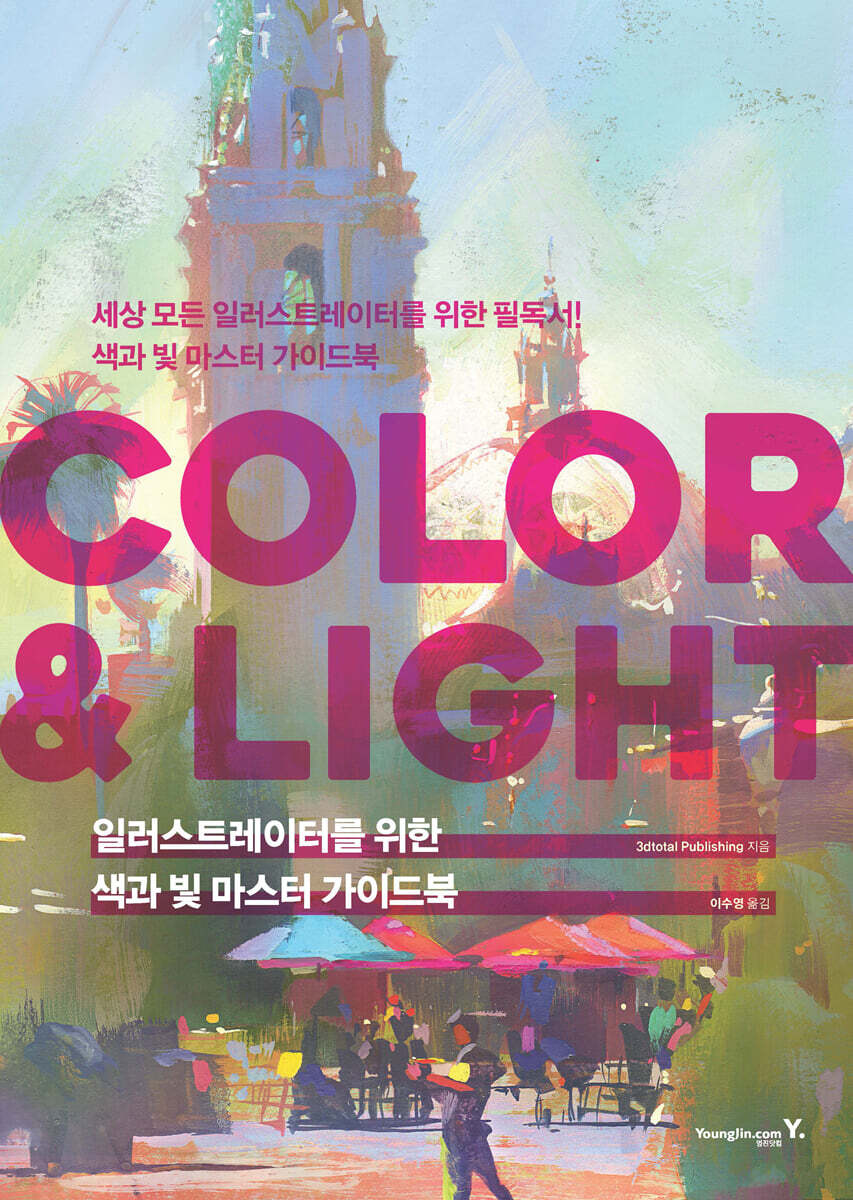
Color & Light Master Guidebook for Illustrators: COLOR & LIGHT
 |
Description
Book Introduction
A must-read for every illustrator in the world!
Color and Light Master Guidebook
[Color and Light Master Guidebook] thoroughly analyzes the theories and practices that can develop art using 'color' and 'light' based on the rich experiences of world-class artists.
In Charlie Picard's introduction to the theory of 'color' and 'light', you will understand color-related terminology and color theory, as well as how to deal with hue, value, and saturation that make up color. You will also learn how to express shape, form, and texture using light and shadow.
Additionally, you can hear vivid stories of how artists who are recognized for their unique works, such as Diamilla Khnopf, Gu Weiz, and Nathan Fox, utilize 'color' and 'light' in their work.
Color and Light Master Guidebook
[Color and Light Master Guidebook] thoroughly analyzes the theories and practices that can develop art using 'color' and 'light' based on the rich experiences of world-class artists.
In Charlie Picard's introduction to the theory of 'color' and 'light', you will understand color-related terminology and color theory, as well as how to deal with hue, value, and saturation that make up color. You will also learn how to express shape, form, and texture using light and shadow.
Additionally, you can hear vivid stories of how artists who are recognized for their unique works, such as Diamilla Khnopf, Gu Weiz, and Nathan Fox, utilize 'color' and 'light' in their work.
- You can preview some of the book's contents.
Preview
index
[COLOR by Charlie Picard]
What you see is subjective
Contrast and harmony
Munsell's color theory
Color hierarchy
Color Constancy PART 01: Brightness
Brightness grouping
Exposure and Us
Brightness keying
Brightness scale
Shape and Border
Color components
CMY vs RBY
Traditional saturation mixing
Saturation and saturation
Light blue, dark blue, and turquoise
Color temperature
Lightness of color
Colors not in the spectrum
Color contrast
Color Constancy PART 02: Color
Exposure in color
[LIGHT by Charlie Picard]
Light: Matte
properties of objects
Basic shapes
plane
Specular reflection
diffuse reflection
Directionality of light
Change in shape = change in brightness
Unique color
Proper brightness
Sculpting of basic shapes
deformation of shape
Practice for intuitive lighting handling
Drawing of cast shadows
Hard light
Ambient light and occlusion
Natural light vs. local lighting
The descent of brightness
Color modeling and color lighting
Shadows created by ambient light
reflected light
The color of the dark part
global illumination
Temperature of the light source
blackbody radiator
Changes in daylight
Light: Specular Reflector
Specular reflection
mirror
Drawing a Mirror, PART 01
Location of the reflection
Drawing a Mirror, Part 02
curved mirror
regular hexahedron
specular sphere
Specular reflector of complex shape
Color change of the reflector
Light: Transparent
transparent body
atmospheric perspective
Understanding Refraction
Surfaces and shapes of transparent bodies
Shadows and first impressions of transparent objects
Total internal reflection
Color change
Refraction and chromaticity
translucent body
Subsurface scattering
Light: Mixing Different Objects
Fresnel effect
Specular reflection effect seen on matte surfaces
Changes in texture
Objects with complex textures: skin
Objects with complex textures: fabrics
Other objects with complex textures
[Tutorial]
DAY BY DAY by Diamilla Knopf
DINNER by Guwaiz
BALBOA SPIRE by Nathan Fox
[Gallery]
Diamilla Knopf
Gu Weiz
Nathan Fox
Beatrice Blue
Nocturne to Dibu
Simon Grünewald
Iraville
Devin Elle Kurtz
Asha Radoska
Phenyle Oerum
What you see is subjective
Contrast and harmony
Munsell's color theory
Color hierarchy
Color Constancy PART 01: Brightness
Brightness grouping
Exposure and Us
Brightness keying
Brightness scale
Shape and Border
Color components
CMY vs RBY
Traditional saturation mixing
Saturation and saturation
Light blue, dark blue, and turquoise
Color temperature
Lightness of color
Colors not in the spectrum
Color contrast
Color Constancy PART 02: Color
Exposure in color
[LIGHT by Charlie Picard]
Light: Matte
properties of objects
Basic shapes
plane
Specular reflection
diffuse reflection
Directionality of light
Change in shape = change in brightness
Unique color
Proper brightness
Sculpting of basic shapes
deformation of shape
Practice for intuitive lighting handling
Drawing of cast shadows
Hard light
Ambient light and occlusion
Natural light vs. local lighting
The descent of brightness
Color modeling and color lighting
Shadows created by ambient light
reflected light
The color of the dark part
global illumination
Temperature of the light source
blackbody radiator
Changes in daylight
Light: Specular Reflector
Specular reflection
mirror
Drawing a Mirror, PART 01
Location of the reflection
Drawing a Mirror, Part 02
curved mirror
regular hexahedron
specular sphere
Specular reflector of complex shape
Color change of the reflector
Light: Transparent
transparent body
atmospheric perspective
Understanding Refraction
Surfaces and shapes of transparent bodies
Shadows and first impressions of transparent objects
Total internal reflection
Color change
Refraction and chromaticity
translucent body
Subsurface scattering
Light: Mixing Different Objects
Fresnel effect
Specular reflection effect seen on matte surfaces
Changes in texture
Objects with complex textures: skin
Objects with complex textures: fabrics
Other objects with complex textures
[Tutorial]
DAY BY DAY by Diamilla Knopf
DINNER by Guwaiz
BALBOA SPIRE by Nathan Fox
[Gallery]
Diamilla Knopf
Gu Weiz
Nathan Fox
Beatrice Blue
Nocturne to Dibu
Simon Grünewald
Iraville
Devin Elle Kurtz
Asha Radoska
Phenyle Oerum
Detailed image

Publisher's Review
Color
Color and light are closely intertwined topics, and in many ways they are virtually the same thing, since color requires light to be visible.
However, to break down such a complex subject into appropriate sections, let's first discuss color, and then discuss the movement of light in [Light].
In [Color], artist Charlie Picard explores the many dimensions and interpretations of color.
Through this, we will discuss how we perceive color, the various ways we can induce color perception, how to control color, and how to utilize color theory in both graphics programs and the actual mixing of pigments.
LIGHT
In the previous [Color], we looked at how color works and how color and light interact.
Now, I would like to delve a little deeper into the subject of light itself.
[Light] introduces light and the basic objects found around us.
And we'll go a little deeper and discuss how to describe diffuse reflection, specular reflection, and transmission that occur on the surface of an object, and how we can represent objects with different surfaces under different lighting.
TUTORIALS
In [Tutorial], we will take time to introduce how artists who are recognized for their unique works, such as Diamilla Khnopf, Gu Weiz, and Nathan Fox, utilize 'color' and 'light' in their works.
In Diamilla Khnopf's [DAY BY DAY], we will depict a summer day in different lighting situations: a cloudy day, a clear sunny day, an early morning sky, a sunset, and a rainy day.
Each lighting situation gives a different mood and story.
In Gu Weizhi's [DINNER], he uses brightness and lighting to express a dark atmosphere and portray the figures on the screen.
It introduces a series of steps to set the brightness, ambient light, and color for each area, and to express the volume, texture, and occlusion of the ambient light on the surface of an object.
Nathan Fox's [BALBOA SPIRE] depicts a unique landscape off the coast of San Diego, California.
Through this, we will learn how sunlight meets vibrant neutral colors to create a striking visual effect.
Gallery
In [Gallery], we will explore how seven artists, including Diamila Khnopf, Gu Weiz, and Nathan Fox, express ‘color’ and ‘light’ in their works.
Color and light are closely intertwined topics, and in many ways they are virtually the same thing, since color requires light to be visible.
However, to break down such a complex subject into appropriate sections, let's first discuss color, and then discuss the movement of light in [Light].
In [Color], artist Charlie Picard explores the many dimensions and interpretations of color.
Through this, we will discuss how we perceive color, the various ways we can induce color perception, how to control color, and how to utilize color theory in both graphics programs and the actual mixing of pigments.
LIGHT
In the previous [Color], we looked at how color works and how color and light interact.
Now, I would like to delve a little deeper into the subject of light itself.
[Light] introduces light and the basic objects found around us.
And we'll go a little deeper and discuss how to describe diffuse reflection, specular reflection, and transmission that occur on the surface of an object, and how we can represent objects with different surfaces under different lighting.
TUTORIALS
In [Tutorial], we will take time to introduce how artists who are recognized for their unique works, such as Diamilla Khnopf, Gu Weiz, and Nathan Fox, utilize 'color' and 'light' in their works.
In Diamilla Khnopf's [DAY BY DAY], we will depict a summer day in different lighting situations: a cloudy day, a clear sunny day, an early morning sky, a sunset, and a rainy day.
Each lighting situation gives a different mood and story.
In Gu Weizhi's [DINNER], he uses brightness and lighting to express a dark atmosphere and portray the figures on the screen.
It introduces a series of steps to set the brightness, ambient light, and color for each area, and to express the volume, texture, and occlusion of the ambient light on the surface of an object.
Nathan Fox's [BALBOA SPIRE] depicts a unique landscape off the coast of San Diego, California.
Through this, we will learn how sunlight meets vibrant neutral colors to create a striking visual effect.
Gallery
In [Gallery], we will explore how seven artists, including Diamila Khnopf, Gu Weiz, and Nathan Fox, express ‘color’ and ‘light’ in their works.
GOODS SPECIFICS
- Date of issue: October 2, 2024
- Format: Hardcover book binding method guide
- Page count, weight, size: 388 pages | 1,754g | 217*304*27mm
- ISBN13: 9788931477429
- ISBN10: 8931477422
You may also like
카테고리
korean


korean

![GQ KOREA Mark (Monthly): December [2025]](http://librairie.coreenne.fr/cdn/shop/files/8ef265dbbfbf186523ed75ba7319009d.jpg?v=1765340328&width=3840)


