

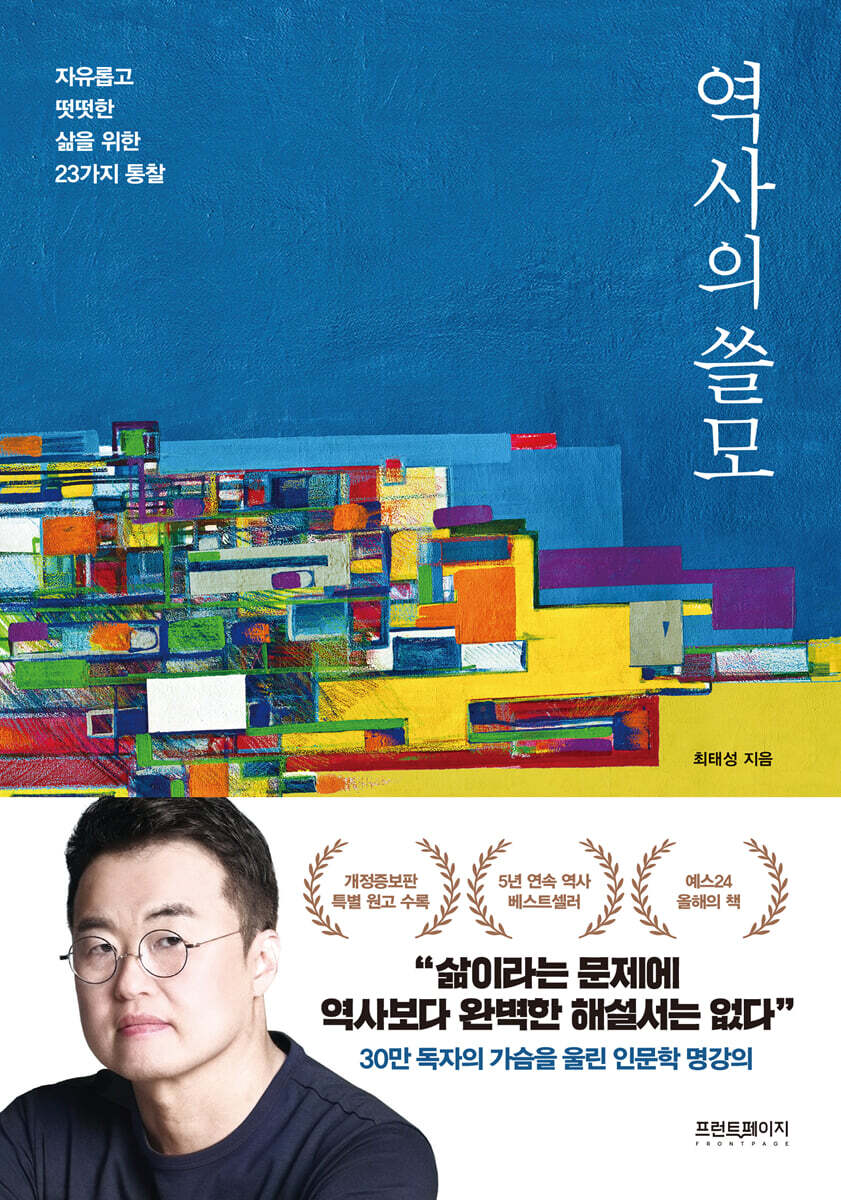
The Usefulness of History
 |
Description
Book Introduction
“On the question of life
“There is no commentary more perfect than history.”
A representative historical textbook of our time, loved by 300,000 readers.
Publication of the revised and expanded edition of "The Usefulness of History"
“Is there any other book that explains so well how useful history is to our lives?” - From a reader review
This book is a revised and expanded edition of the bestseller “The Usefulness of History,” which sold nearly 300,000 copies since its publication.
This book contains the world's most practical methods of using history, acquired through decades of history communication by Choi Tae-seong, Korea's leading history communicator.
This revised and expanded edition includes an article ("Humanity's Survival Guide to Overcoming Crisis") in which the author introduces the newfound utility of history during the COVID-19 pandemic, offering 23 insights.
《The Usefulness of History》 is not a book that explains history in an easy and fun way.
Rather, it is more like a history user manual that teaches us how to solve today's problems using stories from hundreds of years ago.
This is precisely what author Choi Tae-seong did when he used history.
He says that whenever he is faced with a crossroads, he finds answers in history, and he emphasizes that history is the most perfect commentary on life.
And as if to answer those who ask what use is learning history, this book looks at history from a thoroughly practical perspective.
We freely move between Korean and world history, extracting meaning that will serve as a criterion for selection, and summoning as mentors those who have lived their lives creating their own trajectory.
This book, which clearly answers the question, "Why should we learn history?", is cited as a life-changing book by countless readers and has maintained its position as a history bestseller since its publication in 2019.
This revised and expanded edition, published together with the sequel, "The Usefulness of History Again," rewrote the changing social landscape to fit the present time, and refined and supplemented any shortcomings while maintaining the core of the text.
Some of the illustrations in the book have also been replaced.
The Usefulness of History, which has captivated hundreds of thousands of readers and sparked a craze for usefulness in South Korea, is waiting for you in a new outfit.
This book transforms history from a painful subject to memorize into a life guidebook that offers answers whenever you feel lost and wandering. With it, you'll have a hands-on approach to history that allows you to apply its lessons to every aspect of your life.
“There is no commentary more perfect than history.”
A representative historical textbook of our time, loved by 300,000 readers.
Publication of the revised and expanded edition of "The Usefulness of History"
“Is there any other book that explains so well how useful history is to our lives?” - From a reader review
This book is a revised and expanded edition of the bestseller “The Usefulness of History,” which sold nearly 300,000 copies since its publication.
This book contains the world's most practical methods of using history, acquired through decades of history communication by Choi Tae-seong, Korea's leading history communicator.
This revised and expanded edition includes an article ("Humanity's Survival Guide to Overcoming Crisis") in which the author introduces the newfound utility of history during the COVID-19 pandemic, offering 23 insights.
《The Usefulness of History》 is not a book that explains history in an easy and fun way.
Rather, it is more like a history user manual that teaches us how to solve today's problems using stories from hundreds of years ago.
This is precisely what author Choi Tae-seong did when he used history.
He says that whenever he is faced with a crossroads, he finds answers in history, and he emphasizes that history is the most perfect commentary on life.
And as if to answer those who ask what use is learning history, this book looks at history from a thoroughly practical perspective.
We freely move between Korean and world history, extracting meaning that will serve as a criterion for selection, and summoning as mentors those who have lived their lives creating their own trajectory.
This book, which clearly answers the question, "Why should we learn history?", is cited as a life-changing book by countless readers and has maintained its position as a history bestseller since its publication in 2019.
This revised and expanded edition, published together with the sequel, "The Usefulness of History Again," rewrote the changing social landscape to fit the present time, and refined and supplemented any shortcomings while maintaining the core of the text.
Some of the illustrations in the book have also been replaced.
The Usefulness of History, which has captivated hundreds of thousands of readers and sparked a craze for usefulness in South Korea, is waiting for you in a new outfit.
This book transforms history from a painful subject to memorize into a life guidebook that offers answers whenever you feel lost and wandering. With it, you'll have a hands-on approach to history that allows you to apply its lessons to every aspect of your life.
- You can preview some of the book's contents.
Preview
index
Publishing the revised and expanded edition
Introduction | There is no more perfect commentary on the questions of life than history.
Chapter 1 | The Usefulness of Things That Seem Useless
An expedition to find hidden treasures
Meeting people, not records
A tangible hope that makes you dream of a new day
The power of choice to create a dignified life
In order not to remain a spectator of history
Humanity's survival strategy for overcoming crises
Chapter 2 | What History Has Taught Me
Innovation: How the Weak Silla Kingdom Became the Hero of the Unification of the Three Kingdoms
Reflection: Why Did the Inca Empire, the Land of the Sun, Fall?
Creation: The Conditions for Thinking That Change the World
Negotiation: Masters of Negotiation: Give One, Get Two
Empathy: Why did grandparents come out to the plaza holding the Taegeukgi?
Rationality: Should We Care About Face or Practicality?
Communication: How to effectively convey your message
Chapter 3 | One Life, How to Live It
Jeong Do-jeon: To be free from oppression
Kim Yuk: The Meaning of Giving One's Life
Jang Bogo: The Power of Imagining Beyond the Sea
Park Sang-jin: Dreams should be verbs, not nouns.
Lee Hoi-young: A Look at the Challenges of Our Times
Chapter 4 | For those seeking answers to life
Each life requires its own trajectory.
If we look at the present in the flow of history
Is my temperature right now?
The weight of the word citizen
What you need to live well today
The text that comes out | Thinking of those who drew the outline of life
Introduction | There is no more perfect commentary on the questions of life than history.
Chapter 1 | The Usefulness of Things That Seem Useless
An expedition to find hidden treasures
Meeting people, not records
A tangible hope that makes you dream of a new day
The power of choice to create a dignified life
In order not to remain a spectator of history
Humanity's survival strategy for overcoming crises
Chapter 2 | What History Has Taught Me
Innovation: How the Weak Silla Kingdom Became the Hero of the Unification of the Three Kingdoms
Reflection: Why Did the Inca Empire, the Land of the Sun, Fall?
Creation: The Conditions for Thinking That Change the World
Negotiation: Masters of Negotiation: Give One, Get Two
Empathy: Why did grandparents come out to the plaza holding the Taegeukgi?
Rationality: Should We Care About Face or Practicality?
Communication: How to effectively convey your message
Chapter 3 | One Life, How to Live It
Jeong Do-jeon: To be free from oppression
Kim Yuk: The Meaning of Giving One's Life
Jang Bogo: The Power of Imagining Beyond the Sea
Park Sang-jin: Dreams should be verbs, not nouns.
Lee Hoi-young: A Look at the Challenges of Our Times
Chapter 4 | For those seeking answers to life
Each life requires its own trajectory.
If we look at the present in the flow of history
Is my temperature right now?
The weight of the word citizen
What you need to live well today
The text that comes out | Thinking of those who drew the outline of life
Detailed image

Into the book
When I'm driving with dim lights, I check my rearview mirror to make sure I'm going the right way and that my surroundings are safe.
We live in a time when life is more uncertain than ever.
In these times, we, each of us, as we navigate our own lives, need a rearview mirror called history to observe our surroundings.
So as long as life continues, history is still 'useful'.
---From “Publishing the Revised and Expanded Edition”
Some people say that history is simply a record of facts, but I disagree; rather, I emphasize that history is a humanities discipline that encounters people.
History is something that helps us think about and practice how to live by looking into the lives of those who lived before us.
If you study history but don't find any inspiration in life, it's hard to say you've studied history properly.
---From “Introduction_There is no more perfect commentary on the problem of life than history”
Those who are considered great in history are not those who wandered at the top.
They are people who know when to step down and who have stepped down well.
We must learn from history how to 'pass down well'.
Because through this, I can protect my existence and my status.
(…) I believe that historical thinking is of great help in making dignified choices.
Historical thinking means considering how your choices will be interpreted in history and considering the impact they will have on others.
Many people only think about the present.
But no event exists in itself.
---From "The Power of Choice to Create a Dignified Life"
We've described COVID-19 as an unprecedented crisis, but in truth, human history is a record of how humans have dealt with crises.
As this thought crossed my mind, I began to wonder how humanity has overcome so many crises.
We looked into history to see if there was a special secret that allowed humanity to survive until now.
(…) Looking at the history of the countless living things that have appeared on Earth, we realize anew that humans are very weak beings.
It doesn't have sharp teeth or claws, nor does it have poison or wings.
I must have lived in fear, not knowing when I would die.
Yet, the reason humans did not go extinct was because they joined forces.
Solidarity was the way and weapon of human survival.
---From "Humanity's Survival Guide to Overcoming Crisis"
More important than being the first or the best technology is influence.
What Gutenberg's printing press, the iPhone, and Hangul have in common is that they discovered and satisfied a public need that was not even known to exist.
It has made it easier for many people to communicate.
Any act that helps expand human freedom, like Gutenberg's printing press, is bound to leave a significant mark on history.
(…) I believe that technology that is for the minority and represents the interests of the minority does not fit with the flow of history.
History moves towards the expansion of freedom.
Creative inventions with explosive power are not for the few, but for the many.
When we talk about creation or creativity, people are always trying to create something new that never existed before.
However, no matter how new it is, if people don't choose it and don't get excited about it, it won't be widely used.
---From "Creation: The Conditions of Thought That Change the World"
Jeong Do-jeon's ideas were extremely radical.
He advocated confiscating all land and distributing it to the people for free, and also freeing slaves.
(…) What is noteworthy is that he was the one who proposed an alternative.
Jeong Do-jeon, who encountered the crooked world while being exiled and wandering, felt a sense of crisis and thought that such a world needed to be changed.
And I thought about each and every solution in detail.
Instead of giving up in the long, dark tunnel of life, I moved to create the world I wanted.
If he had suffered and drank heavily, saying, "How can you treat someone like me like this? Goryeo should fall!", the name Jeong Do-jeon would have been forgotten in history.
---From "Jeong Do-jeon: To Be Free from Oppression"
Independence activist Park Sang-jin was a student studying law.
He was not only smart, but also came from a famous family with both wealth and power.
In 1910, he passed the judge exam.
I was even transferred to the Pyongyang court, but I am resigning.
Because our country lost its sovereignty.
(…) Park Sang-jin makes up his mind.
Now, the seat I will be sitting in is not the judge's seat, but the defendant's seat, right across from the judge.
If Park Sang-jin had dreamed of becoming a judge, he would not have made such a decision.
But Park Sang-jin's dream was not to become a judge.
His dream was not a noun.
I became a judge to help ordinary people who are always being taken advantage of because they don't know the law, and to prove that justice exists.
This was his dream.
It was a dream of verbs, not nouns.
---From "Park Sang-jin: Dreams should be verbs, not nouns"
Contrary to popular misconception, history is not boring or foolish.
Rather, it is the most useful weapon for grasping the pulse of the present age and a tool that helps us discover hope for the world.
In times of uncertainty, we are always anxious.
Where is this era headed? How should I live in it? Anyone who has studied history will answer these questions positively.
Just as the present is better than the past, the future will be brighter. We just need to believe in the power of 'us' rather than 'me' and live by relying on each other.
Because throughout history, we have gained the strength to believe in the world and people and move forward even in times of chaos.
To those who want to study history again, I would like to say this.
What we study is history, but ultimately, we study people, we study life.
We live in a time when life is more uncertain than ever.
In these times, we, each of us, as we navigate our own lives, need a rearview mirror called history to observe our surroundings.
So as long as life continues, history is still 'useful'.
---From “Publishing the Revised and Expanded Edition”
Some people say that history is simply a record of facts, but I disagree; rather, I emphasize that history is a humanities discipline that encounters people.
History is something that helps us think about and practice how to live by looking into the lives of those who lived before us.
If you study history but don't find any inspiration in life, it's hard to say you've studied history properly.
---From “Introduction_There is no more perfect commentary on the problem of life than history”
Those who are considered great in history are not those who wandered at the top.
They are people who know when to step down and who have stepped down well.
We must learn from history how to 'pass down well'.
Because through this, I can protect my existence and my status.
(…) I believe that historical thinking is of great help in making dignified choices.
Historical thinking means considering how your choices will be interpreted in history and considering the impact they will have on others.
Many people only think about the present.
But no event exists in itself.
---From "The Power of Choice to Create a Dignified Life"
We've described COVID-19 as an unprecedented crisis, but in truth, human history is a record of how humans have dealt with crises.
As this thought crossed my mind, I began to wonder how humanity has overcome so many crises.
We looked into history to see if there was a special secret that allowed humanity to survive until now.
(…) Looking at the history of the countless living things that have appeared on Earth, we realize anew that humans are very weak beings.
It doesn't have sharp teeth or claws, nor does it have poison or wings.
I must have lived in fear, not knowing when I would die.
Yet, the reason humans did not go extinct was because they joined forces.
Solidarity was the way and weapon of human survival.
---From "Humanity's Survival Guide to Overcoming Crisis"
More important than being the first or the best technology is influence.
What Gutenberg's printing press, the iPhone, and Hangul have in common is that they discovered and satisfied a public need that was not even known to exist.
It has made it easier for many people to communicate.
Any act that helps expand human freedom, like Gutenberg's printing press, is bound to leave a significant mark on history.
(…) I believe that technology that is for the minority and represents the interests of the minority does not fit with the flow of history.
History moves towards the expansion of freedom.
Creative inventions with explosive power are not for the few, but for the many.
When we talk about creation or creativity, people are always trying to create something new that never existed before.
However, no matter how new it is, if people don't choose it and don't get excited about it, it won't be widely used.
---From "Creation: The Conditions of Thought That Change the World"
Jeong Do-jeon's ideas were extremely radical.
He advocated confiscating all land and distributing it to the people for free, and also freeing slaves.
(…) What is noteworthy is that he was the one who proposed an alternative.
Jeong Do-jeon, who encountered the crooked world while being exiled and wandering, felt a sense of crisis and thought that such a world needed to be changed.
And I thought about each and every solution in detail.
Instead of giving up in the long, dark tunnel of life, I moved to create the world I wanted.
If he had suffered and drank heavily, saying, "How can you treat someone like me like this? Goryeo should fall!", the name Jeong Do-jeon would have been forgotten in history.
---From "Jeong Do-jeon: To Be Free from Oppression"
Independence activist Park Sang-jin was a student studying law.
He was not only smart, but also came from a famous family with both wealth and power.
In 1910, he passed the judge exam.
I was even transferred to the Pyongyang court, but I am resigning.
Because our country lost its sovereignty.
(…) Park Sang-jin makes up his mind.
Now, the seat I will be sitting in is not the judge's seat, but the defendant's seat, right across from the judge.
If Park Sang-jin had dreamed of becoming a judge, he would not have made such a decision.
But Park Sang-jin's dream was not to become a judge.
His dream was not a noun.
I became a judge to help ordinary people who are always being taken advantage of because they don't know the law, and to prove that justice exists.
This was his dream.
It was a dream of verbs, not nouns.
---From "Park Sang-jin: Dreams should be verbs, not nouns"
Contrary to popular misconception, history is not boring or foolish.
Rather, it is the most useful weapon for grasping the pulse of the present age and a tool that helps us discover hope for the world.
In times of uncertainty, we are always anxious.
Where is this era headed? How should I live in it? Anyone who has studied history will answer these questions positively.
Just as the present is better than the past, the future will be brighter. We just need to believe in the power of 'us' rather than 'me' and live by relying on each other.
Because throughout history, we have gained the strength to believe in the world and people and move forward even in times of chaos.
To those who want to study history again, I would like to say this.
What we study is history, but ultimately, we study people, we study life.
---From "What You Need to Live Well Today"
Publisher's Review
“My eyes welled up several times while reading this book.”
- Yes24 'Book of the Year'
- Gyeongnam, Cheongju, Yangju, Jeongeup, Haenam, and Gwangyang 'Book of the Year'
- National Library for Children and Young Adults' 'Recommended Books for Young Adults'
Back with a new look
Choi Tae-seong's first humanities book!
With 7 million cumulative students, Choi Tae-seong ushered in an era of free online lectures. With his overflowing energy, clear commentary, and earnest approach to history, he has long maintained his position as Korea's leading history instructor.
But it wasn't just students preparing for exams who sought him out.
He was sought out by everyone from ordinary people seeking to cultivate their knowledge, to CEOs seeking business insights, to young people and middle-aged people contemplating their future path, to those struggling with work and life issues.
His lectures go beyond conveying historical facts and delve into the essence of history as “humanities that meet people,” which has the power to make listeners reflect on their attitude toward life.
This is why people of all ages and genders say, "After attending the lecture, my life changed."
Choi Tae-seong's first liberal arts book, "The Usefulness of History," is a carefully selected collection of his famous lectures, many of which he said had a life-changing impact on the hearts of his audiences, thanks to their sincere attitude.
Since its publication, this book has maintained its position as a historical bestseller for five consecutive years, setting records such as being selected as a ‘Youth Recommended Book’ by the National Library for Children and Young Adults, a top 10 non-fiction book frequently loaned by public libraries, a ‘Book of the Year’ by Yes24, and a ‘Book of the Year’ by local governments across the country, including Gyeongnam, Cheongju, and Yangju.
This book, which has truly established itself as a representative historical textbook of our time, has been praised by readers as a life-changing book, with enthusiastic responses such as, “My eyes turned red several times while reading the book,” and “I read it twice and it’s a book I want to keep by my side and read often.”
The author, who has traveled the country year-round to meet the public in the field, says that it is just as important to explain history in an easy and fun way as it is to answer the questions of why we should learn history and what we should learn from it.
The author attempted to answer that question through this book.
Take your first step into a world of history filled with emotion and fun with this book, which vividly captures the author's voice, creating the illusion of listening to a lecture in person.
Solving today's problems with stories from hundreds of years ago
The world's most practical way to use history
“Every time I felt lost and wandered, I looked to history for answers.”
In an age that emphasizes competition and efficiency, the word “useless” is a fatal flaw.
If you can't prove your worth in anything, it's hard to avoid being a loser.
It is an old story that learning about history from hundreds or thousands of years ago has been treated as a synonym for boring and useless study.
But paradoxically, history is also the discipline most sought after by corporate executives who prioritize competition and efficiency.
Why do they, who have so little time to study the things they need to help them manage their business and prepare for the future, become so absorbed in history?
The author begins every lecture with the question, "Why do we learn history?" and in this book, he approaches history from a thoroughly practical perspective to answer this question.
“When studying history, you must ask ‘why’ above all else and find the answer by having a heart-to-heart conversation with the people of that era,” he said, setting his goal solely to answer the question, “What are the benefits of studying history?”
By linking the mass printing technology developed by Gutenberg and the Hunminjeongeum created by King Sejong with the iPhone created by Steve Jobs, we learn the conditions for ideas that change the world, and through the example of King Wonjong of Goryeo, who negotiated to the end to preserve Goryeo's traditions while surrendering to the great Mongol Empire, we learn the art of negotiation by giving up one and gaining two, delivering historical lessons that can serve as a starting point for solving people's concerns and hot social issues regardless of Korean or world history.
“When I drive in dim light, I check my rearview mirror to make sure I’m going the right way and that my surroundings are safe.
We live in a time when life is more uncertain than ever.
In these times, we, each of us, as we navigate our own lives, need a rearview mirror called history to observe our surroundings.
So, as long as life continues, history is still ‘useful.’” - Introducing the revised and expanded edition
“You Only Have One Life, How Should You Live It?”
Be free from what oppresses me
23 Insights for Living a Life of Integrity Before History
If you were given the extraordinary ability to travel through time, what would be the first thing you would do? Like the protagonists in many movies and dramas, you'd probably want to go back in time to undo your mistakes, or you might want to foresee the future and make wise decisions.
Because making choices without knowing what the consequences will be is always a scary thing.
Lacking the special ability to turn back time and fix his life, the author travels back in time through history whenever he faces a crossroads.
Because I believe that history is the most complete commentary on the question of life.
He argues that, just as we might turn to commentary when faced with a seemingly insurmountable problem, we can find answers in history, which contains the choices and consequences of those who came before us.
The author, who emphasizes that “history is the humanities that meet people,” introduces historical figures he has met in “The Usefulness of History” and talks about what insights he gained from their lives and what answers he found to what problems.
This book introduces several people who lived their own lives, drawing their own trajectories, such as Jeong Yak-yong, who wrote over 500 books to avoid being remembered as a sinner; Jeong Do-jeon, who laid the groundwork to create a new nation instead of despairing over the limitations of his origins; and Park Sang-jin, who dreamed of becoming a verb rather than a noun. It provides readers with an opportunity to think for themselves about “how should we live our one and only life?”
As we go through life, we are always faced with a choice.
Whenever you feel lost and anxious, I recommend that you summon a historical figure as a mentor and use him as a strong supporter on the shaky and fragile path of life.
By looking back at the choices and outcomes of countless people, we can predict which choices will make our lives more meaningful.
This book, which allows readers to reflect on their own lives through historical comparisons and discover the answer to the question of what kind of life they should live, will help readers find a way to free themselves from those things that oppress them, make dignified choices, and live lives that stand proudly before history.
- Yes24 'Book of the Year'
- Gyeongnam, Cheongju, Yangju, Jeongeup, Haenam, and Gwangyang 'Book of the Year'
- National Library for Children and Young Adults' 'Recommended Books for Young Adults'
Back with a new look
Choi Tae-seong's first humanities book!
With 7 million cumulative students, Choi Tae-seong ushered in an era of free online lectures. With his overflowing energy, clear commentary, and earnest approach to history, he has long maintained his position as Korea's leading history instructor.
But it wasn't just students preparing for exams who sought him out.
He was sought out by everyone from ordinary people seeking to cultivate their knowledge, to CEOs seeking business insights, to young people and middle-aged people contemplating their future path, to those struggling with work and life issues.
His lectures go beyond conveying historical facts and delve into the essence of history as “humanities that meet people,” which has the power to make listeners reflect on their attitude toward life.
This is why people of all ages and genders say, "After attending the lecture, my life changed."
Choi Tae-seong's first liberal arts book, "The Usefulness of History," is a carefully selected collection of his famous lectures, many of which he said had a life-changing impact on the hearts of his audiences, thanks to their sincere attitude.
Since its publication, this book has maintained its position as a historical bestseller for five consecutive years, setting records such as being selected as a ‘Youth Recommended Book’ by the National Library for Children and Young Adults, a top 10 non-fiction book frequently loaned by public libraries, a ‘Book of the Year’ by Yes24, and a ‘Book of the Year’ by local governments across the country, including Gyeongnam, Cheongju, and Yangju.
This book, which has truly established itself as a representative historical textbook of our time, has been praised by readers as a life-changing book, with enthusiastic responses such as, “My eyes turned red several times while reading the book,” and “I read it twice and it’s a book I want to keep by my side and read often.”
The author, who has traveled the country year-round to meet the public in the field, says that it is just as important to explain history in an easy and fun way as it is to answer the questions of why we should learn history and what we should learn from it.
The author attempted to answer that question through this book.
Take your first step into a world of history filled with emotion and fun with this book, which vividly captures the author's voice, creating the illusion of listening to a lecture in person.
Solving today's problems with stories from hundreds of years ago
The world's most practical way to use history
“Every time I felt lost and wandered, I looked to history for answers.”
In an age that emphasizes competition and efficiency, the word “useless” is a fatal flaw.
If you can't prove your worth in anything, it's hard to avoid being a loser.
It is an old story that learning about history from hundreds or thousands of years ago has been treated as a synonym for boring and useless study.
But paradoxically, history is also the discipline most sought after by corporate executives who prioritize competition and efficiency.
Why do they, who have so little time to study the things they need to help them manage their business and prepare for the future, become so absorbed in history?
The author begins every lecture with the question, "Why do we learn history?" and in this book, he approaches history from a thoroughly practical perspective to answer this question.
“When studying history, you must ask ‘why’ above all else and find the answer by having a heart-to-heart conversation with the people of that era,” he said, setting his goal solely to answer the question, “What are the benefits of studying history?”
By linking the mass printing technology developed by Gutenberg and the Hunminjeongeum created by King Sejong with the iPhone created by Steve Jobs, we learn the conditions for ideas that change the world, and through the example of King Wonjong of Goryeo, who negotiated to the end to preserve Goryeo's traditions while surrendering to the great Mongol Empire, we learn the art of negotiation by giving up one and gaining two, delivering historical lessons that can serve as a starting point for solving people's concerns and hot social issues regardless of Korean or world history.
“When I drive in dim light, I check my rearview mirror to make sure I’m going the right way and that my surroundings are safe.
We live in a time when life is more uncertain than ever.
In these times, we, each of us, as we navigate our own lives, need a rearview mirror called history to observe our surroundings.
So, as long as life continues, history is still ‘useful.’” - Introducing the revised and expanded edition
“You Only Have One Life, How Should You Live It?”
Be free from what oppresses me
23 Insights for Living a Life of Integrity Before History
If you were given the extraordinary ability to travel through time, what would be the first thing you would do? Like the protagonists in many movies and dramas, you'd probably want to go back in time to undo your mistakes, or you might want to foresee the future and make wise decisions.
Because making choices without knowing what the consequences will be is always a scary thing.
Lacking the special ability to turn back time and fix his life, the author travels back in time through history whenever he faces a crossroads.
Because I believe that history is the most complete commentary on the question of life.
He argues that, just as we might turn to commentary when faced with a seemingly insurmountable problem, we can find answers in history, which contains the choices and consequences of those who came before us.
The author, who emphasizes that “history is the humanities that meet people,” introduces historical figures he has met in “The Usefulness of History” and talks about what insights he gained from their lives and what answers he found to what problems.
This book introduces several people who lived their own lives, drawing their own trajectories, such as Jeong Yak-yong, who wrote over 500 books to avoid being remembered as a sinner; Jeong Do-jeon, who laid the groundwork to create a new nation instead of despairing over the limitations of his origins; and Park Sang-jin, who dreamed of becoming a verb rather than a noun. It provides readers with an opportunity to think for themselves about “how should we live our one and only life?”
As we go through life, we are always faced with a choice.
Whenever you feel lost and anxious, I recommend that you summon a historical figure as a mentor and use him as a strong supporter on the shaky and fragile path of life.
By looking back at the choices and outcomes of countless people, we can predict which choices will make our lives more meaningful.
This book, which allows readers to reflect on their own lives through historical comparisons and discover the answer to the question of what kind of life they should live, will help readers find a way to free themselves from those things that oppress them, make dignified choices, and live lives that stand proudly before history.
GOODS SPECIFICS
- Date of issue: July 29, 2024
- Page count, weight, size: 304 pages | 145*210*30mm
- ISBN13: 9791193401200
- ISBN10: 1193401208
You may also like
카테고리
korean


korean

![GQ KOREA Mark (Monthly): December [2025]](http://librairie.coreenne.fr/cdn/shop/files/8ef265dbbfbf186523ed75ba7319009d.jpg?v=1765340328&width=3840)


