

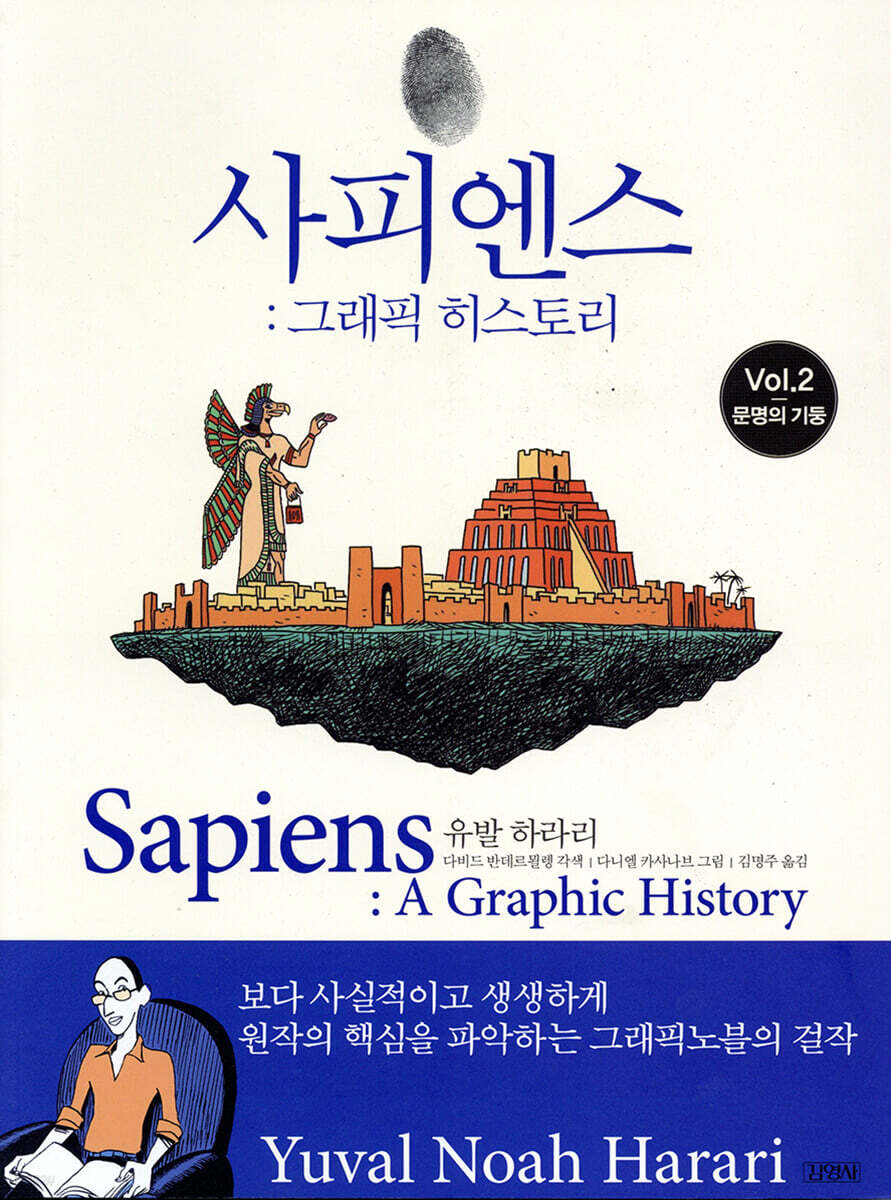
Sapiens: A Graphic History Vol. 2
 |
Description
Book Introduction
The birth of 『Sapiens』 in comics! Meet the bestseller, with 21 million copies sold worldwide and 1.1 million copies in Korea, in "Graphic History." Excellent storytelling and clear illustrations that surpass the original. The second installment of the fun and accessible "Sapiens" Big Questions. The second installment of 『Sapiens: A Graphic History』, ‘Pillars of Civilization’, has been published. This time, we will cover the 'Part 2 Agricultural Revolution', which is the most controversial part of the original work. What secrets lie behind the Agricultural Revolution and the foundation of civilization? A provocative historical interpretation of the Agricultural Revolution—that it was not humans who domesticated wheat, but wheat that domesticated humans—is presented in a captivating way through the plot of "Faust." Historical figures such as Franz Kafka, Confucius, Thomas Jefferson, John Lennon, and Margaret Thatcher make a colorful appearance to testify to the history of civilization that was created by the 'imagined order' of myth, bureaucracy, democracy, and human rights. From the Middle East 12,000 years ago to 21st-century America, locations transcend time and space, revealing the uncomfortable truths lurking beneath the surface of civilization with a more realism than drama and a vividness than film. |
- You can preview some of the book's contents.
Preview
index
Historical Timeline
Little Crop of Terror
About myths and humans
Into the Maze
The Fiction Doctor's Secret Room
Acknowledgements
About the contents of this book
Little Crop of Terror
About myths and humans
Into the Maze
The Fiction Doctor's Secret Room
Acknowledgements
About the contents of this book
Detailed image
.jpg)
Publisher's Review
*If you haven't read the famous Sapiens yet, I recommend the newly released comic book version, which contains only the essential elements.
A delightful and rich imagination that races through human history.
_[Spectator]
*It's exciting.
It's vivid.
A fascinating book that explains the complex story of human evolution in an accessible way.
_[BBC]
*A clear explanation of common misconceptions surrounding human evolution.
An answer to the difficult existential questions of humanity.
_[Publisher's Weekly]
The birth of 『Sapiens』 in comics!
Meet the bestseller, with 21 million copies sold worldwide and 1.1 million copies in Korea, in "Graphic History."
More realistic than a drama and more vivid than a movie
A masterpiece graphic novel that delves into the mysteries of human civilization.
The Sapiens: Graphic History series, which received reviews such as “It is explained in an easy-to-understand cartoon format, so even parts that were difficult to understand in the original work can be read smoothly” ([JoongAng Sunday]), and “It is not just a level of transferring the original work into pictures, but it is rewritten in a detective format to strengthen the storytelling” ([Maeil Business Newspaper]), has returned with the ‘Vol. 2 Pillars of Civilization’ edition.
With the publication of the first installment, "The Birth of Mankind," last year, the series has written a new chapter in the field of cultural non-fiction graphic novels. "Another Easy and Fun 『Sapiens』" delves into the hidden secrets of history with even more ingenious cartoonish imagination and exciting storytelling than the first installment.
The Sapiens: A Graphic History series is a masterpiece of graphic novels, where the core of the original educational non-fiction is reborn as a compelling storytelling through excellent adaptations and clear illustrations.
The new book, "Pillars of Civilization," reveals the hidden side of the agricultural revolution and the foundation of civilization.
A provocative historical interpretation of the agricultural revolution—that it was not humans who domesticated wheat, but wheat that domesticated humans—is presented in an engaging way through the plot of Faust.
Historical figures such as Franz Kafka, Confucius, Thomas Jefferson, John Lennon, and Margaret Thatcher make a colorful appearance to testify to the history of civilization that was created by the 'imagined order' of myth, bureaucracy, democracy, and human rights.
From the Middle East 12,000 years ago to 21st-century America, locations transcend time and space, revealing the uncomfortable truths lurking beneath the surface of civilization with a more realism than drama and a vividness than film.
Sapiens' Big Questions Part 2: Returning to Graphic History
What kind of trap did the agricultural revolution set for Sapiens, who had hoped for prosperity?
Homo sapiens, who became the ruler of the world by eliminating all of the other human species that coexisted with them.
Sapiens, who had been wandering around as hunter-gatherers, began to settle down and farm 12,000 years ago, hoping for a safe and prosperous life.
But the results go in a completely unexpected direction.
As large-scale cooperative networks develop, cities are built and empires prosper, but the life of Sapiens becomes more difficult and arduous.
The very 'pillars of civilization'—agriculture, writing, bureaucracy, and hierarchy—instead gave rise to war, famine, disease, and inequality.
In Volume 1, New York detective Lopez investigated the Sapiens incident that disrupted the ecosystem, and this time he investigates the inequality caused by civilization.
Why are all places where Sapiens thrive based on a pyramidal hierarchy? Detective Lopez, sensing that secrets lie hidden within "imaginary orders" like gods, nations, and money, gradually tightens his grip on Dr. Fiction.
But Dr. Fiction, who took Detective Lopez to the superheroes' secret room, exposes an uncomfortable truth lurking on the other side of civilization... What kind of trap did humanity fall into 12,000 years ago and still remain trapped in?
Excellent storytelling and clear illustrations that surpass the original.
An intellectual journey that connects today's life with yesterday's and imagines tomorrow.
“Yuval Harari is a thinker who presents the big picture”_[The New Yorker] There are things we take for granted.
A daily meal, a meticulously organized bureaucracy, the money necessary for survival... But if some Homo sapiens had made different choices 12,000 years ago, everything might have gone in a very different direction.
What if they had continued to hunt and gather instead of farming? Would cities and empires have been built, and would war, famine, disease, and inequality have occurred? The conditions we live under today are the result of past history.
Knowing this allows us to question norms and conventions and imagine a different life.
The 'big question' that Yuval Harari poses in 'Sapiens: A Graphic History' is directed towards the future.
'Graphic Sapiens' is a book worth trying for readers who found the information-heavy 'brick book' 'Sapiens' burdensome.
The witty and vivid character descriptions that fully utilize the characteristics of the graphic novel genre, and the realistic touches that borrow from famous paintings and popular culture naturally lead readers into another world of 『Sapiens』 that is easy and fun.
Your horizons will broaden, as if you had watched an intellectually sophisticated documentary.
Professor Yuval Harari, one of the most important thinkers of the 21st century, will guide you through "Graphic Sapiens" with his second insight, stimulating your intellectual imagination.
A masterpiece graphic novel that captures the history of human civilization at a glance.
Sapiens: A Graphic History series
Vol.1 The Birth of Mankind
- How did Homo sapiens, the apes from the periphery, become the rulers of the world?
Vol.2 Pillars of Civilization
- How did the agricultural revolution change human life, and how did civilization become possible?
Vol.3 The Unity of Humanity (tentative title)
- How did mankind come to believe in God, the state, money, and law?
Vol. 4~5 Scientific Revolution (tentative title)
- How will the world we live in change in the next thousand years?
A delightful and rich imagination that races through human history.
_[Spectator]
*It's exciting.
It's vivid.
A fascinating book that explains the complex story of human evolution in an accessible way.
_[BBC]
*A clear explanation of common misconceptions surrounding human evolution.
An answer to the difficult existential questions of humanity.
_[Publisher's Weekly]
The birth of 『Sapiens』 in comics!
Meet the bestseller, with 21 million copies sold worldwide and 1.1 million copies in Korea, in "Graphic History."
More realistic than a drama and more vivid than a movie
A masterpiece graphic novel that delves into the mysteries of human civilization.
The Sapiens: Graphic History series, which received reviews such as “It is explained in an easy-to-understand cartoon format, so even parts that were difficult to understand in the original work can be read smoothly” ([JoongAng Sunday]), and “It is not just a level of transferring the original work into pictures, but it is rewritten in a detective format to strengthen the storytelling” ([Maeil Business Newspaper]), has returned with the ‘Vol. 2 Pillars of Civilization’ edition.
With the publication of the first installment, "The Birth of Mankind," last year, the series has written a new chapter in the field of cultural non-fiction graphic novels. "Another Easy and Fun 『Sapiens』" delves into the hidden secrets of history with even more ingenious cartoonish imagination and exciting storytelling than the first installment.
The Sapiens: A Graphic History series is a masterpiece of graphic novels, where the core of the original educational non-fiction is reborn as a compelling storytelling through excellent adaptations and clear illustrations.
The new book, "Pillars of Civilization," reveals the hidden side of the agricultural revolution and the foundation of civilization.
A provocative historical interpretation of the agricultural revolution—that it was not humans who domesticated wheat, but wheat that domesticated humans—is presented in an engaging way through the plot of Faust.
Historical figures such as Franz Kafka, Confucius, Thomas Jefferson, John Lennon, and Margaret Thatcher make a colorful appearance to testify to the history of civilization that was created by the 'imagined order' of myth, bureaucracy, democracy, and human rights.
From the Middle East 12,000 years ago to 21st-century America, locations transcend time and space, revealing the uncomfortable truths lurking beneath the surface of civilization with a more realism than drama and a vividness than film.
Sapiens' Big Questions Part 2: Returning to Graphic History
What kind of trap did the agricultural revolution set for Sapiens, who had hoped for prosperity?
Homo sapiens, who became the ruler of the world by eliminating all of the other human species that coexisted with them.
Sapiens, who had been wandering around as hunter-gatherers, began to settle down and farm 12,000 years ago, hoping for a safe and prosperous life.
But the results go in a completely unexpected direction.
As large-scale cooperative networks develop, cities are built and empires prosper, but the life of Sapiens becomes more difficult and arduous.
The very 'pillars of civilization'—agriculture, writing, bureaucracy, and hierarchy—instead gave rise to war, famine, disease, and inequality.
In Volume 1, New York detective Lopez investigated the Sapiens incident that disrupted the ecosystem, and this time he investigates the inequality caused by civilization.
Why are all places where Sapiens thrive based on a pyramidal hierarchy? Detective Lopez, sensing that secrets lie hidden within "imaginary orders" like gods, nations, and money, gradually tightens his grip on Dr. Fiction.
But Dr. Fiction, who took Detective Lopez to the superheroes' secret room, exposes an uncomfortable truth lurking on the other side of civilization... What kind of trap did humanity fall into 12,000 years ago and still remain trapped in?
Excellent storytelling and clear illustrations that surpass the original.
An intellectual journey that connects today's life with yesterday's and imagines tomorrow.
“Yuval Harari is a thinker who presents the big picture”_[The New Yorker] There are things we take for granted.
A daily meal, a meticulously organized bureaucracy, the money necessary for survival... But if some Homo sapiens had made different choices 12,000 years ago, everything might have gone in a very different direction.
What if they had continued to hunt and gather instead of farming? Would cities and empires have been built, and would war, famine, disease, and inequality have occurred? The conditions we live under today are the result of past history.
Knowing this allows us to question norms and conventions and imagine a different life.
The 'big question' that Yuval Harari poses in 'Sapiens: A Graphic History' is directed towards the future.
'Graphic Sapiens' is a book worth trying for readers who found the information-heavy 'brick book' 'Sapiens' burdensome.
The witty and vivid character descriptions that fully utilize the characteristics of the graphic novel genre, and the realistic touches that borrow from famous paintings and popular culture naturally lead readers into another world of 『Sapiens』 that is easy and fun.
Your horizons will broaden, as if you had watched an intellectually sophisticated documentary.
Professor Yuval Harari, one of the most important thinkers of the 21st century, will guide you through "Graphic Sapiens" with his second insight, stimulating your intellectual imagination.
A masterpiece graphic novel that captures the history of human civilization at a glance.
Sapiens: A Graphic History series
Vol.1 The Birth of Mankind
- How did Homo sapiens, the apes from the periphery, become the rulers of the world?
Vol.2 Pillars of Civilization
- How did the agricultural revolution change human life, and how did civilization become possible?
Vol.3 The Unity of Humanity (tentative title)
- How did mankind come to believe in God, the state, money, and law?
Vol. 4~5 Scientific Revolution (tentative title)
- How will the world we live in change in the next thousand years?
GOODS SPECIFICS
- Publication date: November 22, 2021
- Page count, weight, size: 256 pages | 782g | 206*275*20mm
- ISBN13: 9788934944188
- ISBN10: 8934944188
You may also like
카테고리
korean


korean

![GQ KOREA Mark (Monthly): December [2025]](http://librairie.coreenne.fr/cdn/shop/files/8ef265dbbfbf186523ed75ba7319009d.jpg?v=1765340328&width=3840)


