

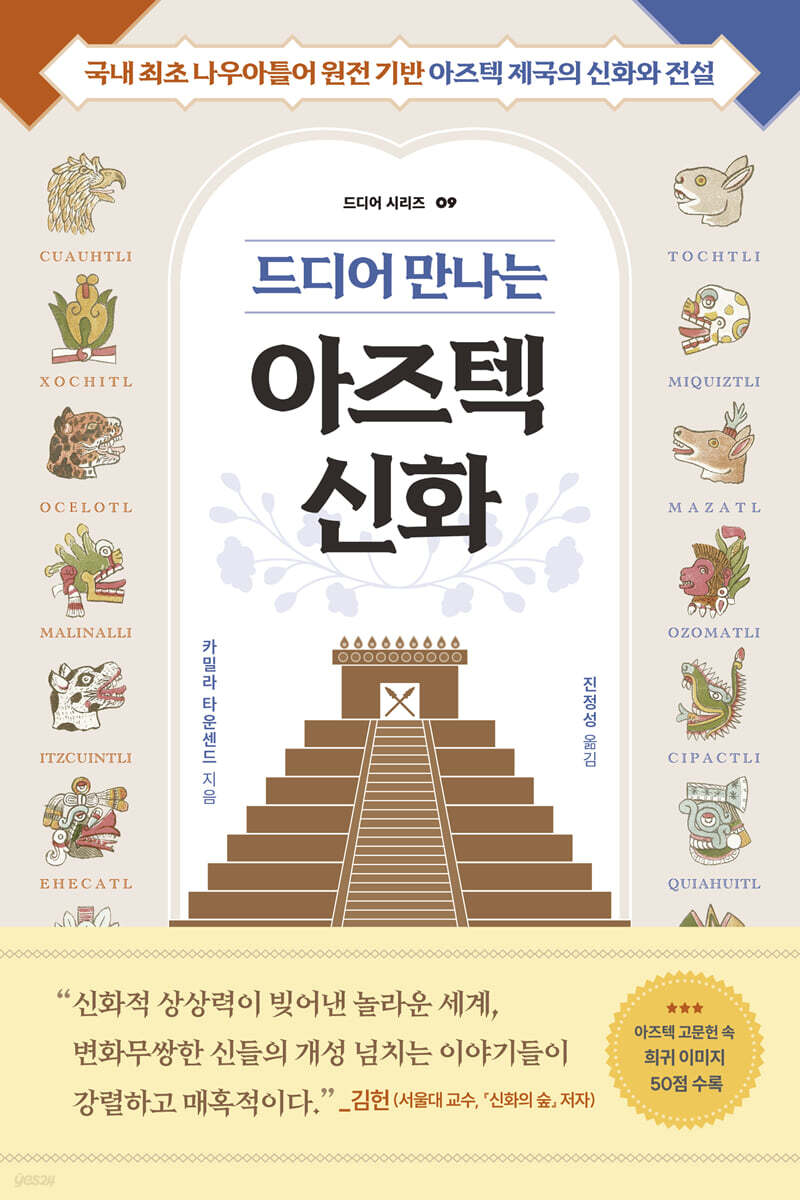
Finally Encountering Aztec Mythology
 |
Description
Book Introduction
The background of 'Day of the Dead' in Pixar's animation 'Coco',
Almost all of Aztec mythology celebrates death
▶ The culmination of 20 years of research by Camilla Townsend, the 2020 Kundil Award-winning author!
In the Pixar animation film Coco, there is a scene where Mexicans are enjoying the traditional festival of the Day of the Dead.
During this three-day period from late October to early November, people enjoy dancing and singing to remember their deceased family and friends.
They see death not as a severance, but as another world connected to life.
The origins of the Day of the Dead come from the Aztec civilization that existed in central Mexico from the 13th to the 16th centuries.
The Aztecs believed that the end was a new beginning, and their worldview was based on the story of a fifth sun rising from a world that had collapsed four times.
Camila Townsend, winner of the prestigious historical writing award in the English-speaking world, "Kundil in History," and a distinguished scholar who teaches history at Rutgers University in the United States and continues to explore Aztec culture, has been researching documents and records written in Nahuatl, the native Aztec language, for the past 20 years.
Based on her research, she vividly describes in this book the ancient narrative, "Aztec mythology," that supported Aztec society and culture.
Understanding one culture broadens your perspective on other cultures as well.
Through this book, "Finally Encountering Aztec Mythology," readers will not only be able to understand the fascinating and powerful stories of the gods in Aztec mythology that they were previously unaware of, but will also be able to enjoy other mythologies from around the world more richly.
Almost all of Aztec mythology celebrates death
▶ The culmination of 20 years of research by Camilla Townsend, the 2020 Kundil Award-winning author!
In the Pixar animation film Coco, there is a scene where Mexicans are enjoying the traditional festival of the Day of the Dead.
During this three-day period from late October to early November, people enjoy dancing and singing to remember their deceased family and friends.
They see death not as a severance, but as another world connected to life.
The origins of the Day of the Dead come from the Aztec civilization that existed in central Mexico from the 13th to the 16th centuries.
The Aztecs believed that the end was a new beginning, and their worldview was based on the story of a fifth sun rising from a world that had collapsed four times.
Camila Townsend, winner of the prestigious historical writing award in the English-speaking world, "Kundil in History," and a distinguished scholar who teaches history at Rutgers University in the United States and continues to explore Aztec culture, has been researching documents and records written in Nahuatl, the native Aztec language, for the past 20 years.
Based on her research, she vividly describes in this book the ancient narrative, "Aztec mythology," that supported Aztec society and culture.
Understanding one culture broadens your perspective on other cultures as well.
Through this book, "Finally Encountering Aztec Mythology," readers will not only be able to understand the fascinating and powerful stories of the gods in Aztec mythology that they were previously unaware of, but will also be able to enjoy other mythologies from around the world more richly.
- You can preview some of the book's contents.
Preview
index
Recommendation: Hear Aztec mythology directly from their own voices.
Before we begin: The Aztec Empire, which ruled central Mexico
5 Essential Facts to Understand the Aztec Civilization
Part 1: Civilizations that emerged in the central highlands of Mexico
Chapter 1: Misconceptions and Truths about the Aztec Civilization
Chapter 2: Why Studying Aztec Culture is Difficult
Part 2: The Mysterious and Complex Aztec Mythology
Chapter 3: A New World Opens
Chapter 4: Colorful Gods with Unique Characters
Part 3: The Aztec Journey
Chapter 5: The various tribes that roamed the central highlands of Mexico
Chapter 6: Settlement of Meshka and Development of the City
Part 4: The Blurry Line Between History and Legend
Chapter 7: Meshka's Allies and Enemies
Chapter 8: The Rise and Fall of the Aztec Empire
Part 5: Those who received revelation from God
Chapter 9: The Aztecs Who Had Spiritual Beliefs
Chapter 10 Rituals to Avoid or Accept God's Will
Chapter 11: Understanding the Aztec Sacrificial Ritual
Part 6: Fusion with Catholicism and Mexico Today
Chapter 12: The Spanish Invasion and the Fall of the Aztecs
Chapter 13: The Day of the Dead and Those Who Protect Tradition
References
Image source
Before we begin: The Aztec Empire, which ruled central Mexico
5 Essential Facts to Understand the Aztec Civilization
Part 1: Civilizations that emerged in the central highlands of Mexico
Chapter 1: Misconceptions and Truths about the Aztec Civilization
Chapter 2: Why Studying Aztec Culture is Difficult
Part 2: The Mysterious and Complex Aztec Mythology
Chapter 3: A New World Opens
Chapter 4: Colorful Gods with Unique Characters
Part 3: The Aztec Journey
Chapter 5: The various tribes that roamed the central highlands of Mexico
Chapter 6: Settlement of Meshka and Development of the City
Part 4: The Blurry Line Between History and Legend
Chapter 7: Meshka's Allies and Enemies
Chapter 8: The Rise and Fall of the Aztec Empire
Part 5: Those who received revelation from God
Chapter 9: The Aztecs Who Had Spiritual Beliefs
Chapter 10 Rituals to Avoid or Accept God's Will
Chapter 11: Understanding the Aztec Sacrificial Ritual
Part 6: Fusion with Catholicism and Mexico Today
Chapter 12: The Spanish Invasion and the Fall of the Aztecs
Chapter 13: The Day of the Dead and Those Who Protect Tradition
References
Image source
Detailed image
.jpg)
Into the book
During the last ice age in history, sea levels were lower than they are today, so present-day Siberia, Russia, and Alaska, USA, were connected by land across the Bering Strait.
About 15,000 to 11,000 years ago, people from the Asian continent migrated across this land to the Americas in three waves.
Initially, they lived a nomadic life in the northern region, but as the glaciers melted and the environment changed, they gradually moved south, following the animals they hunted and the plants they gathered.
--- p.19 「Chapter 1.
From “Misconceptions and Truths about the Aztec Civilization”
The xiupohuali was mainly used to recite old stories, the history of the Aztecs.
The storyteller would sometimes pause to sing a song related to the story, or speak in the present tense as if performing a play.
In the case of stories involving complex interweaving of interests of various tribes, such as war and conflict, when one storyteller tells a story, a speaker from another tribe takes his turn and tells a different story about the same event.
--- p.36 「Chapter 2.
From “Why Studying Aztec Culture is Difficult”
Before the present world came into being, there were four worlds.
In order, there are the Age of Jaguars, the Age of Wind, the Age of Rain, and the Age of Water.
The people who lived in the first era were eaten by wild beasts including jaguars, and the world came to an end.
In the era of the second wind, a huge wind blew.
People who lived on beans hung on trees to avoid being blown away by the wind, and turned into monkeys, and this era soon came to an end.
In the third rainy season, a rain of fire suddenly fell on the farmers who were farming near the water, and the world was destroyed.
--- p.52 「Chapter 3.
From “A New World Opens”
There is one idea and concept that is common in Aztec mythology.
All human beings should cherish the life they have been given on earth.
Storytellers and poets have come together to awaken their audiences to the beauty and glory of life.
Time flies by so quickly, but since it's all we have, we have to enjoy it to the fullest.
The Aztecs considered the time given to humans to be more precious and valuable because they believed it was 'borrowed' from the eternal universe.
--- p.87 Chapter 4.
Among the colorful gods with unique personalities
The Meshka storyteller called the northern land 'Aztlan'.
The Nahuatl word Aztatl means "crane," so some Europeans thought of Aztlán as "the land of the crane."
However, according to Nahuatl grammar, the land of the eagle should be 'Aztatlan'.
Strictly speaking, Aztlan can be interpreted as 'land of tools'.
Some scholars have suggested that Aztlán was an island, based on the observation that egrets nest near the water, but most accounts depict Aztlán as a desert landscape overgrown with thorny mesquite trees (a legume common in northern Mexico and the United States).
--- p.106 「Chapter 5.
Among the various tribes that roamed the central highlands of Mexico
Early Tenochtitlan was a simple and beautiful city.
People came to visit 'the cactus garden in the middle of the water, where eagles soar, snakes dwell and fish swim.'
Meshka made plans and built a city on the island step by step.
It was a stark contrast to the contemporary European cities the Spaniards had left behind.
Tenochtitlán was not built on a haphazard, winding road and alley, but on a well-organized urban plan.
--- p.130 Chapter 6.
From “Settling of Meshka and Development of the City”
Montezuma, the young prince of Meshca, went to Chalco to ask for allies to support his uncle Itzcoatl, but was refused and instead imprisoned there.
But this time, the dark god Youali visited the ruler of Chalco in his dreams and gave him a warning.
They say that Montezuma from Meshca should be released.
He also gave a revelation that Meshka Tenochka, not Tepanekana or Chalka, would be a powerful leader in the future.
The king of Chalco, waking up from his dream, calls the jailer and tells him to release Montezuma, who is imprisoned in the prison.
--- p.161 「Chapter 8.
From "The Rise and Fall of the Aztec Empire"
As is likely the case in any culture, the Aztecs often found themselves caught up in their religious beliefs.
They were torn between the human desire to forge ahead in life, find their purpose, and move forward in the direction they wanted, and the religious belief that life and death depend on God's will.
While I felt awe and respect, I also felt infinitely small and weak in front of God.
I hummed and sang the lyrics, expressing such feelings of sorrow and joy.
--- p.182 「Chapter 9.
Among the Aztecs who had spiritual beliefs
The Aztecs considered the appearance of a skunk in their residential area and its pungent odor to be a negative omen that would bring disaster.
When this happens, no one chases or provokes the skunk, but lets it go on its own.
Also, the snowy owl, with its eerie cry, was considered an ominous sign.
In particular, those who were on the move would gather under a tall tree when they heard the sound of a snowy owl, tie their staffs together, and pray to Yacatecuhtli, the patron god of peddlers, for protection.
--- p.196 Chapter 10.
Among the “rituals to avoid or uphold the will of God”
With all this background knowledge, the Aztec practice of human sacrifice takes on a new dimension.
Their sacrificial rituals were not a bloody, barbaric, or inhumane culture, but a deeply human culture that supported their society.
To truly understand the Aztecs, we need an open mind to understand their rituals from an Aztec perspective, rather than a European or Western one.
--- p.210 「Chapter 11.
From "Understanding the Aztec 'Sacrificial Ritual'"
How Catholicism was transformed and spread in Mexico has long escaped the attention of European scholars.
Europeans viewed the Aztec Empire through a narrow lens from their own perspective.
They believed that the natives mistook Hernán Cortés for the returning god Quetzalcoatl, as per an ancient prophecy.
So Montezuma easily gave up his empire to foreigners, and the European whites spread the monotheistic ideology of Catholicism to the awe-inspiring, uncivilized Aztec people.
This is a false narrative from an extremely Western-centric perspective.
--- p.214 「Chapter 12.
From "The Spanish Invasion and the Fall of the Aztecs"
Preserving the endangered traditions of indigenous and indigenous peoples is not just good for Mexicans.
It's a meaningful thing on a global scale.
Preserving the cultures of minority groups, which are increasingly losing ground or fading away around the world, helps preserve the diversity of humanity as a whole and allows us to view our own cultures from a broader perspective.
Every culture has its own unique characteristics, meaning, and wisdom.
So learning and understanding other cultures broadens our mindset and expands our worldview.
About 15,000 to 11,000 years ago, people from the Asian continent migrated across this land to the Americas in three waves.
Initially, they lived a nomadic life in the northern region, but as the glaciers melted and the environment changed, they gradually moved south, following the animals they hunted and the plants they gathered.
--- p.19 「Chapter 1.
From “Misconceptions and Truths about the Aztec Civilization”
The xiupohuali was mainly used to recite old stories, the history of the Aztecs.
The storyteller would sometimes pause to sing a song related to the story, or speak in the present tense as if performing a play.
In the case of stories involving complex interweaving of interests of various tribes, such as war and conflict, when one storyteller tells a story, a speaker from another tribe takes his turn and tells a different story about the same event.
--- p.36 「Chapter 2.
From “Why Studying Aztec Culture is Difficult”
Before the present world came into being, there were four worlds.
In order, there are the Age of Jaguars, the Age of Wind, the Age of Rain, and the Age of Water.
The people who lived in the first era were eaten by wild beasts including jaguars, and the world came to an end.
In the era of the second wind, a huge wind blew.
People who lived on beans hung on trees to avoid being blown away by the wind, and turned into monkeys, and this era soon came to an end.
In the third rainy season, a rain of fire suddenly fell on the farmers who were farming near the water, and the world was destroyed.
--- p.52 「Chapter 3.
From “A New World Opens”
There is one idea and concept that is common in Aztec mythology.
All human beings should cherish the life they have been given on earth.
Storytellers and poets have come together to awaken their audiences to the beauty and glory of life.
Time flies by so quickly, but since it's all we have, we have to enjoy it to the fullest.
The Aztecs considered the time given to humans to be more precious and valuable because they believed it was 'borrowed' from the eternal universe.
--- p.87 Chapter 4.
Among the colorful gods with unique personalities
The Meshka storyteller called the northern land 'Aztlan'.
The Nahuatl word Aztatl means "crane," so some Europeans thought of Aztlán as "the land of the crane."
However, according to Nahuatl grammar, the land of the eagle should be 'Aztatlan'.
Strictly speaking, Aztlan can be interpreted as 'land of tools'.
Some scholars have suggested that Aztlán was an island, based on the observation that egrets nest near the water, but most accounts depict Aztlán as a desert landscape overgrown with thorny mesquite trees (a legume common in northern Mexico and the United States).
--- p.106 「Chapter 5.
Among the various tribes that roamed the central highlands of Mexico
Early Tenochtitlan was a simple and beautiful city.
People came to visit 'the cactus garden in the middle of the water, where eagles soar, snakes dwell and fish swim.'
Meshka made plans and built a city on the island step by step.
It was a stark contrast to the contemporary European cities the Spaniards had left behind.
Tenochtitlán was not built on a haphazard, winding road and alley, but on a well-organized urban plan.
--- p.130 Chapter 6.
From “Settling of Meshka and Development of the City”
Montezuma, the young prince of Meshca, went to Chalco to ask for allies to support his uncle Itzcoatl, but was refused and instead imprisoned there.
But this time, the dark god Youali visited the ruler of Chalco in his dreams and gave him a warning.
They say that Montezuma from Meshca should be released.
He also gave a revelation that Meshka Tenochka, not Tepanekana or Chalka, would be a powerful leader in the future.
The king of Chalco, waking up from his dream, calls the jailer and tells him to release Montezuma, who is imprisoned in the prison.
--- p.161 「Chapter 8.
From "The Rise and Fall of the Aztec Empire"
As is likely the case in any culture, the Aztecs often found themselves caught up in their religious beliefs.
They were torn between the human desire to forge ahead in life, find their purpose, and move forward in the direction they wanted, and the religious belief that life and death depend on God's will.
While I felt awe and respect, I also felt infinitely small and weak in front of God.
I hummed and sang the lyrics, expressing such feelings of sorrow and joy.
--- p.182 「Chapter 9.
Among the Aztecs who had spiritual beliefs
The Aztecs considered the appearance of a skunk in their residential area and its pungent odor to be a negative omen that would bring disaster.
When this happens, no one chases or provokes the skunk, but lets it go on its own.
Also, the snowy owl, with its eerie cry, was considered an ominous sign.
In particular, those who were on the move would gather under a tall tree when they heard the sound of a snowy owl, tie their staffs together, and pray to Yacatecuhtli, the patron god of peddlers, for protection.
--- p.196 Chapter 10.
Among the “rituals to avoid or uphold the will of God”
With all this background knowledge, the Aztec practice of human sacrifice takes on a new dimension.
Their sacrificial rituals were not a bloody, barbaric, or inhumane culture, but a deeply human culture that supported their society.
To truly understand the Aztecs, we need an open mind to understand their rituals from an Aztec perspective, rather than a European or Western one.
--- p.210 「Chapter 11.
From "Understanding the Aztec 'Sacrificial Ritual'"
How Catholicism was transformed and spread in Mexico has long escaped the attention of European scholars.
Europeans viewed the Aztec Empire through a narrow lens from their own perspective.
They believed that the natives mistook Hernán Cortés for the returning god Quetzalcoatl, as per an ancient prophecy.
So Montezuma easily gave up his empire to foreigners, and the European whites spread the monotheistic ideology of Catholicism to the awe-inspiring, uncivilized Aztec people.
This is a false narrative from an extremely Western-centric perspective.
--- p.214 「Chapter 12.
From "The Spanish Invasion and the Fall of the Aztecs"
Preserving the endangered traditions of indigenous and indigenous peoples is not just good for Mexicans.
It's a meaningful thing on a global scale.
Preserving the cultures of minority groups, which are increasingly losing ground or fading away around the world, helps preserve the diversity of humanity as a whole and allows us to view our own cultures from a broader perspective.
Every culture has its own unique characteristics, meaning, and wisdom.
So learning and understanding other cultures broadens our mindset and expands our worldview.
--- p.233 「Chapter 13.
From "Day of the Dead and Those Who Protect Tradition"
From "Day of the Dead and Those Who Protect Tradition"
Publisher's Review
◆Recommended for these people
1.
Readers who love mythology and fantasy
For those who want to explore a new world of mythology beyond Greek, Roman, and Norse mythology.
2.
Readers interested in world history and the history of civilization
Those who want to break away from the narrow, Eurocentric view of history and understand the values of diverse civilizations.
3.
Cultural content creators
Those looking for original material for creative activities such as games, webtoons, and novels
4.
Readers seeking humanistic insights
For those who want to think deeply about life and death, time and eternity, civilization and nature.
“We are borrowing time from eternity.”
Which world are you living in now?
The Aztec civilization is one of the most powerful, yet most veiled, worlds in human history.
Westerners branded the Aztecs as a 'cruel empire of human sacrifice'.
But the truth was quite the opposite.
Giving one's heart was not murder, it was a cosmic transaction.
The sun god fights with the underworld every night, falls, and is reborn with human blood to bring light to the morning.
The Aztec warriors were heroes who prevented the end of the world by reviving the sun with their hearts.
The Aztecs believed that the world had collapsed four times, and that the fifth sun had risen, ushering in their era.
They cherished life, believing that they were living in the moment, borrowing the 'present' from the long time of eternity.
The 'Story of the Fifth Sun' in Aztec mythology was not simply an old legend, but a grand cosmology that explained the reason for the empire's existence and its social, political, and religious order.
In this way, 『Finally Encountering Aztec Mythology』 is a book that restores the Aztec people's perspective and voice on the world.
As depicted in the beloved Pixar animation Coco, the Aztecs viewed death and life as one, not separate.
For them, death was an extension of life, and the world continued to cycle in God's providence.
This book, through the records of the Aztec indigenous people, vividly reveals to readers for the first time the legends of Mexican gods and the stories of humans that have never been revealed before.
The real Aztecs brought to life by the voices of the indigenous people
The 'Venice on the Lake' that made Spanish conquistadors jealous
Tenochtitlan, first seen by Spanish conquistadors in 1519.
Their diary read:
“A city that seems to be enchanted….
“It is bigger and more beautiful than any European city we know.”
A mega-water city with a population of 200,000.
Larger than London and cleaner than Paris, the city boasted an elaborate aqueduct system, massive twin pyramids, and a central market that could accommodate 50,000 people.
They also recorded the movements of the stars and the sun and offered songs and dances to the gods.
It all began with a mythical revelation that a cactus was built upon which an eagle landed, biting a snake.
The very same symbol depicted on the Mexican flag today.
Throughout history, Aztec mythology and civilization have been read through the eyes of the conquerors.
Spanish conquistador Hernán Cortés described the Aztecs as "devil-worshiping savages."
The history of the victors has been solidified as 'truth' for 500 years.
But everything was turned upside down with the discovery of Nahuatl manuscripts.
The results of deciphering hidden records such as the Auvin Codex and the Cuautitlan Chronicle were shocking.
Camila Townsend, a professor of history at Rutgers University who has been immersed in the study of Nahuatl and Aztec texts for the past 20 years, draws on this vast body of original material to bring together the myths, history, songs, and memories passed down directly by the Aztecs, offering us a new perspective.
Those portrayed as 'cruel conquerors' were in fact closer to 'philosophers who loved poetry and flowers', the system understood as 'uncivilized idolatry' was revealed to be 'an elaborate system of astronomy and mathematics', and 'disorganized barbarism' was revealed to be 'planned cities and advanced agricultural technology'.
This book rescues the Aztec civilization from its brutal image and allows readers to encounter it anew as a rich and sophisticated civilization in world history.
It follows the story of the ordinary god Nanahuatzin who threw himself into fire and became the sun, the lesson of Quetzalcoatl who threw himself into the sea and became the morning star as a sign of repentance for his mistakes, and the rise and fall of the empire that collapsed in the conflict with Spain.
This grand drama, a blend of myth and history, is not simply a legend of the past, but a question that shakes our worldview today.
Reading a myth = putting on a new lens
The gods of Greek mythology resemble human desires.
Norse mythology sings the epic of an honorable warrior.
So what about Aztec mythology?
“Everything changes.
Nothing lasts forever.
Therefore, this moment is the most precious.”
This is the message from a civilization that remembers four destructions.
The Aztecs whisper to modern people who dream of eternity.
Your world will end someday, but don't be afraid.
Because the end is a new beginning.
The Day of the Dead, celebrated throughout Mexico today, is proof that this mythical worldview is still alive.
The festival, where the living and the dead sing and dance together to celebrate life, shows that 'death', as we commonly think of it, is not a separation and an end, but a new world no different from life.
『Finally Encountering Aztec Mythology』 is not simply a book that introduces the legends of the unfamiliar medieval Aztec civilization.
If Greek mythology dealt with human desires and Norse mythology dealt with the fate of heroes, Aztec mythology presents a completely new worldview of 'cycle and transformation.'
Death is not the end, but the beginning of change, and destruction is a prerequisite for creation.
This book offers readers the fascinating experience of reading an 'unknown myth' that is still unknown.
Reading mythology is ultimately an act of looking at life through the eyes of another world, and through that process, the reader expands his or her own worldview.
Like the sun in Aztec mythology, which fell four times and rose a fifth time, we can see the world with new eyes through unknown myths.
1.
Readers who love mythology and fantasy
For those who want to explore a new world of mythology beyond Greek, Roman, and Norse mythology.
2.
Readers interested in world history and the history of civilization
Those who want to break away from the narrow, Eurocentric view of history and understand the values of diverse civilizations.
3.
Cultural content creators
Those looking for original material for creative activities such as games, webtoons, and novels
4.
Readers seeking humanistic insights
For those who want to think deeply about life and death, time and eternity, civilization and nature.
“We are borrowing time from eternity.”
Which world are you living in now?
The Aztec civilization is one of the most powerful, yet most veiled, worlds in human history.
Westerners branded the Aztecs as a 'cruel empire of human sacrifice'.
But the truth was quite the opposite.
Giving one's heart was not murder, it was a cosmic transaction.
The sun god fights with the underworld every night, falls, and is reborn with human blood to bring light to the morning.
The Aztec warriors were heroes who prevented the end of the world by reviving the sun with their hearts.
The Aztecs believed that the world had collapsed four times, and that the fifth sun had risen, ushering in their era.
They cherished life, believing that they were living in the moment, borrowing the 'present' from the long time of eternity.
The 'Story of the Fifth Sun' in Aztec mythology was not simply an old legend, but a grand cosmology that explained the reason for the empire's existence and its social, political, and religious order.
In this way, 『Finally Encountering Aztec Mythology』 is a book that restores the Aztec people's perspective and voice on the world.
As depicted in the beloved Pixar animation Coco, the Aztecs viewed death and life as one, not separate.
For them, death was an extension of life, and the world continued to cycle in God's providence.
This book, through the records of the Aztec indigenous people, vividly reveals to readers for the first time the legends of Mexican gods and the stories of humans that have never been revealed before.
The real Aztecs brought to life by the voices of the indigenous people
The 'Venice on the Lake' that made Spanish conquistadors jealous
Tenochtitlan, first seen by Spanish conquistadors in 1519.
Their diary read:
“A city that seems to be enchanted….
“It is bigger and more beautiful than any European city we know.”
A mega-water city with a population of 200,000.
Larger than London and cleaner than Paris, the city boasted an elaborate aqueduct system, massive twin pyramids, and a central market that could accommodate 50,000 people.
They also recorded the movements of the stars and the sun and offered songs and dances to the gods.
It all began with a mythical revelation that a cactus was built upon which an eagle landed, biting a snake.
The very same symbol depicted on the Mexican flag today.
Throughout history, Aztec mythology and civilization have been read through the eyes of the conquerors.
Spanish conquistador Hernán Cortés described the Aztecs as "devil-worshiping savages."
The history of the victors has been solidified as 'truth' for 500 years.
But everything was turned upside down with the discovery of Nahuatl manuscripts.
The results of deciphering hidden records such as the Auvin Codex and the Cuautitlan Chronicle were shocking.
Camila Townsend, a professor of history at Rutgers University who has been immersed in the study of Nahuatl and Aztec texts for the past 20 years, draws on this vast body of original material to bring together the myths, history, songs, and memories passed down directly by the Aztecs, offering us a new perspective.
Those portrayed as 'cruel conquerors' were in fact closer to 'philosophers who loved poetry and flowers', the system understood as 'uncivilized idolatry' was revealed to be 'an elaborate system of astronomy and mathematics', and 'disorganized barbarism' was revealed to be 'planned cities and advanced agricultural technology'.
This book rescues the Aztec civilization from its brutal image and allows readers to encounter it anew as a rich and sophisticated civilization in world history.
It follows the story of the ordinary god Nanahuatzin who threw himself into fire and became the sun, the lesson of Quetzalcoatl who threw himself into the sea and became the morning star as a sign of repentance for his mistakes, and the rise and fall of the empire that collapsed in the conflict with Spain.
This grand drama, a blend of myth and history, is not simply a legend of the past, but a question that shakes our worldview today.
Reading a myth = putting on a new lens
The gods of Greek mythology resemble human desires.
Norse mythology sings the epic of an honorable warrior.
So what about Aztec mythology?
“Everything changes.
Nothing lasts forever.
Therefore, this moment is the most precious.”
This is the message from a civilization that remembers four destructions.
The Aztecs whisper to modern people who dream of eternity.
Your world will end someday, but don't be afraid.
Because the end is a new beginning.
The Day of the Dead, celebrated throughout Mexico today, is proof that this mythical worldview is still alive.
The festival, where the living and the dead sing and dance together to celebrate life, shows that 'death', as we commonly think of it, is not a separation and an end, but a new world no different from life.
『Finally Encountering Aztec Mythology』 is not simply a book that introduces the legends of the unfamiliar medieval Aztec civilization.
If Greek mythology dealt with human desires and Norse mythology dealt with the fate of heroes, Aztec mythology presents a completely new worldview of 'cycle and transformation.'
Death is not the end, but the beginning of change, and destruction is a prerequisite for creation.
This book offers readers the fascinating experience of reading an 'unknown myth' that is still unknown.
Reading mythology is ultimately an act of looking at life through the eyes of another world, and through that process, the reader expands his or her own worldview.
Like the sun in Aztec mythology, which fell four times and rose a fifth time, we can see the world with new eyes through unknown myths.
GOODS SPECIFICS
- Date of issue: September 24, 2025
- Page count, weight, size: 248 pages | 330g | 140*210*20mm
- ISBN13: 9791139716566
- ISBN10: 1139716565
You may also like
카테고리
korean


korean

![GQ KOREA Mark (Monthly): December [2025]](http://librairie.coreenne.fr/cdn/shop/files/8ef265dbbfbf186523ed75ba7319009d.jpg?v=1765340328&width=3840)


