

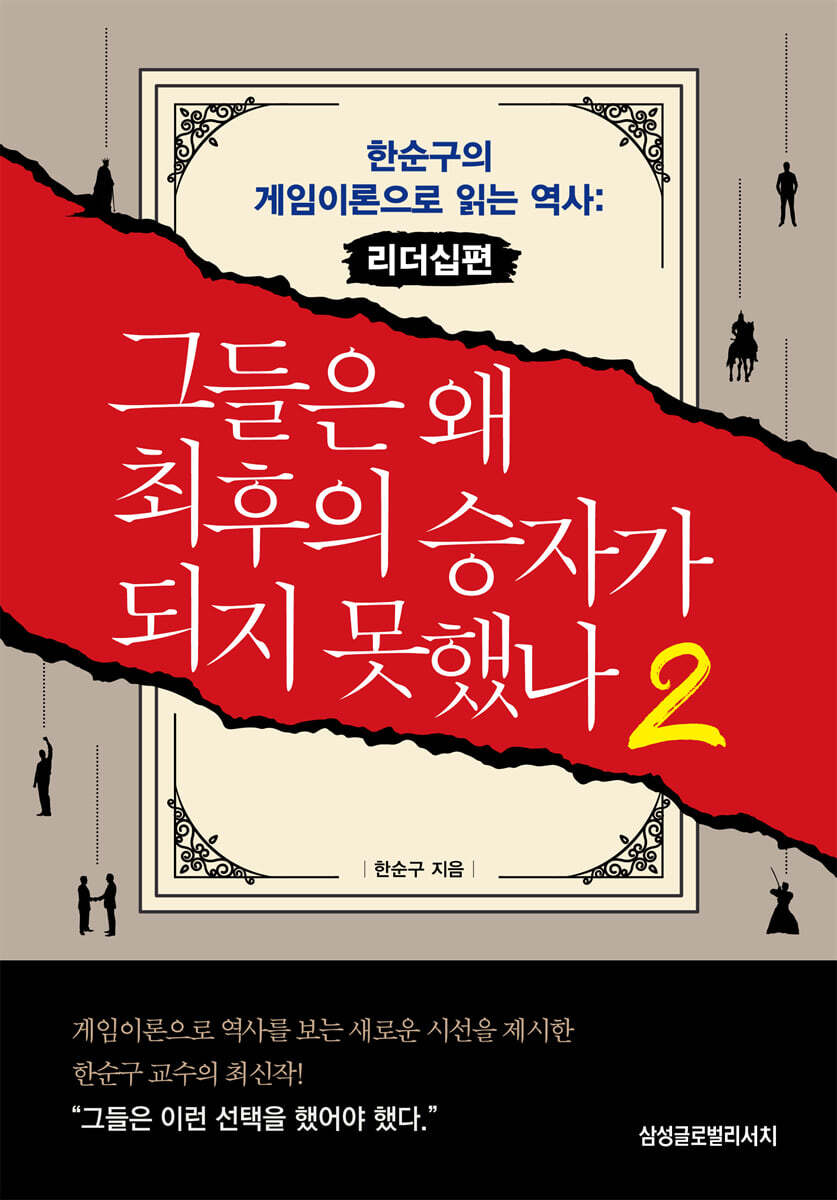
Why They Couldn't Become the Ultimate Winner 2
 |
Description
Book Introduction
The sequel to the bestseller, Why They Couldn't Become the Ultimate Winners,
Professor Han Soon-gu retells the story of game theory and history.
This time it's leadership!
"The concerns of historical figures are ongoing." The author, who met many readers with his previous work, which combined history and game theory, said he became even more convinced of this fact during lectures.
The concerns of CEOs and leaders leading organizations were surprisingly similar to those of people in the past.
Leaders' concerns aren't simply that making decisions is difficult.
Because when faced with a major choice, an unavoidable loneliness follows.
In those moments when it is difficult to openly discuss your feelings with anyone, and even family and colleagues cannot take your place, the responsibility for the outcome also falls entirely on you.
The author says that in these lonely moments, historical figures can be the strong advisors we can rely on.
This book brings those who can be our strong advisors into our reality.
From Yubi to Tokugawa Ieyasu, J.
P. Morgan, Yi Sun-sin, Alexander the Great, Jumong, and even Jeong Do-jeon and Yi Bang-won, although from different countries and eras, this book uses game theory to interpret the choices made by people who faced a lonely moment of decision and how those choices shaped their fates.
This book, which captures the desperate concerns of characters through bolder and more realistic analyses, such as reading the shadow of "collusion" in the much-loved "Peach Garden Oath," and awakening us to the limits of prudence through the Roman general Antony, who ultimately lost even in an advantageous situation, will become a strong supporter of leaders as it approaches the essence of leadership and decision-making.
Professor Han Soon-gu retells the story of game theory and history.
This time it's leadership!
"The concerns of historical figures are ongoing." The author, who met many readers with his previous work, which combined history and game theory, said he became even more convinced of this fact during lectures.
The concerns of CEOs and leaders leading organizations were surprisingly similar to those of people in the past.
Leaders' concerns aren't simply that making decisions is difficult.
Because when faced with a major choice, an unavoidable loneliness follows.
In those moments when it is difficult to openly discuss your feelings with anyone, and even family and colleagues cannot take your place, the responsibility for the outcome also falls entirely on you.
The author says that in these lonely moments, historical figures can be the strong advisors we can rely on.
This book brings those who can be our strong advisors into our reality.
From Yubi to Tokugawa Ieyasu, J.
P. Morgan, Yi Sun-sin, Alexander the Great, Jumong, and even Jeong Do-jeon and Yi Bang-won, although from different countries and eras, this book uses game theory to interpret the choices made by people who faced a lonely moment of decision and how those choices shaped their fates.
This book, which captures the desperate concerns of characters through bolder and more realistic analyses, such as reading the shadow of "collusion" in the much-loved "Peach Garden Oath," and awakening us to the limits of prudence through the Roman general Antony, who ultimately lost even in an advantageous situation, will become a strong supporter of leaders as it approaches the essence of leadership and decision-making.
- You can preview some of the book's contents.
Preview
index
In publishing a book
Chapter 1.
Why can a critical success factor also be a fatal failure factor?
Liu Bei's Shu Kingdom Caught in the 'Collusion' of the 'Peach Garden Oath'
Chapter 2.
Who are the strategic masters in terms of 'risk taking'?
Oda Breaks Through, Toyotomi Calculates, Tokugawa Waits
Chapter 3.
Will we monopolize or coexist?
│The God of War and the Tattoo: A Zero-Sum Game and a Win-Win Game│
Chapter 4.
Who is the leader we need in a crisis?
│ J.
P. Morgan and the 'Residual Responsibility' │
Chapter 5.
Why couldn't they see the world as it was?
Bayesian Update: A Look at King Yeonsangun and King Gwanghaegun
Chapter 6.
What if you could become a subordinate of Admiral Yi Sun-sin, the famous general who saved Joseon?
Rethinking Yi Sun-sin's Leadership After 30 Years of Organizational Life
Chapter 7.
If we eliminate all our enemies, will only our friends remain?
The 'Sleeping with the Enemy' Strategy, Reminiscent of the American Revolutionary War
Chapter 8.
Should we avoid a war with no chance of winning or fight it?
Heungseon Daewongun's isolationism and the Edo shogunate's Meiji Restoration
Chapter 9.
Why did the generals who returned victorious have to be executed?
Asymmetric Information and the Agency Problem Revealed in the Battle of Arginusae
Chapter 10.
A failed leader, yet why is he so attractive?
Kim Sang-heon and his descendants' 'Tit-for-Tat Strategy'
Chapter 11.
How careful should a leader be in making decisions?
Search Theory and the Optimal Halting Problem as Seen Through the Battle of Actium
Chapter 12.
What is the most important factor in overpowering your opponent in negotiations?
The Munich Agreement and the 'Cost of Breakdown'
Chapter 13.
Why doesn't having the upper hand in negotiations work?
Brezhnev's détente diplomacy collapsed due to 'unpredictability'
Chapter 14.
What is the most profitable business strategy?
The 'Network Effect' Used by Taejo Wang Geon and Bill Gates
Chapter 15.
What drives soldiers in war?
│Two 'balances' demonstrated by Alexander the Great and Darius │
Chapter 16.
How should we view the leader's lies from an economic perspective?
Good and Evil as Seen by Jumong and Prince Hodong
Chapter 17.
For a leader whose predecessor failed, is the opposite choice the answer?
The 'Result Bias' That Jungjong and Injo Couldn't Avoid
Chapter 18.
Why should we prepare for even a 1% chance?
The Destruction of Chok and the 'Tail Risk'
Chapter 19.
Why do male peacocks risk their lives to show off their colorful feathers?
King So of Yan's 'Maesamagol' and Shang Yang of Jin's 'Signaling'
Chapter 20.
Why do loyal agents become traitors?
The 'Commitment Problem' as Seen Through King Gongmin and Shin Don
Chapter 21.
Why is a neutral stance dangerous?
The Rise and Fall of the Heike Samurai: A Linear City Model
Chapter 22.
Why did he meet a miserable end even after winning so big?
Minamoto no Yoshitsune's "Mutation Strategy" and the Return to Balance
Chapter 23.
Which is worse: a ruthless leader or an emotional leader?
Song Si-yeol and Yun Jeung's 'Hoenisibi'
Chapter 24.
The power to overcome a crisis: genius or experience?
The Reason Why the Brilliant Son of a Master General Failed
Chapter 25.
Why is internal conflict growing in an unrivaled superpower?
The Anguish of Great Powers and the 'Optimal Currency Area' Theory
Chapter 26.
What is the essence of leadership?
Jeong Do-jeon and Yi Bang-won's Leadership as Analyzed Through the 'Coordination Game'
Chapter 1.
Why can a critical success factor also be a fatal failure factor?
Liu Bei's Shu Kingdom Caught in the 'Collusion' of the 'Peach Garden Oath'
Chapter 2.
Who are the strategic masters in terms of 'risk taking'?
Oda Breaks Through, Toyotomi Calculates, Tokugawa Waits
Chapter 3.
Will we monopolize or coexist?
│The God of War and the Tattoo: A Zero-Sum Game and a Win-Win Game│
Chapter 4.
Who is the leader we need in a crisis?
│ J.
P. Morgan and the 'Residual Responsibility' │
Chapter 5.
Why couldn't they see the world as it was?
Bayesian Update: A Look at King Yeonsangun and King Gwanghaegun
Chapter 6.
What if you could become a subordinate of Admiral Yi Sun-sin, the famous general who saved Joseon?
Rethinking Yi Sun-sin's Leadership After 30 Years of Organizational Life
Chapter 7.
If we eliminate all our enemies, will only our friends remain?
The 'Sleeping with the Enemy' Strategy, Reminiscent of the American Revolutionary War
Chapter 8.
Should we avoid a war with no chance of winning or fight it?
Heungseon Daewongun's isolationism and the Edo shogunate's Meiji Restoration
Chapter 9.
Why did the generals who returned victorious have to be executed?
Asymmetric Information and the Agency Problem Revealed in the Battle of Arginusae
Chapter 10.
A failed leader, yet why is he so attractive?
Kim Sang-heon and his descendants' 'Tit-for-Tat Strategy'
Chapter 11.
How careful should a leader be in making decisions?
Search Theory and the Optimal Halting Problem as Seen Through the Battle of Actium
Chapter 12.
What is the most important factor in overpowering your opponent in negotiations?
The Munich Agreement and the 'Cost of Breakdown'
Chapter 13.
Why doesn't having the upper hand in negotiations work?
Brezhnev's détente diplomacy collapsed due to 'unpredictability'
Chapter 14.
What is the most profitable business strategy?
The 'Network Effect' Used by Taejo Wang Geon and Bill Gates
Chapter 15.
What drives soldiers in war?
│Two 'balances' demonstrated by Alexander the Great and Darius │
Chapter 16.
How should we view the leader's lies from an economic perspective?
Good and Evil as Seen by Jumong and Prince Hodong
Chapter 17.
For a leader whose predecessor failed, is the opposite choice the answer?
The 'Result Bias' That Jungjong and Injo Couldn't Avoid
Chapter 18.
Why should we prepare for even a 1% chance?
The Destruction of Chok and the 'Tail Risk'
Chapter 19.
Why do male peacocks risk their lives to show off their colorful feathers?
King So of Yan's 'Maesamagol' and Shang Yang of Jin's 'Signaling'
Chapter 20.
Why do loyal agents become traitors?
The 'Commitment Problem' as Seen Through King Gongmin and Shin Don
Chapter 21.
Why is a neutral stance dangerous?
The Rise and Fall of the Heike Samurai: A Linear City Model
Chapter 22.
Why did he meet a miserable end even after winning so big?
Minamoto no Yoshitsune's "Mutation Strategy" and the Return to Balance
Chapter 23.
Which is worse: a ruthless leader or an emotional leader?
Song Si-yeol and Yun Jeung's 'Hoenisibi'
Chapter 24.
The power to overcome a crisis: genius or experience?
The Reason Why the Brilliant Son of a Master General Failed
Chapter 25.
Why is internal conflict growing in an unrivaled superpower?
The Anguish of Great Powers and the 'Optimal Currency Area' Theory
Chapter 26.
What is the essence of leadership?
Jeong Do-jeon and Yi Bang-won's Leadership as Analyzed Through the 'Coordination Game'
Detailed image

Into the book
If you think about it that way, I think that my closest friends at the moment of making important decisions might actually be historical figures who were active in the past.
By learning about the decisions that determined the success and failure of historical figures, you can also experience the anxieties and regrets that existed in their hearts at the time.
--- From "Publishing a Book"
Liu Bei's success in ascending to the throne of Shu based on his oath of allegiance and loyalty clearly demonstrates how beneficial collusion can be.
However, the story of Liu Bei, who took over the state of Shu, failing to unify the country because he failed to recruit new talents also clearly shows how detrimental collusion can be on a national level.
It is a grave mistake to believe that just because a strategy has led you to success in the past, it will guarantee future success.
At every stage of success, you need to make the decision to boldly abandon your existing strategy and adopt a new one.
--- From “Chapter 1: Why Do Critical Success Factors Become Fatal Failure Factors?”
It is clear that Seonjo's judgment was foolish and Won Gyun's character was extremely shallow, and this may have been a major reason for the defeat in the battle.
But aren't many office workers today forced to live in an organization with incomprehensible bosses and competitive colleagues, trying to somehow work together?
In that respect, I wonder if Admiral Yi Sun-sin was overly honest and principled.
As a subject of my ancestors, wasn't there really another way to respond more flexibly?
--- From Chapter 6: What if you could become a subordinate of Admiral Yi Sun-sin, the famous general who saved Joseon?
In the end, Alexander, as he embarked on the seemingly reckless conquest of Persia, made it clear that this war was not simply for the king, but a good opportunity for each soldier to enjoy the fruits of conquest.
Unlike the Persian soldiers who were forced to fight, the Greek soldiers could fight for themselves because they could not only protect their homeland from Persian invasion but also gain personal wealth and honor.
--- From Chapter 15: What is the force that moves soldiers in war?
From Lee Suk-beon's perspective, the coordination game led by Lee Bang-won would have seemed to have a clear outcome.
If Yi Bang-won's coordination is successful, the already familiar system of absolute power of the king, not much different from that of the Three Kingdoms or Goryeo periods, will be re-established, and he will be able to enjoy power and be treated well for a long time as a meritorious subject of Yi Bang-won.
On the other hand, the coordination game proposed by Jeong Do-jeon would have seemed unstable and unclear.
By learning about the decisions that determined the success and failure of historical figures, you can also experience the anxieties and regrets that existed in their hearts at the time.
--- From "Publishing a Book"
Liu Bei's success in ascending to the throne of Shu based on his oath of allegiance and loyalty clearly demonstrates how beneficial collusion can be.
However, the story of Liu Bei, who took over the state of Shu, failing to unify the country because he failed to recruit new talents also clearly shows how detrimental collusion can be on a national level.
It is a grave mistake to believe that just because a strategy has led you to success in the past, it will guarantee future success.
At every stage of success, you need to make the decision to boldly abandon your existing strategy and adopt a new one.
--- From “Chapter 1: Why Do Critical Success Factors Become Fatal Failure Factors?”
It is clear that Seonjo's judgment was foolish and Won Gyun's character was extremely shallow, and this may have been a major reason for the defeat in the battle.
But aren't many office workers today forced to live in an organization with incomprehensible bosses and competitive colleagues, trying to somehow work together?
In that respect, I wonder if Admiral Yi Sun-sin was overly honest and principled.
As a subject of my ancestors, wasn't there really another way to respond more flexibly?
--- From Chapter 6: What if you could become a subordinate of Admiral Yi Sun-sin, the famous general who saved Joseon?
In the end, Alexander, as he embarked on the seemingly reckless conquest of Persia, made it clear that this war was not simply for the king, but a good opportunity for each soldier to enjoy the fruits of conquest.
Unlike the Persian soldiers who were forced to fight, the Greek soldiers could fight for themselves because they could not only protect their homeland from Persian invasion but also gain personal wealth and honor.
--- From Chapter 15: What is the force that moves soldiers in war?
From Lee Suk-beon's perspective, the coordination game led by Lee Bang-won would have seemed to have a clear outcome.
If Yi Bang-won's coordination is successful, the already familiar system of absolute power of the king, not much different from that of the Three Kingdoms or Goryeo periods, will be re-established, and he will be able to enjoy power and be treated well for a long time as a meritorious subject of Yi Bang-won.
On the other hand, the coordination game proposed by Jeong Do-jeon would have seemed unstable and unclear.
--- From Chapter 26: What is the Essence of Leadership?
Publisher's Review
The Essence of Leadership in 26 Questions
While the previous work reviewed 13 historical events and pointed out the reasons for the characters' failures, this book covers 26 events, twice as many.
Although the scope is broad, the writing is short and fast-paced, so the pages turn quickly even though there is more story.
Also, by using questions that leaders have pondered at least once, such as “Why do critical success factors become fatal failure factors?” and “Who is the strategic master in terms of ‘risk taking’?” as the titles of each chapter, the book leads readers to imagine, “What choice would I have made if I were in that situation?”
Through this structure, the author makes it clearer that history is not a record of the past, but a mirror reflecting the present.
The 26 questions ultimately lead to one question: What is the essence of leadership and how can we make wise decisions?
Following the author's guidance, readers will encounter Liu Bei, Yi Sun-sin, Tokugawa Ieyasu, and J.
You will have the experience of standing side by side with P. Morgan and others, making choices and making decisions.
Is the symbol of loyalty, the 'Peach Garden Oath', actually a collusion?
This book surprises readers with its provocative questions, but ultimately delivers an analysis that leaves readers nodding along.
Representatively, the author reinterprets the "Peach Garden Oath" of Liu Bei, Guan Yu, and Zhang Fei, which many admire, as a "collusion" from a game theory perspective. He argues that the "Peach Garden Oath," which initially produced explosive results, ultimately hindered free competition and blocked the influx of new talent, weakening the Shu Dynasty.
The success of K-pop can be explained in the same context.
The 'perfect competition' system, where numerous trainees compete fiercely, is the secret to K-pop's global competitiveness.
However, he emphasizes that if collusion is involved in this process, it may guarantee immediate results, but in the long run, it will lose vitality and cause the system itself to decline.
The conclusion is clear.
At some point, Liu Bei should have abandoned his 'loyalty' and established a competitive system.
Liu Bei, who failed to make that decision, remained a lord of the border region, while Cao Cao, who employed talented people based on their abilities, became the master of the world.
The author's message is that leaders must have the courage and determination to boldly abandon even the strategies that led them to success.
In addition, the author's bold perspective, which unfolds from various angles, provides readers with both the pleasure of reading and deep insight, such as the interpretation that Kim Sang-heon's stubbornness in opposing the Qing Dynasty during the Byeongja Horan earned him the respect and support of his descendants, thereby forming the foundation for the Andong Kim clan to maintain power for hundreds of years.
Who is the best expert in game theory?
In the previous work, the author selected Han Gaozu Liu Bang, a master of tolerance, as the master of game theory. In this book, the author evaluates Tokugawa Ieyasu as the greatest master from the perspective of game theory.
He, who had survived by acting almost like a coward, chose to sacrifice his son and abandon his ancestral land to survive.
However, in the Battle of Sekigahara, which decided the future of Japan, he suddenly took a risk and fought a decisive battle.
The author sees the extraordinary nature of Tokugawa Ieyasu precisely in this respect.
Most people remain either "risk-loving" or "risk-averse" throughout their lives, but he changed his attitude toward risk depending on the situation.
When necessary, he was more cautious than anyone else, and when necessary, he was more daring than anyone else.
It was precisely this flexibility that was the key factor in ending the Sengoku period and unifying Japan.
This also applies to modern leadership.
The author emphasizes that the most essential quality for leaders leading organizations in times of high uncertainty is not the extremes of avoiding all risks or taking all risks, but the ability to read situations and flexibly manage risks.
History is the most valuable mock test given to us.
This book makes us reflect once again on the meaning of reading history.
The reason life is difficult is because every moment is a real battle.
No one can practice in advance.
That's why history is the most valuable mock test we've been given, and through examples of success and failure, it helps us make wiser choices today.
The decisions of the countless leaders featured in the book are not simply records of the past, but living insights that can be applied to our lives and organizations today.
The author hopes that readers will experience making decisions through the eyes of past figures and then apply this experience to their own lives, gaining the strength to navigate uncertainty.
Of course, it goes without saying that the pleasure of reading history comes first.
While the previous work reviewed 13 historical events and pointed out the reasons for the characters' failures, this book covers 26 events, twice as many.
Although the scope is broad, the writing is short and fast-paced, so the pages turn quickly even though there is more story.
Also, by using questions that leaders have pondered at least once, such as “Why do critical success factors become fatal failure factors?” and “Who is the strategic master in terms of ‘risk taking’?” as the titles of each chapter, the book leads readers to imagine, “What choice would I have made if I were in that situation?”
Through this structure, the author makes it clearer that history is not a record of the past, but a mirror reflecting the present.
The 26 questions ultimately lead to one question: What is the essence of leadership and how can we make wise decisions?
Following the author's guidance, readers will encounter Liu Bei, Yi Sun-sin, Tokugawa Ieyasu, and J.
You will have the experience of standing side by side with P. Morgan and others, making choices and making decisions.
Is the symbol of loyalty, the 'Peach Garden Oath', actually a collusion?
This book surprises readers with its provocative questions, but ultimately delivers an analysis that leaves readers nodding along.
Representatively, the author reinterprets the "Peach Garden Oath" of Liu Bei, Guan Yu, and Zhang Fei, which many admire, as a "collusion" from a game theory perspective. He argues that the "Peach Garden Oath," which initially produced explosive results, ultimately hindered free competition and blocked the influx of new talent, weakening the Shu Dynasty.
The success of K-pop can be explained in the same context.
The 'perfect competition' system, where numerous trainees compete fiercely, is the secret to K-pop's global competitiveness.
However, he emphasizes that if collusion is involved in this process, it may guarantee immediate results, but in the long run, it will lose vitality and cause the system itself to decline.
The conclusion is clear.
At some point, Liu Bei should have abandoned his 'loyalty' and established a competitive system.
Liu Bei, who failed to make that decision, remained a lord of the border region, while Cao Cao, who employed talented people based on their abilities, became the master of the world.
The author's message is that leaders must have the courage and determination to boldly abandon even the strategies that led them to success.
In addition, the author's bold perspective, which unfolds from various angles, provides readers with both the pleasure of reading and deep insight, such as the interpretation that Kim Sang-heon's stubbornness in opposing the Qing Dynasty during the Byeongja Horan earned him the respect and support of his descendants, thereby forming the foundation for the Andong Kim clan to maintain power for hundreds of years.
Who is the best expert in game theory?
In the previous work, the author selected Han Gaozu Liu Bang, a master of tolerance, as the master of game theory. In this book, the author evaluates Tokugawa Ieyasu as the greatest master from the perspective of game theory.
He, who had survived by acting almost like a coward, chose to sacrifice his son and abandon his ancestral land to survive.
However, in the Battle of Sekigahara, which decided the future of Japan, he suddenly took a risk and fought a decisive battle.
The author sees the extraordinary nature of Tokugawa Ieyasu precisely in this respect.
Most people remain either "risk-loving" or "risk-averse" throughout their lives, but he changed his attitude toward risk depending on the situation.
When necessary, he was more cautious than anyone else, and when necessary, he was more daring than anyone else.
It was precisely this flexibility that was the key factor in ending the Sengoku period and unifying Japan.
This also applies to modern leadership.
The author emphasizes that the most essential quality for leaders leading organizations in times of high uncertainty is not the extremes of avoiding all risks or taking all risks, but the ability to read situations and flexibly manage risks.
History is the most valuable mock test given to us.
This book makes us reflect once again on the meaning of reading history.
The reason life is difficult is because every moment is a real battle.
No one can practice in advance.
That's why history is the most valuable mock test we've been given, and through examples of success and failure, it helps us make wiser choices today.
The decisions of the countless leaders featured in the book are not simply records of the past, but living insights that can be applied to our lives and organizations today.
The author hopes that readers will experience making decisions through the eyes of past figures and then apply this experience to their own lives, gaining the strength to navigate uncertainty.
Of course, it goes without saying that the pleasure of reading history comes first.
GOODS SPECIFICS
- Date of issue: October 24, 2025
- Page count, weight, size: 376 pages | 656g | 150*215*21mm
- ISBN13: 9788976331434
You may also like
카테고리
korean


korean

![GQ KOREA Mark (Monthly): December [2025]](http://librairie.coreenne.fr/cdn/shop/files/8ef265dbbfbf186523ed75ba7319009d.jpg?v=1765340328&width=3840)


