

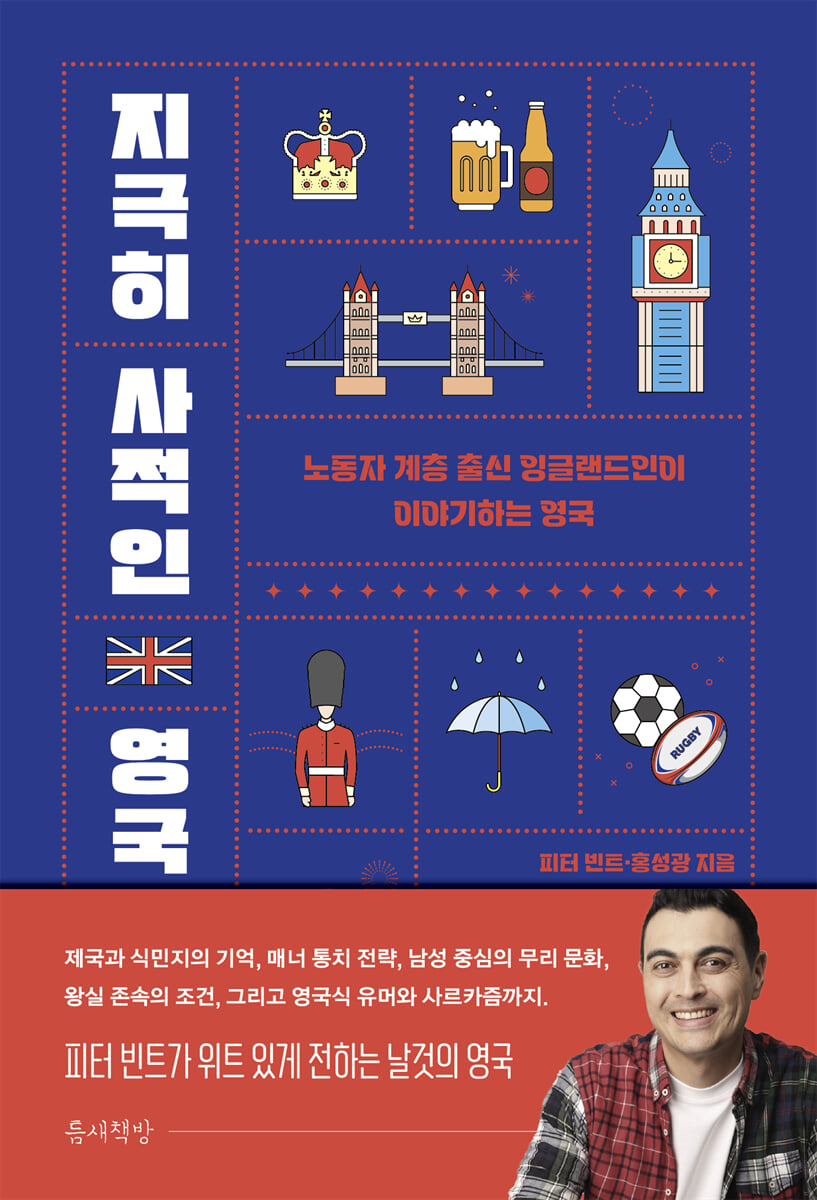
A very private Britain
 |
Description
Book Introduction
A story of a working class we've never encountered: a strange yet fascinating Britain.
Britain's Concerns About Britishness as It Moves Toward a Multiethnic and Multicultural Nation
Pride in British food, memories of empire and colonies, British humor and even sarcasm…
Interesting British culture, told with characteristic British wit.
The new book in the "Guide for Global Travelers" series, a niche bookstore where foreigners introduce their own countries, has been published, "A Very Private Britain."
This is the sixth, following 『Extremely Private Italy』, 『Extremely Private France』, 『Extremely Private Russia』, 『Extremely Private Nepal』, and 『Extremely Private Japan』.
This book is a story about Britain told by Peter Vint, a British citizen who has lived in Korea since 2008.
His England is both familiar and strange.
The author, who came from the working class and graduated from the prestigious Queen Elizabeth School and King's College London, shows Britain as a place for ordinary people, not a "country of gentlemen."
The sentiment symbolized by “Keep Calm and Carry On” reveals that customs and order that appear contradictory on the surface are actually the forces that sustain society.
It shows that behind the splendor of the royal family and the nobility, there exists another Britain with a slow but unique charm.
Britain's Concerns About Britishness as It Moves Toward a Multiethnic and Multicultural Nation
Pride in British food, memories of empire and colonies, British humor and even sarcasm…
Interesting British culture, told with characteristic British wit.
The new book in the "Guide for Global Travelers" series, a niche bookstore where foreigners introduce their own countries, has been published, "A Very Private Britain."
This is the sixth, following 『Extremely Private Italy』, 『Extremely Private France』, 『Extremely Private Russia』, 『Extremely Private Nepal』, and 『Extremely Private Japan』.
This book is a story about Britain told by Peter Vint, a British citizen who has lived in Korea since 2008.
His England is both familiar and strange.
The author, who came from the working class and graduated from the prestigious Queen Elizabeth School and King's College London, shows Britain as a place for ordinary people, not a "country of gentlemen."
The sentiment symbolized by “Keep Calm and Carry On” reveals that customs and order that appear contradictory on the surface are actually the forces that sustain society.
It shows that behind the splendor of the royal family and the nobility, there exists another Britain with a slow but unique charm.
- You can preview some of the book's contents.
Preview
index
prolog
PART Ⅰ.
The Dissolution of the Empire and What Happened After
01.
Four countries, one 'kingdom'
02.
A sense of loss for the vanished British Empire
03.
Will the Commonwealth continue?
04.
Why I Became an Apple Icon
05.
British Views of War and Colonialism
06.
Brexit: A Disaster Created by 'British Exceptionalism'
07.
Arrogant France, cool but boring Germany
08.
British speed
PART Ⅱ.
Who is British
01.
A British expression, “Keep Calm and Carry On”
02.
Concerns about Britishness
03.
Manners maketh the Englishman
04.
Manners Governing Strategy
05.
School life varies depending on class
06.
British pride and belonging
07.
Red-haired heroes Paul Scholes and Ron Weasley
PART Ⅲ.
British culture that pursues masculinity
01.
“Be a real man!”
02.
You have to become part of the group
03.
upper class herding
04.
A social club, a men-only space divided by class
05.
I'm happy without having to climb the social ladder.
06.
Why there are no British female characters
07.
The standard of a good British man
PART IV.
The order that sustains Britain
01.
The Royal Family, a symbol of Britain
02.
What it means to reign but not rule
03.
Elizabeth II, the spiritual leader
04.
Will the British monarchy continue?
05.
Between stability and chaos: Britain's political system
06.
Law is far, custom is near
PART V.
Controversial but famous things
01.
The weather in England is better than you think.
02.
The British don't get depressed because of the weather.
03.
British food is world-class.
04.
Does food have to be delicious?
PART VI.
How the British Live and Raise Their Children
01.
I live with patience at home too
02.
The British dream is a detached house with a garden.
03.
A house steeped in time rather than a new house
04.
In the UK, mothers are required to be discharged from hospital within four hours of giving birth.
05.
British parents are their children's 'advisors'
PART VII.
Daily life and culture of the British people
01.
London and England outside London
02.
The British also enjoy their holidays conservatively.
03.
The village's love room, the pub
04.
British humor without limits
05.
I get hurt little by little in the jokes we exchange every day.
06.
Anyone can bite
07.
Christianity has become more of a culture than a religion.
08.
Conservative but diverse Britain
Epilogue #1 Korea: A Fantasyland
Epilogue #2: The Power of History and Culture that Sustains Britain
PART Ⅰ.
The Dissolution of the Empire and What Happened After
01.
Four countries, one 'kingdom'
02.
A sense of loss for the vanished British Empire
03.
Will the Commonwealth continue?
04.
Why I Became an Apple Icon
05.
British Views of War and Colonialism
06.
Brexit: A Disaster Created by 'British Exceptionalism'
07.
Arrogant France, cool but boring Germany
08.
British speed
PART Ⅱ.
Who is British
01.
A British expression, “Keep Calm and Carry On”
02.
Concerns about Britishness
03.
Manners maketh the Englishman
04.
Manners Governing Strategy
05.
School life varies depending on class
06.
British pride and belonging
07.
Red-haired heroes Paul Scholes and Ron Weasley
PART Ⅲ.
British culture that pursues masculinity
01.
“Be a real man!”
02.
You have to become part of the group
03.
upper class herding
04.
A social club, a men-only space divided by class
05.
I'm happy without having to climb the social ladder.
06.
Why there are no British female characters
07.
The standard of a good British man
PART IV.
The order that sustains Britain
01.
The Royal Family, a symbol of Britain
02.
What it means to reign but not rule
03.
Elizabeth II, the spiritual leader
04.
Will the British monarchy continue?
05.
Between stability and chaos: Britain's political system
06.
Law is far, custom is near
PART V.
Controversial but famous things
01.
The weather in England is better than you think.
02.
The British don't get depressed because of the weather.
03.
British food is world-class.
04.
Does food have to be delicious?
PART VI.
How the British Live and Raise Their Children
01.
I live with patience at home too
02.
The British dream is a detached house with a garden.
03.
A house steeped in time rather than a new house
04.
In the UK, mothers are required to be discharged from hospital within four hours of giving birth.
05.
British parents are their children's 'advisors'
PART VII.
Daily life and culture of the British people
01.
London and England outside London
02.
The British also enjoy their holidays conservatively.
03.
The village's love room, the pub
04.
British humor without limits
05.
I get hurt little by little in the jokes we exchange every day.
06.
Anyone can bite
07.
Christianity has become more of a culture than a religion.
08.
Conservative but diverse Britain
Epilogue #1 Korea: A Fantasyland
Epilogue #2: The Power of History and Culture that Sustains Britain
Into the book
The negative reviews about the weather and food in England are things I only learned after coming to Korea.
As a British person, it was honestly a prejudice that made me want to say, “What are you talking about?”
But living in Korea, I've come to understand to some extent why that perception has developed.
And then I realized that the Britain that Koreans think of and the Britain that British people live in are quite different countries.
So when the opportunity to write this book arose, I was happy to accept the opportunity.
--- From the "Prologue"
I felt a special emotion watching the return of Hong Kong.
I felt as if I had become a displaced person.
When I talk about where I was born, I always say “British Hong Kong.”
It means that the place where I was born was England.
But now there is no British Hong Kong.
A Chinese friend of mine gets sensitive when I talk about Hong Kong.
He even said to me, “Aren’t you Korean, British, or Chinese?”
That's not wrong.
I'm mixed race and born in Hong Kong, so I've had a lot to think about about my identity compared to other British people.
I consider being born in Hong Kong to be part of my identity, but to my Chinese friends, it might seem like I was on the fence.
--- From "The Loss of the Vanished British Empire"
It seems that Britain was rarely praised while doing "Naked History of the World."
I think the 'Singapore' episode was the best.
The program was a place to learn about how Britain has done bad things around the world.
But I think it's fortunate that I had the opportunity to learn these things.
If I had only lived in England, I probably would not have had the opportunity to learn history.
I was grateful to be able to listen to the professors' lectures and learn.
--- From "Why I Became an Apple Icon"
In England there is a saying, “stiff upper lip.”
It's a saying that means to keep your upper lip stiff, and to not reveal your difficulties with an indomitable spirit.
The context will be easier to understand if you connect it with the previously mentioned “Keep Calm and Carry On.”
No matter how difficult it is, endure it without showing it.
This is also reflected in British manners.
--- From "Manners Maketh the Englishman"
Just because they are working class doesn't mean they are ashamed of their class.
Many people are proud of being from a working-class background.
Even on the outside it looks like that.
I have pride in being a person who lives honestly with my own strength and ability.
There is no attempt to climb up to the upper class.
The dignity and manners of the upper class are of no concern.
The working class are people who live like British people while keeping their manners.
--- From "Manners Governing Strategy"
The working class has a sense of pride in being socially respectable.
Some upper-class people try to distance themselves from the working class, calling them rough and uncouth, but they cannot openly ignore them.
This is because the tradition of viewing the working class as an honest and sincere class still holds true.
So, people from working class backgrounds value living while maintaining their own identity.
--- From "I'm happy without having to climb the social ladder"
It is quite important that we have traditions that other countries do not have, and a national image that everyone knows.
I also feel that I have received a somewhat positive impression of the British royal family while living in Korea.
The royal family is at the pinnacle of the perception that the British are gentle and dignified, and the very idea that there are real princes and princesses functions as a form of 'cultural fantasy'.
Even if the real gains are not great, there is not much to lose.
--- From "Will the British Royal Family Continue?"
In Korea, even lunch time is a struggle.
You have to think about what to eat for lunch from the moment you get to work.
Even if you just want to eat something simple, it's not easy.
First of all, there aren't many restaurants where you can have a quick lunch.
But it would be rude to go to a snack bar at lunchtime and eat just one roll of kimbap, so if you order a variety of things, you will end up eating more.
What makes it harder for the British is that there are so many good restaurants.
It's a pain to have to find a new restaurant every day.
Imagine thinking every day, "Which gas station will make my car happy?"
You can't help but feel stressed.
--- From "Does food have to be delicious?"
I don't know which one is better for the child.
This may be why Korea continues to produce outstanding talent.
But it's not good for parents.
That's why I'm afraid of having children.
I also gave birth to and am raising a child in Korea, but it is difficult to keep up with the Korean style of parenting.
I think it's harder because I grew up in the British way and I always end up comparing myself to others.
But anyway, parents' lives are also precious.
It is difficult to carelessly tell people to have children and raise them in Korea in a way that presupposes parental sacrifice.
--- From "British Parents Are Their Children's 'Advisors'"
Before we get into the specifics of the British press, let's talk about its coverage of sports and entertainment.
The British press is unbiased in this area.
It bites everyone equally.
Beckham and Rooney were no exception.
Basically, when someone is doing well, we assume they are 'arrogant' and make them a target of criticism.
When you show humility in such cases, the public's reaction becomes more generous.
I think Son Heung-min is a player who actually benefited from being so humble.
As a British person, it was honestly a prejudice that made me want to say, “What are you talking about?”
But living in Korea, I've come to understand to some extent why that perception has developed.
And then I realized that the Britain that Koreans think of and the Britain that British people live in are quite different countries.
So when the opportunity to write this book arose, I was happy to accept the opportunity.
--- From the "Prologue"
I felt a special emotion watching the return of Hong Kong.
I felt as if I had become a displaced person.
When I talk about where I was born, I always say “British Hong Kong.”
It means that the place where I was born was England.
But now there is no British Hong Kong.
A Chinese friend of mine gets sensitive when I talk about Hong Kong.
He even said to me, “Aren’t you Korean, British, or Chinese?”
That's not wrong.
I'm mixed race and born in Hong Kong, so I've had a lot to think about about my identity compared to other British people.
I consider being born in Hong Kong to be part of my identity, but to my Chinese friends, it might seem like I was on the fence.
--- From "The Loss of the Vanished British Empire"
It seems that Britain was rarely praised while doing "Naked History of the World."
I think the 'Singapore' episode was the best.
The program was a place to learn about how Britain has done bad things around the world.
But I think it's fortunate that I had the opportunity to learn these things.
If I had only lived in England, I probably would not have had the opportunity to learn history.
I was grateful to be able to listen to the professors' lectures and learn.
--- From "Why I Became an Apple Icon"
In England there is a saying, “stiff upper lip.”
It's a saying that means to keep your upper lip stiff, and to not reveal your difficulties with an indomitable spirit.
The context will be easier to understand if you connect it with the previously mentioned “Keep Calm and Carry On.”
No matter how difficult it is, endure it without showing it.
This is also reflected in British manners.
--- From "Manners Maketh the Englishman"
Just because they are working class doesn't mean they are ashamed of their class.
Many people are proud of being from a working-class background.
Even on the outside it looks like that.
I have pride in being a person who lives honestly with my own strength and ability.
There is no attempt to climb up to the upper class.
The dignity and manners of the upper class are of no concern.
The working class are people who live like British people while keeping their manners.
--- From "Manners Governing Strategy"
The working class has a sense of pride in being socially respectable.
Some upper-class people try to distance themselves from the working class, calling them rough and uncouth, but they cannot openly ignore them.
This is because the tradition of viewing the working class as an honest and sincere class still holds true.
So, people from working class backgrounds value living while maintaining their own identity.
--- From "I'm happy without having to climb the social ladder"
It is quite important that we have traditions that other countries do not have, and a national image that everyone knows.
I also feel that I have received a somewhat positive impression of the British royal family while living in Korea.
The royal family is at the pinnacle of the perception that the British are gentle and dignified, and the very idea that there are real princes and princesses functions as a form of 'cultural fantasy'.
Even if the real gains are not great, there is not much to lose.
--- From "Will the British Royal Family Continue?"
In Korea, even lunch time is a struggle.
You have to think about what to eat for lunch from the moment you get to work.
Even if you just want to eat something simple, it's not easy.
First of all, there aren't many restaurants where you can have a quick lunch.
But it would be rude to go to a snack bar at lunchtime and eat just one roll of kimbap, so if you order a variety of things, you will end up eating more.
What makes it harder for the British is that there are so many good restaurants.
It's a pain to have to find a new restaurant every day.
Imagine thinking every day, "Which gas station will make my car happy?"
You can't help but feel stressed.
--- From "Does food have to be delicious?"
I don't know which one is better for the child.
This may be why Korea continues to produce outstanding talent.
But it's not good for parents.
That's why I'm afraid of having children.
I also gave birth to and am raising a child in Korea, but it is difficult to keep up with the Korean style of parenting.
I think it's harder because I grew up in the British way and I always end up comparing myself to others.
But anyway, parents' lives are also precious.
It is difficult to carelessly tell people to have children and raise them in Korea in a way that presupposes parental sacrifice.
--- From "British Parents Are Their Children's 'Advisors'"
Before we get into the specifics of the British press, let's talk about its coverage of sports and entertainment.
The British press is unbiased in this area.
It bites everyone equally.
Beckham and Rooney were no exception.
Basically, when someone is doing well, we assume they are 'arrogant' and make them a target of criticism.
When you show humility in such cases, the public's reaction becomes more generous.
I think Son Heung-min is a player who actually benefited from being so humble.
--- From "Anyone Bites"
Publisher's Review
Britain as it is, neither an empire nor a great power
How do the British describe their own country? They enjoy self-deprecation and satire, and they're merciless even when it comes to their homeland.
Peter Vint describes Britain as a slow-moving, conservative society, one where old customs and masculinity still persist.
The Britain that the author, who comes from a working-class background, shows is not an elegant country represented by royalty and gentlemen, but a Britain of ordinary people who live by the manners and customs of the community.
His story reveals a raw Britain, no longer an empire or a great power.
Nevertheless, his Britain is attractive to Koreans.
Although its imperial status has disappeared, its presence as a cultural powerhouse remains.
Above all, old traditions and customs help us revive values we have forgotten.
For the British, Britain is a country that is recognized without having to boast about it.
So, Peter's writing is calm and has a subtle pride.
This is precisely why 『A Very Private England』 is unique among the series.
While other authors have attempted to present a balanced picture of their country's strengths and weaknesses, Peter presents Britain's outdated traditions and incomprehensible customs more clearly than its virtues.
And that soon reveals the identity of the British people.
The attitude of being reluctant to change, silently enduring discomfort, and finding comfort in it is unfamiliar to Koreans, but it feels refreshing.
For Korea, Britain has long been a fantasy.
Because it was a country with the glory of the British Empire, a symbol of an advanced nation, and a fairytale-like royal family.
But now, Korea has become the object of envy for young people around the world.
With rapid change and overflowing energy, it has become the country closest to the future.
Peter, too, was drawn to this charm and settled in Korea. He experienced the differences between the two countries firsthand and came to understand why they were so irresistibly drawn to each other.
If we follow his gaze, Britain is no longer a 'country of gentlemen'.
It is a country of ordinary people who live a somewhat rustic, simple and leisurely life.
For Koreans, who have left much of their past behind amidst rapid development, Britain offers a different way of life.
It is not the fantasy we long for, but the charm of maintaining peace within a community.
If in the past I was fascinated by the flashy symbols like the royal family, now I see the everyday lives of ordinary British people.
In that respect, Britain is still a fresh and attractive country.
In this respect, 『A Very Private England』 is the best guidebook that shows us the real face of England that we never knew.
It is also interesting that the author is of mixed race with a Korean mother.
Having traveled between Korea and England since childhood and experienced the differences between the two countries, he captures the charm that emerges from that gap.
It explains things that are difficult for Koreans to understand, such as royal and class culture, male-centered group culture, views on empires and colonies, and pride in food, from the perspective of Korean readers.
Of particular note is the discourse on Britishness.
As immigration increases in Britain, discourse on Britishness has entered the public sphere, and the country is pondering how to create British people.
The author, who is of mixed race, says that the most important condition for being recognized as British is not race, religion, class, or wealth, but manners as a British person.
Accepting the norms that must be observed as a member of the community is what makes one British.
This provides valuable insights for Korea, which is moving toward a multi-ethnic and multicultural society, to consider its own "Koreanness."
The book explores British identity while retaining a uniquely British sense of humor and sarcasm.
The author's attitude of telling every story with wit and satire guides readers into an 'unfamiliar but fascinating England.'
His unvarnished gaze conveys a 'real British' look that is difficult to find in other media.
"A Very Private Britain" depicts today's Britain, not the Britain created by the media, but the Britain of ordinary people.
A country that seems full of contradictions, but stands firmly on tradition, which makes it all the more attractive.
The author's perspective, which intersects British pride and satire, will serve as a starting point for readers to take in the 'real Britain.'
How do the British describe their own country? They enjoy self-deprecation and satire, and they're merciless even when it comes to their homeland.
Peter Vint describes Britain as a slow-moving, conservative society, one where old customs and masculinity still persist.
The Britain that the author, who comes from a working-class background, shows is not an elegant country represented by royalty and gentlemen, but a Britain of ordinary people who live by the manners and customs of the community.
His story reveals a raw Britain, no longer an empire or a great power.
Nevertheless, his Britain is attractive to Koreans.
Although its imperial status has disappeared, its presence as a cultural powerhouse remains.
Above all, old traditions and customs help us revive values we have forgotten.
For the British, Britain is a country that is recognized without having to boast about it.
So, Peter's writing is calm and has a subtle pride.
This is precisely why 『A Very Private England』 is unique among the series.
While other authors have attempted to present a balanced picture of their country's strengths and weaknesses, Peter presents Britain's outdated traditions and incomprehensible customs more clearly than its virtues.
And that soon reveals the identity of the British people.
The attitude of being reluctant to change, silently enduring discomfort, and finding comfort in it is unfamiliar to Koreans, but it feels refreshing.
For Korea, Britain has long been a fantasy.
Because it was a country with the glory of the British Empire, a symbol of an advanced nation, and a fairytale-like royal family.
But now, Korea has become the object of envy for young people around the world.
With rapid change and overflowing energy, it has become the country closest to the future.
Peter, too, was drawn to this charm and settled in Korea. He experienced the differences between the two countries firsthand and came to understand why they were so irresistibly drawn to each other.
If we follow his gaze, Britain is no longer a 'country of gentlemen'.
It is a country of ordinary people who live a somewhat rustic, simple and leisurely life.
For Koreans, who have left much of their past behind amidst rapid development, Britain offers a different way of life.
It is not the fantasy we long for, but the charm of maintaining peace within a community.
If in the past I was fascinated by the flashy symbols like the royal family, now I see the everyday lives of ordinary British people.
In that respect, Britain is still a fresh and attractive country.
In this respect, 『A Very Private England』 is the best guidebook that shows us the real face of England that we never knew.
It is also interesting that the author is of mixed race with a Korean mother.
Having traveled between Korea and England since childhood and experienced the differences between the two countries, he captures the charm that emerges from that gap.
It explains things that are difficult for Koreans to understand, such as royal and class culture, male-centered group culture, views on empires and colonies, and pride in food, from the perspective of Korean readers.
Of particular note is the discourse on Britishness.
As immigration increases in Britain, discourse on Britishness has entered the public sphere, and the country is pondering how to create British people.
The author, who is of mixed race, says that the most important condition for being recognized as British is not race, religion, class, or wealth, but manners as a British person.
Accepting the norms that must be observed as a member of the community is what makes one British.
This provides valuable insights for Korea, which is moving toward a multi-ethnic and multicultural society, to consider its own "Koreanness."
The book explores British identity while retaining a uniquely British sense of humor and sarcasm.
The author's attitude of telling every story with wit and satire guides readers into an 'unfamiliar but fascinating England.'
His unvarnished gaze conveys a 'real British' look that is difficult to find in other media.
"A Very Private Britain" depicts today's Britain, not the Britain created by the media, but the Britain of ordinary people.
A country that seems full of contradictions, but stands firmly on tradition, which makes it all the more attractive.
The author's perspective, which intersects British pride and satire, will serve as a starting point for readers to take in the 'real Britain.'
GOODS SPECIFICS
- Date of issue: September 19, 2025
- Page count, weight, size: 392 pages | 422g | 128*188*23mm
- ISBN13: 9791188949793
You may also like
카테고리
korean


korean

![GQ KOREA Mark (Monthly): December [2025]](http://librairie.coreenne.fr/cdn/shop/files/8ef265dbbfbf186523ed75ba7319009d.jpg?v=1765340328&width=3840)


