

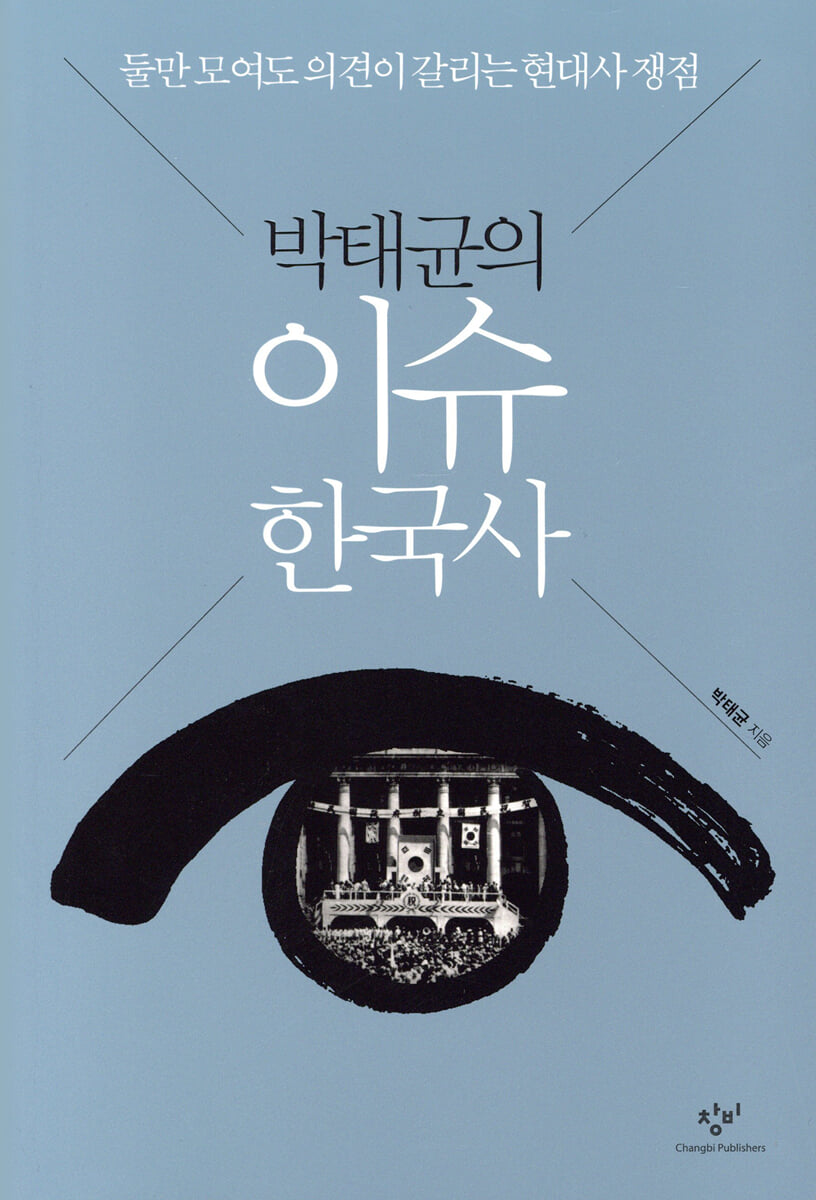
Park Tae-gyun's Issues in Korean History
 |
Description
Book Introduction
Beyond the politicized myth of modern Korean history Professor Park Tae-gyun's lecture on modern history at Seoul National University's Graduate School of International Studies In Korean society, history always causes problems. Modern Korean history is a subject that appears frequently in college entrance exams, and modern history textbooks are rejected as subversive books by local government, school, and military libraries. Professor Park Tae-gyun of Seoul National University has opened his mouth to reinterpret modern history, which has been overshadowed by myths about left-leaning and right-leaning, from a balanced perspective. The author is recognized as an all-round historian who regularly interacts with foreign Korean studies scholars, teaches students of various nationalities at Seoul National University's Graduate School of International Studies, and lectures on Korean history on a radio program whose primary audience is taxi drivers. 『Park Tae-gyun's Issues in Korean History』 does not approach modern Korean history as a general history. Instead, it clearly outlines 10 issues that must be addressed in modern Korean history and the historical facts that must be known in relation to them. The greatest virtue of this book is that it explains complex and difficult historical situations in an easy and detailed manner, especially at the level of the general public, as seen in lectures and broadcasts. This year, with so many significant anniversaries of modern history, including the 70th anniversary of liberation, the 65th anniversary of the Korean War, and the 50th anniversary of the Korea-Japan Treaty of 1919, this book covers ten issues, ranging from the sharp conflict between Korea and Japan to the controversies surrounding South Korea's "national brand" of economic growth and democratization. These issues will serve as a crucial link in understanding the important phases and events of modern Korean history. |
- You can preview some of the book's contents.
Preview
index
1 Dokdo: From now on, it is our land?
2. Past Remarks: Missteps of the US Military Government and the Unjust Treaty between Korea and Japan
3 Territories: Two countries on the Korean Peninsula
4 Colonial Modernization Theory: The Historical Debate Within Us
5 America: The Complex Secrets of Blood Pact
6 Armistice Agreement: Memories of the Lost Two Years of the Korean War
7 The Vietnam War: Between Security and War Specials
8 Economic Growth: Beyond the Myth
9 May 16: A Coup That Wanted to Be a Revolution
10 Sunshine Policy: Its Origins in the 1970s
2. Past Remarks: Missteps of the US Military Government and the Unjust Treaty between Korea and Japan
3 Territories: Two countries on the Korean Peninsula
4 Colonial Modernization Theory: The Historical Debate Within Us
5 America: The Complex Secrets of Blood Pact
6 Armistice Agreement: Memories of the Lost Two Years of the Korean War
7 The Vietnam War: Between Security and War Specials
8 Economic Growth: Beyond the Myth
9 May 16: A Coup That Wanted to Be a Revolution
10 Sunshine Policy: Its Origins in the 1970s
Detailed image

Into the book
It is not important to know history, but to know it properly.
If we learn historical facts that are not objective, they will not be a lesson for the present and the future, but rather will be poisonous.
It's better to not learn history than to not learn it.
(…) Korean history is now surrounded by myths.
Historians are diligently researching, but the history that is socially recognized is somewhat disconnected from the research of researchers.
In short, politicized myths monopolize all historical interpretations.
Politicized myths obstruct an objective understanding of history.
It's the work of piecing together historical facts to arrive at the conclusion you want to reach.
---From "Introduction"
The comfort women issue needs to be looked at a little differently.
If we interpret the individual compensation clause literally, it is correct that the Korean government should pay compensation.
Of course, this is Japan's position.
In fact, that clause is a very toxic clause, but the Korean government just inserted it while receiving money.
And the Japanese government continues to bring up the relevant provisions.
In 1965, when Korea and Japan signed the agreement, there was no awareness of the existence of comfort women.
There was no proper understanding of the existence of sexual slavery, and there was no awareness at all that the state should compensate individuals who suffered harm as a result.
From this perspective, it cannot be said that the comfort women issue was completely resolved with the 1965 Korea-Japan Agreement.
--- p.57
The Everready Plan could literally be a plan that is always prepared, that is, a plan to remove President Syngman Rhee that came out in 1953.
The US thought that if the current situation was maintained, the war would not be stopped and an agreement between South Korea and the US would not be reached.
Of course, this plan was not implemented for the same reasons as in 1952.
The first reason was that there was still no one else who stood out besides President Syngman Rhee.
The second reason was that if such an accident occurred during a war, public opinion would undoubtedly turn against it, and not only in Korea but also around the world, it would not be tolerated.
As mentioned earlier, the aftermath of the release of anti-communist prisoners of war dealt a fatal blow to trust between South Korea and the United States.
--- p.135
Trying to define President Park Chung-hee with a single word or personality is fundamentally ahistorical.
(…) If President Park Chung-hee was a reformist leader immediately after the coup, then from the mid-1960s onwards he was a leader who strengthened social control while also promoting economic growth, and from the early 1970s onwards he was a leader who addressed social and economic issues with a totalitarian iron fist rather than democratic principles.
The evaluation of this will vary depending on one's historical philosophy.
But there is no need for historians to define what is good or bad.
All we have to do is objectively restore historical facts so that each person can evaluate them that way.
History is not about writing biographies of heroes.
If we learn historical facts that are not objective, they will not be a lesson for the present and the future, but rather will be poisonous.
It's better to not learn history than to not learn it.
(…) Korean history is now surrounded by myths.
Historians are diligently researching, but the history that is socially recognized is somewhat disconnected from the research of researchers.
In short, politicized myths monopolize all historical interpretations.
Politicized myths obstruct an objective understanding of history.
It's the work of piecing together historical facts to arrive at the conclusion you want to reach.
---From "Introduction"
The comfort women issue needs to be looked at a little differently.
If we interpret the individual compensation clause literally, it is correct that the Korean government should pay compensation.
Of course, this is Japan's position.
In fact, that clause is a very toxic clause, but the Korean government just inserted it while receiving money.
And the Japanese government continues to bring up the relevant provisions.
In 1965, when Korea and Japan signed the agreement, there was no awareness of the existence of comfort women.
There was no proper understanding of the existence of sexual slavery, and there was no awareness at all that the state should compensate individuals who suffered harm as a result.
From this perspective, it cannot be said that the comfort women issue was completely resolved with the 1965 Korea-Japan Agreement.
--- p.57
The Everready Plan could literally be a plan that is always prepared, that is, a plan to remove President Syngman Rhee that came out in 1953.
The US thought that if the current situation was maintained, the war would not be stopped and an agreement between South Korea and the US would not be reached.
Of course, this plan was not implemented for the same reasons as in 1952.
The first reason was that there was still no one else who stood out besides President Syngman Rhee.
The second reason was that if such an accident occurred during a war, public opinion would undoubtedly turn against it, and not only in Korea but also around the world, it would not be tolerated.
As mentioned earlier, the aftermath of the release of anti-communist prisoners of war dealt a fatal blow to trust between South Korea and the United States.
--- p.135
Trying to define President Park Chung-hee with a single word or personality is fundamentally ahistorical.
(…) If President Park Chung-hee was a reformist leader immediately after the coup, then from the mid-1960s onwards he was a leader who strengthened social control while also promoting economic growth, and from the early 1970s onwards he was a leader who addressed social and economic issues with a totalitarian iron fist rather than democratic principles.
The evaluation of this will vary depending on one's historical philosophy.
But there is no need for historians to define what is good or bad.
All we have to do is objectively restore historical facts so that each person can evaluate them that way.
History is not about writing biographies of heroes.
--- p.271
Publisher's Review
Untied history repeats itself!
: 65th anniversary of the Korean War, 50th anniversary of the Korea-Japan Agreement, 70th anniversary of liberation…
Unresolved history does not remain stagnant, but rather persists and causes various problems.
The Korea-Japan Agreement, which was hastily concluded due to economic growth and relations with the United States, is causing controversy over the issues of comfort women and conscription and forced labor for the Japanese military.
As a historian, the author says that answers to the current situation can be found by focusing on the roots of the worsening Korea-Japan relationship.
The core of the argument is that “there is a reason for Japan’s false statements about the past.”
The Korea-Japan Agreement, which celebrates its 50th anniversary this year, is a prime example of history that has not been resolved.
This is because the compensation money received under the shameful name of “claims funds” through the Korea-Japan Agreement is the background for Japan’s repeated false statements about the past.
'Japan colonized Korea and modernized it, but after Japan's defeat, Korea, which was not even a victorious nation, plundered the Japanese people's property.
Nevertheless, the basic idea of the Japanese right wing is that Japan resolved the issue of compensation for colonial rule through the Korea-Japan Agreement (see pages 41-46 of the text).
Although it is a difficult claim to accept, the Japanese right wing's claims are based on some facts.
Japan had to develop in order to exploit (see pages 104-109 of the text), and the US military government confiscated not only the Japanese government's public property but also the property of Japanese people, and the Korean government received compensation anyway.
Of course, to make such a claim, a sincere apology for the past must come first, but this logic persists because war criminals and past history were not properly dealt with in post-war Japan.
Regarding the Dokdo issue, most Koreans believe that Japan is making groundless claims, but the Japanese government does not doubt that Dokdo is Japanese territory.
In fact, the Dokdo issue is not just a problem between Korea and Japan.
The great powers during the two world wars, especially the United States, cannot escape responsibility for this problem.
However, few people are aware that the Treaty of San Francisco, signed during the Korean War, did not include Dokdo among the lands that Korea was supposed to receive back, and that the treaty was signed without the participation of Korea and China, reflecting the foreign policy of the United States (see pages 26-34 of the text).
This historical experience plays a significant role in Japan's confidence that it can win if it takes this issue to the International Court of Justice.
If we simply dismiss Japan's claims as absurd and fail to take their historical perspective seriously, we may repeat the past, when we were excluded from the United States and Japan and signed unfavorable treaties.
The ten issues presented in this book are nothing more than the wounds of our history that we have not been able to properly resolve and move on from.
As the major issues in modern Korean history originate from the Japanese colonial period, four of the ten issues covered in this book (Dokdo, past history remarks, territory, and colonial modernization theory) are related to the Japanese colonial period and the international agreements made during that period.
When we move beyond focusing solely on political positions or the attitudes of other countries and examine historical facts, our history will be set straight and we will be able to resolve stale relationships with our neighbors.
“History is not a story of heroes!”
: Now is the time to look directly at Presidents Syngman Rhee and Park Chung-hee.
When discussing issues in modern Korean history, it is difficult to leave out the evaluation of Syngman Rhee and Park Chung-hee.
Whether intended or not, Korea's brand of democracy and economic growth was solidified during their long tenure.
The author says that listing all the merits and demerits of historical figures and the pros and cons of events does not make for an objective perspective.
Rather, the bigger problem is that while claiming to be objective, they manipulate historical facts to reach their own desired conclusions or turn history into a heroic story of a specific individual.
President Syngman Rhee is the figure at the center of this controversy, receiving polar opposite evaluations: as a “founding president” and as an “anti-democratic dictator.”
But if we step outside the politicized myth a little, we clearly see a politician who ignored democratic procedures and caused the Busan political upheaval from a wartime refuge, and a president who caused conflict with the United States over the exchange rate issue and the release of anti-communist prisoners of war.
It is surprising that, contrary to the public's assessment that he was pro-American, he was in conflict with the United States throughout his term in office, to the point that the United States even planned to remove Syngman Rhee (see pages 128-36 of the text).
The controversy surrounding President Park Chung-hee is even more intense.
For example, the question, “Is May 16 a coup or a revolution?” is used today as a question for ideological verification, but when considering the definition of the term and the subsequent changes in the May 16 forces, it cannot be anything other than a coup.
Just because we acknowledge these obvious facts does not mean that the Park Chung-hee government's merits and demerits disappear, we need to make an effort to distinguish between fact and myth (see Chapter 9, 'May 16').
The author says that before jumping to conclusions like, “Park Chung-hee is a dictator,” or “Park Chung-hee is an economic president,” it is now necessary to attempt to properly understand Park Chung-hee as a historical figure.
A closer look at the era reveals that democratization and economic growth went hand in hand, and that Park Chung-hee was a man who defied a single definition.
The historical fact in the economic myth of the Republic of Korea is that, since the Syngman Rhee administration, the country has continuously experienced economic crises while simultaneously pursuing economic development plans.
The problems of the Korean economy stem from the fact that successive administrations have failed to resolve crises and instead covered them up with stopgap measures.
Park Chung-hee's August 3 measures, which froze private loans to save failing companies, and the new military government's policy of resolving the economic crisis of the 1980s by relying on the boom of the "three lows" are typical stopgap measures for economic crises (see pages 230-38 of the main text).
The debate surrounding Park Chung-hee extends to the Sunshine Policy.
People often try to divide the Sunshine Policy into Kim Dae-jung and the absorption unification into the military regime.
However, whether it is the Sunshine Policy or the absorption unification theory, their fundamental principles are the same: to achieve unification by changing North Korea.
Even these two policies were promoted during President Park Chung-hee's lifetime.
So, I nod my head in agreement with the author's statement that both sunlight and wind are conservative (see Chapter 10, 'Sunshine Policy').
The ten issues also include two wars that are important to us.
Chapter 6, which deals with the Korean War, is titled "Armistice Agreement," and it deeply depicts the process of concluding the armistice agreement after two years and one month of fierce fighting. Chapter 7, "Vietnam War," deals with the essence of the Vietnam War and its resulting harm, which has not been properly discussed due to being buried in the special nature of war.
It is no exaggeration to say that 『Park Tae-gyun's Issues in Korean History』 is the culmination of the author's research to date.
As a specialist in international relations and economic history, this book embodies the balanced perspectives he has presented not only through numerous research papers he has published but also through his popular books and columns on the Korean and Vietnam Wars.
This book stands out for its concise commentary, which can only be provided by someone who has studied history in depth.
Readers will find it helpful to organize issues in modern history that remain controversial to this day and to refine their own perspectives.
10 Issues Every Korean Is Curious About
: From CEO to Taxi Driver: Top Management Course
If we only look at his outstanding research achievements, it is true that Professor Park Tae-gyun is considered a typical scholar and researcher.
However, the author not only teaches students from around the world and elites from third world countries at Seoul National University's Graduate School of International Studies, but also has a reputation for accurately teaching modern Korean history to CEOs in executive education programs.
Not only that, but he also reaches out directly to the public. The reader feedback he received while hosting "Park Tae-gyun's Korean History" on CBS Radio greatly contributed to the writing of this book.
It was not just about sitting at a desk and writing, but also being able to gauge readers' reactions.
Readers who listen to the program have expressed gratitude for gaining a balanced understanding of previously partial knowledge, and sometimes even raised objections, directly or indirectly contributing to the writing of this book.
The ten issues selected in this book are all the ones that listeners responded most sensitively to.
What is noteworthy about the structure of this book is the translations of international agreements inserted here and there throughout the book.
We have been too negligent in the past of treaties that required a complex and multi-step process for conclusion, even with just one interpretation of the clause.
For example, the Cairo Declaration (see page 20 of the text) that promised independence for Korea at an “appropriate time,” the South Korean government approval bill that recognized the Republic of Korea as the “sole government in Korea” (see pages 77-78 of the text), and Article 2 of the Korea-Japan Agreement (see pages 46-47 of the text) that stipulated that treaties concluded before the Korea-Japan Agreement were “already null and void” have caused much controversy both at the time and even today.
Although it is a dry phrase, it is a valuable resource that allows us to understand how the international community views South Korea.
Just as important as teaching one's own history to one's own people is making it known to the international community.
Professor Park Tae-gyun, who has long interacted with Korean history academics both domestically and internationally, helps readers clearly understand Korean modern history as viewed by the international community, rather than as confined to our own internal perspectives.
Through open Korean history, we will be able to recognize the potential and pain of our history.
: 65th anniversary of the Korean War, 50th anniversary of the Korea-Japan Agreement, 70th anniversary of liberation…
Unresolved history does not remain stagnant, but rather persists and causes various problems.
The Korea-Japan Agreement, which was hastily concluded due to economic growth and relations with the United States, is causing controversy over the issues of comfort women and conscription and forced labor for the Japanese military.
As a historian, the author says that answers to the current situation can be found by focusing on the roots of the worsening Korea-Japan relationship.
The core of the argument is that “there is a reason for Japan’s false statements about the past.”
The Korea-Japan Agreement, which celebrates its 50th anniversary this year, is a prime example of history that has not been resolved.
This is because the compensation money received under the shameful name of “claims funds” through the Korea-Japan Agreement is the background for Japan’s repeated false statements about the past.
'Japan colonized Korea and modernized it, but after Japan's defeat, Korea, which was not even a victorious nation, plundered the Japanese people's property.
Nevertheless, the basic idea of the Japanese right wing is that Japan resolved the issue of compensation for colonial rule through the Korea-Japan Agreement (see pages 41-46 of the text).
Although it is a difficult claim to accept, the Japanese right wing's claims are based on some facts.
Japan had to develop in order to exploit (see pages 104-109 of the text), and the US military government confiscated not only the Japanese government's public property but also the property of Japanese people, and the Korean government received compensation anyway.
Of course, to make such a claim, a sincere apology for the past must come first, but this logic persists because war criminals and past history were not properly dealt with in post-war Japan.
Regarding the Dokdo issue, most Koreans believe that Japan is making groundless claims, but the Japanese government does not doubt that Dokdo is Japanese territory.
In fact, the Dokdo issue is not just a problem between Korea and Japan.
The great powers during the two world wars, especially the United States, cannot escape responsibility for this problem.
However, few people are aware that the Treaty of San Francisco, signed during the Korean War, did not include Dokdo among the lands that Korea was supposed to receive back, and that the treaty was signed without the participation of Korea and China, reflecting the foreign policy of the United States (see pages 26-34 of the text).
This historical experience plays a significant role in Japan's confidence that it can win if it takes this issue to the International Court of Justice.
If we simply dismiss Japan's claims as absurd and fail to take their historical perspective seriously, we may repeat the past, when we were excluded from the United States and Japan and signed unfavorable treaties.
The ten issues presented in this book are nothing more than the wounds of our history that we have not been able to properly resolve and move on from.
As the major issues in modern Korean history originate from the Japanese colonial period, four of the ten issues covered in this book (Dokdo, past history remarks, territory, and colonial modernization theory) are related to the Japanese colonial period and the international agreements made during that period.
When we move beyond focusing solely on political positions or the attitudes of other countries and examine historical facts, our history will be set straight and we will be able to resolve stale relationships with our neighbors.
“History is not a story of heroes!”
: Now is the time to look directly at Presidents Syngman Rhee and Park Chung-hee.
When discussing issues in modern Korean history, it is difficult to leave out the evaluation of Syngman Rhee and Park Chung-hee.
Whether intended or not, Korea's brand of democracy and economic growth was solidified during their long tenure.
The author says that listing all the merits and demerits of historical figures and the pros and cons of events does not make for an objective perspective.
Rather, the bigger problem is that while claiming to be objective, they manipulate historical facts to reach their own desired conclusions or turn history into a heroic story of a specific individual.
President Syngman Rhee is the figure at the center of this controversy, receiving polar opposite evaluations: as a “founding president” and as an “anti-democratic dictator.”
But if we step outside the politicized myth a little, we clearly see a politician who ignored democratic procedures and caused the Busan political upheaval from a wartime refuge, and a president who caused conflict with the United States over the exchange rate issue and the release of anti-communist prisoners of war.
It is surprising that, contrary to the public's assessment that he was pro-American, he was in conflict with the United States throughout his term in office, to the point that the United States even planned to remove Syngman Rhee (see pages 128-36 of the text).
The controversy surrounding President Park Chung-hee is even more intense.
For example, the question, “Is May 16 a coup or a revolution?” is used today as a question for ideological verification, but when considering the definition of the term and the subsequent changes in the May 16 forces, it cannot be anything other than a coup.
Just because we acknowledge these obvious facts does not mean that the Park Chung-hee government's merits and demerits disappear, we need to make an effort to distinguish between fact and myth (see Chapter 9, 'May 16').
The author says that before jumping to conclusions like, “Park Chung-hee is a dictator,” or “Park Chung-hee is an economic president,” it is now necessary to attempt to properly understand Park Chung-hee as a historical figure.
A closer look at the era reveals that democratization and economic growth went hand in hand, and that Park Chung-hee was a man who defied a single definition.
The historical fact in the economic myth of the Republic of Korea is that, since the Syngman Rhee administration, the country has continuously experienced economic crises while simultaneously pursuing economic development plans.
The problems of the Korean economy stem from the fact that successive administrations have failed to resolve crises and instead covered them up with stopgap measures.
Park Chung-hee's August 3 measures, which froze private loans to save failing companies, and the new military government's policy of resolving the economic crisis of the 1980s by relying on the boom of the "three lows" are typical stopgap measures for economic crises (see pages 230-38 of the main text).
The debate surrounding Park Chung-hee extends to the Sunshine Policy.
People often try to divide the Sunshine Policy into Kim Dae-jung and the absorption unification into the military regime.
However, whether it is the Sunshine Policy or the absorption unification theory, their fundamental principles are the same: to achieve unification by changing North Korea.
Even these two policies were promoted during President Park Chung-hee's lifetime.
So, I nod my head in agreement with the author's statement that both sunlight and wind are conservative (see Chapter 10, 'Sunshine Policy').
The ten issues also include two wars that are important to us.
Chapter 6, which deals with the Korean War, is titled "Armistice Agreement," and it deeply depicts the process of concluding the armistice agreement after two years and one month of fierce fighting. Chapter 7, "Vietnam War," deals with the essence of the Vietnam War and its resulting harm, which has not been properly discussed due to being buried in the special nature of war.
It is no exaggeration to say that 『Park Tae-gyun's Issues in Korean History』 is the culmination of the author's research to date.
As a specialist in international relations and economic history, this book embodies the balanced perspectives he has presented not only through numerous research papers he has published but also through his popular books and columns on the Korean and Vietnam Wars.
This book stands out for its concise commentary, which can only be provided by someone who has studied history in depth.
Readers will find it helpful to organize issues in modern history that remain controversial to this day and to refine their own perspectives.
10 Issues Every Korean Is Curious About
: From CEO to Taxi Driver: Top Management Course
If we only look at his outstanding research achievements, it is true that Professor Park Tae-gyun is considered a typical scholar and researcher.
However, the author not only teaches students from around the world and elites from third world countries at Seoul National University's Graduate School of International Studies, but also has a reputation for accurately teaching modern Korean history to CEOs in executive education programs.
Not only that, but he also reaches out directly to the public. The reader feedback he received while hosting "Park Tae-gyun's Korean History" on CBS Radio greatly contributed to the writing of this book.
It was not just about sitting at a desk and writing, but also being able to gauge readers' reactions.
Readers who listen to the program have expressed gratitude for gaining a balanced understanding of previously partial knowledge, and sometimes even raised objections, directly or indirectly contributing to the writing of this book.
The ten issues selected in this book are all the ones that listeners responded most sensitively to.
What is noteworthy about the structure of this book is the translations of international agreements inserted here and there throughout the book.
We have been too negligent in the past of treaties that required a complex and multi-step process for conclusion, even with just one interpretation of the clause.
For example, the Cairo Declaration (see page 20 of the text) that promised independence for Korea at an “appropriate time,” the South Korean government approval bill that recognized the Republic of Korea as the “sole government in Korea” (see pages 77-78 of the text), and Article 2 of the Korea-Japan Agreement (see pages 46-47 of the text) that stipulated that treaties concluded before the Korea-Japan Agreement were “already null and void” have caused much controversy both at the time and even today.
Although it is a dry phrase, it is a valuable resource that allows us to understand how the international community views South Korea.
Just as important as teaching one's own history to one's own people is making it known to the international community.
Professor Park Tae-gyun, who has long interacted with Korean history academics both domestically and internationally, helps readers clearly understand Korean modern history as viewed by the international community, rather than as confined to our own internal perspectives.
Through open Korean history, we will be able to recognize the potential and pain of our history.
GOODS SPECIFICS
- Date of issue: June 25, 2015
- Page count, weight, size: 288 pages | 512g | 153*224*18mm
- ISBN13: 9788936482756
- ISBN10: 8936482750
You may also like
카테고리
korean


korean

![GQ KOREA Mark (Monthly): December [2025]](http://librairie.coreenne.fr/cdn/shop/files/8ef265dbbfbf186523ed75ba7319009d.jpg?v=1765340328&width=3840)


