

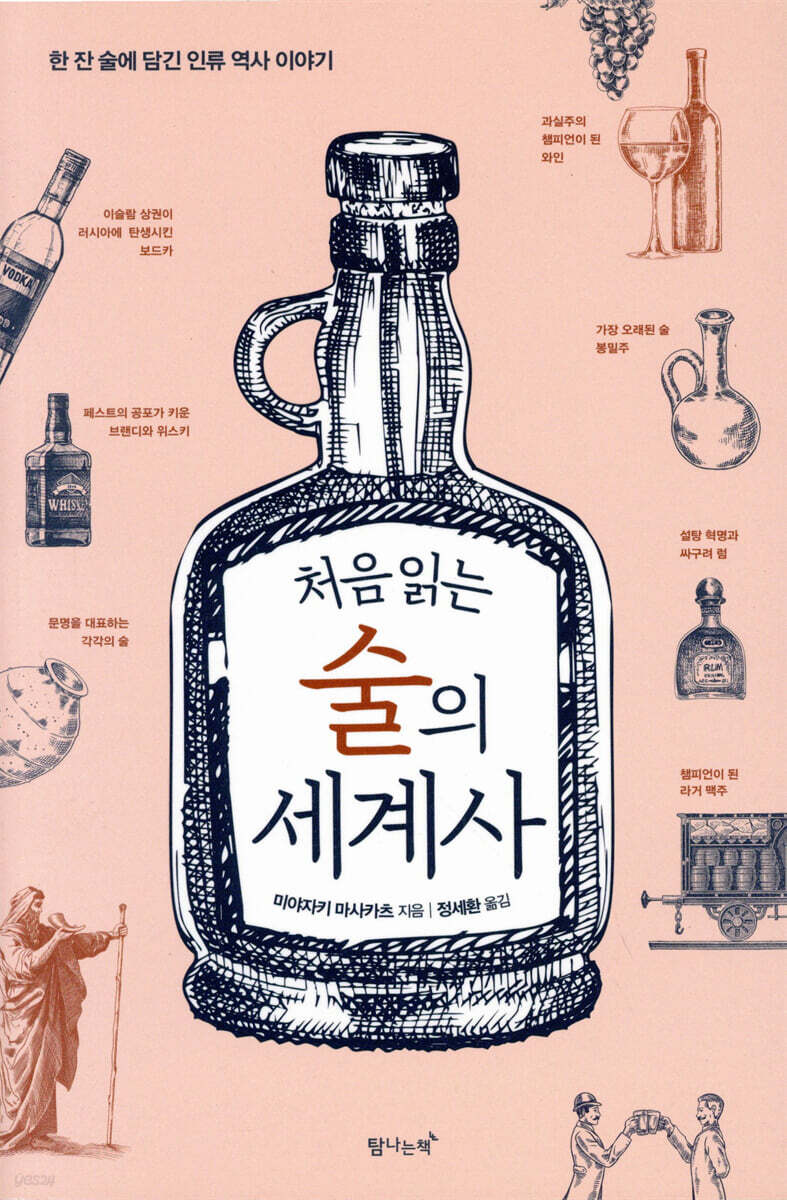
The World History of Alcohol: A First Look
 |
Description
Book Introduction
A drink that tempts humans into the world of the gods
Learning the History of Human Civilization Through Fragrant Alcohol
Can world history be told through alcohol? Scotch, bourbon, Canadian Club, Cognac, Walker, rum, wine—these are all regionally representative spirits, but now they can be enjoyed anywhere in the world.
Examining how the culturally distinctive liquors of each region were born and how they spread throughout the world provides important clues to understanding the history of human civilization.
All distilled spirits around the world, including vodka, tequila, and soju, originated from the alembic, a still invented in the 9th century by the Islamic alchemists.
This book contains the interesting and vivid history and culture of various alcoholic beverages from around the world, including beer, the "liquid bread" that was introduced to Europe from Mesopotamia, whiskey and brandy that were born from the fear of the Black Death, wine that replaced soft drinks during the Age of Exploration, and champagne, the miraculous drink born from the cold of winter.
Learning the History of Human Civilization Through Fragrant Alcohol
Can world history be told through alcohol? Scotch, bourbon, Canadian Club, Cognac, Walker, rum, wine—these are all regionally representative spirits, but now they can be enjoyed anywhere in the world.
Examining how the culturally distinctive liquors of each region were born and how they spread throughout the world provides important clues to understanding the history of human civilization.
All distilled spirits around the world, including vodka, tequila, and soju, originated from the alembic, a still invented in the 9th century by the Islamic alchemists.
This book contains the interesting and vivid history and culture of various alcoholic beverages from around the world, including beer, the "liquid bread" that was introduced to Europe from Mesopotamia, whiskey and brandy that were born from the fear of the Black Death, wine that replaced soft drinks during the Age of Exploration, and champagne, the miraculous drink born from the cold of winter.
- You can preview some of the book's contents.
Preview
index
Entering
Chapter 1: A Happy Encounter with Alcohol
1.
The oldest alcoholic beverage, honey
2.
The wine that became the champion of fruit wines
3.
Horse milk wine grown in the Eurasian steppe
4.
Palm wine spread along the sea route
Chapter 2: A Civilization That Diligently Brewing Alcohol
1.
Each liquor representing the four major civilizations
2.
Beer transmitted from Mesopotamia to Europe
3.
Hwangju, a grain liquor from East Asia
4.
Japanese sake born from rice farming and forests
5.
Chicha, the corn wine of the Inca Empire
Chapter 3 Distilled Liquor Transmitted East to West in the Islamic World
1.
A combination of Chinese and Greek alchemy
2.
Drinking that even the Quran couldn't stop
3.
Vodka, born in Russia by the Islamic commerce
4.
Brandy and whiskey, fueled by the fear of the plague
5.
Liquid gem liqueur
6.
Arak and soju, born from a still brought from the East
7.
The Mongol Empire's conquest of Eurasia and the Aragil Province
Chapter 4: Drinking Culture Expanded by the Sea and Navigation
1.
The wine that supported the 'Age of Exploration'
2.
Fortified wines grown at the forefront of navigation
3.
Sherry, nurtured by the Atlantic route
4.
Tequila, the great legacy of the Aztec civilization
5.
A Northern European liquor made with potatoes from the New World
6.
Plymouth Colony, born from a beer shortage
7.
The Sugar Revolution and Cheap Rum
8.
Hawaii's Iron Butt, a whaling relay station
Chapter 5: Alcohol Developed by Modern Society
1.
Commercialization of alcohol led by Britain and the Netherlands
2.
Cognac, synonymous with high-end liquor
3.
A miracle sparkling champagne created by the winter cold
4.
Gin, a drink born in the Netherlands and cultivated by the British
5.
The Revolutionary War and Bourbon Whiskey
6.
Wine that added color to the French Revolution
Chapter 6: Alcohol Filling a Huge Artificial Space
1.
A bar that colors the streets at night
2.
The Industrial Revolution in the World of Alcohol
3.
The Lager that Became a Champion
4.
Wine becomes a global product thanks to low-temperature pasteurization
5.
Absinthe, the drink that ruined Van Gogh's life
6.
Prohibition, which fueled Al Capone's activities
7.
Global Society and Cocktail Culture
Chapter 1: A Happy Encounter with Alcohol
1.
The oldest alcoholic beverage, honey
2.
The wine that became the champion of fruit wines
3.
Horse milk wine grown in the Eurasian steppe
4.
Palm wine spread along the sea route
Chapter 2: A Civilization That Diligently Brewing Alcohol
1.
Each liquor representing the four major civilizations
2.
Beer transmitted from Mesopotamia to Europe
3.
Hwangju, a grain liquor from East Asia
4.
Japanese sake born from rice farming and forests
5.
Chicha, the corn wine of the Inca Empire
Chapter 3 Distilled Liquor Transmitted East to West in the Islamic World
1.
A combination of Chinese and Greek alchemy
2.
Drinking that even the Quran couldn't stop
3.
Vodka, born in Russia by the Islamic commerce
4.
Brandy and whiskey, fueled by the fear of the plague
5.
Liquid gem liqueur
6.
Arak and soju, born from a still brought from the East
7.
The Mongol Empire's conquest of Eurasia and the Aragil Province
Chapter 4: Drinking Culture Expanded by the Sea and Navigation
1.
The wine that supported the 'Age of Exploration'
2.
Fortified wines grown at the forefront of navigation
3.
Sherry, nurtured by the Atlantic route
4.
Tequila, the great legacy of the Aztec civilization
5.
A Northern European liquor made with potatoes from the New World
6.
Plymouth Colony, born from a beer shortage
7.
The Sugar Revolution and Cheap Rum
8.
Hawaii's Iron Butt, a whaling relay station
Chapter 5: Alcohol Developed by Modern Society
1.
Commercialization of alcohol led by Britain and the Netherlands
2.
Cognac, synonymous with high-end liquor
3.
A miracle sparkling champagne created by the winter cold
4.
Gin, a drink born in the Netherlands and cultivated by the British
5.
The Revolutionary War and Bourbon Whiskey
6.
Wine that added color to the French Revolution
Chapter 6: Alcohol Filling a Huge Artificial Space
1.
A bar that colors the streets at night
2.
The Industrial Revolution in the World of Alcohol
3.
The Lager that Became a Champion
4.
Wine becomes a global product thanks to low-temperature pasteurization
5.
Absinthe, the drink that ruined Van Gogh's life
6.
Prohibition, which fueled Al Capone's activities
7.
Global Society and Cocktail Culture
Detailed image

Into the book
Winemaking originated in the Caucasus region between the Black and Caspian Seas and spread to surrounding regions.
Remains of wine were found on jar fragments excavated from the Haj, Filj and Tepe sites in the Zagros Mountains of northern Iran, dating back 7,400 years.
Wine was later introduced to Mesopotamia and ancient Egypt between 6000 and 4000 BC.
The Sumerians of Mesopotamia called wine 'Geshtin' and thought it was the blood of the gods.
It is said that God created humans by mixing clay with his own blood, wine, and the wine became his blood, giving life to the clay body and bringing it to life.
---From "The Wine that Became the Champion of Fruit Wine"
Beer was already being consumed in Mesopotamia and Egypt 5,000 years before the birth of civilization.
The beer of the time was quite thick and was commonly available to the public, called 'drinkable bread' or 'liquid bread', because the raw material, barley, was readily available.
However, the beer of the time did not have a characteristic bitter taste and had a low alcohol content, so it was too bland a drink to be called alcohol.
However, the Sumerians, who founded the Mesopotamian civilization, were a people who loved alcohol very much, and it is said that they used 40% of the barley they harvested to brew beer, which is a very high percentage compared to today.
---From "Beer Transmitted from Mesopotamia to Europe"
In the Islamic world, alembic was used primarily for refining perfume rather than for making alcohol.
However, Alembic, which was transmitted to the East and West of Eurasia and the Americas, gave rise to various types of distilled liquors in each region.
Whiskey, brandy, vodka, and gin from Europe, arak from West Asia to Southeast Asia, baijiu from China, shochu from Japan, and tequila from Mexico are all drinks that were born from the global spread of alembic.
The grand drama of cultural exchange, not recorded in history textbooks, resonated with the hearts of men who visited taverns and created various distilled spirits.
---From "The Combination of Chinese and Greek Alchemy"
Sailors from beer-culture countries such as the Netherlands and England set sail carrying beer containing hops, which had strong antibacterial properties, as a substitute for beverages.
It was also because wine was expensive.
There is a theory that the foundation of the United States of America was laid thanks to the very beer that was loaded onto ships and ran out.
The story begins with the Pilgrim Fathers, who set out on a long voyage of over 4,400 km, lasting 66 days, on the Mayflower in 1620.
---From "Plymouth Colony, Born from a Beer Shortage"
The story of this accidental discovery is as follows.
Originally, in the Champagne region, wine was made in the fall, with fermentation halted during the cold winter and, if conditions were fortunate, restarted in the spring.
Intrigued by the use of breathable cork as a lid for a water jug by a Spanish monk, Perignon replaced the oil-soaked hemp lids he had previously used with cork for wine lids.
As winter passed and spring came, carbon dioxide was produced in the wine, and the bottle burst because it was tightly sealed with a hard cork.
This is how a sweet wine like a twinkling star was born.
---From "Champagne, a Miraculous Sparkling Wine Created by the Winter Cold"
As the number of absinthe addicts increased among heavy drinkers, social problems such as decreased motivation to work and increased crime occurred frequently.
Artists who enjoyed absinthe include Maupassant, Verlaine, Gauguin, Monet, Degas, Picasso, and Hemingway. Verlaine (1844-1896), known as a delicate poet, and Toulouse-Lautrec (1864-1901), a painter who enjoyed drinking and painting dancers and audiences, both ended their miserable lives due to absinthe addiction.
Van Gogh (1853-1890) also cut off his left ear and attempted suicide several times, saying that it was interfering with his self-portraits. It is believed that these actions were also due to the mental disorder he suffered from drinking absinthe frequently.
Remains of wine were found on jar fragments excavated from the Haj, Filj and Tepe sites in the Zagros Mountains of northern Iran, dating back 7,400 years.
Wine was later introduced to Mesopotamia and ancient Egypt between 6000 and 4000 BC.
The Sumerians of Mesopotamia called wine 'Geshtin' and thought it was the blood of the gods.
It is said that God created humans by mixing clay with his own blood, wine, and the wine became his blood, giving life to the clay body and bringing it to life.
---From "The Wine that Became the Champion of Fruit Wine"
Beer was already being consumed in Mesopotamia and Egypt 5,000 years before the birth of civilization.
The beer of the time was quite thick and was commonly available to the public, called 'drinkable bread' or 'liquid bread', because the raw material, barley, was readily available.
However, the beer of the time did not have a characteristic bitter taste and had a low alcohol content, so it was too bland a drink to be called alcohol.
However, the Sumerians, who founded the Mesopotamian civilization, were a people who loved alcohol very much, and it is said that they used 40% of the barley they harvested to brew beer, which is a very high percentage compared to today.
---From "Beer Transmitted from Mesopotamia to Europe"
In the Islamic world, alembic was used primarily for refining perfume rather than for making alcohol.
However, Alembic, which was transmitted to the East and West of Eurasia and the Americas, gave rise to various types of distilled liquors in each region.
Whiskey, brandy, vodka, and gin from Europe, arak from West Asia to Southeast Asia, baijiu from China, shochu from Japan, and tequila from Mexico are all drinks that were born from the global spread of alembic.
The grand drama of cultural exchange, not recorded in history textbooks, resonated with the hearts of men who visited taverns and created various distilled spirits.
---From "The Combination of Chinese and Greek Alchemy"
Sailors from beer-culture countries such as the Netherlands and England set sail carrying beer containing hops, which had strong antibacterial properties, as a substitute for beverages.
It was also because wine was expensive.
There is a theory that the foundation of the United States of America was laid thanks to the very beer that was loaded onto ships and ran out.
The story begins with the Pilgrim Fathers, who set out on a long voyage of over 4,400 km, lasting 66 days, on the Mayflower in 1620.
---From "Plymouth Colony, Born from a Beer Shortage"
The story of this accidental discovery is as follows.
Originally, in the Champagne region, wine was made in the fall, with fermentation halted during the cold winter and, if conditions were fortunate, restarted in the spring.
Intrigued by the use of breathable cork as a lid for a water jug by a Spanish monk, Perignon replaced the oil-soaked hemp lids he had previously used with cork for wine lids.
As winter passed and spring came, carbon dioxide was produced in the wine, and the bottle burst because it was tightly sealed with a hard cork.
This is how a sweet wine like a twinkling star was born.
---From "Champagne, a Miraculous Sparkling Wine Created by the Winter Cold"
As the number of absinthe addicts increased among heavy drinkers, social problems such as decreased motivation to work and increased crime occurred frequently.
Artists who enjoyed absinthe include Maupassant, Verlaine, Gauguin, Monet, Degas, Picasso, and Hemingway. Verlaine (1844-1896), known as a delicate poet, and Toulouse-Lautrec (1864-1901), a painter who enjoyed drinking and painting dancers and audiences, both ended their miserable lives due to absinthe addiction.
Van Gogh (1853-1890) also cut off his left ear and attempted suicide several times, saying that it was interfering with his self-portraits. It is believed that these actions were also due to the mental disorder he suffered from drinking absinthe frequently.
---From "Absinthe, the drink that led Van Gogh to ruin"
Publisher's Review
A happy encounter between humans and alcohol
A drinking culture that has kept pace with world history
Since when did we start drinking?
There is a theory that the first alcohol made by humans was 'honey wine' made by fermenting honey, and there is also a story about 'monkey wine', which is said to have been made by naturally fermenting fruit that monkeys gathered in a tree hole.
However, we do not know exactly what kind of alcohol was first created.
Since humans have known about the existence of alcohol since the hunter-gatherer era, there is no way that the first alcoholic beverages have been recorded.
Perhaps the first humans to encounter alcoholic fermentation would have hesitantly and cautiously tasted the fragrant, decaying liquid, and, having discovered the exciting sensation of intoxication, would have thought of making this mysterious liquid themselves.
That's how the door to the world of alcohol opened.
As mankind realized the mysterious phenomenon of fermentation in their daily lives, they were able to obtain various alcoholic beverages over time.
World history can be divided into the following periods: ① a long period of hunting and gathering, ② the beginning of agriculture and the emergence of cities, ③ the period of exchange between various Eurasian cultures (7th to 14th centuries), ④ the Age of Exploration, that is, the period of exchange between the old and new continents (15th to 16th centuries), and ⑤ the period after the Industrial Revolution. The process of transformation of alcohol culture also overlaps with this period.
① In the period, people began to make alcohol by fermenting natural ingredients such as grapes, palm trees, and honey. ② In the period, alcohol became popular as it became possible to make large quantities of alcohol by fermenting grains. ③ In the period, distillers from the Islamic world were spread from East to West, giving rise to distilled alcohol such as arak, soju, vodka, whiskey, and brandy.
④ In the period, exchanges between the New World and the Old World became active, and spices, fruits, etc. became intertwined with alcohol culture, giving rise to various mixed drinks. In the period ⑤, the invention of the continuous still allowed for the mass production of alcohol, and the cocktail market grew, leading to the globalization of alcohol culture.
If we consider the history of humankind and the history of alcohol together, it is clear that alcohol is also a part of human culture.
Distilled liquor born from the exchange of civilizations
A great revolution that expanded the world of alcohol in one fell swoop
The world's countless alcoholic beverages can be broadly classified into three categories.
It can be divided into 'brewed liquor', which is made by fermenting sugar into alcohol by yeast, 'distilled liquor', which is made by distilling brewed liquor to increase alcohol purity, and 'mixed liquor', which is made by mixing herbs, spices, etc. into distilled liquor.
At first, alcoholic beverages were made using fruits that easily undergo alcoholic fermentation, such as grapes and apples, sap from palm trees or mushrooms, honey, and milk from livestock.
Representative examples include honey wine, wine, mare's milk wine, and palm wine.
Since then, fermentation technology has developed, making it possible to produce large quantities of brewed alcohol using grains, which are widely used as the most important food for mankind, as raw materials.
These include beer, sake, Japanese rice wine, and chicha.
The world of alcohol expanded rapidly when stills, originally designed to artificially create gold and silver through alchemy in the Islamic world, were used in alcohol production.
Distilled liquor began to be made by heating and distilling the brewed liquor in a still to increase its alcohol content.
There are many types of distilled spirits, including brandy, calvados, kirschwasser, whiskey, gin, vodka, aquavit, rum, and tequila.
Also, if herbs, spices, fruits, sugar cane, and coloring are added to distilled liquor, it becomes a mixed liquor.
The drinking culture that emerged sequentially over time overlapped and combined over time, culminating in the sophisticated and developed world of drinking we see today.
Decisive Moments in World History Shaped by Alcohol
Alcohol, a beautiful gift from heaven
There are moments in human history when alcohol played a decisive role.
For example, King James I of England severely persecuted the Puritans, and 102 Puritans, unable to tolerate this, boarded the Mayflower and crossed the Atlantic Ocean to the New World.
After a difficult voyage of more than two months, they reached the coast of America. They had originally planned to go further south and establish a colony in the warm southern lands, but they ran out of beer, which they had been drinking instead of water, and had no choice but to drop anchor in Massachusetts Bay.
It could be said that beer gave birth to America.
It is also said that the French Revolution began with the storming of the Bastille prison by Parisian citizens, but it is also said that three days before the storming of the Bastille, a mob led by wine smugglers raided customs gates around Paris, and that the storming of the Bastille was an extension of this.
Ironically, the whiskey 'Bourbon', which bears the name of the Bourbon dynasty that was overthrown in the French Revolution, was born in the United States in the same year that the revolution broke out and became the national drink of the United States.
In addition, this book is full of interesting and entertaining stories about alcohol in world history, including wine in Egyptian and Greek mythology, the first beer that was liquid bread, odorless and colorless vodka, brandy that was called the water of life that cured the plague, whiskey from Scotland and Ireland, liqueur spread by the Medici family, tequila made from agave, aquavit, a tonic made from potatoes, rum, a pirate's drink made from sugarcane waste, champagne, a sparkling wine created by the cold, gin, ale, and lager beer jointly developed by the Netherlands, England, and the United States, absinthe that ruined Van Gogh's life, Canadian whiskey and British scotch that grew up taking advantage of American prohibition, and representative cocktails such as the Manhattan and Martini.
Long ago, people believed that the special feeling that alcohol gave them, allowing them to lightly break down the barriers of everyday life, was the path to the world of the gods.
People who believed that they were led into an extraordinary world, experiencing pleasure, illusions, hallucinations, and dizziness due to intoxication, had no choice but to interpret alcohol in relation to the divine, saying that they had come into contact with the divine or had become a god.
There are also records in China that alcohol was called 'a beautiful gift from heaven.'
Alcohol, a gift from heaven, has always been with humans.
Looking back at the history of alcohol will provide important clues that will take us one step closer to understanding humanity.
· What is the oldest alcohol in human history?
· Soju is related to alchemy?
· What is the secret behind the birth of champagne, a noble drink from the beginning?
· What is the difference between lager and ale beer?
· Why did cocktails develop in America?
A drinking culture that has kept pace with world history
Since when did we start drinking?
There is a theory that the first alcohol made by humans was 'honey wine' made by fermenting honey, and there is also a story about 'monkey wine', which is said to have been made by naturally fermenting fruit that monkeys gathered in a tree hole.
However, we do not know exactly what kind of alcohol was first created.
Since humans have known about the existence of alcohol since the hunter-gatherer era, there is no way that the first alcoholic beverages have been recorded.
Perhaps the first humans to encounter alcoholic fermentation would have hesitantly and cautiously tasted the fragrant, decaying liquid, and, having discovered the exciting sensation of intoxication, would have thought of making this mysterious liquid themselves.
That's how the door to the world of alcohol opened.
As mankind realized the mysterious phenomenon of fermentation in their daily lives, they were able to obtain various alcoholic beverages over time.
World history can be divided into the following periods: ① a long period of hunting and gathering, ② the beginning of agriculture and the emergence of cities, ③ the period of exchange between various Eurasian cultures (7th to 14th centuries), ④ the Age of Exploration, that is, the period of exchange between the old and new continents (15th to 16th centuries), and ⑤ the period after the Industrial Revolution. The process of transformation of alcohol culture also overlaps with this period.
① In the period, people began to make alcohol by fermenting natural ingredients such as grapes, palm trees, and honey. ② In the period, alcohol became popular as it became possible to make large quantities of alcohol by fermenting grains. ③ In the period, distillers from the Islamic world were spread from East to West, giving rise to distilled alcohol such as arak, soju, vodka, whiskey, and brandy.
④ In the period, exchanges between the New World and the Old World became active, and spices, fruits, etc. became intertwined with alcohol culture, giving rise to various mixed drinks. In the period ⑤, the invention of the continuous still allowed for the mass production of alcohol, and the cocktail market grew, leading to the globalization of alcohol culture.
If we consider the history of humankind and the history of alcohol together, it is clear that alcohol is also a part of human culture.
Distilled liquor born from the exchange of civilizations
A great revolution that expanded the world of alcohol in one fell swoop
The world's countless alcoholic beverages can be broadly classified into three categories.
It can be divided into 'brewed liquor', which is made by fermenting sugar into alcohol by yeast, 'distilled liquor', which is made by distilling brewed liquor to increase alcohol purity, and 'mixed liquor', which is made by mixing herbs, spices, etc. into distilled liquor.
At first, alcoholic beverages were made using fruits that easily undergo alcoholic fermentation, such as grapes and apples, sap from palm trees or mushrooms, honey, and milk from livestock.
Representative examples include honey wine, wine, mare's milk wine, and palm wine.
Since then, fermentation technology has developed, making it possible to produce large quantities of brewed alcohol using grains, which are widely used as the most important food for mankind, as raw materials.
These include beer, sake, Japanese rice wine, and chicha.
The world of alcohol expanded rapidly when stills, originally designed to artificially create gold and silver through alchemy in the Islamic world, were used in alcohol production.
Distilled liquor began to be made by heating and distilling the brewed liquor in a still to increase its alcohol content.
There are many types of distilled spirits, including brandy, calvados, kirschwasser, whiskey, gin, vodka, aquavit, rum, and tequila.
Also, if herbs, spices, fruits, sugar cane, and coloring are added to distilled liquor, it becomes a mixed liquor.
The drinking culture that emerged sequentially over time overlapped and combined over time, culminating in the sophisticated and developed world of drinking we see today.
Decisive Moments in World History Shaped by Alcohol
Alcohol, a beautiful gift from heaven
There are moments in human history when alcohol played a decisive role.
For example, King James I of England severely persecuted the Puritans, and 102 Puritans, unable to tolerate this, boarded the Mayflower and crossed the Atlantic Ocean to the New World.
After a difficult voyage of more than two months, they reached the coast of America. They had originally planned to go further south and establish a colony in the warm southern lands, but they ran out of beer, which they had been drinking instead of water, and had no choice but to drop anchor in Massachusetts Bay.
It could be said that beer gave birth to America.
It is also said that the French Revolution began with the storming of the Bastille prison by Parisian citizens, but it is also said that three days before the storming of the Bastille, a mob led by wine smugglers raided customs gates around Paris, and that the storming of the Bastille was an extension of this.
Ironically, the whiskey 'Bourbon', which bears the name of the Bourbon dynasty that was overthrown in the French Revolution, was born in the United States in the same year that the revolution broke out and became the national drink of the United States.
In addition, this book is full of interesting and entertaining stories about alcohol in world history, including wine in Egyptian and Greek mythology, the first beer that was liquid bread, odorless and colorless vodka, brandy that was called the water of life that cured the plague, whiskey from Scotland and Ireland, liqueur spread by the Medici family, tequila made from agave, aquavit, a tonic made from potatoes, rum, a pirate's drink made from sugarcane waste, champagne, a sparkling wine created by the cold, gin, ale, and lager beer jointly developed by the Netherlands, England, and the United States, absinthe that ruined Van Gogh's life, Canadian whiskey and British scotch that grew up taking advantage of American prohibition, and representative cocktails such as the Manhattan and Martini.
Long ago, people believed that the special feeling that alcohol gave them, allowing them to lightly break down the barriers of everyday life, was the path to the world of the gods.
People who believed that they were led into an extraordinary world, experiencing pleasure, illusions, hallucinations, and dizziness due to intoxication, had no choice but to interpret alcohol in relation to the divine, saying that they had come into contact with the divine or had become a god.
There are also records in China that alcohol was called 'a beautiful gift from heaven.'
Alcohol, a gift from heaven, has always been with humans.
Looking back at the history of alcohol will provide important clues that will take us one step closer to understanding humanity.
· What is the oldest alcohol in human history?
· Soju is related to alchemy?
· What is the secret behind the birth of champagne, a noble drink from the beginning?
· What is the difference between lager and ale beer?
· Why did cocktails develop in America?
GOODS SPECIFICS
- Date of issue: August 4, 2023
- Page count, weight, size: 248 pages | 140*213*19mm
- ISBN13: 9791193130094
- ISBN10: 1193130093
You may also like
카테고리
korean


korean

![GQ KOREA Mark (Monthly): December [2025]](http://librairie.coreenne.fr/cdn/shop/files/8ef265dbbfbf186523ed75ba7319009d.jpg?v=1765340328&width=3840)


