

If you go to Japan, you should know this much about its history.
 |
Description
Book Introduction
★ How to enjoy your trip to Japan even more
★ A masterpiece that easily explains the history of Japan, a close but 'unknown country'
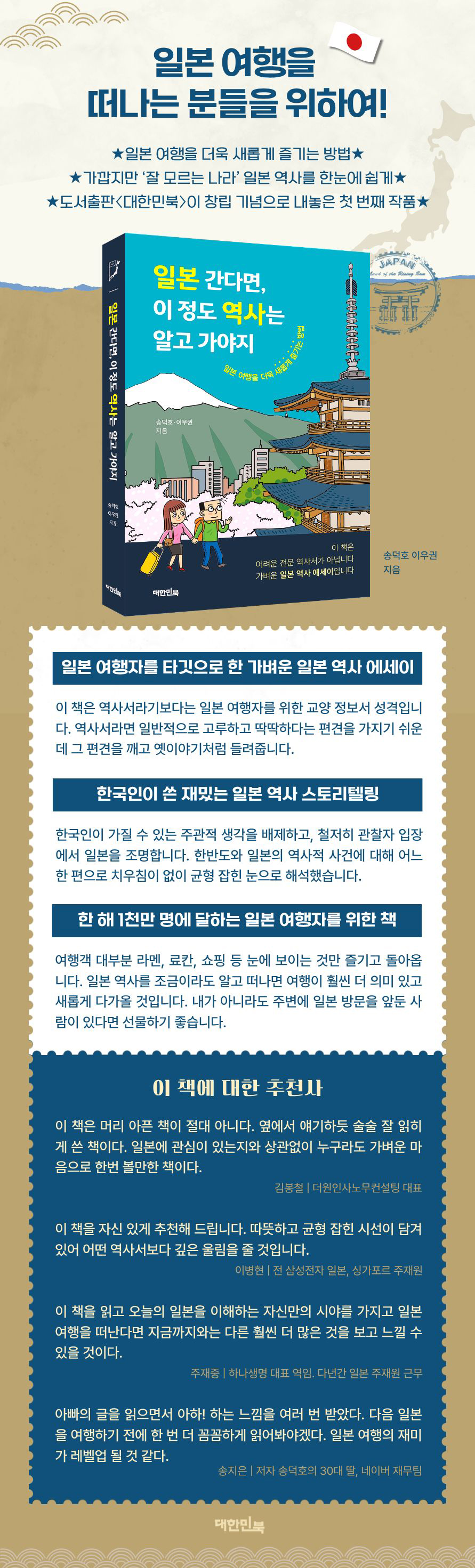
An easy and fun history book targeting Japanese travelers has been published.
This book is titled, “If you go to Japan, you should know this much history.”
The subtitles are 'A new way to enjoy your trip to Japan' and 'A taste of Japanese history before ramen!'
It feels more like a travel book than a history book.
Upon closer inspection, I found that this book is more of a cultural information book for travelers to Japan than a history book.
It's easy to have a prejudice that history books are generally boring and stiff, but this book breaks that prejudice and is written lightly, as if telling an old story.
It is also interesting that this book is a history of Japan written by a Korean.
The two co-authors who wrote the book are said to be friends.
Among the co-authors, Song Deok-ho is a management consultant who worked as an executive at a leading company and is currently a professor teaching business administration.
I have worked in Japan and still travel frequently to Japan to continue studying Japanese history and culture.
Co-author Lee Woo-kwon is currently working as the head of a public interest corporation after completing his public service career.
Two people with such backgrounds have written a book about Japanese history together.
What is particularly interesting is that it looks at Japan from an objective perspective.
It examines Japan from a thorough observer's perspective, excluding any subjective thoughts that Koreans may have.
★ A masterpiece that easily explains the history of Japan, a close but 'unknown country'
An easy and fun history book targeting Japanese travelers has been published.
This book is titled, “If you go to Japan, you should know this much history.”
The subtitles are 'A new way to enjoy your trip to Japan' and 'A taste of Japanese history before ramen!'
It feels more like a travel book than a history book.
Upon closer inspection, I found that this book is more of a cultural information book for travelers to Japan than a history book.
It's easy to have a prejudice that history books are generally boring and stiff, but this book breaks that prejudice and is written lightly, as if telling an old story.
It is also interesting that this book is a history of Japan written by a Korean.
The two co-authors who wrote the book are said to be friends.
Among the co-authors, Song Deok-ho is a management consultant who worked as an executive at a leading company and is currently a professor teaching business administration.
I have worked in Japan and still travel frequently to Japan to continue studying Japanese history and culture.
Co-author Lee Woo-kwon is currently working as the head of a public interest corporation after completing his public service career.
Two people with such backgrounds have written a book about Japanese history together.
What is particularly interesting is that it looks at Japan from an objective perspective.
It examines Japan from a thorough observer's perspective, excluding any subjective thoughts that Koreans may have.
- You can preview some of the book's contents.
Preview
index
index
preface
Use and Structure of This Book
Chapter 1: Hello! Are you curious about Japan?
Wait a minute! Let's start with the geography and place names of the island nation of Japan.
Four Differences Between Japanese History and Ours
How does Japan divide its eras?
Main Events by Era Menu
A History-Centered Journey: From Kyushu to Tokyo
The bitter and bitter feelings between Japan and the Korean Peninsula
Is the Emperor the Pope of Japan?
What are the shogunate and the shogun?
Chapter 2: Were Baekje and Japan Related?: Ancient Times
Wait a minute! A quick look at the ancient times.
Did Japan have a period called the Kofun period?
What ancient tombs are worth visiting?
The Asuka period, which loved Baekje
Are the ancestors of Japanese people from the Korean Peninsula?
Two Men of the Asuka Era
The origin of the national name 'Japan'
Believe it or not, the Japanese Chronicles
Why did 600,000 troops come?
The End of Antiquity, the Nara and Heian Periods
Chapter 3: The Rise of the Samurai, the Age of the Shogunate: The Middle Ages
Hold on! A Glimpse of the Middle Ages
The sword is good.
The first Kamakura shogunate
The Muromachi shogunate had a weak presence
Who was the ultimate victor of the Warring States Period?
Ah! A meaningless death, Oda Nobunaga
Toyotomi Hideyoshi, the owner of Osaka Castle
The Imjin War as Seen Through Japanese Eyes
The Battle of Sekigahara, the last major event of the Middle Ages
Chapter 4: The Edo Shogunate, Enjoying Peace and Prosperity in Tokyo: Early Modern Times
Tokugawa Ieyasu, who opened the Edo (Tokyo) period
Hold on! A quick look at the early modern era.
Edo (江戶) transformed from a wasteland into the capital city of Tokyo.
What is the last system?
The unexpected prosperity brought about by the alternate-labor system
How did Edo become the world's largest city?
Having a tsundere relationship with the West
The story of the Joseon Tongsinsa that you didn't learn in school
The Background to Japan's Successful Modernization We Didn't Know About
Chapter 5: Sayonara Samurai! The Meiji Restoration: Modern Times
Emergence on the world stage
Hold on! A Glance at the Modern Era
Ten Major Events Around the Meiji Restoration
The Choshu and Satsuma domains, which played a pivotal role in modern history
The Emperor, who came to power through the Meiji Restoration
A Twisted Look at the Meiji Restoration
Personal Profiles of 12 Key Figures of the Meiji Restoration
Is Ito Hirobumi a hero or a villain?
The behind-the-scenes battle between Western powers and Japan
34 years of Joseon's Enlightenment and Japan
The Story of Manchukuo
The Pacific War: The Fall of Japan
Chapter 6: Some Aspects of Japan Today: Modern Times
Is Japan still a strong country?
The Emperor and the Prime Minister: Japan's Unique One-Party Politics
How are Japan's administrative districts divided?
Japan, the country of railways
Hereditary politics, harmony, Western orientation, Kyoto, food
Some interesting facts about Japanese
Chapter 7: In Search of a City Where You Can Feel the Scent of History
The capital, Tokyo, is a treasure trove of modern relics.
What are some historical sites worth visiting near Tokyo?
Kyoto, the spiritual capital of Japan
Osaka, the city of Toyotomi Hideyoshi
Nara and Asuka, filled with the scent of ancient history
Nagoya, a city of logistics and commerce
It's attractive.
Kyushu region near the Korean Peninsula
Other cities worth exploring
preface
Use and Structure of This Book
Chapter 1: Hello! Are you curious about Japan?
Wait a minute! Let's start with the geography and place names of the island nation of Japan.
Four Differences Between Japanese History and Ours
How does Japan divide its eras?
Main Events by Era Menu
A History-Centered Journey: From Kyushu to Tokyo
The bitter and bitter feelings between Japan and the Korean Peninsula
Is the Emperor the Pope of Japan?
What are the shogunate and the shogun?
Chapter 2: Were Baekje and Japan Related?: Ancient Times
Wait a minute! A quick look at the ancient times.
Did Japan have a period called the Kofun period?
What ancient tombs are worth visiting?
The Asuka period, which loved Baekje
Are the ancestors of Japanese people from the Korean Peninsula?
Two Men of the Asuka Era
The origin of the national name 'Japan'
Believe it or not, the Japanese Chronicles
Why did 600,000 troops come?
The End of Antiquity, the Nara and Heian Periods
Chapter 3: The Rise of the Samurai, the Age of the Shogunate: The Middle Ages
Hold on! A Glimpse of the Middle Ages
The sword is good.
The first Kamakura shogunate
The Muromachi shogunate had a weak presence
Who was the ultimate victor of the Warring States Period?
Ah! A meaningless death, Oda Nobunaga
Toyotomi Hideyoshi, the owner of Osaka Castle
The Imjin War as Seen Through Japanese Eyes
The Battle of Sekigahara, the last major event of the Middle Ages
Chapter 4: The Edo Shogunate, Enjoying Peace and Prosperity in Tokyo: Early Modern Times
Tokugawa Ieyasu, who opened the Edo (Tokyo) period
Hold on! A quick look at the early modern era.
Edo (江戶) transformed from a wasteland into the capital city of Tokyo.
What is the last system?
The unexpected prosperity brought about by the alternate-labor system
How did Edo become the world's largest city?
Having a tsundere relationship with the West
The story of the Joseon Tongsinsa that you didn't learn in school
The Background to Japan's Successful Modernization We Didn't Know About
Chapter 5: Sayonara Samurai! The Meiji Restoration: Modern Times
Emergence on the world stage
Hold on! A Glance at the Modern Era
Ten Major Events Around the Meiji Restoration
The Choshu and Satsuma domains, which played a pivotal role in modern history
The Emperor, who came to power through the Meiji Restoration
A Twisted Look at the Meiji Restoration
Personal Profiles of 12 Key Figures of the Meiji Restoration
Is Ito Hirobumi a hero or a villain?
The behind-the-scenes battle between Western powers and Japan
34 years of Joseon's Enlightenment and Japan
The Story of Manchukuo
The Pacific War: The Fall of Japan
Chapter 6: Some Aspects of Japan Today: Modern Times
Is Japan still a strong country?
The Emperor and the Prime Minister: Japan's Unique One-Party Politics
How are Japan's administrative districts divided?
Japan, the country of railways
Hereditary politics, harmony, Western orientation, Kyoto, food
Some interesting facts about Japanese
Chapter 7: In Search of a City Where You Can Feel the Scent of History
The capital, Tokyo, is a treasure trove of modern relics.
What are some historical sites worth visiting near Tokyo?
Kyoto, the spiritual capital of Japan
Osaka, the city of Toyotomi Hideyoshi
Nara and Asuka, filled with the scent of ancient history
Nagoya, a city of logistics and commerce
It's attractive.
Kyushu region near the Korean Peninsula
Other cities worth exploring
Detailed image
Into the book
Japan is only geographically close to us, but its social structure has developed very differently.
The imperial system is like that, and the military-centered system is like that.
There were classes of scholars, farmers, artisans, and merchants, but 'sa' (士) means warrior, not scholar.
So what makes Japan seem so unique and strange compared to our country?
1.
The coexistence of the emperor and the shogunate system
In Japan, just like in our country, there has always been a king called the 'Emperor'.
But the actual, secular ruler was not the emperor.
It was ruled by the shogun of the shogunate, a warrior regime.
Japan maintained this shogunate system for a long period of about 700 years.
The emperor existed only symbolically.
However, this does not mean that the Emperor was completely ignored.
Because even if they were not actual rulers, they had their own unique role.
Because the shogun derived his authority from the fact that he had received his position from the emperor, the emperor's presence was very important to him as well.
2.
unmanned system
The shogunate was a collection of warriors.
Beginning with the shogun, the leader, all members of the group were warriors.
As a result, Japan maintained a society centered on unmanned vehicles until the modern era.
There was no such thing as a civil service examination system like ours to select officials.
There were social classes called the scholars, farmers, artisans, and merchants, but the major difference was that the ruling class, the 'sa (士),' were not 'scholars' like in Joseon, but were 'samurai', or 'busa (武士)' in Japan.
3.
Decentralized Japan
Our country maintained a centralized system for over a thousand years, from the Unified Silla period to the Joseon period.
The local government was a system in which officials were dispatched from the central government.
However, although the shogunate ruled the entire country in Japan, each region was ruled by local lords called 'daimyo'.
And the position of daimyo was hereditary.
It was similar to the feudal system in Europe.
For this reason, Japan still retains a strong local decentralization character today.
4.
Division of eras by shogunate, not dynasty
In our country or China, when the dynasty changed, the country name also changed.
Therefore, the division of eras was also based on the country name, such as ‘Goryeo Dynasty’ and ‘Joseon Dynasty.’
However, Japan did not change its national name because the imperial system continued.
For this reason, when dividing eras, Japan, unlike us, uses the names of the regions where the ruling shogunate was based.
--- pp.24-26
When did the national name "Japan" first appear? Officially, it is said to have been established as the national name through the Taiho Code in 701, during the Asuka period.
However, there is also a theory that the name of the country, Japan, was actually given by Baekje.
Why is this story possible?
The name 'Japan' first appeared around the 7th or 8th century when the Ritsuryo system was introduced.
Officially, it is believed that it was first established as a national title by the Yamato government through the Taiho Code in 701.
Before that, there is a record of the 'Emperor of the place where the sun rises' in a document sent by Prince Shotoku to Emperor Yang of the Sui Dynasty in 607.
Related information can also be found in our country's data. In the Annals of Silla in the Samguk Sagi, there is a record that 'the country of Wa changed its name to Japan.'
According to another theory, the name 'Japan' was not given to the people of the Japanese archipelago by themselves, but was given to them by the people of the Korean Peninsula.
It is claimed that due to this influence, when the Taiho Code was created in 701, it was adopted as the official name of the country.
The word Japan means 'place where the sun rises'.
From the perspective of the Japanese archipelago, the place where the sun rises is the Pacific Ocean, and the only people who can call the Japanese archipelago the place where the sun rises are those who live on the western side of the Japanese archipelago.
Those western people are Baekje, and I think the Baekje people may have called the Japanese islands that.
Regarding the Taiho Ritsuryo, it is necessary to examine its contents more broadly than just the origin of the Japanese national name.
The Taiho Ritsuryo was created by Emperor Monmu during the Asuka period as part of an internal system reorganization effort to strengthen the centralized government system.
The Code of Edicts began work in 700 AD when the Emperor issued a decree, and was enacted in 701 AD.
One thing to note in relation to this movement to establish the law is the fall of Baekje.
Japan had maintained a close relationship with Baekje, but this relationship was broken when Baekje was destroyed following Silla's unification of the Korean Peninsula.
In 663, when Baekje was in crisis, Wa sent a large force to rescue Baekje, but was defeated by the Silla-Tang allied forces and failed to achieve their goal.
With its relationship with Baekje severed, Japan was now faced with the situation of having to stand on its own two feet, and it had to seek change, which was the Taiho Reforms.
It can be assumed that during the Taiho Reforms, the name 'Japan' used by Baekje was used as the national title.
--- pp.66-68
Immediately after the Imjin War, Joseon sent an envoy to push for the repatriation of Joseon prisoners of war.
However, of the estimated 30,000 prisoners, only a few thousand returned.
If you look at the 'Busangrok' written by Lee Gyeong-jik, who went to Japan to repatriate prisoners of war, it says, "There were people who said they would not return because the economic situation in Japan was better than in Joseon."
Jo Eom, who also went to the news agency to bring in sweet potatoes, praised the sophistication of Japanese architecture and showed great interest in the waterwheels used in Japan.
In addition, there are also articles written based on the clothing of Japanese people seen on the street.
By synthesizing various records, the correspondents of the time were able to confirm with their own eyes that Edo was a large city, culturally developed, and economically advanced compared to Joseon.
However, even though so many people have visited Japan, there has been little active discussion about what we can learn from Japan.
In the case of the Qing Dynasty, there were some members of the Northern Learning School who insisted that they should learn from them after visiting, but there were no voices saying that they should learn from Japan.
Our perception remains at the level of the fact that the news agency introduced advanced civilization to Japan and earned their respect.
And then I feel a little bit of superiority.
So what did we gain? The Joseon people, as believers in Neo-Confucianism, didn't place much value on material things, and they may have even tried to ignore Japan's advancements.
Moreover, it would have been difficult to say that the Japanese, who were considered barbarians, had something to learn.
Let's say that our ancestors during the Joseon Dynasty lived with Confucian values.
But we are different now.
Focus on substance.
It would be inappropriate to simply feel superior to the fact that the news agency taught Japan something.
We should be critical of what we failed to learn from Japan at that time.
That's what needs to be taught.
Just because you hate Japan, does that mean you shouldn't learn from it even though there is something to learn from it?
The imperial system is like that, and the military-centered system is like that.
There were classes of scholars, farmers, artisans, and merchants, but 'sa' (士) means warrior, not scholar.
So what makes Japan seem so unique and strange compared to our country?
1.
The coexistence of the emperor and the shogunate system
In Japan, just like in our country, there has always been a king called the 'Emperor'.
But the actual, secular ruler was not the emperor.
It was ruled by the shogun of the shogunate, a warrior regime.
Japan maintained this shogunate system for a long period of about 700 years.
The emperor existed only symbolically.
However, this does not mean that the Emperor was completely ignored.
Because even if they were not actual rulers, they had their own unique role.
Because the shogun derived his authority from the fact that he had received his position from the emperor, the emperor's presence was very important to him as well.
2.
unmanned system
The shogunate was a collection of warriors.
Beginning with the shogun, the leader, all members of the group were warriors.
As a result, Japan maintained a society centered on unmanned vehicles until the modern era.
There was no such thing as a civil service examination system like ours to select officials.
There were social classes called the scholars, farmers, artisans, and merchants, but the major difference was that the ruling class, the 'sa (士),' were not 'scholars' like in Joseon, but were 'samurai', or 'busa (武士)' in Japan.
3.
Decentralized Japan
Our country maintained a centralized system for over a thousand years, from the Unified Silla period to the Joseon period.
The local government was a system in which officials were dispatched from the central government.
However, although the shogunate ruled the entire country in Japan, each region was ruled by local lords called 'daimyo'.
And the position of daimyo was hereditary.
It was similar to the feudal system in Europe.
For this reason, Japan still retains a strong local decentralization character today.
4.
Division of eras by shogunate, not dynasty
In our country or China, when the dynasty changed, the country name also changed.
Therefore, the division of eras was also based on the country name, such as ‘Goryeo Dynasty’ and ‘Joseon Dynasty.’
However, Japan did not change its national name because the imperial system continued.
For this reason, when dividing eras, Japan, unlike us, uses the names of the regions where the ruling shogunate was based.
--- pp.24-26
When did the national name "Japan" first appear? Officially, it is said to have been established as the national name through the Taiho Code in 701, during the Asuka period.
However, there is also a theory that the name of the country, Japan, was actually given by Baekje.
Why is this story possible?
The name 'Japan' first appeared around the 7th or 8th century when the Ritsuryo system was introduced.
Officially, it is believed that it was first established as a national title by the Yamato government through the Taiho Code in 701.
Before that, there is a record of the 'Emperor of the place where the sun rises' in a document sent by Prince Shotoku to Emperor Yang of the Sui Dynasty in 607.
Related information can also be found in our country's data. In the Annals of Silla in the Samguk Sagi, there is a record that 'the country of Wa changed its name to Japan.'
According to another theory, the name 'Japan' was not given to the people of the Japanese archipelago by themselves, but was given to them by the people of the Korean Peninsula.
It is claimed that due to this influence, when the Taiho Code was created in 701, it was adopted as the official name of the country.
The word Japan means 'place where the sun rises'.
From the perspective of the Japanese archipelago, the place where the sun rises is the Pacific Ocean, and the only people who can call the Japanese archipelago the place where the sun rises are those who live on the western side of the Japanese archipelago.
Those western people are Baekje, and I think the Baekje people may have called the Japanese islands that.
Regarding the Taiho Ritsuryo, it is necessary to examine its contents more broadly than just the origin of the Japanese national name.
The Taiho Ritsuryo was created by Emperor Monmu during the Asuka period as part of an internal system reorganization effort to strengthen the centralized government system.
The Code of Edicts began work in 700 AD when the Emperor issued a decree, and was enacted in 701 AD.
One thing to note in relation to this movement to establish the law is the fall of Baekje.
Japan had maintained a close relationship with Baekje, but this relationship was broken when Baekje was destroyed following Silla's unification of the Korean Peninsula.
In 663, when Baekje was in crisis, Wa sent a large force to rescue Baekje, but was defeated by the Silla-Tang allied forces and failed to achieve their goal.
With its relationship with Baekje severed, Japan was now faced with the situation of having to stand on its own two feet, and it had to seek change, which was the Taiho Reforms.
It can be assumed that during the Taiho Reforms, the name 'Japan' used by Baekje was used as the national title.
--- pp.66-68
Immediately after the Imjin War, Joseon sent an envoy to push for the repatriation of Joseon prisoners of war.
However, of the estimated 30,000 prisoners, only a few thousand returned.
If you look at the 'Busangrok' written by Lee Gyeong-jik, who went to Japan to repatriate prisoners of war, it says, "There were people who said they would not return because the economic situation in Japan was better than in Joseon."
Jo Eom, who also went to the news agency to bring in sweet potatoes, praised the sophistication of Japanese architecture and showed great interest in the waterwheels used in Japan.
In addition, there are also articles written based on the clothing of Japanese people seen on the street.
By synthesizing various records, the correspondents of the time were able to confirm with their own eyes that Edo was a large city, culturally developed, and economically advanced compared to Joseon.
However, even though so many people have visited Japan, there has been little active discussion about what we can learn from Japan.
In the case of the Qing Dynasty, there were some members of the Northern Learning School who insisted that they should learn from them after visiting, but there were no voices saying that they should learn from Japan.
Our perception remains at the level of the fact that the news agency introduced advanced civilization to Japan and earned their respect.
And then I feel a little bit of superiority.
So what did we gain? The Joseon people, as believers in Neo-Confucianism, didn't place much value on material things, and they may have even tried to ignore Japan's advancements.
Moreover, it would have been difficult to say that the Japanese, who were considered barbarians, had something to learn.
Let's say that our ancestors during the Joseon Dynasty lived with Confucian values.
But we are different now.
Focus on substance.
It would be inappropriate to simply feel superior to the fact that the news agency taught Japan something.
We should be critical of what we failed to learn from Japan at that time.
That's what needs to be taught.
Just because you hate Japan, does that mean you shouldn't learn from it even though there is something to learn from it?
--- pp.153-155
Publisher's Review
★ Are you going to travel to Japan?
Must-read books before boarding a flight to Japan
★ Easy and light Japanese history essays for travelers to Japan
If you want to experience Japan in a new way, before you go for ramen, taste Japanese history!
★ A really good idea for a real trip
If you leave knowing history, the taste of travel will change.
This book is definitely not a headache-inducing book.
This book is written so that it is easy to read, as if you were talking to someone right next to you.
Regardless of whether you are interested in Japan or not, this is a book that anyone can read with a light heart.
Kim Bong-cheol, CEO of The One Human Resources Consulting
I confidently recommend this book.
It contains a warm and balanced perspective, and will resonate more deeply than any history book.
- Lee Byung-hyun / Former Samsung Electronics Japan and Singapore resident
If you read this book and travel to Japan with your own perspective on understanding today's Japan, you will be able to see and experience much more than you have ever experienced before.
- Former CEO of Hana Life Insurance.
Working in Japan for many years
While reading my father's writing, I had several "Aha!" moments.
I'll have to read this again carefully before my next trip to Japan.
It seems like the fun of traveling in Japan will level up.
- Song Ji-eun / Author Song Deok-ho's 30-year-old daughter, Naver Finance Team
In a word, this book is a light essay on Japanese history.
This is not a difficult, specialized history book written by a history major.
This is a delicious and well-prepared story of Japanese history for Japanese travelers, as if telling a story to a friend.
Its characteristic is that it is easy and not hard.
So, we can say that it is a little different in nature from the history books we commonly know.
This book is a co-authored work by two friends.
One of my friends doesn't know much about Japan.
I've hardly ever been to Japan.
A friend of mine knows Japan well.
I used to live in Japan, and I still travel there often.
So, every time we met, a friend who didn't know much about Japan would ask a friend who knew much about Japan.
How did Japan develop? We went through changes in our country's name, from Silla to Goryeo to Joseon, but why is Japan still just called Japan, past and present?
My friend answered in an easy-to-understand manner.
This book is a compilation of those questions and answers.
As the co-authors often talk about Japan, they felt it would be a shame to keep it to themselves, so they compiled it into a book to share it with the world.
I especially wanted to share this with travelers visiting Japan.
Japan is a favorite travel destination for Koreans.
But unfortunately, most people only experience ramen, sushi, ryokans, and shopping and come back.
If you know even a little bit about Japanese history, the taste of your trip will change, but it means that you come back only enjoying the superficial things.
It is not difficult to look into history in advance and then leave.
No specialized knowledge is required.
What is covered in this book is sufficient.
There are quite a few books on Japanese history on the market, but they are mostly specialized and difficult to understand.
But this book is different.
It breaks the prejudice that history books are difficult.
Because it is a light essay format, told as if a friend with a lot of experience in Japan were talking to a friend who doesn't.
Looking at the structure of the book, it first outlines the characteristics of Japan and Japanese history, and then examines the close relationship between ancient Japan and Baekje.
In the case of ancient Japan, it cannot be explained without Baekje.
It then covers the emergence of the samurai and the era of the shogunate.
This book explores the story of the Edo shogunate, which enjoyed peace and prosperity in Edo, now the capital city of Tokyo, the end of the samurai era, the Meiji Restoration, and modern Japanese society.
Finally, it includes stories of Japanese cities full of the scent of history.
This book covers the entire history of Japan, but does not describe all historical facts.
It is composed mainly of content that we Koreans would be interested in.
In particular, it was interesting to compare Japan from a Korean perspective and the Korean Peninsula from a Japanese perspective.
Therefore, I believe that this will be very useful not only for tourists, but also for anyone who has a plan to stay in Japan, visit Japan for business, work, or other reasons, or even for anyone who is interested in Japan.
How can you claim to have seen Japan well without truly understanding its neighboring country's history? I confidently recommend this book.
Another thing to note is that although this book is a history book, it was published not for history majors but for travelers to Japan.
It is said that the number of Koreans traveling to Japan will exceed 10 million by 2025.
Japan has become the number one overseas travel destination.
However, most tourists come back after enjoying only the sights, such as ramen, ryokans, and shopping.
The co-author regrets this.
He says that if you leave with even a little knowledge of Japanese history, your trip will be much more meaningful and new, but it is a shame to return after only satisfying your emotional desires.
For example, the author says that if you know in advance that Osaka, a tourist destination beloved by Koreans, was surprisingly built by Toyotomi Hideyoshi, the main culprit of the Imjin War, you will be able to experience Japan in a more unique way.
In that sense, this book is worth reading not only for travelers to Japan, but also for anyone visiting Japan on business, working there, or interested in Japanese history.
Must-read books before boarding a flight to Japan
★ Easy and light Japanese history essays for travelers to Japan
If you want to experience Japan in a new way, before you go for ramen, taste Japanese history!
★ A really good idea for a real trip
If you leave knowing history, the taste of travel will change.
This book is definitely not a headache-inducing book.
This book is written so that it is easy to read, as if you were talking to someone right next to you.
Regardless of whether you are interested in Japan or not, this is a book that anyone can read with a light heart.
Kim Bong-cheol, CEO of The One Human Resources Consulting
I confidently recommend this book.
It contains a warm and balanced perspective, and will resonate more deeply than any history book.
- Lee Byung-hyun / Former Samsung Electronics Japan and Singapore resident
If you read this book and travel to Japan with your own perspective on understanding today's Japan, you will be able to see and experience much more than you have ever experienced before.
- Former CEO of Hana Life Insurance.
Working in Japan for many years
While reading my father's writing, I had several "Aha!" moments.
I'll have to read this again carefully before my next trip to Japan.
It seems like the fun of traveling in Japan will level up.
- Song Ji-eun / Author Song Deok-ho's 30-year-old daughter, Naver Finance Team
In a word, this book is a light essay on Japanese history.
This is not a difficult, specialized history book written by a history major.
This is a delicious and well-prepared story of Japanese history for Japanese travelers, as if telling a story to a friend.
Its characteristic is that it is easy and not hard.
So, we can say that it is a little different in nature from the history books we commonly know.
This book is a co-authored work by two friends.
One of my friends doesn't know much about Japan.
I've hardly ever been to Japan.
A friend of mine knows Japan well.
I used to live in Japan, and I still travel there often.
So, every time we met, a friend who didn't know much about Japan would ask a friend who knew much about Japan.
How did Japan develop? We went through changes in our country's name, from Silla to Goryeo to Joseon, but why is Japan still just called Japan, past and present?
My friend answered in an easy-to-understand manner.
This book is a compilation of those questions and answers.
As the co-authors often talk about Japan, they felt it would be a shame to keep it to themselves, so they compiled it into a book to share it with the world.
I especially wanted to share this with travelers visiting Japan.
Japan is a favorite travel destination for Koreans.
But unfortunately, most people only experience ramen, sushi, ryokans, and shopping and come back.
If you know even a little bit about Japanese history, the taste of your trip will change, but it means that you come back only enjoying the superficial things.
It is not difficult to look into history in advance and then leave.
No specialized knowledge is required.
What is covered in this book is sufficient.
There are quite a few books on Japanese history on the market, but they are mostly specialized and difficult to understand.
But this book is different.
It breaks the prejudice that history books are difficult.
Because it is a light essay format, told as if a friend with a lot of experience in Japan were talking to a friend who doesn't.
Looking at the structure of the book, it first outlines the characteristics of Japan and Japanese history, and then examines the close relationship between ancient Japan and Baekje.
In the case of ancient Japan, it cannot be explained without Baekje.
It then covers the emergence of the samurai and the era of the shogunate.
This book explores the story of the Edo shogunate, which enjoyed peace and prosperity in Edo, now the capital city of Tokyo, the end of the samurai era, the Meiji Restoration, and modern Japanese society.
Finally, it includes stories of Japanese cities full of the scent of history.
This book covers the entire history of Japan, but does not describe all historical facts.
It is composed mainly of content that we Koreans would be interested in.
In particular, it was interesting to compare Japan from a Korean perspective and the Korean Peninsula from a Japanese perspective.
Therefore, I believe that this will be very useful not only for tourists, but also for anyone who has a plan to stay in Japan, visit Japan for business, work, or other reasons, or even for anyone who is interested in Japan.
How can you claim to have seen Japan well without truly understanding its neighboring country's history? I confidently recommend this book.
Another thing to note is that although this book is a history book, it was published not for history majors but for travelers to Japan.
It is said that the number of Koreans traveling to Japan will exceed 10 million by 2025.
Japan has become the number one overseas travel destination.
However, most tourists come back after enjoying only the sights, such as ramen, ryokans, and shopping.
The co-author regrets this.
He says that if you leave with even a little knowledge of Japanese history, your trip will be much more meaningful and new, but it is a shame to return after only satisfying your emotional desires.
For example, the author says that if you know in advance that Osaka, a tourist destination beloved by Koreans, was surprisingly built by Toyotomi Hideyoshi, the main culprit of the Imjin War, you will be able to experience Japan in a more unique way.
In that sense, this book is worth reading not only for travelers to Japan, but also for anyone visiting Japan on business, working there, or interested in Japanese history.
GOODS SPECIFICS
- Date of issue: September 18, 2025
- Page count, weight, size: 288 pages | 408g | 136*200*17mm
- ISBN13: 9791199456105
- ISBN10: 1199456101
You may also like
카테고리
korean


korean

![GQ KOREA Mark (Monthly): December [2025]](http://librairie.coreenne.fr/cdn/shop/files/8ef265dbbfbf186523ed75ba7319009d.jpg?v=1765340328&width=3840)


