

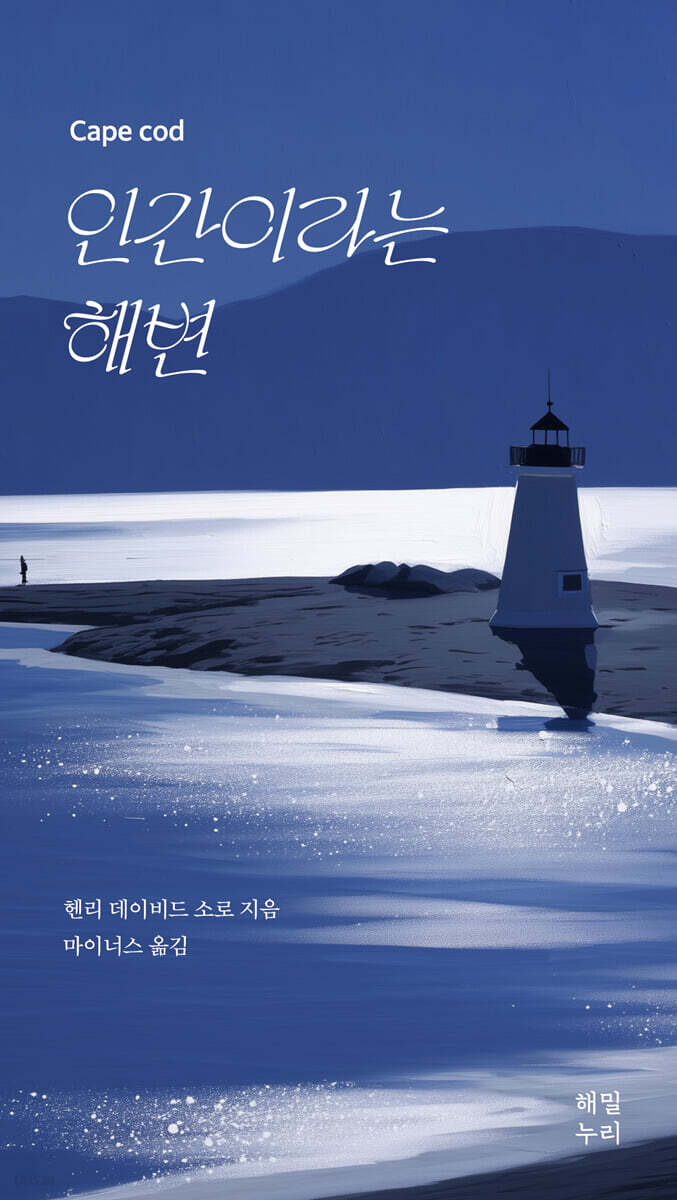
The beach of humanity
 |
Description
Book Introduction
Henry David Thoreau's words
A travel essay and a meditation on human existence.
"The Beach of Man" is a travelogue, a philosophical treatise, and a meditation on human existence by Henry David Thoreau.
This book is a record of his observations and reflections during four trips to Cape Cod, Massachusetts, between 1849 and 1857, and is the product of his thorough contemplation on the border between nature and humanity.
In this book, Thoreau does not portray the ocean as a simple natural landscape.
For him, the sea is an endless cycle of life and a giant mirror reflecting the finitude of human beings.
From the bones of whales washed up on the shore and the remains of shipwrecks, to the ever-shifting sand dunes and even the lonely lighthouse – he interprets everything as a symbol.
If Walden is a work that asks, “How should humans live in nature?” through inner reflection in the forest, “The Beach of Man” is a record of expanded thought that asks, “How should humans stand before nature?”
In this book, Thoreau's sentences are always double-edged.
He reveres nature while also being wary of human civilization's arrogance, and while contemplating the transience of life, he sees the cycle and order of life within it.
The sea is both an object of fear and a source of inspiration for him, a transcendent being that can never be mastered by human will.
But in that very despair, he finds a paradoxical peace.
The moment we accept that humans cannot control nature, we become free.
The title, “The Beach of Man,” encapsulates Thoreau’s philosophy.
The beach is a space of constant change and sway between the sea and the land.
It is a metaphor for human existence.
We are all beings washed by waves, tossed by the wind, and having our names carved in the sand.
On that beach, Soro gazes at the essence of humanity, standing on the border between civilization and nature, the finite and the eternal.
If Walden is about the inner solitude of a quiet lakeside, The Shore of Man is about the solitude of the external world discovered amidst the strong winds and waves.
However, the two works are headed towards the same destination.
It is “how to exist as a human being in nature.”
Thoreau's reasoning remains valid today, even beyond the 19th century.
This book reawakens the senses we have lost in our rapidly changing civilization - the language of nature and the tranquility of thought.
A travel essay and a meditation on human existence.
"The Beach of Man" is a travelogue, a philosophical treatise, and a meditation on human existence by Henry David Thoreau.
This book is a record of his observations and reflections during four trips to Cape Cod, Massachusetts, between 1849 and 1857, and is the product of his thorough contemplation on the border between nature and humanity.
In this book, Thoreau does not portray the ocean as a simple natural landscape.
For him, the sea is an endless cycle of life and a giant mirror reflecting the finitude of human beings.
From the bones of whales washed up on the shore and the remains of shipwrecks, to the ever-shifting sand dunes and even the lonely lighthouse – he interprets everything as a symbol.
If Walden is a work that asks, “How should humans live in nature?” through inner reflection in the forest, “The Beach of Man” is a record of expanded thought that asks, “How should humans stand before nature?”
In this book, Thoreau's sentences are always double-edged.
He reveres nature while also being wary of human civilization's arrogance, and while contemplating the transience of life, he sees the cycle and order of life within it.
The sea is both an object of fear and a source of inspiration for him, a transcendent being that can never be mastered by human will.
But in that very despair, he finds a paradoxical peace.
The moment we accept that humans cannot control nature, we become free.
The title, “The Beach of Man,” encapsulates Thoreau’s philosophy.
The beach is a space of constant change and sway between the sea and the land.
It is a metaphor for human existence.
We are all beings washed by waves, tossed by the wind, and having our names carved in the sand.
On that beach, Soro gazes at the essence of humanity, standing on the border between civilization and nature, the finite and the eternal.
If Walden is about the inner solitude of a quiet lakeside, The Shore of Man is about the solitude of the external world discovered amidst the strong winds and waves.
However, the two works are headed towards the same destination.
It is “how to exist as a human being in nature.”
Thoreau's reasoning remains valid today, even beyond the 19th century.
This book reawakens the senses we have lost in our rapidly changing civilization - the language of nature and the tranquility of thought.
index
Introduction 6
Shipwreck 23
Scenery from the Stagecoach 30
Noset Plains 43
Beach 72
Wellfleet's Oyster Merchant 97
Back to the beach 122
151 across the Cape
Highland Lighthouse 174
Sea and Desert 203
Provincetown 244
Translator's Note 314
Shipwreck 23
Scenery from the Stagecoach 30
Noset Plains 43
Beach 72
Wellfleet's Oyster Merchant 97
Back to the beach 122
151 across the Cape
Highland Lighthouse 174
Sea and Desert 203
Provincetown 244
Translator's Note 314
Detailed image
Into the book
At best, Paris is a school where you learn how to live, a stepping stone to your hometown.
--- p.8
Even the storms of nature cannot shake the soul.
Because even the wind is a part of the soul.
The will of the righteous is not broken by any obstacle in the world, but rather breaks through it.
--- p.24
But our villages are infinitely shabby in front of nature.
However, it only looks slightly better when compared to other villages.
--- p.32
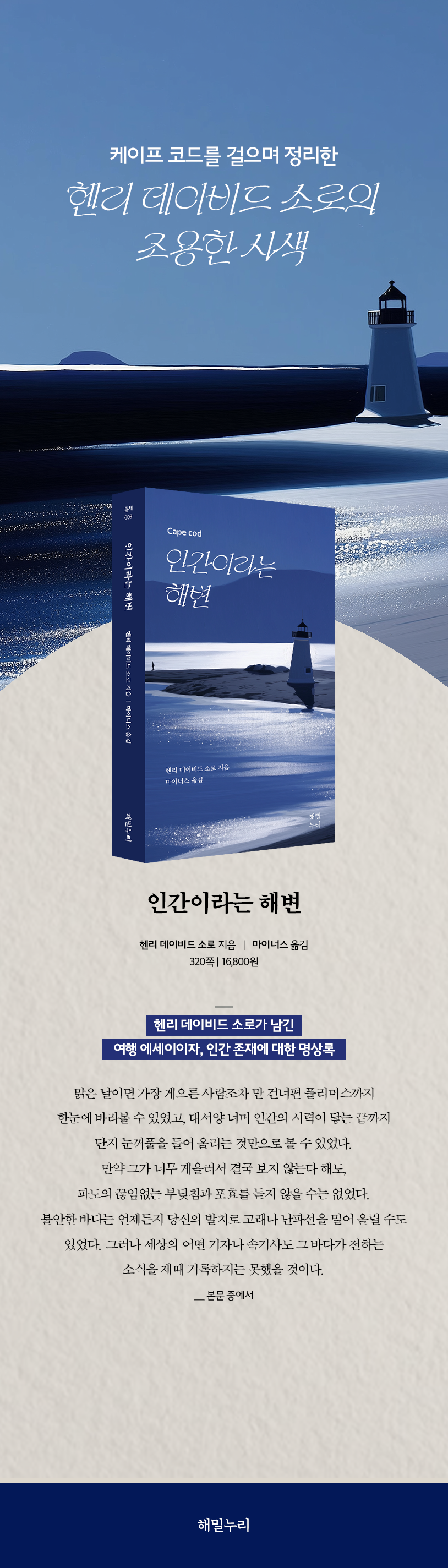
The restless seas could push a whale or a shipwreck right at your feet at any moment.
But no reporter or stenographer in the world could have recorded the news the sea conveyed in time.
--- p.212
The beach is a kind of neutral ground, the best place to contemplate the world.
--- p.215
Think about what history is made of.
Most of them are just stories agreed upon by descendants.
--- p.285
Nevertheless, Cape residents generally don't complain about their "soil" and will tell you that it's good enough for drying their fish.
--- p.8
Even the storms of nature cannot shake the soul.
Because even the wind is a part of the soul.
The will of the righteous is not broken by any obstacle in the world, but rather breaks through it.
--- p.24
But our villages are infinitely shabby in front of nature.
However, it only looks slightly better when compared to other villages.
--- p.32
The restless seas could push a whale or a shipwreck right at your feet at any moment.
But no reporter or stenographer in the world could have recorded the news the sea conveyed in time.
--- p.212
The beach is a kind of neutral ground, the best place to contemplate the world.
--- p.215
Think about what history is made of.
Most of them are just stories agreed upon by descendants.
--- p.285
Nevertheless, Cape residents generally don't complain about their "soil" and will tell you that it's good enough for drying their fish.
--- p.256
Publisher's Review
★ Hearing the human voice again in the silence of nature ★
★ Carving traces of existence on the waves of time ★
★ The most transparent and decisive journey of thought left by Soro ★
"The Beach of Man" is a record of Henry David Thoreau's thoughts reached at the end of his gaze on nature.
If Walden is a book that explores the depths of the inner self through the quiet self-sufficiency of the forest, then The Beach of Man is the result of that thought going out to the sea.
In this work, rather than conquering or praising nature, Thoreau contemplates how humans reside and disappear within it.
The coast of Cape Cod, with its sand and wind, waves and shipwrecks and whale bones, becomes a giant mirror for him.
Human civilization appears infinitely small and temporary before it.
But that very realization was not despair to Soro, but freedom.
The sea always outlives humans, and no matter how many footprints humans try to leave, the tides erase every trace.
In that indifference, he finds solace.
In this book, Thoreau's sentences are more transparent and more decisive than before.
His language, while describing landscapes, always aims at the essence of existence.
He portrays waves as “a rhythm of thought that breaks ceaselessly yet never stops,” and the beach as “a temporary place where humans stay and the boundary of life.”
His gaze expands from a single point on the beach to all of humanity, to the finiteness of time and the eternity of nature.
This expansion goes beyond a simple description of a nature journey to an ontological meditation.
"The Beach of Humanity" is not simply a book describing nature, but a record of an attempt to confront the instability of human existence and find new meaning within it.
Thoreau realizes how feeble human language is in the face of the immense silence of the sea.
But he is not afraid of that silence.
Rather, I see in it the possibility of humans reconnecting with nature.
For Thoreau, the sea is not simply a space, but a philosophical stage that tests the boundaries of the human spirit.
Today, we are increasingly moving away from nature in the face of the speed of technology and information.
But Soro's beach still asks us:
“What do you believe?” His question originated on the bleak shores of 19th-century New England, but its echoes remain relevant today.
"The Beach of Humanity" prompts us to reconsider the relationship between nature and humanity, and leads us to recover the humility and tranquility forgotten in the heart of civilization.
It is the most beautiful philosophical journey for humans to return to being a part of nature and to regain the essence of existence.
★ Carving traces of existence on the waves of time ★
★ The most transparent and decisive journey of thought left by Soro ★
"The Beach of Man" is a record of Henry David Thoreau's thoughts reached at the end of his gaze on nature.
If Walden is a book that explores the depths of the inner self through the quiet self-sufficiency of the forest, then The Beach of Man is the result of that thought going out to the sea.
In this work, rather than conquering or praising nature, Thoreau contemplates how humans reside and disappear within it.
The coast of Cape Cod, with its sand and wind, waves and shipwrecks and whale bones, becomes a giant mirror for him.
Human civilization appears infinitely small and temporary before it.
But that very realization was not despair to Soro, but freedom.
The sea always outlives humans, and no matter how many footprints humans try to leave, the tides erase every trace.
In that indifference, he finds solace.
In this book, Thoreau's sentences are more transparent and more decisive than before.
His language, while describing landscapes, always aims at the essence of existence.
He portrays waves as “a rhythm of thought that breaks ceaselessly yet never stops,” and the beach as “a temporary place where humans stay and the boundary of life.”
His gaze expands from a single point on the beach to all of humanity, to the finiteness of time and the eternity of nature.
This expansion goes beyond a simple description of a nature journey to an ontological meditation.
"The Beach of Humanity" is not simply a book describing nature, but a record of an attempt to confront the instability of human existence and find new meaning within it.
Thoreau realizes how feeble human language is in the face of the immense silence of the sea.
But he is not afraid of that silence.
Rather, I see in it the possibility of humans reconnecting with nature.
For Thoreau, the sea is not simply a space, but a philosophical stage that tests the boundaries of the human spirit.
Today, we are increasingly moving away from nature in the face of the speed of technology and information.
But Soro's beach still asks us:
“What do you believe?” His question originated on the bleak shores of 19th-century New England, but its echoes remain relevant today.
"The Beach of Humanity" prompts us to reconsider the relationship between nature and humanity, and leads us to recover the humility and tranquility forgotten in the heart of civilization.
It is the most beautiful philosophical journey for humans to return to being a part of nature and to regain the essence of existence.
GOODS SPECIFICS
- Date of issue: October 30, 2025
- Page count, weight, size: 320 pages | 105*186*20mm
- ISBN13: 9791175052079
- ISBN10: 1175052078
You may also like
카테고리
korean


korean

![GQ KOREA Mark (Monthly): December [2025]](http://librairie.coreenne.fr/cdn/shop/files/8ef265dbbfbf186523ed75ba7319009d.jpg?v=1765340328&width=3840)


