

Controversial Korean History: Modern Times
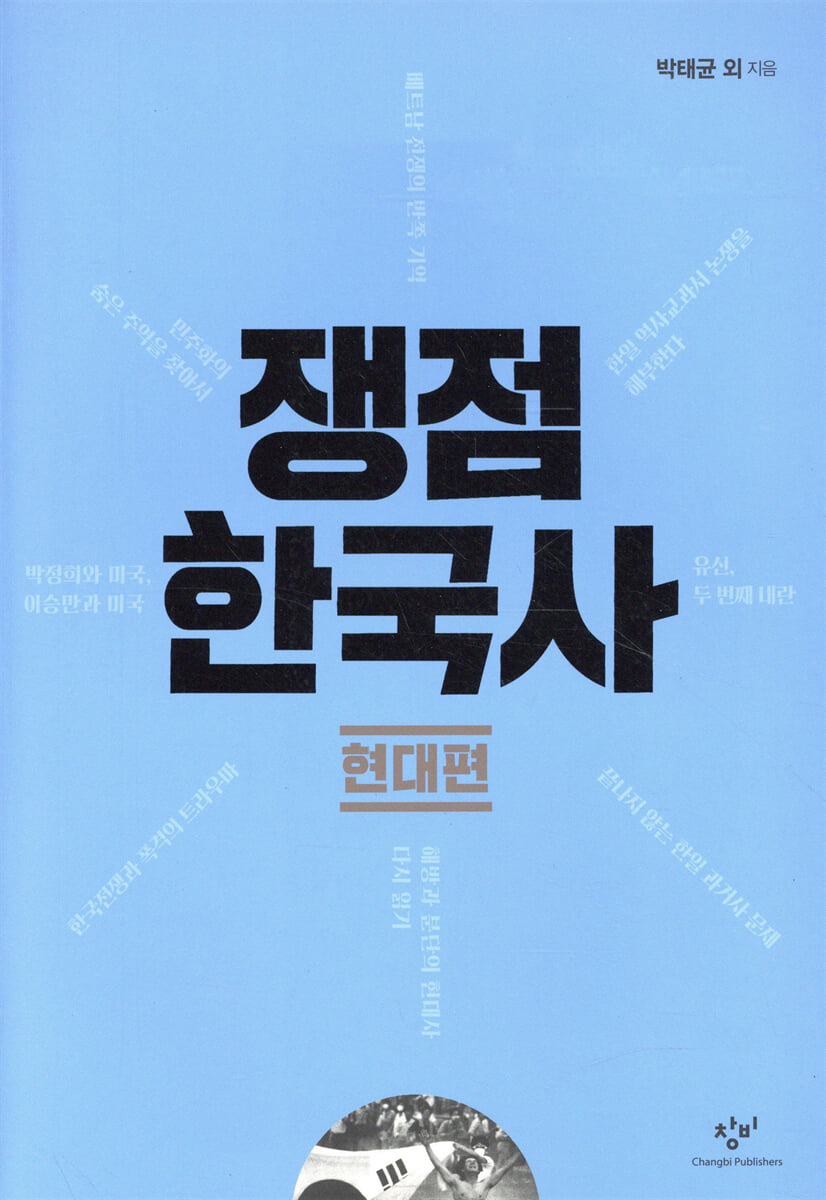 |
Description
Book Introduction
Amidst the controversy over national textbooks
A "New Korean History" to Counter the "Correct History Textbook"
At a time when the debate over nationalizing history textbooks is in full swing, 『Controversial Korean History』 (3 volumes) presents an understanding of the various perspectives surrounding history and a correct view of history.
The "Controversial Korean History" series, consisting of three volumes covering pre-modern, modern, and contemporary times, contains 24 key issues in Korean history selected by historians, ranging from the controversy over the territory of Dangun Joseon to the debate over Korea-Japan history textbooks.
Unlike typical textbooks that focus on general history, 『Controversial Korean History』 reconstructs Korean history by focusing on historical debates and issues.
Twenty-three prominent historians representing each era and field, including Han Myeong-gi, Lee Ki-hoon, and Park Tae-gyun, reinterpreted various topics such as war, people, diplomacy, past history, democratization, and history textbook controversies from their own perspectives, creating "24 colorful Korean histories" rather than "one correct history."
The themes of this book, painstakingly selected by the greatest historians of our time, not only prompt a fresh reflection on the past and a deeper reflection on today's realities, but also present alternatives and a sense of crisis that will guide the future.
From veterans in the history field, such as Kang Man-gil, Lee Man-yeol, Yoo Hong-jun, and Jo Hee-yeon, to leaders in the education field, many people concerned about history education in Korea unanimously recommended 『Controversial Korean History』.
This is because I know that this book is a "reliable Korean history" written with decades of research and meticulous argumentation, and that it is also the "front line of Korean history research" that is constantly being reinterpreted as times change.
A "New Korean History" to Counter the "Correct History Textbook"
At a time when the debate over nationalizing history textbooks is in full swing, 『Controversial Korean History』 (3 volumes) presents an understanding of the various perspectives surrounding history and a correct view of history.
The "Controversial Korean History" series, consisting of three volumes covering pre-modern, modern, and contemporary times, contains 24 key issues in Korean history selected by historians, ranging from the controversy over the territory of Dangun Joseon to the debate over Korea-Japan history textbooks.
Unlike typical textbooks that focus on general history, 『Controversial Korean History』 reconstructs Korean history by focusing on historical debates and issues.
Twenty-three prominent historians representing each era and field, including Han Myeong-gi, Lee Ki-hoon, and Park Tae-gyun, reinterpreted various topics such as war, people, diplomacy, past history, democratization, and history textbook controversies from their own perspectives, creating "24 colorful Korean histories" rather than "one correct history."
The themes of this book, painstakingly selected by the greatest historians of our time, not only prompt a fresh reflection on the past and a deeper reflection on today's realities, but also present alternatives and a sense of crisis that will guide the future.
From veterans in the history field, such as Kang Man-gil, Lee Man-yeol, Yoo Hong-jun, and Jo Hee-yeon, to leaders in the education field, many people concerned about history education in Korea unanimously recommended 『Controversial Korean History』.
This is because I know that this book is a "reliable Korean history" written with decades of research and meticulous argumentation, and that it is also the "front line of Korean history research" that is constantly being reinterpreted as times change.
- You can preview some of the book's contents.
Preview
index
Chapter 1: The Never-ending Issue of Korea-Japan History
The Meaning of Japan's Defeat and Unconditional Surrender│The Usefulness of the Emperor│Two Completely Different Occupations: Korea and Japan│The Normalization of Korea-Japan Diplomatic Relations and the Fractured Korea-Japan Relations
Chapter 2: Rereading the Modern History of Liberation and Division
Diverging Views on the Status of Liberated Korea│The US's "Free Base" Policy, the Soviet Union's "Democratic Base" Policy│Korean Responses│Korea in 1948│Syngman Rhee and Kim Gu
Chapter 3: The Trauma of the Korean War and Bombing
The emergence of precision bombing policy│Exponentially increasing civilian casualties│Chinese military intervention and the devastation of North Korea│Bombing and its aftermath
Chapter 4: Park Chung-hee and the United States, Syngman Rhee and the United States
Syngman Rhee's Opposition to the Armistice, the Shadow of Northward-Forward Diplomacy for Unification│The Unstable Honeymoon Relations of Park Chung-hee and Johnson│Nixon and Park Chung-hee, Reduction of US Forces in Korea and Détente│The Policy of Withdrawing Ground Forces from Korea and the Trilateral Talks│Beyond the Cold War Military Alliance
Chapter 5: Yushin, the Second Civil War
How was the Yushin regime possible? Korean democracy? Park Chung-hee didn't order Kim Dae-jung's death. Judicial murders and the suppression of the press. After Jang Jun-ha's death. The Yushin regime is over, but it's not over.
Chapter 6: Half-Memories of the Vietnam War
Why the US Intervened in Vietnam | Why Did the Korean Army Go? | Did the Korean Government Achieve Its Objectives | What We Should Really Gain from the Vietnam War
Chapter 7: In Search of the Hidden Heroes of Democracy
The 85-year-old president's fourth run for office│The full story of the largest election fraud since Dangun│Masan ignites the flames of the April 19 Revolution│Bloody Tuesday│Victory Tuesday│Students unite with citizens
Chapter 8: Dissecting the Korea-Japan History Textbook Controversy
The Textbook War Since 2002│From the History Textbook Debate Immediately After the Government's Establishment to "Correcting History"│The History Textbook Debate Related to the Essence of Historiography│Looking Back at Japan's Attack on History Textbooks│China's Northeast Project: More Dangerous Than Japan│What Should We Do in the History Debate?
The Meaning of Japan's Defeat and Unconditional Surrender│The Usefulness of the Emperor│Two Completely Different Occupations: Korea and Japan│The Normalization of Korea-Japan Diplomatic Relations and the Fractured Korea-Japan Relations
Chapter 2: Rereading the Modern History of Liberation and Division
Diverging Views on the Status of Liberated Korea│The US's "Free Base" Policy, the Soviet Union's "Democratic Base" Policy│Korean Responses│Korea in 1948│Syngman Rhee and Kim Gu
Chapter 3: The Trauma of the Korean War and Bombing
The emergence of precision bombing policy│Exponentially increasing civilian casualties│Chinese military intervention and the devastation of North Korea│Bombing and its aftermath
Chapter 4: Park Chung-hee and the United States, Syngman Rhee and the United States
Syngman Rhee's Opposition to the Armistice, the Shadow of Northward-Forward Diplomacy for Unification│The Unstable Honeymoon Relations of Park Chung-hee and Johnson│Nixon and Park Chung-hee, Reduction of US Forces in Korea and Détente│The Policy of Withdrawing Ground Forces from Korea and the Trilateral Talks│Beyond the Cold War Military Alliance
Chapter 5: Yushin, the Second Civil War
How was the Yushin regime possible? Korean democracy? Park Chung-hee didn't order Kim Dae-jung's death. Judicial murders and the suppression of the press. After Jang Jun-ha's death. The Yushin regime is over, but it's not over.
Chapter 6: Half-Memories of the Vietnam War
Why the US Intervened in Vietnam | Why Did the Korean Army Go? | Did the Korean Government Achieve Its Objectives | What We Should Really Gain from the Vietnam War
Chapter 7: In Search of the Hidden Heroes of Democracy
The 85-year-old president's fourth run for office│The full story of the largest election fraud since Dangun│Masan ignites the flames of the April 19 Revolution│Bloody Tuesday│Victory Tuesday│Students unite with citizens
Chapter 8: Dissecting the Korea-Japan History Textbook Controversy
The Textbook War Since 2002│From the History Textbook Debate Immediately After the Government's Establishment to "Correcting History"│The History Textbook Debate Related to the Essence of Historiography│Looking Back at Japan's Attack on History Textbooks│China's Northeast Project: More Dangerous Than Japan│What Should We Do in the History Debate?
Publisher's Review
Amidst the controversy over national textbooks
A "New Korean History" to Counter the "Correct History Textbook"
At a time when the debate over nationalizing history textbooks is in full swing, 『Controversial Korean History』 (3 volumes) examines various perspectives and new interpretations surrounding history, and presents a "true" and accurate Korean history that delves into the hidden aspects of history.
The "Controversial Korean History" series, consisting of three volumes covering pre-modern, modern, and contemporary times, contains 24 key issues in Korean history selected by historians, ranging from the controversy over the territory of Dangun Joseon to the debate over Korea-Japan history textbooks.
Unlike typical history textbooks that focus on general topics, 『Controversial Korean History』 reconstructs Korean history by focusing on historical debates and issues.
Professors Han Myeong-gi, Lee Ki-hoon, and Park Tae-gyun, the most trusted historians in academia, planned this book, and 23 prominent historians representing each era and field reinterpreted various topics such as war, people, diplomacy, past history, democratization, and history textbook controversies from their own perspectives, creating '24 colorful Korean histories' rather than 'one correct history.'
The themes of this book, painstakingly selected by the greatest historians of our time, not only prompt a fresh reflection on the past and a deeper reflection on today's realities, but also present alternatives and a sense of crisis that will guide the future.
From veterans in the history field, such as Kang Man-gil, Lee Man-yeol, Yoo Hong-jun, and Jo Hee-yeon, to leaders in the education field, many people concerned about history education in Korea unanimously recommended 『Controversial Korean History』.
This is because I know that this book is a "reliable Korean history" written with decades of research and meticulous argumentation, and that it is also the "front line of Korean history research" that is constantly being reinterpreted as times change.
In the modern era, which is the history closest to today, many prominent historians were mobilized.
Professor Park Tae-gyun, the planner, carefully selected historians who have been in close contact with the public at the forefront of modern history, the main battlefield of the 'history war,' including himself.
Professor Jeong Byeong-jun reorganizes the history of the three years of liberation based on the international situation (Chapter 2, “Rereading the Modern History of Liberation and Division”), Professor Han Hong-gu clearly organizes and presents the context before and after the Yushin era (Chapter 5, “Yushin, the Second Civil War”), and Professor Hong Seok-ryul provides a detailed account of the dramatic process of Korea-US relations from the Syngman Rhee government to the Park Chung-hee government (Chapter 4, “Park Chung-hee and the US, Syngman Rhee and the US”).
In addition, a large number of scholars who have produced cutting-edge research results in their fields, including Professor Lee Shin-cheol, an expert on the Korea-Japan history textbook issue (Chapter 8, “Dissecting the Korea-Japan History Textbook Debate”), Professors Kim Tae-woo, Yoo Ji-ah, and Oh Je-yeon, have participated, further expanding the depth and breadth of modern history.
The authors reveal hidden stories of modern history in detail, such as how the post-war Korea-Japan relationship and division relate to the United States (Chapter 1, “The Never-ending Problem of Korea-Japan Past History,” by Yoo Ji-ah), why North Korea is so obsessed with nuclear development (Chapter 3, “The Trauma of the Korean War and Bombing,” by Kim Tae-woo), and who the true protagonists of the democratization movement in modern history are (Chapter 7, “In Search of the Hidden Heroes of Democratization,” by Oh Je-yeon).
In addition, it conveys without fail important scenes from our modern history that must be remembered, such as the Syngman Rhee dictatorship, Park Chung-hee's Yushin, the Korean War, and the Vietnam War.
Readers will be able to clearly grasp the sharp issues in our society, from the historical issues between Korea and Japan to the history textbook debate.
Ⅰ.
Characteristics of 『Controversial Korean History』
The most pressing issue right now!
From the "comfort women" issue to the history textbook debate, we revisit some of the most hotly debated issues in our society today from a historical perspective.
It goes without saying that historians who have led debates both inside and outside academia have participated in this topic.
For example, amidst the renewed controversy over the National Foundation Day regarding the expression "Establishment of the Republic of Korea" in 1948 in the national history textbook, Professor Park Chan-seung talks about the misunderstandings surrounding the Provisional Government of the Republic of Korea and its historical significance (Chapter 4, Modern History, "How to View the Provisional Government of the Republic of Korea"), and Professor Lee Shin-cheol, an expert on history textbook issues, looks back on the history of the Korea-Japan history textbook dispute and compares and analyzes its contents (Chapter 8, "Dissecting the Korea-Japan History Textbook Dispute").
Also, Professor So Hyun-sook's article (Modern Era, Chapter 8, "The Wrong First Button, Japanese Military 'Comfort Women'"), which criticized Park Yu-ha's "Comfort Women of the Empire" point by point, which caused shock with its claim that "comfort women were Japanese military comrades and prostitutes," and Professor Lee Jun-sik's article (Modern Era, Chapter 7, "The Price of Not Being able to Liquidate Pro-Japanese Collaborators"), which revealed the history of healthy forces in our society being purged by pro-Japanese collaborators as a result of our failure to liquidate pro-Japanese collaborators, also provide us with many insights.
The best experts in each field in one place!
The planners of each volume, Professors Han Myeong-gi, Lee Ki-hoon, and Park Tae-gyun, are true experts in their respective fields.
The pre-modern period, which covers the longest period of history but has limitations in terms of historical materials, was handled by Professor Han Myeong-gi, who is renowned for clearly identifying the core of the era and its current significance.
The modern era, a battleground between nationalism and colonialism, was led by Professor Lee Ki-hoon, who is leading the way in reading and writing history from a new perspective. The modern era, a battleground of the "history war," was led by Professor Park Tae-gyun, who combines academic rigor with popular writing skills and leads research on modern history centered on historical materials.
The part that the planners of each volume put as much effort into selecting the topic as they did into organizing the writing staff.
Historians, who could not stand by and watch the historical regression of nationalization, readily responded to the demands of a credible planner.
Twenty-three prominent historians representing their respective fields, including Song Ho-jeong, Lim Ki-hwan, Bae Hang-seop, Park Chan-seung, Jeong Byeong-jun, and Han Hong-gu, participated in reinterpreting their long-standing research findings in a way that appeals to the general public.
For example, Professor Song Ho-jeong, famous as the 'first doctor of Gojoseon', engages in a head-on confrontation with 'non-government historians' on the controversial topic of 'What is the extent of the scope of our ancient history?' (Chapter 1 of the Pre-Modern Era, 'What is the extent of the scope of our ancient history?').
Drawing on cutting-edge research and a wealth of archaeological data, he clearly reveals how far their efforts to find a "grand ancient history" from a nationalistic perspective differ from actual history.
Meanwhile, Professor Han Hong-gu, who recently received attention for his research on Kim Ki-chun, evaluated the Yushin era under Park Chung-hee and defined it as “a clear-cut act of rebellion, with no room for excuse, for Park Chung-hee to drive out tanks and dissolve the National Assembly” (Modern Times, Chapter 5, “Yushin, the Second Rebellion”).
The reason this book is able to make such strong claims while dealing with such a controversial topic is because the researchers who contributed to this book are all experts among the most authoritative experts in their fields.
The back story and the details of history!
Unlike most history textbooks that are structured in a chronological order, this book reconstructs history by focusing on major issues.
Instead of uniformly describing all scenes of history, the narrative is revived by highlighting specific events or people, and the previously overlooked aspects of history are brought to the forefront.
It also adds to the fun of reading by including the detailed circumstances and backstory hidden behind the incident.
A representative example is Professor Lee Ki-hoon's article, which reconstructs the March 1st Movement through the lives of three people (Chapter 3 of the Modern Era, "March 1st Movement, Three Different Memories").
Here, the memories of the March 1st Movement intersect from the perspectives of Lee Deok-sun, a farmer from Anseong, Gyeonggi Province, Yang Ju-heup, a student studying abroad in Japan, and Jang Byeong-jun, an intellectual youth who returned from studying abroad.
This article, which is written with such realism that it feels like looking into the diaries of three people, will allow readers to feel as if they have entered the scene of history.
Public lectures compiled into a book, making them easy and fun!
『Controversial Korean History』 was created based on the Changbi Academy course of the same name that was held for two months starting in February 2016.
Since the course itself was designed for the general public, the contents of the book were written in a clear and easy-to-understand manner that was tailored to the general public.
We minimized the use of difficult historical terms and filled it with rich historical backstories.
We also actively reflected the questions and issues raised during the lecture.
For example, Professor Do Hyeon-cheol, who wrote the pre-modern section, “Chapter 6: How to View the Yuan Intervention Period,” created a separate chapter (“Three Mysteries of the Relationship Between the Yuan Dynasty and the Yeo-Yuan Dynasty”) to actively address readers’ questions surrounding this period.
Ⅱ.
Contents of each volume
In the pre-modern section, we shed new light on issues that have sparked sharp debate both within and outside academia, or are considered major historical mysteries among the general public.
Professor Han Myeong-gi, the planner, carefully selected eight topics that, while brief, offer significant insight, covering a long period of over 2,000 years.
For example, by looking at the history of Gojoseon, the first state in our history, it is revealed why the belief that Dangun Joseon was founded in 2333 BC is clearly false (Chapter 1, “How far does the scope of our ancient history extend?”, Song Ho-jeong), or it explains the background that allowed a queen to be born in Silla, a strict patriarchal state (Chapter 2, “The Emergence of a Queen in Silla: How Was It Possible?”, Kang Jong-hoon).
Also, it is clearly explained why Silla, not Goguryeo, unified the three kingdoms (Chapter 3, “Yeon Gaesomun and Kim Chun-chu, a choice that changed the fate of the nation,” by Lim Ki-hwan), why the Yuan Dynasty, which built a world empire, did not annex Goryeo (Chapter 6, “How to view the Yuan Intervention Period,” by Do Hyeon-cheol), and how Joseon was able to maintain its system in the aftermath of the Imjin War, which changed the ruling systems of China and Japan (Chapter 7, “The power of Joseon politics, factional strife, and the Daedong Law,” by Lee Jeong-cheol).
“Does it clearly illuminate today’s reality by reflecting on history in a new way?” was also an important criterion for selecting a topic.
For example, it allows us to look back on the reality of South Korea, which was in crisis due to the collapse of leadership, through the qualities of the leader who directly influenced the rise and fall of the nation (Chapter 2), and raises questions about South Korea's diplomacy, which was lost between the United States and China, while outlining the flow of Joseon's diplomacy as it struggled to overcome the limitations of being 'sandwiched' between two great powers (Ming-Qing and Japan) (Chapter 8, "Is Joseon a Closed Country?", Han Myeong-gi).
This will allow readers to feel that history is not just a tale of the past unrelated to reality, but a wellspring of wisdom that provides the insights we need to move forward.
In the modern era section, we focused on people and facts that were not well known to the public, in an attempt to break the perception that the modern era was a dark period in our history.
Professor Lee Ki-hoon, the planner, selected eight themes that could demonstrate the movement to overcome the contemporary era beyond the perspective of national historical suffering.
The authors of each topic responded by offering opinions that highlighted aspects overlooked in the existing syntax-centered history.
For example, while pointing out the limitations of the diplomacy of the Korean Empire, which was floundering in the cracks between the world powers, it also examines the efforts of the diplomatic line, including Emperor Gojong, who sought to make Korea a neutral nation (Chapter 2, “The Possibilities and Limitations of the Korean Empire’s Diplomacy,” Eun Jeong-tae), tracing the actions of three people who participated in the March 1st Movement (Chapter 3, “The March 1st Movement, Three Different Memories”), reconstructing the lives of colonial youth who had no choice but to grow up prematurely in the midst of the trials of the times (Chapter 5, “Young People in the Colony, Young People of Today,” Lee Ki-hoon), and bringing back forgotten socialist revolutionaries (Chapter 6, “Socialist Revolutionaries Beyond Memory,” Choi Gyu-jin).
Some topics are both real-world issues and academic hot topics.
Although the National Foundation Day controversy is in full swing, there are still many things we don't know about the history of the Provisional Government of the Republic of Korea (Chapter 4, "How Should We View the Provisional Government of the Republic of Korea?", Park Chan-seung), the Donghak Peasant Revolution should not be explained within the framework of a major national historical event, but rather as an event created by the experiences of the people that have continued since the pre-modern era (Chapter 1, "Rethinking the Donghak Peasant Revolution," Bae Hang-seop), and a rebuttal to Professor Park Yu-ha's opinion that the "comfort women" issue, the biggest point of contention in Korea-Japan diplomacy, was buttoned up wrong from the start and that the responsibility for the "discord" between Korea and Japan lies with the Korean Council for Military Sexual Slavery by Japan or the victims (Chapter 8, "The First Button Wrongly Buttoned, Japanese Military 'Comfort Women'," So Hyeon-suk).
As history shows, the healthy forces in our society were purged by pro-Japanese collaborators as a result of the failure to liquidate pro-Japanese collaborators (Chapter 7, “The Price of Not Liquidating Pro-Japanese Collaborators,” Lee Jun-sik), the modern era is not simply a thing of the past, but an era that has a profound impact on our lives today.
Readers will be able to deeply engrave in their hearts through this book what it means to learn from the past.
A "New Korean History" to Counter the "Correct History Textbook"
At a time when the debate over nationalizing history textbooks is in full swing, 『Controversial Korean History』 (3 volumes) examines various perspectives and new interpretations surrounding history, and presents a "true" and accurate Korean history that delves into the hidden aspects of history.
The "Controversial Korean History" series, consisting of three volumes covering pre-modern, modern, and contemporary times, contains 24 key issues in Korean history selected by historians, ranging from the controversy over the territory of Dangun Joseon to the debate over Korea-Japan history textbooks.
Unlike typical history textbooks that focus on general topics, 『Controversial Korean History』 reconstructs Korean history by focusing on historical debates and issues.
Professors Han Myeong-gi, Lee Ki-hoon, and Park Tae-gyun, the most trusted historians in academia, planned this book, and 23 prominent historians representing each era and field reinterpreted various topics such as war, people, diplomacy, past history, democratization, and history textbook controversies from their own perspectives, creating '24 colorful Korean histories' rather than 'one correct history.'
The themes of this book, painstakingly selected by the greatest historians of our time, not only prompt a fresh reflection on the past and a deeper reflection on today's realities, but also present alternatives and a sense of crisis that will guide the future.
From veterans in the history field, such as Kang Man-gil, Lee Man-yeol, Yoo Hong-jun, and Jo Hee-yeon, to leaders in the education field, many people concerned about history education in Korea unanimously recommended 『Controversial Korean History』.
This is because I know that this book is a "reliable Korean history" written with decades of research and meticulous argumentation, and that it is also the "front line of Korean history research" that is constantly being reinterpreted as times change.
In the modern era, which is the history closest to today, many prominent historians were mobilized.
Professor Park Tae-gyun, the planner, carefully selected historians who have been in close contact with the public at the forefront of modern history, the main battlefield of the 'history war,' including himself.
Professor Jeong Byeong-jun reorganizes the history of the three years of liberation based on the international situation (Chapter 2, “Rereading the Modern History of Liberation and Division”), Professor Han Hong-gu clearly organizes and presents the context before and after the Yushin era (Chapter 5, “Yushin, the Second Civil War”), and Professor Hong Seok-ryul provides a detailed account of the dramatic process of Korea-US relations from the Syngman Rhee government to the Park Chung-hee government (Chapter 4, “Park Chung-hee and the US, Syngman Rhee and the US”).
In addition, a large number of scholars who have produced cutting-edge research results in their fields, including Professor Lee Shin-cheol, an expert on the Korea-Japan history textbook issue (Chapter 8, “Dissecting the Korea-Japan History Textbook Debate”), Professors Kim Tae-woo, Yoo Ji-ah, and Oh Je-yeon, have participated, further expanding the depth and breadth of modern history.
The authors reveal hidden stories of modern history in detail, such as how the post-war Korea-Japan relationship and division relate to the United States (Chapter 1, “The Never-ending Problem of Korea-Japan Past History,” by Yoo Ji-ah), why North Korea is so obsessed with nuclear development (Chapter 3, “The Trauma of the Korean War and Bombing,” by Kim Tae-woo), and who the true protagonists of the democratization movement in modern history are (Chapter 7, “In Search of the Hidden Heroes of Democratization,” by Oh Je-yeon).
In addition, it conveys without fail important scenes from our modern history that must be remembered, such as the Syngman Rhee dictatorship, Park Chung-hee's Yushin, the Korean War, and the Vietnam War.
Readers will be able to clearly grasp the sharp issues in our society, from the historical issues between Korea and Japan to the history textbook debate.
Ⅰ.
Characteristics of 『Controversial Korean History』
The most pressing issue right now!
From the "comfort women" issue to the history textbook debate, we revisit some of the most hotly debated issues in our society today from a historical perspective.
It goes without saying that historians who have led debates both inside and outside academia have participated in this topic.
For example, amidst the renewed controversy over the National Foundation Day regarding the expression "Establishment of the Republic of Korea" in 1948 in the national history textbook, Professor Park Chan-seung talks about the misunderstandings surrounding the Provisional Government of the Republic of Korea and its historical significance (Chapter 4, Modern History, "How to View the Provisional Government of the Republic of Korea"), and Professor Lee Shin-cheol, an expert on history textbook issues, looks back on the history of the Korea-Japan history textbook dispute and compares and analyzes its contents (Chapter 8, "Dissecting the Korea-Japan History Textbook Dispute").
Also, Professor So Hyun-sook's article (Modern Era, Chapter 8, "The Wrong First Button, Japanese Military 'Comfort Women'"), which criticized Park Yu-ha's "Comfort Women of the Empire" point by point, which caused shock with its claim that "comfort women were Japanese military comrades and prostitutes," and Professor Lee Jun-sik's article (Modern Era, Chapter 7, "The Price of Not Being able to Liquidate Pro-Japanese Collaborators"), which revealed the history of healthy forces in our society being purged by pro-Japanese collaborators as a result of our failure to liquidate pro-Japanese collaborators, also provide us with many insights.
The best experts in each field in one place!
The planners of each volume, Professors Han Myeong-gi, Lee Ki-hoon, and Park Tae-gyun, are true experts in their respective fields.
The pre-modern period, which covers the longest period of history but has limitations in terms of historical materials, was handled by Professor Han Myeong-gi, who is renowned for clearly identifying the core of the era and its current significance.
The modern era, a battleground between nationalism and colonialism, was led by Professor Lee Ki-hoon, who is leading the way in reading and writing history from a new perspective. The modern era, a battleground of the "history war," was led by Professor Park Tae-gyun, who combines academic rigor with popular writing skills and leads research on modern history centered on historical materials.
The part that the planners of each volume put as much effort into selecting the topic as they did into organizing the writing staff.
Historians, who could not stand by and watch the historical regression of nationalization, readily responded to the demands of a credible planner.
Twenty-three prominent historians representing their respective fields, including Song Ho-jeong, Lim Ki-hwan, Bae Hang-seop, Park Chan-seung, Jeong Byeong-jun, and Han Hong-gu, participated in reinterpreting their long-standing research findings in a way that appeals to the general public.
For example, Professor Song Ho-jeong, famous as the 'first doctor of Gojoseon', engages in a head-on confrontation with 'non-government historians' on the controversial topic of 'What is the extent of the scope of our ancient history?' (Chapter 1 of the Pre-Modern Era, 'What is the extent of the scope of our ancient history?').
Drawing on cutting-edge research and a wealth of archaeological data, he clearly reveals how far their efforts to find a "grand ancient history" from a nationalistic perspective differ from actual history.
Meanwhile, Professor Han Hong-gu, who recently received attention for his research on Kim Ki-chun, evaluated the Yushin era under Park Chung-hee and defined it as “a clear-cut act of rebellion, with no room for excuse, for Park Chung-hee to drive out tanks and dissolve the National Assembly” (Modern Times, Chapter 5, “Yushin, the Second Rebellion”).
The reason this book is able to make such strong claims while dealing with such a controversial topic is because the researchers who contributed to this book are all experts among the most authoritative experts in their fields.
The back story and the details of history!
Unlike most history textbooks that are structured in a chronological order, this book reconstructs history by focusing on major issues.
Instead of uniformly describing all scenes of history, the narrative is revived by highlighting specific events or people, and the previously overlooked aspects of history are brought to the forefront.
It also adds to the fun of reading by including the detailed circumstances and backstory hidden behind the incident.
A representative example is Professor Lee Ki-hoon's article, which reconstructs the March 1st Movement through the lives of three people (Chapter 3 of the Modern Era, "March 1st Movement, Three Different Memories").
Here, the memories of the March 1st Movement intersect from the perspectives of Lee Deok-sun, a farmer from Anseong, Gyeonggi Province, Yang Ju-heup, a student studying abroad in Japan, and Jang Byeong-jun, an intellectual youth who returned from studying abroad.
This article, which is written with such realism that it feels like looking into the diaries of three people, will allow readers to feel as if they have entered the scene of history.
Public lectures compiled into a book, making them easy and fun!
『Controversial Korean History』 was created based on the Changbi Academy course of the same name that was held for two months starting in February 2016.
Since the course itself was designed for the general public, the contents of the book were written in a clear and easy-to-understand manner that was tailored to the general public.
We minimized the use of difficult historical terms and filled it with rich historical backstories.
We also actively reflected the questions and issues raised during the lecture.
For example, Professor Do Hyeon-cheol, who wrote the pre-modern section, “Chapter 6: How to View the Yuan Intervention Period,” created a separate chapter (“Three Mysteries of the Relationship Between the Yuan Dynasty and the Yeo-Yuan Dynasty”) to actively address readers’ questions surrounding this period.
Ⅱ.
Contents of each volume
In the pre-modern section, we shed new light on issues that have sparked sharp debate both within and outside academia, or are considered major historical mysteries among the general public.
Professor Han Myeong-gi, the planner, carefully selected eight topics that, while brief, offer significant insight, covering a long period of over 2,000 years.
For example, by looking at the history of Gojoseon, the first state in our history, it is revealed why the belief that Dangun Joseon was founded in 2333 BC is clearly false (Chapter 1, “How far does the scope of our ancient history extend?”, Song Ho-jeong), or it explains the background that allowed a queen to be born in Silla, a strict patriarchal state (Chapter 2, “The Emergence of a Queen in Silla: How Was It Possible?”, Kang Jong-hoon).
Also, it is clearly explained why Silla, not Goguryeo, unified the three kingdoms (Chapter 3, “Yeon Gaesomun and Kim Chun-chu, a choice that changed the fate of the nation,” by Lim Ki-hwan), why the Yuan Dynasty, which built a world empire, did not annex Goryeo (Chapter 6, “How to view the Yuan Intervention Period,” by Do Hyeon-cheol), and how Joseon was able to maintain its system in the aftermath of the Imjin War, which changed the ruling systems of China and Japan (Chapter 7, “The power of Joseon politics, factional strife, and the Daedong Law,” by Lee Jeong-cheol).
“Does it clearly illuminate today’s reality by reflecting on history in a new way?” was also an important criterion for selecting a topic.
For example, it allows us to look back on the reality of South Korea, which was in crisis due to the collapse of leadership, through the qualities of the leader who directly influenced the rise and fall of the nation (Chapter 2), and raises questions about South Korea's diplomacy, which was lost between the United States and China, while outlining the flow of Joseon's diplomacy as it struggled to overcome the limitations of being 'sandwiched' between two great powers (Ming-Qing and Japan) (Chapter 8, "Is Joseon a Closed Country?", Han Myeong-gi).
This will allow readers to feel that history is not just a tale of the past unrelated to reality, but a wellspring of wisdom that provides the insights we need to move forward.
In the modern era section, we focused on people and facts that were not well known to the public, in an attempt to break the perception that the modern era was a dark period in our history.
Professor Lee Ki-hoon, the planner, selected eight themes that could demonstrate the movement to overcome the contemporary era beyond the perspective of national historical suffering.
The authors of each topic responded by offering opinions that highlighted aspects overlooked in the existing syntax-centered history.
For example, while pointing out the limitations of the diplomacy of the Korean Empire, which was floundering in the cracks between the world powers, it also examines the efforts of the diplomatic line, including Emperor Gojong, who sought to make Korea a neutral nation (Chapter 2, “The Possibilities and Limitations of the Korean Empire’s Diplomacy,” Eun Jeong-tae), tracing the actions of three people who participated in the March 1st Movement (Chapter 3, “The March 1st Movement, Three Different Memories”), reconstructing the lives of colonial youth who had no choice but to grow up prematurely in the midst of the trials of the times (Chapter 5, “Young People in the Colony, Young People of Today,” Lee Ki-hoon), and bringing back forgotten socialist revolutionaries (Chapter 6, “Socialist Revolutionaries Beyond Memory,” Choi Gyu-jin).
Some topics are both real-world issues and academic hot topics.
Although the National Foundation Day controversy is in full swing, there are still many things we don't know about the history of the Provisional Government of the Republic of Korea (Chapter 4, "How Should We View the Provisional Government of the Republic of Korea?", Park Chan-seung), the Donghak Peasant Revolution should not be explained within the framework of a major national historical event, but rather as an event created by the experiences of the people that have continued since the pre-modern era (Chapter 1, "Rethinking the Donghak Peasant Revolution," Bae Hang-seop), and a rebuttal to Professor Park Yu-ha's opinion that the "comfort women" issue, the biggest point of contention in Korea-Japan diplomacy, was buttoned up wrong from the start and that the responsibility for the "discord" between Korea and Japan lies with the Korean Council for Military Sexual Slavery by Japan or the victims (Chapter 8, "The First Button Wrongly Buttoned, Japanese Military 'Comfort Women'," So Hyeon-suk).
As history shows, the healthy forces in our society were purged by pro-Japanese collaborators as a result of the failure to liquidate pro-Japanese collaborators (Chapter 7, “The Price of Not Liquidating Pro-Japanese Collaborators,” Lee Jun-sik), the modern era is not simply a thing of the past, but an era that has a profound impact on our lives today.
Readers will be able to deeply engrave in their hearts through this book what it means to learn from the past.
GOODS SPECIFICS
- Date of issue: March 1, 2017
- Page count, weight, size: 252 pages | 400g | 152*225*30mm
- ISBN13: 9788936482831
- ISBN10: 8936482831
You may also like
카테고리
korean


korean

![GQ KOREA Mark (Monthly): December [2025]](http://librairie.coreenne.fr/cdn/shop/files/8ef265dbbfbf186523ed75ba7319009d.jpg?v=1765340328&width=3840)


