

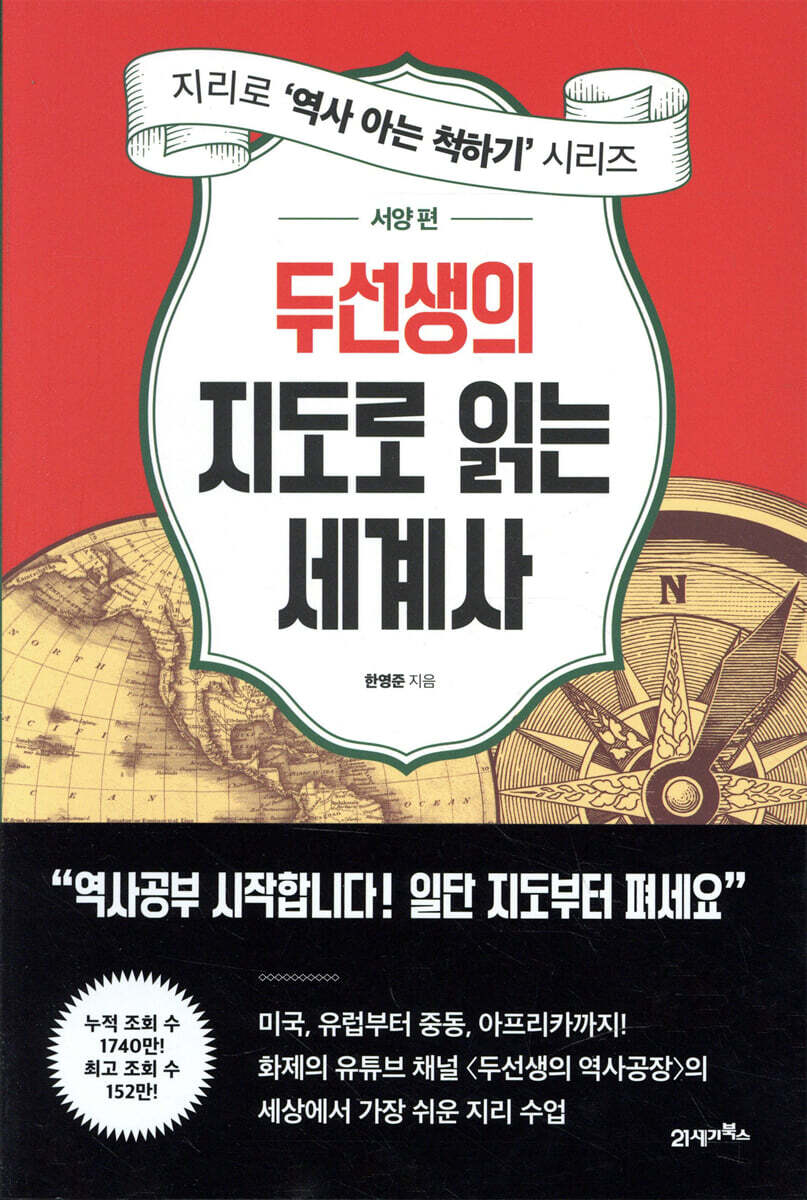
World History Under the Guidance of Two Teachers: Western Edition
 |
Description
Book Introduction
"Let's start studying history! First, spread out the map."
★ Cumulative views: 17.4 million, peak views: 1.52 million ★
★ Popular YouTube channel "Two Teachers' History Factory" ★
From the US and Europe to the Middle East and Africa
If you just know where the mountains and the sea are,
You can read the history that has been built up over thousands of years!
With 17.4 million cumulative views and a peak of 1.52 million, the lectures from the popular YouTube channel [Two Teachers' History Factory] have been reborn as a book.
If you've ever thought studying history meant just memorizing and scanning a timeline, open this book right now.
Maps and geography no longer simply describe the appearance of the land.
It is a window to the past and a blueprint for reading the future.
In an age where geography has become a universal law, to truly study 'real' history, one must first understand geography, which contains the stories of mountain ranges and seas.
The author's characteristically humorous explanations, easily understood even by those unfamiliar with history, and the rich visual aid of 50 illustrated color maps will correct your perception that history is long and boring and maps are complex and difficult to read.
★ Cumulative views: 17.4 million, peak views: 1.52 million ★
★ Popular YouTube channel "Two Teachers' History Factory" ★
From the US and Europe to the Middle East and Africa
If you just know where the mountains and the sea are,
You can read the history that has been built up over thousands of years!
With 17.4 million cumulative views and a peak of 1.52 million, the lectures from the popular YouTube channel [Two Teachers' History Factory] have been reborn as a book.
If you've ever thought studying history meant just memorizing and scanning a timeline, open this book right now.
Maps and geography no longer simply describe the appearance of the land.
It is a window to the past and a blueprint for reading the future.
In an age where geography has become a universal law, to truly study 'real' history, one must first understand geography, which contains the stories of mountain ranges and seas.
The author's characteristically humorous explanations, easily understood even by those unfamiliar with history, and the rich visual aid of 50 illustrated color maps will correct your perception that history is long and boring and maps are complex and difficult to read.
- You can preview some of the book's contents.
Preview
index
Recommendation | Geography is fun!
Opening the Book | A Time and Space for Reading Geography and History
CHAPTER 1 From the Cradle of Civilization to a Continent of Chaos: The Middle East
[Physical Geography of the Middle East] How far does the Middle East extend?
- Levant, from a land of civilization to a land of conflict
- The Arabian Peninsula, a desert fertilized by oil
- A colorful history, Egypt and North Africa
- High plains surrounded by mountains
[History and Human Geography of the Middle East] To properly view the map of the Middle East
- The emergence of Islam and the formation of the Arab world
- Israel, a Jewish nation built in the heart of Islam
- Iran, the first empire to emerge in the Middle East
- Türkiye, the last empire of the Islamic world
Independence from without, division from within
Middle East Chapter Summary
CHAPTER 2 Why are there so many countries in Europe?
[European Geography] Europe, a land of mountains and seas
- Southern Europe, where the sea meets the mountains
- The Balkan Peninsula, Europe's powder keg
- A slice of Europe's fertile pizza, Central Europe
- The highlands from west to north, northern Europe
[History of the European Continent] Why it's OK to be more than one
- The great power of southern and northern Europe
- New diversity created by fragmented geography
[European Human Geography] Distinguishing between similar yet different European regions
- Europe in Language
- Europe divided by religion
Eastern Europe divided by the Cold War
- Confusing countries in Europe
European Chapter Summary
CHAPTER 3 The United States: A Superpower Created by Geography
[American Physical Geography] Nature's 'Natural Fortresses'
- America seen from outside, hitting the ice and sand barrier
- America as seen from within, the land flowing with milk and honey
[History of the United States] Why did the United States become so large?
- Immigrants seeking freedom, 13 colonies
- America declares independence
- Best real estate investment
- Reborn as the leader of America
- From a newly independent nation to an imperialist nation
[American Geography] A Closer Look at the Vast United States
- Various belts in the United States
- American political landscape
Summary of the US Chapter
CHAPTER 4: The Americas, Central and South America
[Physical Geography of Central and South America] A Continent Similar to the United States, Yet Different
- From South America to Latin America
- Mountains and plateaus that embrace civilization, and the Caribbean Sea
- People who do not live near rivers or inland areas
[History of Central and South America] Central and South America before and after the discovery of the New World
- Civilizations that began in mountain ranges and plateaus
- Why only Brazil speaks Portuguese
- Remnants of the colonial era
[Human Geography of Central and South America] Latin America: A Continent at a Crossroads
Why Can't Central and South America Be Like the United States?
- Latin America, the mixed continent
Central and South America Chapter Summary
CHAPTER 5 The Beginning of Humanity and the End of the World: Africa
[Africa's Natural Geography] A Place Full of Deserts and Jungles
- Africa seen from outside, the second largest continent on Earth
- Africa seen from within, a land divided by geography
[History of the African Continent] The Continent Where Humanity Was Born
- The continent where humanity was born
- The end of the world, the unknown continent
[Human Geography of Africa] One Continent, Many Countries
- 'Continent' not 'country'
- Imperialism engraved in the country's name
Africa Chapter Summary
Concluding the Book | Stories about People, Geography
Opening the Book | A Time and Space for Reading Geography and History
CHAPTER 1 From the Cradle of Civilization to a Continent of Chaos: The Middle East
[Physical Geography of the Middle East] How far does the Middle East extend?
- Levant, from a land of civilization to a land of conflict
- The Arabian Peninsula, a desert fertilized by oil
- A colorful history, Egypt and North Africa
- High plains surrounded by mountains
[History and Human Geography of the Middle East] To properly view the map of the Middle East
- The emergence of Islam and the formation of the Arab world
- Israel, a Jewish nation built in the heart of Islam
- Iran, the first empire to emerge in the Middle East
- Türkiye, the last empire of the Islamic world
Independence from without, division from within
Middle East Chapter Summary
CHAPTER 2 Why are there so many countries in Europe?
[European Geography] Europe, a land of mountains and seas
- Southern Europe, where the sea meets the mountains
- The Balkan Peninsula, Europe's powder keg
- A slice of Europe's fertile pizza, Central Europe
- The highlands from west to north, northern Europe
[History of the European Continent] Why it's OK to be more than one
- The great power of southern and northern Europe
- New diversity created by fragmented geography
[European Human Geography] Distinguishing between similar yet different European regions
- Europe in Language
- Europe divided by religion
Eastern Europe divided by the Cold War
- Confusing countries in Europe
European Chapter Summary
CHAPTER 3 The United States: A Superpower Created by Geography
[American Physical Geography] Nature's 'Natural Fortresses'
- America seen from outside, hitting the ice and sand barrier
- America as seen from within, the land flowing with milk and honey
[History of the United States] Why did the United States become so large?
- Immigrants seeking freedom, 13 colonies
- America declares independence
- Best real estate investment
- Reborn as the leader of America
- From a newly independent nation to an imperialist nation
[American Geography] A Closer Look at the Vast United States
- Various belts in the United States
- American political landscape
Summary of the US Chapter
CHAPTER 4: The Americas, Central and South America
[Physical Geography of Central and South America] A Continent Similar to the United States, Yet Different
- From South America to Latin America
- Mountains and plateaus that embrace civilization, and the Caribbean Sea
- People who do not live near rivers or inland areas
[History of Central and South America] Central and South America before and after the discovery of the New World
- Civilizations that began in mountain ranges and plateaus
- Why only Brazil speaks Portuguese
- Remnants of the colonial era
[Human Geography of Central and South America] Latin America: A Continent at a Crossroads
Why Can't Central and South America Be Like the United States?
- Latin America, the mixed continent
Central and South America Chapter Summary
CHAPTER 5 The Beginning of Humanity and the End of the World: Africa
[Africa's Natural Geography] A Place Full of Deserts and Jungles
- Africa seen from outside, the second largest continent on Earth
- Africa seen from within, a land divided by geography
[History of the African Continent] The Continent Where Humanity Was Born
- The continent where humanity was born
- The end of the world, the unknown continent
[Human Geography of Africa] One Continent, Many Countries
- 'Continent' not 'country'
- Imperialism engraved in the country's name
Africa Chapter Summary
Concluding the Book | Stories about People, Geography
Detailed image

Into the book
We cannot fully empathize with the international situation, trends, and circumstances of that time.
However, the spatial environment of the Korean Peninsula has not changed significantly.
Through the geographical medium of the Korean Peninsula, we can get one step closer to the history of the people who lived there in the past.
---From "Opening the Book | Time and Space for Reading Geography and History"
The area from Iraq to the Levant and, more broadly, to Egypt, is called the 'Fertile Crescent'.
Thanks to the fertile land and the development of agriculture and livestock farming, many ancient civilizations and cities were established.
But today, this place is remembered as a place of numerous wars and desertification, belying its former reputation.
---From "CHAPTER 1: From the Cradle of Civilization to the Continent of Chaos, the Middle East"
Why are there so many countries in Europe? Why did Southern Europe, once prosperous in ancient times, reverse course, and Northern Europe now enjoys greater prosperity? The answer lies entirely in physical geography.
---From "CHAPTER 2: Why Are There So Many Countries, Europe"
The valleys between the mountains will flow and gather to eventually become rivers.
What good would it be if water gathered like this? It would make life better for people.
In fact, many rivers originate from the Rocky Mountains and the Appalachian Mountains.
Many rivers converge between the two mountain ranges, creating a plain ideal for farming.
---From "CHAPTER 3: The United States, a Superpower Created by Geography"
The Amazon River basin, which occupies most of the inland, is in this situation, making it difficult for the inland of South America to develop.
So, most of South America developed coastal cities.
Wealthy immigrants from Europe live in coastal cities, while the poor live in inland villages.
---From "CHAPTER 4: America, Central and South America"
Our ancestors evolved by coming down from the trees to the ground.
As the dry grasslands expand here, they also help large herbivorous mammals, such as antelope and zebra, which humans can hunt, to thrive.
It is said that this is why many of the distant ancestors of modern humans have been found in East Africa.
---From "CHAPTER 5: The Beginning and End of Humanity, Africa"
Geographical environment does not determine everything about humans and society.
The history of mankind is a process of adapting to nature, but it is also a process of overcoming nature.
However, the spatial environment of the Korean Peninsula has not changed significantly.
Through the geographical medium of the Korean Peninsula, we can get one step closer to the history of the people who lived there in the past.
---From "Opening the Book | Time and Space for Reading Geography and History"
The area from Iraq to the Levant and, more broadly, to Egypt, is called the 'Fertile Crescent'.
Thanks to the fertile land and the development of agriculture and livestock farming, many ancient civilizations and cities were established.
But today, this place is remembered as a place of numerous wars and desertification, belying its former reputation.
---From "CHAPTER 1: From the Cradle of Civilization to the Continent of Chaos, the Middle East"
Why are there so many countries in Europe? Why did Southern Europe, once prosperous in ancient times, reverse course, and Northern Europe now enjoys greater prosperity? The answer lies entirely in physical geography.
---From "CHAPTER 2: Why Are There So Many Countries, Europe"
The valleys between the mountains will flow and gather to eventually become rivers.
What good would it be if water gathered like this? It would make life better for people.
In fact, many rivers originate from the Rocky Mountains and the Appalachian Mountains.
Many rivers converge between the two mountain ranges, creating a plain ideal for farming.
---From "CHAPTER 3: The United States, a Superpower Created by Geography"
The Amazon River basin, which occupies most of the inland, is in this situation, making it difficult for the inland of South America to develop.
So, most of South America developed coastal cities.
Wealthy immigrants from Europe live in coastal cities, while the poor live in inland villages.
---From "CHAPTER 4: America, Central and South America"
Our ancestors evolved by coming down from the trees to the ground.
As the dry grasslands expand here, they also help large herbivorous mammals, such as antelope and zebra, which humans can hunt, to thrive.
It is said that this is why many of the distant ancestors of modern humans have been found in East Africa.
---From "CHAPTER 5: The Beginning and End of Humanity, Africa"
Geographical environment does not determine everything about humans and society.
The history of mankind is a process of adapting to nature, but it is also a process of overcoming nature.
---From "Ending the Book | Stories about People, Geography"
Publisher's Review
Two teachers' delightful explanations that even 'reverse idiots' can understand in an instant!
Includes 50 vivid color maps that will capture the hearts of geography nerds!
“To know history, you must first know the geography of the place.
To understand the history of the Middle East, it is essential to know where Mesopotamia is and what its geographic characteristics are.
“We also need to understand the history of the United States, which began as the 13 British colonies and expanded its territory.”
_From the text
The ancient Egyptians gathered around the Nile River and established the Egyptian civilization, and the people living in Central and South America established the Inca civilization in the Andes Mountains.
Southern Europe, which led the ancient history of Europe, and Northwestern Europe, which was treated as a barbarian tribe, received conflicting evaluations since the Middle Ages, with Southern Europe suffering from severe financial difficulties and Northwestern Europe leading the Age of Exploration.
Even if we have similar environments and similar historical experiences, our history will differ depending on the geographical characteristics of the region.
The landforms engraved on the map, such as the land that created civilization, the sea that provided a foundation for expansion and exchange, and the mountain ranges that divide borders, provide clues for easier communication with the past and a closer look at history.
This is why we need to open up maps to study 'real' history.
※ Main contents ※
◆ Middle East - Why is the Middle East always at war?
- Why are Türkiye and Iran not 'Arab'?
◆ Europe - Why are there so many countries in such a small country?
- What is the standard for distinguishing between Northern Europe, Eastern Europe, and Western Europe?
◆ The United States - Why did it go from a newly independent nation to a 21st-century superpower?
- What are the six scenes that tell the history of the American territory?
◆ Central and South America - Why did Central and South American civilization begin in mountain ranges and plateaus?
- Why does only Brazil speak Portuguese?
◆ Africa - The African continent is the second largest in the entire land area?
- Why did mankind originate in Africa?
Knowing geography is true culture!
Maps for history, geography for current affairs!
“This book is a coherent collection of stories.
It is a compilation of what history needs from the vast world of geography.
If you want to understand history properly, start with geography. If you want to start with difficult and complex geography easily, come here.”
Heo Jin-mo (author of "History of War, History of Civilization, History of the World")
Why are conflicts so persistent in the Middle East? Where did the conflict between Russia and Ukraine originate? How did Alaska and Hawaii in the US come to have such different political leanings? How did Central and South America come to be called Latin America? To truly understand the history of a region, we must first understand its geography.
Geography is no longer simply a ‘story of the land.’
It is a window to the past and a blueprint for the future.
This book helps readers efficiently understand the long flow of world history by arranging the events in the following order: the Middle East, where civilization was born; Europe, where Middle Eastern civilization spread; America, which was influenced by European culture; and Africa, which was colonized.
In addition, the author's characteristically cheerful explanations make the vast world history easy and fun to understand, and simple yet clear color maps are included to help readers understand complex geography at a glance.
Geographical environment does not determine everything about humans and society.
However, as the process of mankind adapting to and overcoming nature has become history, geography is the most accurate tool for reading history.
If you've ever thought studying history meant simply memorizing events one by one, open this book right now.
There will come a time when you will learn history when you read a map, and when you understand geography, you will understand current events.
Includes 50 vivid color maps that will capture the hearts of geography nerds!
“To know history, you must first know the geography of the place.
To understand the history of the Middle East, it is essential to know where Mesopotamia is and what its geographic characteristics are.
“We also need to understand the history of the United States, which began as the 13 British colonies and expanded its territory.”
_From the text
The ancient Egyptians gathered around the Nile River and established the Egyptian civilization, and the people living in Central and South America established the Inca civilization in the Andes Mountains.
Southern Europe, which led the ancient history of Europe, and Northwestern Europe, which was treated as a barbarian tribe, received conflicting evaluations since the Middle Ages, with Southern Europe suffering from severe financial difficulties and Northwestern Europe leading the Age of Exploration.
Even if we have similar environments and similar historical experiences, our history will differ depending on the geographical characteristics of the region.
The landforms engraved on the map, such as the land that created civilization, the sea that provided a foundation for expansion and exchange, and the mountain ranges that divide borders, provide clues for easier communication with the past and a closer look at history.
This is why we need to open up maps to study 'real' history.
※ Main contents ※
◆ Middle East - Why is the Middle East always at war?
- Why are Türkiye and Iran not 'Arab'?
◆ Europe - Why are there so many countries in such a small country?
- What is the standard for distinguishing between Northern Europe, Eastern Europe, and Western Europe?
◆ The United States - Why did it go from a newly independent nation to a 21st-century superpower?
- What are the six scenes that tell the history of the American territory?
◆ Central and South America - Why did Central and South American civilization begin in mountain ranges and plateaus?
- Why does only Brazil speak Portuguese?
◆ Africa - The African continent is the second largest in the entire land area?
- Why did mankind originate in Africa?
Knowing geography is true culture!
Maps for history, geography for current affairs!
“This book is a coherent collection of stories.
It is a compilation of what history needs from the vast world of geography.
If you want to understand history properly, start with geography. If you want to start with difficult and complex geography easily, come here.”
Heo Jin-mo (author of "History of War, History of Civilization, History of the World")
Why are conflicts so persistent in the Middle East? Where did the conflict between Russia and Ukraine originate? How did Alaska and Hawaii in the US come to have such different political leanings? How did Central and South America come to be called Latin America? To truly understand the history of a region, we must first understand its geography.
Geography is no longer simply a ‘story of the land.’
It is a window to the past and a blueprint for the future.
This book helps readers efficiently understand the long flow of world history by arranging the events in the following order: the Middle East, where civilization was born; Europe, where Middle Eastern civilization spread; America, which was influenced by European culture; and Africa, which was colonized.
In addition, the author's characteristically cheerful explanations make the vast world history easy and fun to understand, and simple yet clear color maps are included to help readers understand complex geography at a glance.
Geographical environment does not determine everything about humans and society.
However, as the process of mankind adapting to and overcoming nature has become history, geography is the most accurate tool for reading history.
If you've ever thought studying history meant simply memorizing events one by one, open this book right now.
There will come a time when you will learn history when you read a map, and when you understand geography, you will understand current events.
GOODS SPECIFICS
- Publication date: March 30, 2022
- Page count, weight, size: 240 pages | 536g | 125*225*17mm
- ISBN13: 9788950900199
- ISBN10: 895090019X
You may also like
카테고리
korean


korean

![GQ KOREA Mark (Monthly): December [2025]](http://librairie.coreenne.fr/cdn/shop/files/8ef265dbbfbf186523ed75ba7319009d.jpg?v=1765340328&width=3840)


