

My Modern Korean History 1959-2020
 |
Description
Book Introduction
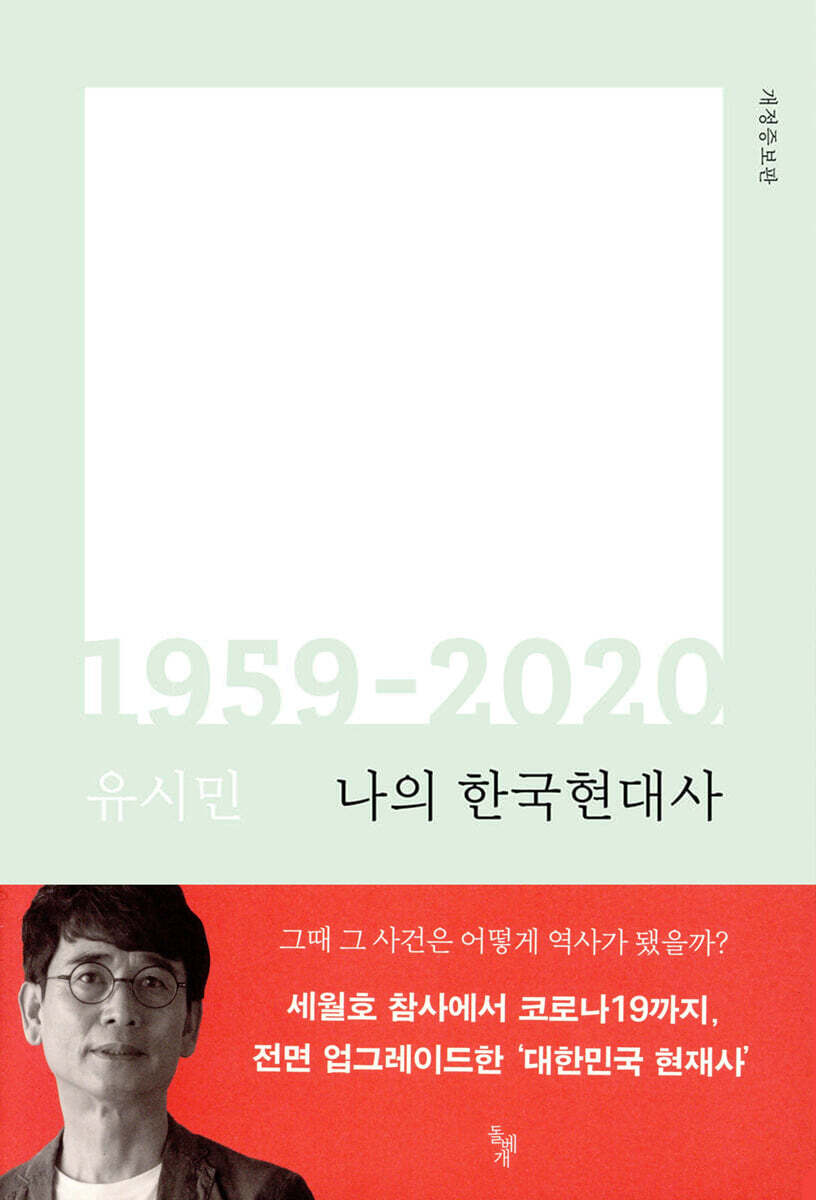
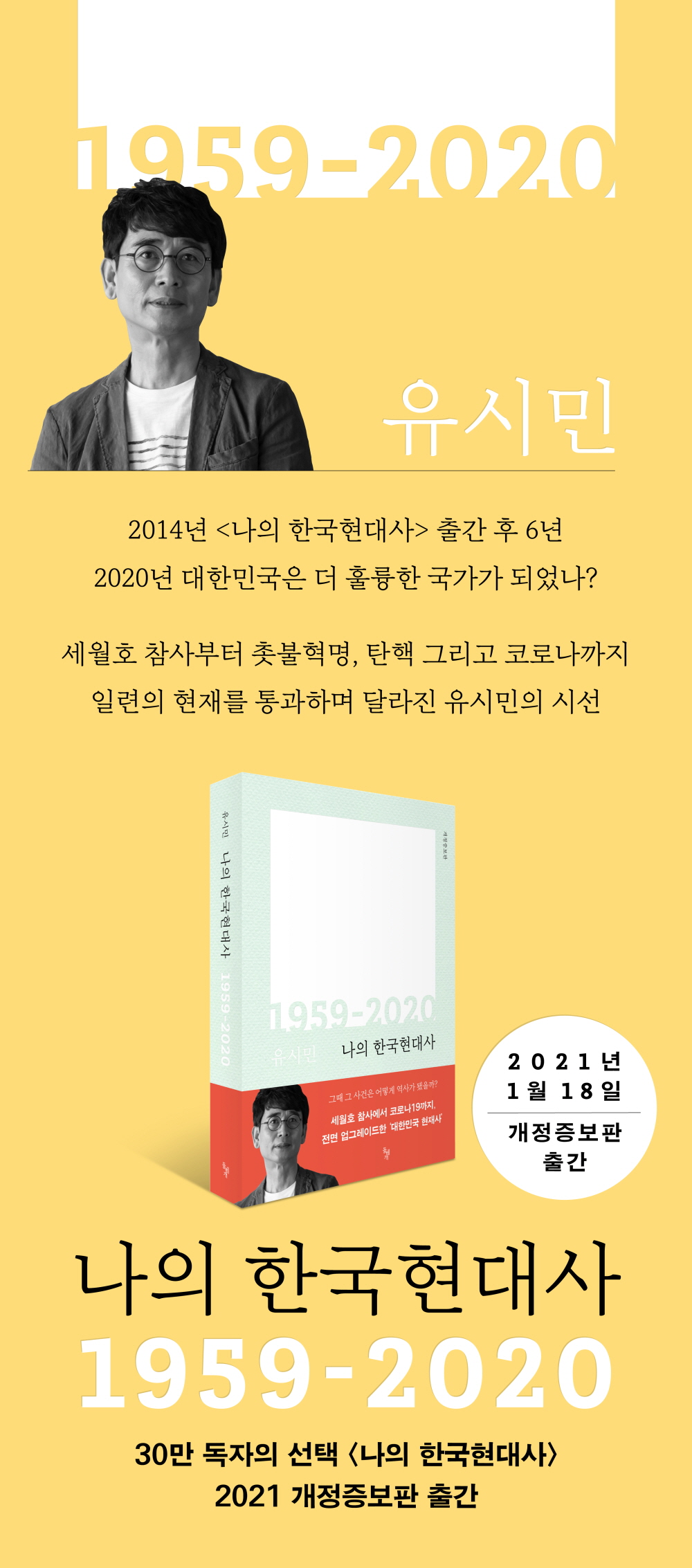
How did that incident become history? From the Sewol Ferry Disaster to COVID-19, a comprehensively updated "Current History of the Republic of Korea" Yu Si-min's "My Modern Korean History," which has captured the hearts of 300,000 readers and maintained its position as a steady seller in the history field, has returned with a revised and expanded edition after six years. While maintaining the method of recording what I saw, experienced, and felt, going back and forth between 'objective facts' and 'subjective experiences,' I completely rewrote it to include the traces of time that have passed. This is the first book to keep its promise made at the time of its initial publication to periodically supplement data and review accumulated facts. This revised and expanded edition was supplemented by utilizing various statistical data that highlighted notable events from early July 2014 to December 2020 and showed social changes such as population, national income, and income distribution. In particular, the importance of Japan's export restrictions announced on July 4, 2019, and the MeToo and disability movements that have expanded since 2016 were each given special attention. I've removed what appears to be unnecessary content at this point, reworked the overall sentence structure, and retitled most chapters and sections. Taking into account the revised and added parts, we selected and rearranged the photographic materials and gave the cover and main text a new look. The reason why Yoo Si-min poured his affection into the revised and expanded edition is simple. Because I believe that in order to understand the present and look forward to the future, we must look back at the past. If so, couldn't his attempt to repeatedly recall history and connect it to the present be called 'present history'? In fact, the book goes beyond listing events since 2014 and contains glimpses of the Republic of Korea rediscovered along the way. I hope that the joy of confirming this will reach readers who have read the first edition, and that it will serve as a useful guide for contemporary readers who have lived through turbulent times, looking back on the past. |
- You can preview some of the book's contents.
Preview
index
Preface to the Revised and Expanded Edition
Preface to the First Edition: Dangerous Modern History
Prologue: A Liberal's Historical Experience
1 South Korea in 1959 and 2020
Year of the Pig in 1959 | A Dictatorship of Uniform Poverty | A Democracy of Uneven Affluence | Prioritizing Desire | When Desire Races from Ground Zero
2 April 19 and May 16
The Division of the Nation, the Nation, and the People | The Sad End of the Special Committee on Anti-National Activities | The Rise of the Democratic Forces | The Emergence of the Industrialization Forces
3 Absolute poverty, high growth, and polarization
The Miracle on the Han River: My Witness | The Korean Economy's Flight Trajectory | State-Led Industrialization | The Secrets of Korean Economic Growth | What the IMF Crisis Left Behind | Data-Based Trends in Polarization | From Follower to Leader
4 Korean-style democratization through nationwide urban uprisings
The Algorithm of the Korean Democratization Movement | Embryonic Stage: From the May 16th Coup to the October Yushin Coup | Growth Stage 1: From the October Yushin Coup to October 26th | Growth Stage 2: From October 26th Coup to the June Democracy Movement | Maturity Stage: The Light and Shadow of the 1987 Regime
5 Monochromatic barracks into a rainbow-colored square
An Aging Republic of Korea | Family Planning and Parasite Eradication | From Barren Mountains to Brilliant Mountains | Forbidden Books, Forbidden Songs, and the National Education Charter | "Why Do We Pray for the Repose of Souls Every Day?" | From a Security State to a Welfare State | People with Disabilities, LGBTQ+ People, and Women
6 75 years of hostile coexistence
The Taboo of Red | Everyone Who's Not "On Our Side" Is "The Enemy" | A Country in Need of Spies | Four Opportunities | The Armistice Agreement and the North Korean Nuclear Issue | The Path to Peaceful Unification
Epilogue: Rediscovering South Korea
References
Preface to the First Edition: Dangerous Modern History
Prologue: A Liberal's Historical Experience
1 South Korea in 1959 and 2020
Year of the Pig in 1959 | A Dictatorship of Uniform Poverty | A Democracy of Uneven Affluence | Prioritizing Desire | When Desire Races from Ground Zero
2 April 19 and May 16
The Division of the Nation, the Nation, and the People | The Sad End of the Special Committee on Anti-National Activities | The Rise of the Democratic Forces | The Emergence of the Industrialization Forces
3 Absolute poverty, high growth, and polarization
The Miracle on the Han River: My Witness | The Korean Economy's Flight Trajectory | State-Led Industrialization | The Secrets of Korean Economic Growth | What the IMF Crisis Left Behind | Data-Based Trends in Polarization | From Follower to Leader
4 Korean-style democratization through nationwide urban uprisings
The Algorithm of the Korean Democratization Movement | Embryonic Stage: From the May 16th Coup to the October Yushin Coup | Growth Stage 1: From the October Yushin Coup to October 26th | Growth Stage 2: From October 26th Coup to the June Democracy Movement | Maturity Stage: The Light and Shadow of the 1987 Regime
5 Monochromatic barracks into a rainbow-colored square
An Aging Republic of Korea | Family Planning and Parasite Eradication | From Barren Mountains to Brilliant Mountains | Forbidden Books, Forbidden Songs, and the National Education Charter | "Why Do We Pray for the Repose of Souls Every Day?" | From a Security State to a Welfare State | People with Disabilities, LGBTQ+ People, and Women
6 75 years of hostile coexistence
The Taboo of Red | Everyone Who's Not "On Our Side" Is "The Enemy" | A Country in Need of Spies | Four Opportunities | The Armistice Agreement and the North Korean Nuclear Issue | The Path to Peaceful Unification
Epilogue: Rediscovering South Korea
References
Detailed image
Publisher's Review
What happened to us between 2014 and 2020?
The first manuscript of “My Modern Korean History” was completed immediately after the Sewol Ferry Disaster in April 2014.
At that time, Yoo Si-min wrote about the inexplicable misery in “Epilogue.”
Now, six years later, the revised and expanded edition brings us back to that place and those feelings.
But what Yoo Si-min is paying attention to is not only April 16th of that year.
This is the ‘Republic of Korea’ and ‘our lives’ that have changed through a series of events.
From the second half of 2014 to 2020, we experienced many events that brought us both joy and despair.
MERS, Choi Soon-sil's state affairs scandal, the impeachment of the president, the North-South Korea-US summit, the MeToo movement, the "Kim Yong-gyun Act," K-culture represented by [Parasite] and BTS, COVID-19...
Because it wasn't an incident that only affected one or two specific people, the process of experiencing it 'together' brought about significant changes in each person's life.
For example, the candlelight revolution and impeachment of 2016-2017 will remain special memories for most people.
Because I felt proud that I had contributed to creating a good Republic of Korea.
This is also what Yoo Si-min wants to share.
Amidst the challenges facing the world, including the COVID-19 pandemic, aging populations, climate change, and energy depletion, past experiences can serve as a small message of hope.
So, shouldn't we ask ourselves what kind of history the past six breathless years will leave behind for us? This revised and expanded edition will help us open the door to that question.
A historical guide that provides a thread of empathy across generations
Discussing modern history carries risks.
This is because it often involves current figures and deals with unfinished cases, so there are always political differences of opinion.
This book, titled ‘Modern History,’ also seems to have difficulty being free from that aspect.
Countless political events and policies, including those of past presidents, are mentioned and evaluated.
Besides, isn't the author 'Yoo Si-min'?
However, many readers who read the first edition said that they came to understand the older generation better or that the author tried not to be biased.
This was the reaction that Yoo Si-min most wanted to hear from his readers.
I hoped that modern history would open the way to comfort and empathy, rather than one that reaffirms and solidifies conflict and confrontation.
In that respect, expectations for the younger generation remain unchanged.
“If progressive change is to come to the future of the Republic of Korea, its driving force will inevitably be the higher-order desires and empathy of the younger generation.” (p. 425)
Do you not understand parents waving the Taegeukgi? Do you dislike children holding candles? If so, how can we live in this era? If you've ever asked yourself these questions, I encourage you to trust in the guide named Yoo Si-min and open this book.
In a place where prejudice and judgment stop, we may first encounter weak and small humans.
For the creation of 'My Modern Korean History' together
“My Modern Korean History” consists of six chapters.
Chapters 1 and 2 are a warm-up for the 60-year journey, starting in 1959 and ending in 2020.
The Republic of Korea is a country that, after liberation and the establishment of a government, was in the midst of absolute poverty, but achieved rapid growth and remarkable development, but has not been able to escape chronic social problems such as polarization and the chaebol economy.
In addition, as the two major forces represented by the April 19 Revolution and the May 16 Revolution (democratization and industrialization) took over power, they also followed the public's desires, giving rise to various phenomena.
This is the main framework that Yoo Si-min shows, and it remains unchanged even now.
Chapters 3 through 6 cover the 'Korean-style' economy, politics, socio-culture, and inter-Korean relations based on these unique characteristics of the Republic of Korea.
If we follow the history of each topic, we arrive at the conclusion that Yoo Si-min emphasizes.
The point is that history cannot be made alone.
The increased volume in the revised and expanded edition also proves the volume and weight of the history we have experienced and written together.
If so, couldn't we apply the property of history—that it can always be rewritten—to books? After all, in the world of books, being given new meaning depending on who reads them, when, and how they are received—that's the most common and beautiful thing about them.
I wonder what kind of readers the 2021 edition of "My Modern Korean History," which is going out into the world with a new face, will meet and live with.
The first manuscript of “My Modern Korean History” was completed immediately after the Sewol Ferry Disaster in April 2014.
At that time, Yoo Si-min wrote about the inexplicable misery in “Epilogue.”
Now, six years later, the revised and expanded edition brings us back to that place and those feelings.
But what Yoo Si-min is paying attention to is not only April 16th of that year.
This is the ‘Republic of Korea’ and ‘our lives’ that have changed through a series of events.
From the second half of 2014 to 2020, we experienced many events that brought us both joy and despair.
MERS, Choi Soon-sil's state affairs scandal, the impeachment of the president, the North-South Korea-US summit, the MeToo movement, the "Kim Yong-gyun Act," K-culture represented by [Parasite] and BTS, COVID-19...
Because it wasn't an incident that only affected one or two specific people, the process of experiencing it 'together' brought about significant changes in each person's life.
For example, the candlelight revolution and impeachment of 2016-2017 will remain special memories for most people.
Because I felt proud that I had contributed to creating a good Republic of Korea.
This is also what Yoo Si-min wants to share.
Amidst the challenges facing the world, including the COVID-19 pandemic, aging populations, climate change, and energy depletion, past experiences can serve as a small message of hope.
So, shouldn't we ask ourselves what kind of history the past six breathless years will leave behind for us? This revised and expanded edition will help us open the door to that question.
A historical guide that provides a thread of empathy across generations
Discussing modern history carries risks.
This is because it often involves current figures and deals with unfinished cases, so there are always political differences of opinion.
This book, titled ‘Modern History,’ also seems to have difficulty being free from that aspect.
Countless political events and policies, including those of past presidents, are mentioned and evaluated.
Besides, isn't the author 'Yoo Si-min'?
However, many readers who read the first edition said that they came to understand the older generation better or that the author tried not to be biased.
This was the reaction that Yoo Si-min most wanted to hear from his readers.
I hoped that modern history would open the way to comfort and empathy, rather than one that reaffirms and solidifies conflict and confrontation.
In that respect, expectations for the younger generation remain unchanged.
“If progressive change is to come to the future of the Republic of Korea, its driving force will inevitably be the higher-order desires and empathy of the younger generation.” (p. 425)
Do you not understand parents waving the Taegeukgi? Do you dislike children holding candles? If so, how can we live in this era? If you've ever asked yourself these questions, I encourage you to trust in the guide named Yoo Si-min and open this book.
In a place where prejudice and judgment stop, we may first encounter weak and small humans.
For the creation of 'My Modern Korean History' together
“My Modern Korean History” consists of six chapters.
Chapters 1 and 2 are a warm-up for the 60-year journey, starting in 1959 and ending in 2020.
The Republic of Korea is a country that, after liberation and the establishment of a government, was in the midst of absolute poverty, but achieved rapid growth and remarkable development, but has not been able to escape chronic social problems such as polarization and the chaebol economy.
In addition, as the two major forces represented by the April 19 Revolution and the May 16 Revolution (democratization and industrialization) took over power, they also followed the public's desires, giving rise to various phenomena.
This is the main framework that Yoo Si-min shows, and it remains unchanged even now.
Chapters 3 through 6 cover the 'Korean-style' economy, politics, socio-culture, and inter-Korean relations based on these unique characteristics of the Republic of Korea.
If we follow the history of each topic, we arrive at the conclusion that Yoo Si-min emphasizes.
The point is that history cannot be made alone.
The increased volume in the revised and expanded edition also proves the volume and weight of the history we have experienced and written together.
If so, couldn't we apply the property of history—that it can always be rewritten—to books? After all, in the world of books, being given new meaning depending on who reads them, when, and how they are received—that's the most common and beautiful thing about them.
I wonder what kind of readers the 2021 edition of "My Modern Korean History," which is going out into the world with a new face, will meet and live with.
GOODS SPECIFICS
- Publication date: January 18, 2021
- Page count, weight, size: 432 pages | 750g | 152*225*30mm
- ISBN13: 9788971999080
- ISBN10: 897199908X
You may also like
카테고리
korean


korean

![GQ KOREA Mark (Monthly): December [2025]](http://librairie.coreenne.fr/cdn/shop/files/8ef265dbbfbf186523ed75ba7319009d.jpg?v=1765340328&width=3840)


