

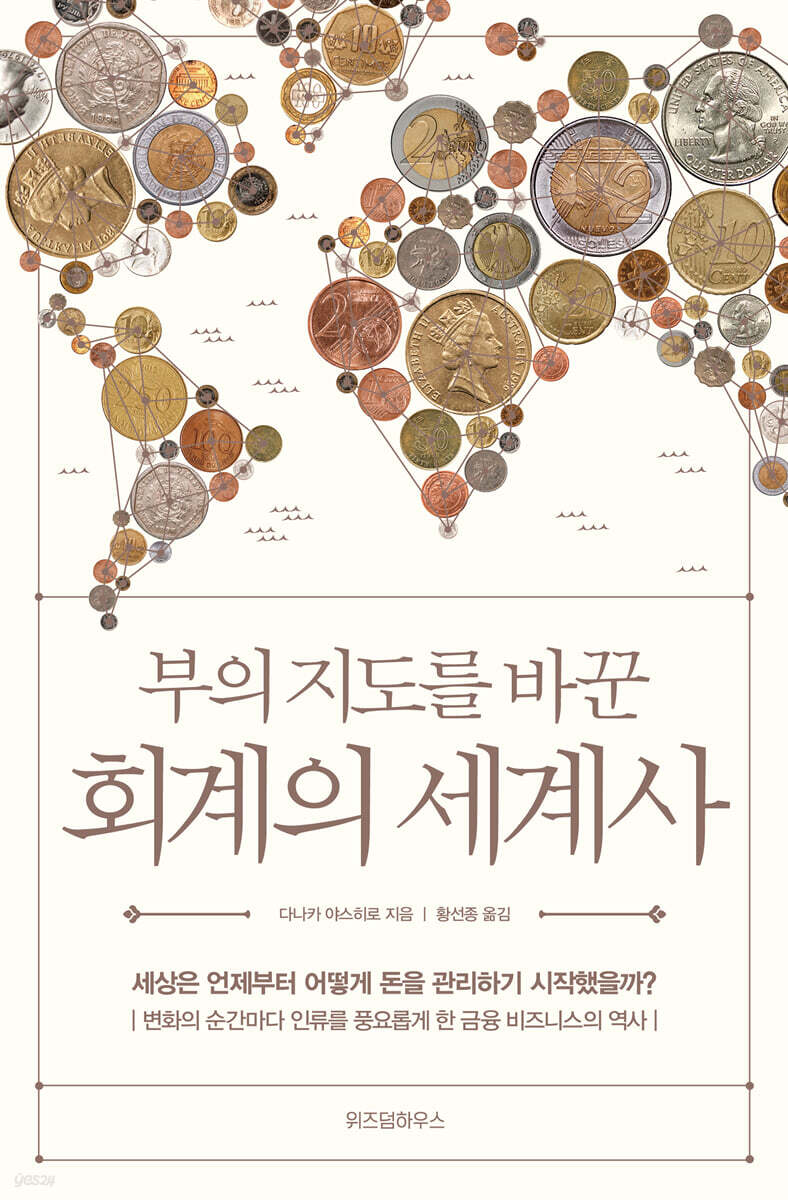
The World History of Accounting: How It Changed the Map of Wealth
 |
Description
Book Introduction
Build your accounting knowledge and culture by reading world history!
A bestseller in Japan with cumulative sales of 50,000 copies,
The world's easiest and most fun history of accounting
When we think of accounting, we usually think of complex numbers, calculations, and formulas.
Accounting, which may be unfamiliar to the general public who does not work in accounting, is actually one of the factors that has had a decisive influence on the course of history.
The origins of financial business, including accounting, began as early as medieval Europe, and individuals and nations that accumulated wealth through this began to systematize their commercial and financial systems for a prosperous future.
This book examines the history of financial business, which has enriched humanity at every moment of historical change from the 15th century to the present.
It provides an opportunity to read world history from a new perspective, such as the Banco of medieval Italy, which was created to protect merchants who had to trade by ship; the Dutch East India Company during the Renaissance, which created shareholders to build a large fleet and engage in trade; the law of depreciation, which was created to ensure the stable operation of railroad companies after the invention of the steam locomotive in the 19th century; and the secret stories of the birth of global wealthy people and companies such as Carnegie, Rockefeller, and Goldman Sachs in the 20th century.
A bestseller in Japan with cumulative sales of 50,000 copies,
The world's easiest and most fun history of accounting
When we think of accounting, we usually think of complex numbers, calculations, and formulas.
Accounting, which may be unfamiliar to the general public who does not work in accounting, is actually one of the factors that has had a decisive influence on the course of history.
The origins of financial business, including accounting, began as early as medieval Europe, and individuals and nations that accumulated wealth through this began to systematize their commercial and financial systems for a prosperous future.
This book examines the history of financial business, which has enriched humanity at every moment of historical change from the 15th century to the present.
It provides an opportunity to read world history from a new perspective, such as the Banco of medieval Italy, which was created to protect merchants who had to trade by ship; the Dutch East India Company during the Renaissance, which created shareholders to build a large fleet and engage in trade; the law of depreciation, which was created to ensure the stable operation of railroad companies after the invention of the steam locomotive in the 19th century; and the secret stories of the birth of global wealthy people and companies such as Carnegie, Rockefeller, and Goldman Sachs in the 20th century.
- You can preview some of the book's contents.
Preview
index
Welcome to the 'History of Accounting Journey'
Part 1: From Business to Finance: Bookkeeping and Stocks
Chapter 1: Becoming a Center of Mediterranean Trade and Commerce - 15th-Century Italy: The Banking Revolution
1.
Why the artist was flooded with orders for "Tobias and the Angel"
2.
Rishikare, who was active in the Mediterranean, and Banco, who helped them
3.
Banco and Bougie, who supported Italy's golden age
Chapter 2: The Medici Family Creates a Financial Network - 15th-Century Italy: The Bookkeeping Revolution
1.
A fateful encounter between Leonardo da Vinci and the 'Father of Boogie'
2.
The Renaissance supported by Cosimo de' Medici, who escaped execution
3.
The settlement method of merchants who began to keep ledgers without a notary public
4.
The demise of the Medici Bank, which faced its worst financial crisis at a crossroads in modern times.
Chapter 3: The Birth of the World's First Joint Stock Company - 17th-Century Netherlands: The Accounting Revolution
1.
A new era opens, shifting from a God-centered approach to a human-centered one.
2.
Rembrandt and the prosperity of the Netherlands in its heyday
3.
Changes in Dutch maritime trade and the emergence of unclaimed shareholders
4.
The Dutch Golden Age was short-lived due to poor management.
Part 2: From Movement to Expansion: Capital and the Enterprise
Chapter 4: The Steam Engine: Transforming British Industry - 19th-Century Britain: The Profit Revolution
1.
Coal and the steam engine: How Britain rose to become a world power.
2 .
The advent of the steam locomotive and railroad companies that changed the history of accounting.
3 .
The era of railroad enthusiasts, where opportunities and expectations for making a fortune coexisted.
4 .
The advent of depreciation and the rise of "profit" in 19th-century railroads.
Chapter 5: Crossing the Atlantic to America - 20th Century America: The Investment Revolution
1.
Immigrants and investment funds that crossed the sea to the new continent in the west
2.
New York Rhapsody on the brink of collapse, at risk of bankruptcy
3.
President Roosevelt transforms the stock market with his groundbreaking appointments.
4.
The line between public and private in asking for social responsibility
Chapter 6: Unifying Global Accounting Standards - The 21st Century Global: International Revolution
1.
The son of a locomotive driver obsessed with cars creates a dream.
2.
Britain's global strategy to achieve hegemony through shipping and IT
3.
Globalization and International Accounting Standards: Changing the Landscape of Financial Capital Markets
4.
The globalization of capital markets and investment, where borders disappear
Part 3: From Efficiency to Value: Investment and Forecasting
Chapter 7: The Logic of Capital Beginning with the Railroads - 19th-Century America: The Standards Revolution
1.
The opening of the transcontinental railroad after the Civil War connected cities.
2.
The problem of division of labor and cost accounting in mass production factories
3.
In the gold rush era, companies grew by crushing their competitors.
4.
Coca-Cola and jazz moved with the flow of money from South to North.
Chapter 8: Music and Accounting Crossover - 20th-Century America: The Management Revolution
1.
The rise of the Jazz Age, where people studied accounting during the day and enjoyed jazz at night.
2.
Segment information that promotes selection, focus, and decentralization
3.
The management accounting revolution brought about by DuPont from France
4.
Music and Accounting Crossover Begins with the Growth of the Music Industry
Chapter 9: The Power of Numbers in Investing in Future Value - 21st Century America: The Value Revolution
1.
Learning Values from Michael Jackson, the Beatles' Copyright Owner
2.
The meaning of a company's capabilities and corporate value that are not on the balance sheet
3.
Investment banks and funds are leading the new era of finance.
4.
The 21st century, a wandering age, pursuing changeable "values."
Ending the trip
Acknowledgements
References
Part 1: From Business to Finance: Bookkeeping and Stocks
Chapter 1: Becoming a Center of Mediterranean Trade and Commerce - 15th-Century Italy: The Banking Revolution
1.
Why the artist was flooded with orders for "Tobias and the Angel"
2.
Rishikare, who was active in the Mediterranean, and Banco, who helped them
3.
Banco and Bougie, who supported Italy's golden age
Chapter 2: The Medici Family Creates a Financial Network - 15th-Century Italy: The Bookkeeping Revolution
1.
A fateful encounter between Leonardo da Vinci and the 'Father of Boogie'
2.
The Renaissance supported by Cosimo de' Medici, who escaped execution
3.
The settlement method of merchants who began to keep ledgers without a notary public
4.
The demise of the Medici Bank, which faced its worst financial crisis at a crossroads in modern times.
Chapter 3: The Birth of the World's First Joint Stock Company - 17th-Century Netherlands: The Accounting Revolution
1.
A new era opens, shifting from a God-centered approach to a human-centered one.
2.
Rembrandt and the prosperity of the Netherlands in its heyday
3.
Changes in Dutch maritime trade and the emergence of unclaimed shareholders
4.
The Dutch Golden Age was short-lived due to poor management.
Part 2: From Movement to Expansion: Capital and the Enterprise
Chapter 4: The Steam Engine: Transforming British Industry - 19th-Century Britain: The Profit Revolution
1.
Coal and the steam engine: How Britain rose to become a world power.
2 .
The advent of the steam locomotive and railroad companies that changed the history of accounting.
3 .
The era of railroad enthusiasts, where opportunities and expectations for making a fortune coexisted.
4 .
The advent of depreciation and the rise of "profit" in 19th-century railroads.
Chapter 5: Crossing the Atlantic to America - 20th Century America: The Investment Revolution
1.
Immigrants and investment funds that crossed the sea to the new continent in the west
2.
New York Rhapsody on the brink of collapse, at risk of bankruptcy
3.
President Roosevelt transforms the stock market with his groundbreaking appointments.
4.
The line between public and private in asking for social responsibility
Chapter 6: Unifying Global Accounting Standards - The 21st Century Global: International Revolution
1.
The son of a locomotive driver obsessed with cars creates a dream.
2.
Britain's global strategy to achieve hegemony through shipping and IT
3.
Globalization and International Accounting Standards: Changing the Landscape of Financial Capital Markets
4.
The globalization of capital markets and investment, where borders disappear
Part 3: From Efficiency to Value: Investment and Forecasting
Chapter 7: The Logic of Capital Beginning with the Railroads - 19th-Century America: The Standards Revolution
1.
The opening of the transcontinental railroad after the Civil War connected cities.
2.
The problem of division of labor and cost accounting in mass production factories
3.
In the gold rush era, companies grew by crushing their competitors.
4.
Coca-Cola and jazz moved with the flow of money from South to North.
Chapter 8: Music and Accounting Crossover - 20th-Century America: The Management Revolution
1.
The rise of the Jazz Age, where people studied accounting during the day and enjoyed jazz at night.
2.
Segment information that promotes selection, focus, and decentralization
3.
The management accounting revolution brought about by DuPont from France
4.
Music and Accounting Crossover Begins with the Growth of the Music Industry
Chapter 9: The Power of Numbers in Investing in Future Value - 21st Century America: The Value Revolution
1.
Learning Values from Michael Jackson, the Beatles' Copyright Owner
2.
The meaning of a company's capabilities and corporate value that are not on the balance sheet
3.
Investment banks and funds are leading the new era of finance.
4.
The 21st century, a wandering age, pursuing changeable "values."
Ending the trip
Acknowledgements
References
Detailed image

Into the book
From the time of his father, Giovanni, to the time of his son, Cosimo, the Medici family expanded into various businesses, including wool, trade, and banking, and developed into one of the most prominent families not only in Florence but also in Europe.
(Omitted) There were already several bancos in Florence, and the Medici family started the banco business a little later.
The Bardi and Peruzzi families, who had previously become prominent in Florence through successful business, made a fortune in wool textiles and trade, and then entered the banking business.
(Omitted) Banco of Florence was cautious when lending money to kings or nobles.
The Medici Bank must have been fully aware of the fact that 'the king or the nobles may betray you at any time.'
---From "Chapter 2: The Medici Family Creates a Financial Network"
The profits of the VOC (Dutch East India Company) gradually decreased over a long period of time because the prices of its main products, 'spices, tea, and sugar', fell.
For products with falling prices, the only way to compete is through quantity, and as transaction volume increases, transportation and storage costs increase.
However, a segment accounting structure that calculates profit and loss for each product has not yet emerged.
By clinging to the declining profit margins of spices, they missed the opportunity to switch to silk and cotton fabrics, which had begun to gain popularity in the late 17th century, and eventually lost this field to the British.
By these points, the Netherlands had already been 'defeated in commercial activities' by the British before the Anglo-French War.
---From "Chapter 3: The Birth of the World's First Joint Stock Company"
Railway companies have a large proportion of fixed assets and need to be managed for the long term.
Like the East India Company, the railway company also had a strong public interest, so the 'government's intention' was deeply involved.
In the case of the Liverpool-Manchester Railway, the government made various demands on the debt ratio and fare determination when raising funds. The steam locomotive was not only the emergence of a new 'autonomous transportation method', but also the world's first experiment in 'how a joint stock company with many fixed assets raises and operates funds'.
Even if the steam locomotive had been technically perfected, it would not have been able to spread throughout the world without an organization to support its 'procurement and operation'.
---From Chapter 4, “Steam Engines: Transforming British Industry”
As railways became widespread, telecommunications such as wired communication, wireless communication, and radar were developed in Britain, and as telecommunications technology advanced, the communications network expanded rapidly.
By the late 20th century, computers were connected through networks, and technologies were developed to transmit information in fine-grained packets and reconstruct it at its destination.
This Internet technology has enabled us to conduct email, search for information, and conduct financial transactions over the network.
Looking at it this way, we can see that the 'two trends' of industrialization and informatization emerged from the railroad.
One is the 'industrialization' of transportation, which expanded from steam locomotives to automobiles and airplanes.
Another is 'informatization', which started with wireless signals that communicated between stations and expanded to the Internet.
---From Chapter 6, Unifying the World's Accounting Standards
American manufacturing, which values 'scale' and aims for mass production while also trying to produce at low cost, often competes with 'single items'.
It goes without saying that single items can be produced in large quantities and at low cost.
The tradition of 'single-item competition' that continued with Carnegie's steel, Rockefeller's oil, and Candler's Coca-Cola reached its peak with the Model T Ford.
Signs of change are beginning to appear in the lineage of such 'single-item businesses'.
It all started with GE, which began manufacturing home appliances. Starting with incandescent light bulbs, GE gradually expanded its product lineup to include refrigerators, microwave ovens, washing machines, and vacuum cleaners.
---From Chapter 8, "Music and Accounting, Crossover"
Throughout history and the present, various types of investments have been made in commercial transactions.
In the Mediterranean trade of the Middle Ages, investments were made in spices, and in the factories that emerged after the Industrial Revolution, investments were made in buildings and machinery.
Even Michael Jackson surprised people by investing in copyright.
Investments made by a company are recorded as 'assets' on the balance sheet.
At the top of the balance sheet are 'current assets' that can be quickly converted to cash, and at the bottom are 'fixed assets' that take time to be converted to cash.
The question is, 'How do we value such assets?'
This 'asset valuation' is the most important issue in accounting and is also not an easy problem.
(Omitted) There were already several bancos in Florence, and the Medici family started the banco business a little later.
The Bardi and Peruzzi families, who had previously become prominent in Florence through successful business, made a fortune in wool textiles and trade, and then entered the banking business.
(Omitted) Banco of Florence was cautious when lending money to kings or nobles.
The Medici Bank must have been fully aware of the fact that 'the king or the nobles may betray you at any time.'
---From "Chapter 2: The Medici Family Creates a Financial Network"
The profits of the VOC (Dutch East India Company) gradually decreased over a long period of time because the prices of its main products, 'spices, tea, and sugar', fell.
For products with falling prices, the only way to compete is through quantity, and as transaction volume increases, transportation and storage costs increase.
However, a segment accounting structure that calculates profit and loss for each product has not yet emerged.
By clinging to the declining profit margins of spices, they missed the opportunity to switch to silk and cotton fabrics, which had begun to gain popularity in the late 17th century, and eventually lost this field to the British.
By these points, the Netherlands had already been 'defeated in commercial activities' by the British before the Anglo-French War.
---From "Chapter 3: The Birth of the World's First Joint Stock Company"
Railway companies have a large proportion of fixed assets and need to be managed for the long term.
Like the East India Company, the railway company also had a strong public interest, so the 'government's intention' was deeply involved.
In the case of the Liverpool-Manchester Railway, the government made various demands on the debt ratio and fare determination when raising funds. The steam locomotive was not only the emergence of a new 'autonomous transportation method', but also the world's first experiment in 'how a joint stock company with many fixed assets raises and operates funds'.
Even if the steam locomotive had been technically perfected, it would not have been able to spread throughout the world without an organization to support its 'procurement and operation'.
---From Chapter 4, “Steam Engines: Transforming British Industry”
As railways became widespread, telecommunications such as wired communication, wireless communication, and radar were developed in Britain, and as telecommunications technology advanced, the communications network expanded rapidly.
By the late 20th century, computers were connected through networks, and technologies were developed to transmit information in fine-grained packets and reconstruct it at its destination.
This Internet technology has enabled us to conduct email, search for information, and conduct financial transactions over the network.
Looking at it this way, we can see that the 'two trends' of industrialization and informatization emerged from the railroad.
One is the 'industrialization' of transportation, which expanded from steam locomotives to automobiles and airplanes.
Another is 'informatization', which started with wireless signals that communicated between stations and expanded to the Internet.
---From Chapter 6, Unifying the World's Accounting Standards
American manufacturing, which values 'scale' and aims for mass production while also trying to produce at low cost, often competes with 'single items'.
It goes without saying that single items can be produced in large quantities and at low cost.
The tradition of 'single-item competition' that continued with Carnegie's steel, Rockefeller's oil, and Candler's Coca-Cola reached its peak with the Model T Ford.
Signs of change are beginning to appear in the lineage of such 'single-item businesses'.
It all started with GE, which began manufacturing home appliances. Starting with incandescent light bulbs, GE gradually expanded its product lineup to include refrigerators, microwave ovens, washing machines, and vacuum cleaners.
---From Chapter 8, "Music and Accounting, Crossover"
Throughout history and the present, various types of investments have been made in commercial transactions.
In the Mediterranean trade of the Middle Ages, investments were made in spices, and in the factories that emerged after the Industrial Revolution, investments were made in buildings and machinery.
Even Michael Jackson surprised people by investing in copyright.
Investments made by a company are recorded as 'assets' on the balance sheet.
At the top of the balance sheet are 'current assets' that can be quickly converted to cash, and at the bottom are 'fixed assets' that take time to be converted to cash.
The question is, 'How do we value such assets?'
This 'asset valuation' is the most important issue in accounting and is also not an easy problem.
---From Chapter 9, “The Power of Numbers in Investing in Future Value”
Publisher's Review
Across the sea, challenging a wider world
The emergence of bookkeeping and stocks, which systematized money management
It was merchants who brought prosperity to 15th-century Italy, a politically unstable country made up of small city-states.
Merchants who bought and sold Eastern goods through the Mediterranean trade were constantly exposed to dangers such as disasters and theft.
At this time, bancos were created, which made it possible to conduct commercial activities without cash.
Banko offered bills of exchange transactions, enabling merchants to use cashless services, and developed a commission business by providing currency exchange services for each city-state.
As the scale of commerce grew, systematic records became necessary, and accounting concepts such as ledgers, bookkeeping, and balance sheets emerged.
The author provides an interesting account of the life and works of Leonardo da Vinci, whose father was a notary, by linking them to the development of commerce based on the Banko era.
We also examine how commerce changed in the early modern era, including the Medici family's banking business and the beginning of a financial network that brought about the heyday of the Renaissance in the 15th and 16th centuries, the Dutch and the large-scale East India Company in the 17th and 18th centuries, and the birth of stocks, shareholders, and the stock exchange.
This confirms that the development of maritime trade systematized financial business, and that commerce centered on family and kinship led to the establishment of joint-stock companies with shareholders without connections.
How the Railway Changed Britain and America
Capital and enterprises that are gradually expanding and expanding
The invention of the steam locomotive in 19th-century Britain revolutionized the industrial landscape.
As railroad companies needed a lot of money, they changed their management to a form of dividend distribution, gathering investors and making profits.
At this time, the income statement emerged as a tool to explain to investors with a tendency toward materialism, and the accounting rule called depreciation emerged to level out profits and ensure stable distribution of dividends.
Now, the main character of accounting has changed from 'oneself (manager)' to 'others (shareholders)', and as the nature of reporting has become stronger, accounting, which was the job of accounting, has moved into the realm of accountants.
As the number of people who made profits by investing in railroad companies increased, many people rushed to invest in stocks.
From the late 19th century until the Great Depression, the New York stock market was in full swing, and stocks in new industries such as railroads, manufacturing companies, radio, and telecommunications companies attracted people's attention.
On the other hand, disorderly transactions such as fraud and insider trading were also prevalent, and to prevent these, institutions such as the U.S. Securities and Exchange Commission were created to regulate them, and accounting systems were legislated.
International accounting standards were also established to ensure that all countries could follow the standards.
As funding became more massive and stocks became more active, accounting, which had been performed 'for oneself', began to take on the role of disclosing data 'for others'.
In this rapidly changing global era, future values are crucial.
The power of numbers in investing in the invisible
Beginning in the early 20th century, American entrepreneurs, applying management and accounting techniques derived from the railroad industry, attempted mass production and merged competing companies, ushering in the era of the large corporation.
World-renowned industrialist Andrew Carnegie introduced a division of labor system in factories to create factories that even beginners could mass-produce, and oil magnate John D. Rockefeller controlled oil sales prices by implementing horizontal and vertical integration of competing companies.
Coca-Cola was the first franchise company, and General Electric began selling expensive electronics on installment plans.
This is how the management method commonly seen in today's corporate management was born.
Meanwhile, the author presents recording as a notable historical change after the 20th century.
Recording, which emerged in the early 20th century, contributed to the commercialization of live music and the creation of the concept of copyright.
The author says that we need to have the vision to invest in future value, just like Michael Jackson did when he bought the copyright to the Beatles' hit songs "Yesterday" and "Let It Be" for about 130 billion won.
Now, we must move beyond accounting, which only shows past results, and focus on new financial products such as investment banks and funds that help us invest in future value.
From the 15th century, when ledgers were born, to the present, the financial business has changed with each passing era as the flow of history has changed.
But the core of each era is that it has systematized institutions to adapt and embrace new changes that create wealth and discover future value.
For readers who need a broader perspective and their own perspective, this book will provide a new perspective.
The emergence of bookkeeping and stocks, which systematized money management
It was merchants who brought prosperity to 15th-century Italy, a politically unstable country made up of small city-states.
Merchants who bought and sold Eastern goods through the Mediterranean trade were constantly exposed to dangers such as disasters and theft.
At this time, bancos were created, which made it possible to conduct commercial activities without cash.
Banko offered bills of exchange transactions, enabling merchants to use cashless services, and developed a commission business by providing currency exchange services for each city-state.
As the scale of commerce grew, systematic records became necessary, and accounting concepts such as ledgers, bookkeeping, and balance sheets emerged.
The author provides an interesting account of the life and works of Leonardo da Vinci, whose father was a notary, by linking them to the development of commerce based on the Banko era.
We also examine how commerce changed in the early modern era, including the Medici family's banking business and the beginning of a financial network that brought about the heyday of the Renaissance in the 15th and 16th centuries, the Dutch and the large-scale East India Company in the 17th and 18th centuries, and the birth of stocks, shareholders, and the stock exchange.
This confirms that the development of maritime trade systematized financial business, and that commerce centered on family and kinship led to the establishment of joint-stock companies with shareholders without connections.
How the Railway Changed Britain and America
Capital and enterprises that are gradually expanding and expanding
The invention of the steam locomotive in 19th-century Britain revolutionized the industrial landscape.
As railroad companies needed a lot of money, they changed their management to a form of dividend distribution, gathering investors and making profits.
At this time, the income statement emerged as a tool to explain to investors with a tendency toward materialism, and the accounting rule called depreciation emerged to level out profits and ensure stable distribution of dividends.
Now, the main character of accounting has changed from 'oneself (manager)' to 'others (shareholders)', and as the nature of reporting has become stronger, accounting, which was the job of accounting, has moved into the realm of accountants.
As the number of people who made profits by investing in railroad companies increased, many people rushed to invest in stocks.
From the late 19th century until the Great Depression, the New York stock market was in full swing, and stocks in new industries such as railroads, manufacturing companies, radio, and telecommunications companies attracted people's attention.
On the other hand, disorderly transactions such as fraud and insider trading were also prevalent, and to prevent these, institutions such as the U.S. Securities and Exchange Commission were created to regulate them, and accounting systems were legislated.
International accounting standards were also established to ensure that all countries could follow the standards.
As funding became more massive and stocks became more active, accounting, which had been performed 'for oneself', began to take on the role of disclosing data 'for others'.
In this rapidly changing global era, future values are crucial.
The power of numbers in investing in the invisible
Beginning in the early 20th century, American entrepreneurs, applying management and accounting techniques derived from the railroad industry, attempted mass production and merged competing companies, ushering in the era of the large corporation.
World-renowned industrialist Andrew Carnegie introduced a division of labor system in factories to create factories that even beginners could mass-produce, and oil magnate John D. Rockefeller controlled oil sales prices by implementing horizontal and vertical integration of competing companies.
Coca-Cola was the first franchise company, and General Electric began selling expensive electronics on installment plans.
This is how the management method commonly seen in today's corporate management was born.
Meanwhile, the author presents recording as a notable historical change after the 20th century.
Recording, which emerged in the early 20th century, contributed to the commercialization of live music and the creation of the concept of copyright.
The author says that we need to have the vision to invest in future value, just like Michael Jackson did when he bought the copyright to the Beatles' hit songs "Yesterday" and "Let It Be" for about 130 billion won.
Now, we must move beyond accounting, which only shows past results, and focus on new financial products such as investment banks and funds that help us invest in future value.
From the 15th century, when ledgers were born, to the present, the financial business has changed with each passing era as the flow of history has changed.
But the core of each era is that it has systematized institutions to adapt and embrace new changes that create wealth and discover future value.
For readers who need a broader perspective and their own perspective, this book will provide a new perspective.
GOODS SPECIFICS
- Date of publication: June 28, 2019
- Page count, weight, size: 400 pages | 516g | 142*210*27mm
- ISBN13: 9791190182430
- ISBN10: 1190182432
You may also like
카테고리
korean


korean

![GQ KOREA Mark (Monthly): December [2025]](http://librairie.coreenne.fr/cdn/shop/files/8ef265dbbfbf186523ed75ba7319009d.jpg?v=1765340328&width=3840)


