

The joy of enduring life
 |
Description
Book Introduction
Now that we are going through difficult times,
The Joy of Enduring Life, What We Need Most
A feast of sentences like the light of a lighthouse illuminating the night
Following Hermann Hesse's collection of essays, "Longing Drives Me," which contained passionate confessions about hometown, nature, and art, "The Joy of Enduring Life," which sublimates his loneliness and pain into art, has been published along with his handwritten notes.
In the manuscript notes, readers can find Hesse's beloved sentences.
The wonderful and affectionate words Hesse offers to us who are going through difficult times for our own reasons will become a joy that helps us endure life.
Hesse achieved remarkable honors as a writer, including winning both the Nobel Prize in Literature and the Goethe Prize in 1946.
However, while engaging in anti-war activities against his homeland, Germany, he was subjected to all kinds of criticism from fellow Germans.
On a personal level, his wife suffered from mental illness, and Hesse himself had a difficult life, suffering from suicidal impulses from a young age due to his sensitive sensibilities.
Nevertheless, Hesse did not give in to any hardship, but looked at the world with a childlike purity, felt pain, and tasted happiness.
He also expressed his experiences through writing and drawing in various genres, including essays, fairy tales, and poetry.
His works still bring us joy today.
Psychologist Carl Gustav Jung praised his writings as "a lighthouse beacon on a stormy night."
As the saying goes, Hesse's writings, which sparkle with hope and enlightenment even amidst all kinds of hardship and depression, serve as a beacon that illuminates our lives.
While reading this book, readers will experience the existential wonder that affirms life itself.
The Joy of Enduring Life, What We Need Most
A feast of sentences like the light of a lighthouse illuminating the night
Following Hermann Hesse's collection of essays, "Longing Drives Me," which contained passionate confessions about hometown, nature, and art, "The Joy of Enduring Life," which sublimates his loneliness and pain into art, has been published along with his handwritten notes.
In the manuscript notes, readers can find Hesse's beloved sentences.
The wonderful and affectionate words Hesse offers to us who are going through difficult times for our own reasons will become a joy that helps us endure life.
Hesse achieved remarkable honors as a writer, including winning both the Nobel Prize in Literature and the Goethe Prize in 1946.
However, while engaging in anti-war activities against his homeland, Germany, he was subjected to all kinds of criticism from fellow Germans.
On a personal level, his wife suffered from mental illness, and Hesse himself had a difficult life, suffering from suicidal impulses from a young age due to his sensitive sensibilities.
Nevertheless, Hesse did not give in to any hardship, but looked at the world with a childlike purity, felt pain, and tasted happiness.
He also expressed his experiences through writing and drawing in various genres, including essays, fairy tales, and poetry.
His works still bring us joy today.
Psychologist Carl Gustav Jung praised his writings as "a lighthouse beacon on a stormy night."
As the saying goes, Hesse's writings, which sparkle with hope and enlightenment even amidst all kinds of hardship and depression, serve as a beacon that illuminates our lives.
While reading this book, readers will experience the existential wonder that affirms life itself.
- You can preview some of the book's contents.
Preview
index
Part 1: The Voice of the Soul
Little Joys 12
Never forget 22
The Aesthetics of Idleness 24
Beautiful Today 40
Sleepless Night 42
Dream 52
Inner Riches 54
Night Greetings 60
Lonely Night 62
March 68: Leaving in the Midnight
Old Music 70
Walking Alone 81
Part 2: Unconditional Happiness
City 84
Relationship 94
Are you really happy 96
Happiness 102
Unique Ability 104
A Diary 106
To me, both are the same story 118
Artists and Psychologist 120
Running without stopping 132
Cloudy Sky 134
Do you know that too? 141
Overcoming Fear 142
Letter to a Friend in Difficult Times 154
Always Cultivating a New Self 156
A Fairy Tale - The Perilous Road 168
Part 3: The True Beauty of Life
Hospital Diary 184
Meditation 230
All kinds of death 238
Whistling 240
Life Affirmation 242
Embracing Life 246
Psychology 255
What We Lack 257
The Poet's Hymn to Death 259
Trying the Impossible Again 261
Somewhere 266
Lament 268
Summer Train Journey 270
What We Don't Know 280
Fireworks 281
Night's Reflections 293
The Ability to Rejoice 298
Blue Butterfly 301
Secrets of a Beautiful Life 302
305 Rising and Falling Sounds
Goodbye World 306
Translator's Note 308
Hermann Hesse Chronology 311
The Joy of Enduring Life, Notes 313
Little Joys 12
Never forget 22
The Aesthetics of Idleness 24
Beautiful Today 40
Sleepless Night 42
Dream 52
Inner Riches 54
Night Greetings 60
Lonely Night 62
March 68: Leaving in the Midnight
Old Music 70
Walking Alone 81
Part 2: Unconditional Happiness
City 84
Relationship 94
Are you really happy 96
Happiness 102
Unique Ability 104
A Diary 106
To me, both are the same story 118
Artists and Psychologist 120
Running without stopping 132
Cloudy Sky 134
Do you know that too? 141
Overcoming Fear 142
Letter to a Friend in Difficult Times 154
Always Cultivating a New Self 156
A Fairy Tale - The Perilous Road 168
Part 3: The True Beauty of Life
Hospital Diary 184
Meditation 230
All kinds of death 238
Whistling 240
Life Affirmation 242
Embracing Life 246
Psychology 255
What We Lack 257
The Poet's Hymn to Death 259
Trying the Impossible Again 261
Somewhere 266
Lament 268
Summer Train Journey 270
What We Don't Know 280
Fireworks 281
Night's Reflections 293
The Ability to Rejoice 298
Blue Butterfly 301
Secrets of a Beautiful Life 302
305 Rising and Falling Sounds
Goodbye World 306
Translator's Note 308
Hermann Hesse Chronology 311
The Joy of Enduring Life, Notes 313
Detailed image

Into the book
A prisoner who walks to work muttering a good verse or humming a beautiful tune is someone who has something beautiful deep within him, rather than someone who is exhausted in body and mind by the splendid beauty and sweet temptations that are everywhere.
---From "Inner Wealth"
The organ sounded loud and powerful.
The sound instantly filled the vast space and surrounded us, forming a single space.
Then it would grow louder and then pause for a moment, and then other sounds would follow it, and then suddenly all the sounds would sound like they were falling off a cliff, or like they were praying earnestly, or like they were stubbornly trying to hold on, and then before they knew it, they were in harmony with the other sounds.
---From "Old Music"
So love the pain.
Don't reject it, don't run away! Don't accept it reluctantly, but taste the sweetness that lies within its secret depths.
It is not something else that causes pain.
The heart that rejects it will only cause you pain.
If you are with it, pain is not pain and death is not death.
Incline your ear and listen carefully to the sounds they make.
You'll find that it's great music.
---From "A Diary"
Humans can ultimately neither become 'healthy' nor free from suffering.
Of course, it's rare for me to have a day without pain.
Yet, we begin to be curious again about what lies ahead and fall in love with destiny.
---From "Always Cultivating a New Self"
The artist's final destination and goal is no longer the act of art or the work itself, but rather the act of forgetting and renouncing oneself, sacrificing the ego that is always suffering and narrow-minded, obsessed with complexes, in order to enjoy a peaceful and dignified existence.
---From "Sickbed Diary"
The train, now slowing down, will soon stop at an unknown station whose signs will be unreadable due to the smoke it is emitting.
I don't care what the town's name is, I'll get off.
And somewhere nearby you will surely find a forest, and you will be able to lie down at its edge and look at the clouds.
You might also find a stream somewhere nearby, where you can cool your face and watch the trout swimming around.
---From "Inner Wealth"
The organ sounded loud and powerful.
The sound instantly filled the vast space and surrounded us, forming a single space.
Then it would grow louder and then pause for a moment, and then other sounds would follow it, and then suddenly all the sounds would sound like they were falling off a cliff, or like they were praying earnestly, or like they were stubbornly trying to hold on, and then before they knew it, they were in harmony with the other sounds.
---From "Old Music"
So love the pain.
Don't reject it, don't run away! Don't accept it reluctantly, but taste the sweetness that lies within its secret depths.
It is not something else that causes pain.
The heart that rejects it will only cause you pain.
If you are with it, pain is not pain and death is not death.
Incline your ear and listen carefully to the sounds they make.
You'll find that it's great music.
---From "A Diary"
Humans can ultimately neither become 'healthy' nor free from suffering.
Of course, it's rare for me to have a day without pain.
Yet, we begin to be curious again about what lies ahead and fall in love with destiny.
---From "Always Cultivating a New Self"
The artist's final destination and goal is no longer the act of art or the work itself, but rather the act of forgetting and renouncing oneself, sacrificing the ego that is always suffering and narrow-minded, obsessed with complexes, in order to enjoy a peaceful and dignified existence.
---From "Sickbed Diary"
The train, now slowing down, will soon stop at an unknown station whose signs will be unreadable due to the smoke it is emitting.
I don't care what the town's name is, I'll get off.
And somewhere nearby you will surely find a forest, and you will be able to lie down at its edge and look at the clouds.
You might also find a stream somewhere nearby, where you can cool your face and watch the trout swimming around.
---From "A Summer Train Journey"
Publisher's Review
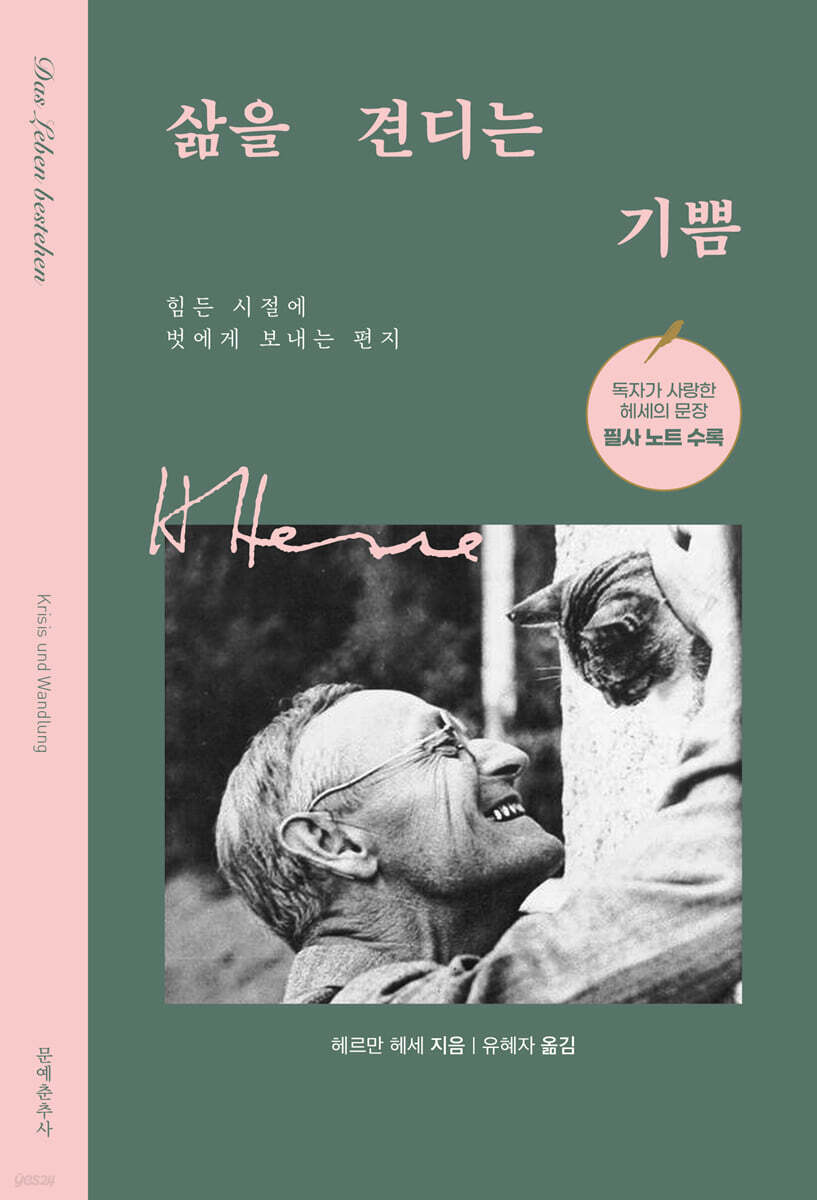
Looking at his transparent smile
Hesse's smile is transparent.
His simple smile, as if liberated, like that of an old monk who has practiced Taoism all his life, makes us forget for a moment that he is a great writer who won the Nobel Prize in Literature.
Where did that unadorned smile come from? Perhaps it stems from long reflections on life and suffering.
Born in 1877 as the eldest son of a German Protestant pastor, Hermann Hesse enjoyed a glorious life as a writer, but his personal life was dark.
As is well known, he suffered from a sensitive personality and suicidal impulses as a child, his wife suffered from mental illness, and during World War II, he participated in an anti-war movement against his home country (Germany) and was criticized by his own countrymen.
A life stained with pain and sorrow like this irritated Hesse's already sensitive nerves.
This is why the essays in this book are generally calm, melancholic, and sometimes passionate.
Fortunately, Hesse, who possessed the sensibility of a painter and the reason of a writer, did not ignore or distort the suffering of life, nor was he overcome by it.
Rather, like a genius artist, he transformed depression into the courage to endlessly challenge life through writing, painting, and traveling.
Pain and Happiness, the Two Pillars of Life
Hesse used the trivial aspects of his daily life as material to deeply contemplate happiness and suffering, life and death.
Hesse finds suffering in things that seem insignificant to us—a dream he had last night, a sneak peek at a reading of his work, a beautiful concert, letters from readers—and constantly ponders what torments him.
Every time he finishes thinking, he suddenly realizes something.
Suffering is a process towards blessing, and blessing is also a process towards suffering.
Ultimately, happiness and suffering are the two pillars that support our lives.
People usually struggle to escape from pain, but the more they do, the more excruciating the pain becomes.
Hesse, in a gentle yet firm tone, quietly extends a helping hand to those in pain, saying, "Pain can make people soft and hard as steel."
According to the truth Hesse discovered, all suffering has a limit, and when it reaches that limit, it either ends or transforms into something else, taking on the color of life.
His image of melting all kinds of suffering into words and pictures and creating new life and hope comes to us, who are depressed by all the world's problems, as the 'joy of enduring life' itself.
A contemplative journey to discover the true beauty of life.
This book contains 48 essays that serve as a mirror reflecting Hesse's deep inner thoughts.
As you enjoy the simple writing and the beautiful Swiss mountain scenery together, you will come to understand what 'unconditional happiness' is.
I recommend this book to anyone who is tired of living a fleeting, cruel, foolish, and yet glamorous life, and is struggling to read it in silence.
And I hope you will take a journey through the river of reflection with the author, who, like ordinary people, has fallen into despair in life and then tried to find meaning in it.
In the meantime, you can learn a lesson from Hermann Hesse, who embraced life as it is, without pretense or pretense.
Hesse's smile is transparent.
His simple smile, as if liberated, like that of an old monk who has practiced Taoism all his life, makes us forget for a moment that he is a great writer who won the Nobel Prize in Literature.
Where did that unadorned smile come from? Perhaps it stems from long reflections on life and suffering.
Born in 1877 as the eldest son of a German Protestant pastor, Hermann Hesse enjoyed a glorious life as a writer, but his personal life was dark.
As is well known, he suffered from a sensitive personality and suicidal impulses as a child, his wife suffered from mental illness, and during World War II, he participated in an anti-war movement against his home country (Germany) and was criticized by his own countrymen.
A life stained with pain and sorrow like this irritated Hesse's already sensitive nerves.
This is why the essays in this book are generally calm, melancholic, and sometimes passionate.
Fortunately, Hesse, who possessed the sensibility of a painter and the reason of a writer, did not ignore or distort the suffering of life, nor was he overcome by it.
Rather, like a genius artist, he transformed depression into the courage to endlessly challenge life through writing, painting, and traveling.
Pain and Happiness, the Two Pillars of Life
Hesse used the trivial aspects of his daily life as material to deeply contemplate happiness and suffering, life and death.
Hesse finds suffering in things that seem insignificant to us—a dream he had last night, a sneak peek at a reading of his work, a beautiful concert, letters from readers—and constantly ponders what torments him.
Every time he finishes thinking, he suddenly realizes something.
Suffering is a process towards blessing, and blessing is also a process towards suffering.
Ultimately, happiness and suffering are the two pillars that support our lives.
People usually struggle to escape from pain, but the more they do, the more excruciating the pain becomes.
Hesse, in a gentle yet firm tone, quietly extends a helping hand to those in pain, saying, "Pain can make people soft and hard as steel."
According to the truth Hesse discovered, all suffering has a limit, and when it reaches that limit, it either ends or transforms into something else, taking on the color of life.
His image of melting all kinds of suffering into words and pictures and creating new life and hope comes to us, who are depressed by all the world's problems, as the 'joy of enduring life' itself.
A contemplative journey to discover the true beauty of life.
This book contains 48 essays that serve as a mirror reflecting Hesse's deep inner thoughts.
As you enjoy the simple writing and the beautiful Swiss mountain scenery together, you will come to understand what 'unconditional happiness' is.
I recommend this book to anyone who is tired of living a fleeting, cruel, foolish, and yet glamorous life, and is struggling to read it in silence.
And I hope you will take a journey through the river of reflection with the author, who, like ordinary people, has fallen into despair in life and then tried to find meaning in it.
In the meantime, you can learn a lesson from Hermann Hesse, who embraced life as it is, without pretense or pretense.
GOODS SPECIFICS
- Date of issue: February 28, 2024
- Page count, weight, size: 336 pages | 348g | 128*188*17mm
- ISBN13: 9788976046529
- ISBN10: 8976046528
You may also like
카테고리
korean


korean

![GQ KOREA Mark (Monthly): December [2025]](http://librairie.coreenne.fr/cdn/shop/files/8ef265dbbfbf186523ed75ba7319009d.jpg?v=1765340328&width=3840)


