

Necropolitics
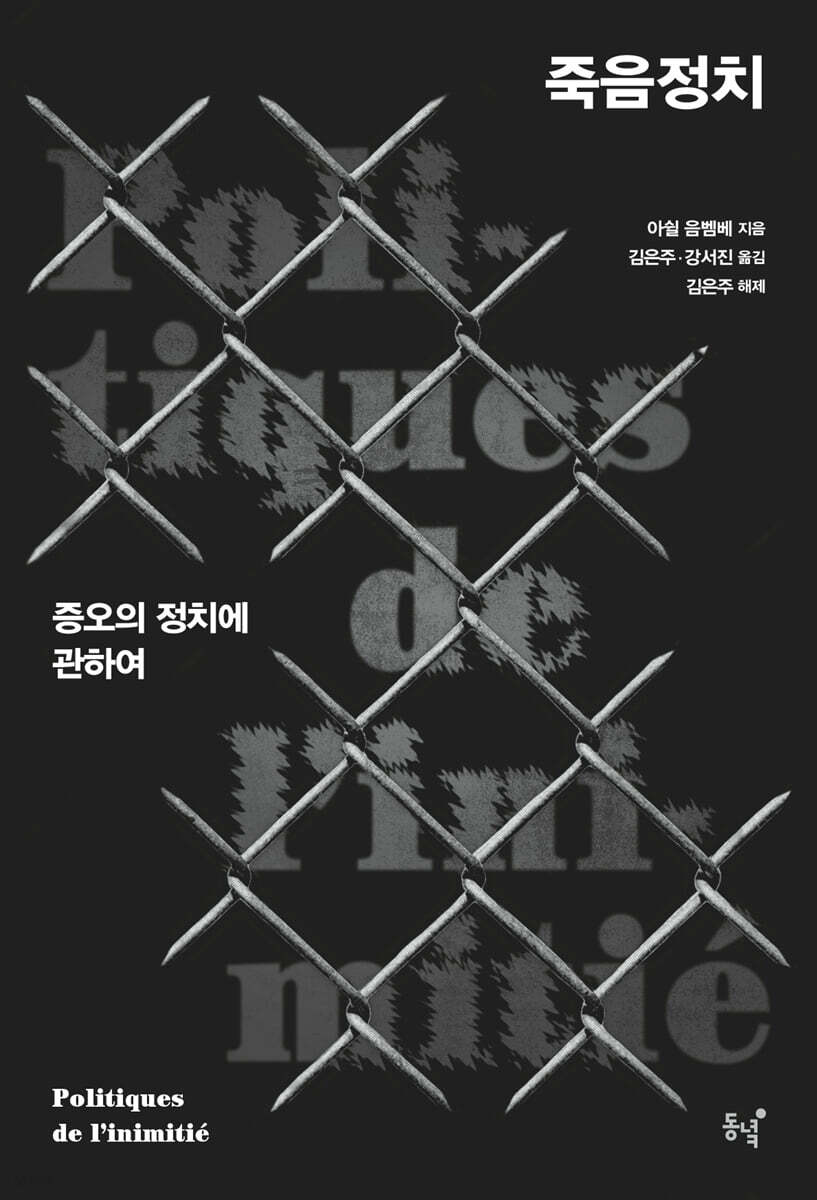 |
Description
Book Introduction
- A word from MD
-
Modern sovereignty was a killing force.A major work by Ashiele Mbembe, a Cameroonian political philosopher and historian.
Imperialism, Auschwitz, and other modern history have also been stories of mass murder.
In these divisive times, it is time to critically examine human civilization once again.
September 24, 2025. Min-gyu Son, Social and Political PD
At the forefront of contemporary critical thought: Ashile Mbembe's Necropolitics
The publication of Necropolitics, a major work by Cameroonian political philosopher and historian Ashiele Mbembe, who is considered an intellectual at the forefront of contemporary critical theory, has been published.
Mbembe has served as an assistant professor of history at Columbia University, an assistant professor at the University of Pennsylvania, and the secretary general of the Council for the Study of Social Sciences in Africa (CODESRIA). He currently holds a position at the Institute of Social and Economic Research at the University of the Witwatersrand in South Africa, and is a vocal advocate in academic and public forums around the world.
He has received several awards for his scholarly contributions, most notably the 2024 Holberg Prize, often called the Nobel Prize in the Humanities.
His theories, which expand the discourse of postcolonialism, critical theory, and biopolitics based on the experiences of the African continent and the legacy of colonialism, are widely cited in various fields such as postcolonial discourse, African studies, political philosophy, gender and queer theory, and art theory.
《Necropolitics》 is a book that represents the ideological trajectory of Ashil Mbembe, and reveals how the politics of regression, departure, violence, exclusion, separation, disgust, and hatred of contemporary democracy have been operating.
In particular, in the postcolonial context, he critically read and expanded upon Foucault's biopolitics and Schmitt and Agamben's state of exception, establishing and expanding the concept of 'necropolitics' in this book, shaking up the world's intellectual community.
(This book is a Korean translation of the French version of 《Politiques de l'inimitie (Politics of Hatred)》(2016), but at the author's request, the author's English paper 〈Necropolitics (Death Politics)〉(2003) was inserted.
The concept of 'necropolitics' was formalized in this paper published before the publication of the original book, and this paper is also included in the English version of this book published in 2019, which is titled 《Necropolitics》 after this paper. Furthermore, this book, relying on Frantz Fanon, proposes a planetary ethical and political alternative in vulnerability and finitude.
Judith Butler describes this book as “tracing the pernicious legacy of sovereign power.
Mbembe proposes a new global ethics based on global resistance against the spread of the dead world,” said Arjun Appadurai, adding that the book “firmly establishes Mbembe as one of the most important humanistic thinkers in today’s world studying sovereignty, democracy, migration, and war.”
The publication of Necropolitics, a major work by Cameroonian political philosopher and historian Ashiele Mbembe, who is considered an intellectual at the forefront of contemporary critical theory, has been published.
Mbembe has served as an assistant professor of history at Columbia University, an assistant professor at the University of Pennsylvania, and the secretary general of the Council for the Study of Social Sciences in Africa (CODESRIA). He currently holds a position at the Institute of Social and Economic Research at the University of the Witwatersrand in South Africa, and is a vocal advocate in academic and public forums around the world.
He has received several awards for his scholarly contributions, most notably the 2024 Holberg Prize, often called the Nobel Prize in the Humanities.
His theories, which expand the discourse of postcolonialism, critical theory, and biopolitics based on the experiences of the African continent and the legacy of colonialism, are widely cited in various fields such as postcolonial discourse, African studies, political philosophy, gender and queer theory, and art theory.
《Necropolitics》 is a book that represents the ideological trajectory of Ashil Mbembe, and reveals how the politics of regression, departure, violence, exclusion, separation, disgust, and hatred of contemporary democracy have been operating.
In particular, in the postcolonial context, he critically read and expanded upon Foucault's biopolitics and Schmitt and Agamben's state of exception, establishing and expanding the concept of 'necropolitics' in this book, shaking up the world's intellectual community.
(This book is a Korean translation of the French version of 《Politiques de l'inimitie (Politics of Hatred)》(2016), but at the author's request, the author's English paper 〈Necropolitics (Death Politics)〉(2003) was inserted.
The concept of 'necropolitics' was formalized in this paper published before the publication of the original book, and this paper is also included in the English version of this book published in 2019, which is titled 《Necropolitics》 after this paper. Furthermore, this book, relying on Frantz Fanon, proposes a planetary ethical and political alternative in vulnerability and finitude.
Judith Butler describes this book as “tracing the pernicious legacy of sovereign power.
Mbembe proposes a new global ethics based on global resistance against the spread of the dead world,” said Arjun Appadurai, adding that the book “firmly establishes Mbembe as one of the most important humanistic thinkers in today’s world studying sovereignty, democracy, migration, and war.”
- You can preview some of the book's contents.
Preview
index
Introduction: Trials of the World 6
Acknowledgments 19
Chapter 1: Departure from Democracy 21
Chapter 2: Society of Hatred 81
Chapter 3: Necropolitics 125
Chapter 4: Fanon's Pharmacy 179
Chapter 5: A Breathtaking Midday 251
Conclusion: Ethics of the Pedestrian 295
Release: Necropolitics: On Democracy and the Politics of Hate 305
Acknowledgments 19
Chapter 1: Departure from Democracy 21
Chapter 2: Society of Hatred 81
Chapter 3: Necropolitics 125
Chapter 4: Fanon's Pharmacy 179
Chapter 5: A Breathtaking Midday 251
Conclusion: Ethics of the Pedestrian 295
Release: Necropolitics: On Democracy and the Politics of Hate 305
Detailed image

Into the book
“Mbembe’s work goes beyond simply analyzing colonialism; it becomes a crucial turning point for thinking about inequality, data colonialism, war and occupation, pandemics, and the climate crisis in the planetary age.
Necropolitics prompts reflection on the "human condition" of the planetary age, a concept that remains urgently needed in situations such as the Israeli occupation of Palestine, the refugee crisis, the digital surveillance society, and the climate crisis.
This is particularly timely in our time of hardening borders, the spectre of fascism, the rise of far-right populism, the retreat of democracy, and the questioning and reimagining of 'democracy' in the face of the climate crisis as a planetary event.”
--- From "Release"
This is clearly not broadening the circle of inclusion.
Rather, borders are becoming primal, meant to keep away enemies, invaders, strangers—everyone who is not us.
In a world where mobility is more unequally redistributed than ever before, and where, for many, movement and wandering are the only means of survival, the brutality of borders has become a fundamental reality of our time.
The border is no longer a place to cross, but a line that separates.
In this reduced and militarized space, everything must stop moving.
Many people lose their lives in it.
They are lost, electrocuted, or forcibly deported.
--- p.9~10
Almost everywhere the law of blood, the law of retribution (the law of talion), and the obligations of race are resurfacing.
These three are the two core complementary elements that constitute primitive nationalism, and they are reappearing in our times.
Violence, which had been somewhat hidden within democracy, is now rising to the surface, creating a death spiral that tightens the imagination, and it is becoming increasingly difficult to escape from this spiral.
Today's political order is almost everywhere reorganized into organizations for death.
--- p.15
The colonial world, a product of democracy, was not the antithesis of the democratic order.
It has always been the face of democracy, or the face of the night.
There is no democracy, whatever its name or structure, that does not have its own colonies.
Colonies are not outside democracy.
It doesn't necessarily have to be outside the fence.
Just as colonies often harbor democracy in disguise, democracy harbors colonies within itself.
--- p.56~57
In this age when the psychological life of the nation is depressed, the desire for an enemy, or even the impulse to an enemy, is no longer merely a social demand.
It corresponds to an ontological need that is almost anal.
In a context of heightened mimetic competition fueled by the "War on Terror," disposing of one's enemies—especially in a spectacular manner—has become an inevitable rite of passage for establishing one's subjectivity and entering the symbolic realm of our time.
Moreover, everything happens as if the absence of the enemy is itself experienced as a deep wound of narcissism.
To have no enemies? Or to have never experienced attacks or other atrocities committed by those who oppose us and our way of life? This ultimately means being deprived of a kind of hostility that allows all sorts of desires that would otherwise be forbidden to burst forth.
--- p.94~95
Nanoracism has become an indispensable complement to hydraulic racism.
It is the racism of micro, macro, judicial-bureaucratic, and institutional devices, and the racism of the state machine.
This machine mercilessly treats illegal immigrants and illegals, continuously confining them to detention centers on the outskirts of the city like a pile of unmatched goods, and mass-producing 'people without papers [illegal immigrants]' as if scooping them out with a shovel.
The machine simultaneously expels people from the territory, shocks them at the border, and otherwise simply accepts [refugee boats] wrecked on the high seas.
This machine indiscriminately searches faces on buses, in airport terminals, underground, and on the streets; it rips off Muslim women's veils and hurls them with force; it expands detention and detention centers and transit camps; it invests lavishly in deportation technologies; it discriminates and segregates in broad daylight, all the while swearing to the neutrality and impartiality of a secular, republican state indifferent to difference.
--- p.113~114
I have argued that the concept of biopower is inadequate to explain contemporary forms of subordination of life to the power of death.
Furthermore, I proposed the concept of necropolitics and death power.
This is to illustrate the various ways in which weapons are deployed in the contemporary world, driven by vested interests that seek to destroy people as much as possible and create death-worlds.
At this time, the world of the dead is a new, unique form of social existence, in which large numbers of people are forced to be subject to conditions of life that confer upon them the status of the living dead.
--- p.316
Ultimately, not belonging to any specific place is what constitutes 'human uniqueness.'
Because humans are a composite of other living beings and other species, and they belong together in all places.
Learning to move constantly from one place to another must be a human task, because it is human destiny anyway.
But moving from one place to another also means weaving together a dual relationship of solidarity and distance with each place.
Let us call this experience of presence and distance, of solidarity and distance, but never of indifference, the ethics of the passerby.
It is an ethic that says that only when we distance ourselves from a place can we give it a better name and better inhabit it.
Necropolitics prompts reflection on the "human condition" of the planetary age, a concept that remains urgently needed in situations such as the Israeli occupation of Palestine, the refugee crisis, the digital surveillance society, and the climate crisis.
This is particularly timely in our time of hardening borders, the spectre of fascism, the rise of far-right populism, the retreat of democracy, and the questioning and reimagining of 'democracy' in the face of the climate crisis as a planetary event.”
--- From "Release"
This is clearly not broadening the circle of inclusion.
Rather, borders are becoming primal, meant to keep away enemies, invaders, strangers—everyone who is not us.
In a world where mobility is more unequally redistributed than ever before, and where, for many, movement and wandering are the only means of survival, the brutality of borders has become a fundamental reality of our time.
The border is no longer a place to cross, but a line that separates.
In this reduced and militarized space, everything must stop moving.
Many people lose their lives in it.
They are lost, electrocuted, or forcibly deported.
--- p.9~10
Almost everywhere the law of blood, the law of retribution (the law of talion), and the obligations of race are resurfacing.
These three are the two core complementary elements that constitute primitive nationalism, and they are reappearing in our times.
Violence, which had been somewhat hidden within democracy, is now rising to the surface, creating a death spiral that tightens the imagination, and it is becoming increasingly difficult to escape from this spiral.
Today's political order is almost everywhere reorganized into organizations for death.
--- p.15
The colonial world, a product of democracy, was not the antithesis of the democratic order.
It has always been the face of democracy, or the face of the night.
There is no democracy, whatever its name or structure, that does not have its own colonies.
Colonies are not outside democracy.
It doesn't necessarily have to be outside the fence.
Just as colonies often harbor democracy in disguise, democracy harbors colonies within itself.
--- p.56~57
In this age when the psychological life of the nation is depressed, the desire for an enemy, or even the impulse to an enemy, is no longer merely a social demand.
It corresponds to an ontological need that is almost anal.
In a context of heightened mimetic competition fueled by the "War on Terror," disposing of one's enemies—especially in a spectacular manner—has become an inevitable rite of passage for establishing one's subjectivity and entering the symbolic realm of our time.
Moreover, everything happens as if the absence of the enemy is itself experienced as a deep wound of narcissism.
To have no enemies? Or to have never experienced attacks or other atrocities committed by those who oppose us and our way of life? This ultimately means being deprived of a kind of hostility that allows all sorts of desires that would otherwise be forbidden to burst forth.
--- p.94~95
Nanoracism has become an indispensable complement to hydraulic racism.
It is the racism of micro, macro, judicial-bureaucratic, and institutional devices, and the racism of the state machine.
This machine mercilessly treats illegal immigrants and illegals, continuously confining them to detention centers on the outskirts of the city like a pile of unmatched goods, and mass-producing 'people without papers [illegal immigrants]' as if scooping them out with a shovel.
The machine simultaneously expels people from the territory, shocks them at the border, and otherwise simply accepts [refugee boats] wrecked on the high seas.
This machine indiscriminately searches faces on buses, in airport terminals, underground, and on the streets; it rips off Muslim women's veils and hurls them with force; it expands detention and detention centers and transit camps; it invests lavishly in deportation technologies; it discriminates and segregates in broad daylight, all the while swearing to the neutrality and impartiality of a secular, republican state indifferent to difference.
--- p.113~114
I have argued that the concept of biopower is inadequate to explain contemporary forms of subordination of life to the power of death.
Furthermore, I proposed the concept of necropolitics and death power.
This is to illustrate the various ways in which weapons are deployed in the contemporary world, driven by vested interests that seek to destroy people as much as possible and create death-worlds.
At this time, the world of the dead is a new, unique form of social existence, in which large numbers of people are forced to be subject to conditions of life that confer upon them the status of the living dead.
--- p.316
Ultimately, not belonging to any specific place is what constitutes 'human uniqueness.'
Because humans are a composite of other living beings and other species, and they belong together in all places.
Learning to move constantly from one place to another must be a human task, because it is human destiny anyway.
But moving from one place to another also means weaving together a dual relationship of solidarity and distance with each place.
Let us call this experience of presence and distance, of solidarity and distance, but never of indifference, the ethics of the passerby.
It is an ethic that says that only when we distance ourselves from a place can we give it a better name and better inhabit it.
--- p.301
Publisher's Review
Necropolitics: A Genealogy of Modern Politics that Deployed Death Beyond Biopolitics
Mbembe's thinking, and the concept of 'necropolitics' at the center of this book, are the core of post-modern politics that Mbembe advocates.
As the name suggests, this concept begins with a critical reading and expansion of Foucault's 'biopolitics' in a postcolonial context.
That is, he goes beyond Foucault's analysis of sovereign power as a biopolitics and biopower art of governing that 'let's humans live and die' as a population, and reveals to us that the core of politics since the modern era lies in creating hostile others, targeting them for extermination, and systematically deploying death.
For this work, he follows the arguments of Carl Schmitt, who understands sovereignty as the power to decide on the state of exception, and Georges Agamben, who reveals that life loses its political status through the state of exception, but expands the discussion to the context of African colonial experience, racism, and postcolonialism, suggesting that sovereignty exercises death as a central mechanism for political management and division.
According to Mbembe, colonial powers transformed the ruled not into manageable beings, but into beings capable of being killed at any time, a group given over to death.
Sovereignty is now defined as the power to actively determine and arrange who should live and who should die.
This is what we are witnessing vividly today in the refugee camps, the strengthening of borders, and the occupation and massacre of Palestinians.
This work illuminates the essence of contemporary politics and violence, and through Hegel and Georges Bataille, he ultimately criticizes the philosophical project of modernity itself.
Politics should be understood as a way of deploying the action of death, inevitably accompanied by the operation of passions, rather than as an exercise of reason.
In this way, necropolitics is established as a concept that illuminates the operation of contemporary sovereignty that deploys extinction, destruction, terror, and fear that Foucault's biopower and biopolitics cannot explain.
His necropolitics is a concept established by monopolizing the thoughts of postcolonial thinkers such as Foucault, Agamben, Édouard Glissant, and Frantz Fanon. In particular, Fanon's analysis of the radical nature of violence and the conditions of human existence is treated as very important.
This is because, within the context of postcolonial thought, we actively explore the possibilities after death politics.
These concepts have been reinterpreted and given renewed contemporary meaning in works such as Jasbia Puar's conceptualization of crippling sovereignty, Lauren Berlant's slow death, and Judith Butler's work on the possibility and vulnerability of mourning.
Tracing the origins of the decline of democracy, the politics of exclusion and division, and hatred and resentment.
This book, which centers around the concept of necropolitics, ultimately diagnoses and traces the origins of the crisis and regression of democracy, stained by exclusion, division, hatred, and aversion, and moves forward to propose new thinking and ethics on a planetary scale.
In Chapter 1, he persistently reveals that democracy has always included the excluded others within it from the beginning, and that it has rather functioned only on the premise of and through that exclusion.
In particular, we can see how myth and sacredness justify violence, and how necropolitics institutionalizes relationships without desire.
Chapter 2 explores in earnest the structural relationship between democracy and hatred.
Democracy is a system that constantly creates enemies, and these enemies are existential adversaries, while society imaginarily produces objects of anxiety.
If in the past it was Jews, 'Negr', now it is Muslims, refugees and foreigners who have taken their place.
In particular, this chapter exposes the mechanisms of necropolitics operating in Israel's occupation of Palestine and contemporary concentration camps, elucidating how they constitute a violence that dismantles entire lives and, furthermore, how the project of separation is not simply exclusion but a structure of anxiety that exposes the Other to the threat of annihilation.
Chapter 3 focuses on formalizing the concept of necropolitics beyond Foucault's biopolitics, revealing that the power to determine who should live and who should die, the power to define certain groups as having "lives not worth living" and to treat them as "already dead" even while they are alive, is the real foundation of politics today.
Mbembe describes how, within the historical context of colonialism, necropolitics goes beyond mere acts of murder to institutionally create the "conditions that drive certain groups to death," and what sovereignty looks like as a technology for managing and distributing death.
Chapter 4 traces the origins of democracy, revealing that slavery, colonialism, and imperialism were not exceptional conditions outside of democracy, but rather the very foundations that made democracy possible.
In particular, by reinterpreting Fanon's ideas here, we examine the wounds left by colonialism and racism, political violence, and the possibility of healing in a three-dimensional way.
Chapter 5 exposes the limitations of Western-centric humanism, which is intertwined with colonialism and racism, and critically confronts the principles of destruction left by colonialism. In particular, he transcends the boundary between human and non-human, transforming the experience of black objectification into a prophetic sign of future humanity.
In the midst of this universalizing reification, he calls for an ethical and political shift based on a re-recognition of vulnerability, care, and the materiality of words.
Towards the ethics of pedestrians
Necropolitics, which actively appropriates the critical awareness of postcolonial thinkers such as Fanon and Glissant, as well as Foucault's biopolitics and Agamben's state of exception, does not stop at diagnosing reality, but, continuing the thinking of Fanon and Glissant, explores the potential for humanity to form relationships within common vulnerability and finitude.
He proposes an ethics of the 'passer', a being who is constantly moving and crossing boundaries rather than being bound by a fixed identity, border, or territory, and proposes a planetary 'common' and 'ethics of communal life' based on care and solidarity.
We are witnessing a crisis of democracy in real time.
The structures of hatred that permeate colonial rule, slavery, and racism are recurring today in refugee exclusion, planetary inequality, the rise of the far right, and digital hatred.
Israel's occupation of Palestine, the recent genocide, the ever-increasing number of concentration camps and borders, and even the recent strengthening of "pure-blood" citizenship are all concretely evident in Korean society.
In a world reshaped by division, separation, and an obsession with identity, and by a regression beyond the crisis of democracy, Mbembe's cry is a very urgent call to action.
Mbembe's thinking, and the concept of 'necropolitics' at the center of this book, are the core of post-modern politics that Mbembe advocates.
As the name suggests, this concept begins with a critical reading and expansion of Foucault's 'biopolitics' in a postcolonial context.
That is, he goes beyond Foucault's analysis of sovereign power as a biopolitics and biopower art of governing that 'let's humans live and die' as a population, and reveals to us that the core of politics since the modern era lies in creating hostile others, targeting them for extermination, and systematically deploying death.
For this work, he follows the arguments of Carl Schmitt, who understands sovereignty as the power to decide on the state of exception, and Georges Agamben, who reveals that life loses its political status through the state of exception, but expands the discussion to the context of African colonial experience, racism, and postcolonialism, suggesting that sovereignty exercises death as a central mechanism for political management and division.
According to Mbembe, colonial powers transformed the ruled not into manageable beings, but into beings capable of being killed at any time, a group given over to death.
Sovereignty is now defined as the power to actively determine and arrange who should live and who should die.
This is what we are witnessing vividly today in the refugee camps, the strengthening of borders, and the occupation and massacre of Palestinians.
This work illuminates the essence of contemporary politics and violence, and through Hegel and Georges Bataille, he ultimately criticizes the philosophical project of modernity itself.
Politics should be understood as a way of deploying the action of death, inevitably accompanied by the operation of passions, rather than as an exercise of reason.
In this way, necropolitics is established as a concept that illuminates the operation of contemporary sovereignty that deploys extinction, destruction, terror, and fear that Foucault's biopower and biopolitics cannot explain.
His necropolitics is a concept established by monopolizing the thoughts of postcolonial thinkers such as Foucault, Agamben, Édouard Glissant, and Frantz Fanon. In particular, Fanon's analysis of the radical nature of violence and the conditions of human existence is treated as very important.
This is because, within the context of postcolonial thought, we actively explore the possibilities after death politics.
These concepts have been reinterpreted and given renewed contemporary meaning in works such as Jasbia Puar's conceptualization of crippling sovereignty, Lauren Berlant's slow death, and Judith Butler's work on the possibility and vulnerability of mourning.
Tracing the origins of the decline of democracy, the politics of exclusion and division, and hatred and resentment.
This book, which centers around the concept of necropolitics, ultimately diagnoses and traces the origins of the crisis and regression of democracy, stained by exclusion, division, hatred, and aversion, and moves forward to propose new thinking and ethics on a planetary scale.
In Chapter 1, he persistently reveals that democracy has always included the excluded others within it from the beginning, and that it has rather functioned only on the premise of and through that exclusion.
In particular, we can see how myth and sacredness justify violence, and how necropolitics institutionalizes relationships without desire.
Chapter 2 explores in earnest the structural relationship between democracy and hatred.
Democracy is a system that constantly creates enemies, and these enemies are existential adversaries, while society imaginarily produces objects of anxiety.
If in the past it was Jews, 'Negr', now it is Muslims, refugees and foreigners who have taken their place.
In particular, this chapter exposes the mechanisms of necropolitics operating in Israel's occupation of Palestine and contemporary concentration camps, elucidating how they constitute a violence that dismantles entire lives and, furthermore, how the project of separation is not simply exclusion but a structure of anxiety that exposes the Other to the threat of annihilation.
Chapter 3 focuses on formalizing the concept of necropolitics beyond Foucault's biopolitics, revealing that the power to determine who should live and who should die, the power to define certain groups as having "lives not worth living" and to treat them as "already dead" even while they are alive, is the real foundation of politics today.
Mbembe describes how, within the historical context of colonialism, necropolitics goes beyond mere acts of murder to institutionally create the "conditions that drive certain groups to death," and what sovereignty looks like as a technology for managing and distributing death.
Chapter 4 traces the origins of democracy, revealing that slavery, colonialism, and imperialism were not exceptional conditions outside of democracy, but rather the very foundations that made democracy possible.
In particular, by reinterpreting Fanon's ideas here, we examine the wounds left by colonialism and racism, political violence, and the possibility of healing in a three-dimensional way.
Chapter 5 exposes the limitations of Western-centric humanism, which is intertwined with colonialism and racism, and critically confronts the principles of destruction left by colonialism. In particular, he transcends the boundary between human and non-human, transforming the experience of black objectification into a prophetic sign of future humanity.
In the midst of this universalizing reification, he calls for an ethical and political shift based on a re-recognition of vulnerability, care, and the materiality of words.
Towards the ethics of pedestrians
Necropolitics, which actively appropriates the critical awareness of postcolonial thinkers such as Fanon and Glissant, as well as Foucault's biopolitics and Agamben's state of exception, does not stop at diagnosing reality, but, continuing the thinking of Fanon and Glissant, explores the potential for humanity to form relationships within common vulnerability and finitude.
He proposes an ethics of the 'passer', a being who is constantly moving and crossing boundaries rather than being bound by a fixed identity, border, or territory, and proposes a planetary 'common' and 'ethics of communal life' based on care and solidarity.
We are witnessing a crisis of democracy in real time.
The structures of hatred that permeate colonial rule, slavery, and racism are recurring today in refugee exclusion, planetary inequality, the rise of the far right, and digital hatred.
Israel's occupation of Palestine, the recent genocide, the ever-increasing number of concentration camps and borders, and even the recent strengthening of "pure-blood" citizenship are all concretely evident in Korean society.
In a world reshaped by division, separation, and an obsession with identity, and by a regression beyond the crisis of democracy, Mbembe's cry is a very urgent call to action.
GOODS SPECIFICS
- Date of issue: August 31, 2025
- Page count, weight, size: 324 pages | 490g | 152*223*20mm
- ISBN13: 9788972971818
- ISBN10: 8972971812
You may also like
카테고리
korean


korean

![GQ KOREA Mark (Monthly): December [2025]](http://librairie.coreenne.fr/cdn/shop/files/8ef265dbbfbf186523ed75ba7319009d.jpg?v=1765340328&width=3840)


