

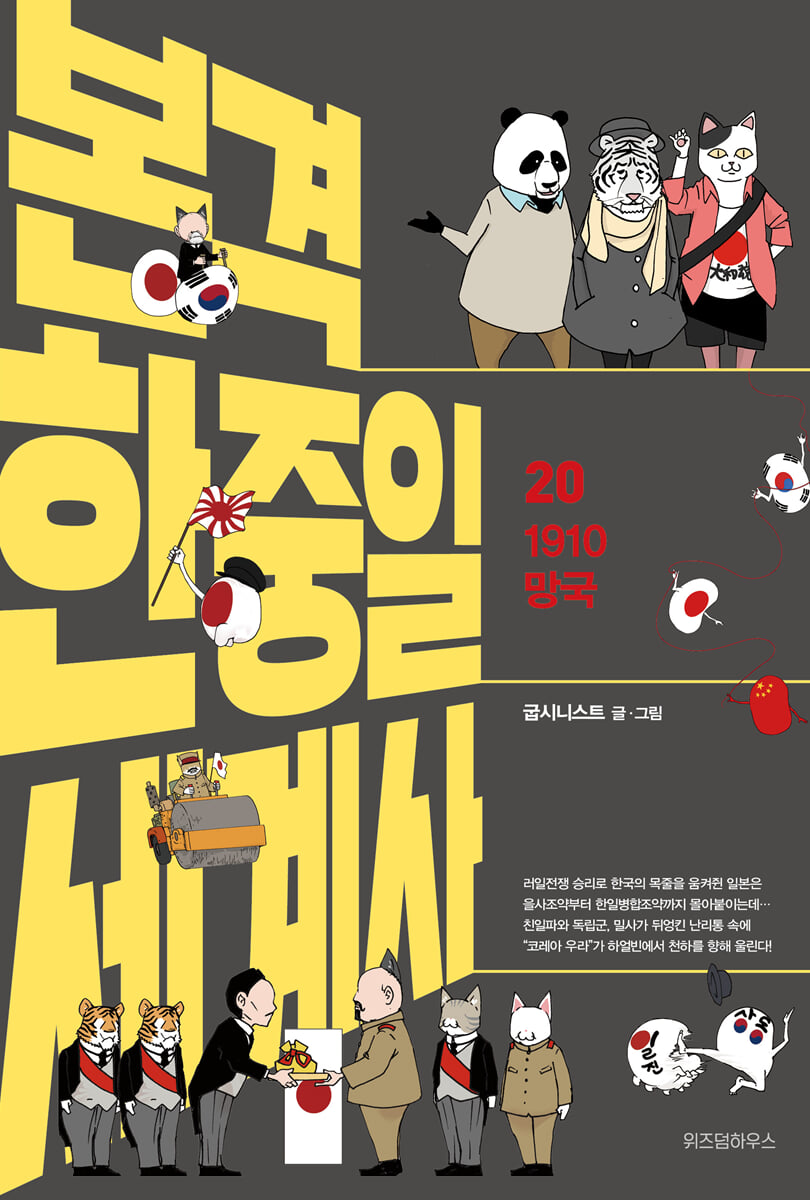
Authentic Korean-Chinese-Japanese World History 20
 |
Description
Book Introduction
Knowledge and drip, blending Korea, China, Japan and the world
A must-read for both 'reverse nerds' and 'reverse idiots'!
Chosen by 150,000 readers
'A Complete History of the World: Sino-Japanese, Korean, and Chinese', Finally Completed!
The "Full-fledged Korean-Chinese-Japanese World History" series, which has been ongoing since 2017, has finally reached its final publication after a long journey of 373 webtoon episodes and 20 volumes of 7,032 pages in single volume form.
This series, which vividly depicts the 70-year turmoil in East Asia from the Opium War of 1839 to the Japan-Korea annexation of 1910, has been loved by 150,000 readers as a must-read for a complete understanding of 19th-century world history.
In particular, the unique interpretation and fresh 'drip' of Gupsi-nim, who is called the 'king of historical comics', are appropriately blended, and it has established itself as a series that both 'reverse nerds' and 'reverse idiots' can enjoy together.
In fact, the 19th century in world history is called a beautiful era because it was a complex mosaic of economic and cultural abundance mixed with the dark clouds of imperialism.
On the other hand, the story of Korea, China, and Japan is also included, but it has not been properly viewed until now due to being overshadowed by Western-centric historical narratives.
Amidst such regret, "A Full-Fledged History of Korea, China, and Japan" finally arrives! It unfolds the story of Korea, China, and Japan's tumultuous journey across the globe with a thrilling, epic drama-like narrative, offering a uniquely entertaining experience.
"A Full-Fledged History of Korea, China, and Japan" allows anyone to delve into and savor the vast scale of 19th-century East Asian history.
Although the final chapter is a bad ending of 'national ruin,' the author holds onto the hope that "it is not meaningless to testify to our sense of modern history and to pass on the passion we harbored for history."
Let's follow the pieces of that passion from the beginning to the end of the series.
You will gain unexpected knowledge through unexpected fun!
A must-read for both 'reverse nerds' and 'reverse idiots'!
Chosen by 150,000 readers
'A Complete History of the World: Sino-Japanese, Korean, and Chinese', Finally Completed!
The "Full-fledged Korean-Chinese-Japanese World History" series, which has been ongoing since 2017, has finally reached its final publication after a long journey of 373 webtoon episodes and 20 volumes of 7,032 pages in single volume form.
This series, which vividly depicts the 70-year turmoil in East Asia from the Opium War of 1839 to the Japan-Korea annexation of 1910, has been loved by 150,000 readers as a must-read for a complete understanding of 19th-century world history.
In particular, the unique interpretation and fresh 'drip' of Gupsi-nim, who is called the 'king of historical comics', are appropriately blended, and it has established itself as a series that both 'reverse nerds' and 'reverse idiots' can enjoy together.
In fact, the 19th century in world history is called a beautiful era because it was a complex mosaic of economic and cultural abundance mixed with the dark clouds of imperialism.
On the other hand, the story of Korea, China, and Japan is also included, but it has not been properly viewed until now due to being overshadowed by Western-centric historical narratives.
Amidst such regret, "A Full-Fledged History of Korea, China, and Japan" finally arrives! It unfolds the story of Korea, China, and Japan's tumultuous journey across the globe with a thrilling, epic drama-like narrative, offering a uniquely entertaining experience.
"A Full-Fledged History of Korea, China, and Japan" allows anyone to delve into and savor the vast scale of 19th-century East Asian history.
Although the final chapter is a bad ending of 'national ruin,' the author holds onto the hope that "it is not meaningless to testify to our sense of modern history and to pass on the passion we harbored for history."
Let's follow the pieces of that passion from the beginning to the end of the series.
You will gain unexpected knowledge through unexpected fun!
- You can preview some of the book's contents.
Preview
index
preface
Chapter 1: Bloody Sunday
Chapter 2 Mission Possible
Chapter 3: Battle of Xiandanpu
Chapter 4: The Revolution of Fengtian
Chapter 5: The Journey
Chapter 6 Taking advantage of this gap
Chapter 7: The Battle of Tsushima
Chapter 8 Treaty of Portsmouth
Chapter 9: Transfer
Chapter 10 Iljins
Chapter 11 To America
Chapter 12: Alice in Wonderland
Chapter 13 Towards the Protectorate
Chapter 14: The Eulsa Treaty
Chapter 15: Bamboo Forest of Blood Chapter 16: Justice under Heaven
Chapter 17 1907
Chapter 18 To the Hague
Chapter 19: The Scream of Huis Ten Bosch
Chapter 20: Yunghui
Chapter 21: From Namdaemun to Yangju
Chapter 22: Seoul My Soul
Chapter 23: Therapeutic Bullets
Chapter 24 The Big Dipper
Chapter 25: Chupungdan Lantern
Chapter 26: Accounting
Chapter 27, Final Episode
Major events and people
Chapter 1: Bloody Sunday
Chapter 2 Mission Possible
Chapter 3: Battle of Xiandanpu
Chapter 4: The Revolution of Fengtian
Chapter 5: The Journey
Chapter 6 Taking advantage of this gap
Chapter 7: The Battle of Tsushima
Chapter 8 Treaty of Portsmouth
Chapter 9: Transfer
Chapter 10 Iljins
Chapter 11 To America
Chapter 12: Alice in Wonderland
Chapter 13 Towards the Protectorate
Chapter 14: The Eulsa Treaty
Chapter 15: Bamboo Forest of Blood Chapter 16: Justice under Heaven
Chapter 17 1907
Chapter 18 To the Hague
Chapter 19: The Scream of Huis Ten Bosch
Chapter 20: Yunghui
Chapter 21: From Namdaemun to Yangju
Chapter 22: Seoul My Soul
Chapter 23: Therapeutic Bullets
Chapter 24 The Big Dipper
Chapter 25: Chupungdan Lantern
Chapter 26: Accounting
Chapter 27, Final Episode
Major events and people
Into the book
On Sunday, January 22nd, as scheduled, Father Gapon led a crowd of about 150,000 people in a march toward the Winter Palace.
“Tsar, come on~!!” “May you live long and prosper!” “The Tsar is buying lunch today.” And then, in front of the palace gate, they face the guns of the military troops.
(…) “In that way, the father of the people, the Tsar, became a bloody tyrant in one day.
Starting from this Bloody Sunday, the first Russian Revolution began in 1905, which would plunge Russia into chaos.
If the Japanese had even a small part in this whole situation... wouldn't that be a fascinating story? Haha.
--- From "Chapter 1 Bloody Sunday"
“If only the Baltic Fleet could arrive in the Far East and annihilate the Japanese Navy in a fleet battle… and the losing streak in land battles! and the crazy revolutionary chaos at home!! This one ultimate move that will put an end to everything!! For such a great victory, we’ll need more numbers to win reliably… Wait a little longer so we can gather as much as possible.” “Aaaa ...
--- From Chapter 5, Journey
The two leading battleships of the Baltic Fleet, the flagship Suvorov and Oslavia, were hit by a concentrated barrage of over 100 shells and were largely disabled within 20 minutes of the start of the battle.
(…) “I didn’t know he could be so defeated;;” (…) “The shocking appearance of an Asian rookie on the main stage of world history, the game board of the great powers, exclusive to Western white nations! The crazy number that suddenly appeared in the first roll of the dice that determined the course of 20th century world history, where will this century lead!!!”
--- From "Chapter 7: The Battle of Tsushima"
The Great Game between Britain and Russia, which had lasted for over 90 years, effectively ended with Russia's crushing defeat - (...) The end of the Great Game opened the way for improved relations between Britain and Russia! "Gasp!!ㅠㅠ Finally! ;ㅁ; The gimmick of enemies becoming comrades is always touching!!" While the grand plan for the Great Britain-France-Russia-Germany encirclement strategy was being drawn, no one wanted Russia to be fatally wounded and bleed from a stab wound by the likes of Japan.
“Ha, so I should definitely collect the small rewards first…” (…) And the biggest quest reward, the Korean Peninsula.
--- From "Chapter 9: The Battle of Jeon I-oe"
“Ha… Secretary Taft’s diplomatic failure to visit Korea has already been resolved;; Still, perhaps we can let the American people know about Koreans’ feelings toward Japan through that American princess?” On September 22, the Koreans guided Alice to Empress Myeongseong’s tomb.
“This is the tomb of the late Empress Dowager.
Oh, well, you may have heard, the Japanese came in and killed everyone with swords… “Oh! It’s the petite, pretty Stone Pony~♡!!” This visit left behind a legendary photo of the rudeness.
--- From "Chapter 12 Alice in Wonderland"
While the ministers were hesitating, Minister of Education Lee Wan-yong actively advocated for the treaty.
"You know this is all just a formality, whether we agree or not! Since the Russo-Japanese War ended like that, whether or not Baek Yi-suk-jae comes out of here, this country will become a Japanese protectorate within the year.
Since last year, all of our ministers have been branded pro-Japanese by His Majesty. Do you think His Majesty will find it attractive if we try to hold out here pretending to be loyal martyrs? If we act half-heartedly, we'll all end up in the Nakdong River.
You can't be a proper patriot, nor can you be a proper traitor.
In that case, it would be better to…” (…) And so, at 2:00 on November 18, 1905, the 2nd Korea-Japan Agreement was signed.
--- From Chapter 14, Eulsa Treaty
The Hague Peace Conference, which marked the completion of the 1907 system.
“I was only relying on Russia’s goodwill…” “With Japan stuck in the trilateral negotiations with England, France, and Russia, there’s no way Korea’s appeals will be accepted by the great powers…” “Still, if you want to make even a show of making a move… you have no choice but to send a special envoy;; If you don’t do this as a monarch who went on a path to ruin, won’t you be remembered in history as the person with the highest share of ruined nations;;; You should be cursed less than your father and wife…” Still, if you try to light a small ray of hope, the United States, which led the hosting of this Second Hague Peace Conference - has become quite cold these days.
“We were beaten by the US with the Treaty of Portsmouth…” “JAPS is so ungrateful~”
--- From "Chapter 17, 1907"
June 15, 1907, the Second Hague Peace Conference begins.
June 25th, the 10th day of the meeting.
“The Korean delegation! They are trying to enter the conference hall with invitations from Russia!!” “Whoa?!?” The special delegation arrived in The Hague on June 25th, but were denied entry to the conference hall.
(…) Afterwards, the special delegation held a protest in front of the Huis Ten Bosch Palace conference hall, distributing petition pamphlets to the press and citizens.
(…) Despite a three-week public opinion war, the doors of Huis Ten Bosch Palace were ultimately not opened to Koreans.
“Kuhhhh!! Is the justice of the great powers nothing more than a thinly veiled covering for the filthy law of the jungle?!”
--- From "Chapter 19: The Scream of Huis Ten Bosch"
“The world is indignant, and now the disbanded soldiers have joined in! Now is the time and the mood is ripe for all the volunteers from all over the country to gather and advance on Seoul! Before 1907 ends! Let’s all gather in Yangju! Gather everyone and march on Seoul!!!” The volunteer army leaders from all over the country simultaneously responded to Lee In-young’s buster call.
(…) Now in Yangju!! All together!! 10,000 troops!! 13th Provincial Army!
--- From Chapter 21, From Namdaemun to Yangju
“While the entire Korean Peninsula was being roughly disinfected, the Deep South, where resistance was most rampant, was the place to be! Wipe out Honam!!” The operation to eradicate the righteous army in 1909 reached its climax with the Great Southern Expedition that took place in September and October.
An extermination operation swept through the Honam region, killing approximately 10,000 people and arresting 2,000.
“The political and administrative conquest of Seoul has been completed… and the physical and military conquest of the entire Korean Peninsula has been completed!!” “Gyaaaaak!!”
--- From "Chapter 23: The Healing Bullet"
At 7:00 AM on October 26, An Jung-geun arrived in Harbin and waited at a cafe.
At 9:30 a.m., a special train arrived in Harbin.
(…) After the chaos of swordsmanship during the Yushin era… After the chaos of gunfire during the war… “Is this old C-class Yushin patriot who finally reached the remotest part of this continent trying to force the next generation to follow that path again…” The path of the Yushin era… The path of the empire… … The path of glory “But… that path… On that splendid paved road…” “Korea Ura!” (…) The assassination of Ito Hirobumi sends turmoil through the East.
--- From "Chapter 25, Chupungdan Lantern"
June 3, 1910, the Japanese government decided to annex Korea.
“The annexed Korean Peninsula will be placed under the Emperor’s supremacy, not under constitutional rule.” In other words, like Taiwan, it will be placed outside the constitutional rule, in an “outside territory.”
“If Ito were alive, his territory, Joseon, would have been under the jurisdiction of the cabinet and ruled by civil officials… but thanks to Ito’s death, the Korean Peninsula was swept under the army’s territory, the Yamagata Line!” In August 1910, Prime Minister Yi Wan-yong and Resident-General Terauchi began negotiations for the annexation of Korea and Japan.
(…) On August 18, the Emperor stamped the power of attorney to promote the annexation treaty.
(…) August 22, 1910, Japan-Korea Annexation Treaty signed.
August 29, 1910, the Korean Empire ceased to exist with the promulgation of the treaty.
“Tsar, come on~!!” “May you live long and prosper!” “The Tsar is buying lunch today.” And then, in front of the palace gate, they face the guns of the military troops.
(…) “In that way, the father of the people, the Tsar, became a bloody tyrant in one day.
Starting from this Bloody Sunday, the first Russian Revolution began in 1905, which would plunge Russia into chaos.
If the Japanese had even a small part in this whole situation... wouldn't that be a fascinating story? Haha.
--- From "Chapter 1 Bloody Sunday"
“If only the Baltic Fleet could arrive in the Far East and annihilate the Japanese Navy in a fleet battle… and the losing streak in land battles! and the crazy revolutionary chaos at home!! This one ultimate move that will put an end to everything!! For such a great victory, we’ll need more numbers to win reliably… Wait a little longer so we can gather as much as possible.” “Aaaa ...
--- From Chapter 5, Journey
The two leading battleships of the Baltic Fleet, the flagship Suvorov and Oslavia, were hit by a concentrated barrage of over 100 shells and were largely disabled within 20 minutes of the start of the battle.
(…) “I didn’t know he could be so defeated;;” (…) “The shocking appearance of an Asian rookie on the main stage of world history, the game board of the great powers, exclusive to Western white nations! The crazy number that suddenly appeared in the first roll of the dice that determined the course of 20th century world history, where will this century lead!!!”
--- From "Chapter 7: The Battle of Tsushima"
The Great Game between Britain and Russia, which had lasted for over 90 years, effectively ended with Russia's crushing defeat - (...) The end of the Great Game opened the way for improved relations between Britain and Russia! "Gasp!!ㅠㅠ Finally! ;ㅁ; The gimmick of enemies becoming comrades is always touching!!" While the grand plan for the Great Britain-France-Russia-Germany encirclement strategy was being drawn, no one wanted Russia to be fatally wounded and bleed from a stab wound by the likes of Japan.
“Ha, so I should definitely collect the small rewards first…” (…) And the biggest quest reward, the Korean Peninsula.
--- From "Chapter 9: The Battle of Jeon I-oe"
“Ha… Secretary Taft’s diplomatic failure to visit Korea has already been resolved;; Still, perhaps we can let the American people know about Koreans’ feelings toward Japan through that American princess?” On September 22, the Koreans guided Alice to Empress Myeongseong’s tomb.
“This is the tomb of the late Empress Dowager.
Oh, well, you may have heard, the Japanese came in and killed everyone with swords… “Oh! It’s the petite, pretty Stone Pony~♡!!” This visit left behind a legendary photo of the rudeness.
--- From "Chapter 12 Alice in Wonderland"
While the ministers were hesitating, Minister of Education Lee Wan-yong actively advocated for the treaty.
"You know this is all just a formality, whether we agree or not! Since the Russo-Japanese War ended like that, whether or not Baek Yi-suk-jae comes out of here, this country will become a Japanese protectorate within the year.
Since last year, all of our ministers have been branded pro-Japanese by His Majesty. Do you think His Majesty will find it attractive if we try to hold out here pretending to be loyal martyrs? If we act half-heartedly, we'll all end up in the Nakdong River.
You can't be a proper patriot, nor can you be a proper traitor.
In that case, it would be better to…” (…) And so, at 2:00 on November 18, 1905, the 2nd Korea-Japan Agreement was signed.
--- From Chapter 14, Eulsa Treaty
The Hague Peace Conference, which marked the completion of the 1907 system.
“I was only relying on Russia’s goodwill…” “With Japan stuck in the trilateral negotiations with England, France, and Russia, there’s no way Korea’s appeals will be accepted by the great powers…” “Still, if you want to make even a show of making a move… you have no choice but to send a special envoy;; If you don’t do this as a monarch who went on a path to ruin, won’t you be remembered in history as the person with the highest share of ruined nations;;; You should be cursed less than your father and wife…” Still, if you try to light a small ray of hope, the United States, which led the hosting of this Second Hague Peace Conference - has become quite cold these days.
“We were beaten by the US with the Treaty of Portsmouth…” “JAPS is so ungrateful~”
--- From "Chapter 17, 1907"
June 15, 1907, the Second Hague Peace Conference begins.
June 25th, the 10th day of the meeting.
“The Korean delegation! They are trying to enter the conference hall with invitations from Russia!!” “Whoa?!?” The special delegation arrived in The Hague on June 25th, but were denied entry to the conference hall.
(…) Afterwards, the special delegation held a protest in front of the Huis Ten Bosch Palace conference hall, distributing petition pamphlets to the press and citizens.
(…) Despite a three-week public opinion war, the doors of Huis Ten Bosch Palace were ultimately not opened to Koreans.
“Kuhhhh!! Is the justice of the great powers nothing more than a thinly veiled covering for the filthy law of the jungle?!”
--- From "Chapter 19: The Scream of Huis Ten Bosch"
“The world is indignant, and now the disbanded soldiers have joined in! Now is the time and the mood is ripe for all the volunteers from all over the country to gather and advance on Seoul! Before 1907 ends! Let’s all gather in Yangju! Gather everyone and march on Seoul!!!” The volunteer army leaders from all over the country simultaneously responded to Lee In-young’s buster call.
(…) Now in Yangju!! All together!! 10,000 troops!! 13th Provincial Army!
--- From Chapter 21, From Namdaemun to Yangju
“While the entire Korean Peninsula was being roughly disinfected, the Deep South, where resistance was most rampant, was the place to be! Wipe out Honam!!” The operation to eradicate the righteous army in 1909 reached its climax with the Great Southern Expedition that took place in September and October.
An extermination operation swept through the Honam region, killing approximately 10,000 people and arresting 2,000.
“The political and administrative conquest of Seoul has been completed… and the physical and military conquest of the entire Korean Peninsula has been completed!!” “Gyaaaaak!!”
--- From "Chapter 23: The Healing Bullet"
At 7:00 AM on October 26, An Jung-geun arrived in Harbin and waited at a cafe.
At 9:30 a.m., a special train arrived in Harbin.
(…) After the chaos of swordsmanship during the Yushin era… After the chaos of gunfire during the war… “Is this old C-class Yushin patriot who finally reached the remotest part of this continent trying to force the next generation to follow that path again…” The path of the Yushin era… The path of the empire… … The path of glory “But… that path… On that splendid paved road…” “Korea Ura!” (…) The assassination of Ito Hirobumi sends turmoil through the East.
--- From "Chapter 25, Chupungdan Lantern"
June 3, 1910, the Japanese government decided to annex Korea.
“The annexed Korean Peninsula will be placed under the Emperor’s supremacy, not under constitutional rule.” In other words, like Taiwan, it will be placed outside the constitutional rule, in an “outside territory.”
“If Ito were alive, his territory, Joseon, would have been under the jurisdiction of the cabinet and ruled by civil officials… but thanks to Ito’s death, the Korean Peninsula was swept under the army’s territory, the Yamagata Line!” In August 1910, Prime Minister Yi Wan-yong and Resident-General Terauchi began negotiations for the annexation of Korea and Japan.
(…) On August 18, the Emperor stamped the power of attorney to promote the annexation treaty.
(…) August 22, 1910, Japan-Korea Annexation Treaty signed.
August 29, 1910, the Korean Empire ceased to exist with the promulgation of the treaty.
--- From "Chapter 27, Last Episode"
Publisher's Review
Britain is shocked, America is appalled, and Russia is brought to its knees!
Who can stand in the way of Japan's victory in the Russo-Japanese War?
Volume 20, which concludes the series, begins its story in the final stages of the Russo-Japanese War.
At the end of January 1905, a little over a year after the outbreak of the Russo-Japanese War, the front line, which had been at a standstill in front of Fengtian in Manchuria, was shaken by a surprise attack by the Russian army.
The Russian army waged an all-out war, suffering casualties exceeding 10,000, but was ultimately blocked by the Japanese army's "space defense" and failed to turn the tide of the war.
Afterwards, the Japanese army launched a counterattack and surrendered Bongcheon in mid-March, forcing a retreat.
Russia, slowly being pushed back from the Manchurian plains, had only one last hope: the Baltic Fleet! Leaving the Baltic Sea in October 1904, the fleet suffered British obstruction and delays in joining forces, and after a series of setbacks, it finally reached the Korea Strait in May 1905, seven months later.
The Japanese Combined Fleet, having made thorough preparations over the past few months, sets up camp near Tsushima Island and engages in a final battle.
Thus, the Battle of Tsushima, which took place on the 27th, ended in victory for the Combined Fleet, with the Baltic Fleet's flagship being neutralized in just 20 minutes.
The Baltic Fleet loses almost all of its battleships in a one-sided 'hunt' by the Combined Fleet that continues until the next morning.
Japan, encouraged by the tremendous victory, and Russia, which had lost its will to fight, entered into a peace conference with the mediation of the United States and signed the Treaty of Portsmouth in September 1905.
However, due to pressure from Britain, which needed Russia to keep Germany in check, Japan was unable to obtain as much spoils as it wanted.
Can Korea truly be safe from Japan, which is strongly clinging to the Korean Peninsula that it has secured?
The final chapter of 'Authentic Korean-Chinese-Japanese World History' is all black!
At the dawn of the pitch-black 20th century, is there hope for Korea?
In fact, Japan had been laying the groundwork for dominating the Korean Peninsula even before the signing of the Treaty of Portsmouth.
Thus, in July 1905, the Katsura-Taft Secret Agreement was signed with the United States, and in August, the Second Anglo-Japanese Alliance was signed with the United Kingdom, reaching some kind of agreement with the two great powers that had interests in East Asia.
Now, Japan appears on stage.
As soon as the peace negotiations with Russia were concluded, Ito Hirobumi stormed into Hanyang in November and threatened Emperor Gojong and his ministers, forcing them to hand over diplomatic rights.
In the process, Yi Wan-yong played a major role in selling out the country with his possessed tongue, and the Eulsa Treaty was eventually signed on the 18th.
At that moment, the Korean Empire was reduced to a protectorate of Japan… .
This news spread throughout the country in just two days as “Shiil Ya Bang Seong Dae Gok.”
The people's anger boils over, and ministers including Min Yeong-hwan commit suicide in protest, appealing to the world about the injustice.
King Gojong, who believed that a direct confrontation would lead to certain defeat, decided to resort to 'secret diplomacy'.
So, in June 1907, a special envoy was sent to The Hague to avoid Japan's attention.
The International Peace Conference, held after eight years, has finally arrived! But the cries of the weak nations have fallen on deaf ears of the powerful nations.
Japan, on the other hand, used this as an excuse to force Emperor Gojong to abdicate in July.
Enraged by this, the volunteer soldiers rose up and formed the 13th Provincial Army with 10,000 men and advanced toward Seoul, but were defeated by the Japanese army in front of Dongdaemun in January 1908 and disbanded in vain.
Afterwards, the volunteers continued to wage guerrilla warfare throughout the country, but in the fall of 1909, the Japanese army's extermination operation led by Korean auxiliaries brought an end to the volunteers' activities on the Korean Peninsula.
Where did all those volunteer soldiers go? Most of them crossed the Tumen River to Gando and the Maritime Province, and young Ahn Jung-geun joined that group.
In February 1909, An Jung-geun, who cut off his left ring finger and formed the Danji Alliance with like-minded comrades, heard the news of Ito's visit to Manchuria in the summer.
At 9:30 a.m. on October 26th, could the cries of “Korea Ura” that shook Harbin Station truly stop the wheel of history that was carelessly rolling toward the annexation of Korea by Japan?
Who can stand in the way of Japan's victory in the Russo-Japanese War?
Volume 20, which concludes the series, begins its story in the final stages of the Russo-Japanese War.
At the end of January 1905, a little over a year after the outbreak of the Russo-Japanese War, the front line, which had been at a standstill in front of Fengtian in Manchuria, was shaken by a surprise attack by the Russian army.
The Russian army waged an all-out war, suffering casualties exceeding 10,000, but was ultimately blocked by the Japanese army's "space defense" and failed to turn the tide of the war.
Afterwards, the Japanese army launched a counterattack and surrendered Bongcheon in mid-March, forcing a retreat.
Russia, slowly being pushed back from the Manchurian plains, had only one last hope: the Baltic Fleet! Leaving the Baltic Sea in October 1904, the fleet suffered British obstruction and delays in joining forces, and after a series of setbacks, it finally reached the Korea Strait in May 1905, seven months later.
The Japanese Combined Fleet, having made thorough preparations over the past few months, sets up camp near Tsushima Island and engages in a final battle.
Thus, the Battle of Tsushima, which took place on the 27th, ended in victory for the Combined Fleet, with the Baltic Fleet's flagship being neutralized in just 20 minutes.
The Baltic Fleet loses almost all of its battleships in a one-sided 'hunt' by the Combined Fleet that continues until the next morning.
Japan, encouraged by the tremendous victory, and Russia, which had lost its will to fight, entered into a peace conference with the mediation of the United States and signed the Treaty of Portsmouth in September 1905.
However, due to pressure from Britain, which needed Russia to keep Germany in check, Japan was unable to obtain as much spoils as it wanted.
Can Korea truly be safe from Japan, which is strongly clinging to the Korean Peninsula that it has secured?
The final chapter of 'Authentic Korean-Chinese-Japanese World History' is all black!
At the dawn of the pitch-black 20th century, is there hope for Korea?
In fact, Japan had been laying the groundwork for dominating the Korean Peninsula even before the signing of the Treaty of Portsmouth.
Thus, in July 1905, the Katsura-Taft Secret Agreement was signed with the United States, and in August, the Second Anglo-Japanese Alliance was signed with the United Kingdom, reaching some kind of agreement with the two great powers that had interests in East Asia.
Now, Japan appears on stage.
As soon as the peace negotiations with Russia were concluded, Ito Hirobumi stormed into Hanyang in November and threatened Emperor Gojong and his ministers, forcing them to hand over diplomatic rights.
In the process, Yi Wan-yong played a major role in selling out the country with his possessed tongue, and the Eulsa Treaty was eventually signed on the 18th.
At that moment, the Korean Empire was reduced to a protectorate of Japan… .
This news spread throughout the country in just two days as “Shiil Ya Bang Seong Dae Gok.”
The people's anger boils over, and ministers including Min Yeong-hwan commit suicide in protest, appealing to the world about the injustice.
King Gojong, who believed that a direct confrontation would lead to certain defeat, decided to resort to 'secret diplomacy'.
So, in June 1907, a special envoy was sent to The Hague to avoid Japan's attention.
The International Peace Conference, held after eight years, has finally arrived! But the cries of the weak nations have fallen on deaf ears of the powerful nations.
Japan, on the other hand, used this as an excuse to force Emperor Gojong to abdicate in July.
Enraged by this, the volunteer soldiers rose up and formed the 13th Provincial Army with 10,000 men and advanced toward Seoul, but were defeated by the Japanese army in front of Dongdaemun in January 1908 and disbanded in vain.
Afterwards, the volunteers continued to wage guerrilla warfare throughout the country, but in the fall of 1909, the Japanese army's extermination operation led by Korean auxiliaries brought an end to the volunteers' activities on the Korean Peninsula.
Where did all those volunteer soldiers go? Most of them crossed the Tumen River to Gando and the Maritime Province, and young Ahn Jung-geun joined that group.
In February 1909, An Jung-geun, who cut off his left ring finger and formed the Danji Alliance with like-minded comrades, heard the news of Ito's visit to Manchuria in the summer.
At 9:30 a.m. on October 26th, could the cries of “Korea Ura” that shook Harbin Station truly stop the wheel of history that was carelessly rolling toward the annexation of Korea by Japan?
GOODS SPECIFICS
- Date of issue: August 27, 2025
- Page count, weight, size: 448 pages | 820g | 152*225*28mm
- ISBN13: 9791171714858
- ISBN10: 1171714858
You may also like
카테고리
korean


korean

![GQ KOREA Mark (Monthly): December [2025]](http://librairie.coreenne.fr/cdn/shop/files/8ef265dbbfbf186523ed75ba7319009d.jpg?v=1765340328&width=3840)


