

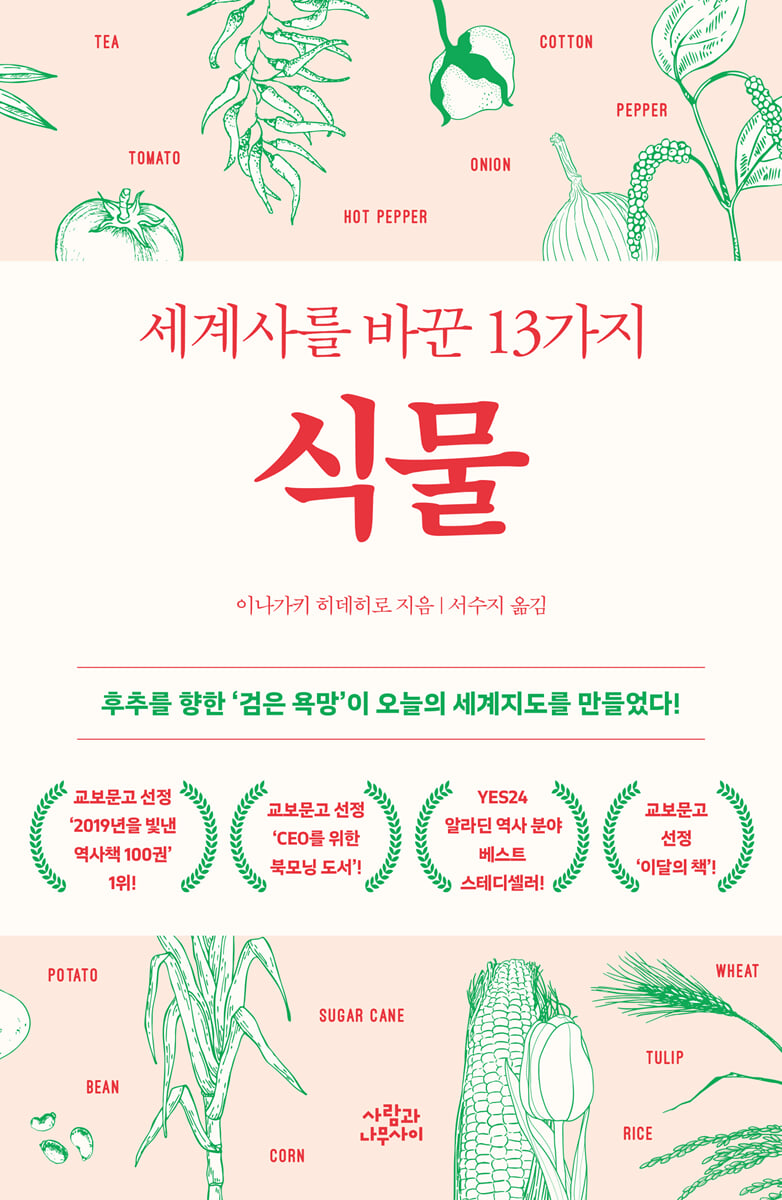
13 Plants That Changed World History
 |
Description
Book Introduction
- Kyobo Book Centre's "100 History Books of 2019" ranked 1st
- Selected by Kyobo Book Centre as a 'Book Morning Book for CEOs'
- Kyobo Book Centre's 'Book of the Month'
- YES24ㆍAladdin History Category BestsellerㆍSteady Seller
It was all because of the 'pepper'!
The 'black desire' for pepper created today's world map!
It all started with 'pepper'.
No, it all began with the seething desire of individuals and nations to monopolize wealth and power by obtaining the black spice pepper, which was so valuable that it was traded at a price equal to its weight in pure gold.
Christopher Columbus's discovery of the American continent, Vasco da Gama's great voyage, and Ferdinand Magellan's first circumnavigation of the world all started with 'pepper'.
The fact that Portugal and Spain ushered in the Age of Exploration, that Britain built the British Empire, the "nation on which the sun never sets," and that the United States later took over from Britain and established itself as the world's sole superpower, all stemmed from pepper.
Would you believe that plants changed world history? It's true.
A mutant wheat seed discovered by chance during a time when humans relied on hunting and gathering to survive.
That one tiny grain of rice made agriculture possible, allowing humanity to survive and thrive.
It created wealth and power, the gap between rich and poor, and class.
It gave birth to civilization and led to the creation and development of nations.
As you read this book, you will gain new perspectives and profound insights into the history of humanity, created by seemingly inert plants that move passionately, stimulating and driving human desires.
- Selected by Kyobo Book Centre as a 'Book Morning Book for CEOs'
- Kyobo Book Centre's 'Book of the Month'
- YES24ㆍAladdin History Category BestsellerㆍSteady Seller
It was all because of the 'pepper'!
The 'black desire' for pepper created today's world map!
It all started with 'pepper'.
No, it all began with the seething desire of individuals and nations to monopolize wealth and power by obtaining the black spice pepper, which was so valuable that it was traded at a price equal to its weight in pure gold.
Christopher Columbus's discovery of the American continent, Vasco da Gama's great voyage, and Ferdinand Magellan's first circumnavigation of the world all started with 'pepper'.
The fact that Portugal and Spain ushered in the Age of Exploration, that Britain built the British Empire, the "nation on which the sun never sets," and that the United States later took over from Britain and established itself as the world's sole superpower, all stemmed from pepper.
Would you believe that plants changed world history? It's true.
A mutant wheat seed discovered by chance during a time when humans relied on hunting and gathering to survive.
That one tiny grain of rice made agriculture possible, allowing humanity to survive and thrive.
It created wealth and power, the gap between rich and poor, and class.
It gave birth to civilization and led to the creation and development of nations.
As you read this book, you will gain new perspectives and profound insights into the history of humanity, created by seemingly inert plants that move passionately, stimulating and driving human desires.
- You can preview some of the book's contents.
Preview
index
Introduction: The story of a great plant that stimulated the primal desires of humans and shaped the great course of world history.
1.
The "Devil's Plant," the Potato, That Made America a Superpower
Marie Antoinette's favorite flower wasn't roses, but potato flowers?
Europeans were shocked when they first saw underground tuberous potatoes.
The story of the unfortunate potato who was convicted by the Inquisition and burned at the stake.
Elizabeth I nearly died from solanine poisoning while trying to popularize potatoes.
Why Frederick II declared that "from now on, only the nobility will be allowed to eat potatoes in this country"
Potatoes solve food problems not only for humans but also for pigs.
Louis XVI succeeded in popularizing potatoes through clever psychological warfare.
Potatoes changed European food culture from vegetarian to meat-eating?
Did you know that potatoes saved the lives of many sailors by preventing scurvy?
The potato blight that plunged one million Irish people into the hell of the Great Famine
The potato that made America a superpower and changed world history
The person who first created curry rice wasn't Indian?
2.
The bright red tomato that changed the human diet
An unfortunate plant that was rejected by Europeans for 200 years
Why did Europeans so thoroughly shun and reject tomatoes?
Is it because of the 'red color' of the fruit that tomatoes are mistaken for poisonous plants?
The Hidden Reason Why Tomatoes Have Become a Signature Italian Ingredient
How did tomato ketchup, which transformed tables around the world, come about?
Tomatoes, the world's largest non-food crop, are among the most productive.
I heard that tomatoes were once put on trial in the US?
3.
Pepper, the 'Black Desire' that ushered in the Age of Exploration
Pepper, a plant worth its weight in gold
A time when the country that controlled the spices dominated the world.
The two countries that opened the Age of Exploration and divided the world in two
Why the Dutch Gave Up the Threatening Spice Trade
The Real Reason Pepper Sold for as High a Price as Gold
The 'black desire' for pepper shaped today's world map.
4.
Columbus's agony and Asia's passion for peppers
Why the chili pepper discovered in the Americas had to be 'pepper' to Columbus
Columbus's exploration of the American continent began with a desire for pepper.
How Chili Peppers Overtook All Spices, Including Black Pepper, in Asia
Plants that captivate humans with their powerful 'addiction'
Capsaicin, a component of chili peppers that promotes the release of endorphins in the human brain
Why chili peppers, 100 times hotter than black pepper, fascinate people
The pepper's unique evolutionary strategy to spread widely by being eaten by birds
The secret to chili peppers' much greater success in Korea than in Japan
Nostalgia and longing for the 'pepper' that permeates bell peppers and paprika
5.
The medicinal onion that supported the giant pyramid
If there were no onions, there would be no pyramids?
Why Onions Have Such Excellent Medicinal Properties
The onions we eat are not the roots or the fruit, but the 'stems' and 'leaves'?
6.
The catalyst for the two wars that changed world history
Tea, the plant that Qin Shi Huang believed was the elixir of immortality
The reason why the matcha tradition, which disappeared from China with the fall of the Song Dynasty, has continued in Japan.
Men's 'coffee houses' are being pushed out by women's 'tea gardens'.
Why was black tea so beloved by factory workers during the Industrial Revolution?
Black tea, the fuse that ignited the powder keg of the American Revolutionary War
The Opium Wars: A Tragic Tragedy Born from the British's Deformed Love of Tea
Assam tea, which overnight transformed India into the world's leading black tea producing region.
The tea that Qin Shi Huang admired changed world history.
7.
Sugarcane, the sweet and dangerous flavor that led to the slave trade, a disaster for humanity.
Why finding sweet tastes and smells was a matter of survival.
Sugar, a luxurious item that was only enjoyed by royalty and nobles
Sugarcane, a cruel plant that grows by feeding on human hard labor
Sugarcane cultivation spread to the rich West Indies
The sweet and dangerous desire of the European powers to turn the natural environment into a vast sugarcane field.
Over 414 years, 9.4 million black Africans were enslaved on sugarcane farms.
How the brutal sugarcane slave trade began
The sugarcane plantations that made Hawaii a multi-ethnic society
8.
Cotton, the plant that sparked the Industrial Revolution
Cotton, a pure white, soft, and unique plant that revolutionized human clothing culture.
The era when fabrics were made from animal fur and bird feathers
Europeans imagined a plant with many sheep hanging from it
If there was no cotton, there would have been no industrial revolution?
The United States, a new nation that gained wealth through cotton cultivation and the triangular trade, which exploited black slaves.
President Lincoln's Cunning Strategy Hidden in the Emancipation of Slaves
Cotton cultivation in Central Asia caused the disappearance of the Aral Sea
9.
Grain and wheat, the incubators that gave birth to civilization from a single seed
Which is more evolved, trees or grass?
Why monocotyledons are more evolved and developed than dicots
Clever grasses engage in a 'brain battle' with herbivores
Why do rice plants deplete their own leaves of nutrients?
Herbivores counterattack against the stealthy attacks of grasses and plants.
A single seed of 'mutant wheat' that solved early humans' food problems.
Why did agriculture begin in harsh environments rather than bountiful ones?
Livestock, a clever strategy for human survival using rice and plants
Why cereals and plants use carbohydrates as their main source of nutrition
Becoming a captive of carbohydrates and entering the harsh path of hard labor
With the advent of farming, humanity entered the racetrack of endless competition.
10.
Rice, the crop that formed the foundation of the ancient nation
Before rice farming, the ancient Japanese consumed starch from taro.
The Huang He and Changjiang civilizations clash over limited land.
Why did agricultural peoples in the ancient world inevitably become powerful nations?
Why did early farmers grow rice instead of wheat or barley?
Why Asia is the Best Continent for Rice Farming
Perfecting rice farming with the invention of the "discussion"
Some conditions that made it inevitable for rice to be used as currency in early agricultural societies
Japan's rice farming supports six times more people than Britain's wheat farming.
11.
Soybeans, the plant that helped us overcome the crisis of the Great Depression
Soybeans, native to China, conquer the Americas.
Rice and soybeans, two great crops that underpinned China's 4,000-year civilization.
The ancestor of soybeans is a weed called 'dolkong'?
Why Soybeans Are Called "Meat from the Field"
Why Rice and Beans Make a Fantastic Combo
Why did miso develop so greatly in Japan during the Sengoku period, a time of war?
Soybeans threatened corn's position in North America in the aftermath of the Great Depression.
Soybeans, once grown in the backyards of Asian immigrants, have become a key crop supporting the economies of South American countries.
12.
Corn, the most widely grown crop worldwide
Corn, a plant that cannot grow without human help, like livestock
The Mayans believed that God created humans from corn.
A strange plant rejected by Europeans for being "against the laws of nature"
What is the most widely grown crop in the world?
Half of the human body is made of corn?
Without corn, there would be no cutting-edge 21st-century scientific civilization.
13.
The tulip, the bulb of desire that created the first bubble economy in human history
Wild tulip seeds from Türkiye sneaked into Europe with the luggage of the Crusaders.
Introduced flowers that shaped the Dutch Golden Age
A single tulip bulb was sold for the price of a house?
The end of the bubble economy caused by the bulb of desire, the tulip
Conclusion: Intelligent plants that survive and reproduce through fierce brain battles with animals and even humans.
References
1.
The "Devil's Plant," the Potato, That Made America a Superpower
Marie Antoinette's favorite flower wasn't roses, but potato flowers?
Europeans were shocked when they first saw underground tuberous potatoes.
The story of the unfortunate potato who was convicted by the Inquisition and burned at the stake.
Elizabeth I nearly died from solanine poisoning while trying to popularize potatoes.
Why Frederick II declared that "from now on, only the nobility will be allowed to eat potatoes in this country"
Potatoes solve food problems not only for humans but also for pigs.
Louis XVI succeeded in popularizing potatoes through clever psychological warfare.
Potatoes changed European food culture from vegetarian to meat-eating?
Did you know that potatoes saved the lives of many sailors by preventing scurvy?
The potato blight that plunged one million Irish people into the hell of the Great Famine
The potato that made America a superpower and changed world history
The person who first created curry rice wasn't Indian?
2.
The bright red tomato that changed the human diet
An unfortunate plant that was rejected by Europeans for 200 years
Why did Europeans so thoroughly shun and reject tomatoes?
Is it because of the 'red color' of the fruit that tomatoes are mistaken for poisonous plants?
The Hidden Reason Why Tomatoes Have Become a Signature Italian Ingredient
How did tomato ketchup, which transformed tables around the world, come about?
Tomatoes, the world's largest non-food crop, are among the most productive.
I heard that tomatoes were once put on trial in the US?
3.
Pepper, the 'Black Desire' that ushered in the Age of Exploration
Pepper, a plant worth its weight in gold
A time when the country that controlled the spices dominated the world.
The two countries that opened the Age of Exploration and divided the world in two
Why the Dutch Gave Up the Threatening Spice Trade
The Real Reason Pepper Sold for as High a Price as Gold
The 'black desire' for pepper shaped today's world map.
4.
Columbus's agony and Asia's passion for peppers
Why the chili pepper discovered in the Americas had to be 'pepper' to Columbus
Columbus's exploration of the American continent began with a desire for pepper.
How Chili Peppers Overtook All Spices, Including Black Pepper, in Asia
Plants that captivate humans with their powerful 'addiction'
Capsaicin, a component of chili peppers that promotes the release of endorphins in the human brain
Why chili peppers, 100 times hotter than black pepper, fascinate people
The pepper's unique evolutionary strategy to spread widely by being eaten by birds
The secret to chili peppers' much greater success in Korea than in Japan
Nostalgia and longing for the 'pepper' that permeates bell peppers and paprika
5.
The medicinal onion that supported the giant pyramid
If there were no onions, there would be no pyramids?
Why Onions Have Such Excellent Medicinal Properties
The onions we eat are not the roots or the fruit, but the 'stems' and 'leaves'?
6.
The catalyst for the two wars that changed world history
Tea, the plant that Qin Shi Huang believed was the elixir of immortality
The reason why the matcha tradition, which disappeared from China with the fall of the Song Dynasty, has continued in Japan.
Men's 'coffee houses' are being pushed out by women's 'tea gardens'.
Why was black tea so beloved by factory workers during the Industrial Revolution?
Black tea, the fuse that ignited the powder keg of the American Revolutionary War
The Opium Wars: A Tragic Tragedy Born from the British's Deformed Love of Tea
Assam tea, which overnight transformed India into the world's leading black tea producing region.
The tea that Qin Shi Huang admired changed world history.
7.
Sugarcane, the sweet and dangerous flavor that led to the slave trade, a disaster for humanity.
Why finding sweet tastes and smells was a matter of survival.
Sugar, a luxurious item that was only enjoyed by royalty and nobles
Sugarcane, a cruel plant that grows by feeding on human hard labor
Sugarcane cultivation spread to the rich West Indies
The sweet and dangerous desire of the European powers to turn the natural environment into a vast sugarcane field.
Over 414 years, 9.4 million black Africans were enslaved on sugarcane farms.
How the brutal sugarcane slave trade began
The sugarcane plantations that made Hawaii a multi-ethnic society
8.
Cotton, the plant that sparked the Industrial Revolution
Cotton, a pure white, soft, and unique plant that revolutionized human clothing culture.
The era when fabrics were made from animal fur and bird feathers
Europeans imagined a plant with many sheep hanging from it
If there was no cotton, there would have been no industrial revolution?
The United States, a new nation that gained wealth through cotton cultivation and the triangular trade, which exploited black slaves.
President Lincoln's Cunning Strategy Hidden in the Emancipation of Slaves
Cotton cultivation in Central Asia caused the disappearance of the Aral Sea
9.
Grain and wheat, the incubators that gave birth to civilization from a single seed
Which is more evolved, trees or grass?
Why monocotyledons are more evolved and developed than dicots
Clever grasses engage in a 'brain battle' with herbivores
Why do rice plants deplete their own leaves of nutrients?
Herbivores counterattack against the stealthy attacks of grasses and plants.
A single seed of 'mutant wheat' that solved early humans' food problems.
Why did agriculture begin in harsh environments rather than bountiful ones?
Livestock, a clever strategy for human survival using rice and plants
Why cereals and plants use carbohydrates as their main source of nutrition
Becoming a captive of carbohydrates and entering the harsh path of hard labor
With the advent of farming, humanity entered the racetrack of endless competition.
10.
Rice, the crop that formed the foundation of the ancient nation
Before rice farming, the ancient Japanese consumed starch from taro.
The Huang He and Changjiang civilizations clash over limited land.
Why did agricultural peoples in the ancient world inevitably become powerful nations?
Why did early farmers grow rice instead of wheat or barley?
Why Asia is the Best Continent for Rice Farming
Perfecting rice farming with the invention of the "discussion"
Some conditions that made it inevitable for rice to be used as currency in early agricultural societies
Japan's rice farming supports six times more people than Britain's wheat farming.
11.
Soybeans, the plant that helped us overcome the crisis of the Great Depression
Soybeans, native to China, conquer the Americas.
Rice and soybeans, two great crops that underpinned China's 4,000-year civilization.
The ancestor of soybeans is a weed called 'dolkong'?
Why Soybeans Are Called "Meat from the Field"
Why Rice and Beans Make a Fantastic Combo
Why did miso develop so greatly in Japan during the Sengoku period, a time of war?
Soybeans threatened corn's position in North America in the aftermath of the Great Depression.
Soybeans, once grown in the backyards of Asian immigrants, have become a key crop supporting the economies of South American countries.
12.
Corn, the most widely grown crop worldwide
Corn, a plant that cannot grow without human help, like livestock
The Mayans believed that God created humans from corn.
A strange plant rejected by Europeans for being "against the laws of nature"
What is the most widely grown crop in the world?
Half of the human body is made of corn?
Without corn, there would be no cutting-edge 21st-century scientific civilization.
13.
The tulip, the bulb of desire that created the first bubble economy in human history
Wild tulip seeds from Türkiye sneaked into Europe with the luggage of the Crusaders.
Introduced flowers that shaped the Dutch Golden Age
A single tulip bulb was sold for the price of a house?
The end of the bubble economy caused by the bulb of desire, the tulip
Conclusion: Intelligent plants that survive and reproduce through fierce brain battles with animals and even humans.
References
Detailed image
Into the book
Potato leaves also contain poison.
After potatoes were introduced to Europe in the 16th century, a series of incidents of poisoning from eating the crop occurred, strengthening the image of potatoes as a poisonous plant.
In addition, because of its bumpy appearance, an absurd superstition spread that eating potatoes would cause leprosy.
To make matters worse, potatoes were a 'plant not mentioned in the Bible.'
The Bible says that God created plants that reproduce from seeds, but potatoes reproduce from tubers, not seeds.
So it was perhaps natural that potatoes, which propagate by rhizomes, seemed like a strange plant to Europeans.
Westerners often avoided and disliked plants not mentioned in the Bible, considering them to be evil.
For that reason, potatoes ended up having to live with the label of 'devil's plant' for a while.
At one time, religious trials, such as witch trials, were prevalent in medieval Europe.
But the day came when the potato, branded as a devil's plant, stood before this dreadful Inquisition.
The court found Potato guilty and, surprisingly, she was sentenced to be burned at the stake, just like those accused of witchcraft.
The basis for the guilt was that while all living things in the world reproduce through the harmony of male and female, potatoes reproduce only through rhizomes.
This method of reproduction was considered to be sexually very impure.
Anyway, the smell of potatoes roasted golden brown in the fire must have been so appetizing that it stimulated the salivary glands, but it seems that Europeans at the time did not find it to be a mouth-watering smell.
--- From "The Story of the Unlucky Potato Convicted by the Inquisition and Burned at the Stave"
In the Islamic world, cuisine using all kinds of spices developed.
Pepper was introduced to Europe after the Crusades.
Knights and soldiers who went on crusades to Islamic regions tasted various foods there and brought back spices, including pepper, to their home countries.
Medieval Europeans, captivated by its unique and exotic aroma, began to crave spices like pepper.
‘What if various spices, including pepper, could be brought to Europe by sea rather than by land?’ This thought flashed through the minds of European merchants at the time.
At that time, the popularity of spices in Europe was soaring by the day, so it seemed like a huge profit could be made if they could do that.
They lost sleep over the thought of striking it rich by bringing in pepper by sea.
But it wasn't as easy as it seemed.
The European love of pepper remained something elusive, like a mirage, an unrequited love that was difficult to achieve.
For medieval European sailors, the sea primarily meant the Mediterranean Sea.
Portugal and Spain are countries at the edge of the Mediterranean Sea.
Therefore, it was difficult for these two countries to actively participate in Mediterranean trade.
Interestingly, these geopolitical weaknesses and limitations of both countries have worked to their advantage and created new opportunities in the long term.
Instead of trying to force their way into Mediterranean trade, the two countries ventured into the open seas outside the Mediterranean.
--- From "The era when the country that controlled the spices dominated the world"
Columbus's mistake did not end there.
The purpose of his voyage was to open a direct route to secure pepper from India and bring it directly to Spain.
At that time, pepper, which was essential for preserving meat, was produced throughout Asia and brought to India, and then passed through the hands of Arab merchants to Europe.
At that time, the Asian pepper trade was in the hands of Arab merchants.
Given these circumstances, the price of pepper was also influenced by Arab merchants.
In addition to the various factors that made pepper expensive within Europe, the trickery of Arab merchants combined to make pepper traded at exorbitant prices, almost as high as its weight in gold.
Ironically, there is a historical, political, economic, and cultural context behind the fact that Columbus came to call the chili pepper he discovered in the Americas "pepper."
Pepper is a plant native to the subtropical climate of southern India, so if Columbus, who was born and raised in Europe, makes the excuse that he did not know much about the plant called pepper, then there is nothing to say.
Even today, when pepper is used daily as a spice, surprisingly few people know that pepper is a climbing plant.
So, it is quite acceptable to say that he did not know what the plant called pepper looked like.
But did Columbus, who embarked on a rough and arduous voyage in search of pepper, not even know its taste? I think he was deliberately mistaken.
In other words, for Columbus, the peppers of the American continent had to be peppers.
--- From "Columbus's Exploration of the American Continent, Began from a Desire for Pepper"
As the British loved and enjoyed drinking tea, they had to buy more tea from China.
So Britain had to pour huge amounts of silver into China to buy tea.
However, the Qing Dynasty did not have many products worth buying from Britain.
As a result, Britain's trade deficit snowballed.
When even the United States, which had been providing financial support, became independent, the British government's finances became even tighter.
It was around that time that Britain came up with the clever idea of 'triangular trade'.
The British, unable to consume all the cheap cotton fabrics mass-produced in factories during the Industrial Revolution, exported them to India.
As a result, India's traditional cotton textile industry collapsed one after another.
Britain cultivated poppies, a source of narcotic drugs, in India, where the country's main industry had collapsed, and sold the opium made from them to Qing merchants.
In this way, Britain created the concept of a triangular trade, selling opium produced in India to China and cotton products produced in Britain to India to recover the silver lost while importing tea.
It was natural that the Qing Dynasty immediately opposed this trade.
Eventually, friction arose between the Qing, which sought to confiscate the cargo of British merchants dealing in opium, and the British, which insisted on protecting their own trade, leading to the Opium War between the Qing and the British in 1840.
--- From "The Opium War, a Tragedy Caused by the British's Deformed Love of Tea"
Christopher Columbus explored the Americas with the support of Queen Isabella of Spain, but he did not find the pepper she desperately sought.
Spain originally supported Columbus's voyage because it was obsessed with amassing enormous wealth from pepper and wanting to overwhelm other European countries, such as Portugal.
However, Spain was not satisfied with just exploring the American continent discovered by Columbus.
Eventually, Spain decided to embark on new economic activities to create wealth in the West Indies.
Columbus is also the person who introduced all kinds of rare plants from the American continent to Europe.
On the other hand, he also attempted to bring plants from the Old World, Europe, to the New World, America, and cultivate them.
He was well aware of the existence of sugarcane, which was cultivated in the Madeira Archipelago (Arquipelago da Madeira) off the coast of Portugal.
Columbus, who noticed the warm climate of the Caribbean islands at the time, brought sugar cane to the Americas.
Sugarcane, introduced and cultivated according to his plan, grew into a goose that laid golden eggs, replacing pepper, and created enormous wealth.
In this way, sugar produced in large quantities by growing sugarcane in the Americas flowed into Europe.
Sugar extracted from sugarcane is merely a luxury item and not a food.
This means that you won't starve to death if there is no sugarcane.
However, the prosperous island came under the rule of Spain, which was obsessed with making money, and its natural environment was destroyed and turned into vast sugarcane fields.
--- From "The Sweet and Dangerous Desire of the European Powers That Turned the Natural Environment into a Giant Sugarcane Field"
The decisive moment that allowed humans to use rice plants as their main food source came by chance.
Surprisingly, the solution was provided by 'mutant wheat'.
Einkorn wheat is a crop that has been cultivated by humans since the Stone Age and is considered the ancestor of wheat.
Long ago, one of our ancestors made one of the greatest discoveries in history.
It was a major event that discovered a seedling that had a mutation that prevented it from falling to the ground.
There are times when a mutation with a very low probability of 'non-dropping' occurs, where the seeds do not fall, and humans were lucky enough to discover the base of that mutation, which appears with a probability lower than the probability of beans sprouting in a drought.
If the seeds do not fall to the ground when they ripen, the plant cannot leave offspring in nature.
Therefore, the characteristic of non-seedling, that is, the property of seeds not falling to the ground, is a fatal defect in plants and a decisive factor that hinders reproduction.
Ironically, these flaws and misfortunes of plants have actually been a blessing and a boon to mankind.
Seeds that do not fall to the ground even after they have withered provide food for humans.
And if you carefully gather the seeds from the base of a crop that does not shed seeds and then plant them, you can obtain wheat that has the property of not shedding seeds.
This means that if you are lucky, you will be able to secure a stable supply of food.
That's how agriculture began.
After potatoes were introduced to Europe in the 16th century, a series of incidents of poisoning from eating the crop occurred, strengthening the image of potatoes as a poisonous plant.
In addition, because of its bumpy appearance, an absurd superstition spread that eating potatoes would cause leprosy.
To make matters worse, potatoes were a 'plant not mentioned in the Bible.'
The Bible says that God created plants that reproduce from seeds, but potatoes reproduce from tubers, not seeds.
So it was perhaps natural that potatoes, which propagate by rhizomes, seemed like a strange plant to Europeans.
Westerners often avoided and disliked plants not mentioned in the Bible, considering them to be evil.
For that reason, potatoes ended up having to live with the label of 'devil's plant' for a while.
At one time, religious trials, such as witch trials, were prevalent in medieval Europe.
But the day came when the potato, branded as a devil's plant, stood before this dreadful Inquisition.
The court found Potato guilty and, surprisingly, she was sentenced to be burned at the stake, just like those accused of witchcraft.
The basis for the guilt was that while all living things in the world reproduce through the harmony of male and female, potatoes reproduce only through rhizomes.
This method of reproduction was considered to be sexually very impure.
Anyway, the smell of potatoes roasted golden brown in the fire must have been so appetizing that it stimulated the salivary glands, but it seems that Europeans at the time did not find it to be a mouth-watering smell.
--- From "The Story of the Unlucky Potato Convicted by the Inquisition and Burned at the Stave"
In the Islamic world, cuisine using all kinds of spices developed.
Pepper was introduced to Europe after the Crusades.
Knights and soldiers who went on crusades to Islamic regions tasted various foods there and brought back spices, including pepper, to their home countries.
Medieval Europeans, captivated by its unique and exotic aroma, began to crave spices like pepper.
‘What if various spices, including pepper, could be brought to Europe by sea rather than by land?’ This thought flashed through the minds of European merchants at the time.
At that time, the popularity of spices in Europe was soaring by the day, so it seemed like a huge profit could be made if they could do that.
They lost sleep over the thought of striking it rich by bringing in pepper by sea.
But it wasn't as easy as it seemed.
The European love of pepper remained something elusive, like a mirage, an unrequited love that was difficult to achieve.
For medieval European sailors, the sea primarily meant the Mediterranean Sea.
Portugal and Spain are countries at the edge of the Mediterranean Sea.
Therefore, it was difficult for these two countries to actively participate in Mediterranean trade.
Interestingly, these geopolitical weaknesses and limitations of both countries have worked to their advantage and created new opportunities in the long term.
Instead of trying to force their way into Mediterranean trade, the two countries ventured into the open seas outside the Mediterranean.
--- From "The era when the country that controlled the spices dominated the world"
Columbus's mistake did not end there.
The purpose of his voyage was to open a direct route to secure pepper from India and bring it directly to Spain.
At that time, pepper, which was essential for preserving meat, was produced throughout Asia and brought to India, and then passed through the hands of Arab merchants to Europe.
At that time, the Asian pepper trade was in the hands of Arab merchants.
Given these circumstances, the price of pepper was also influenced by Arab merchants.
In addition to the various factors that made pepper expensive within Europe, the trickery of Arab merchants combined to make pepper traded at exorbitant prices, almost as high as its weight in gold.
Ironically, there is a historical, political, economic, and cultural context behind the fact that Columbus came to call the chili pepper he discovered in the Americas "pepper."
Pepper is a plant native to the subtropical climate of southern India, so if Columbus, who was born and raised in Europe, makes the excuse that he did not know much about the plant called pepper, then there is nothing to say.
Even today, when pepper is used daily as a spice, surprisingly few people know that pepper is a climbing plant.
So, it is quite acceptable to say that he did not know what the plant called pepper looked like.
But did Columbus, who embarked on a rough and arduous voyage in search of pepper, not even know its taste? I think he was deliberately mistaken.
In other words, for Columbus, the peppers of the American continent had to be peppers.
--- From "Columbus's Exploration of the American Continent, Began from a Desire for Pepper"
As the British loved and enjoyed drinking tea, they had to buy more tea from China.
So Britain had to pour huge amounts of silver into China to buy tea.
However, the Qing Dynasty did not have many products worth buying from Britain.
As a result, Britain's trade deficit snowballed.
When even the United States, which had been providing financial support, became independent, the British government's finances became even tighter.
It was around that time that Britain came up with the clever idea of 'triangular trade'.
The British, unable to consume all the cheap cotton fabrics mass-produced in factories during the Industrial Revolution, exported them to India.
As a result, India's traditional cotton textile industry collapsed one after another.
Britain cultivated poppies, a source of narcotic drugs, in India, where the country's main industry had collapsed, and sold the opium made from them to Qing merchants.
In this way, Britain created the concept of a triangular trade, selling opium produced in India to China and cotton products produced in Britain to India to recover the silver lost while importing tea.
It was natural that the Qing Dynasty immediately opposed this trade.
Eventually, friction arose between the Qing, which sought to confiscate the cargo of British merchants dealing in opium, and the British, which insisted on protecting their own trade, leading to the Opium War between the Qing and the British in 1840.
--- From "The Opium War, a Tragedy Caused by the British's Deformed Love of Tea"
Christopher Columbus explored the Americas with the support of Queen Isabella of Spain, but he did not find the pepper she desperately sought.
Spain originally supported Columbus's voyage because it was obsessed with amassing enormous wealth from pepper and wanting to overwhelm other European countries, such as Portugal.
However, Spain was not satisfied with just exploring the American continent discovered by Columbus.
Eventually, Spain decided to embark on new economic activities to create wealth in the West Indies.
Columbus is also the person who introduced all kinds of rare plants from the American continent to Europe.
On the other hand, he also attempted to bring plants from the Old World, Europe, to the New World, America, and cultivate them.
He was well aware of the existence of sugarcane, which was cultivated in the Madeira Archipelago (Arquipelago da Madeira) off the coast of Portugal.
Columbus, who noticed the warm climate of the Caribbean islands at the time, brought sugar cane to the Americas.
Sugarcane, introduced and cultivated according to his plan, grew into a goose that laid golden eggs, replacing pepper, and created enormous wealth.
In this way, sugar produced in large quantities by growing sugarcane in the Americas flowed into Europe.
Sugar extracted from sugarcane is merely a luxury item and not a food.
This means that you won't starve to death if there is no sugarcane.
However, the prosperous island came under the rule of Spain, which was obsessed with making money, and its natural environment was destroyed and turned into vast sugarcane fields.
--- From "The Sweet and Dangerous Desire of the European Powers That Turned the Natural Environment into a Giant Sugarcane Field"
The decisive moment that allowed humans to use rice plants as their main food source came by chance.
Surprisingly, the solution was provided by 'mutant wheat'.
Einkorn wheat is a crop that has been cultivated by humans since the Stone Age and is considered the ancestor of wheat.
Long ago, one of our ancestors made one of the greatest discoveries in history.
It was a major event that discovered a seedling that had a mutation that prevented it from falling to the ground.
There are times when a mutation with a very low probability of 'non-dropping' occurs, where the seeds do not fall, and humans were lucky enough to discover the base of that mutation, which appears with a probability lower than the probability of beans sprouting in a drought.
If the seeds do not fall to the ground when they ripen, the plant cannot leave offspring in nature.
Therefore, the characteristic of non-seedling, that is, the property of seeds not falling to the ground, is a fatal defect in plants and a decisive factor that hinders reproduction.
Ironically, these flaws and misfortunes of plants have actually been a blessing and a boon to mankind.
Seeds that do not fall to the ground even after they have withered provide food for humans.
And if you carefully gather the seeds from the base of a crop that does not shed seeds and then plant them, you can obtain wheat that has the property of not shedding seeds.
This means that if you are lucky, you will be able to secure a stable supply of food.
That's how agriculture began.
--- From "A single seed of 'mutant wheat' that solved the food problem of early humans"
Publisher's Review
Stimulating the primal desires of humans
The story of a great plant that shaped the great flow of world history.
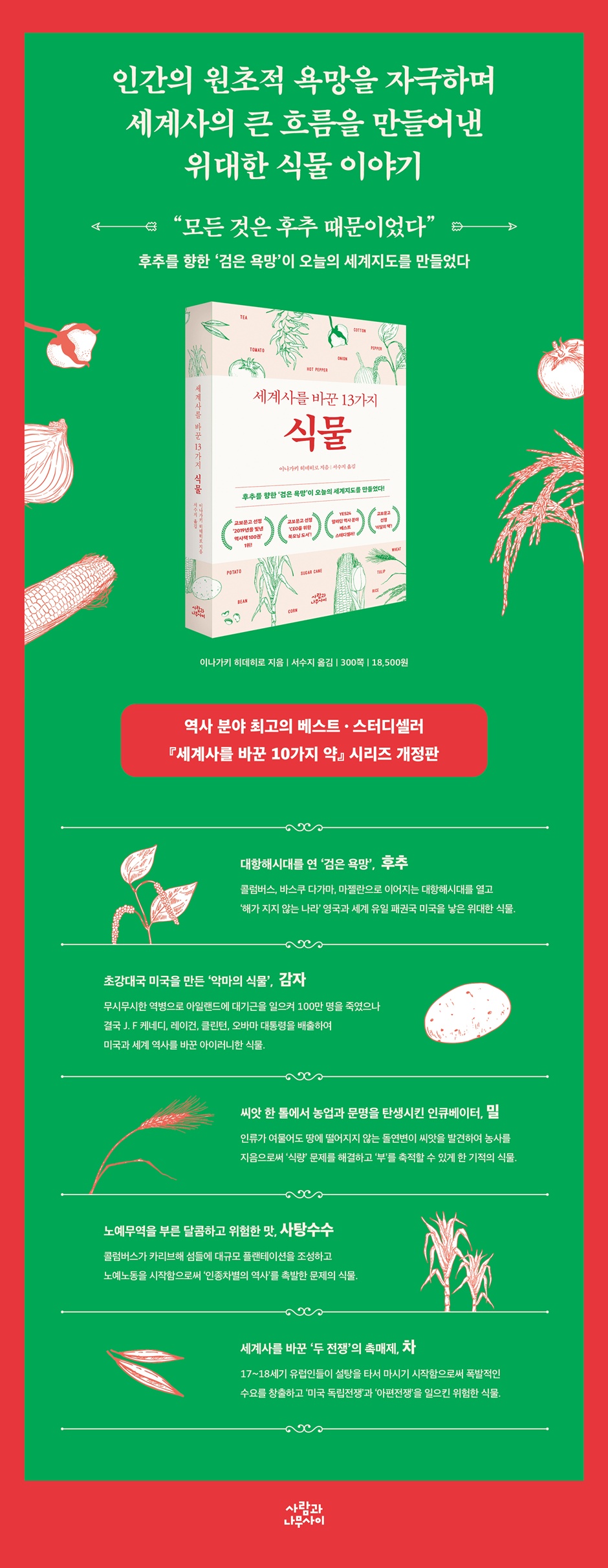
ㆍPepper, the 'black desire' that opened the Age of Exploration - The great plant that opened the Age of Exploration, which continued with Columbus, Vasco da Gama, and Magellan, and gave birth to England, the 'nation on which the sun never sets', and the United States, the world's only superpower.
ㆍThe 'devil's plant' that created the superpower America, the potato - caused a famine in Ireland with a terrible plague that killed 1 million people, but was eventually defeated by J.
An ironic plant that changed American and world history by producing Presidents F. Kennedy, Reagan, Clinton, and Obama.
ㆍWheat, the incubator that gave birth to agriculture and civilization from a single seed - a miraculous plant that allowed mankind to solve the 'food' problem and accumulate 'wealth' by discovering a mutant seed that does not fall to the ground even when ripe and cultivating it.
ㆍSugarcane, the sweet and dangerous taste that led to the slave trade - the problematic plant that triggered the 'history of racial discrimination' when Columbus established large-scale plantations on Caribbean islands and began using slave labor.
ㆍTea, the catalyst for the 'two wars' that changed world history - A dangerous plant that created explosive demand when Europeans began drinking it with sugar in the 17th and 18th centuries, sparking the 'American Revolutionary War' and the 'Opium Wars.'
Stimulating the primal desires of humans
The story of a great plant that shaped the great flow of world history.
The second book in the series, "10 Medicines That Changed World History," which has been a bestseller in the history category for over a year in major online and offline bookstores such as Kyobo Bookstore and Yes24, and has provided new inspiration and enjoyable knowledge to many history students, natural science students, and general readers with a strong intellectual curiosity, has been published by People and Trees.
As the title suggests, 『13 Plants That Changed World History』 is composed of 13 chapters, including the specific outline of "The Devil's Plant That Created the Superpower America - Potato", "The Bright Red Fruit That Changed the Table of Mankind - Tomato", "The 'Black Desire' That Opened the Age of Exploration - Pepper", "Columbus's Anguish and Asia's Frenzy - Chili Pepper", "The Medicinal Effects That Supported the Great Pyramids - Onion", "The Catalyst of the 'Two Wars' That Changed World History - Tea", "The Sweet and Dangerous Taste That Caused the Slave Trade, a Disaster for Mankind - Sugarcane", "The Plant That Sparked the Industrial Revolution - Cotton", "The Incubator That Gave Birth to Civilization from a Single Seed - Grain and Wheat", "The Crops That Laid the Foundation for the Birth of Ancient Nations - Rice", "The Plant That Overcame the Crisis of the Great Depression - Soybeans", "The Most Widely Cultivated Crop in the World - Corn", and "The Bulb of Desire That Created the First Bubble Economy in Human History - Tulips".
Would you believe that plants have completely changed 10,000 years of human history? A mutant wheat seed discovered by chance during a time when humans relied on hunting and gathering to survive.
That one tiny grain of rice made agriculture possible, allowing humanity to survive and thrive.
It created wealth and power, the gap between rich and poor, and class.
It gave birth to civilization and led to the creation and development of nations.
As you read this book, you will gain new perspectives and profound insights into the history of humanity, created by seemingly inert plants that move passionately, stimulating and driving human desires.
ㆍThe 'black desire' for pepper created today's world map... ...?!
It was all because of 'pepper'.
No, to be more precise, it all started with man's 'black desire' for pepper.
Christopher Columbus's discovery of the American continent, Vasco da Gama's great voyage, and Ferdinand Magellan's first circumnavigation of the world all originated from 'pepper'.
When you look closely, the fact that Spain and Portugal ushered in the Age of Exploration, that Britain built the British Empire, the "nation on which the sun never sets," and that the United States then took over from Britain and established itself as the world's sole superpower and continued its rise was all due to pepper.
In 15th century Europe, the price of pepper skyrocketed by the day.
It was said that 'the price of pepper is equivalent to the price of gold', and this was not an exaggeration.
In fact, one gram of pepper was traded at a price similar to the price of pure gold of the same weight.
In that way, in contemporary Europe, individuals who acquired pepper could amass wealth and wield power.
The same was true for the country.
A country that monopolized the pepper trade could gain a unique position over its formidable competitors.
Portugal's sponsorship of Vasco da Gama and Spain's sponsorship of Columbus and Magellan on their expeditions were also manifestations of a dark desire to monopolize pepper, which was produced only in India.
ㆍIf there had been no Irish famine caused by potato blight and the Great Migration to America, American and world history would have unfolded completely differently… …?!
It's hard to believe that potatoes played a significant role in making the United States the superpower it is today.
19th century Ireland was the starting point.
At that time, a great famine caused by potato blight swept through Ireland.
The Great Famine had disastrous consequences for Ireland.
As many as one million people suffered from hunger and died.
Those who were lucky enough to survive left their hometowns and immigrated to the United States, which was considered a new world at the time.
The number reached a whopping 4 million.
In the 19th century, America was entering a period of full-scale industrialization.
Around this time, the Irish, who had immigrated to the United States to escape the Great Famine, transformed into a large group of workers and contributed greatly to the industrialization and modernization of the United States.
During this period, the United States, based on the wealth and energy it accumulated intensively, surpassed Britain, the most powerful country at the time, and emerged as the world's leading industrial nation.
The impact of the Irish Famine did not end there.
Among those who immigrated to the United States to escape the Great Famine was J.J., who was the main character in the lunar exploration project and the 35th President of the United States.
There was also F. Kennedy's grandfather, Patrick Kennedy.
The ancestors of Presidents Reagan, Clinton, and Obama, who were among the key figures in shaping modern American and world history, were also among them.
In addition, Walt Disney, who created Walt Disney, and the McDonald brothers, who founded McDonald's, are also descendants of Irish immigrants.
There are no "ifs" in history, but what if the 19th-century Irish potato famine had never occurred, and the resulting Irish exodus to America had never occurred?
Even outstanding American presidents like Kennedy, Reagan, Clinton, and Obama would not have emerged.
And today, America, the world, and the world map likely look quite different.
ㆍThe large-scale sugarcane plantations that Columbus, unable to find pepper, established in the Caribbean islands as an alternative means of gaining wealth and power created a history of slave trade and racial discrimination… …?!
Sugarcane, a crop with a sweet taste, changed world history.
Even in this dramatic page of world history, the problematic figure Columbus appears.
Columbus explored the Americas with the support of Queen Isabella of Spain, but he did not find the pepper she desperately wanted.
Pepper, which originated in southern India, was only produced in that area, as the land that Columbus reached after his long voyage was the American continent, not India in Asia.
Of course, there was no pepper there.
Columbus led his men for days in search of pepper, but they never found it.
Instead of pepper, the crop he discovered was 'chili pepper'.
Columbus sent chili peppers, a completely different crop from pepper, to Spain disguised as pepper.
Just as the American continent had to be India for him, the pepper he discovered there had to be pepper (according to the author, this is why the islands of the Caribbean in Central and South America today are called the 'West Indies' and why the English names for hot peppers (red peppers), green peppers, and sweet peppers, which have nothing to do with pepper, include the word 'pepper'._Translator's note).
Can't you picture Columbus, who set out on a great adventure betting everything on pepper, being embarrassed and troubled in front of pepper?
Ultimately, Columbus and Spain embarked on new economic activities to create wealth and power in the West Indies.
The crop they focused on was sugarcane, the raw material for sugar, a luxurious commodity that was only available to some royalty and nobles at the time.
Sugarcane is native to Southeast Asia, which has a subtropical climate, but the warm climate of the Caribbean islands seemed suitable for sugarcane cultivation, and Columbus brought this crop to the Americas.
Sugarcane, introduced as planned, grew into a goose that laid golden eggs, replacing pepper, and created enormous wealth.
Sugarcane cultivation was an agricultural activity that required a huge amount of labor.
Unlike rice farming, the entire process, from planting seedlings to harvesting, had to be done by human strength and effort, not by livestock.
Sugarcane farming in the West Indies, initiated and developed by Columbus, developed into large-scale plantations. To meet the enormous labor force required for these operations, the slave trade was attempted, and a terrible history of racial discrimination and abuse began.
When tea was introduced from Asia (China) to Europe in the 17th century, it greatly increased the value of sugar.
Unlike Asians who enjoy the original bitter taste of tea, in Europe, sugar was added to eliminate the bitter taste and enhance the sweetness, which led to the popularization of black tea culture and explosive increase in demand for sugar.
Sugarcane, the raw material for sugar, once again significantly changed world history as it intertwined with the popularization of black tea in Europe.
In each and every plant we grow and eat,
Who knew there was such an amazing story hidden there!
Wheat, the incubator that gave birth to civilization from a single seed
It was a single, accidentally discovered seed of a mutant wheat that solved the food problem of early humans who relied on hunting and gathering.
Originally, wheat seeds, a type of grass, could not be farmed by storing them and then planting them in the ground because of their 'shedding' nature (the property of plants to shed seeds from their bodies to increase the possibility of reproduction).
However, in very rare cases, wheat varieties have appeared that are 'non-droppable', meaning that the seeds do not fall to the ground even when ripe.
Some early humans who noticed this picked up the mutant seeds, saved them, and began planting them in the ground.
That's how agriculture began, created wealth, and fundamentally changed world history.
ㆍOnions, the medicinal properties that supported the giant pyramids
Archaeologists examining pyramid reliefs built several centuries BC make a surprising discovery.
It is a scene of workers building a pyramid with onions hanging from their waists.
This is because the ancient Egyptian royal family provided onions, which served as a tonic, to the pyramid construction workers.
Some historians even claim that the Great Pyramid, the greatest cultural heritage of mankind, would not have been successfully completed if it had not been supported by the excellent efficacy of onions.
This is because building the pyramids was a task that required enormous labor and high-level skills.
Tomatoes, the bright red fruit that changed the human diet
Tomatoes, which are native to the Andes Mountains of South America, were introduced to Europe in the 16th century after Columbus's exploration of the American continent.
However, tomatoes were branded as poisonous and were completely ignored for over 200 years, bearing the stigma of being the 'devil's plant', until the 18th century when the people of Naples, Italy, began using them as a food ingredient in cooking for workers and commoners, and they began to take the path to becoming popular.
Tomatoes have become so popular that they are ranked as the world's largest non-food crop in terms of production, changing the way people eat.
Corn, the most widely cultivated crop worldwide
There is a strange(?) plant that was rejected by Europeans because it was said to be 'against the laws of nature'.
It's corn.
To Europeans, who were accustomed to cereals such as barley and wheat, corn was a strange plant.
Corn cannot disperse its seeds because they are tightly wrapped in husks, which should allow them to spread far.
Moreover, even if the yellow kernels wrapped in a shell are exposed, the seeds do not fall to the ground.
If you don't drop the seeds on the ground like that, you won't be able to leave offspring.
Surprisingly, however, today corn is the most produced crop worldwide.
It is used not only as food for humans and livestock, but also as materials for industrial alcohol and paper boxes, and as a bioenergy source to replace petroleum.
Modern civilization would not be possible without corn.
ㆍTea, the catalyst for the 'two wars' that changed world history
A small change in European habits in the 17th and 18th centuries, when they began adding sugar, which had come from America, to tea, a mysterious beverage from the East, completely changed world history.
Black tea, which became a favorite of Europeans thanks to sugar, changed world history by triggering the 'Two Wars' in the process of trying to meet the explosive demand.
One is the American Revolutionary War, and the other is the Opium War between Britain and China.
The story of a great plant that shaped the great flow of world history.
ㆍPepper, the 'black desire' that opened the Age of Exploration - The great plant that opened the Age of Exploration, which continued with Columbus, Vasco da Gama, and Magellan, and gave birth to England, the 'nation on which the sun never sets', and the United States, the world's only superpower.
ㆍThe 'devil's plant' that created the superpower America, the potato - caused a famine in Ireland with a terrible plague that killed 1 million people, but was eventually defeated by J.
An ironic plant that changed American and world history by producing Presidents F. Kennedy, Reagan, Clinton, and Obama.
ㆍWheat, the incubator that gave birth to agriculture and civilization from a single seed - a miraculous plant that allowed mankind to solve the 'food' problem and accumulate 'wealth' by discovering a mutant seed that does not fall to the ground even when ripe and cultivating it.
ㆍSugarcane, the sweet and dangerous taste that led to the slave trade - the problematic plant that triggered the 'history of racial discrimination' when Columbus established large-scale plantations on Caribbean islands and began using slave labor.
ㆍTea, the catalyst for the 'two wars' that changed world history - A dangerous plant that created explosive demand when Europeans began drinking it with sugar in the 17th and 18th centuries, sparking the 'American Revolutionary War' and the 'Opium Wars.'
Stimulating the primal desires of humans
The story of a great plant that shaped the great flow of world history.
The second book in the series, "10 Medicines That Changed World History," which has been a bestseller in the history category for over a year in major online and offline bookstores such as Kyobo Bookstore and Yes24, and has provided new inspiration and enjoyable knowledge to many history students, natural science students, and general readers with a strong intellectual curiosity, has been published by People and Trees.
As the title suggests, 『13 Plants That Changed World History』 is composed of 13 chapters, including the specific outline of "The Devil's Plant That Created the Superpower America - Potato", "The Bright Red Fruit That Changed the Table of Mankind - Tomato", "The 'Black Desire' That Opened the Age of Exploration - Pepper", "Columbus's Anguish and Asia's Frenzy - Chili Pepper", "The Medicinal Effects That Supported the Great Pyramids - Onion", "The Catalyst of the 'Two Wars' That Changed World History - Tea", "The Sweet and Dangerous Taste That Caused the Slave Trade, a Disaster for Mankind - Sugarcane", "The Plant That Sparked the Industrial Revolution - Cotton", "The Incubator That Gave Birth to Civilization from a Single Seed - Grain and Wheat", "The Crops That Laid the Foundation for the Birth of Ancient Nations - Rice", "The Plant That Overcame the Crisis of the Great Depression - Soybeans", "The Most Widely Cultivated Crop in the World - Corn", and "The Bulb of Desire That Created the First Bubble Economy in Human History - Tulips".
Would you believe that plants have completely changed 10,000 years of human history? A mutant wheat seed discovered by chance during a time when humans relied on hunting and gathering to survive.
That one tiny grain of rice made agriculture possible, allowing humanity to survive and thrive.
It created wealth and power, the gap between rich and poor, and class.
It gave birth to civilization and led to the creation and development of nations.
As you read this book, you will gain new perspectives and profound insights into the history of humanity, created by seemingly inert plants that move passionately, stimulating and driving human desires.
ㆍThe 'black desire' for pepper created today's world map... ...?!
It was all because of 'pepper'.
No, to be more precise, it all started with man's 'black desire' for pepper.
Christopher Columbus's discovery of the American continent, Vasco da Gama's great voyage, and Ferdinand Magellan's first circumnavigation of the world all originated from 'pepper'.
When you look closely, the fact that Spain and Portugal ushered in the Age of Exploration, that Britain built the British Empire, the "nation on which the sun never sets," and that the United States then took over from Britain and established itself as the world's sole superpower and continued its rise was all due to pepper.
In 15th century Europe, the price of pepper skyrocketed by the day.
It was said that 'the price of pepper is equivalent to the price of gold', and this was not an exaggeration.
In fact, one gram of pepper was traded at a price similar to the price of pure gold of the same weight.
In that way, in contemporary Europe, individuals who acquired pepper could amass wealth and wield power.
The same was true for the country.
A country that monopolized the pepper trade could gain a unique position over its formidable competitors.
Portugal's sponsorship of Vasco da Gama and Spain's sponsorship of Columbus and Magellan on their expeditions were also manifestations of a dark desire to monopolize pepper, which was produced only in India.
ㆍIf there had been no Irish famine caused by potato blight and the Great Migration to America, American and world history would have unfolded completely differently… …?!
It's hard to believe that potatoes played a significant role in making the United States the superpower it is today.
19th century Ireland was the starting point.
At that time, a great famine caused by potato blight swept through Ireland.
The Great Famine had disastrous consequences for Ireland.
As many as one million people suffered from hunger and died.
Those who were lucky enough to survive left their hometowns and immigrated to the United States, which was considered a new world at the time.
The number reached a whopping 4 million.
In the 19th century, America was entering a period of full-scale industrialization.
Around this time, the Irish, who had immigrated to the United States to escape the Great Famine, transformed into a large group of workers and contributed greatly to the industrialization and modernization of the United States.
During this period, the United States, based on the wealth and energy it accumulated intensively, surpassed Britain, the most powerful country at the time, and emerged as the world's leading industrial nation.
The impact of the Irish Famine did not end there.
Among those who immigrated to the United States to escape the Great Famine was J.J., who was the main character in the lunar exploration project and the 35th President of the United States.
There was also F. Kennedy's grandfather, Patrick Kennedy.
The ancestors of Presidents Reagan, Clinton, and Obama, who were among the key figures in shaping modern American and world history, were also among them.
In addition, Walt Disney, who created Walt Disney, and the McDonald brothers, who founded McDonald's, are also descendants of Irish immigrants.
There are no "ifs" in history, but what if the 19th-century Irish potato famine had never occurred, and the resulting Irish exodus to America had never occurred?
Even outstanding American presidents like Kennedy, Reagan, Clinton, and Obama would not have emerged.
And today, America, the world, and the world map likely look quite different.
ㆍThe large-scale sugarcane plantations that Columbus, unable to find pepper, established in the Caribbean islands as an alternative means of gaining wealth and power created a history of slave trade and racial discrimination… …?!
Sugarcane, a crop with a sweet taste, changed world history.
Even in this dramatic page of world history, the problematic figure Columbus appears.
Columbus explored the Americas with the support of Queen Isabella of Spain, but he did not find the pepper she desperately wanted.
Pepper, which originated in southern India, was only produced in that area, as the land that Columbus reached after his long voyage was the American continent, not India in Asia.
Of course, there was no pepper there.
Columbus led his men for days in search of pepper, but they never found it.
Instead of pepper, the crop he discovered was 'chili pepper'.
Columbus sent chili peppers, a completely different crop from pepper, to Spain disguised as pepper.
Just as the American continent had to be India for him, the pepper he discovered there had to be pepper (according to the author, this is why the islands of the Caribbean in Central and South America today are called the 'West Indies' and why the English names for hot peppers (red peppers), green peppers, and sweet peppers, which have nothing to do with pepper, include the word 'pepper'._Translator's note).
Can't you picture Columbus, who set out on a great adventure betting everything on pepper, being embarrassed and troubled in front of pepper?
Ultimately, Columbus and Spain embarked on new economic activities to create wealth and power in the West Indies.
The crop they focused on was sugarcane, the raw material for sugar, a luxurious commodity that was only available to some royalty and nobles at the time.
Sugarcane is native to Southeast Asia, which has a subtropical climate, but the warm climate of the Caribbean islands seemed suitable for sugarcane cultivation, and Columbus brought this crop to the Americas.
Sugarcane, introduced as planned, grew into a goose that laid golden eggs, replacing pepper, and created enormous wealth.
Sugarcane cultivation was an agricultural activity that required a huge amount of labor.
Unlike rice farming, the entire process, from planting seedlings to harvesting, had to be done by human strength and effort, not by livestock.
Sugarcane farming in the West Indies, initiated and developed by Columbus, developed into large-scale plantations. To meet the enormous labor force required for these operations, the slave trade was attempted, and a terrible history of racial discrimination and abuse began.
When tea was introduced from Asia (China) to Europe in the 17th century, it greatly increased the value of sugar.
Unlike Asians who enjoy the original bitter taste of tea, in Europe, sugar was added to eliminate the bitter taste and enhance the sweetness, which led to the popularization of black tea culture and explosive increase in demand for sugar.
Sugarcane, the raw material for sugar, once again significantly changed world history as it intertwined with the popularization of black tea in Europe.
In each and every plant we grow and eat,
Who knew there was such an amazing story hidden there!
Wheat, the incubator that gave birth to civilization from a single seed
It was a single, accidentally discovered seed of a mutant wheat that solved the food problem of early humans who relied on hunting and gathering.
Originally, wheat seeds, a type of grass, could not be farmed by storing them and then planting them in the ground because of their 'shedding' nature (the property of plants to shed seeds from their bodies to increase the possibility of reproduction).
However, in very rare cases, wheat varieties have appeared that are 'non-droppable', meaning that the seeds do not fall to the ground even when ripe.
Some early humans who noticed this picked up the mutant seeds, saved them, and began planting them in the ground.
That's how agriculture began, created wealth, and fundamentally changed world history.
ㆍOnions, the medicinal properties that supported the giant pyramids
Archaeologists examining pyramid reliefs built several centuries BC make a surprising discovery.
It is a scene of workers building a pyramid with onions hanging from their waists.
This is because the ancient Egyptian royal family provided onions, which served as a tonic, to the pyramid construction workers.
Some historians even claim that the Great Pyramid, the greatest cultural heritage of mankind, would not have been successfully completed if it had not been supported by the excellent efficacy of onions.
This is because building the pyramids was a task that required enormous labor and high-level skills.
Tomatoes, the bright red fruit that changed the human diet
Tomatoes, which are native to the Andes Mountains of South America, were introduced to Europe in the 16th century after Columbus's exploration of the American continent.
However, tomatoes were branded as poisonous and were completely ignored for over 200 years, bearing the stigma of being the 'devil's plant', until the 18th century when the people of Naples, Italy, began using them as a food ingredient in cooking for workers and commoners, and they began to take the path to becoming popular.
Tomatoes have become so popular that they are ranked as the world's largest non-food crop in terms of production, changing the way people eat.
Corn, the most widely cultivated crop worldwide
There is a strange(?) plant that was rejected by Europeans because it was said to be 'against the laws of nature'.
It's corn.
To Europeans, who were accustomed to cereals such as barley and wheat, corn was a strange plant.
Corn cannot disperse its seeds because they are tightly wrapped in husks, which should allow them to spread far.
Moreover, even if the yellow kernels wrapped in a shell are exposed, the seeds do not fall to the ground.
If you don't drop the seeds on the ground like that, you won't be able to leave offspring.
Surprisingly, however, today corn is the most produced crop worldwide.
It is used not only as food for humans and livestock, but also as materials for industrial alcohol and paper boxes, and as a bioenergy source to replace petroleum.
Modern civilization would not be possible without corn.
ㆍTea, the catalyst for the 'two wars' that changed world history
A small change in European habits in the 17th and 18th centuries, when they began adding sugar, which had come from America, to tea, a mysterious beverage from the East, completely changed world history.
Black tea, which became a favorite of Europeans thanks to sugar, changed world history by triggering the 'Two Wars' in the process of trying to meet the explosive demand.
One is the American Revolutionary War, and the other is the Opium War between Britain and China.
GOODS SPECIFICS
- Date of issue: August 28, 2025
- Page count, weight, size: 300 pages | 494g | 141*215*25mm
- ISBN13: 9791194096238
- ISBN10: 1194096239
You may also like
카테고리
korean


korean

![GQ KOREA Mark (Monthly): December [2025]](http://librairie.coreenne.fr/cdn/shop/files/8ef265dbbfbf186523ed75ba7319009d.jpg?v=1765340328&width=3840)


