

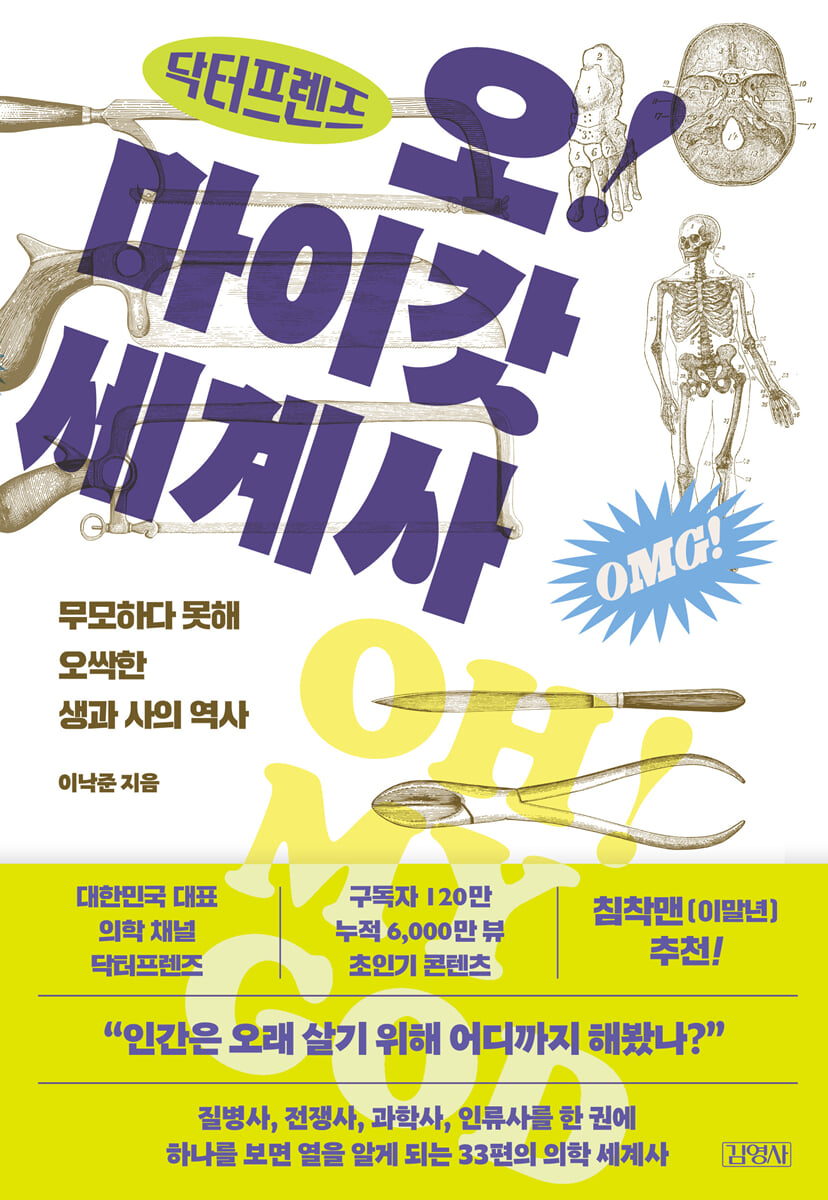
Doctor Friends' Oh My God World History
 |
Description
Book Introduction
The super popular content "History of Medicine" from Doctor Friends, Korea's leading medical channel with 1.2 million subscribers and 60 million cumulative views, has been published. From the ancient times when people were digging in the ground, to the Middle Ages when digging was rampant, to the modern era when countless atrocities unfolded, to the present day when we enjoy cutting-edge medical services, humanity has long striven to live longer and healthier lives, reaching the present age. A chilling, if reckless, history of life and death, crafted with a profound knowledge of history and medicine, masterful storytelling, and extensive research. A rich viewing experience with stories not covered in the video, over 70 photos and illustrations, and colorful medical commentary. Everyday culture and medical common sense that transcends war and civilization, religion and art, science and philosophy. The moment you close the last page of this book, you will be reborn as a truly cultured person. |
- You can preview some of the book's contents.
Preview
index
Introduction│The history of medicine, by far the most interesting history in the world.
Chapter 1: Between Passion and the Majesty: The History of Medical Development
Anatomy│Why Anatomy in Ancient Greece Was Called the Devil's Knowledge
Death Diagnosis│Why Our Ancestors Held Three-Day Funerals
Handwashing│Why the University of Vienna Medical School in Austria is the Best in the World
Anesthesia│What Happens When You Have Surgery While Sober
Surgical Gloves│The World's Most Romantic Invention
Blood Transfusion│The Struggles of Doctors Who Didn't Know Blood Types
Medical Tools│What were surgeries done with in the past?
Epidemiological Survey│Why 19th-Century Waterworks and Sewerage Were a Real Hell
Shaving│Humans have been managing their hair with hair removal cream since the Bronze Age.
Hair Loss│Oh God, I'll do anything
Chapter 2: A Disease Healer Who Overcame Challenges with a Single Spirit
Scurvy│Why Healthy Sailors Continued to Die During the Age of Exploration
Malaria│Why the Roman Empire Never Fell
Hemorrhoids│I tried licking them with my tongue and burning them with fire, but
Syphilis│A venereal disease that crossed from the New World to the Old World
Diabetes│A disease that can lead to death if you find a bug in your urine.
Smallpox│Our ancestors responded surprisingly well to the worst infectious disease.
Phantom Pain│Pain proven only after 30,000 limbs were amputated
Hypertension│How did we learn the usefulness of blood pressure measurement?
Chapter 3: The Cruel History of Drug Abuse and Ignorance
Opium│Oh my goodness, you drugged your children to put them to sleep?
Cannabis│Humanity began farming for drugs, not food?
Cocaine│A Gift from God or a Whisper from the Devil?
Arsenic│If you eat too much, you'll die, so should I eat a little?
Mercury│People who dreamed of immortality by drinking silver water
Lead│I should have known that lead tastes sweet.
Radiation│The Tragedies Born from the Illusion of a Panacea
Chapter 4: From Stone Axes to Cutting-Edge 21st-Century Medical Technology
Vasectomy│People here are sincere, past and present.
Wound Treatment│Not only did it rot, but you poured boiling oil on it?
Headache Treatment│Humans Covered Their Skulls with Stones to Catch Bugs
Psychiatry│Something Even the Royal Family Couldn't Do in Their Lives
Urinary Stones│All those who do not know this pain, please keep quiet.
Cataract Surgery│When Going Blind Was a Better Option
Plastic Surgery│A History of Recovery Beginning in Ancient India?
Liposuction│The dangers of suddenly losing weight
References
Chapter 1: Between Passion and the Majesty: The History of Medical Development
Anatomy│Why Anatomy in Ancient Greece Was Called the Devil's Knowledge
Death Diagnosis│Why Our Ancestors Held Three-Day Funerals
Handwashing│Why the University of Vienna Medical School in Austria is the Best in the World
Anesthesia│What Happens When You Have Surgery While Sober
Surgical Gloves│The World's Most Romantic Invention
Blood Transfusion│The Struggles of Doctors Who Didn't Know Blood Types
Medical Tools│What were surgeries done with in the past?
Epidemiological Survey│Why 19th-Century Waterworks and Sewerage Were a Real Hell
Shaving│Humans have been managing their hair with hair removal cream since the Bronze Age.
Hair Loss│Oh God, I'll do anything
Chapter 2: A Disease Healer Who Overcame Challenges with a Single Spirit
Scurvy│Why Healthy Sailors Continued to Die During the Age of Exploration
Malaria│Why the Roman Empire Never Fell
Hemorrhoids│I tried licking them with my tongue and burning them with fire, but
Syphilis│A venereal disease that crossed from the New World to the Old World
Diabetes│A disease that can lead to death if you find a bug in your urine.
Smallpox│Our ancestors responded surprisingly well to the worst infectious disease.
Phantom Pain│Pain proven only after 30,000 limbs were amputated
Hypertension│How did we learn the usefulness of blood pressure measurement?
Chapter 3: The Cruel History of Drug Abuse and Ignorance
Opium│Oh my goodness, you drugged your children to put them to sleep?
Cannabis│Humanity began farming for drugs, not food?
Cocaine│A Gift from God or a Whisper from the Devil?
Arsenic│If you eat too much, you'll die, so should I eat a little?
Mercury│People who dreamed of immortality by drinking silver water
Lead│I should have known that lead tastes sweet.
Radiation│The Tragedies Born from the Illusion of a Panacea
Chapter 4: From Stone Axes to Cutting-Edge 21st-Century Medical Technology
Vasectomy│People here are sincere, past and present.
Wound Treatment│Not only did it rot, but you poured boiling oil on it?
Headache Treatment│Humans Covered Their Skulls with Stones to Catch Bugs
Psychiatry│Something Even the Royal Family Couldn't Do in Their Lives
Urinary Stones│All those who do not know this pain, please keep quiet.
Cataract Surgery│When Going Blind Was a Better Option
Plastic Surgery│A History of Recovery Beginning in Ancient India?
Liposuction│The dangers of suddenly losing weight
References
Detailed image

Into the book
I dare say that the history of medicine is the most interesting of all history.
I'm not just saying this out of the blue.
The history of medicine is the story of humanity's desperate struggle to fight the most fearsome and powerful enemy: disease.
At the center of it all are doctors who did their best, even if they lacked knowledge and experience.
There were patients who gave their bodies to doctors, prepared to die.
Ultimately, the history of medicine is the story of doctors and patients who fought against disease.
The countless trials and errors of humanity as they confronted the pain and suffering of disease head-on ultimately led to the remarkable advancements of modern medicine.
---From "Entering"
The Alexandrian leader gives Herophilus permission to dissect the body until it dies.
At that time, Alexandria performed autopsies on condemned prisoners.
If you look closely at the records, it says that the autopsy was performed while the condemned man was still breathing.
Some accounts even say that dissection was performed as a means of execution.
It's really horrible.
Because he dissected a living person, Herophilus was able to discover the existence of invisible nerves.
In this way, Herophilus dissected until his death, leaving behind pioneering knowledge based on the suffering of countless people.
---From "Anatomy│Why Anatomy in Ancient Greece Was Called the Devil's Knowledge"
It is no exaggeration to say that the development of anesthetics and antibiotics has brought about a quantum leap in surgery.
Only through anesthesia can we perform surgery while considering the anatomical structure of the human body.
But when there was no anesthesia, they gave them alcohol.
Opium was excellent for pain relief, but if given to a patient whose physical condition was deteriorating, it could easily lead to death from respiratory distress.
Some swindler doctors claimed that hypnosis was possible, but you can't be hypnotized when you're holding a knife in front of you.
But how desperate must it have been?
---From "Medical Tools│What Did They Use for Surgery in the Olden Days?"
The interesting thing here is that pirates did not suffer from scurvy.
Pirates don't move for long.
They hid and attacked passing ships, so they could fish and eat fresh food on land, avoiding scurvy.
Then someone eats a lemon and gets better.
By chance, I gave him a lemon, the freshest food on the ship, and he got better after eating it.
Then, you should feed them lemons as a remedy, right? But lemons were expensive and rare back then.
So we look for a replacement.
Lemon? Sour? Acidic? So dilute the sulfuric acid and drink it.
Instead of getting better, I keep dying.
This situation continued until 1740.
Time passes without scurvy being cured.
---From "Scurvy│The Age of Exploration, Why Healthy Sailors Continued to Die"
Based on Galen's idea, we first tie up the hemorrhoids and then cauterize them.
But then, because the ending isn't clean after the treatment, I keep dying.
So, tie the hemorrhoid, wait a long time, and then cut it off with scissors.
Then it was the cleanest.
After Felix masters this, he goes to the Sun King.
75 poor people died before this hemorrhoid surgery was discovered.
Medicine truly feeds on life and advances.
Louis XIV does not die after Felix's surgery.
This was such a great feat that the Paris Medical School reinstated surgery as a regular subject.
A portrait of Felix hangs in the Royal Academy of Surgery of France, founded in the early 18th century.
I'm not just saying this out of the blue.
The history of medicine is the story of humanity's desperate struggle to fight the most fearsome and powerful enemy: disease.
At the center of it all are doctors who did their best, even if they lacked knowledge and experience.
There were patients who gave their bodies to doctors, prepared to die.
Ultimately, the history of medicine is the story of doctors and patients who fought against disease.
The countless trials and errors of humanity as they confronted the pain and suffering of disease head-on ultimately led to the remarkable advancements of modern medicine.
---From "Entering"
The Alexandrian leader gives Herophilus permission to dissect the body until it dies.
At that time, Alexandria performed autopsies on condemned prisoners.
If you look closely at the records, it says that the autopsy was performed while the condemned man was still breathing.
Some accounts even say that dissection was performed as a means of execution.
It's really horrible.
Because he dissected a living person, Herophilus was able to discover the existence of invisible nerves.
In this way, Herophilus dissected until his death, leaving behind pioneering knowledge based on the suffering of countless people.
---From "Anatomy│Why Anatomy in Ancient Greece Was Called the Devil's Knowledge"
It is no exaggeration to say that the development of anesthetics and antibiotics has brought about a quantum leap in surgery.
Only through anesthesia can we perform surgery while considering the anatomical structure of the human body.
But when there was no anesthesia, they gave them alcohol.
Opium was excellent for pain relief, but if given to a patient whose physical condition was deteriorating, it could easily lead to death from respiratory distress.
Some swindler doctors claimed that hypnosis was possible, but you can't be hypnotized when you're holding a knife in front of you.
But how desperate must it have been?
---From "Medical Tools│What Did They Use for Surgery in the Olden Days?"
The interesting thing here is that pirates did not suffer from scurvy.
Pirates don't move for long.
They hid and attacked passing ships, so they could fish and eat fresh food on land, avoiding scurvy.
Then someone eats a lemon and gets better.
By chance, I gave him a lemon, the freshest food on the ship, and he got better after eating it.
Then, you should feed them lemons as a remedy, right? But lemons were expensive and rare back then.
So we look for a replacement.
Lemon? Sour? Acidic? So dilute the sulfuric acid and drink it.
Instead of getting better, I keep dying.
This situation continued until 1740.
Time passes without scurvy being cured.
---From "Scurvy│The Age of Exploration, Why Healthy Sailors Continued to Die"
Based on Galen's idea, we first tie up the hemorrhoids and then cauterize them.
But then, because the ending isn't clean after the treatment, I keep dying.
So, tie the hemorrhoid, wait a long time, and then cut it off with scissors.
Then it was the cleanest.
After Felix masters this, he goes to the Sun King.
75 poor people died before this hemorrhoid surgery was discovered.
Medicine truly feeds on life and advances.
Louis XIV does not die after Felix's surgery.
This was such a great feat that the Paris Medical School reinstated surgery as a regular subject.
A portrait of Felix hangs in the Royal Academy of Surgery of France, founded in the early 18th century.
---From "Hemorrhoids│I've tried licking them with my tongue and burning them with fire"
Publisher's Review
“How far have humans gone to live a long and healthy life?”
History of disease, history of war, history of science, and history of mankind in one volume
33 World History of Medicine: Seeing One and Knowing Ten
Doctor Friends, Korea's leading medical channel with 1.2 million subscribers.
Among them, the super popular content boasting 60 million cumulative views has finally been published.
This is a story of fierce life and death created by the will of humans to live, from the ancient times when people were digging in the bare ground, to the Middle Ages when people were digging in the ground, to the modern times when countless atrocities unfolded, to the present day when we enjoy cutting-edge medical services, until we reach the age of 100, when humanity longed to live healthily without illness.
Author Lee Nak-jun is an otolaryngologist and web novel writer.
This content began when he introduced the surprising stories he discovered through his fascination with medical history to the Doctor Friends channel.
The compelling videos, created through extensive research, excellent storytelling, and extensive knowledge of history and medicine, immediately captivated the eyes and ears of viewers.
In this way, it became a popular content that many people sought out and enjoyed, receiving reviews such as, "History that you can trust and watch" and "Each historical event is new when connected to medicine."
This book enriches the viewing experience with more stories than were covered in the video, along with over 70 photographs and illustrations, and colorful medical commentary.
Also, with the writing skills of a popular web novel writer, the story was given a unique liveliness, making it very enjoyable to read.
History will become more interesting and the unfamiliarity with medicine will disappear.
“The history of medicine is the story of humanity’s desperate struggle to fight the most fearsome and powerful enemy known as ‘disease.’
At the center of it all are doctors who did their best, even if they lacked knowledge and experience.
There are times when I think, 'Oh, maybe I shouldn't have tried my best.'
Yet, the reason why the history of medicine was able to continue is because it was not only doctors who fought disease.
There were patients who gave their bodies to doctors, prepared to die.
Ultimately, the history of medicine is the story of doctors and patients who fought against disease.” _From “Introduction”
It consists of a total of 4 chapters.
Chapter 1 examines how the foundations of medicine, including anatomy, death diagnosis, hand washing, blood transfusions, and anesthesia, have developed and developed from ancient times to the present.
Chapter 2 guides you through the historical traces of diseases such as scurvy, smallpox, malaria, diabetes, and hypertension, along with past and present treatments.
Chapter 3 covers the history of ignorance and abuse of drugs such as marijuana, cocaine, opium, mercury, and radioactivity, raising awareness of drugs and heavy metals.
Chapter 4 tells the history of surgery, a time when humans did not hesitate to see blood to relieve physical pain, such as wounds, mental illness, kidney stones, and cataracts.
The history of medicine is the history of mankind.
A glance at the flow of world history through the lens of medicine.
From ancient Egyptian civilization to cutting-edge 21st-century medical technology, this is a story of survival, written with a spirit of challenge, curiosity, and passion.
Through countless reckless, absurd, and bizarre trials and errors, it conveys everyday culture and medical common sense that transcends war and civilization, religion and art, science and philosophy, without missing out on both fun and usefulness.
The moment you close the last page of this book, you will be reborn as a truly cultured person.
“Oh, God! Free humanity from suffering!”
Unraveled with engaging storytelling and medical insight
Crucial scenes that saved humanity
What if someone in the 21st century caught a cold or developed hemorrhoids? They'd go to the hospital and get treatment right away.
You can find the cause of your illness, get medication, and if necessary, have surgery.
It is possible to take appropriate action.
But was this series of events possible in the past?
This wasn't the case until just a century ago.
Despite the rapid advancement of science, radium was prescribed to patients suffering from rapid decline in vitality, and frontal lobotomy was performed on those suffering from mental illness.
It is truly a history that makes you exclaim, “Oh my God!”
But even if it seems improbable, even if it makes you wonder, "Does it make sense?", it's all real, non-fiction.
The important point here is that medicine has ultimately developed through the curiosity, challenges, passion, sacrifice, and death of countless people.
This is why modern medicine allows us to look at diseases objectively and receive proper treatment.
Cataract surgery, invented by a British Air Force surgeon during World War II, has saved countless patients from blindness to this day.
Surgical gloves, invented by a genius surgeon, freed medical staff from the pain of disinfection, who had to wash their hands with lime chloride at the time.
Surgery made great strides in 19th-century Europe when nitrous oxide and ether, which were party drugs, began to be used as anesthetics.
The contribution of these crucial moments to the advancement of medicine is immeasurable.
We are the biggest beneficiaries of that discovery.
These are histories like a drama that saved humanity from suffering and disease.
· The easiest and simplest solution to save mothers from death
In the 19th century, in the obstetrics and gynecology department of a general hospital in Vienna, Austria, there was a five-fold difference in mortality rates between wards 1 and 2.
The main cause of death was puerperal fever, and the only difference between the two wards was that in Ward 1, patients were cared for by doctors and medical students, while in Ward 2, patients were cared for by midwives and assistants.
An autopsy was in full swing to find the cause of puerperal fever, but one of the doctors performing the autopsy cut his index finger and died.
While dissecting the body of a dead doctor, he discovers that the deaths of the deceased mothers are similar, and realizes that the doctors have been causing the deaths of the mothers in the first ward.
Afterwards, the guideline was created that 'after an autopsy, you must wash your hands and examine the patient', and the mortality rate was reduced to 1% through hand washing.
However, at the time, surgeries were performed with bare hands and hands were only washed with lime chloride, so hand washing was torture in itself for the medical staff.
Later, surgical gloves were invented to solve this pain.
A genius surgeon fell in love and created surgical gloves as a gift for a nurse who suffered from hand washing.
It is a decisive moment that has once again advanced the history of medicine.
· Boiling water before drinking was more important than cleaning the Thames River.
The Thames River, where 30 million salmon were caught annually, became a river of death overflowing with sewage in just one century.
It was so dirty that a ship sank in the Thames River, and of the 800 passengers who fell into the river, 600 died from asphyxiation rather than drowning.
At that time, London was plagued by cholera, and the cause of the disease was believed to be the stench, not the water.
Dr. John Snow, who was suspicious of this, conducted an epidemiological investigation and discovered that cholera was spread through people, not through the air.
While pondering 'Why is that?', a cholera outbreak broke out in a slum, and John Snow, who felt strangely that there was a clear difference in the mortality rates of people living on the right and left sides of the road, discovered that the water sources were different.
He went to the British Parliament and told them that boiling water was more important than cleaning the Thames River, but the British did not easily give up their belief in the poison theory.
The stench was eliminated through sewer repair work, but only after cholera broke out again did John Snow's claims become accepted.
By boiling water like that and drinking it, you can save your life from cholera.
· The barber who freed Louis XIV from the pain of hemorrhoids
Louis XIV, the Sun King of France, suffered from severe constipation due to frequent overeating and eating a lot of sweets.
The pain was even more severe because I also suffered from hemorrhoids.
Louis XIV sends out a manhunt throughout Europe to find someone who can cure his hemorrhoids, and summons the barber Charles François Felix.
At that time, the authority of surgery was at an all-time low, so barbers were performing surgical procedures instead.
Louis XIV ordered that the technique be practiced repeatedly on ordinary people until his own hemorrhoids were completely cured.
Felix, who had the power of the king on his back, mastered the hemorrhoid surgery through the sacrifice of 75 poor people, and with that surgery completely cured Louis XIV of his hemorrhoids.
Afterwards, hemorrhoid surgery was performed on the principle of 'tying and cutting', and this led to surgery being designated as a regular subject again at the Paris Medical School.
It is a great event that freed mankind from the pain of hemorrhoids.
· The history of how European party drugs became anesthetics
A 19th-century American dentist goes to a laughing gas party and finds his leg torn off but feels no pain, which is odd.
Then he breathes laughing gas (nitrous oxide) again and has his colleague pull out his tooth, again confirming that there is no pain.
He goes to Massachusetts General Hospital with dreams of becoming a doctor and demonstrates the anesthetic effects of nitrous oxide, but fails the demonstration because he uses too little nitrous oxide.
A doctor who saw this and saw the possibility demonstrated anesthesia again with ether instead of nitrous oxide at the same hospital and succeeded.
This marked the beginning of anesthesia in the late 19th century, and with the subsequent introduction of chloroform, anesthesia progressed further.
It is safe to say that surgery can be divided into the period before and after the discovery of anesthesia, so the discovery of anesthesia cannot be anything other than a decisive moment in history that saved humanity.
"Doctor Friends' Oh My God World History" is the best knowledge book that kills three birds with one stone: it contains history, general knowledge, and medical common sense.
This history book, like another novel, offers a fresh stimulus with its vivid stories that inspire a spirit of challenge, curiosity, and passion.
After reading it all, you will not only feel regretful, thinking, "It's already over?" but also look forward to the next book, thinking, "When will Professor Lee Nak-jun's world history book come out?"
History of disease, history of war, history of science, and history of mankind in one volume
33 World History of Medicine: Seeing One and Knowing Ten
Doctor Friends, Korea's leading medical channel with 1.2 million subscribers.
Among them, the super popular content boasting 60 million cumulative views has finally been published.
This is a story of fierce life and death created by the will of humans to live, from the ancient times when people were digging in the bare ground, to the Middle Ages when people were digging in the ground, to the modern times when countless atrocities unfolded, to the present day when we enjoy cutting-edge medical services, until we reach the age of 100, when humanity longed to live healthily without illness.
Author Lee Nak-jun is an otolaryngologist and web novel writer.
This content began when he introduced the surprising stories he discovered through his fascination with medical history to the Doctor Friends channel.
The compelling videos, created through extensive research, excellent storytelling, and extensive knowledge of history and medicine, immediately captivated the eyes and ears of viewers.
In this way, it became a popular content that many people sought out and enjoyed, receiving reviews such as, "History that you can trust and watch" and "Each historical event is new when connected to medicine."
This book enriches the viewing experience with more stories than were covered in the video, along with over 70 photographs and illustrations, and colorful medical commentary.
Also, with the writing skills of a popular web novel writer, the story was given a unique liveliness, making it very enjoyable to read.
History will become more interesting and the unfamiliarity with medicine will disappear.
“The history of medicine is the story of humanity’s desperate struggle to fight the most fearsome and powerful enemy known as ‘disease.’
At the center of it all are doctors who did their best, even if they lacked knowledge and experience.
There are times when I think, 'Oh, maybe I shouldn't have tried my best.'
Yet, the reason why the history of medicine was able to continue is because it was not only doctors who fought disease.
There were patients who gave their bodies to doctors, prepared to die.
Ultimately, the history of medicine is the story of doctors and patients who fought against disease.” _From “Introduction”
It consists of a total of 4 chapters.
Chapter 1 examines how the foundations of medicine, including anatomy, death diagnosis, hand washing, blood transfusions, and anesthesia, have developed and developed from ancient times to the present.
Chapter 2 guides you through the historical traces of diseases such as scurvy, smallpox, malaria, diabetes, and hypertension, along with past and present treatments.
Chapter 3 covers the history of ignorance and abuse of drugs such as marijuana, cocaine, opium, mercury, and radioactivity, raising awareness of drugs and heavy metals.
Chapter 4 tells the history of surgery, a time when humans did not hesitate to see blood to relieve physical pain, such as wounds, mental illness, kidney stones, and cataracts.
The history of medicine is the history of mankind.
A glance at the flow of world history through the lens of medicine.
From ancient Egyptian civilization to cutting-edge 21st-century medical technology, this is a story of survival, written with a spirit of challenge, curiosity, and passion.
Through countless reckless, absurd, and bizarre trials and errors, it conveys everyday culture and medical common sense that transcends war and civilization, religion and art, science and philosophy, without missing out on both fun and usefulness.
The moment you close the last page of this book, you will be reborn as a truly cultured person.
“Oh, God! Free humanity from suffering!”
Unraveled with engaging storytelling and medical insight
Crucial scenes that saved humanity
What if someone in the 21st century caught a cold or developed hemorrhoids? They'd go to the hospital and get treatment right away.
You can find the cause of your illness, get medication, and if necessary, have surgery.
It is possible to take appropriate action.
But was this series of events possible in the past?
This wasn't the case until just a century ago.
Despite the rapid advancement of science, radium was prescribed to patients suffering from rapid decline in vitality, and frontal lobotomy was performed on those suffering from mental illness.
It is truly a history that makes you exclaim, “Oh my God!”
But even if it seems improbable, even if it makes you wonder, "Does it make sense?", it's all real, non-fiction.
The important point here is that medicine has ultimately developed through the curiosity, challenges, passion, sacrifice, and death of countless people.
This is why modern medicine allows us to look at diseases objectively and receive proper treatment.
Cataract surgery, invented by a British Air Force surgeon during World War II, has saved countless patients from blindness to this day.
Surgical gloves, invented by a genius surgeon, freed medical staff from the pain of disinfection, who had to wash their hands with lime chloride at the time.
Surgery made great strides in 19th-century Europe when nitrous oxide and ether, which were party drugs, began to be used as anesthetics.
The contribution of these crucial moments to the advancement of medicine is immeasurable.
We are the biggest beneficiaries of that discovery.
These are histories like a drama that saved humanity from suffering and disease.
· The easiest and simplest solution to save mothers from death
In the 19th century, in the obstetrics and gynecology department of a general hospital in Vienna, Austria, there was a five-fold difference in mortality rates between wards 1 and 2.
The main cause of death was puerperal fever, and the only difference between the two wards was that in Ward 1, patients were cared for by doctors and medical students, while in Ward 2, patients were cared for by midwives and assistants.
An autopsy was in full swing to find the cause of puerperal fever, but one of the doctors performing the autopsy cut his index finger and died.
While dissecting the body of a dead doctor, he discovers that the deaths of the deceased mothers are similar, and realizes that the doctors have been causing the deaths of the mothers in the first ward.
Afterwards, the guideline was created that 'after an autopsy, you must wash your hands and examine the patient', and the mortality rate was reduced to 1% through hand washing.
However, at the time, surgeries were performed with bare hands and hands were only washed with lime chloride, so hand washing was torture in itself for the medical staff.
Later, surgical gloves were invented to solve this pain.
A genius surgeon fell in love and created surgical gloves as a gift for a nurse who suffered from hand washing.
It is a decisive moment that has once again advanced the history of medicine.
· Boiling water before drinking was more important than cleaning the Thames River.
The Thames River, where 30 million salmon were caught annually, became a river of death overflowing with sewage in just one century.
It was so dirty that a ship sank in the Thames River, and of the 800 passengers who fell into the river, 600 died from asphyxiation rather than drowning.
At that time, London was plagued by cholera, and the cause of the disease was believed to be the stench, not the water.
Dr. John Snow, who was suspicious of this, conducted an epidemiological investigation and discovered that cholera was spread through people, not through the air.
While pondering 'Why is that?', a cholera outbreak broke out in a slum, and John Snow, who felt strangely that there was a clear difference in the mortality rates of people living on the right and left sides of the road, discovered that the water sources were different.
He went to the British Parliament and told them that boiling water was more important than cleaning the Thames River, but the British did not easily give up their belief in the poison theory.
The stench was eliminated through sewer repair work, but only after cholera broke out again did John Snow's claims become accepted.
By boiling water like that and drinking it, you can save your life from cholera.
· The barber who freed Louis XIV from the pain of hemorrhoids
Louis XIV, the Sun King of France, suffered from severe constipation due to frequent overeating and eating a lot of sweets.
The pain was even more severe because I also suffered from hemorrhoids.
Louis XIV sends out a manhunt throughout Europe to find someone who can cure his hemorrhoids, and summons the barber Charles François Felix.
At that time, the authority of surgery was at an all-time low, so barbers were performing surgical procedures instead.
Louis XIV ordered that the technique be practiced repeatedly on ordinary people until his own hemorrhoids were completely cured.
Felix, who had the power of the king on his back, mastered the hemorrhoid surgery through the sacrifice of 75 poor people, and with that surgery completely cured Louis XIV of his hemorrhoids.
Afterwards, hemorrhoid surgery was performed on the principle of 'tying and cutting', and this led to surgery being designated as a regular subject again at the Paris Medical School.
It is a great event that freed mankind from the pain of hemorrhoids.
· The history of how European party drugs became anesthetics
A 19th-century American dentist goes to a laughing gas party and finds his leg torn off but feels no pain, which is odd.
Then he breathes laughing gas (nitrous oxide) again and has his colleague pull out his tooth, again confirming that there is no pain.
He goes to Massachusetts General Hospital with dreams of becoming a doctor and demonstrates the anesthetic effects of nitrous oxide, but fails the demonstration because he uses too little nitrous oxide.
A doctor who saw this and saw the possibility demonstrated anesthesia again with ether instead of nitrous oxide at the same hospital and succeeded.
This marked the beginning of anesthesia in the late 19th century, and with the subsequent introduction of chloroform, anesthesia progressed further.
It is safe to say that surgery can be divided into the period before and after the discovery of anesthesia, so the discovery of anesthesia cannot be anything other than a decisive moment in history that saved humanity.
"Doctor Friends' Oh My God World History" is the best knowledge book that kills three birds with one stone: it contains history, general knowledge, and medical common sense.
This history book, like another novel, offers a fresh stimulus with its vivid stories that inspire a spirit of challenge, curiosity, and passion.
After reading it all, you will not only feel regretful, thinking, "It's already over?" but also look forward to the next book, thinking, "When will Professor Lee Nak-jun's world history book come out?"
GOODS SPECIFICS
- Date of issue: April 25, 2024
- Page count, weight, size: 360 pages | 530g | 145*210*20mm
- ISBN13: 9788934965077
- ISBN10: 893496507X
You may also like
카테고리
korean


korean

![GQ KOREA Mark (Monthly): December [2025]](http://librairie.coreenne.fr/cdn/shop/files/8ef265dbbfbf186523ed75ba7319009d.jpg?v=1765340328&width=3840)


