

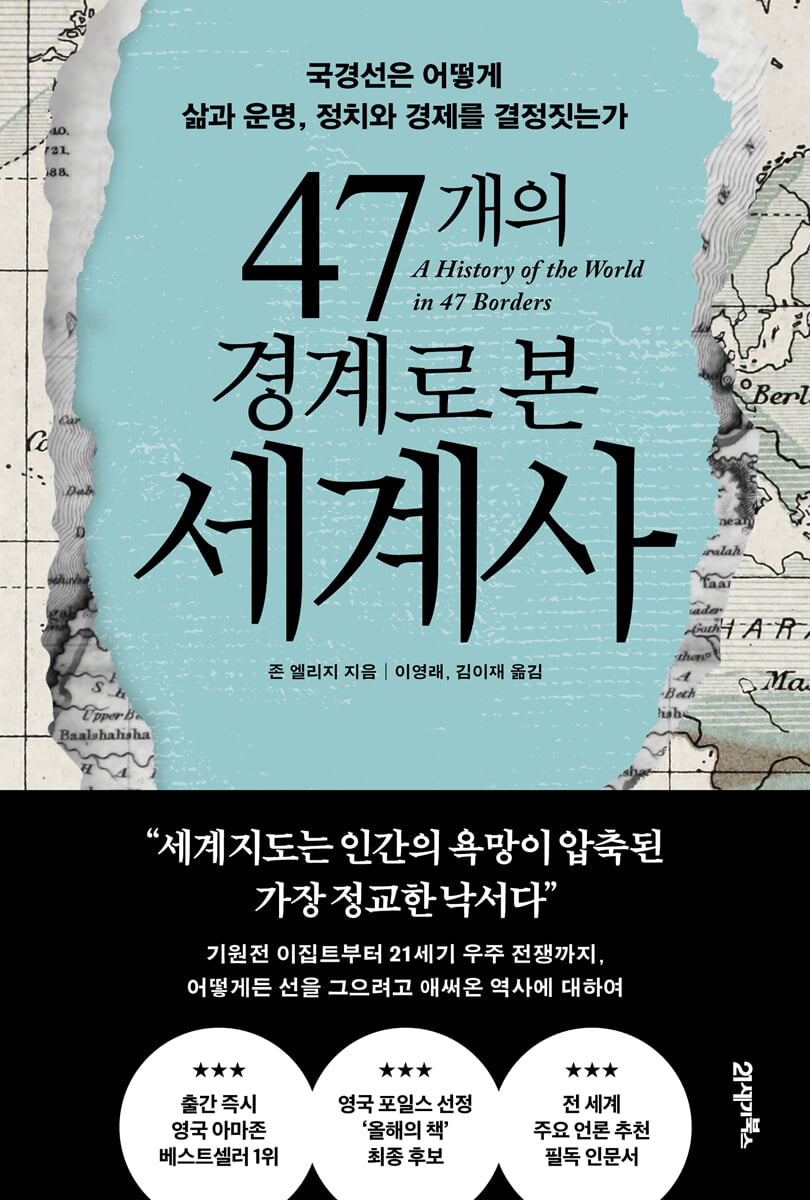
World History Through 47 Borders
 |
Description
Book Introduction
★ #1 on Amazon UK immediately after publication
★ A '21st Century Must-Read History Book' Selected by Major Media Around the World
★ Recommended by Bill Bryson, author of the best-selling book “A Short History of Nearly Everything”!
“Human history began with a single line that divides you and me!”
47 History Changes from Ancient to Modern Times, Created by Carelessly Drawn Lines
Everything about the "boundaries" that the world is obsessed with, from land and sea to sky and space.
A must-read for geopolitics to understand the turbulent international situation.
"World History Through 47 Borders" is a book that takes a fresh look at the other side of human history through the lens of borders.
It reminds us that a single thin line on a map encapsulates thousands of years of stories of power and war, identity and division, revealing the boundaries of a world we have taken for granted in a strange yet vivid way.
The borders that we take for granted in modern times are often nothing more than arbitrary boundaries.
Sometimes they were the result of a single war or negotiation, sometimes they were drawn arbitrarily according to the interests of a powerful nation, or even due to the mistakes of a cartographer.
But the results that line brought about were not always light.
Some lines have given birth to conflict and violence, some have become the seeds of endless conflict, and some still function as invisible barriers that perpetuate the structures and inequalities of a society.
This book carefully selects '47 of the most interesting and decisive borders' and explores their backgrounds and consequences from multi-layered perspectives including politics, geography, history, and culture.
From the first border of ancient Egypt, to the continental line established by Europe to separate it from Asia, to the dividing line between the Middle East and Africa irresponsibly drawn by European powers, to the 38th parallel that divided the Korean Peninsula as a legacy of the Cold War, to the demilitarized zone that still exists in a state of tense tension, and even to the border of space, which will become the new border of the future.
Author John Ellridge delves into the human ambitions and fears that have constantly drawn lines on the map, and the countless wars, treaties, and narratives of belonging and domination that have resulted from them, with a delightful yet persistent gaze.
This fascinating journey, cutting across the map and transcending time and space, shakes up our perspective on the world and restructures the very fabric of the world we live in.
Furthermore, it reminds us of how fragile the human order is based on agreement.
For all those who wish to view the grand flow of history from a different perspective, this book will serve as a starting point for new thinking.
★ A '21st Century Must-Read History Book' Selected by Major Media Around the World
★ Recommended by Bill Bryson, author of the best-selling book “A Short History of Nearly Everything”!
“Human history began with a single line that divides you and me!”
47 History Changes from Ancient to Modern Times, Created by Carelessly Drawn Lines
Everything about the "boundaries" that the world is obsessed with, from land and sea to sky and space.
A must-read for geopolitics to understand the turbulent international situation.
"World History Through 47 Borders" is a book that takes a fresh look at the other side of human history through the lens of borders.
It reminds us that a single thin line on a map encapsulates thousands of years of stories of power and war, identity and division, revealing the boundaries of a world we have taken for granted in a strange yet vivid way.
The borders that we take for granted in modern times are often nothing more than arbitrary boundaries.
Sometimes they were the result of a single war or negotiation, sometimes they were drawn arbitrarily according to the interests of a powerful nation, or even due to the mistakes of a cartographer.
But the results that line brought about were not always light.
Some lines have given birth to conflict and violence, some have become the seeds of endless conflict, and some still function as invisible barriers that perpetuate the structures and inequalities of a society.
This book carefully selects '47 of the most interesting and decisive borders' and explores their backgrounds and consequences from multi-layered perspectives including politics, geography, history, and culture.
From the first border of ancient Egypt, to the continental line established by Europe to separate it from Asia, to the dividing line between the Middle East and Africa irresponsibly drawn by European powers, to the 38th parallel that divided the Korean Peninsula as a legacy of the Cold War, to the demilitarized zone that still exists in a state of tense tension, and even to the border of space, which will become the new border of the future.
Author John Ellridge delves into the human ambitions and fears that have constantly drawn lines on the map, and the countless wars, treaties, and narratives of belonging and domination that have resulted from them, with a delightful yet persistent gaze.
This fascinating journey, cutting across the map and transcending time and space, shakes up our perspective on the world and restructures the very fabric of the world we live in.
Furthermore, it reminds us of how fragile the human order is based on agreement.
For all those who wish to view the grand flow of history from a different perspective, this book will serve as a starting point for new thinking.
- You can preview some of the book's contents.
Preview
index
Preface│Dynamic History Expressed Through Boundaries
PART 1.
history
1. United Kingdom of Egypt
2 The Great Wall of China, a border that serves as a unifying force
3 Europe draws a line with the Asian continent
4 Roman borders and peripheral power
5 Charlemagne's Legacy
6 British borders
7 Feudalism, Marquisates, Margraves, and Border Lords
8 Genghis Khan's open border policy
9 Spain vs.
Portugal
10 Divinity, Rome, and the Empire
11 Britain, Ireland, and the Invention of Cartographic Colonialism
12 The Unjust Mason-Dixon Line
13 Napoleon's local government reforms
14 The American invasion of Mexico
15 Schleswig-Holstein Problem
16 Where no white man has ever set foot
17 Sudan-Uganda Border Commission
18 European Nationalism and the Greater Austrian Alliance
19 The line in the sand drawn by Britain and France
20 Partition of Ulster
21 Partition of India
22 The Iron Curtain and the Division of Berlin
PART 2.
legacy
23 Kaliningrad, East Germany, and Western Russia
24 The Strange Case of Bir Tawil
25 Division of the Korean Peninsula, from 1945 to the present
26 Territorial disputes surrounding the South China Sea
27 The uncertain border between Israel and Palestine
28 Siamese Twin Village between the Netherlands and Belgium
29 The US-Canada Border: A Straight Line and the Challenges It Brings
30 Some places outside Switzerland
31 A few thoughts on small countries
32 City boundaries
33 The Curse of Detroit
34 Squares Surrounding Washington
35 Underground Boundary
36 Accidental invasion of Liechtenstein
37 Google Maps Wars
38 The Cartographer's Dilemma
PART 3.
external effects
39 A Brief History of the Prime Meridian
A few thoughts on the 40 time zone
41 A Brief History of the International Date Line
42 Maritime Boundaries and Maritime Law
43 A Few Stories About Landlocked Countries
44 Antarctic sovereignty dispute
45 A different, bigger, more musical Europe
46 Air Boundary
47 The Last Frontier
Conclusion│Countless Border Crises Beyond 2023
Translator's Note
PART 1.
history
1. United Kingdom of Egypt
2 The Great Wall of China, a border that serves as a unifying force
3 Europe draws a line with the Asian continent
4 Roman borders and peripheral power
5 Charlemagne's Legacy
6 British borders
7 Feudalism, Marquisates, Margraves, and Border Lords
8 Genghis Khan's open border policy
9 Spain vs.
Portugal
10 Divinity, Rome, and the Empire
11 Britain, Ireland, and the Invention of Cartographic Colonialism
12 The Unjust Mason-Dixon Line
13 Napoleon's local government reforms
14 The American invasion of Mexico
15 Schleswig-Holstein Problem
16 Where no white man has ever set foot
17 Sudan-Uganda Border Commission
18 European Nationalism and the Greater Austrian Alliance
19 The line in the sand drawn by Britain and France
20 Partition of Ulster
21 Partition of India
22 The Iron Curtain and the Division of Berlin
PART 2.
legacy
23 Kaliningrad, East Germany, and Western Russia
24 The Strange Case of Bir Tawil
25 Division of the Korean Peninsula, from 1945 to the present
26 Territorial disputes surrounding the South China Sea
27 The uncertain border between Israel and Palestine
28 Siamese Twin Village between the Netherlands and Belgium
29 The US-Canada Border: A Straight Line and the Challenges It Brings
30 Some places outside Switzerland
31 A few thoughts on small countries
32 City boundaries
33 The Curse of Detroit
34 Squares Surrounding Washington
35 Underground Boundary
36 Accidental invasion of Liechtenstein
37 Google Maps Wars
38 The Cartographer's Dilemma
PART 3.
external effects
39 A Brief History of the Prime Meridian
A few thoughts on the 40 time zone
41 A Brief History of the International Date Line
42 Maritime Boundaries and Maritime Law
43 A Few Stories About Landlocked Countries
44 Antarctic sovereignty dispute
45 A different, bigger, more musical Europe
46 Air Boundary
47 The Last Frontier
Conclusion│Countless Border Crises Beyond 2023
Translator's Note
Detailed image

Into the book
No boundary is inevitable or eternal.
Borders are arbitrary and accidental, and in many cases, a single war, a treaty, or the decisions of a few weary Europeans might have shaped them very differently.
Some boundaries exist temporarily and then disappear, while others persist for centuries.
Some are ridiculous, some are outrageous, and some have claimed millions of lives.
--- From "Dynamic History Expressed by Boundaries"
Few good maps of these complex territories remain.
No, rather, it should be said that there are several maps that are clearly contradictory.
Borders at the time were often vague or undefined, and not only borders but also the countries themselves were constantly changing.
And this fragmented state was not simply a theoretical problem.
Numerous currencies existed within the empire (some countries used multiple currencies), and each country had the right to impose its own taxes and duties on travelers passing through its territory.
If you were to imagine a concept diametrically opposed to today's European Union single market, it would be the Holy Roman Empire in the 18th century.
--- From "Holy, Roman, and Empire"
In other words, what harmed Africa was not simply the fact of conquest and exploitation itself.
By meaninglessly carving up the continent and drawing lines that ignore natural unity, many communities have felt a stronger connection to their neighbors across the border, and have become more disconnected from their compatriots in the capital.
Such irresponsible borders cost lives.
--- From "Where No White Man Has Ever Tread"
The first thing you need to know about the Korean Peninsula's borders is this:
That is, an increasingly wealthy South Korea, the maker of K-pop and the Squid Game, and an isolated, communist, yet theocratic North Korea, whose border does not run along the 38th parallel.
--- From “The Division of the Korean Peninsula, from 1945 to the Present”
The 8,891-kilometer border between the United States and Canada is renowned as the world's longest demilitarized border.
Perhaps lesser known, this is not only a demilitarized border, but also the longest border in the world.
Of course, this is a claim that contains some trickery.
In fact, this border is divided into two.
One is the 6,416-kilometer border between Canada and the continental United States (the lower 48 states), and the other is the 2,475-kilometer border between Canada and Alaska.
--- From "The US-Canada Border: The Difficulties Caused by a Straight Line"
The debate over sovereignty may not stop at the maritime border.
The Outer Space Treaty, signed by the majority of the world's nations in 1967, defined space exploration as "for the benefit of all nations and the domain of all mankind."
The treaty states that “outer space is not an object that can be appropriated by a state through sovereignty claims, use, occupation, or other means.
“The moon and other celestial bodies shall be used only for peaceful purposes.”
That's a really good point.
However, the treaty's value is limited because it does not provide a precise definition of what is meant by peaceful purposes.
Borders are arbitrary and accidental, and in many cases, a single war, a treaty, or the decisions of a few weary Europeans might have shaped them very differently.
Some boundaries exist temporarily and then disappear, while others persist for centuries.
Some are ridiculous, some are outrageous, and some have claimed millions of lives.
--- From "Dynamic History Expressed by Boundaries"
Few good maps of these complex territories remain.
No, rather, it should be said that there are several maps that are clearly contradictory.
Borders at the time were often vague or undefined, and not only borders but also the countries themselves were constantly changing.
And this fragmented state was not simply a theoretical problem.
Numerous currencies existed within the empire (some countries used multiple currencies), and each country had the right to impose its own taxes and duties on travelers passing through its territory.
If you were to imagine a concept diametrically opposed to today's European Union single market, it would be the Holy Roman Empire in the 18th century.
--- From "Holy, Roman, and Empire"
In other words, what harmed Africa was not simply the fact of conquest and exploitation itself.
By meaninglessly carving up the continent and drawing lines that ignore natural unity, many communities have felt a stronger connection to their neighbors across the border, and have become more disconnected from their compatriots in the capital.
Such irresponsible borders cost lives.
--- From "Where No White Man Has Ever Tread"
The first thing you need to know about the Korean Peninsula's borders is this:
That is, an increasingly wealthy South Korea, the maker of K-pop and the Squid Game, and an isolated, communist, yet theocratic North Korea, whose border does not run along the 38th parallel.
--- From “The Division of the Korean Peninsula, from 1945 to the Present”
The 8,891-kilometer border between the United States and Canada is renowned as the world's longest demilitarized border.
Perhaps lesser known, this is not only a demilitarized border, but also the longest border in the world.
Of course, this is a claim that contains some trickery.
In fact, this border is divided into two.
One is the 6,416-kilometer border between Canada and the continental United States (the lower 48 states), and the other is the 2,475-kilometer border between Canada and Alaska.
--- From "The US-Canada Border: The Difficulties Caused by a Straight Line"
The debate over sovereignty may not stop at the maritime border.
The Outer Space Treaty, signed by the majority of the world's nations in 1967, defined space exploration as "for the benefit of all nations and the domain of all mankind."
The treaty states that “outer space is not an object that can be appropriated by a state through sovereignty claims, use, occupation, or other means.
“The moon and other celestial bodies shall be used only for peaceful purposes.”
That's a really good point.
However, the treaty's value is limited because it does not provide a precise definition of what is meant by peaceful purposes.
--- From "The Last Frontier"
Publisher's Review
“Borders are the lines of destiny of humanity, rewritten in every era!”
A masterpiece exploring human nature hidden within 47 boundaries: desire, fear, vanity, and fantasy.
A delightful yet compelling narrative of war and treaties, belonging and domination.
This book delves deeply into how deeply human desires are engraved in the countless lines that divide the world.
For example, at the Berlin Conference of 1884, European powers arbitrarily divided up lands that no white man had ever set foot on, and carved up the African continent without even knowing the locations of its mountains and rivers.
The boundaries were set according to the convenience of the empire, ignoring nationality, language, and culture.
This was a distorted result of the ambition to first possess and dominate even a world that one had not directly experienced or understood, the illusion of controlling the world through such a thing, and the vanity of showing off one's superiority in the name of civilization.
The legacy of this ignorance and arrogance continues to be the backdrop for fierce conflict to this day.
The 'Sykes-Picot Agreement' introduced in the book is also one of those boundaries.
This secret agreement between Britain and France in 1916, which divided the Middle East like a straight line, was decided solely based on imperial interests without any consideration for ethnicity, religion, or language, and became the starting point for the complex divisions of the modern Middle East.
The case of Detroit, USA is similar.
The obsession with expansion and greed eroded the city's foundations, and racism and exclusionary sentiments divided it internally, ultimately leading to the first major city bankruptcy in American history.
In this way, 『World History in 47 Borders』 subtly demonstrates, through numerous examples, how closely borders on maps are intertwined with human nature.
Borders, which determine where "us" ends and where "others" begin, can be seen as social structures that reflect not only human ambition and anxiety, but also the weakness of fearing what lies beyond the border.
As we trace the lines drawn by humanity and how they have been accepted, the nature of humanity, rather than the shape of the world, begins to become more clearly evident.
In short, if we constantly ask ourselves how a single line on a map creates the world and what kind of beings humans are within that world, we arrive at the fact that understanding boundaries is ultimately understanding humans.
"How long will modern maps remain valid? How will new borders be drawn?"
A border war that extends beyond the sea and sky into space.
A frontline where technological capital intertwines and a starting point for the battle for dominance.
The boundaries are being rewritten even at this very moment.
The sea, once owned by no one, was defined as a new boundary under the concept of the 'exclusive economic zone' with the advent of maritime law.
The sky has also been subdivided into national airspace zones since the mid-20th century, with the expansion of air traffic.
And now space is emerging as the 'final frontier' that humanity will face.
From the debate surrounding the Karman Line, the race to place satellites in orbit, to diplomatic rhetoric surrounding the lunar safe zone, humanity is expanding its concept of boundaries beyond land, sea, and sky, into space.
In other words, modern borders are no longer confined to lines drawn on a map, but can be seen as sharp front lines where technology and capital intersect, and as the starting point of a battle for leadership toward the future.
And it also hints that the battle for new space and resources for future generations has already begun.
The book views this changing world order as an extension of boundaries, offering a three-dimensional insight into not only historical decisions made long ago, but also the "present and future of boundaries" still being debated around the world.
And it asks where humanity has come and what line it will draw in the future.
At this turning point of change, we must now imagine beyond the map.
How far do the lines we've drawn so far extend? And what standards and values should guide us in drawing new boundaries in the future? If those lines once again exclude and encroach upon others, becoming seeds of imbalance, what kind of future will humanity face?
We can either create a map of coexistence we've never seen before, or we can repeat a map of division that has persisted for a long time.
Therefore, this book goes beyond the simple history of boundaries and presents a new perspective on the future by asking ethical questions about how we should define the world in which humanity will coexist.
“The moment a line is drawn on the map, what was gained and what was lost?”
Borders: The Key to Reading the Hidden Rules of Geopolitics
World Order as Seen Through the Birth and Transformation of 47 Borders
Conflicts around the world, stemming from geopolitical conflicts, are putting the world on edge.
Even today, lines on maps continue to be a source of conflict: the Russia-Ukraine war stemming from a dispute over control of the Crimean Peninsula and Donbas, the escalating conflict between China and its neighbors over maritime sovereignty in the South China Sea, the clash between India and China over the vague Himalayan border, and the armed conflict between Israel and Palestine over Jerusalem and the Gaza Strip, where religion, history, and borders are intricately intertwined.
To understand the chaotic world situation, we must decipher the hidden rules of geopolitics that flow beneath the complex maps.
Right at the center of it all is the ‘border’.
Because borders are real power lines where history, resources, security, and identity intersect.
"A World History Through 47 Borders" systematically explains the emergence and evolution of 47 borders, including how they influenced the world and shaped the logic of power.
This soon becomes an important framework for understanding how a world divided by interests creates a grand order through conflict and solidarity.
Ultimately, reading geopolitics is about understanding how the world we live in works and assessing our own position within it.
Books provide the very core of such awareness, and they cultivate a sense of interpreting the world beyond the behind-the-scenes of history.
Only when we see the other side of geopolitical conflicts can we begin to sense where the world is headed. This book will serve as the most intelligent tool for interpreting the present and future amidst the ever-changing international situation.
A masterpiece exploring human nature hidden within 47 boundaries: desire, fear, vanity, and fantasy.
A delightful yet compelling narrative of war and treaties, belonging and domination.
This book delves deeply into how deeply human desires are engraved in the countless lines that divide the world.
For example, at the Berlin Conference of 1884, European powers arbitrarily divided up lands that no white man had ever set foot on, and carved up the African continent without even knowing the locations of its mountains and rivers.
The boundaries were set according to the convenience of the empire, ignoring nationality, language, and culture.
This was a distorted result of the ambition to first possess and dominate even a world that one had not directly experienced or understood, the illusion of controlling the world through such a thing, and the vanity of showing off one's superiority in the name of civilization.
The legacy of this ignorance and arrogance continues to be the backdrop for fierce conflict to this day.
The 'Sykes-Picot Agreement' introduced in the book is also one of those boundaries.
This secret agreement between Britain and France in 1916, which divided the Middle East like a straight line, was decided solely based on imperial interests without any consideration for ethnicity, religion, or language, and became the starting point for the complex divisions of the modern Middle East.
The case of Detroit, USA is similar.
The obsession with expansion and greed eroded the city's foundations, and racism and exclusionary sentiments divided it internally, ultimately leading to the first major city bankruptcy in American history.
In this way, 『World History in 47 Borders』 subtly demonstrates, through numerous examples, how closely borders on maps are intertwined with human nature.
Borders, which determine where "us" ends and where "others" begin, can be seen as social structures that reflect not only human ambition and anxiety, but also the weakness of fearing what lies beyond the border.
As we trace the lines drawn by humanity and how they have been accepted, the nature of humanity, rather than the shape of the world, begins to become more clearly evident.
In short, if we constantly ask ourselves how a single line on a map creates the world and what kind of beings humans are within that world, we arrive at the fact that understanding boundaries is ultimately understanding humans.
"How long will modern maps remain valid? How will new borders be drawn?"
A border war that extends beyond the sea and sky into space.
A frontline where technological capital intertwines and a starting point for the battle for dominance.
The boundaries are being rewritten even at this very moment.
The sea, once owned by no one, was defined as a new boundary under the concept of the 'exclusive economic zone' with the advent of maritime law.
The sky has also been subdivided into national airspace zones since the mid-20th century, with the expansion of air traffic.
And now space is emerging as the 'final frontier' that humanity will face.
From the debate surrounding the Karman Line, the race to place satellites in orbit, to diplomatic rhetoric surrounding the lunar safe zone, humanity is expanding its concept of boundaries beyond land, sea, and sky, into space.
In other words, modern borders are no longer confined to lines drawn on a map, but can be seen as sharp front lines where technology and capital intersect, and as the starting point of a battle for leadership toward the future.
And it also hints that the battle for new space and resources for future generations has already begun.
The book views this changing world order as an extension of boundaries, offering a three-dimensional insight into not only historical decisions made long ago, but also the "present and future of boundaries" still being debated around the world.
And it asks where humanity has come and what line it will draw in the future.
At this turning point of change, we must now imagine beyond the map.
How far do the lines we've drawn so far extend? And what standards and values should guide us in drawing new boundaries in the future? If those lines once again exclude and encroach upon others, becoming seeds of imbalance, what kind of future will humanity face?
We can either create a map of coexistence we've never seen before, or we can repeat a map of division that has persisted for a long time.
Therefore, this book goes beyond the simple history of boundaries and presents a new perspective on the future by asking ethical questions about how we should define the world in which humanity will coexist.
“The moment a line is drawn on the map, what was gained and what was lost?”
Borders: The Key to Reading the Hidden Rules of Geopolitics
World Order as Seen Through the Birth and Transformation of 47 Borders
Conflicts around the world, stemming from geopolitical conflicts, are putting the world on edge.
Even today, lines on maps continue to be a source of conflict: the Russia-Ukraine war stemming from a dispute over control of the Crimean Peninsula and Donbas, the escalating conflict between China and its neighbors over maritime sovereignty in the South China Sea, the clash between India and China over the vague Himalayan border, and the armed conflict between Israel and Palestine over Jerusalem and the Gaza Strip, where religion, history, and borders are intricately intertwined.
To understand the chaotic world situation, we must decipher the hidden rules of geopolitics that flow beneath the complex maps.
Right at the center of it all is the ‘border’.
Because borders are real power lines where history, resources, security, and identity intersect.
"A World History Through 47 Borders" systematically explains the emergence and evolution of 47 borders, including how they influenced the world and shaped the logic of power.
This soon becomes an important framework for understanding how a world divided by interests creates a grand order through conflict and solidarity.
Ultimately, reading geopolitics is about understanding how the world we live in works and assessing our own position within it.
Books provide the very core of such awareness, and they cultivate a sense of interpreting the world beyond the behind-the-scenes of history.
Only when we see the other side of geopolitical conflicts can we begin to sense where the world is headed. This book will serve as the most intelligent tool for interpreting the present and future amidst the ever-changing international situation.
GOODS SPECIFICS
- Date of issue: August 13, 2025
- Page count, weight, size: 416 pages | 152*225*30mm
- ISBN13: 9791173574092
- ISBN10: 1173574093
You may also like
카테고리
korean


korean

![GQ KOREA Mark (Monthly): December [2025]](http://librairie.coreenne.fr/cdn/shop/files/8ef265dbbfbf186523ed75ba7319009d.jpg?v=1765340328&width=3840)


