

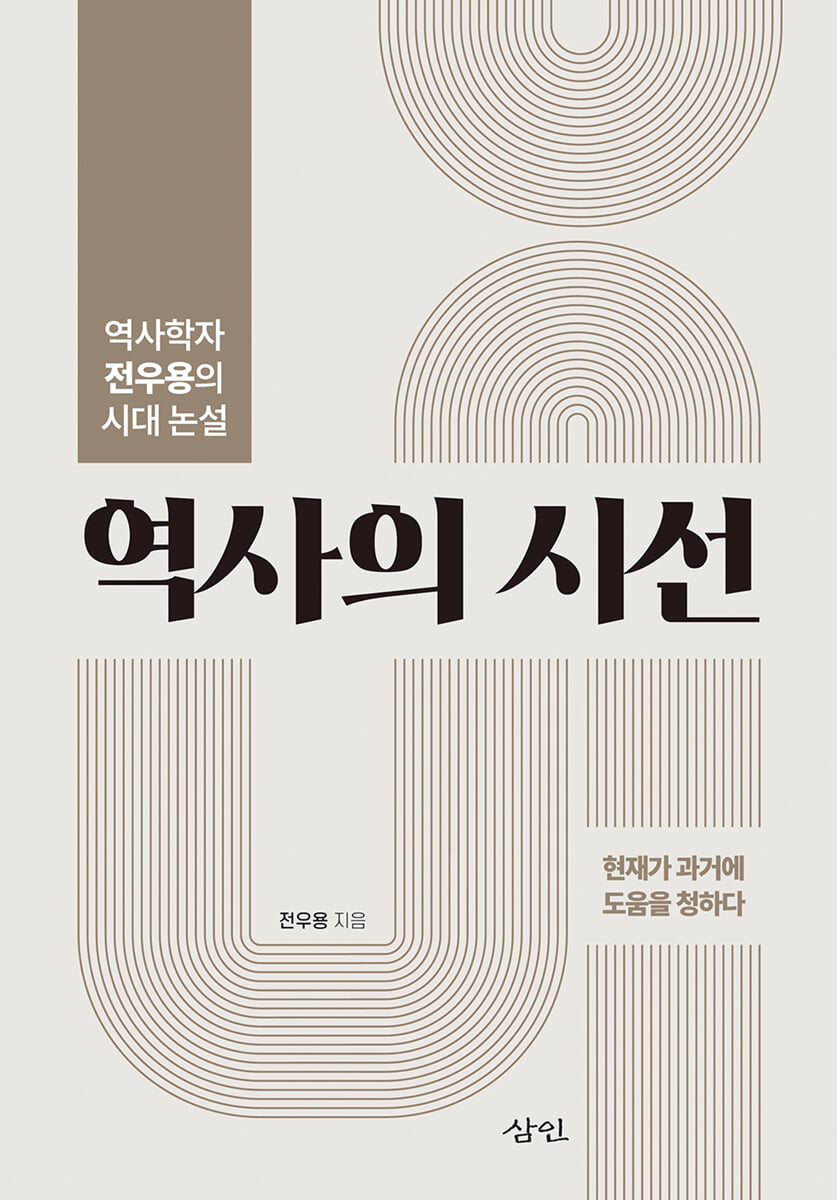
The gaze of history
 |
Description
Book Introduction
Age of Chaos,
What should we do now?
Find the answer in history!
"The Perspective of History" is a book that contains the result of Jeon Woo-yong, a historian working in the field, intensely contemplating where "we" should go now.
What sets 『The Perspective of History』 apart from other similar books is that it finds the results of its deliberations in ‘history.’
'History' is something that everyone knows.
So you can get the right direction on where to go.
In other words, if we follow where history sees us and where history points us, ‘we now’ can become ‘we who live in a better future.’
Just because the author appears primarily on progressive YouTube channels, it shouldn't be hastily concluded that he or she is biased towards one side or the other.
The author did not speak from one side from the beginning.
Talk about what is wrong, based on facts, without mixing up the essence, and clearly what needs to be corrected.
And the basis for this is found in unchanging history.
There is a saying that 'history is an unending dialogue between the past and the present.'
Only by having the will to learn from the past and engaging in constant dialogue can we receive the answers we need in the present.
"The Perspective of History" can be said to be a book that organizes how to hear the answer and what to do after hearing it.
Now is the time to think about where history's eyes are looking and what we can learn from history.
What should we do now?
Find the answer in history!
"The Perspective of History" is a book that contains the result of Jeon Woo-yong, a historian working in the field, intensely contemplating where "we" should go now.
What sets 『The Perspective of History』 apart from other similar books is that it finds the results of its deliberations in ‘history.’
'History' is something that everyone knows.
So you can get the right direction on where to go.
In other words, if we follow where history sees us and where history points us, ‘we now’ can become ‘we who live in a better future.’
Just because the author appears primarily on progressive YouTube channels, it shouldn't be hastily concluded that he or she is biased towards one side or the other.
The author did not speak from one side from the beginning.
Talk about what is wrong, based on facts, without mixing up the essence, and clearly what needs to be corrected.
And the basis for this is found in unchanging history.
There is a saying that 'history is an unending dialogue between the past and the present.'
Only by having the will to learn from the past and engaging in constant dialogue can we receive the answers we need in the present.
"The Perspective of History" can be said to be a book that organizes how to hear the answer and what to do after hearing it.
Now is the time to think about where history's eyes are looking and what we can learn from history.
- You can preview some of the book's contents.
Preview
index
· At the beginning of the book
Chapter 1: About the World They Created
01.
Deliberation and murder
02.
Politics without compassion
03.
What is the 'vested interest group'?
04.
Madness virus
05.
The President's Study
06.
What Censorship Wants and Creates
07.
Yuchuimannyeon
08.
The past system and the recommendation system
09.
Modern Shaman
10.
Monument to Flattery
11.
The eyes of a conqueror, the eyes of a saint
12.
The era of pro-Japanese collaborators
13.
Those who undermine the dignity of their own history
14.
If only King Sejong had not created Hangul
15.
There is no evidence that Dokdo is Korean territory?
16.
Should we make August 15th National Foundation Day?
17.
History textbooks and the spirit of the Constitution
Chapter 2 What to Throw Away?
01.
Green and red beetles
02.
governor, magistrate, local official, local leader
03.
faith, ideology, knowledge, mood
04.
A meal and pride
05.
The Age of the God of Wisdom
06.
East and West
07.
The Age of Justice and Humanity
08.
The ideal wife and wise mother, the image of women in the militaristic era
09.
The era of red hunting
10.
The Age of Absolute Monarchs and Dictators
11.
The Age of Experts
12.
Land and power
Chapter 3: People Don't Get Better on Their Own
01.
Liberation of the 'Castle of the Devil'
02.
The trap of 'eating and living'
03.
A classroom for Danwon High School students and an alley in Itaewon
04.
The era of new and new
05.
The body-centered era
06.
The Age of Power Worship
07.
The ultra-high-speed era
08.
An era of stagnant jobs
09.
Reasons to live a good life
10.
An era where machines and humans are compatible
11.
How to choose a servant
12.
Training to maintain peace is also necessary.
Chapter 4 Where Are We?
01.
A century of four generations
02.
Disobedient students, readers who don't believe the newspaper
03.
You might as well revive the Gongmyeongcheop.
04.
You earn like a dog and spend like a prime minister?
05.
Hell Joseon and nationalism
06.
Just do as you are told
07.
King Sejong's reign
08.
low birth rate era
09.
The Age of Fake News
10.
Is this an era of rule of law or an era of lawlessness?
11.
The era of popularizing universities
Chapter 5 Hoping for even a small change
01.
How to prevent generational war
02.
An unhappy age for young people is just an unhappy age.
03.
The Age of Great Men
04.
Stay still
05.
Congratulations! Passed the safety inspection.
06.
aging era
07.
The distance between knowledge and consciousness
08.
The world of direct communication and the world map
09.
The era of 'nim'
10.
Correct speech can set the world right.
11.
The era of division
12.
Peace cannot be achieved by force.
Chapter 1: About the World They Created
01.
Deliberation and murder
02.
Politics without compassion
03.
What is the 'vested interest group'?
04.
Madness virus
05.
The President's Study
06.
What Censorship Wants and Creates
07.
Yuchuimannyeon
08.
The past system and the recommendation system
09.
Modern Shaman
10.
Monument to Flattery
11.
The eyes of a conqueror, the eyes of a saint
12.
The era of pro-Japanese collaborators
13.
Those who undermine the dignity of their own history
14.
If only King Sejong had not created Hangul
15.
There is no evidence that Dokdo is Korean territory?
16.
Should we make August 15th National Foundation Day?
17.
History textbooks and the spirit of the Constitution
Chapter 2 What to Throw Away?
01.
Green and red beetles
02.
governor, magistrate, local official, local leader
03.
faith, ideology, knowledge, mood
04.
A meal and pride
05.
The Age of the God of Wisdom
06.
East and West
07.
The Age of Justice and Humanity
08.
The ideal wife and wise mother, the image of women in the militaristic era
09.
The era of red hunting
10.
The Age of Absolute Monarchs and Dictators
11.
The Age of Experts
12.
Land and power
Chapter 3: People Don't Get Better on Their Own
01.
Liberation of the 'Castle of the Devil'
02.
The trap of 'eating and living'
03.
A classroom for Danwon High School students and an alley in Itaewon
04.
The era of new and new
05.
The body-centered era
06.
The Age of Power Worship
07.
The ultra-high-speed era
08.
An era of stagnant jobs
09.
Reasons to live a good life
10.
An era where machines and humans are compatible
11.
How to choose a servant
12.
Training to maintain peace is also necessary.
Chapter 4 Where Are We?
01.
A century of four generations
02.
Disobedient students, readers who don't believe the newspaper
03.
You might as well revive the Gongmyeongcheop.
04.
You earn like a dog and spend like a prime minister?
05.
Hell Joseon and nationalism
06.
Just do as you are told
07.
King Sejong's reign
08.
low birth rate era
09.
The Age of Fake News
10.
Is this an era of rule of law or an era of lawlessness?
11.
The era of popularizing universities
Chapter 5 Hoping for even a small change
01.
How to prevent generational war
02.
An unhappy age for young people is just an unhappy age.
03.
The Age of Great Men
04.
Stay still
05.
Congratulations! Passed the safety inspection.
06.
aging era
07.
The distance between knowledge and consciousness
08.
The world of direct communication and the world map
09.
The era of 'nim'
10.
Correct speech can set the world right.
11.
The era of division
12.
Peace cannot be achieved by force.
Detailed image
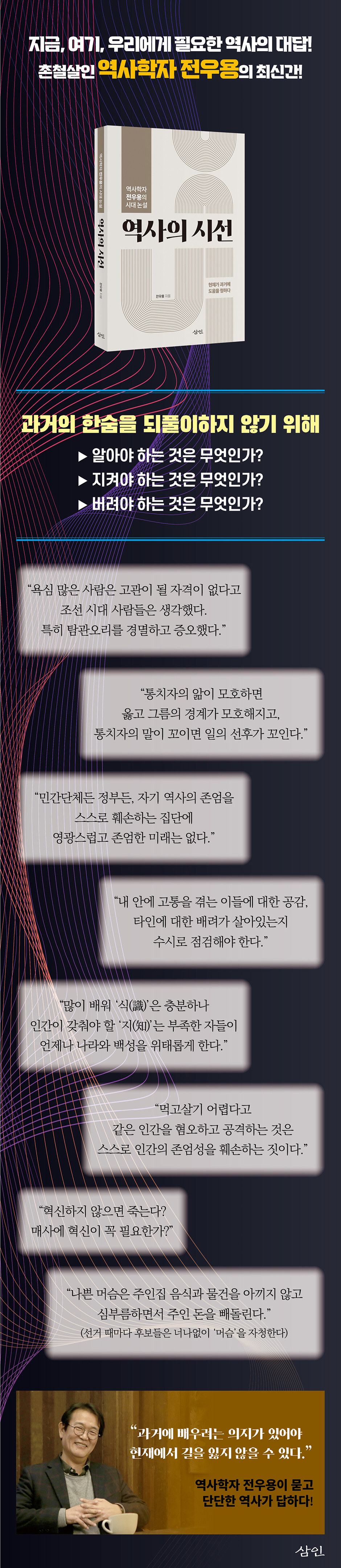
Into the book
In the Joseon Dynasty, petitions often compared the king to a doctor.
There were also articles criticizing the king for being indifferent to alleviating the people's illness and suffering, and articles requesting that he adopt a prescription that he had created to cure the nation's ills.
But in any case, the first step in what they call the 'medicine that cures the nation's illness' was to read the minds of the people and communicate with them through their hearts.
The virtues of 'Sim-ui', whom King Sejo of Joseon considered the most outstanding physician, and the virtues of 'a physician who saves the country' as considered by intellectuals of the court and the opposition were completely identical.
First, open the patient's mind and then prescribe the medicine.
King Sejong, whom modern Koreans revere as a "sage king of the nation," was not enraged by the disrespect of the starving people who blocked the royal carriage to complain, but by the loyalty of a high-ranking official who stood between the king and the people out of concern for distracting the king's attention.
He believed that it was the duty of a monarch to open a way for the poor people to appeal directly to the king, and that any minister who blocked that way deserved to be punished.
Everyone hopes that their thoughts and judgments are correct, but there is always a gap between hope and reality.
I could be right, you could be right, or we could both be wrong.
Democracy is a system that tolerates ‘differences.’
Only after all efforts have been made to harmonize the 'other things', finally, the 'principle of majority rule' is applied.
However, our society today seems to be obsessed with the impulse to not only use the word 'different' as 'wrong', but also not to distinguish between 'dislike' and 'bad'.
The future facing such a society is uncertain.
Both Hitler and Stalin were 'people' born from a culture of treating people who thought differently from them as criminals.
After liberation and the Korean War, the value of 'strength', a soldier's virtue, was further enhanced.
Then, in the 1960s, the era of 'assault construction' began, in which development and construction were carried out in a military-like manner, and in the process, 'power' became established as the single factor determining human value.
The word 'power' was attached to all sorts of things, including competitiveness, leadership, charm, friendliness, intelligence, economic power, creativity, thinking ability, understanding ability, logic, judgment, and even things that had nothing to do with power.
Thinking is not a force, and Hangul was not created by force.
On the other hand, words like love, consideration, compassion, morality, shame, spirit, integrity, conscience, and justice do not contain the character '力'.
The royal government, whose finances were in dire straits after the Imjin War and the Byeongja War, began to 'sell' certificates of civil service examination.
It was the so-called 'empty name sheet', which was literally a sheet of paper with the name column of the person receiving the official position left blank.
Anyone who bought a public offering, whether of their own free will or under duress, had to write their own name in the blank space.
The price was, of course, proportional to the rank of the official, but the official position was of little use in real life.
After death, only the words written on the memorial tablet could be changed.
Strictly speaking, the Gongmyeongcheop was nothing more than a 'certificate of an ignorant person with some money'.
There were also articles criticizing the king for being indifferent to alleviating the people's illness and suffering, and articles requesting that he adopt a prescription that he had created to cure the nation's ills.
But in any case, the first step in what they call the 'medicine that cures the nation's illness' was to read the minds of the people and communicate with them through their hearts.
The virtues of 'Sim-ui', whom King Sejo of Joseon considered the most outstanding physician, and the virtues of 'a physician who saves the country' as considered by intellectuals of the court and the opposition were completely identical.
First, open the patient's mind and then prescribe the medicine.
King Sejong, whom modern Koreans revere as a "sage king of the nation," was not enraged by the disrespect of the starving people who blocked the royal carriage to complain, but by the loyalty of a high-ranking official who stood between the king and the people out of concern for distracting the king's attention.
He believed that it was the duty of a monarch to open a way for the poor people to appeal directly to the king, and that any minister who blocked that way deserved to be punished.
Everyone hopes that their thoughts and judgments are correct, but there is always a gap between hope and reality.
I could be right, you could be right, or we could both be wrong.
Democracy is a system that tolerates ‘differences.’
Only after all efforts have been made to harmonize the 'other things', finally, the 'principle of majority rule' is applied.
However, our society today seems to be obsessed with the impulse to not only use the word 'different' as 'wrong', but also not to distinguish between 'dislike' and 'bad'.
The future facing such a society is uncertain.
Both Hitler and Stalin were 'people' born from a culture of treating people who thought differently from them as criminals.
After liberation and the Korean War, the value of 'strength', a soldier's virtue, was further enhanced.
Then, in the 1960s, the era of 'assault construction' began, in which development and construction were carried out in a military-like manner, and in the process, 'power' became established as the single factor determining human value.
The word 'power' was attached to all sorts of things, including competitiveness, leadership, charm, friendliness, intelligence, economic power, creativity, thinking ability, understanding ability, logic, judgment, and even things that had nothing to do with power.
Thinking is not a force, and Hangul was not created by force.
On the other hand, words like love, consideration, compassion, morality, shame, spirit, integrity, conscience, and justice do not contain the character '力'.
The royal government, whose finances were in dire straits after the Imjin War and the Byeongja War, began to 'sell' certificates of civil service examination.
It was the so-called 'empty name sheet', which was literally a sheet of paper with the name column of the person receiving the official position left blank.
Anyone who bought a public offering, whether of their own free will or under duress, had to write their own name in the blank space.
The price was, of course, proportional to the rank of the official, but the official position was of little use in real life.
After death, only the words written on the memorial tablet could be changed.
Strictly speaking, the Gongmyeongcheop was nothing more than a 'certificate of an ignorant person with some money'.
--- From the text
Publisher's Review
Historian Jeon Woo-yong's
A special lecture on "History Helping the Present"
Historian Jeon Woo-yong, known to many as a sharp and sharp critic for his articles that point out how to view countless social phenomena that occur every day based on historical facts, has published 『The Perspective of History』, a collection of articles from his newspaper columns that we need to know now and revised to fit the current time period.
When I read a book, I never feel like I'm being criticized unconditionally just because my thoughts are different, or that the content changes depending on the situation.
Because it is a story based on unchanging historical facts and historical figures.
1.
Why mistakes are repeated
In Chapter 1, “On the World They Created,” we analyze from a historical perspective why the same situation is being repeated even though it clearly happened in the past and we would think it should not have happened.
· Mencius preached that politics should be based on compassion (a heart that sympathizes with the poor).
King Sejong's creation of Hangul was also a product of his compassion for the people.
Just as a person without compassion is not human, politics without compassion is nothing but tyranny.
· Children from prestigious families entered the government before they turned twenty and built strong networks through marriage, relationships with teachers, and friendships.
It was thoroughly prevented from interfering with any foreign entities.
· The old officials did not flatter others beyond a certain point.
But now even that kind of gold has disappeared, and shameless flattery is rampant.
The lord praised by flatterers was always a tyrant.
2.
An era that requires courtesy toward people
In Chapter 2, “What Should We Throw Away?” and Chapter 3, “People Don’t Get Better on Their Own,” the conditions of a sensible person are explained through the lens of history.
· The Joseon Dynasty's 'Dangdongbeol-i', which unconditionally supported one's own side and unconditionally rejected the other side without regard for right or wrong, still exists.
We must not forget that we live in an era of democracy that tolerates ‘differences.’
· It has been quite some time since it became impossible to separate the spaces of men and women inside and outside the home, but the culture of separating them still persists.
It is time to send words containing sexist values such as “gentleman,” “hero,” and “good wife and good mother” to the museum collection.
· Ahn Jung-geun said that order maintained by force can never be peaceful, as it only creates resentment in the hearts of the enemy and prepares for future war.
Now is the time to break free from the inertia of trying to solve all problems militarily.
3.
Minimal change for a better world
Chapter 4: Where Are We? and Chapter 5: Hoping for Even Small Changes, provide historical perspectives on where we stand and what we should do to create a better world.
· During the Joseon Dynasty, corrupt officials were punished by beating.
Even though it was an honorary punishment that allowed one to enter and leave the big pot, if one was executed, their family and relatives treated them as a 'dead person'.
It was a punishment equivalent to death for corrupt officials.
· Although the rule of law is said to be a product of modern times, in countries with Confucian culture before the modern era, the rule of law was an unshakable principle.
If those who enforce the law apply it based on personal preference, it is a denial of the principle of the rule of law.
An era that requires answers
History that gives answers
We are currently living in an era of unprecedented turmoil.
These days, it's hard to know what to do.
The author suggests that in times like these, we must seek solutions in history.
We must have the will to learn from history so that we do not lose our way in the present.
So, I revised the writings I had written in the past and published them as a book this time.
Let's not forget this.
'The past only helps the present when it asks for help.'
A special lecture on "History Helping the Present"
Historian Jeon Woo-yong, known to many as a sharp and sharp critic for his articles that point out how to view countless social phenomena that occur every day based on historical facts, has published 『The Perspective of History』, a collection of articles from his newspaper columns that we need to know now and revised to fit the current time period.
When I read a book, I never feel like I'm being criticized unconditionally just because my thoughts are different, or that the content changes depending on the situation.
Because it is a story based on unchanging historical facts and historical figures.
1.
Why mistakes are repeated
In Chapter 1, “On the World They Created,” we analyze from a historical perspective why the same situation is being repeated even though it clearly happened in the past and we would think it should not have happened.
· Mencius preached that politics should be based on compassion (a heart that sympathizes with the poor).
King Sejong's creation of Hangul was also a product of his compassion for the people.
Just as a person without compassion is not human, politics without compassion is nothing but tyranny.
· Children from prestigious families entered the government before they turned twenty and built strong networks through marriage, relationships with teachers, and friendships.
It was thoroughly prevented from interfering with any foreign entities.
· The old officials did not flatter others beyond a certain point.
But now even that kind of gold has disappeared, and shameless flattery is rampant.
The lord praised by flatterers was always a tyrant.
2.
An era that requires courtesy toward people
In Chapter 2, “What Should We Throw Away?” and Chapter 3, “People Don’t Get Better on Their Own,” the conditions of a sensible person are explained through the lens of history.
· The Joseon Dynasty's 'Dangdongbeol-i', which unconditionally supported one's own side and unconditionally rejected the other side without regard for right or wrong, still exists.
We must not forget that we live in an era of democracy that tolerates ‘differences.’
· It has been quite some time since it became impossible to separate the spaces of men and women inside and outside the home, but the culture of separating them still persists.
It is time to send words containing sexist values such as “gentleman,” “hero,” and “good wife and good mother” to the museum collection.
· Ahn Jung-geun said that order maintained by force can never be peaceful, as it only creates resentment in the hearts of the enemy and prepares for future war.
Now is the time to break free from the inertia of trying to solve all problems militarily.
3.
Minimal change for a better world
Chapter 4: Where Are We? and Chapter 5: Hoping for Even Small Changes, provide historical perspectives on where we stand and what we should do to create a better world.
· During the Joseon Dynasty, corrupt officials were punished by beating.
Even though it was an honorary punishment that allowed one to enter and leave the big pot, if one was executed, their family and relatives treated them as a 'dead person'.
It was a punishment equivalent to death for corrupt officials.
· Although the rule of law is said to be a product of modern times, in countries with Confucian culture before the modern era, the rule of law was an unshakable principle.
If those who enforce the law apply it based on personal preference, it is a denial of the principle of the rule of law.
An era that requires answers
History that gives answers
We are currently living in an era of unprecedented turmoil.
These days, it's hard to know what to do.
The author suggests that in times like these, we must seek solutions in history.
We must have the will to learn from history so that we do not lose our way in the present.
So, I revised the writings I had written in the past and published them as a book this time.
Let's not forget this.
'The past only helps the present when it asks for help.'
GOODS SPECIFICS
- Date of issue: March 7, 2025
- Page count, weight, size: 332 pages | 576g | 150*215*20mm
- ISBN13: 9788964362761
- ISBN10: 8964362764
You may also like
카테고리
korean


korean

![GQ KOREA Mark (Monthly): December [2025]](http://librairie.coreenne.fr/cdn/shop/files/8ef265dbbfbf186523ed75ba7319009d.jpg?v=1765340328&width=3840)


