

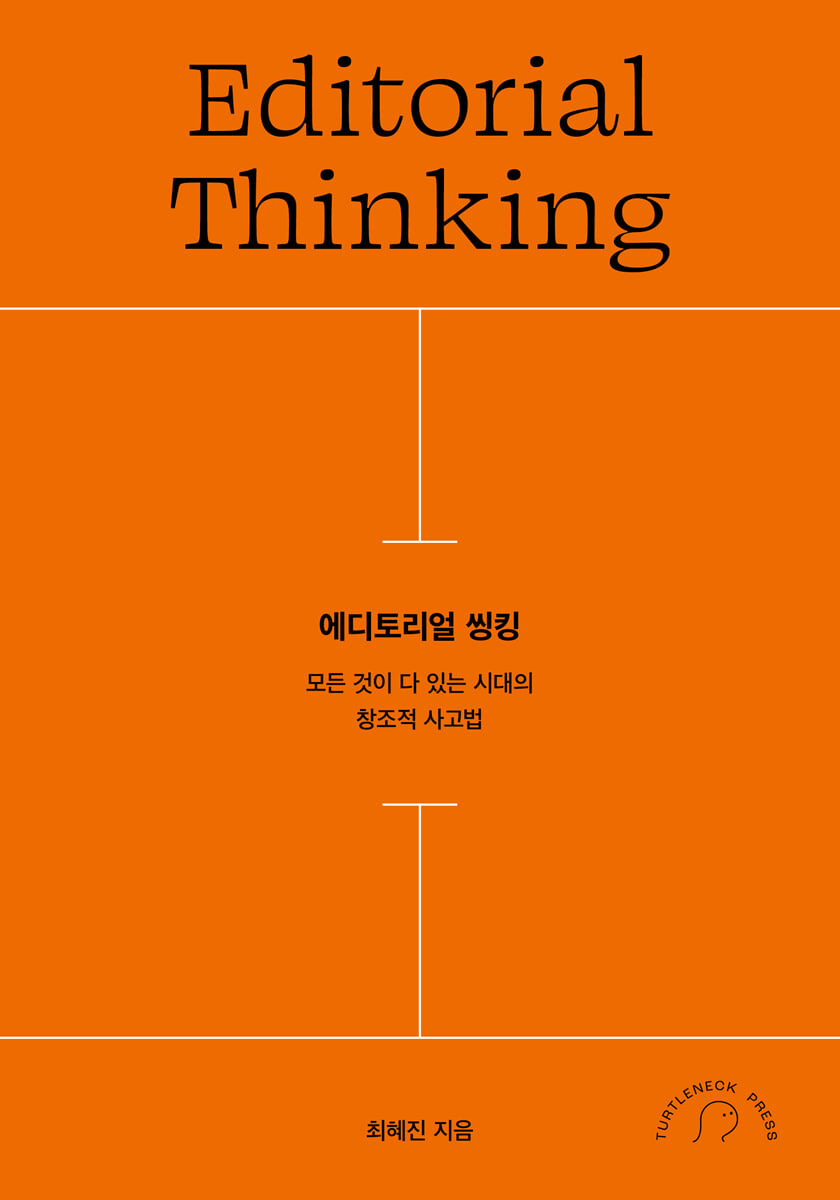
Editorial Thinking
 |
Description
Book Introduction
An era where there is nothing new under the sky,
How do planners and creators make a difference?
Editorial Thinking: Creative Thinking in an Age of Everything
In an age of saturation of everything—products, knowledge, news, data, brands, content—creation today is no longer about creating something from nothing.
It depends on how you 'edit' what already exists, that is, from 'you' to 'you'.
The book "Editorial Thinking," which provides insight into the editor's way of thinking, a job that brings order to scattered things and finds meaning in noise, presents the editing process with a clear focus by organizing it into 12 keywords: collection, association, categorization, frame, and concept.
This book teaches you how to ask questions and think for yourself while peeking into the creative secrets of these exceptional editors through the artworks of contemporary artists that appear in each keyword.
"Editorial Thinking" is a compilation of the know-how of multi-talented Choi Hye-jin, who has continuously expanded the value of editing as an art book writer, picture book expert, and verbal branding expert, based on the cognitive and planning skills honed over 20 years as a magazine editor. It will serve as a source of new inspiration for editors, planners, creators, and everyone who seeks to work creatively.
How do planners and creators make a difference?
Editorial Thinking: Creative Thinking in an Age of Everything
In an age of saturation of everything—products, knowledge, news, data, brands, content—creation today is no longer about creating something from nothing.
It depends on how you 'edit' what already exists, that is, from 'you' to 'you'.
The book "Editorial Thinking," which provides insight into the editor's way of thinking, a job that brings order to scattered things and finds meaning in noise, presents the editing process with a clear focus by organizing it into 12 keywords: collection, association, categorization, frame, and concept.
This book teaches you how to ask questions and think for yourself while peeking into the creative secrets of these exceptional editors through the artworks of contemporary artists that appear in each keyword.
"Editorial Thinking" is a compilation of the know-how of multi-talented Choi Hye-jin, who has continuously expanded the value of editing as an art book writer, picture book expert, and verbal branding expert, based on the cognitive and planning skills honed over 20 years as a magazine editor. It will serve as a source of new inspiration for editors, planners, creators, and everyone who seeks to work creatively.
- You can preview some of the book's contents.
Preview
index
Prologue
Let's start thinking about editorial.
1.
Gathering Materials: Finding and gathering materials with potential.
2.
Association: How to Increase Your Chances of Making New Connections
3.
Categorization: Finding Similarities and Relationships
4.
Relationships and Spacing: Adjusting the Appropriate Distance for Your Purpose
5.
Reference: Relocation and Recontextualization to Create Newness
6.
Concept: Sharp differentiation for recognition and positioning
7.
Bottom line: an eye for the essentials
8.
Frame: Establishing and revealing your position and perspective
9.
Objectivity and Subjectivity: The Power of the Subjective
10.
Omission: The ability to discern and eliminate unnecessary details
11.
Question: How to Create a Good Question
12.
Visual Materials: A Sense of Distance Between Message and Visuals
Epilogue
Let's start thinking about editorial.
1.
Gathering Materials: Finding and gathering materials with potential.
2.
Association: How to Increase Your Chances of Making New Connections
3.
Categorization: Finding Similarities and Relationships
4.
Relationships and Spacing: Adjusting the Appropriate Distance for Your Purpose
5.
Reference: Relocation and Recontextualization to Create Newness
6.
Concept: Sharp differentiation for recognition and positioning
7.
Bottom line: an eye for the essentials
8.
Frame: Establishing and revealing your position and perspective
9.
Objectivity and Subjectivity: The Power of the Subjective
10.
Omission: The ability to discern and eliminate unnecessary details
11.
Question: How to Create a Good Question
12.
Visual Materials: A Sense of Distance Between Message and Visuals
Epilogue
Detailed image
.jpg)
Into the book
Editing is now required in almost every field.
Because we are dizzyingly saturated with products, knowledge, news, data, brands, and content.
Choosing and paying attention is becoming increasingly difficult, and comparing and verifying information is becoming a daunting task.
This is why it has become common to outsource one's tastes, curiosity, and judgment to algorithms or to imitate others.
In a world already so overflowing with everything, how can we create our own uniqueness or new distinctions? It's at this point that the ability to edit existing materials to create cognitive distinctions becomes crucial.
---From the "Prologue"
Just as a dictionary filled with words does not immediately become poetry, and a stamp collector's archive is not called a work of art, collecting something does not immediately create creative meaning.
The emphasis is on 'finding out' rather than 'collecting'.
(...) So how can we develop a keen eye for discerning the potential for material meaning? I find fragments of an answer to this question in art galleries.
---From "01 Collecting Materials"
There is a cognitive psychology concept called the cocktail party effect.
It refers to the brain's ability to prioritize and select information that is important to oneself even in a distracting and noisy environment.
(...) When you buy a new car, you suddenly feel like there are more models of the same car on the road, and when you need to buy furniture before moving, you only see furniture wherever you go. These are all cognitive processes in the same vein.
In a similar way, questions point out where I should focus my attention now.
When you have questions, information comes.
If questions are magnets, information is iron filings.
---From "02 Association"
Categorization is a core process by which our brain perceives information and the world.
(...) When we meet a strange cat on the street, we call it 'cat' and assign it to the 'cat' drawer in our heads.
Thanks to this, we can deduce that the new furry friend will also like fish, have sharp claws, be very alert, and purr when in a good mood.
Thanks to the existing system of knowledge (drawers in the head), we quickly understood new objects.
---From "03 Categorization"
There is editing to organize things so that they can be communicated smoothly with the majority, and there is also editing to create new meanings or images that did not exist before.
You can't just arbitrarily judge what is persuasive and what is not.
What matters is the purpose of each project and the preferences of its recipients.
It's about pinpointing the exact destination you want your choices and arrangements to produce, and adjusting the distance between pieces of information to suit the situation.
It's about finding the right ratio of familiarity and clarity, unfamiliarity and ambiguity to suit your purpose.
I think that's the essence of editing.
---From "04 Relationships and Gap"
“Where does the power to actively utilize references and ultimately create something ‘one’s own’ come from?”
I believe this question is one of the core of editorial thinking.
The materials we use are no longer original.
Even if the idea you have in mind seems new, a little research will reveal similar results.
The references are infinite.
---From "05 Reference"
We also often ask ourselves, “What feelings or thoughts do you want people to have at the end of this content?”
What kind of state do you want people to be in when they watch this content? What emotions do you want them to feel when they finally close the book or pause the video? Do you want them to be surprised? Do you want them to accept themselves as they are? Do you want them to be enraged by the absurd? Do you want them to feel well-rested? Do you want them to feel a sense of tension? Do you want them to be inspired to create? By striving to empathize with the audience, you discover the nuances you want to convey within their minds.
---From "06 Concept"
Artist Lee Geon-yong shows how place and meaning are closely related.
This can be easily understood if you think about how a single volume of a book changes its meaning: when it is on the shelf of a bookstore, it is a 'product'; when it is in a distribution warehouse, it is 'stock'; when it is in a garbage dump, it is 'paper waste'; when it is in a public library, it is a 'collection'; and when it is in the hands of an author or reader, it is a 'work'.
Editorial thinking is the ability to flexibly handle the meaning of information that changes depending on the context.
---From "08 Frame"
To create, at some point you have to leap into assertion.
You have to choose what information to take and what to discard, and make that decision public.
If you believe that all the information you collect from all sides is equally meaningful, you have nothing to claim.
(...) Writing, editing, and creating are not tasks of eliminating errors.
It is raising one hand, stating one's position, and framing something with errors, even though there is room for different interpretations.
Because we are dizzyingly saturated with products, knowledge, news, data, brands, and content.
Choosing and paying attention is becoming increasingly difficult, and comparing and verifying information is becoming a daunting task.
This is why it has become common to outsource one's tastes, curiosity, and judgment to algorithms or to imitate others.
In a world already so overflowing with everything, how can we create our own uniqueness or new distinctions? It's at this point that the ability to edit existing materials to create cognitive distinctions becomes crucial.
---From the "Prologue"
Just as a dictionary filled with words does not immediately become poetry, and a stamp collector's archive is not called a work of art, collecting something does not immediately create creative meaning.
The emphasis is on 'finding out' rather than 'collecting'.
(...) So how can we develop a keen eye for discerning the potential for material meaning? I find fragments of an answer to this question in art galleries.
---From "01 Collecting Materials"
There is a cognitive psychology concept called the cocktail party effect.
It refers to the brain's ability to prioritize and select information that is important to oneself even in a distracting and noisy environment.
(...) When you buy a new car, you suddenly feel like there are more models of the same car on the road, and when you need to buy furniture before moving, you only see furniture wherever you go. These are all cognitive processes in the same vein.
In a similar way, questions point out where I should focus my attention now.
When you have questions, information comes.
If questions are magnets, information is iron filings.
---From "02 Association"
Categorization is a core process by which our brain perceives information and the world.
(...) When we meet a strange cat on the street, we call it 'cat' and assign it to the 'cat' drawer in our heads.
Thanks to this, we can deduce that the new furry friend will also like fish, have sharp claws, be very alert, and purr when in a good mood.
Thanks to the existing system of knowledge (drawers in the head), we quickly understood new objects.
---From "03 Categorization"
There is editing to organize things so that they can be communicated smoothly with the majority, and there is also editing to create new meanings or images that did not exist before.
You can't just arbitrarily judge what is persuasive and what is not.
What matters is the purpose of each project and the preferences of its recipients.
It's about pinpointing the exact destination you want your choices and arrangements to produce, and adjusting the distance between pieces of information to suit the situation.
It's about finding the right ratio of familiarity and clarity, unfamiliarity and ambiguity to suit your purpose.
I think that's the essence of editing.
---From "04 Relationships and Gap"
“Where does the power to actively utilize references and ultimately create something ‘one’s own’ come from?”
I believe this question is one of the core of editorial thinking.
The materials we use are no longer original.
Even if the idea you have in mind seems new, a little research will reveal similar results.
The references are infinite.
---From "05 Reference"
We also often ask ourselves, “What feelings or thoughts do you want people to have at the end of this content?”
What kind of state do you want people to be in when they watch this content? What emotions do you want them to feel when they finally close the book or pause the video? Do you want them to be surprised? Do you want them to accept themselves as they are? Do you want them to be enraged by the absurd? Do you want them to feel well-rested? Do you want them to feel a sense of tension? Do you want them to be inspired to create? By striving to empathize with the audience, you discover the nuances you want to convey within their minds.
---From "06 Concept"
Artist Lee Geon-yong shows how place and meaning are closely related.
This can be easily understood if you think about how a single volume of a book changes its meaning: when it is on the shelf of a bookstore, it is a 'product'; when it is in a distribution warehouse, it is 'stock'; when it is in a garbage dump, it is 'paper waste'; when it is in a public library, it is a 'collection'; and when it is in the hands of an author or reader, it is a 'work'.
Editorial thinking is the ability to flexibly handle the meaning of information that changes depending on the context.
---From "08 Frame"
To create, at some point you have to leap into assertion.
You have to choose what information to take and what to discard, and make that decision public.
If you believe that all the information you collect from all sides is equally meaningful, you have nothing to claim.
(...) Writing, editing, and creating are not tasks of eliminating errors.
It is raising one hand, stating one's position, and framing something with errors, even though there is room for different interpretations.
---From "10 Omissions"
GOODS SPECIFICS
- Date of issue: December 22, 2023
- Page count, weight, size: 224 pages | 330g | 140*200*16mm
- ISBN13: 9791198340924
- ISBN10: 1198340924
You may also like
카테고리
korean


korean

![GQ KOREA Mark (Monthly): December [2025]](http://librairie.coreenne.fr/cdn/shop/files/8ef265dbbfbf186523ed75ba7319009d.jpg?v=1765340328&width=3840)


